Darwin and Natural Selection
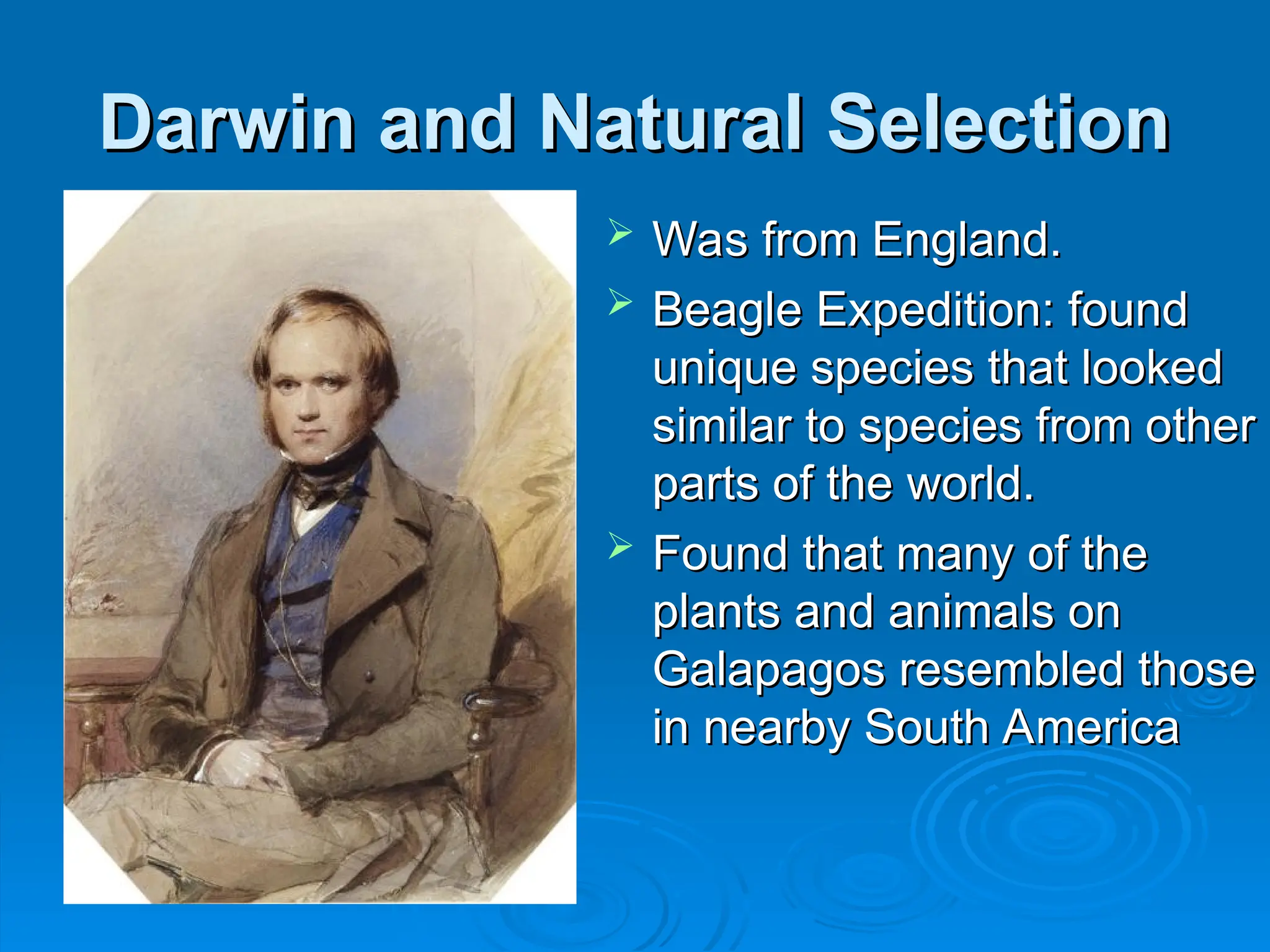
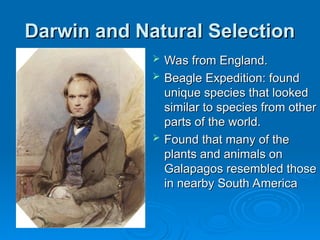
 Was from England.
Was from England.
 Beagle Expedition: found
Beagle Expedition: found
unique species that looked
similar to species from other
parts of the world.
parts of the world.
 Found that many of the
Found that many of the
plants and animals on
Galapagos resembled those
in nearby South America
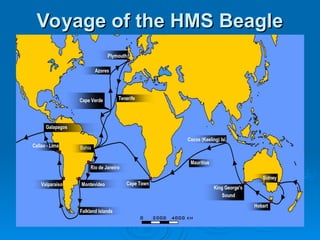
Voyage of the HMS Beagle
The Origin of the Species
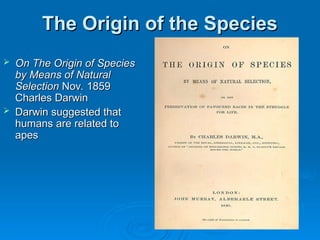
 On The Origin of Species
On The Origin of Species
by Means of Natural
by Means of Natural
Selection
Selection Nov. 1859
Nov. 1859
Charles Darwin
Charles Darwin
 Darwin suggested that
Darwin suggested that
humans are related to
apes
apes
Other scientist
Other scientist

Lamarck believed that over the lifetime of an
individual, physical features increase in size
because of use and decrease from nonuse

Malthus suggested that human pops. do not
grow unchecked because death caused by
disease, war, and famine slows growth
Natural Selection
Natural Selection
 Natural selection: organisms with favorable
Natural selection: organisms with favorable
traits for a particular environment survive,
reproduce, and pass these traits on to the
next generation (those with less favorable
traits are less likely to survive).
 Adaptation- inherited trait that has become
Adaptation- inherited trait that has become
common in a population because the trait
provides a selective advantage
Evolution of Humans
Evolution of Humans
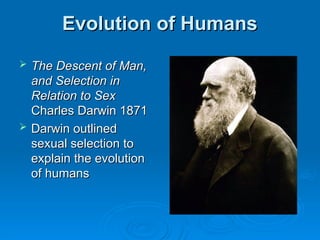
 The Descent of Man,
The Descent of Man,
and Selection in
and Selection in
Relation to Sex
Relation to Sex
Charles Darwin 1871
Charles Darwin 1871
 Darwin outlined
Darwin outlined
sexual selection to
sexual selection to
explain the evolution
of humans
of humans
4 Tenets of Natural
4 Tenets of Natural
Selection
Selection
 All populations have genetic variation.
All populations have genetic variation.
 The environment presents challenges to
The environment presents challenges to
successful reproduction.
 Individuals tend to produce more offspring
Individuals tend to produce more offspring
than the environment can support.
 Individuals that are better fit their
Individuals that are better fit their
environment tend to live longer, reproduce
more, and spread their genes throughout the
population.
population.
Darwin’s 4 Facts
Darwin’s 4 Facts
 Exponential Growth of Populations
Exponential Growth of Populations
 Factors will prevent Exponential
Factors will prevent Exponential
Growth(Steady State)
 Variability among species
Variability among species
 Traits are inheritable
Traits are inheritable
Darwin’s 2 Inferences
 Competition for resources
Competition for resources
 Individuals most fit for their environment
Individuals most fit for their environment
will survive.
will survive.
Sources of Genetic Variation
 Mutation/ Translocation- Mutation slowly
Mutation/ Translocation- Mutation slowly
introduces new alleles which natural selection
helps distribute (can be harmful, beneficial or
have no significance)
 Crossing Over- exchange of homologous
Crossing Over- exchange of homologous
chromosome segments
chromosome segments
 Independent Assortment- assortment of
Independent Assortment- assortment of
chromosomes
chromosomes
 Sexual Reproduction- combination of allelles of
Sexual Reproduction- combination of allelles of
two individuals
two individuals
 Immigration- incoming allelles to a gene pool
Immigration- incoming allelles to a gene pool
Mechanisms for Evolutionary
Change
Change
 Natural Selection
Natural Selection
Population Genetics and
Evolution
Evolution
 Populations evolve when natural selection causes changes
Populations evolve when natural selection causes changes
in their allele distribution.
 Natural selection causes the greatest changes to
Natural selection causes the greatest changes to
populations’ gene pools, but is not the only cause
of change
of change
 Gene Pool- all the alleles of a population of a species
Gene Pool- all the alleles of a population of a species

In a population’s gene pool, each allele has a certain
frequency which governs the frequency of phenotypes

If a population’s allele frequencies do not change, it is not
evolving and is said to be in genetic equilibrium
 Individuals don’t evolve, populations of species do!
Individuals don’t evolve, populations of species do!
Other Influences on the Gene
Pool
Pool
 In
In small
small populations, change events
populations, change events
(crossing over, translation errors) can
cause shifts in a gene pool = genetic drift
 Individuals may move into or out of a
Individuals may move into or out of a
population, bringing or taking alleles with
them = migration
them = migration
Population Evolution
 Gene flow-the movement of genes into or
Gene flow-the movement of genes into or
out of a population due to interbreeding.

Immigration- the flow of alleles into a
population.
population.

Emigration-the flow of alleles out of a
population.
population.
 Genetic drift- the random change of allele
Genetic drift- the random change of allele
frequency in a population, not due to natural
selection.
selection.
Population Evolution
 Artificial selection- a process in which humans
Artificial selection- a process in which humans
consciously select for or against particular features
in organisms.
in organisms.
 Genetic bottleneck-an event in which the
Genetic bottleneck-an event in which the
populations’ size is greatly reduced; reduces
genetic variability
genetic variability
 Founder effect-changes in gene frequency from
Founder effect-changes in gene frequency from
starting a new population from a small number of
individuals; reduces genetic variability.
Adaptations
Adaptations
 Structural:
Structural:

Can change the size and/or shape of a body part

For example: thorns, wings, mimicry (copy the appearance
of another species), camouflage (blend in with environment)

Change within a population over time (anywhere from 100
years to millions of years) depending on type of adaptation,
rate of reproduction and environmental factors
 Physiological
Physiological

Help populations overcome chemicals they encounter
(antibiotics, pesticides, herbicides, etc)

Develop rapidly (example: bacterial resistance to penicillin)
Evidence for Evolution
 Fossils
Fossils
 Anatomical relationships
Anatomical relationships
 Embryological development
Embryological development
 Genetic comparisons
Genetic comparisons
Fossils
Fossils
 Fossils can help provide a record for life
Fossils can help provide a record for life
 However, the fossil record is incomplete -
However, the fossil record is incomplete -
there are large gaps - therefore each and
every step of evolution can not be followed
 Scientists need to find intermediate
Scientists need to find intermediate
species - and once they do, they can
provide us with a step by step sequence of
evolution
evolution
Anatomical Comparisons
 Homologous structures
Homologous structures

Same form, different use

Indication of common evolutionary ancestor
 Vestigial structures
Vestigial structures

Evolutionary remnants of structures that were
important in a past ancestor
Embryological Development
 There are noted similarities between the
There are noted similarities between the
embryological development of all
vertebrates (fish, chicken, rabbit, human,
etc)
etc)

Presence of gills and tails in all supports
evidence that gill-breathing vertebrates
preceded air-breathing, terrestrial species
Genetic Comparisons
Genetic Comparisons
 All living things use DNA.
All living things use DNA.
 All living things use the same genetic code.
All living things use the same genetic code.
 Can show relationships between species
Can show relationships between species
(human and chimpanzee DNA are 99%
identical and are closer than chimpanzees
are to apes)
are to apes)
 Can help reveal when species diverged
Can help reveal when species diverged
from their ancestral types
Types of Natural Selection
 Stabilizing Selection - favors average traits
Stabilizing Selection - favors average traits
(average sized spiders fair better than
both large and small)
 Directional Selection - favors one extreme
Directional Selection - favors one extreme
of a trait (the longer the beak the better)
 Disruptive Selection - favors both
Disruptive Selection - favors both
extremes of a trait (intermediate at
disadvantage - often eliminated)
Evolution of a Species =
Speciation
Speciation
 Species = group of organisms that look
Species = group of organisms that look
alike and have the ability to interbreed and
produce fertile offspring in nature
 Speciation occurs when
Speciation occurs when

Interbreeding is prevented

Production of fertile offspring is prevented
Causes of Speciation
 Isolation of populations
Isolation of populations - Two populations of the
- Two populations of the
same species do not mate because of some
form of separation
form of separation

If populations can’t interbreed due to isolation, their
allele frequencies can become more and more
different from each other

Each population will adapt to its environment,
eventually preventing breeding with members of
other populations (reproductive isolation)
 Changes in chromosome number causes
Changes in chromosome number causes
instantaneous speciation
 Most speciation happens gradually
Most speciation happens gradually
Types of Isolation
Types of Isolation
 Geographic- geographic barriers form that
Geographic- geographic barriers form that
separate two populations.
 Ecological- different environmental factors
Ecological- different environmental factors
may cause isolation (wet vs. dry, soil
conditions, etc.)
conditions, etc.)
 Reproductive- mating structures and
Reproductive- mating structures and
behaviors may isolate two populations
 Temporal- two populations may reproduce at
Temporal- two populations may reproduce at
different times
different times
Types of Evolution
Types of Evolution
 Divergence (ex: adaptive radiation);
Divergence (ex: adaptive radiation);

Single populations splits to adapt to different
environments
environments
 Convergence
Convergence

Unrelated species become similar as they
adapt to a similar environment.

Analogous structures
• Same use, different form
Same use, different form
• Not evidence of a common evolutionary
Not evidence of a common evolutionary
ancestor
ancestor
Rate of Speciation
Rate of Speciation
 Fossil record suggests the rate is variable
Fossil record suggests the rate is variable

Gradualism: slow, steady process of
change
change

Punctuated equilibrium: long periods of
genetic stability punctuated by rapid
changes to new environmental
conditions
conditions
Pace of Evolution
Pace of Evolution
 Gradualism- the pace of natural selection
Gradualism- the pace of natural selection
is gradual change.
is gradual change.
 Punctuated Equilibrium- model of
Punctuated Equilibrium- model of
evolutions that states there are differing
periods of rapid change and periods of
little to no change.
 Why? What could cause this?
Why? What could cause this?
Evolution Notes Darwin Natural Selection.ppt

  • 1.
    Darwin and NaturalSelection Darwin and Natural Selection  Was from England. Was from England.  Beagle Expedition: found Beagle Expedition: found unique species that looked unique species that looked similar to species from other similar to species from other parts of the world. parts of the world.  Found that many of the Found that many of the plants and animals on plants and animals on Galapagos resembled those Galapagos resembled those in nearby South America in nearby South America
  • 2.
    Voyage of theHMS Beagle Voyage of the HMS Beagle
  • 3.
    The Origin ofthe Species The Origin of the Species  On The Origin of Species On The Origin of Species by Means of Natural by Means of Natural Selection Selection Nov. 1859 Nov. 1859 Charles Darwin Charles Darwin  Darwin suggested that Darwin suggested that humans are related to humans are related to apes apes
  • 4.
    Other scientist Other scientist  Lamarckbelieved that over the lifetime of an Lamarck believed that over the lifetime of an individual, physical features increase in size individual, physical features increase in size because of use and decrease from nonuse because of use and decrease from nonuse  Malthus suggested that human pops. do not Malthus suggested that human pops. do not grow unchecked because death caused by grow unchecked because death caused by disease, war, and famine slows growth disease, war, and famine slows growth
  • 5.
    Natural Selection Natural Selection Natural selection: organisms with favorable Natural selection: organisms with favorable traits for a particular environment survive, traits for a particular environment survive, reproduce, and pass these traits on to the reproduce, and pass these traits on to the next generation (those with less favorable next generation (those with less favorable traits are less likely to survive). traits are less likely to survive).  Adaptation- inherited trait that has become Adaptation- inherited trait that has become common in a population because the trait common in a population because the trait provides a selective advantage provides a selective advantage
  • 6.
    Evolution of Humans Evolutionof Humans  The Descent of Man, The Descent of Man, and Selection in and Selection in Relation to Sex Relation to Sex Charles Darwin 1871 Charles Darwin 1871  Darwin outlined Darwin outlined sexual selection to sexual selection to explain the evolution explain the evolution of humans of humans
  • 7.
    4 Tenets ofNatural 4 Tenets of Natural Selection Selection  All populations have genetic variation. All populations have genetic variation.  The environment presents challenges to The environment presents challenges to successful reproduction. successful reproduction.  Individuals tend to produce more offspring Individuals tend to produce more offspring than the environment can support. than the environment can support.  Individuals that are better fit their Individuals that are better fit their environment tend to live longer, reproduce environment tend to live longer, reproduce more, and spread their genes throughout the more, and spread their genes throughout the population. population.
  • 8.
    Darwin’s 4 Facts Darwin’s4 Facts  Exponential Growth of Populations Exponential Growth of Populations  Factors will prevent Exponential Factors will prevent Exponential Growth(Steady State) Growth(Steady State)  Variability among species Variability among species  Traits are inheritable Traits are inheritable
  • 9.
    Darwin’s 2 Inferences Darwin’s2 Inferences  Competition for resources Competition for resources  Individuals most fit for their environment Individuals most fit for their environment will survive. will survive.
  • 10.
    Sources of GeneticVariation Sources of Genetic Variation  Mutation/ Translocation- Mutation slowly Mutation/ Translocation- Mutation slowly introduces new alleles which natural selection introduces new alleles which natural selection helps distribute (can be harmful, beneficial or helps distribute (can be harmful, beneficial or have no significance) have no significance)  Crossing Over- exchange of homologous Crossing Over- exchange of homologous chromosome segments chromosome segments  Independent Assortment- assortment of Independent Assortment- assortment of chromosomes chromosomes  Sexual Reproduction- combination of allelles of Sexual Reproduction- combination of allelles of two individuals two individuals  Immigration- incoming allelles to a gene pool Immigration- incoming allelles to a gene pool
  • 11.
    Mechanisms for Evolutionary Mechanismsfor Evolutionary Change Change  Natural Selection Natural Selection
  • 12.
    Population Genetics and PopulationGenetics and Evolution Evolution  Populations evolve when natural selection causes changes Populations evolve when natural selection causes changes in their allele distribution. in their allele distribution.  Natural selection causes the greatest changes to Natural selection causes the greatest changes to populations’ gene pools, but is not the only cause populations’ gene pools, but is not the only cause of change of change  Gene Pool- all the alleles of a population of a species Gene Pool- all the alleles of a population of a species  In a population’s gene pool, each allele has a certain In a population’s gene pool, each allele has a certain frequency which governs the frequency of phenotypes frequency which governs the frequency of phenotypes  If a population’s allele frequencies do not change, it is not If a population’s allele frequencies do not change, it is not evolving and is said to be in genetic equilibrium evolving and is said to be in genetic equilibrium  Individuals don’t evolve, populations of species do! Individuals don’t evolve, populations of species do!
  • 13.
    Other Influences onthe Gene Other Influences on the Gene Pool Pool  In In small small populations, change events populations, change events (crossing over, translation errors) can (crossing over, translation errors) can cause shifts in a gene pool = genetic drift cause shifts in a gene pool = genetic drift  Individuals may move into or out of a Individuals may move into or out of a population, bringing or taking alleles with population, bringing or taking alleles with them = migration them = migration
  • 14.
    Population Evolution Population Evolution Gene flow-the movement of genes into or Gene flow-the movement of genes into or out of a population due to interbreeding. out of a population due to interbreeding.  Immigration- the flow of alleles into a Immigration- the flow of alleles into a population. population.  Emigration-the flow of alleles out of a Emigration-the flow of alleles out of a population. population.  Genetic drift- the random change of allele Genetic drift- the random change of allele frequency in a population, not due to natural frequency in a population, not due to natural selection. selection.
  • 15.
    Population Evolution Population Evolution Artificial selection- a process in which humans Artificial selection- a process in which humans consciously select for or against particular features consciously select for or against particular features in organisms. in organisms.  Genetic bottleneck-an event in which the Genetic bottleneck-an event in which the populations’ size is greatly reduced; reduces populations’ size is greatly reduced; reduces genetic variability genetic variability  Founder effect-changes in gene frequency from Founder effect-changes in gene frequency from starting a new population from a small number of starting a new population from a small number of individuals; reduces genetic variability. individuals; reduces genetic variability.
  • 16.
    Adaptations Adaptations  Structural: Structural:  Can changethe size and/or shape of a body part Can change the size and/or shape of a body part  For example: thorns, wings, mimicry (copy the appearance For example: thorns, wings, mimicry (copy the appearance of another species), camouflage (blend in with environment) of another species), camouflage (blend in with environment)  Change within a population over time (anywhere from 100 Change within a population over time (anywhere from 100 years to millions of years) depending on type of adaptation, years to millions of years) depending on type of adaptation, rate of reproduction and environmental factors rate of reproduction and environmental factors  Physiological Physiological  Help populations overcome chemicals they encounter Help populations overcome chemicals they encounter (antibiotics, pesticides, herbicides, etc) (antibiotics, pesticides, herbicides, etc)  Develop rapidly (example: bacterial resistance to penicillin) Develop rapidly (example: bacterial resistance to penicillin)
  • 17.
    Evidence for Evolution Evidencefor Evolution  Fossils Fossils  Anatomical relationships Anatomical relationships  Embryological development Embryological development  Genetic comparisons Genetic comparisons
  • 18.
    Fossils Fossils  Fossils canhelp provide a record for life Fossils can help provide a record for life  However, the fossil record is incomplete - However, the fossil record is incomplete - there are large gaps - therefore each and there are large gaps - therefore each and every step of evolution can not be followed every step of evolution can not be followed  Scientists need to find intermediate Scientists need to find intermediate species - and once they do, they can species - and once they do, they can provide us with a step by step sequence of provide us with a step by step sequence of evolution evolution
  • 19.
    Anatomical Comparisons Anatomical Comparisons Homologous structures Homologous structures  Same form, different use Same form, different use  Indication of common evolutionary ancestor Indication of common evolutionary ancestor  Vestigial structures Vestigial structures  Evolutionary remnants of structures that were Evolutionary remnants of structures that were important in a past ancestor important in a past ancestor
  • 20.
    Embryological Development Embryological Development There are noted similarities between the There are noted similarities between the embryological development of all embryological development of all vertebrates (fish, chicken, rabbit, human, vertebrates (fish, chicken, rabbit, human, etc) etc)  Presence of gills and tails in all supports Presence of gills and tails in all supports evidence that gill-breathing vertebrates evidence that gill-breathing vertebrates preceded air-breathing, terrestrial species preceded air-breathing, terrestrial species
  • 21.
    Genetic Comparisons Genetic Comparisons All living things use DNA. All living things use DNA.  All living things use the same genetic code. All living things use the same genetic code.  Can show relationships between species Can show relationships between species (human and chimpanzee DNA are 99% (human and chimpanzee DNA are 99% identical and are closer than chimpanzees identical and are closer than chimpanzees are to apes) are to apes)  Can help reveal when species diverged Can help reveal when species diverged from their ancestral types from their ancestral types
  • 22.
    Types of NaturalSelection Types of Natural Selection  Stabilizing Selection - favors average traits Stabilizing Selection - favors average traits (average sized spiders fair better than (average sized spiders fair better than both large and small) both large and small)  Directional Selection - favors one extreme Directional Selection - favors one extreme of a trait (the longer the beak the better) of a trait (the longer the beak the better)  Disruptive Selection - favors both Disruptive Selection - favors both extremes of a trait (intermediate at extremes of a trait (intermediate at disadvantage - often eliminated) disadvantage - often eliminated)
  • 23.
    Evolution of aSpecies = Evolution of a Species = Speciation Speciation  Species = group of organisms that look Species = group of organisms that look alike and have the ability to interbreed and alike and have the ability to interbreed and produce fertile offspring in nature produce fertile offspring in nature  Speciation occurs when Speciation occurs when  Interbreeding is prevented Interbreeding is prevented  Production of fertile offspring is prevented Production of fertile offspring is prevented
  • 24.
    Causes of Speciation Causesof Speciation  Isolation of populations Isolation of populations - Two populations of the - Two populations of the same species do not mate because of some same species do not mate because of some form of separation form of separation  If populations can’t interbreed due to isolation, their If populations can’t interbreed due to isolation, their allele frequencies can become more and more allele frequencies can become more and more different from each other different from each other  Each population will adapt to its environment, Each population will adapt to its environment, eventually preventing breeding with members of eventually preventing breeding with members of other populations (reproductive isolation) other populations (reproductive isolation)  Changes in chromosome number causes Changes in chromosome number causes instantaneous speciation instantaneous speciation  Most speciation happens gradually Most speciation happens gradually
  • 25.
    Types of Isolation Typesof Isolation  Geographic- geographic barriers form that Geographic- geographic barriers form that separate two populations. separate two populations.  Ecological- different environmental factors Ecological- different environmental factors may cause isolation (wet vs. dry, soil may cause isolation (wet vs. dry, soil conditions, etc.) conditions, etc.)  Reproductive- mating structures and Reproductive- mating structures and behaviors may isolate two populations behaviors may isolate two populations  Temporal- two populations may reproduce at Temporal- two populations may reproduce at different times different times
  • 26.
    Types of Evolution Typesof Evolution  Divergence (ex: adaptive radiation); Divergence (ex: adaptive radiation);  Single populations splits to adapt to different Single populations splits to adapt to different environments environments  Convergence Convergence  Unrelated species become similar as they Unrelated species become similar as they adapt to a similar environment. adapt to a similar environment.  Analogous structures Analogous structures • Same use, different form Same use, different form • Not evidence of a common evolutionary Not evidence of a common evolutionary ancestor ancestor
  • 27.
    Rate of Speciation Rateof Speciation  Fossil record suggests the rate is variable Fossil record suggests the rate is variable  Gradualism: slow, steady process of Gradualism: slow, steady process of change change  Punctuated equilibrium: long periods of Punctuated equilibrium: long periods of genetic stability punctuated by rapid genetic stability punctuated by rapid changes to new environmental changes to new environmental conditions conditions
  • 28.
    Pace of Evolution Paceof Evolution  Gradualism- the pace of natural selection Gradualism- the pace of natural selection is gradual change. is gradual change.  Punctuated Equilibrium- model of Punctuated Equilibrium- model of evolutions that states there are differing evolutions that states there are differing periods of rapid change and periods of periods of rapid change and periods of little to no change. little to no change.  Why? What could cause this? Why? What could cause this?