 I.Non-genetic
 II.Genetic
 i.Individual variation in time
 ii.Social variations
 iii.Ecological variations
 iv.Traumatic variations
 Age variations
 Seasonal variations of an individual
 Seasonal variations of generations
 Animals in general pass through a series of
juvenile or larval stages in which they may be
quite different from adults.
 E.g the immature stages of the eel(Anguilla)
were originally described as Leptocephalus
brevirostris Kaup.
 Similarly the difficulties for the taxonomist
are even greater in groups with larval stages
which are so different that they have not even
the faintest resemblence to the adult(e.g
catterpiller and butterfly)
 In animals that live as adults through several
breeding seasons,it sometimes happens that
the same individual has a very different
appearance in different parts of the year.
 In arctic and subarctic birds such as
Ptarmigans ,there may be a change from a
white winter dress to a normally coloured
summer dress .
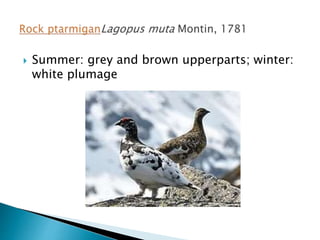
 Summer: grey and brown upperparts; winter:
white plumage
 In the europeon starling (Sturnus vulgaris) the
freshly molted bird of october is covered with
white spots and all the feathers show
whittish margins.During winter the edges of
the feathers wears off ,and in the spring,at
the beginning of the breeding season, the
whole bird is a beautiful glossy black without
the molt of a single feather.
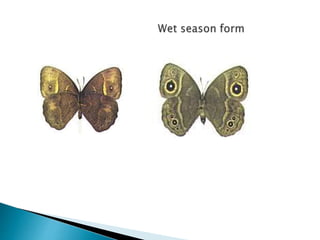
 These variations are called polyphenism.
 E.g African butterfly Bicyclus anynana
 Wet season form --- eyespots along the
margin(on ventral side)
 Dry season form – very small or almost no
eyespots
 In social insects like honey bees there are definite
groups of individuals within a colony in addition
to the reproductiv castes(Queen and males or
drones),workers and soldiers.
 The drones are the males in a bee colony. They
are the product of unfertilized eggs
 The queen is one of many females in the colony;
however, she is the only one that is developed
specifically for laying eggs
 The queen is the product of a fertilized egg that
is fed an abundance of royal jelly during its
development
 They are all females and, thus, come from
fertilized eggs. The workers are the majority
of the population of the colony. There are
about 2,000 to 60,000 workers per colony
 a.Habitat variation
 b. Variation induced by temporary climatic
conditions
 c.Host-determined variations
 d.Density dependent variations
 e.Allometric variation
 f.Neurogenic color variations
 Populations of a single species that that occur
in different habitats in the same region are
often visibly different.
 Dall gave a very instructive account of all the
variations he observed in a study of the
oyster(Crassostrea virginica)
 When a specimen grows in still water,it tends
to assume a more rounded or broader form.
 When it grows in a strong current the valves
become narrow and elongated,usually also
quite striaght.
 When an oyster grows in clean water on a
pebble,which raises it slightly above the
bottom level,the lower valve is usually deep
and more or less sharply radially ribbed
acquiring thus a strength which is not needed
when the attachment is to a perfectly flat
surface which acts as a shield on that side of
the shell..for the same reason oysters which
lie in a muddy bottom with only parts of the
valve s above the surface , are less commonly
ribbed.
 Some animals with a highly plastic phenotype
may produce year classes that differ visibly
from the norm owing to unusual
conditions(drought,cold,food supply)
 Gerould has reported that the braconid wasp
Apanteles flaviconchae,spins white cocoons
when reared from blue-green catterpillers of
Coliase philodice, but golden cocoons when
reared from yellow-green catterpillers from
the same species.
 Kennedy and others have shown that gregarious
species of locusts exist in various unstable
biological phases.these phases differ in
anatomy,color and behaviour characteristics and
have often been described as distinct species.
 When newly hatched nymphs are reared under
crowded conditions,they mostly developed into
the gregarious phase
 Under less crowded conditions into the
transitional phase and when isolated and reared
separately,into the solitary phase.
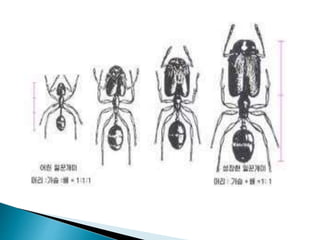
 Allometric growth result in the
disproportionate size of some structure in
relation to that of the rest of the body.
 If individuals of a population show allometric
growth,animals of different size will show
allometric variability.
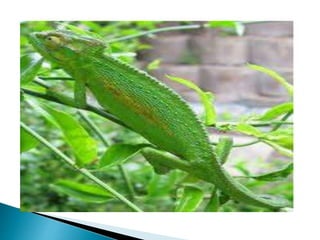
 Neurogenic variation is color change in response to
the environment.
 Chameleons have specialized cells, chromatophores,
which contain pigments in their cytoplasm, in three
layers below their transparent outer skin:
 The chromatophores in the upper layer, called
xanthophores and erythrophores, contain yellow and
red pigments, respectively.
 Below the chromatophores is a second layer of
chromatophores called iridophores or guanophores;
these contain guanine, appearing blue or white.
 The deepest layer of chromatophores, called
melanophores, contain the dark pigmentmelanin,
which controls how much light is reflected.
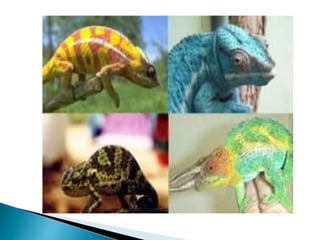
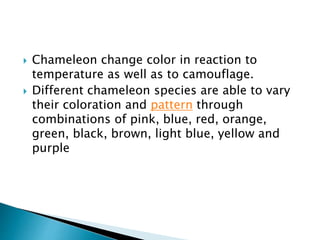
 Chameleon change color in reaction to
temperature as well as to camouflage.
 Different chameleon species are able to vary
their coloration and pattern through
combinations of pink, blue, red, orange,
green, black, brown, light blue, yellow and
purple
 1.Accidental and teratological variations
 In most animals it may be readily identified
 However,in those forms which undergo
metamorphosis, injuries to an earlier stage
may produce later abnormalities which are
not so easily recognized as such.this is
especially true when the anomalies involve
characters which are normally of taxonomic
value in the group concerned.
 E.g symmetrical modification of wing pattern.
 In many group of animals it is impossible to
prevent post-morteum changes of preserved
specimens.
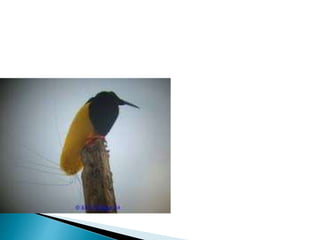
 Some extreme cases are known in birds
 E.g deep orange yellow plumes of twelve-wire
birds of paradise(Seleucidis ignotus) fade in
collection to white
 -skin of chinese jay(Kitta chinensis) whose
plumage is green in life,turn blue in collections
 -chemical action of preservative:
 Wasp overexposed to cyanide turn bright red
 1.Sex-associated variations
 2.non sex-associated variations
 A.-Primary sex differences
 B.-Secondary sex differences
 C.Alternating generations
 These are differences involving the primary
sex organs utilized in reproduction.
 They are rarely a source of taxonomic
confusion
 -sexual dimorphism
 -in some cases male and female are strikingly
different from one another
 Examples
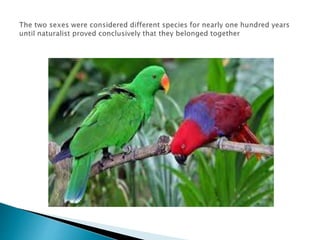
 King parrot Eclectus roratus
 Male--------green with an orange bill
 Female-------red and blue with black bills
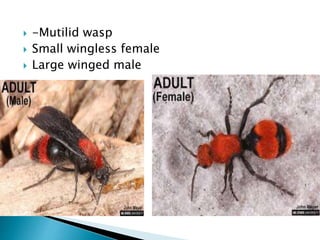
 -Mutilid wasp
 Small wingless female
 Large winged male
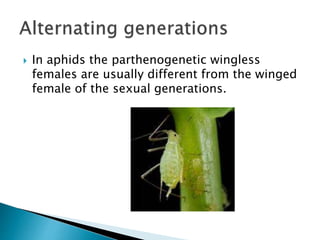
 In aphids the parthenogenetic wingless
females are usually different from the winged
female of the sexual generations.
 A.continous variations
 B.Non-continous variationss
 Continous variation is the result of slight
genetic differences which exist between
individuals.
 -it is now evident that no one individual is
“typical” of the characters of a
populations.only the statistics of the whole
population can give a true picture of the
population.
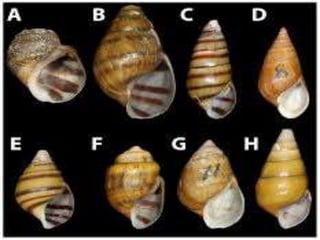
 114 species of the snail genus melania were
found to be nothing but individual variants .
 In certain species ,the members of a
population can be grouped into very definite
classes,determined by the presence of certain
conspicous characters.such discontinous
variations is called polymorphism.
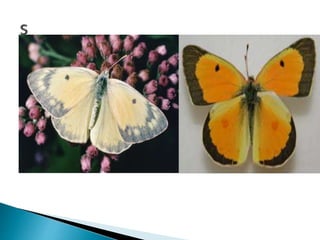
 -common alfalfa butterfly ---Coliase
eurytheme—has two strikingly different
female forms-one resembling the orange
colored male while the other is largely white
Intrapopulation variations 9

Intrapopulation variations 9

  • 2.
  • 3.
     i.Individual variationin time  ii.Social variations  iii.Ecological variations  iv.Traumatic variations
  • 4.
     Age variations Seasonal variations of an individual  Seasonal variations of generations
  • 5.
     Animals ingeneral pass through a series of juvenile or larval stages in which they may be quite different from adults.  E.g the immature stages of the eel(Anguilla) were originally described as Leptocephalus brevirostris Kaup.  Similarly the difficulties for the taxonomist are even greater in groups with larval stages which are so different that they have not even the faintest resemblence to the adult(e.g catterpiller and butterfly)
  • 6.
     In animalsthat live as adults through several breeding seasons,it sometimes happens that the same individual has a very different appearance in different parts of the year.  In arctic and subarctic birds such as Ptarmigans ,there may be a change from a white winter dress to a normally coloured summer dress .
  • 7.
     Summer: greyand brown upperparts; winter: white plumage
  • 8.
     In theeuropeon starling (Sturnus vulgaris) the freshly molted bird of october is covered with white spots and all the feathers show whittish margins.During winter the edges of the feathers wears off ,and in the spring,at the beginning of the breeding season, the whole bird is a beautiful glossy black without the molt of a single feather.
  • 9.
     These variationsare called polyphenism.  E.g African butterfly Bicyclus anynana  Wet season form --- eyespots along the margin(on ventral side)  Dry season form – very small or almost no eyespots
  • 11.
     In socialinsects like honey bees there are definite groups of individuals within a colony in addition to the reproductiv castes(Queen and males or drones),workers and soldiers.  The drones are the males in a bee colony. They are the product of unfertilized eggs  The queen is one of many females in the colony; however, she is the only one that is developed specifically for laying eggs  The queen is the product of a fertilized egg that is fed an abundance of royal jelly during its development
  • 12.
     They areall females and, thus, come from fertilized eggs. The workers are the majority of the population of the colony. There are about 2,000 to 60,000 workers per colony
  • 13.
     a.Habitat variation b. Variation induced by temporary climatic conditions  c.Host-determined variations  d.Density dependent variations  e.Allometric variation  f.Neurogenic color variations
  • 14.
     Populations ofa single species that that occur in different habitats in the same region are often visibly different.  Dall gave a very instructive account of all the variations he observed in a study of the oyster(Crassostrea virginica)  When a specimen grows in still water,it tends to assume a more rounded or broader form.  When it grows in a strong current the valves become narrow and elongated,usually also quite striaght.
  • 15.
     When anoyster grows in clean water on a pebble,which raises it slightly above the bottom level,the lower valve is usually deep and more or less sharply radially ribbed acquiring thus a strength which is not needed when the attachment is to a perfectly flat surface which acts as a shield on that side of the shell..for the same reason oysters which lie in a muddy bottom with only parts of the valve s above the surface , are less commonly ribbed.
  • 16.
     Some animalswith a highly plastic phenotype may produce year classes that differ visibly from the norm owing to unusual conditions(drought,cold,food supply)
  • 17.
     Gerould hasreported that the braconid wasp Apanteles flaviconchae,spins white cocoons when reared from blue-green catterpillers of Coliase philodice, but golden cocoons when reared from yellow-green catterpillers from the same species.
  • 18.
     Kennedy andothers have shown that gregarious species of locusts exist in various unstable biological phases.these phases differ in anatomy,color and behaviour characteristics and have often been described as distinct species.  When newly hatched nymphs are reared under crowded conditions,they mostly developed into the gregarious phase  Under less crowded conditions into the transitional phase and when isolated and reared separately,into the solitary phase.
  • 19.
     Allometric growthresult in the disproportionate size of some structure in relation to that of the rest of the body.  If individuals of a population show allometric growth,animals of different size will show allometric variability.
  • 21.
     Neurogenic variationis color change in response to the environment.  Chameleons have specialized cells, chromatophores, which contain pigments in their cytoplasm, in three layers below their transparent outer skin:  The chromatophores in the upper layer, called xanthophores and erythrophores, contain yellow and red pigments, respectively.  Below the chromatophores is a second layer of chromatophores called iridophores or guanophores; these contain guanine, appearing blue or white.  The deepest layer of chromatophores, called melanophores, contain the dark pigmentmelanin, which controls how much light is reflected.
  • 24.
     Chameleon changecolor in reaction to temperature as well as to camouflage.  Different chameleon species are able to vary their coloration and pattern through combinations of pink, blue, red, orange, green, black, brown, light blue, yellow and purple
  • 25.
     1.Accidental andteratological variations
  • 26.
     In mostanimals it may be readily identified  However,in those forms which undergo metamorphosis, injuries to an earlier stage may produce later abnormalities which are not so easily recognized as such.this is especially true when the anomalies involve characters which are normally of taxonomic value in the group concerned.  E.g symmetrical modification of wing pattern.
  • 27.
     In manygroup of animals it is impossible to prevent post-morteum changes of preserved specimens.  Some extreme cases are known in birds  E.g deep orange yellow plumes of twelve-wire birds of paradise(Seleucidis ignotus) fade in collection to white  -skin of chinese jay(Kitta chinensis) whose plumage is green in life,turn blue in collections  -chemical action of preservative:  Wasp overexposed to cyanide turn bright red
  • 29.
     1.Sex-associated variations 2.non sex-associated variations
  • 30.
     A.-Primary sexdifferences  B.-Secondary sex differences  C.Alternating generations
  • 31.
     These aredifferences involving the primary sex organs utilized in reproduction.  They are rarely a source of taxonomic confusion
  • 32.
     -sexual dimorphism -in some cases male and female are strikingly different from one another  Examples  King parrot Eclectus roratus  Male--------green with an orange bill  Female-------red and blue with black bills
  • 34.
     -Mutilid wasp Small wingless female  Large winged male
  • 35.
     In aphidsthe parthenogenetic wingless females are usually different from the winged female of the sexual generations.
  • 36.
     A.continous variations B.Non-continous variationss
  • 37.
     Continous variationis the result of slight genetic differences which exist between individuals.  -it is now evident that no one individual is “typical” of the characters of a populations.only the statistics of the whole population can give a true picture of the population.  114 species of the snail genus melania were found to be nothing but individual variants .
  • 39.
     In certainspecies ,the members of a population can be grouped into very definite classes,determined by the presence of certain conspicous characters.such discontinous variations is called polymorphism.  -common alfalfa butterfly ---Coliase eurytheme—has two strikingly different female forms-one resembling the orange colored male while the other is largely white