Evolution and Darwin Visit  www.worldofteaching.com For 100’s of free powerpoints
Evolution The  processes  that have transformed life on earth from it’s  earliest forms  to the vast  diversity  that characterizes it today. A  change  in the  genes!!!!!!!!
Old Theories of Evolution Jean Baptiste Lamarck   (early 1800’s) proposed: “ The inheritance of acquired characteristics” He proposed that by using or not using its body parts, an individual tends to   develop   certain   characteristics , which it   passes   on to its   offspring .
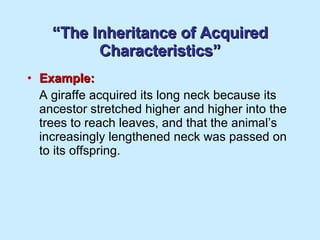
“ The Inheritance of Acquired Characteristics” Example: A giraffe acquired its long neck because its ancestor stretched higher and higher into the trees to reach leaves, and that the animal’s increasingly lengthened neck was passed on to its offspring.
Charles Darwin Influenced by Charles Lyell  who published  “Principles of Geology”. This publication led  Darwin  to realize that natural forces gradually change Earth’s surface and that the forces of the past are still operating in modern times.
Charles Darwin Darwin set sail on the  H.M.S. Beagle  (1831-1836) to survey the south seas  (mainly South America and the Galapagos Islands)  to collect plants and animals. On the  Galapagos Islands,  Darwin observed species that lived no where else in the world. These observations led Darwin to write a book.
Charles Darwin Wrote in 1859 : “On the Origin of Species by Means of Natural Selection” Two main points: 1. Species were not created in their present  form, but evolved from ancestral species. 2. Proposed a mechanism for evolution:   NATURAL SELECTION
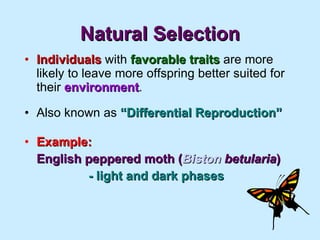
Natural Selection Individuals  with  favorable   traits  are more likely to leave more offspring better suited for their  environment . Also known as  “Differential Reproduction” Example: English peppered moth ( Biston   betularia ) - light and dark phases
Artificial Selection The  selective breeding  of domesticated plants and animals by man. Question: What’s the ancestor of the domesticated dog? Answer:   WOLF
Evidence of Evolution 1.   Biogeography: Geographical distribution of species. 2.  Fossil Record: Fossils and the order in which they appear  in layers of sedimentary rock  (strongest  evidence).
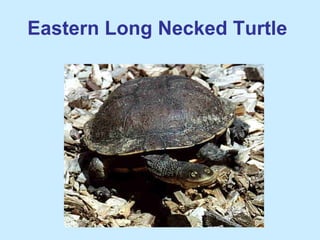
Eastern Long Necked Turtle
Evidence of Evolution 3.  Taxonomy: Classification of life forms. 4.  Homologous structures: Structures that are similar because of  common ancestry  (comparative anatomy)
Evidence of Evolution 5.  Comparative embryology: Study of structures that appear during  embryonic development. 6.  Molecular biology: DNA and proteins (amino acids)
Population Genetics The  science  of  genetic change  in population. Remember: Hardy-Weinberg equation.
Population A localized group of  individuals  belonging to the  same species .
Species A group of  populations  whose  individuals  have the potential to  interbreed  and produce  viable  offspring.
Gene Pool The total  collection of genes  in a population at any one time.
Hardy-Weinberg Principle The  concept  that the  shuffling of genes  that occur during sexual reproduction, by itself,  cannot change  the overall genetic makeup of a population.
Hardy-Weinberg Principle This  principle  will be maintained in nature only if all  five  of the following conditions are met: 1. Very large population 2. Isolation from other populations 3. No net mutations 4. Random mating 5. No natural selection
Hardy-Weinberg Principle Remember: If these conditions are met, the  population is at  equilibrium . This means  “No Change” or “No Evolution”.
Macroevolution The origin of taxonomic groups  higher than the species level .
Microevolution A change in a  population’s gene pool  over a secession of generations. Evolutionary changes  in species over relatively brief periods of  geological time .
Five Mechanisms of Microevolution 1.  Genetic drift: Change in the gene pool of a small  population due to chance. Two examples: a.  Bottleneck effect b.  Founder effect
a.  Bottleneck Effect Genetic drift  (reduction of alleles in a population) resulting from a  disaster  that drastically  reduces population size . Examples: 1. Earthquakes 2. Volcano’s
b.  Founder Effect Genetic drift  resulting from the  colonization  of a new location by a small number of individuals. Results in  random change  of the gene pool. Example: 1. Islands (first Darwin finch)
Five Mechanisms of Microevolution 2.  Gene Flow: T he  gain or loss of alleles  from a  population by the  movement  of individuals  or gametes. Immigration or emigration .
Five Mechanisms of Microevolution 3.  Mutation: Change in an organism’s DNA that creates a new allele. 4.  Non-random mating: The selection of mates other than by chance. 5.  Natural selection: Differential reproduction.
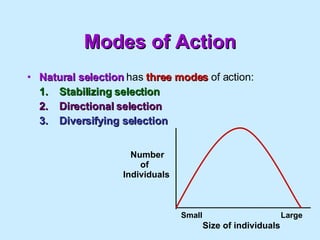
Modes of Action Natural selection  has  three modes  of action: 1. Stabilizing selection 2. Directional selection 3. Diversifying selection Number of Individuals Size of individuals Small  Large
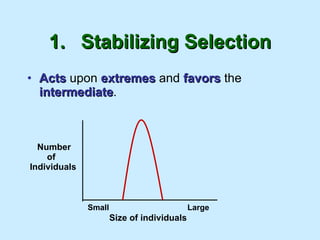
1. Stabilizing Selection Acts  upon  extremes  and  favors  the  intermediate . Number of Individuals Size of individuals Small  Large
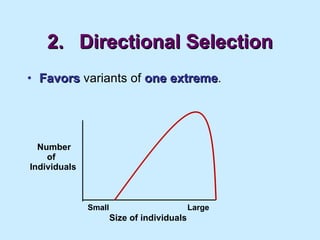
2. Directional Selection Favors  variants of  one extreme . Number of Individuals Size of individuals Small  Large
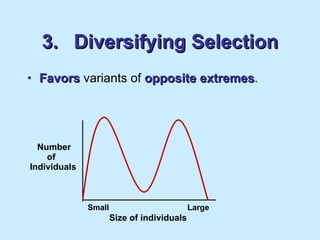
3. Diversifying Selection Favors  variants of  opposite extremes . Number of Individuals Size of individuals Small  Large
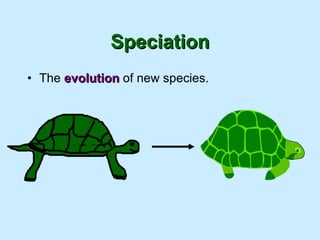
Speciation The  evolution  of new species.
Reproductive Barriers Any  mechanism  that  impedes  two species from producing  fertile and/or viable hybrid offspring . Two barriers: 1. Pre-zygotic barriers 2. Post-zygotic barriers
1. Pre-zygotic Barriers a.  Temporal isolation: Breeding occurs at different times for  different species. b.  Habitat isolation: Species breed in different habitats. c.  Behavioral isolation: Little or no sexual attraction between  species.
1. Pre-zygotic Barriers d.  Mechanical isolation: Structural differences prevent gamete  exchange. e.  Gametic isolation: Gametes die before uniting with gametes  of other species, or gametes fail to unite.
2. Post-zygotic Barriers a.  Hybrid inviability: Hybrid zygotes fail to develop or fail to  reach sexual maturity. b.  Hybrid sterility: Hybrid fails to produce functional gametes. c.  Hybrid breakdown: Offspring of hybrids are weak or infertile.
Allopatric Speciation Induced when the  ancestral  population becomes  separated  by a  geographical barrier. Example: Grand Canyon and ground squirrels
Adaptive Radiation Emergence of numerous species  from a  common ancestor  introduced to new and diverse environments. Example: Darwin’s Finches
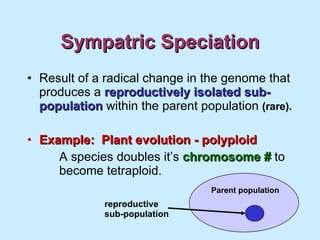
Sympatric Speciation Result of a radical change in the genome that produces a  reproductively isolated sub-population  within the parent population  (rare). Example:  Plant evolution - polyploid A species doubles it’s  chromosome #  to  become tetraploid. reproductive sub-population Parent population
Interpretations of Speciation Two theories: 1. Gradualist Model (Neo-Darwinian): Slow changes in species overtime. 2. Punctuated Equilibrium: Evolution occurs in spurts of  relatively  rapid change.
Convergent Evolution Species  from different  evolutionary branches  may come to resemble one another if they live in  very similar environments. Example: 1. Ostrich (Africa) and Emu (Australia). 2. Sidewinder (Mojave Desert) and Horned Viper (Middle East Desert)
Coevolution Evolutionary change , in which one species act as a  selective force  on a  second  species, inducing adaptations that in turn act as selective force on the  first  species. Example: 1. Acacia ants and acacia trees 2. Humming birds and plants with flowers  with long tubes

Darwin

  • 1.
    Evolution and DarwinVisit www.worldofteaching.com For 100’s of free powerpoints
  • 2.
    Evolution The processes that have transformed life on earth from it’s earliest forms to the vast diversity that characterizes it today. A change in the genes!!!!!!!!
  • 3.
    Old Theories ofEvolution Jean Baptiste Lamarck (early 1800’s) proposed: “ The inheritance of acquired characteristics” He proposed that by using or not using its body parts, an individual tends to develop certain characteristics , which it passes on to its offspring .
  • 4.
    “ The Inheritanceof Acquired Characteristics” Example: A giraffe acquired its long neck because its ancestor stretched higher and higher into the trees to reach leaves, and that the animal’s increasingly lengthened neck was passed on to its offspring.
  • 5.
    Charles Darwin Influencedby Charles Lyell who published “Principles of Geology”. This publication led Darwin to realize that natural forces gradually change Earth’s surface and that the forces of the past are still operating in modern times.
  • 6.
    Charles Darwin Darwinset sail on the H.M.S. Beagle (1831-1836) to survey the south seas (mainly South America and the Galapagos Islands) to collect plants and animals. On the Galapagos Islands, Darwin observed species that lived no where else in the world. These observations led Darwin to write a book.
  • 7.
    Charles Darwin Wrotein 1859 : “On the Origin of Species by Means of Natural Selection” Two main points: 1. Species were not created in their present form, but evolved from ancestral species. 2. Proposed a mechanism for evolution: NATURAL SELECTION
  • 8.
    Natural Selection Individuals with favorable traits are more likely to leave more offspring better suited for their environment . Also known as “Differential Reproduction” Example: English peppered moth ( Biston betularia ) - light and dark phases
  • 9.
    Artificial Selection The selective breeding of domesticated plants and animals by man. Question: What’s the ancestor of the domesticated dog? Answer: WOLF
  • 10.
    Evidence of Evolution1. Biogeography: Geographical distribution of species. 2. Fossil Record: Fossils and the order in which they appear in layers of sedimentary rock (strongest evidence).
  • 11.
  • 12.
    Evidence of Evolution3. Taxonomy: Classification of life forms. 4. Homologous structures: Structures that are similar because of common ancestry (comparative anatomy)
  • 13.
    Evidence of Evolution5. Comparative embryology: Study of structures that appear during embryonic development. 6. Molecular biology: DNA and proteins (amino acids)
  • 14.
    Population Genetics The science of genetic change in population. Remember: Hardy-Weinberg equation.
  • 15.
    Population A localizedgroup of individuals belonging to the same species .
  • 16.
    Species A groupof populations whose individuals have the potential to interbreed and produce viable offspring.
  • 17.
    Gene Pool Thetotal collection of genes in a population at any one time.
  • 18.
    Hardy-Weinberg Principle The concept that the shuffling of genes that occur during sexual reproduction, by itself, cannot change the overall genetic makeup of a population.
  • 19.
    Hardy-Weinberg Principle This principle will be maintained in nature only if all five of the following conditions are met: 1. Very large population 2. Isolation from other populations 3. No net mutations 4. Random mating 5. No natural selection
  • 20.
    Hardy-Weinberg Principle Remember:If these conditions are met, the population is at equilibrium . This means “No Change” or “No Evolution”.
  • 21.
    Macroevolution The originof taxonomic groups higher than the species level .
  • 22.
    Microevolution A changein a population’s gene pool over a secession of generations. Evolutionary changes in species over relatively brief periods of geological time .
  • 23.
    Five Mechanisms ofMicroevolution 1. Genetic drift: Change in the gene pool of a small population due to chance. Two examples: a. Bottleneck effect b. Founder effect
  • 24.
    a. BottleneckEffect Genetic drift (reduction of alleles in a population) resulting from a disaster that drastically reduces population size . Examples: 1. Earthquakes 2. Volcano’s
  • 25.
    b. FounderEffect Genetic drift resulting from the colonization of a new location by a small number of individuals. Results in random change of the gene pool. Example: 1. Islands (first Darwin finch)
  • 26.
    Five Mechanisms ofMicroevolution 2. Gene Flow: T he gain or loss of alleles from a population by the movement of individuals or gametes. Immigration or emigration .
  • 27.
    Five Mechanisms ofMicroevolution 3. Mutation: Change in an organism’s DNA that creates a new allele. 4. Non-random mating: The selection of mates other than by chance. 5. Natural selection: Differential reproduction.
  • 28.
    Modes of ActionNatural selection has three modes of action: 1. Stabilizing selection 2. Directional selection 3. Diversifying selection Number of Individuals Size of individuals Small Large
  • 29.
    1. Stabilizing SelectionActs upon extremes and favors the intermediate . Number of Individuals Size of individuals Small Large
  • 30.
    2. Directional SelectionFavors variants of one extreme . Number of Individuals Size of individuals Small Large
  • 31.
    3. Diversifying SelectionFavors variants of opposite extremes . Number of Individuals Size of individuals Small Large
  • 32.
    Speciation The evolution of new species.
  • 33.
    Reproductive Barriers Any mechanism that impedes two species from producing fertile and/or viable hybrid offspring . Two barriers: 1. Pre-zygotic barriers 2. Post-zygotic barriers
  • 34.
    1. Pre-zygotic Barriersa. Temporal isolation: Breeding occurs at different times for different species. b. Habitat isolation: Species breed in different habitats. c. Behavioral isolation: Little or no sexual attraction between species.
  • 35.
    1. Pre-zygotic Barriersd. Mechanical isolation: Structural differences prevent gamete exchange. e. Gametic isolation: Gametes die before uniting with gametes of other species, or gametes fail to unite.
  • 36.
    2. Post-zygotic Barriersa. Hybrid inviability: Hybrid zygotes fail to develop or fail to reach sexual maturity. b. Hybrid sterility: Hybrid fails to produce functional gametes. c. Hybrid breakdown: Offspring of hybrids are weak or infertile.
  • 37.
    Allopatric Speciation Inducedwhen the ancestral population becomes separated by a geographical barrier. Example: Grand Canyon and ground squirrels
  • 38.
    Adaptive Radiation Emergenceof numerous species from a common ancestor introduced to new and diverse environments. Example: Darwin’s Finches
  • 39.
    Sympatric Speciation Resultof a radical change in the genome that produces a reproductively isolated sub-population within the parent population (rare). Example: Plant evolution - polyploid A species doubles it’s chromosome # to become tetraploid. reproductive sub-population Parent population
  • 40.
    Interpretations of SpeciationTwo theories: 1. Gradualist Model (Neo-Darwinian): Slow changes in species overtime. 2. Punctuated Equilibrium: Evolution occurs in spurts of relatively rapid change.
  • 41.
    Convergent Evolution Species from different evolutionary branches may come to resemble one another if they live in very similar environments. Example: 1. Ostrich (Africa) and Emu (Australia). 2. Sidewinder (Mojave Desert) and Horned Viper (Middle East Desert)
  • 42.
    Coevolution Evolutionary change, in which one species act as a selective force on a second species, inducing adaptations that in turn act as selective force on the first species. Example: 1. Acacia ants and acacia trees 2. Humming birds and plants with flowers with long tubes