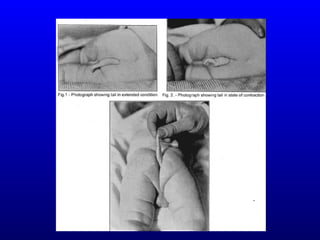
Other Evidence
Ontogeny, Phylogeny, and
Recapitulation
• Ontogeny recapitulates phylogeny!
• Ontogeny: is the history of the
development of an organism through its
entire life.
• Early developmental and ebryological
features contribute greatly to our
knowledge of homology and common
descent.
Ontogeny, Phylogeny, and
Recapitulation
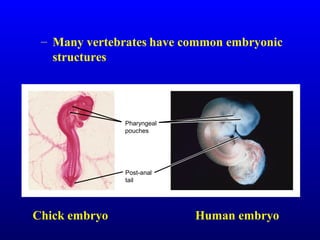
– Many vertebrates have common embryonic
structures
Post-anal
tail
Pharyngeal
pouches
Chick embryo Human embryo
Ontogeny, Phylogeny, and
Recapitulation
• Ernst Haeckel: Ontogeny (individual
development) recapitulates (repeats)
phylogeny (evolutionary descent).
Ontogeny, Phylogeny, and
Recapitulation
• Haeckel based his law on the flawed
premise that evolutionary change occurs
by successively adding new features onto
the end of an unaltered ancestral
ontogeny while condensing the ancestral
ontogeny into earlier developmental
stages.
Ontogeny, Phylogeny, and
Recapitulation
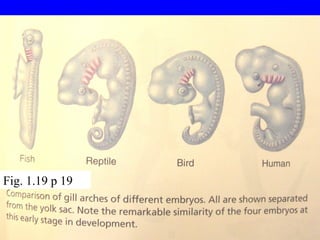
• K. E. von Baer, disagreed, he argued that
early developmental features were simply
more widely shared among different
animal groups than later ones.
Fig. 1.19 p 19
Heterochrony
• We now know that there are many
parallels between ontogeny and
phylogeny, but this ancestral ontogeny
can be shifted either to earlier or later
stages in descendent ontogenies.
III. Multiplication of species
• Since evolution is a branching process,
unless there is a high rate of extinction,
more species will be produced through
time.
III. Multiplication of species
• Since evolution is a branching process,
unless there is a high rate of extinction,
more species will be produced through
time.
• But what then is a species?
Species Definition
1. Common ancestry
Species Definition
1. Common ancestry
2. Interbreeding
Species Definition
1. Common ancestry
2. Interbreeding
3. Genotypic and phenotypic cohesion
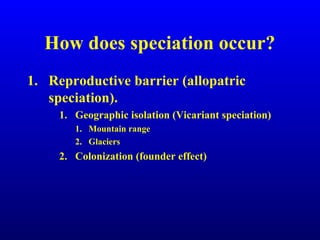
How does speciation occur?
1. Reproductive barrier (allopatric
speciation).
How does speciation occur?
1. Reproductive barrier (allopatric
speciation).
1. Geographic isolation (Vicariant speciation)
1. Mountain range
2. Glaciers
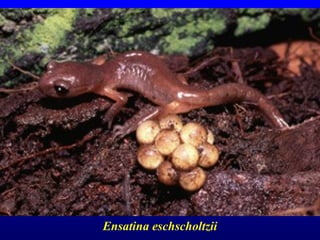
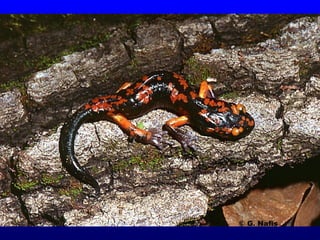
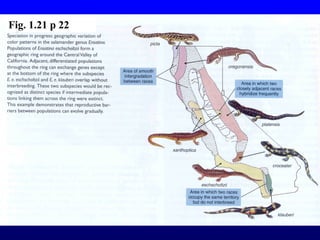
Ensatina eschscholtzii
Fig. 1.21 p 22
How does speciation occur?
1. Reproductive barrier (allopatric
speciation).
1. Geographic isolation (Vicariant speciation)
1. Mountain range
2. Glaciers
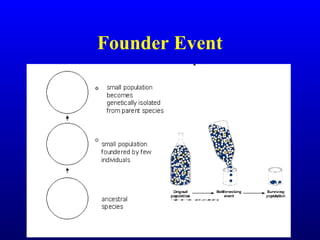
2. Colonization (founder effect)
Founder Event
How does speciation occur?
1. Reproductive barrier (allopatric speciation)
1. Geographic isolation
1. Mountain range
2. Glaciers
2. Colonization (founder effect)
2. Without reproductive barrier
(sympatric speciation). Speciation
forming without geographic isolation.
3) Adaptive Radiation: The production of
ecologically diverse species from a
common ancestral stock.
How does speciation occur?
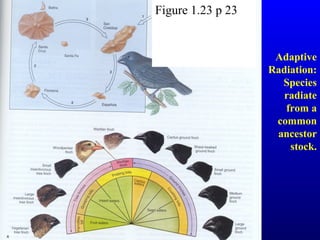
Adaptive
Radiation:
Species
radiate
from a
common
ancestor
stock.
Figure 1.23 p 23
IV. Darwin Argued that Species
Arise by Gradualism
IV. Darwin Argued that Species
Arise by Gradualism
• Based on Leyell’s theory of
uniformitarianism.
IV. Darwin Argued that Species
Arise by Gradualism
• Based on Leyell’s theory of
uniformitarianism.
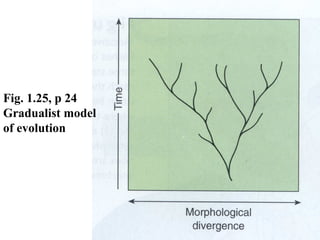
• States that larger changes in organisms
occur by the accumulation of many
smaller changes (i.e. evolution is a slow,
continuous process)
Fig. 1.25, p 24
Gradualist model
of evolution
What evidence would support
Gradualism?
What evidence would support
Gradualism?
• Fossil record should have a long series of
intermediate forms connecting the
phenotypes of ancestral and descendant
populations.
What evidence would support
Gradualism?
• So do we see lots of intermediate forms in
the fossil record?
Others Argued that species arise
by Punctuated Equilibrium
Others Argued that species arise
by Punctuated Equilibrium
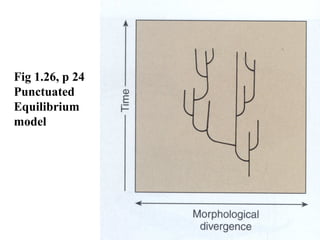
• Phenotypic evolution is concentrated in
relatively brief events of branching
speciation, followed by much longer
intervals of evolutionary stasis.
Fig 1.26, p 24
Punctuated
Equilibrium
model
Gradualism Vs. Punctuated
Equilibrium
• So which one is correct?
V. Natural Selection
• Differential reproduction and survival of
individuals carrying alternative,
inherited traits.
V. Natural Selection
• Natural selection is the major process or
mechanism by which evolution occurs in
Darwin’s theory of evolution.
So how did Darwin come up with
this explanation?
Darwin’s Observations
• Observation 1: Organisms can produce
more offspring than just replacing the
parents
Darwin’s Observations
• Observation 1: Organisms can produce
more offspring than just replacing the
parents
• Observation 2: Number of individuals in
a population remains constant
Darwin’s Observations
• Observation 1: Organisms can produce
more offspring than just replacing the
parents
• Observation 2: Number of individuals in
a population remains constant
• Observation 3: Individuals within a
species vary (size, color, behavior, etc..)
Darwin’s Observations
• Observation 1: Organisms can produce
more offspring than just replacing the
parents
• Observation 2: Number of individuals in
a population remains constant
• Observation 3: Individuals within a
species vary (size, color, behavior, etc..)
• Observation 4: Variation in individuals is
heritable.
Darwin’s Deductions
Darwin’s Deductions
• Deduction 1: Individuals must compete
for resources, and only some will survive
Darwin’s Deductions
• Deduction 1: Individuals must compete
for resources, and only some will survive
• Deduction 2: Individuals with variations
more suited to the environment will be
more likely to survive and reproduce:
natural selection
Darwin’s Deductions
• Deduction 1: Individuals must compete for
resources, and only some will survive
• Deduction 2: Individuals with variations more
suited to the environment will be more likely to
survive and reproduce: natural selection
• Deduction 3: Over many generations and long
periods of time, these variations accumulate in
the population, resulting in evolution, or
change over time.
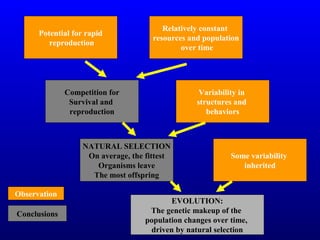
Potential for rapid
reproduction
Relatively constant
resources and population
over time
Variability in
structures and
behaviors
Some variability
inherited
Competition for
Survival and
reproduction
NATURAL SELECTION
On average, the fittest
Organisms leave
The most offspring
EVOLUTION:
The genetic makeup of the
population changes over time,
driven by natural selection
Conclusions
Observation
Evidence for evolution
1) Artificial Selection
2) Fossil Record
3) Comparative anatomy
4) Homologous/vestigial structures
5) Embryology
After Darwin
• Neo-Darwinism: August Weismann’s
change to Darwin’s theory by removing
inheritance of acquired characteristics.
After Darwin
• Neo-Darwinism: August Weismann’s change to
Darwin’s theory by removing inheritance of acquired
characteristics.
• The synthetic theory: combination of
Darwin’s and Mendelian genetics
– Microevolution
– Macroevolution
The Big Picture
• The theory of evolution was derived through
the scientific method.
• REMEMBER: this makes evolution testable!
• After more than 100 years of intensive testing,
Darwin’s theory has only been slightly altered.
• Evolution explains the diversity of life on earth.

Theory of recapitulation

  • 1.
  • 2.
    Ontogeny, Phylogeny, and Recapitulation •Ontogeny recapitulates phylogeny!
  • 3.
    • Ontogeny: isthe history of the development of an organism through its entire life. • Early developmental and ebryological features contribute greatly to our knowledge of homology and common descent. Ontogeny, Phylogeny, and Recapitulation
  • 4.
    – Many vertebrateshave common embryonic structures Post-anal tail Pharyngeal pouches Chick embryo Human embryo
  • 6.
    Ontogeny, Phylogeny, and Recapitulation •Ernst Haeckel: Ontogeny (individual development) recapitulates (repeats) phylogeny (evolutionary descent).
  • 7.
    Ontogeny, Phylogeny, and Recapitulation •Haeckel based his law on the flawed premise that evolutionary change occurs by successively adding new features onto the end of an unaltered ancestral ontogeny while condensing the ancestral ontogeny into earlier developmental stages.
  • 8.
    Ontogeny, Phylogeny, and Recapitulation •K. E. von Baer, disagreed, he argued that early developmental features were simply more widely shared among different animal groups than later ones.
  • 9.
  • 10.
    Heterochrony • We nowknow that there are many parallels between ontogeny and phylogeny, but this ancestral ontogeny can be shifted either to earlier or later stages in descendent ontogenies.
  • 11.
    III. Multiplication ofspecies • Since evolution is a branching process, unless there is a high rate of extinction, more species will be produced through time.
  • 12.
    III. Multiplication ofspecies • Since evolution is a branching process, unless there is a high rate of extinction, more species will be produced through time. • But what then is a species?
  • 13.
  • 14.
    Species Definition 1. Commonancestry 2. Interbreeding
  • 15.
    Species Definition 1. Commonancestry 2. Interbreeding 3. Genotypic and phenotypic cohesion
  • 16.
  • 17.
    How does speciationoccur? 1. Reproductive barrier (allopatric speciation).
  • 18.
    How does speciationoccur? 1. Reproductive barrier (allopatric speciation). 1. Geographic isolation (Vicariant speciation) 1. Mountain range 2. Glaciers
  • 19.
  • 22.
  • 23.
    How does speciationoccur? 1. Reproductive barrier (allopatric speciation). 1. Geographic isolation (Vicariant speciation) 1. Mountain range 2. Glaciers 2. Colonization (founder effect)
  • 24.
  • 25.
    How does speciationoccur? 1. Reproductive barrier (allopatric speciation) 1. Geographic isolation 1. Mountain range 2. Glaciers 2. Colonization (founder effect) 2. Without reproductive barrier (sympatric speciation). Speciation forming without geographic isolation.
  • 27.
    3) Adaptive Radiation:The production of ecologically diverse species from a common ancestral stock. How does speciation occur?
  • 28.
  • 29.
    IV. Darwin Arguedthat Species Arise by Gradualism
  • 30.
    IV. Darwin Arguedthat Species Arise by Gradualism • Based on Leyell’s theory of uniformitarianism.
  • 31.
    IV. Darwin Arguedthat Species Arise by Gradualism • Based on Leyell’s theory of uniformitarianism. • States that larger changes in organisms occur by the accumulation of many smaller changes (i.e. evolution is a slow, continuous process)
  • 32.
    Fig. 1.25, p24 Gradualist model of evolution
  • 33.
    What evidence wouldsupport Gradualism?
  • 34.
    What evidence wouldsupport Gradualism? • Fossil record should have a long series of intermediate forms connecting the phenotypes of ancestral and descendant populations.
  • 35.
    What evidence wouldsupport Gradualism? • So do we see lots of intermediate forms in the fossil record?
  • 36.
    Others Argued thatspecies arise by Punctuated Equilibrium
  • 37.
    Others Argued thatspecies arise by Punctuated Equilibrium • Phenotypic evolution is concentrated in relatively brief events of branching speciation, followed by much longer intervals of evolutionary stasis.
  • 38.
    Fig 1.26, p24 Punctuated Equilibrium model
  • 39.
  • 40.
    V. Natural Selection •Differential reproduction and survival of individuals carrying alternative, inherited traits.
  • 41.
    V. Natural Selection •Natural selection is the major process or mechanism by which evolution occurs in Darwin’s theory of evolution.
  • 42.
    So how didDarwin come up with this explanation?
  • 43.
  • 44.
    Darwin’s Observations • Observation1: Organisms can produce more offspring than just replacing the parents
  • 45.
    Darwin’s Observations • Observation1: Organisms can produce more offspring than just replacing the parents • Observation 2: Number of individuals in a population remains constant
  • 46.
    Darwin’s Observations • Observation1: Organisms can produce more offspring than just replacing the parents • Observation 2: Number of individuals in a population remains constant • Observation 3: Individuals within a species vary (size, color, behavior, etc..)
  • 47.
    Darwin’s Observations • Observation1: Organisms can produce more offspring than just replacing the parents • Observation 2: Number of individuals in a population remains constant • Observation 3: Individuals within a species vary (size, color, behavior, etc..) • Observation 4: Variation in individuals is heritable.
  • 48.
  • 49.
    Darwin’s Deductions • Deduction1: Individuals must compete for resources, and only some will survive
  • 50.
    Darwin’s Deductions • Deduction1: Individuals must compete for resources, and only some will survive • Deduction 2: Individuals with variations more suited to the environment will be more likely to survive and reproduce: natural selection
  • 51.
    Darwin’s Deductions • Deduction1: Individuals must compete for resources, and only some will survive • Deduction 2: Individuals with variations more suited to the environment will be more likely to survive and reproduce: natural selection • Deduction 3: Over many generations and long periods of time, these variations accumulate in the population, resulting in evolution, or change over time.
  • 52.
    Potential for rapid reproduction Relativelyconstant resources and population over time Variability in structures and behaviors Some variability inherited Competition for Survival and reproduction NATURAL SELECTION On average, the fittest Organisms leave The most offspring EVOLUTION: The genetic makeup of the population changes over time, driven by natural selection Conclusions Observation
  • 53.
    Evidence for evolution 1)Artificial Selection 2) Fossil Record 3) Comparative anatomy 4) Homologous/vestigial structures 5) Embryology
  • 54.
    After Darwin • Neo-Darwinism:August Weismann’s change to Darwin’s theory by removing inheritance of acquired characteristics.
  • 55.
    After Darwin • Neo-Darwinism:August Weismann’s change to Darwin’s theory by removing inheritance of acquired characteristics. • The synthetic theory: combination of Darwin’s and Mendelian genetics – Microevolution – Macroevolution
  • 56.
    The Big Picture •The theory of evolution was derived through the scientific method. • REMEMBER: this makes evolution testable! • After more than 100 years of intensive testing, Darwin’s theory has only been slightly altered. • Evolution explains the diversity of life on earth.