MICELLIZATION AND
THEIR
PHARMACEUTICAL
APPLICATIONS
By
Maria Shuaib
Contents
 Introduction to micelles
 Process of micellization
 Factors affecting micellization
 Critical micelle concentration (CMC)
 Factors affecting CMC
 Determination of CMC
 Thermodynamic aspects
 Pharmaceutical applications
Micelle
 A micelle is an electrically charged particle
formed by an aggregate of molecules, above a
critical concentration and occurring in certain
colloidal electrolyte solutions, especially those of
soaps and detergents.
Micelle
A micelle is an aggregate of surfactant molecules
dispersed in a liquid colloid.
The process of forming micelle is known as
micellization.
Introduction
5
 In dilute solution Amphiphiles tend to reduce Surface
tension
 As concentration molecules of amphiphiles goes on
increasing they disturb hydrogen structure, to
minimize the disturbance molecules tend to form
aggregate into a structure
 Structure called as micelle and Amphiphilic molecule
Surface Active Agent
PHYSICOCHEMICAL
BACKGROUND
6
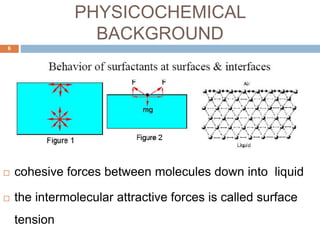
 cohesive forces between molecules down into liquid
 the intermolecular attractive forces is called surface
tension
Micelle formation
7
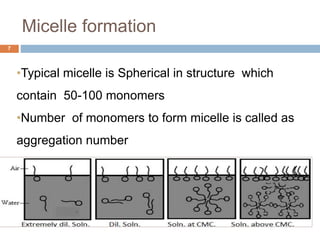
•Typical micelle is Spherical in structure which
contain 50-100 monomers
•Number of monomers to form micelle is called as
aggregation number
• A micelle is an aggregate of monomer surfactant
molecules dispersed in a liquid colloid.
• Hydrophilic "head" regions in contact with
surrounding solvent, sequestering the hydrophobic tail
regions in the micelle centre. (oil-in-water micelle).
• Inverse micelles have the head groups at the centre
with the tails extending out (water-in-oil micelle).
Micelle
8
9
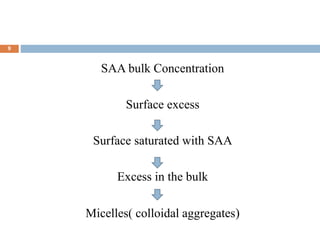
SAA bulk Concentration
Surface excess
Surface saturated with SAA
Excess in the bulk
Micelles( colloidal aggregates)
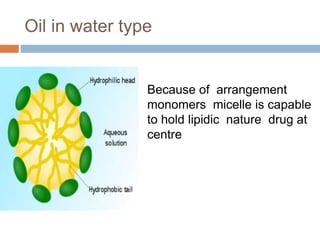
Oil in water type
Because of arrangement
monomers micelle is capable
to hold lipidic nature drug at
centre
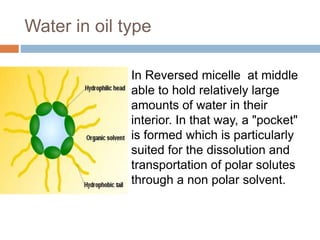
Water in oil type
In Reversed micelle at middle
able to hold relatively large
amounts of water in their
interior. In that way, a "pocket"
is formed which is particularly
suited for the dissolution and
transportation of polar solutes
through a non polar solvent.
Factors affecting process of
micelles formation
 Molecular wt. of monomer
 Aggregation no.
 Proportion of hydrophobic and hydrophilic chain
length
 Preparation process
 CMC
Critical micelle concentration
(CMC)
13
 The lowest concentration at which micelles
first appear is called the critical concentration
for micelle formation
 The critical micelle concentration is the point at
which surfactant molecules aggregate together
in the liquid to form groups known as micelles.
14
 The critical micelle concentration of a surfactant
indicates the point at which surface active properties
are at an optimum and performance is maximised.
 The CMC is the concentration above surfactant when
micelles will form spontaneously.
 Increase in concentration of surfactant beyond CMC
change number size or shape but not provide
increase in concentration of monomeric species
Determination of the CMC
15
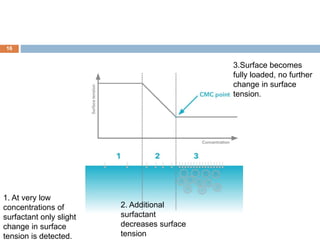
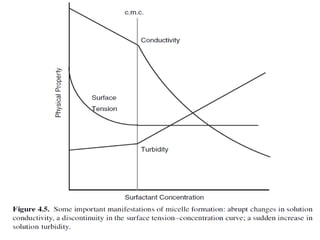
 Micelles are formed at the critical micelle
concentration (CMC), which is detected as an
inflection point in physical properties which are
plotted as a function of concentration.
• surface tension,
• Conductivity,
• Turbidity,
• Osmotic Pressure
16
1. At very low
concentrations of
surfactant only slight
change in surface
tension is detected.
2. Additional
surfactant
decreases surface
tension
3.Surface becomes
fully loaded, no further
change in surface
tension.
17
Factors Affecting CMC
18
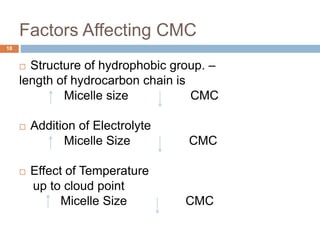
 Structure of hydrophobic group. –
length of hydrocarbon chain is
Micelle size CMC
 Addition of Electrolyte
Micelle Size CMC
 Effect of Temperature
up to cloud point
Micelle Size CMC
Thermodynamic aspect
 The formation of micelle can be understood using
thermodynamics: micelles can form
spontaneously because of balance between
entropy and enthalpy
 For ionic surfactants, the solubility of a material
will often be observed to undergo a sharp,
discontinuous increase at some characteristic
temperature, commonly referred to as the Krafft
 A surfactant, when present at low concentrations in a system,
adsorbs onto surfaces or interfaces significantly changing the
surface or interfacial free energy
 Primary reason of micelle formation is attainment of minimal free
energy
 Free energy change ∆G depend upon both Etropy,S and Enthlpy
H at temperature T
∆G= ∆H-T∆S (T∆S is 90-95% value of ∆G)
Pharmaceutical Applications
 Micelles are an important factor of
pharmaceutical chemistry and have a number of
applications which give them great importance
in delivering medicines to patients, or to specific
locations within the patient
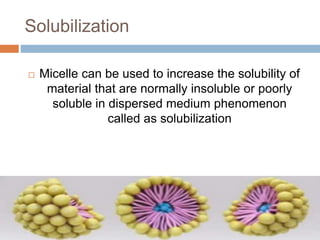
Solubilization
 Micelle can be used to increase the solubility of
material that are normally insoluble or poorly
soluble in dispersed medium phenomenon
called as solubilization
Solubilization
 Solubilization can be defined as ‘‘the
preparation of a thermodynamically stable
isotropic solution of a substance normally
insoluble or very slightly soluble in a given
solvent by the introduction of an additional
amphiphilic component or components.
Solubilization by micelles
 The location of a solubilized molecule in a
micelle is determined primarily by the chemical
structure of the solubilizate.
 Solubilization can occur at a number of different
sites in a micelle
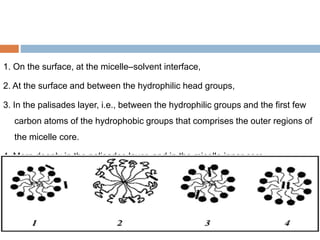
1. On the surface, at the micelle–solvent interface,
2. At the surface and between the hydrophilic head groups,
3. In the palisades layer, i.e., between the hydrophilic groups and the first few
carbon atoms of the hydrophobic groups that comprises the outer regions of
the micelle core.
4. More deeply in the palisades layer, and in the micelle inner core.
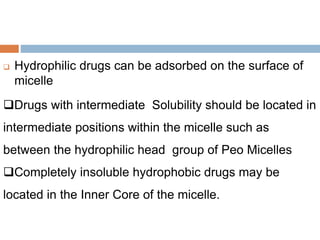
 Hydrophilic drugs can be adsorbed on the surface of
micelle
Drugs with intermediate Solubility should be located in
intermediate positions within the micelle such as
between the hydrophilic head group of Peo Micelles
Completely insoluble hydrophobic drugs may be
located in the Inner Core of the micelle.
Examples
 1. Polar alcohols are soluble in aqueous
solution, so it located in solution / on surface of
micelle.
 2. Phenol are having polar –OH group and non
polar benzene ring. In which –OH gr. Located in
hydrophilic environment and benzene ring in
hydrophobic environment, so it located at the
surface and between the hydrophilic head
 3. Semi polar materials, such as fatty acids are
usually located in the palisades layer, the depth
of penetration depending on the ratio of polar to
non-polar structures in the solubilisate molecule.
 4. Non-polar additives such as hydrocarbons
tend to be intimately associated with the
hydrocarbon core of the micelle.
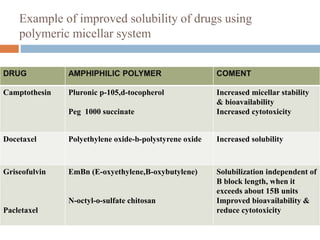
Example of improved solubility of drugs using
polymeric micellar system
DRUG AMPHIPHILIC POLYMER COMENT
Camptothesin Pluronic p-105,d-tocopherol
Peg 1000 succinate
Increased micellar stability
& bioavailability
Increased cytotoxicity
Docetaxel Polyethylene oxide-b-polystyrene oxide Increased solubility
Griseofulvin
Pacletaxel
EmBn (E-oxyethylene,B-oxybutylene)
N-octyl-o-sulfate chitosan
Solubilization independent of
B block length, when it
exceeds about 15B units
Improved bioavailability &
reduce cytotoxicity
Drug Protection
 Protection of drug molecules from degradation
via hydrolysis or other physicochemical
reactions — this increases their shelf life, or
prolongs their stability during use.
Targeted Drug Delivery
 Micelles may have an increasingly important
role as carriers of drug molecules to target sites,
for example, delivering doxorubicin to a tumour.
 Polymeric micelles, self-assembling nano-
constructs of amphiphilic copolymers, are widely
considered as convenient nano-carriers for a
variety of applications, such as diagnostic
imaging, and drug and gene delivery.
Conclusion
33
 By using Phenomenon of micellization we improve
solubility of API
 Considering factor of CMC we modify micelle size
Shape & release profile
Conclusion
 Applying this knowledge in field of Pharmacy
Improve API stability
Maintain Bioavailability long period
 Research is continued in Targeted DDS
(Cancer)
References
35
 A. N. Martin, Martin's Physical Pharmacy and
Pharmaceutical Sciences, 6th edition, p.
 M.E. Aulton, Pharmaceutics science of dosage
form design, 2nd Edition, p. 88-89
 Leon Lachman, The Theory and Practice of
Industrial Pharmacy, 3rd edition, p. 106
 H.A. Liebereman, M.M. Rieger, G.S. Banker,
Pharmaceutical Dosage Forms: Disperse
Systems,2nd Edition, Vol.3, p. 216-220
36
 Sanjay K. Jain, Vandana Soni, Benley’s Text
Book of Pharmaceutics, p.68-74
 Ram I. Mahato Pharmaceutical Dosage Forms
and Drug Delivery,CRC press pharmacy
education series, p.111-119
 Nita K. Pandit & Robert R. Soltis, Introduction to
the Pharmacetical Sciences 2nd Edition, p.54-55
 Online Reference
http://www.biolinscientific.com/attension/applicatio
ns/?card=AA8
References
 Martins physical pharmacy & pharmacuetical
sciences maryland USA lippincott williams &
wilkins:2007 pg no. 469-97
 Moroi y.micelles: theorotical &applied aspects
springer international ed. New york:springer:2005
pg no.41-50
 Jones mc ,leroux jc polymeric micelles: a new
generation of colloidal drug carriers. Eur j pharm
biopharm 1999 pg no.101-11
References
 Torchilin VP. Micellar nanocarriers:
pharmaceutical perspectives. Pharmaceutical
Research 2007:24:1–16.
 Chen H, Khemtong C, Yang X et al.
Nanonization strategies for poorly water-soluble
drugs. Drug Discovery Today 2011:16:354–60.

Micellization and their pharmaceutical applications

  • 1.
  • 2.
    Contents  Introduction tomicelles  Process of micellization  Factors affecting micellization  Critical micelle concentration (CMC)  Factors affecting CMC  Determination of CMC  Thermodynamic aspects  Pharmaceutical applications
  • 3.
    Micelle  A micelleis an electrically charged particle formed by an aggregate of molecules, above a critical concentration and occurring in certain colloidal electrolyte solutions, especially those of soaps and detergents.
  • 4.
    Micelle A micelle isan aggregate of surfactant molecules dispersed in a liquid colloid. The process of forming micelle is known as micellization.
  • 5.
    Introduction 5  In dilutesolution Amphiphiles tend to reduce Surface tension  As concentration molecules of amphiphiles goes on increasing they disturb hydrogen structure, to minimize the disturbance molecules tend to form aggregate into a structure  Structure called as micelle and Amphiphilic molecule Surface Active Agent
  • 6.
    PHYSICOCHEMICAL BACKGROUND 6  cohesive forcesbetween molecules down into liquid  the intermolecular attractive forces is called surface tension
  • 7.
    Micelle formation 7 •Typical micelleis Spherical in structure which contain 50-100 monomers •Number of monomers to form micelle is called as aggregation number
  • 8.
    • A micelleis an aggregate of monomer surfactant molecules dispersed in a liquid colloid. • Hydrophilic "head" regions in contact with surrounding solvent, sequestering the hydrophobic tail regions in the micelle centre. (oil-in-water micelle). • Inverse micelles have the head groups at the centre with the tails extending out (water-in-oil micelle). Micelle 8
  • 9.
    9 SAA bulk Concentration Surfaceexcess Surface saturated with SAA Excess in the bulk Micelles( colloidal aggregates)
  • 10.
    Oil in watertype Because of arrangement monomers micelle is capable to hold lipidic nature drug at centre
  • 11.
    Water in oiltype In Reversed micelle at middle able to hold relatively large amounts of water in their interior. In that way, a "pocket" is formed which is particularly suited for the dissolution and transportation of polar solutes through a non polar solvent.
  • 12.
    Factors affecting processof micelles formation  Molecular wt. of monomer  Aggregation no.  Proportion of hydrophobic and hydrophilic chain length  Preparation process  CMC
  • 13.
    Critical micelle concentration (CMC) 13 The lowest concentration at which micelles first appear is called the critical concentration for micelle formation  The critical micelle concentration is the point at which surfactant molecules aggregate together in the liquid to form groups known as micelles.
  • 14.
    14  The criticalmicelle concentration of a surfactant indicates the point at which surface active properties are at an optimum and performance is maximised.  The CMC is the concentration above surfactant when micelles will form spontaneously.  Increase in concentration of surfactant beyond CMC change number size or shape but not provide increase in concentration of monomeric species
  • 15.
    Determination of theCMC 15  Micelles are formed at the critical micelle concentration (CMC), which is detected as an inflection point in physical properties which are plotted as a function of concentration. • surface tension, • Conductivity, • Turbidity, • Osmotic Pressure
  • 16.
    16 1. At verylow concentrations of surfactant only slight change in surface tension is detected. 2. Additional surfactant decreases surface tension 3.Surface becomes fully loaded, no further change in surface tension.
  • 17.
  • 18.
    Factors Affecting CMC 18 Structure of hydrophobic group. – length of hydrocarbon chain is Micelle size CMC  Addition of Electrolyte Micelle Size CMC  Effect of Temperature up to cloud point Micelle Size CMC
  • 19.
    Thermodynamic aspect  Theformation of micelle can be understood using thermodynamics: micelles can form spontaneously because of balance between entropy and enthalpy  For ionic surfactants, the solubility of a material will often be observed to undergo a sharp, discontinuous increase at some characteristic temperature, commonly referred to as the Krafft
  • 20.
     A surfactant,when present at low concentrations in a system, adsorbs onto surfaces or interfaces significantly changing the surface or interfacial free energy  Primary reason of micelle formation is attainment of minimal free energy  Free energy change ∆G depend upon both Etropy,S and Enthlpy H at temperature T ∆G= ∆H-T∆S (T∆S is 90-95% value of ∆G)
  • 21.
    Pharmaceutical Applications  Micellesare an important factor of pharmaceutical chemistry and have a number of applications which give them great importance in delivering medicines to patients, or to specific locations within the patient
  • 22.
    Solubilization  Micelle canbe used to increase the solubility of material that are normally insoluble or poorly soluble in dispersed medium phenomenon called as solubilization
  • 23.
    Solubilization  Solubilization canbe defined as ‘‘the preparation of a thermodynamically stable isotropic solution of a substance normally insoluble or very slightly soluble in a given solvent by the introduction of an additional amphiphilic component or components.
  • 24.
    Solubilization by micelles The location of a solubilized molecule in a micelle is determined primarily by the chemical structure of the solubilizate.  Solubilization can occur at a number of different sites in a micelle
  • 25.
    1. On thesurface, at the micelle–solvent interface, 2. At the surface and between the hydrophilic head groups, 3. In the palisades layer, i.e., between the hydrophilic groups and the first few carbon atoms of the hydrophobic groups that comprises the outer regions of the micelle core. 4. More deeply in the palisades layer, and in the micelle inner core.
  • 26.
     Hydrophilic drugscan be adsorbed on the surface of micelle Drugs with intermediate Solubility should be located in intermediate positions within the micelle such as between the hydrophilic head group of Peo Micelles Completely insoluble hydrophobic drugs may be located in the Inner Core of the micelle.
  • 27.
    Examples  1. Polaralcohols are soluble in aqueous solution, so it located in solution / on surface of micelle.  2. Phenol are having polar –OH group and non polar benzene ring. In which –OH gr. Located in hydrophilic environment and benzene ring in hydrophobic environment, so it located at the surface and between the hydrophilic head
  • 28.
     3. Semipolar materials, such as fatty acids are usually located in the palisades layer, the depth of penetration depending on the ratio of polar to non-polar structures in the solubilisate molecule.  4. Non-polar additives such as hydrocarbons tend to be intimately associated with the hydrocarbon core of the micelle.
  • 29.
    Example of improvedsolubility of drugs using polymeric micellar system DRUG AMPHIPHILIC POLYMER COMENT Camptothesin Pluronic p-105,d-tocopherol Peg 1000 succinate Increased micellar stability & bioavailability Increased cytotoxicity Docetaxel Polyethylene oxide-b-polystyrene oxide Increased solubility Griseofulvin Pacletaxel EmBn (E-oxyethylene,B-oxybutylene) N-octyl-o-sulfate chitosan Solubilization independent of B block length, when it exceeds about 15B units Improved bioavailability & reduce cytotoxicity
  • 30.
    Drug Protection  Protectionof drug molecules from degradation via hydrolysis or other physicochemical reactions — this increases their shelf life, or prolongs their stability during use.
  • 31.
    Targeted Drug Delivery Micelles may have an increasingly important role as carriers of drug molecules to target sites, for example, delivering doxorubicin to a tumour.
  • 32.
     Polymeric micelles,self-assembling nano- constructs of amphiphilic copolymers, are widely considered as convenient nano-carriers for a variety of applications, such as diagnostic imaging, and drug and gene delivery.
  • 33.
    Conclusion 33  By usingPhenomenon of micellization we improve solubility of API  Considering factor of CMC we modify micelle size Shape & release profile
  • 34.
    Conclusion  Applying thisknowledge in field of Pharmacy Improve API stability Maintain Bioavailability long period  Research is continued in Targeted DDS (Cancer)
  • 35.
    References 35  A. N.Martin, Martin's Physical Pharmacy and Pharmaceutical Sciences, 6th edition, p.  M.E. Aulton, Pharmaceutics science of dosage form design, 2nd Edition, p. 88-89  Leon Lachman, The Theory and Practice of Industrial Pharmacy, 3rd edition, p. 106  H.A. Liebereman, M.M. Rieger, G.S. Banker, Pharmaceutical Dosage Forms: Disperse Systems,2nd Edition, Vol.3, p. 216-220
  • 36.
    36  Sanjay K.Jain, Vandana Soni, Benley’s Text Book of Pharmaceutics, p.68-74  Ram I. Mahato Pharmaceutical Dosage Forms and Drug Delivery,CRC press pharmacy education series, p.111-119  Nita K. Pandit & Robert R. Soltis, Introduction to the Pharmacetical Sciences 2nd Edition, p.54-55  Online Reference http://www.biolinscientific.com/attension/applicatio ns/?card=AA8
  • 37.
    References  Martins physicalpharmacy & pharmacuetical sciences maryland USA lippincott williams & wilkins:2007 pg no. 469-97  Moroi y.micelles: theorotical &applied aspects springer international ed. New york:springer:2005 pg no.41-50  Jones mc ,leroux jc polymeric micelles: a new generation of colloidal drug carriers. Eur j pharm biopharm 1999 pg no.101-11
  • 38.
    References  Torchilin VP.Micellar nanocarriers: pharmaceutical perspectives. Pharmaceutical Research 2007:24:1–16.  Chen H, Khemtong C, Yang X et al. Nanonization strategies for poorly water-soluble drugs. Drug Discovery Today 2011:16:354–60.