SOLUBILIZATION
BY;
Sanjay Kumar (DE_073)
To:
DR_TEHMINA _ADNAN
Physical pharmacy
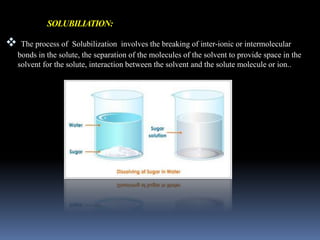
 The process of Solubilization involves the breaking of inter-ionic or intermolecular
bonds in the solute, the separation of the molecules of the solvent to provide space in the
solvent for the solute, interaction between the solvent and the solute molecule or ion..
SOLUBILIATION:
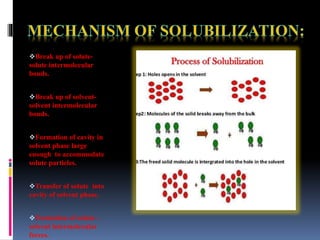
Break up of solute-
solute intermolecular
bonds.
Break up of solvent-
solvent intermolecular
bonds.
Formation of cavity in
solvent phase large
enough to accommodate
solute particles.
Transfer of solute into
cavity of solvent phase.
Formation of solute –
solvent intermolecular
forces.
Solubility;
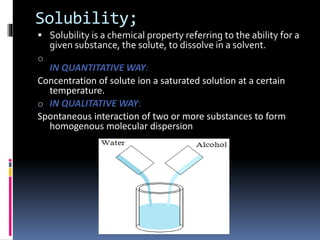
 Solubility is a chemical property referring to the ability for a
given substance, the solute, to dissolve in a solvent.
o
IN QUANTITATIVE WAY:
Concentration of solute ion a saturated solution at a certain
temperature.
o IN QUALITATIVE WAY:
Spontaneous interaction of two or more substances to form
homogenous molecular dispersion
surfactant
 Surfactants are chemical species that act as
wetting agents to lower the surface tension of
a liquid and allow for increased spread ability
 STRUCTURE OF SURFACTANTS
Surfactant molecules are usually organic
compounds that contain hydrophobic groups
or "tails" and hydrophilic groups or "heads.“
 EXAMPLE
 Sodium stearate
 4-(5-dodecyl) benzenesulfonate
 alkyl ether phosphates
 benzalkaonium chloride (BAC)
Types of surfactant;
 There are four types of surfactants.
 Anionic,
 Nonionic,
 Cationic,
 Zwitter (amphoteric) ion.
Nonionic surfactant
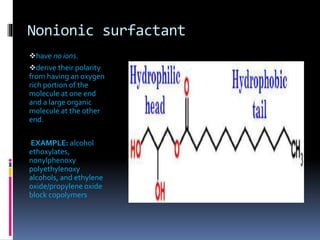
have no ions.
derive their polarity
from having an oxygen
rich portion of the
molecule at one end
and a large organic
molecule at the other
end.
EXAMPLE: alcohol
ethoxylates,
nonylphenoxy
polyethylenoxy
alcohols, and ethylene
oxide/propylene oxide
block copolymers
Cationic surfactant
Are positively charged
molecules usually derived
from nitrogen compounds.
Not commonly used as
cleaning agents .
 Many cationic surfactants
have bactericidal or other
sanitizing properties.
Cationic surfactants are
usually incompatible with
anionic surfactants, because
they will react with the
negatively charged anionic
surfactant to form an
insoluble or ineffective
compound.
Amphoteric (zwitter) ionic
surfactant
Change their charge
with pH.
They can be anionic,
nonionic, or cationic
depending on pH.
 For the amphoteric
surfactants the charge of
the hydrophilic part is
controlled by the pH of
the solution.
They can act as anionic
surfactant in an alkalic
solution or as cationic
surfactant in an acidic
solution.
Are made out of amphipathic molecules.
A micelle is a ball that forms when amphipathic molecules are put in a
liquid.
The liquid can be polar like water or
non-polar like butane or octane. Micelles will form because only one
end of the amphipathic molecules will be compatible with the liquid.
 In the aqueous system the high interfacial energy between the water
molecules and the hydrocarbon chains of the surfactant is the primary factor in
the process, while in a nonpolar system the attractive interaction between the
polar parts serves as the force governing the association process.
The micellization in aqueous solutions may be perceived as a phase
separation that is modified through geometrical restrictions, while the
corresponding phenomenon in oils is a chemical equilibrium similar to that of
alcohols in such media.
The consequence of this difference is that the process in water is highly
cooperative and the designation of a critical micellization concentration (cmc) is
justified.
 In the nonpolar environment, on the other hand, the association process is
gradual and the term cmc is not warranted. In this case the interactions leading
to the micellization are amenable to analysis by spectroscopic methods.
TYPES OF MICELLE
Following are three types of micelles
Spherical micelle,
Rod shaped micelle,
 Laminar micelle,
SPHERICALMICELLE
 Amphipatic can form bilayers that
sandwich the tails in the middle, or they
can form spherical micelles.
 Phospholipids are amphipathic molecules
that contain two water-fearing tails.
 Phospholipids prefer to form bilayers.
 Fatty acids have only one water-fearing
tail, so forming a micelle is easier and
more stable for them
ROD SHAPED MICELLE
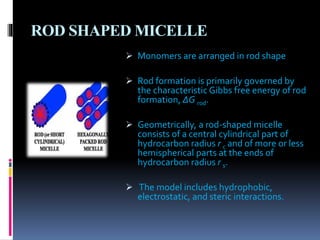
 Monomers are arranged in rod shape
 Rod formation is primarily governed by
the characteristic Gibbs free energy of rod
formation, ΔG rod.
 Geometrically, a rod-shaped micelle
consists of a central cylindrical part of
hydrocarbon radius r c and of more or less
hemispherical parts at the ends of
hydrocarbon radius r s.
 The model includes hydrophobic,
electrostatic, and steric interactions.
LAMINAR MICELLE
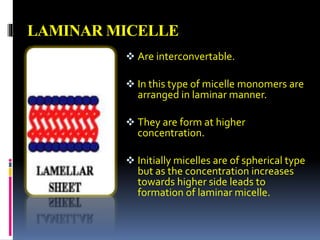
 Are interconvertable.
 In this type of micelle monomers are
arranged in laminar manner.
 They are form at higher
concentration.
 Initially micelles are of spherical type
but as the concentration increases
towards higher side leads to
formation of laminar micelle.
Solubilization

Solubilization

  • 1.
  • 2.
     The processof Solubilization involves the breaking of inter-ionic or intermolecular bonds in the solute, the separation of the molecules of the solvent to provide space in the solvent for the solute, interaction between the solvent and the solute molecule or ion.. SOLUBILIATION:
  • 3.
    Break up ofsolute- solute intermolecular bonds. Break up of solvent- solvent intermolecular bonds. Formation of cavity in solvent phase large enough to accommodate solute particles. Transfer of solute into cavity of solvent phase. Formation of solute – solvent intermolecular forces.
  • 4.
    Solubility;  Solubility isa chemical property referring to the ability for a given substance, the solute, to dissolve in a solvent. o IN QUANTITATIVE WAY: Concentration of solute ion a saturated solution at a certain temperature. o IN QUALITATIVE WAY: Spontaneous interaction of two or more substances to form homogenous molecular dispersion
  • 5.
    surfactant  Surfactants arechemical species that act as wetting agents to lower the surface tension of a liquid and allow for increased spread ability  STRUCTURE OF SURFACTANTS Surfactant molecules are usually organic compounds that contain hydrophobic groups or "tails" and hydrophilic groups or "heads.“  EXAMPLE  Sodium stearate  4-(5-dodecyl) benzenesulfonate  alkyl ether phosphates  benzalkaonium chloride (BAC)
  • 6.
    Types of surfactant; There are four types of surfactants.  Anionic,  Nonionic,  Cationic,  Zwitter (amphoteric) ion.
  • 7.
    Nonionic surfactant have noions. derive their polarity from having an oxygen rich portion of the molecule at one end and a large organic molecule at the other end. EXAMPLE: alcohol ethoxylates, nonylphenoxy polyethylenoxy alcohols, and ethylene oxide/propylene oxide block copolymers
  • 8.
    Cationic surfactant Are positivelycharged molecules usually derived from nitrogen compounds. Not commonly used as cleaning agents .  Many cationic surfactants have bactericidal or other sanitizing properties. Cationic surfactants are usually incompatible with anionic surfactants, because they will react with the negatively charged anionic surfactant to form an insoluble or ineffective compound.
  • 9.
    Amphoteric (zwitter) ionic surfactant Changetheir charge with pH. They can be anionic, nonionic, or cationic depending on pH.  For the amphoteric surfactants the charge of the hydrophilic part is controlled by the pH of the solution. They can act as anionic surfactant in an alkalic solution or as cationic surfactant in an acidic solution.
  • 10.
    Are made outof amphipathic molecules. A micelle is a ball that forms when amphipathic molecules are put in a liquid. The liquid can be polar like water or non-polar like butane or octane. Micelles will form because only one end of the amphipathic molecules will be compatible with the liquid.
  • 11.
     In theaqueous system the high interfacial energy between the water molecules and the hydrocarbon chains of the surfactant is the primary factor in the process, while in a nonpolar system the attractive interaction between the polar parts serves as the force governing the association process. The micellization in aqueous solutions may be perceived as a phase separation that is modified through geometrical restrictions, while the corresponding phenomenon in oils is a chemical equilibrium similar to that of alcohols in such media. The consequence of this difference is that the process in water is highly cooperative and the designation of a critical micellization concentration (cmc) is justified.  In the nonpolar environment, on the other hand, the association process is gradual and the term cmc is not warranted. In this case the interactions leading to the micellization are amenable to analysis by spectroscopic methods.
  • 12.
    TYPES OF MICELLE Followingare three types of micelles Spherical micelle, Rod shaped micelle,  Laminar micelle,
  • 13.
    SPHERICALMICELLE  Amphipatic canform bilayers that sandwich the tails in the middle, or they can form spherical micelles.  Phospholipids are amphipathic molecules that contain two water-fearing tails.  Phospholipids prefer to form bilayers.  Fatty acids have only one water-fearing tail, so forming a micelle is easier and more stable for them
  • 14.
    ROD SHAPED MICELLE Monomers are arranged in rod shape  Rod formation is primarily governed by the characteristic Gibbs free energy of rod formation, ΔG rod.  Geometrically, a rod-shaped micelle consists of a central cylindrical part of hydrocarbon radius r c and of more or less hemispherical parts at the ends of hydrocarbon radius r s.  The model includes hydrophobic, electrostatic, and steric interactions.
  • 15.
    LAMINAR MICELLE  Areinterconvertable.  In this type of micelle monomers are arranged in laminar manner.  They are form at higher concentration.  Initially micelles are of spherical type but as the concentration increases towards higher side leads to formation of laminar micelle.