1
SURFACE ACTIVE AGENTS
AND THEIR CLASSIFICATION
Introduction
Also called Surfactants, surface active agents are compounds
that lower the surface tension (or interfacial tension) between
two liquids or between a liquid and a solid.
Surfactants include detergents, wetting agents, emulsifiers,
foaming agents and dispersants.
Structure
Surfactants are organic amphiphillic compounds containing 2
parts:
1. Lyophilic (solvent loving) part
2. Lyophobic (solvent hating) part
Usually the solvent is water, thus the 2 parts are usually
termed as:
1. Hydrophilic part or water soluble phase which is anionic,
cationic, amphoteric or non-ionic. It is also called polar
head.
2. Hydrophobic part or water insoluble phase that is
equivalent to 8-18 carbon hydrocarbon chain which may
be branched, linear or aromatic. It is also called non-polar
tail.
2
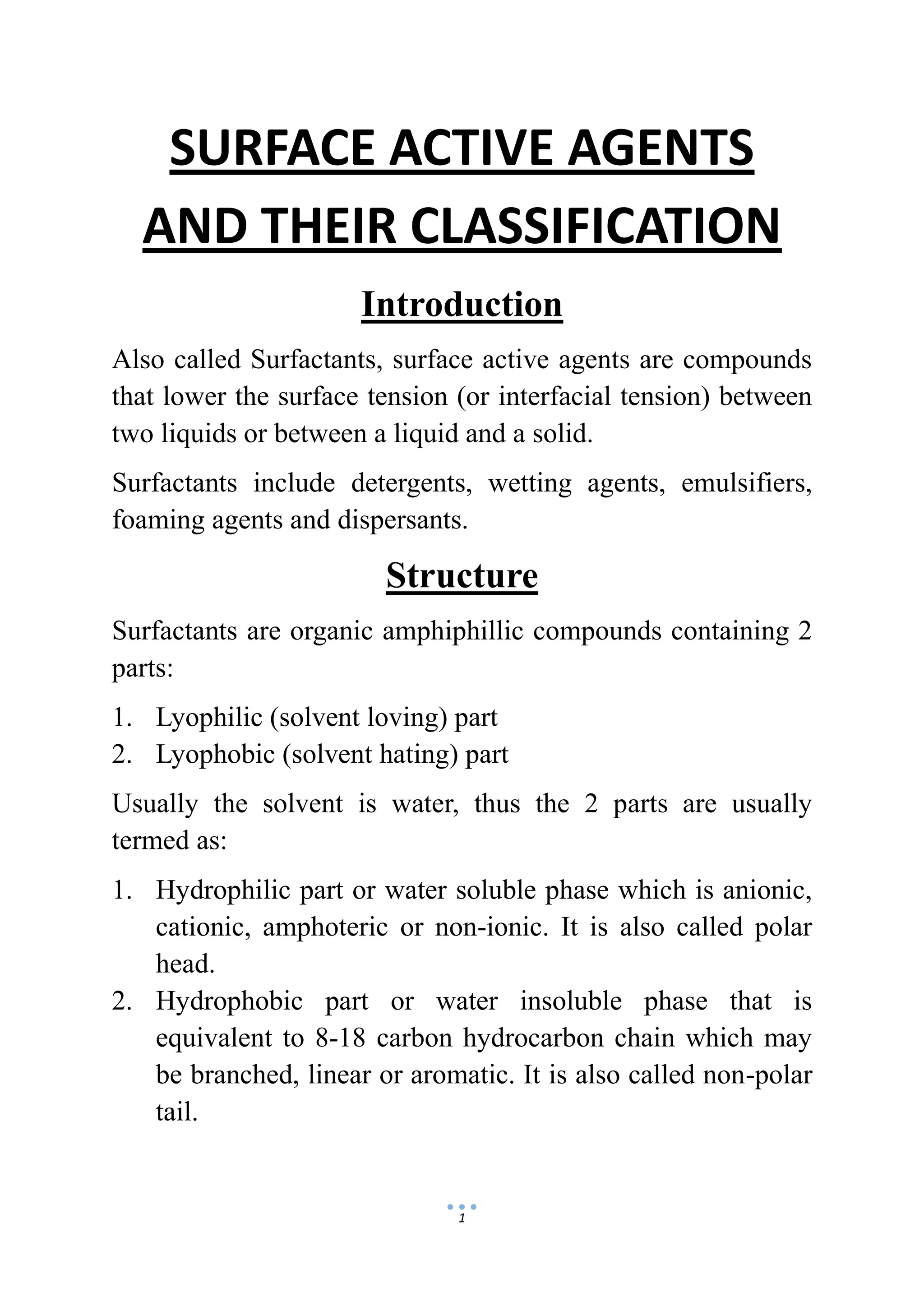
So the surfactant molecules align at the surface and internally
in such a way that the hydrophilic end is towards water and
hydrophobic end is away from water.
Figure 1: Alignment of Molecules
Thus surfactants can be defined as polyether chains
terminating in a highly polar anionic or cationic or amphoteric
or non-ionic group.
Mode of Action
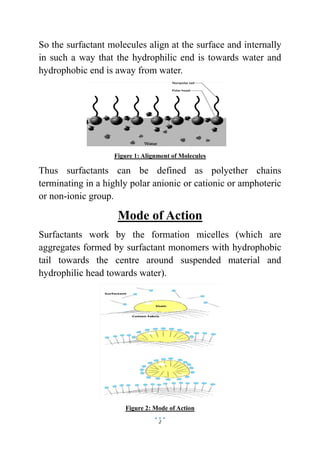
Surfactants work by the formation micelles (which are
aggregates formed by surfactant monomers with hydrophobic
tail towards the centre around suspended material and
hydrophilic head towards water).
Figure 2: Mode of Action
3
The hydrophilic ends associate with the neighbouring
molecules and form a protective coating around suspended
material. This suspension so formed results in the action of
surfactant. The stability of the suspension so formed depends
on the particle size and the density of suspended material.
Classification of Surfactants
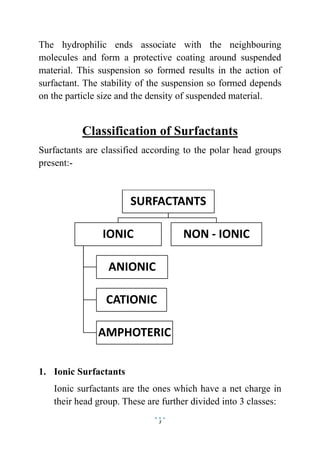
Surfactants are classified according to the polar head groups
present:-
1. Ionic Surfactants
Ionic surfactants are the ones which have a net charge in
their head group. These are further divided into 3 classes:
SURFACTANTS
IONIC
ANIONIC
CATIONIC
AMPHOTERIC
NON - IONIC
4
a) Anionic Surfactants: The head has negatively
charged group due to presence of groups like sulphate,
sulphonate, phosphate and carboxylate.
The examples include alkyl sulphates (like Sodium
lauryl sulphate), alkyl carboxylates (like Sodium
stearate), perfluoro butane sulphonate (PFBS), etc.
b) Cationic Surfactants: The head has positively
charged group due to the presence of groups like
primary, secondary or tertiary amine or quaternary
ammonium cation.
The examples include alkyl trimethylammonium salts
{like Cetyl trimethylammonium bromide (CTAB)},
Cetyl pyridinium chloride (CPC), Benzethonium
chloride (BEC), etc.
c) Amphoteric/Zwitter Ionic Surfactants: They have
both anionic and cationic centres on the same
molecule.
The anionic part can have sulphonate, betaines or
phosphate group.
The cationic part is of primary, secondary, tertiary or
quaternary amine molecule or quaternary ammonium
cation.
The examples include Cocamidopropyl betaine,
lecithin, etc.
2. Non Ionic Surfactants
These are those surfactant molecules which have no
charge on their head.
They are salts of sulphonic acid or long chain alcohols.
These are formed when higher molecular mass alcohols
5
like stearyl alcohol, cetyl alcohol, etc. react with
molecules of ethylenedioxide.
The examples include Polyoxyethylene glycol alkyl ether
(like Octaethylene glycol monododecyl ether), Glucoside
alkyl ethers (Decylglucoside), etc.
References
1. Advanced Physical Chemistry; Gurtu, J.N. and Gurtu, A.
2. Principles of Physical Chemistry; Puri, B.R., Sharma,
L.R. and Pathania, M.S.
THANKS

Surface active agents

  • 1.
    1 SURFACE ACTIVE AGENTS ANDTHEIR CLASSIFICATION Introduction Also called Surfactants, surface active agents are compounds that lower the surface tension (or interfacial tension) between two liquids or between a liquid and a solid. Surfactants include detergents, wetting agents, emulsifiers, foaming agents and dispersants. Structure Surfactants are organic amphiphillic compounds containing 2 parts: 1. Lyophilic (solvent loving) part 2. Lyophobic (solvent hating) part Usually the solvent is water, thus the 2 parts are usually termed as: 1. Hydrophilic part or water soluble phase which is anionic, cationic, amphoteric or non-ionic. It is also called polar head. 2. Hydrophobic part or water insoluble phase that is equivalent to 8-18 carbon hydrocarbon chain which may be branched, linear or aromatic. It is also called non-polar tail.
  • 2.
    2 So the surfactantmolecules align at the surface and internally in such a way that the hydrophilic end is towards water and hydrophobic end is away from water. Figure 1: Alignment of Molecules Thus surfactants can be defined as polyether chains terminating in a highly polar anionic or cationic or amphoteric or non-ionic group. Mode of Action Surfactants work by the formation micelles (which are aggregates formed by surfactant monomers with hydrophobic tail towards the centre around suspended material and hydrophilic head towards water). Figure 2: Mode of Action
  • 3.
    3 The hydrophilic endsassociate with the neighbouring molecules and form a protective coating around suspended material. This suspension so formed results in the action of surfactant. The stability of the suspension so formed depends on the particle size and the density of suspended material. Classification of Surfactants Surfactants are classified according to the polar head groups present:- 1. Ionic Surfactants Ionic surfactants are the ones which have a net charge in their head group. These are further divided into 3 classes: SURFACTANTS IONIC ANIONIC CATIONIC AMPHOTERIC NON - IONIC
  • 4.
    4 a) Anionic Surfactants:The head has negatively charged group due to presence of groups like sulphate, sulphonate, phosphate and carboxylate. The examples include alkyl sulphates (like Sodium lauryl sulphate), alkyl carboxylates (like Sodium stearate), perfluoro butane sulphonate (PFBS), etc. b) Cationic Surfactants: The head has positively charged group due to the presence of groups like primary, secondary or tertiary amine or quaternary ammonium cation. The examples include alkyl trimethylammonium salts {like Cetyl trimethylammonium bromide (CTAB)}, Cetyl pyridinium chloride (CPC), Benzethonium chloride (BEC), etc. c) Amphoteric/Zwitter Ionic Surfactants: They have both anionic and cationic centres on the same molecule. The anionic part can have sulphonate, betaines or phosphate group. The cationic part is of primary, secondary, tertiary or quaternary amine molecule or quaternary ammonium cation. The examples include Cocamidopropyl betaine, lecithin, etc. 2. Non Ionic Surfactants These are those surfactant molecules which have no charge on their head. They are salts of sulphonic acid or long chain alcohols. These are formed when higher molecular mass alcohols
  • 5.
    5 like stearyl alcohol,cetyl alcohol, etc. react with molecules of ethylenedioxide. The examples include Polyoxyethylene glycol alkyl ether (like Octaethylene glycol monododecyl ether), Glucoside alkyl ethers (Decylglucoside), etc. References 1. Advanced Physical Chemistry; Gurtu, J.N. and Gurtu, A. 2. Principles of Physical Chemistry; Puri, B.R., Sharma, L.R. and Pathania, M.S. THANKS