Presented by:- Christy P George
M. Parma 1st year
Department of Pharmaceutics
BHARATI VIDYAPEETH UNIVERSITY POONA COLLEGE OF
PHARMACY,PUNE
TOPICS DISCUSSED:-
 MICELLISATION
 STRUCTURE OF MICELLES
 SHAPE OF MICELLES
 SIZE OF MICELLES
 FACTORS AFFECTING CMC AND MICELLAR SIZE
SURFACTANTS
They are low to moderate molecular weight compounds
with a hydrophobic part and a hydrophilic part
[amphiphile].
Based on the nature of polar head groups they are
classified as
Anionic surfactants
Cationic surfactants
Non ionic surfactants
Zwitter ionic surfactants
SURFACTANTS IN AQUEOUS SYSTEM
Surfactants when dissolved in aqueous system
Hydrophobic part - more water insoluble
Hydrophilic part – more water soluble
But the contact between water and hydrophobic part is
energetically less favorable resulting in
Hydrophobic
domain Align by
the surface or
interface
Hydrophobic
domain aggregate
to form various
structures
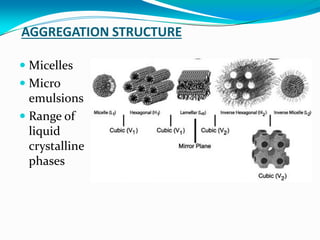
AGGREGATION STRUCTURE
 Micelles
 Micro
emulsions
 Range of
liquid
crystalline
phases
MICELLES
 Micelles are basically aggregation structure formed by the surfactants.
Each single surfactants are called as monomers. When the concentration
is increased aggregation occurs over a narrow concentration range
 Aggregation number – it is the number of monomers that aggregate to
form a micelle
 Micelles are aggregates with 50 or more monomers. (50 Armstrong
diameter)
CriticalMicellar
Concentration(CMC)
When the concentration of surfactants
are increased in the solution
micellization occurs at a narrow
concentration range. The
concentration at which the micelle
is formed is called critical micellar
concentration
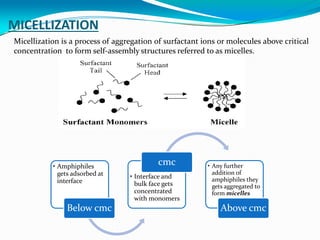
MICELLIZATION
• Amphiphiles
gets adsorbed at
interface
Below cmc
• Interface and
bulk face gets
concentrated
with monomers
cmc • Any further
addition of
amphiphiles they
gets aggregated to
form micelles
Above cmc
Micellization is a process of aggregation of surfactant ions or molecules above critical
concentration to form self-assembly structures referred to as micelles.
• Interaction of hydrophobic
partsDriving forces
• Electrostatic repulsive
interaction
• Repulsive osmotic
interaction
• Steric interaction of bulky
head groups
Opposing forces
The main reason for micelle formation is the attainment of a minimum
free energy state. The main driving force for the formation of micelles is
the increase of entropy that occurs when the hydrophobic regions of the
surfactant are removed from water and the ordered structure of the water
molecules around this region of the molecule is lost
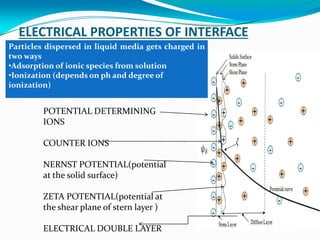
ELECTRICAL PROPERTIES OF INTERFACE
POTENTIAL DETERMINING
IONS
COUNTER IONS
NERNST POTENTIAL(potential
at the solid surface)
ZETA POTENTIAL(potential at
the shear plane of stern layer )
ELECTRICAL DOUBLE LAYER
Particles dispersed in liquid media gets charged in
two ways
•Adsorption of ionic species from solution
•Ionization (depends on ph and degree of
ionization)
MICELLE STRUCTURE [ionic, zwitter ionic ]
•Liquid core-
formed by the n
number
hydrocarbon chains
•Stern layer- ionic
head groups + (1-
alpha) n counter
ions
•Diffusion layer or
gouy Chapman
layer- alpha n
counter ions
Location of
interface is
0.08nm above the
alpha carbon of
alkyl chains
Outermost boundary of the
stern layer corresponds the
hydrodynamic shear surface of
the micelles. The core and the
stern layer form the kinetic
micelle.
Total charge is given as
α*n*e (where n is the number
of monomers, e is elementary
charge and alpha is degree of
ionization)
Surface potential of kinetic
micelle is electrophoretic zeta
potential
MICELLE STRUCTURE[non ionic]
Typical example of
non ionic micelles is
those formed by
polyoxyethylated
surfactants. Its main
components are
 Core
 Palisade layer
Core is surrounded
by a layer of
polyoxyethylene
chains to which
solvent molecules
may be hydrogen
bonded. This region
of micelle is called
palisade layer.
MICELLAR SHAPE
 Micelles are dynamic
structures with a liquid
core. So it is unrealistic to
regard them as rigid
structures with precise
shape
 Micellar sphericity –
micelles are assumed
spherical structure for all
experimental
considerations
 Small micelles – they are
assumed to have
ellipsoid structure.
Maximum number of
monomers can be
included in this shape
FACTORS AFFECTING MICELLAR SHAPE
 Concentration
 Flexible rod like aggregates are observed at high concentration.
 E.g.:- in CTAB(cetyltrimethylammoniumbromide) a transition from
spherical to rod shape is observed
 Temperature
 Presence of electrolytes
 At high electrolyte concentration the micelles of ionic surfactants may
become non-spherical.
Micelle shape undergo transition to more
asymmetric form when there is change to these
parameters
POLYDISPERSITY OF MICELLES (size of micelles)
 Polydispersity is the
measure of the
heterogeneity of sizes
of molecules or
particles
 It is expressed as a ratio
of weight average(nw)
to number average(nn)
 Size distribution curves
are plotted from data
obtained by methods
like ultrasonic
absorption technique
Size distribution curve of polymeric surfactants
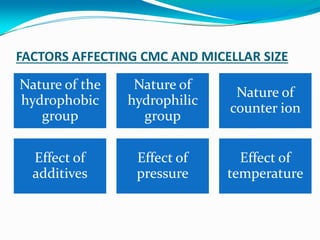
FACTORS AFFECTING CMC AND MICELLAR SIZE
Nature of the
hydrophobic
group
Nature of
hydrophilic
group
Nature of
counter ion
Effect of
additives
Effect of
pressure
Effect of
temperature
NATURE OF HYDROPHOBIC GROUP
CHAIN
LENGTH OF HYDROCARBON
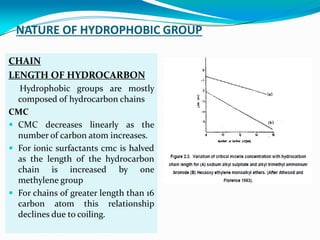
Hydrophobic groups are mostly
composed of hydrocarbon chains
CMC
 CMC decreases linearly as the
number of carbon atom increases.
 For ionic surfactants cmc is halved
as the length of the hydrocarbon
chain is increased by one
methylene group
 For chains of greater length than 16
carbon atom this relationship
declines due to coiling.
 For non ionic surfactants cmc is
decreased one third as one
methylene group is added. It has
more pronounced decrease in cmc
compared to ionic surfactants
 For branched chains the effect is less
prominent compared to straight
chain
 The relationship can be expressed as
log cmc =A-Bm,
where A and B are constants for
homologous series and m is the
number of carbon atoms in the
chain
SIZE
 Increased chain length increases
hydrophobicity and thereby
increase micellar size. Linear
relationship exist between
log(micellar weight) and carbon
chain length
INTRODUCTION CF3 GROUP
 Substitution of the CF3(more hydrophobic) group for terminal CH3 group of
the surfactants hydrocarbon chain doubled the cmc. Since CF3 is hydrophobic
it was expected to promote micellization but it was observed to increase the
cmc (or impede micellization)
 This is observed due to the mutual phobicity of hydrocarbon and fluorocarbon
moieties
EFFECTS OF OTHER GROUPS
 Surfactants possessing two hydrocarbon chains attached to a single head form
lamellar structures
 Addition of phenyl group increases cmc.
 Presence of substituent's (-Cl, -Br, -I, F, -CH3) increase cmc
 Aromatic hydrocarbon tends to form association structures( non micellar)
NATURE OF HYDROPHILIC GROUP
There is difference between cmc
of ionic and non ionic surfactants
with identical hydrophobic
groups. This depends on nature
the hydrophilic groups. Main
aspects are
 Ionic surfactants are reported to
have a higher cmc compared to
non ionic surfactants. This is due
to the increased electrical work
required to form the micelles.
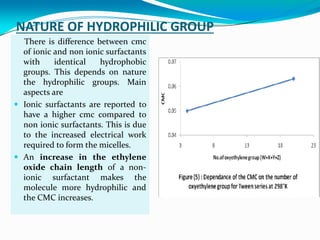
 An increase in the ethylene
oxide chain length of a non-
ionic surfactant makes the
molecule more hydrophilic and
the CMC increases.
 Mean distance between the counter ion and the charge centre of
the surfactants affect the size of micelles.
E.g. decylammonium bromide forms very much larger micelles than
decyltrimethylammonium bromide because the Br- counter ions are
able to approach the charged nitrogen atom more easily thus effectively
shielding the electrical forces and allowing larger micelles to form
 Solvent interaction like formation of hydrogen bonds may affect the
size of micelles
 Position of ionic groups also affects the cmc
e.g.:- increase of cmc when sulphate group is moved from terminal to
medial position in sodium alkyl sulphates
EFFECT OF ADDITIVES
 Electrolytes
 Electrolyte addition to solutions of ionic surfactants decreases the CMC
and increases the micellar size. Eg. Aggregation number of sodium
dodecyl sulphate (NaDS) micelles show large variation
 This is because the electrolyte reduces the forces of repulsion between
the charged head groups at the micelle surface, so allowing the micelle
to grow. Equation relating cmc and electrolyte concentration is given as
log CMC = -alogcc + b (a and b are constants related to ionic groups
cc total counter ion concentration)
• Lowering of cmc of
polyoxyethylated non ionic
surfactants is observed but it is
comparatively small
 Inorganic Electrolytes
 Inorganic additives have appreciable effect on cloud point of non ionic
surfactants. Two categories of additives are identified that make change
to cloud point.
(a)urea and salts with anion known to break the water structure such
as iodides, thiocynates etc
(b)salts with cations
 Alcohols
 Addition of lower alcohols to ionic surfactant causes a decrease in the
cmc which becomes more pronounced with increase in hydrophobicity
of added alcohol
 Linear relationship between cmc and the number of carbon atom in
the alcohol molecule was established in a series of potassium soaps
 In non ionic surfactants lower alcohols causes increase in the
cmc(weakening of hydrophobic bond) and higher alcohols causes
increase. (penetration of alcohol in the palisade layer)
NATURE OF COUNTER ION
 In ionic surfactants the change of the counter ion to one of greater
polarizability or valence leads to decrease in cmc and corresponding
increase in aggregation number
 Micellar size increases for a particular cationic surfactant as the
counter ion is changed according to the series Cl− < Br− < I−, and for a
particular anionic surfactant according to Na+ < K+ < Cs+.
 Ionic surfactants with organic counter ions (e.g. maleates) have lower
CMCs and higher aggregation numbers than those with inorganic
counter ions.
EFFECT OF TEMPERATURE
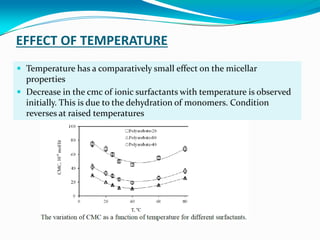
 Temperature has a comparatively small effect on the micellar
properties
 Decrease in the cmc of ionic surfactants with temperature is observed
initially. This is due to the dehydration of monomers. Condition
reverses at raised temperatures
 Aqueous solutions of many non-ionic surfactants become turbid at a
characteristic temperature called the cloud point.
 At temperatures up to the cloud point there is an increase in micellar
size and a corresponding decrease in CMC.
 Increase in temperature results in a decreased micellar size
EFFECT OF PRESSURE
 An increase in cmc with pressure increase has been observed up to
pressure of 150 M pa followed by decrease
 This can be due to solidification of the micellar interior or change in
the dielectric constant of water at high pressure
 Dissociation of monomers is observed at low pressure while association
at high pressure
MICELLE SYSTEM IN DRUG DELIVERY
 Through enhanced soluabilisation more amount of
sparingly soluble drug can be incorporated in an
aqueous solution.
 Decreased hydrolytic degradation and enhanced
stability.
Drugs containing esters and anhydrides are
hydrolytically sensitive and becomes unstable in
presence of moisture. E.g. indomethacin stabilized by
polymeric micelles
E.g. are various non polar drugs which are solubilised by
micelles. nimeusilide can be solubilized by micellisation
 Controlling release rate of drug.
 Effective masking of taste of noxious drug can be
achieved by micellization.
 It also helps in the intra venous delivery of drug
IV administration of drug results in rapid clearance and
accumulation of drug in tissues associated with reticuloendothelial
system. micelles can be effectively used here to restrict the action of
RES
E.g. in cancer therapy prolonged blood stream circulation and
reduced RES uptake can be attained by using micelles
Reference
 Martin Malmsten. Surfactants And Polymers In Drug
Delivery. Drugs And Pharmaceutical Science series
volume 122
 Alfred Martin, James Swarbrick, Arthur Cammarta.
Physical Pharmacy. 3rd edition
 Research papers

Surfactnts

  • 1.
    Presented by:- ChristyP George M. Parma 1st year Department of Pharmaceutics BHARATI VIDYAPEETH UNIVERSITY POONA COLLEGE OF PHARMACY,PUNE
  • 2.
    TOPICS DISCUSSED:-  MICELLISATION STRUCTURE OF MICELLES  SHAPE OF MICELLES  SIZE OF MICELLES  FACTORS AFFECTING CMC AND MICELLAR SIZE
  • 3.
    SURFACTANTS They are lowto moderate molecular weight compounds with a hydrophobic part and a hydrophilic part [amphiphile]. Based on the nature of polar head groups they are classified as Anionic surfactants Cationic surfactants Non ionic surfactants Zwitter ionic surfactants
  • 5.
    SURFACTANTS IN AQUEOUSSYSTEM Surfactants when dissolved in aqueous system Hydrophobic part - more water insoluble Hydrophilic part – more water soluble But the contact between water and hydrophobic part is energetically less favorable resulting in Hydrophobic domain Align by the surface or interface Hydrophobic domain aggregate to form various structures
  • 6.
    AGGREGATION STRUCTURE  Micelles Micro emulsions  Range of liquid crystalline phases
  • 7.
    MICELLES  Micelles arebasically aggregation structure formed by the surfactants. Each single surfactants are called as monomers. When the concentration is increased aggregation occurs over a narrow concentration range  Aggregation number – it is the number of monomers that aggregate to form a micelle  Micelles are aggregates with 50 or more monomers. (50 Armstrong diameter) CriticalMicellar Concentration(CMC) When the concentration of surfactants are increased in the solution micellization occurs at a narrow concentration range. The concentration at which the micelle is formed is called critical micellar concentration
  • 8.
    MICELLIZATION • Amphiphiles gets adsorbedat interface Below cmc • Interface and bulk face gets concentrated with monomers cmc • Any further addition of amphiphiles they gets aggregated to form micelles Above cmc Micellization is a process of aggregation of surfactant ions or molecules above critical concentration to form self-assembly structures referred to as micelles.
  • 9.
    • Interaction ofhydrophobic partsDriving forces • Electrostatic repulsive interaction • Repulsive osmotic interaction • Steric interaction of bulky head groups Opposing forces The main reason for micelle formation is the attainment of a minimum free energy state. The main driving force for the formation of micelles is the increase of entropy that occurs when the hydrophobic regions of the surfactant are removed from water and the ordered structure of the water molecules around this region of the molecule is lost
  • 10.
    ELECTRICAL PROPERTIES OFINTERFACE POTENTIAL DETERMINING IONS COUNTER IONS NERNST POTENTIAL(potential at the solid surface) ZETA POTENTIAL(potential at the shear plane of stern layer ) ELECTRICAL DOUBLE LAYER Particles dispersed in liquid media gets charged in two ways •Adsorption of ionic species from solution •Ionization (depends on ph and degree of ionization)
  • 11.
    MICELLE STRUCTURE [ionic,zwitter ionic ] •Liquid core- formed by the n number hydrocarbon chains •Stern layer- ionic head groups + (1- alpha) n counter ions •Diffusion layer or gouy Chapman layer- alpha n counter ions Location of interface is 0.08nm above the alpha carbon of alkyl chains
  • 12.
    Outermost boundary ofthe stern layer corresponds the hydrodynamic shear surface of the micelles. The core and the stern layer form the kinetic micelle. Total charge is given as α*n*e (where n is the number of monomers, e is elementary charge and alpha is degree of ionization) Surface potential of kinetic micelle is electrophoretic zeta potential
  • 13.
    MICELLE STRUCTURE[non ionic] Typicalexample of non ionic micelles is those formed by polyoxyethylated surfactants. Its main components are  Core  Palisade layer Core is surrounded by a layer of polyoxyethylene chains to which solvent molecules may be hydrogen bonded. This region of micelle is called palisade layer.
  • 14.
    MICELLAR SHAPE  Micellesare dynamic structures with a liquid core. So it is unrealistic to regard them as rigid structures with precise shape  Micellar sphericity – micelles are assumed spherical structure for all experimental considerations  Small micelles – they are assumed to have ellipsoid structure. Maximum number of monomers can be included in this shape
  • 15.
    FACTORS AFFECTING MICELLARSHAPE  Concentration  Flexible rod like aggregates are observed at high concentration.  E.g.:- in CTAB(cetyltrimethylammoniumbromide) a transition from spherical to rod shape is observed  Temperature  Presence of electrolytes  At high electrolyte concentration the micelles of ionic surfactants may become non-spherical. Micelle shape undergo transition to more asymmetric form when there is change to these parameters
  • 16.
    POLYDISPERSITY OF MICELLES(size of micelles)  Polydispersity is the measure of the heterogeneity of sizes of molecules or particles  It is expressed as a ratio of weight average(nw) to number average(nn)  Size distribution curves are plotted from data obtained by methods like ultrasonic absorption technique Size distribution curve of polymeric surfactants
  • 17.
    FACTORS AFFECTING CMCAND MICELLAR SIZE Nature of the hydrophobic group Nature of hydrophilic group Nature of counter ion Effect of additives Effect of pressure Effect of temperature
  • 18.
    NATURE OF HYDROPHOBICGROUP CHAIN LENGTH OF HYDROCARBON Hydrophobic groups are mostly composed of hydrocarbon chains CMC  CMC decreases linearly as the number of carbon atom increases.  For ionic surfactants cmc is halved as the length of the hydrocarbon chain is increased by one methylene group  For chains of greater length than 16 carbon atom this relationship declines due to coiling.
  • 19.
     For nonionic surfactants cmc is decreased one third as one methylene group is added. It has more pronounced decrease in cmc compared to ionic surfactants  For branched chains the effect is less prominent compared to straight chain  The relationship can be expressed as log cmc =A-Bm, where A and B are constants for homologous series and m is the number of carbon atoms in the chain SIZE  Increased chain length increases hydrophobicity and thereby increase micellar size. Linear relationship exist between log(micellar weight) and carbon chain length
  • 20.
    INTRODUCTION CF3 GROUP Substitution of the CF3(more hydrophobic) group for terminal CH3 group of the surfactants hydrocarbon chain doubled the cmc. Since CF3 is hydrophobic it was expected to promote micellization but it was observed to increase the cmc (or impede micellization)  This is observed due to the mutual phobicity of hydrocarbon and fluorocarbon moieties EFFECTS OF OTHER GROUPS  Surfactants possessing two hydrocarbon chains attached to a single head form lamellar structures  Addition of phenyl group increases cmc.  Presence of substituent's (-Cl, -Br, -I, F, -CH3) increase cmc  Aromatic hydrocarbon tends to form association structures( non micellar)
  • 21.
    NATURE OF HYDROPHILICGROUP There is difference between cmc of ionic and non ionic surfactants with identical hydrophobic groups. This depends on nature the hydrophilic groups. Main aspects are  Ionic surfactants are reported to have a higher cmc compared to non ionic surfactants. This is due to the increased electrical work required to form the micelles.  An increase in the ethylene oxide chain length of a non- ionic surfactant makes the molecule more hydrophilic and the CMC increases.
  • 22.
     Mean distancebetween the counter ion and the charge centre of the surfactants affect the size of micelles. E.g. decylammonium bromide forms very much larger micelles than decyltrimethylammonium bromide because the Br- counter ions are able to approach the charged nitrogen atom more easily thus effectively shielding the electrical forces and allowing larger micelles to form  Solvent interaction like formation of hydrogen bonds may affect the size of micelles  Position of ionic groups also affects the cmc e.g.:- increase of cmc when sulphate group is moved from terminal to medial position in sodium alkyl sulphates
  • 23.
    EFFECT OF ADDITIVES Electrolytes  Electrolyte addition to solutions of ionic surfactants decreases the CMC and increases the micellar size. Eg. Aggregation number of sodium dodecyl sulphate (NaDS) micelles show large variation  This is because the electrolyte reduces the forces of repulsion between the charged head groups at the micelle surface, so allowing the micelle to grow. Equation relating cmc and electrolyte concentration is given as log CMC = -alogcc + b (a and b are constants related to ionic groups cc total counter ion concentration) • Lowering of cmc of polyoxyethylated non ionic surfactants is observed but it is comparatively small
  • 24.
     Inorganic Electrolytes Inorganic additives have appreciable effect on cloud point of non ionic surfactants. Two categories of additives are identified that make change to cloud point. (a)urea and salts with anion known to break the water structure such as iodides, thiocynates etc (b)salts with cations  Alcohols  Addition of lower alcohols to ionic surfactant causes a decrease in the cmc which becomes more pronounced with increase in hydrophobicity of added alcohol  Linear relationship between cmc and the number of carbon atom in the alcohol molecule was established in a series of potassium soaps  In non ionic surfactants lower alcohols causes increase in the cmc(weakening of hydrophobic bond) and higher alcohols causes increase. (penetration of alcohol in the palisade layer)
  • 25.
    NATURE OF COUNTERION  In ionic surfactants the change of the counter ion to one of greater polarizability or valence leads to decrease in cmc and corresponding increase in aggregation number  Micellar size increases for a particular cationic surfactant as the counter ion is changed according to the series Cl− < Br− < I−, and for a particular anionic surfactant according to Na+ < K+ < Cs+.  Ionic surfactants with organic counter ions (e.g. maleates) have lower CMCs and higher aggregation numbers than those with inorganic counter ions.
  • 26.
    EFFECT OF TEMPERATURE Temperature has a comparatively small effect on the micellar properties  Decrease in the cmc of ionic surfactants with temperature is observed initially. This is due to the dehydration of monomers. Condition reverses at raised temperatures
  • 27.
     Aqueous solutionsof many non-ionic surfactants become turbid at a characteristic temperature called the cloud point.  At temperatures up to the cloud point there is an increase in micellar size and a corresponding decrease in CMC.  Increase in temperature results in a decreased micellar size
  • 28.
    EFFECT OF PRESSURE An increase in cmc with pressure increase has been observed up to pressure of 150 M pa followed by decrease  This can be due to solidification of the micellar interior or change in the dielectric constant of water at high pressure  Dissociation of monomers is observed at low pressure while association at high pressure
  • 29.
    MICELLE SYSTEM INDRUG DELIVERY  Through enhanced soluabilisation more amount of sparingly soluble drug can be incorporated in an aqueous solution.  Decreased hydrolytic degradation and enhanced stability. Drugs containing esters and anhydrides are hydrolytically sensitive and becomes unstable in presence of moisture. E.g. indomethacin stabilized by polymeric micelles E.g. are various non polar drugs which are solubilised by micelles. nimeusilide can be solubilized by micellisation
  • 30.
     Controlling releaserate of drug.  Effective masking of taste of noxious drug can be achieved by micellization.  It also helps in the intra venous delivery of drug IV administration of drug results in rapid clearance and accumulation of drug in tissues associated with reticuloendothelial system. micelles can be effectively used here to restrict the action of RES E.g. in cancer therapy prolonged blood stream circulation and reduced RES uptake can be attained by using micelles
  • 31.
    Reference  Martin Malmsten.Surfactants And Polymers In Drug Delivery. Drugs And Pharmaceutical Science series volume 122  Alfred Martin, James Swarbrick, Arthur Cammarta. Physical Pharmacy. 3rd edition  Research papers