OMPRAKASH PATEL
M.Sc. CHEMISTRY(III-SEM.)
Dr. ASHISH KUMAR BHUI
 INTRODUCTION
 SURFACTANT
 CLASSIFICATION OF SURFACTANT
 USES OF SURFACTANT
 FORMATION OF MICELLE
 TYPES OF MICELLE
 CRITICAL MICELLE CONCENTRATION
 REFERENCES
INTRODUCTION:-
 Micelles are lipid molecule that arrange
themselves in a spherical form in aqueous
solution.
 Amphiphilic molecules form micelles.
 Micelles are formed when temperature of medium
is ideal and a certain concentration of electrolytes
(called critical micelle concentration) in the
medium.
 A micelle is an aggregate of surfactant molecule
dispersed in liquid collide.
 Surfactant are compounds that lower the surface
tension (interfacial tension) between two liquids and a
liquid and a solid.
 Surfactants are amphiphilic compound with two
opposing portions, one part is hydrophilic (head) and
other is hydrophobic (tail).
 A surfactant interact with both polar and non-polar
molecules.
 The ‘tails’ of most surfactants are fairly similar,
consisting of a hydrocarbon chain, which can be
branched, linear or aromatic.
e.g.- fluorosurfactant have fluorocarbon chain.
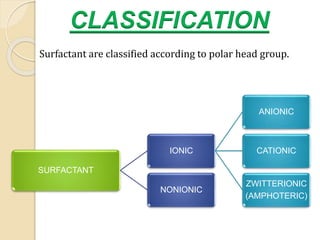
CLASSIFICATION
SURFACTANT
IONIC
ANIONIC
CATIONIC
ZWITTERIONIC
(AMPHOTERIC)
NONIONIC
Surfactant are classified according to polar head group.
 ANIONIC SURFACTANT:-
• Contain anionic(negative) functional group
at their head.
• Based on permanent anions or pH
dependent anions.
• E.g.-Sulphate–alkyl sulphates, alkyl ether
sulphates
Sulphonates - Alkyl benzene
sulphonates
Phosphate – alkyl & aryl ether
phosphate
Carboxylates – Alkyl carboxylates,
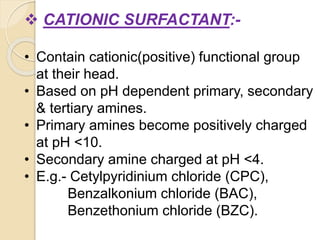
 CATIONIC SURFACTANT:-
• Contain cationic(positive) functional group
at their head.
• Based on pH dependent primary, secondary
& tertiary amines.
• Primary amines become positively charged
at pH <10.
• Secondary amine charged at pH <4.
• E.g.- Cetylpyridinium chloride (CPC),
Benzalkonium chloride (BAC),
Benzethonium chloride (BZC).
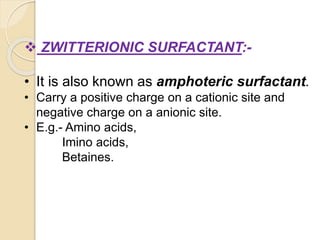
 ZWITTERIONIC SURFACTANT:-
• It is also known as amphoteric surfactant.
• Carry a positive charge on a cationic site and
negative charge on a anionic site.
• E.g.- Amino acids,
Imino acids,
Betaines.
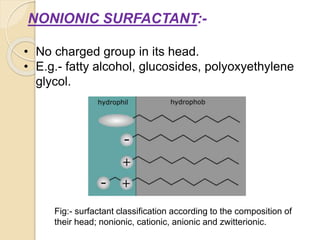
NONIONIC SURFACTANT:-
• No charged group in its head.
• E.g.- fatty alcohol, glucosides, polyoxyethylene
glycol.
Fig:- surfactant classification according to the composition of
their head; nonionic, cationic, anionic and zwitterionic.
•Detergents
•Fabric softeners
•Emulsifying agents in
emulsion
•Paints
•Inks
•Antifogs
•Pipeline
•Wetting agents
•Dispersants
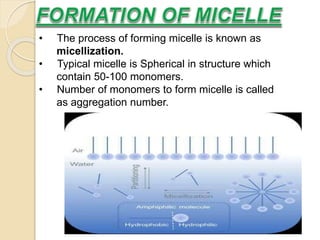
• The process of forming micelle is known as
micellization.
• Typical micelle is Spherical in structure which
contain 50-100 monomers.
• Number of monomers to form micelle is called
as aggregation number.
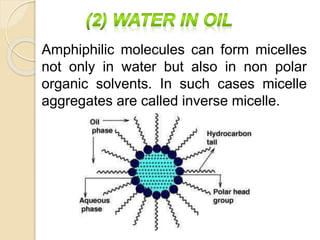
Amphiphilic molecules can form micelles
not only in water but also in non polar
organic solvents. In such cases micelle
aggregates are called inverse micelle.
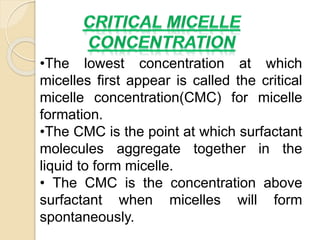
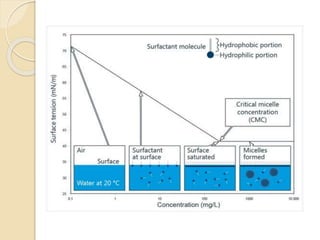
•The lowest concentration at which
micelles first appear is called the critical
micelle concentration(CMC) for micelle
formation.
•The CMC is the point at which surfactant
molecules aggregate together in the
liquid to form micelle.
• The CMC is the concentration above
surfactant when micelles will form
spontaneously.
 INTERNET WEB ADDRESS-
1) https://www.kruss-scientific.com/services/education-
theory/glossary/critical-micelle-concentration-cmc-and-
surfactant-concentration/
 BOOK REFERRED-
ADVANCED PHYSICAL CHEMISTRY
BY DR. J.N. GURTU & DR. A. GURTU,
TWELFTH EDITION 2010.
micelle and surfactant

micelle and surfactant

  • 1.
  • 2.
     INTRODUCTION  SURFACTANT CLASSIFICATION OF SURFACTANT  USES OF SURFACTANT  FORMATION OF MICELLE  TYPES OF MICELLE  CRITICAL MICELLE CONCENTRATION  REFERENCES
  • 3.
    INTRODUCTION:-  Micelles arelipid molecule that arrange themselves in a spherical form in aqueous solution.  Amphiphilic molecules form micelles.  Micelles are formed when temperature of medium is ideal and a certain concentration of electrolytes (called critical micelle concentration) in the medium.  A micelle is an aggregate of surfactant molecule dispersed in liquid collide.
  • 4.
     Surfactant arecompounds that lower the surface tension (interfacial tension) between two liquids and a liquid and a solid.  Surfactants are amphiphilic compound with two opposing portions, one part is hydrophilic (head) and other is hydrophobic (tail).  A surfactant interact with both polar and non-polar molecules.  The ‘tails’ of most surfactants are fairly similar, consisting of a hydrocarbon chain, which can be branched, linear or aromatic. e.g.- fluorosurfactant have fluorocarbon chain.
  • 5.
  • 6.
     ANIONIC SURFACTANT:- •Contain anionic(negative) functional group at their head. • Based on permanent anions or pH dependent anions. • E.g.-Sulphate–alkyl sulphates, alkyl ether sulphates Sulphonates - Alkyl benzene sulphonates Phosphate – alkyl & aryl ether phosphate Carboxylates – Alkyl carboxylates,
  • 7.
     CATIONIC SURFACTANT:- •Contain cationic(positive) functional group at their head. • Based on pH dependent primary, secondary & tertiary amines. • Primary amines become positively charged at pH <10. • Secondary amine charged at pH <4. • E.g.- Cetylpyridinium chloride (CPC), Benzalkonium chloride (BAC), Benzethonium chloride (BZC).
  • 8.
     ZWITTERIONIC SURFACTANT:- •It is also known as amphoteric surfactant. • Carry a positive charge on a cationic site and negative charge on a anionic site. • E.g.- Amino acids, Imino acids, Betaines.
  • 9.
    NONIONIC SURFACTANT:- • Nocharged group in its head. • E.g.- fatty alcohol, glucosides, polyoxyethylene glycol. Fig:- surfactant classification according to the composition of their head; nonionic, cationic, anionic and zwitterionic.
  • 10.
    •Detergents •Fabric softeners •Emulsifying agentsin emulsion •Paints •Inks •Antifogs •Pipeline •Wetting agents •Dispersants
  • 11.
    • The processof forming micelle is known as micellization. • Typical micelle is Spherical in structure which contain 50-100 monomers. • Number of monomers to form micelle is called as aggregation number.
  • 13.
    Amphiphilic molecules canform micelles not only in water but also in non polar organic solvents. In such cases micelle aggregates are called inverse micelle.
  • 14.
    •The lowest concentrationat which micelles first appear is called the critical micelle concentration(CMC) for micelle formation. •The CMC is the point at which surfactant molecules aggregate together in the liquid to form micelle. • The CMC is the concentration above surfactant when micelles will form spontaneously.
  • 16.
     INTERNET WEBADDRESS- 1) https://www.kruss-scientific.com/services/education- theory/glossary/critical-micelle-concentration-cmc-and- surfactant-concentration/  BOOK REFERRED- ADVANCED PHYSICAL CHEMISTRY BY DR. J.N. GURTU & DR. A. GURTU, TWELFTH EDITION 2010.