SURFACTANTS
(Critical Micelle Concentration and
Hydrophilic Lipophilic Balance)
By - Dr. Smita D. More
Department of Pharmaceutics
PES, Modern College of Pharmacy (For Ladies), Moshi
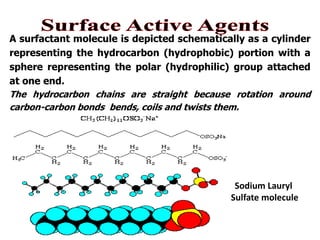
A surfactant molecule is depicted schematically as a cylinder
representing the hydrocarbon (hydrophobic) portion with a
sphere representing the polar (hydrophilic) group attached
at one end.
The hydrocarbon chains are straight because rotation around
carbon-carbon bonds bends, coils and twists them.
Sodium Lauryl
Sulfate molecule
Surface-Active Agents
• It is the amphiphilic nature of surface-active agents that causes
them to be absorbed at interfaces,
• Thus, in an aqueous dispersion of amphiphile, the polar group is
able to associate with the water molecules. The nonpolar portion is
rejected,
• As a result, the amphiphile is adsorbed at the interface.
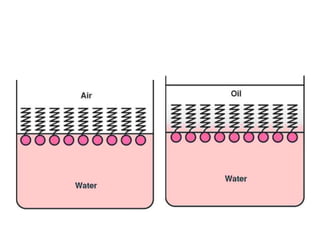
• The situation for a fatty acid at the air–water and oil–water
interface:
• At the oil–water interface, the lipophilic chains are directed upward
into the air;
• at the air–oil interface, they are associated with the oil phase.
• For the amphiphile to be concentrated at the
interface, it must be balanced with the proper
amount of water- and oil-soluble groups.
• If the molecule is too hydrophilic, it remains within
the body of the aqueous phase and exerts no effect
at the interface.
• if it is too lipophilic, it dissolves completely in the oil
phase and little appears at the interface
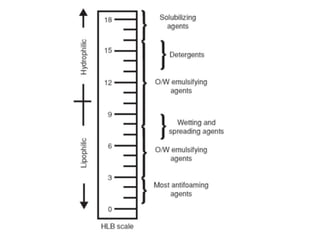
Systems of Hydrophile–Lipophile Classification
• The higher the HLB of an agent, the more hydrophilic
it is.
• The Spans, sorbitan esters , are lipophilic and have
low HLB values (1.8–8.6);
• The Tweens, polyoxyethylene derivatives of the
Spans, are hydrophilic and have high HLB values
(9.6–16.7).
Micelles and the Critical Micelle Concentration
• When present in a liquid medium at low
concentrations, the amphiphiles exist separately.
• As the concentration is increased, aggregation
occurs. These aggregates, which may contain 50 or
more monomers, are called micelles
• The concentration of monomer at which micelles
form is termed the critical micelle
concentration(CMC).
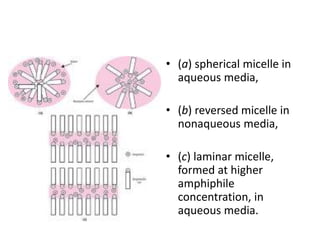
• (a) spherical micelle in
aqueous media,
• (b) reversed micelle in
nonaqueous media,
• (c) laminar micelle,
formed at higher
amphiphile
concentration, in
aqueous media.
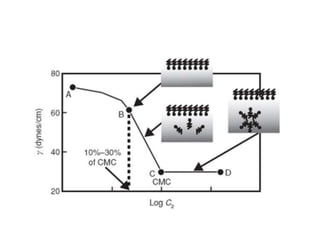
• The surface tension decreases up to the CMC .
• When the surface tension, γ, of a surfactant is
plotted against the logarithm of the surfactant
activity or concentration, log c2, the plot takes on the
shape shown in Figure.
• The initial curved segment A–B is followed by a linear
segment, B–C, along which there is a sharp decrease
in surface tension as log c2 increases.
• The point C corresponds to the critical micelle
concentration (CMC), the concentration at which
micelles form in the solution.
• Beyond the CMC, the line becomes horizontal
because further additions of surfactant are no longer
being accompanied by a decrease in surface tension.
• is the ability of the micelles to increase the solubility
of materials that are normally insoluble, or only
slightly soluble, in the dispersion medium used.
• This phenomenon, known as solubilization,
Adsorption at Solid Interfaces
SOLID–GAS ADSORPTION:
• the removal of objectionable odors from rooms and
food,
• the operation of gas masks,
• the measurement of the dimensions of particles in a
powder.
SOLID–LIQUID ADSORPTION:
• decolorizing solutions,
• adsorption chromatography,
• detergency, wetting.
• THANKYOU

Surfactants

  • 1.
    SURFACTANTS (Critical Micelle Concentrationand Hydrophilic Lipophilic Balance) By - Dr. Smita D. More Department of Pharmaceutics PES, Modern College of Pharmacy (For Ladies), Moshi
  • 2.
    A surfactant moleculeis depicted schematically as a cylinder representing the hydrocarbon (hydrophobic) portion with a sphere representing the polar (hydrophilic) group attached at one end. The hydrocarbon chains are straight because rotation around carbon-carbon bonds bends, coils and twists them. Sodium Lauryl Sulfate molecule
  • 3.
    Surface-Active Agents • Itis the amphiphilic nature of surface-active agents that causes them to be absorbed at interfaces, • Thus, in an aqueous dispersion of amphiphile, the polar group is able to associate with the water molecules. The nonpolar portion is rejected, • As a result, the amphiphile is adsorbed at the interface. • The situation for a fatty acid at the air–water and oil–water interface: • At the oil–water interface, the lipophilic chains are directed upward into the air; • at the air–oil interface, they are associated with the oil phase.
  • 5.
    • For theamphiphile to be concentrated at the interface, it must be balanced with the proper amount of water- and oil-soluble groups. • If the molecule is too hydrophilic, it remains within the body of the aqueous phase and exerts no effect at the interface. • if it is too lipophilic, it dissolves completely in the oil phase and little appears at the interface
  • 6.
    Systems of Hydrophile–LipophileClassification • The higher the HLB of an agent, the more hydrophilic it is. • The Spans, sorbitan esters , are lipophilic and have low HLB values (1.8–8.6); • The Tweens, polyoxyethylene derivatives of the Spans, are hydrophilic and have high HLB values (9.6–16.7).
  • 8.
    Micelles and theCritical Micelle Concentration • When present in a liquid medium at low concentrations, the amphiphiles exist separately. • As the concentration is increased, aggregation occurs. These aggregates, which may contain 50 or more monomers, are called micelles • The concentration of monomer at which micelles form is termed the critical micelle concentration(CMC).
  • 9.
    • (a) sphericalmicelle in aqueous media, • (b) reversed micelle in nonaqueous media, • (c) laminar micelle, formed at higher amphiphile concentration, in aqueous media.
  • 10.
    • The surfacetension decreases up to the CMC . • When the surface tension, γ, of a surfactant is plotted against the logarithm of the surfactant activity or concentration, log c2, the plot takes on the shape shown in Figure. • The initial curved segment A–B is followed by a linear segment, B–C, along which there is a sharp decrease in surface tension as log c2 increases.
  • 11.
    • The pointC corresponds to the critical micelle concentration (CMC), the concentration at which micelles form in the solution. • Beyond the CMC, the line becomes horizontal because further additions of surfactant are no longer being accompanied by a decrease in surface tension.
  • 13.
    • is theability of the micelles to increase the solubility of materials that are normally insoluble, or only slightly soluble, in the dispersion medium used. • This phenomenon, known as solubilization,
  • 14.
    Adsorption at SolidInterfaces SOLID–GAS ADSORPTION: • the removal of objectionable odors from rooms and food, • the operation of gas masks, • the measurement of the dimensions of particles in a powder. SOLID–LIQUID ADSORPTION: • decolorizing solutions, • adsorption chromatography, • detergency, wetting.
  • 15.