MISCELLES
Sreeraj M Ajay
Government Engineering College Kozhikode
Credit Website: DrWorkout.fitness
MISCELLES
• The hydroxy ethelene chain, which is quite long and slightly
hydrophilic is coiled in a solution and binds water due to the
entropy effect.
• At a given temperature and concentration, the miscelles of a
surfactant are mono disperse.
• When the surfactant molecules in the water-air interface become
so packed in the monolayer that no more molecules can be
accommodated with ease, they agglometrate in the bulk of the
solution leading to the formation of aggregates , are known as
Miscelles.
• The Miscelle concentration increases with the total surfactant
concentration.
In Polar Medium
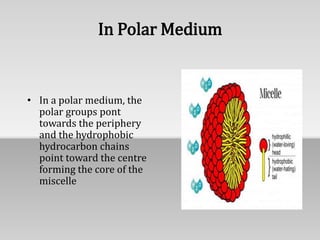
• In a polar medium, the
polar groups pont
towards the periphery
and the hydrophobic
hydrocarbon chains
point toward the centre
forming the core of the
miscelle
In Non-Polar Medum
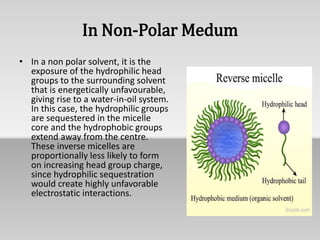
• In a non polar solvent, it is the
exposure of the hydrophilic head
groups to the surrounding solvent
that is energetically unfavourable,
giving rise to a water-in-oil system.
In this case, the hydrophilic groups
are sequestered in the micelle
core and the hydrophobic groups
extend away from the centre.
These inverse micelles are
proportionally less likely to form
on increasing head group charge,
since hydrophilic sequestration
would create highly unfavorable
electrostatic interactions.
Formation:
Micelles form only when the concentration of surfactant is greater than the critical
micelle concentration (CMC), and the temperature of the system is greater than
the critical micelle temperature, or Krafft temperature. The formation of micelles
can be understood using thermodynamics: Micelles can form spontaneously
because of a balance between entropy and enthalpy. In water, the hydrophobic
effect is the driving force for micelle formation, despite the fact that assembling
surfactant molecules is unfavorable in terms of both enthalpy and entropy of the
system. At very low concentrations of the surfactant, only monomers are present
in solution. As the concentration of the surfactant is increased, a point is reached
at which the unfavorable entropy contribution, from clustering the hydrophobic
tails of the molecules, is overcome by a gain in entropy due to release of the
solvation shells around the surfactant tails. At this point, the lipid tails of a part of
the surfactants must be segregated from the water. Hence, they start to form
micelles.
In broad terms, above the CMC, the loss of entropy due to assembly of the
surfactant molecules is less than the gain in entropy by setting free the water
molecules that were "trapped" in the solvation shells of the surfactant monomers.
Also important are enthalpic considerations, such as the electrostatic interactions
that occur between the charged parts of surfactants
Uses
• When surfactants are present above the Critcal Miscelle
Concentration (CMC), they can act as emulsifiers that will allow a
compound that is normally insoluble (in the solvent being used) to
dissolve. This occurs because the insoluble species can be incorporated
into the micelle core, which is itself solubilized in the bulk solvent by
virtue of the head groups' favorable interactions with solvent species. The
most common example of this phenomenon is detergents, which clean
poorly soluble lipophilic material (such as oils and waxes) that cannot be
removed by water alone. Detergents clean also by lowering the surface
tension of water, making it easier to remove material from a surface. The
emulsifying property of surfactants is also the basis foremulsion
polymerization.
• Micelle formation is essential for the absorption of fat-soluble vitamins
and complicated lipids within the human body. Bile salts formed in the
liver and secreted by the gall bladder allow micelles of fatty acids to form.
This allows the absorption of complicated lipids (e.g., lecithin) and lipid-
soluble vitamins (A, D, E, and K) within the micelle by the small intestine.
• Micelles can also be used for targeted drug delivery as gold nano particles.
Credit: DrWorkout.fitness

Miscelles

  • 1.
    MISCELLES Sreeraj M Ajay GovernmentEngineering College Kozhikode Credit Website: DrWorkout.fitness
  • 2.
    MISCELLES • The hydroxyethelene chain, which is quite long and slightly hydrophilic is coiled in a solution and binds water due to the entropy effect. • At a given temperature and concentration, the miscelles of a surfactant are mono disperse. • When the surfactant molecules in the water-air interface become so packed in the monolayer that no more molecules can be accommodated with ease, they agglometrate in the bulk of the solution leading to the formation of aggregates , are known as Miscelles. • The Miscelle concentration increases with the total surfactant concentration.
  • 3.
    In Polar Medium •In a polar medium, the polar groups pont towards the periphery and the hydrophobic hydrocarbon chains point toward the centre forming the core of the miscelle
  • 4.
    In Non-Polar Medum •In a non polar solvent, it is the exposure of the hydrophilic head groups to the surrounding solvent that is energetically unfavourable, giving rise to a water-in-oil system. In this case, the hydrophilic groups are sequestered in the micelle core and the hydrophobic groups extend away from the centre. These inverse micelles are proportionally less likely to form on increasing head group charge, since hydrophilic sequestration would create highly unfavorable electrostatic interactions.
  • 5.
    Formation: Micelles form onlywhen the concentration of surfactant is greater than the critical micelle concentration (CMC), and the temperature of the system is greater than the critical micelle temperature, or Krafft temperature. The formation of micelles can be understood using thermodynamics: Micelles can form spontaneously because of a balance between entropy and enthalpy. In water, the hydrophobic effect is the driving force for micelle formation, despite the fact that assembling surfactant molecules is unfavorable in terms of both enthalpy and entropy of the system. At very low concentrations of the surfactant, only monomers are present in solution. As the concentration of the surfactant is increased, a point is reached at which the unfavorable entropy contribution, from clustering the hydrophobic tails of the molecules, is overcome by a gain in entropy due to release of the solvation shells around the surfactant tails. At this point, the lipid tails of a part of the surfactants must be segregated from the water. Hence, they start to form micelles. In broad terms, above the CMC, the loss of entropy due to assembly of the surfactant molecules is less than the gain in entropy by setting free the water molecules that were "trapped" in the solvation shells of the surfactant monomers. Also important are enthalpic considerations, such as the electrostatic interactions that occur between the charged parts of surfactants
  • 6.
    Uses • When surfactantsare present above the Critcal Miscelle Concentration (CMC), they can act as emulsifiers that will allow a compound that is normally insoluble (in the solvent being used) to dissolve. This occurs because the insoluble species can be incorporated into the micelle core, which is itself solubilized in the bulk solvent by virtue of the head groups' favorable interactions with solvent species. The most common example of this phenomenon is detergents, which clean poorly soluble lipophilic material (such as oils and waxes) that cannot be removed by water alone. Detergents clean also by lowering the surface tension of water, making it easier to remove material from a surface. The emulsifying property of surfactants is also the basis foremulsion polymerization. • Micelle formation is essential for the absorption of fat-soluble vitamins and complicated lipids within the human body. Bile salts formed in the liver and secreted by the gall bladder allow micelles of fatty acids to form. This allows the absorption of complicated lipids (e.g., lecithin) and lipid- soluble vitamins (A, D, E, and K) within the micelle by the small intestine. • Micelles can also be used for targeted drug delivery as gold nano particles.
  • 7.

Editor's Notes

  • #4 Wouldn’t it be cool to walk around a level of your favorite video game and battle life-size game characters? Freeing gamers from their living rooms is just one application of the burgeoning technology called augmented reality (AR). Augmented Reality is a growing area in virtual reality . An Augmented Reality system generates a composite view for the user. It’s a combination of the real scene viewed by the user and a virtual scene generated by the computer It augments the scene generated by the computer and includes additional information. Using AR, it is possible to achieve a level of immersion that is beyond what most people associate with video games.
  • #5 A revolution in computer interface design is changing the way we think about computers. Rather than immersing people in an artificially created virtual world, the goal is to augment objects in the physical world by enhancing them with a wealth of digital information and communication capabilities