ADSORPTION AT LIQUID
SURFACE/INTERFACE
Venkidesh Rajagpal
Adsorption is the adhesion of atom , ions or molecules from a gas, liquid, a dissolved solid to a
surface.
Certain solute molecules and ions when added to a liquid are partitioned in favour of surface or
the interface
This is termed as POSITIVE ADSORPTION
Some other solute molecules or ions are partitioned in favour of bulk of the liquid
This is termed as NEGATIVE ADSORPTION
NEGATIVE ADSORPTION POSITIVE ADSORPTION
Molecules partitioned in favour
of bulk
Molecules partitioned in favour
of surface/interface
Increase in the surface tension Decrease in the surface tension
Eg: Glucose, Sodium Chloride Eg: Tweens, Spans
Solute molecules or ions that are adsorbed at surface/interface and reduce the
surface/interfacial tension are termed as SURFACTANTS (SURFACE ACTIVE
AGENTS)
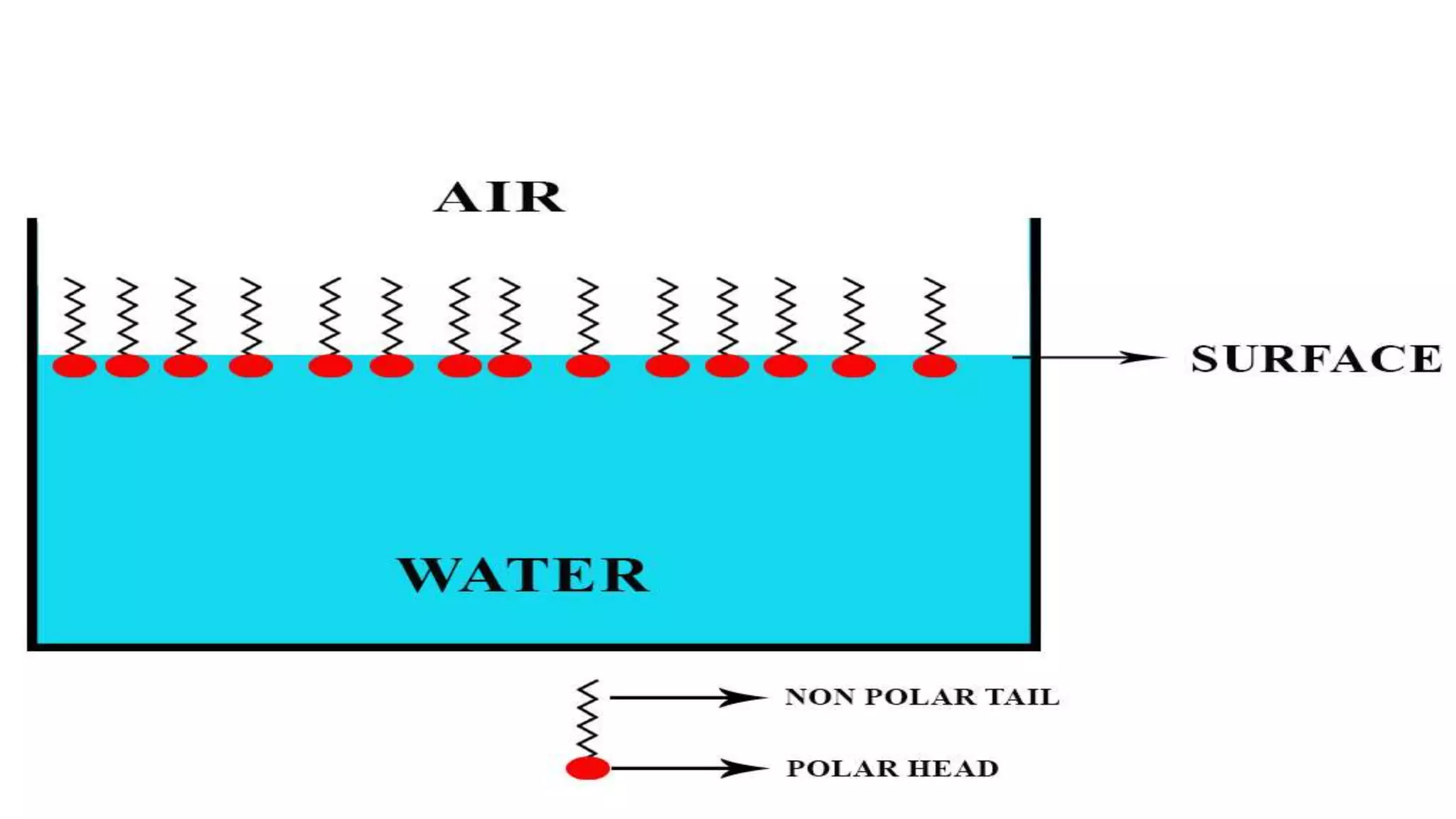
Surfactant molecules are amphiphiles
They contain a POLAR HEAD and a NON POLAR TAIL
When a surfactant is added to water
 Hydrophilic head will be oriented towards water
 Lipophilic end will be oriented away from water
Surfactant may be Hydrophilic if it is predominantly polar in nature and
Lipophilic if it is predominantly non polar
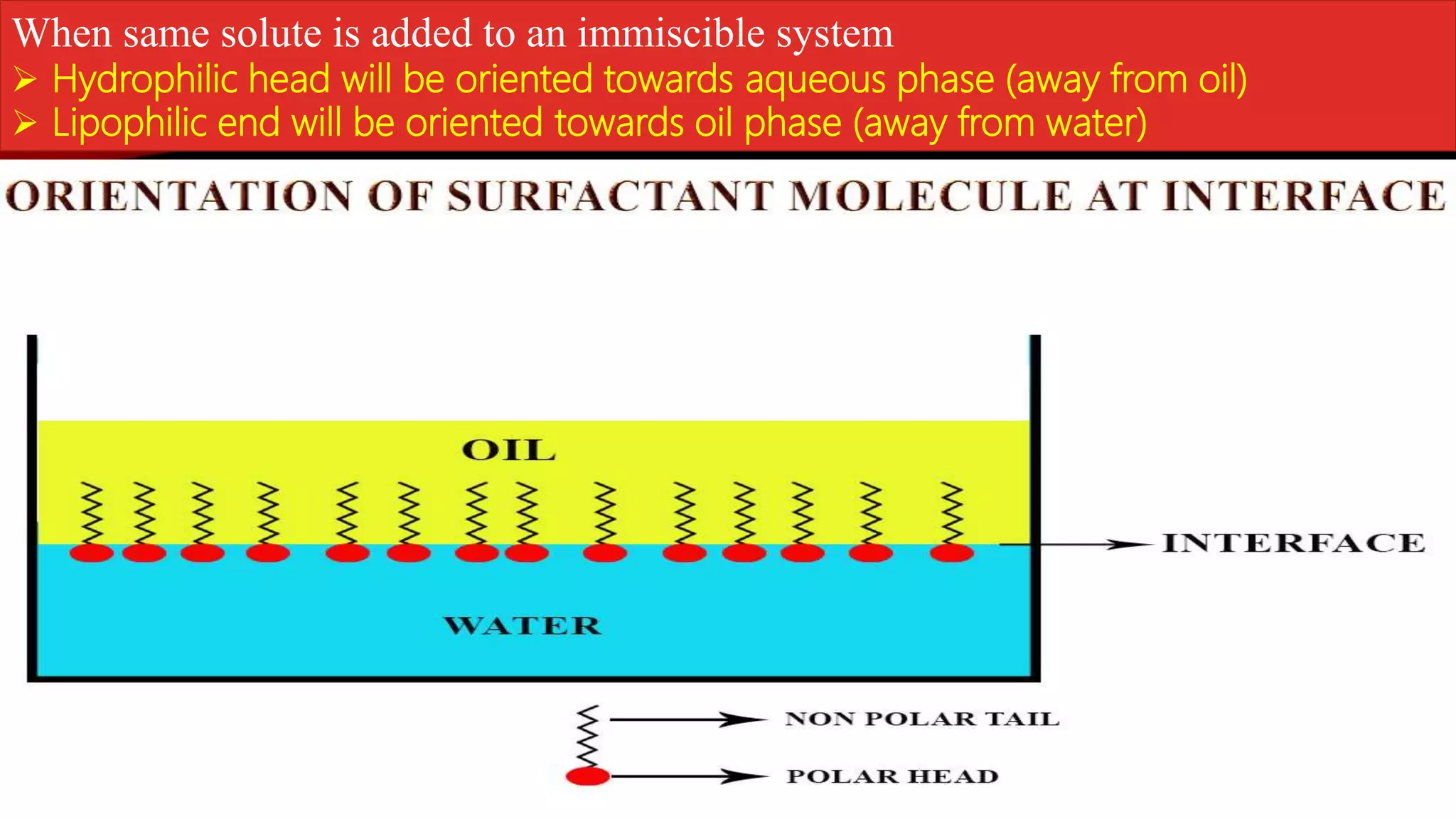
When same solute is added to an immiscible system
 Hydrophilic head will be oriented towards aqueous phase (away from oil)
 Lipophilic end will be oriented towards oil phase (away from water)
At lower concentration surfactant molecules will be distributed at
the surface and the surface will not be completely filled
As concentration increases the surface is filled up progressively
and finally the surface will be saturated with surfactant with a
marked decrease in the surface tension
After the saturation of the surface of the liquid the molecules will
move into the bulk of the liquid and associated into small
aggregates called MICELLES
Micelles formed are of spherical shape in colloidal dimension
(0.001 - 0.5µm)
Each micelle contains around 50 – 100 surfactant molecules
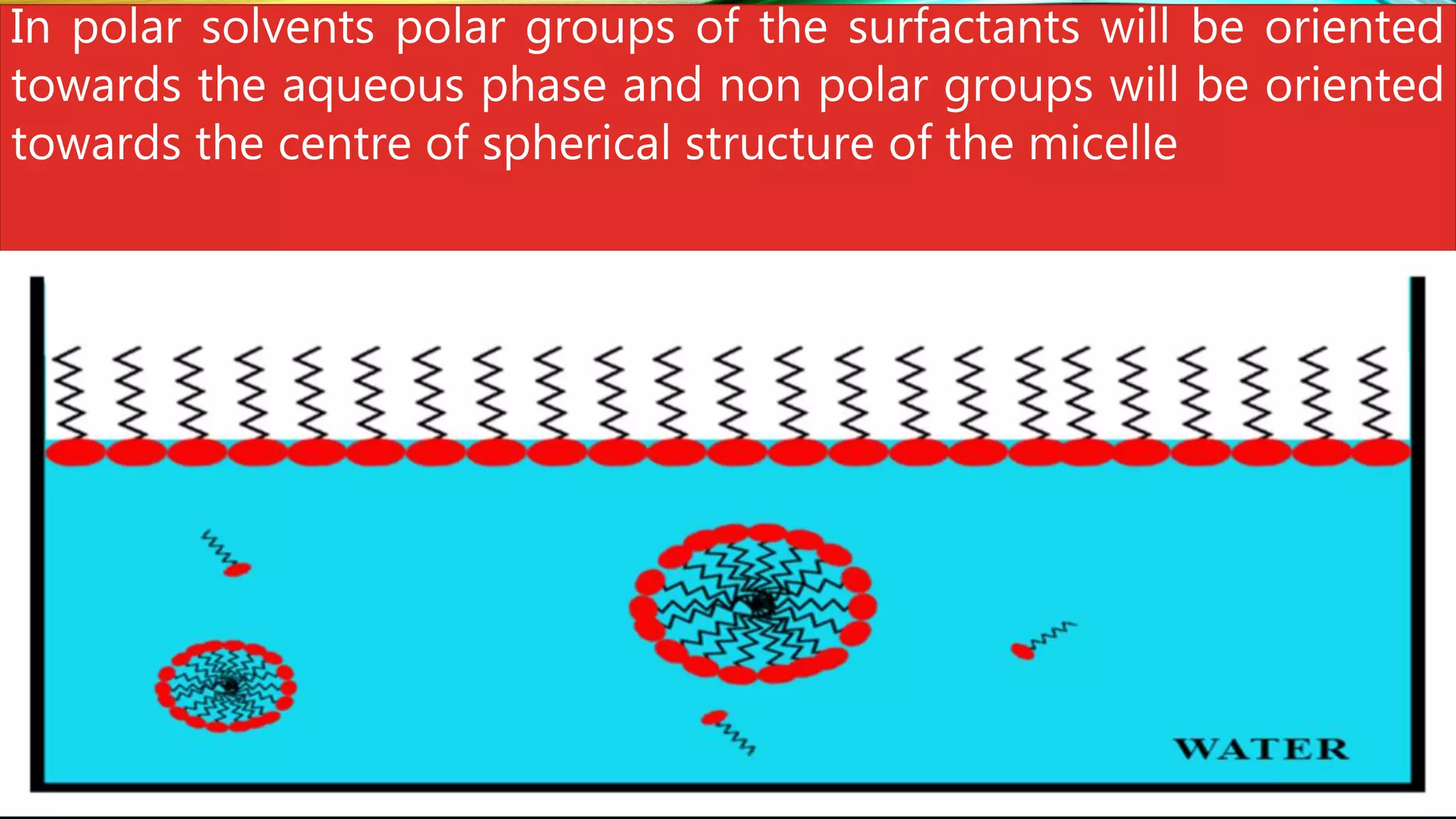
Micelle
In polar solvents polar groups of the surfactants will be oriented
towards the aqueous phase and non polar groups will be oriented
towards the centre of spherical structure of the micelle
In non-polar solvents non polar groups of the surfactants will be
oriented towards the non aqueous phase (oil) and non groups will
be oriented towards the centre of spherical structure of the micelle
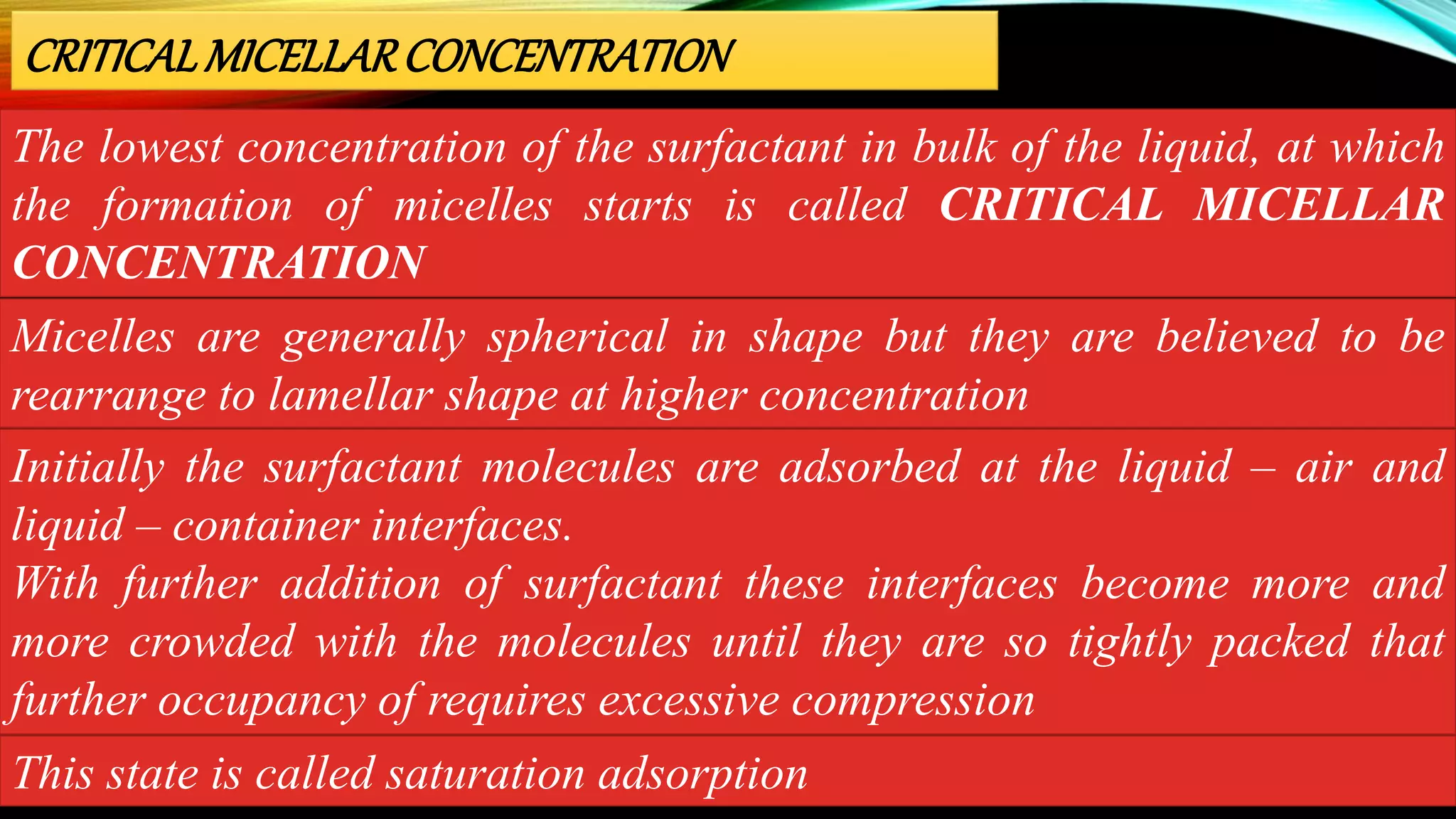
The lowest concentration of the surfactant in bulk of the liquid, at which
the formation of micelles starts is called CRITICAL MICELLAR
CONCENTRATION
CRITICALMICELLARCONCENTRATION
Micelles are generally spherical in shape but they are believed to be
rearrange to lamellar shape at higher concentration
Initially the surfactant molecules are adsorbed at the liquid – air and
liquid – container interfaces.
With further addition of surfactant these interfaces become more and
more crowded with the molecules until they are so tightly packed that
further occupancy of requires excessive compression
This state is called saturation adsorption
Further addition of surfactants from this state the increase in
concentration at the interface/surface will be very low but concentration
will increase in the bulk of the liquid.
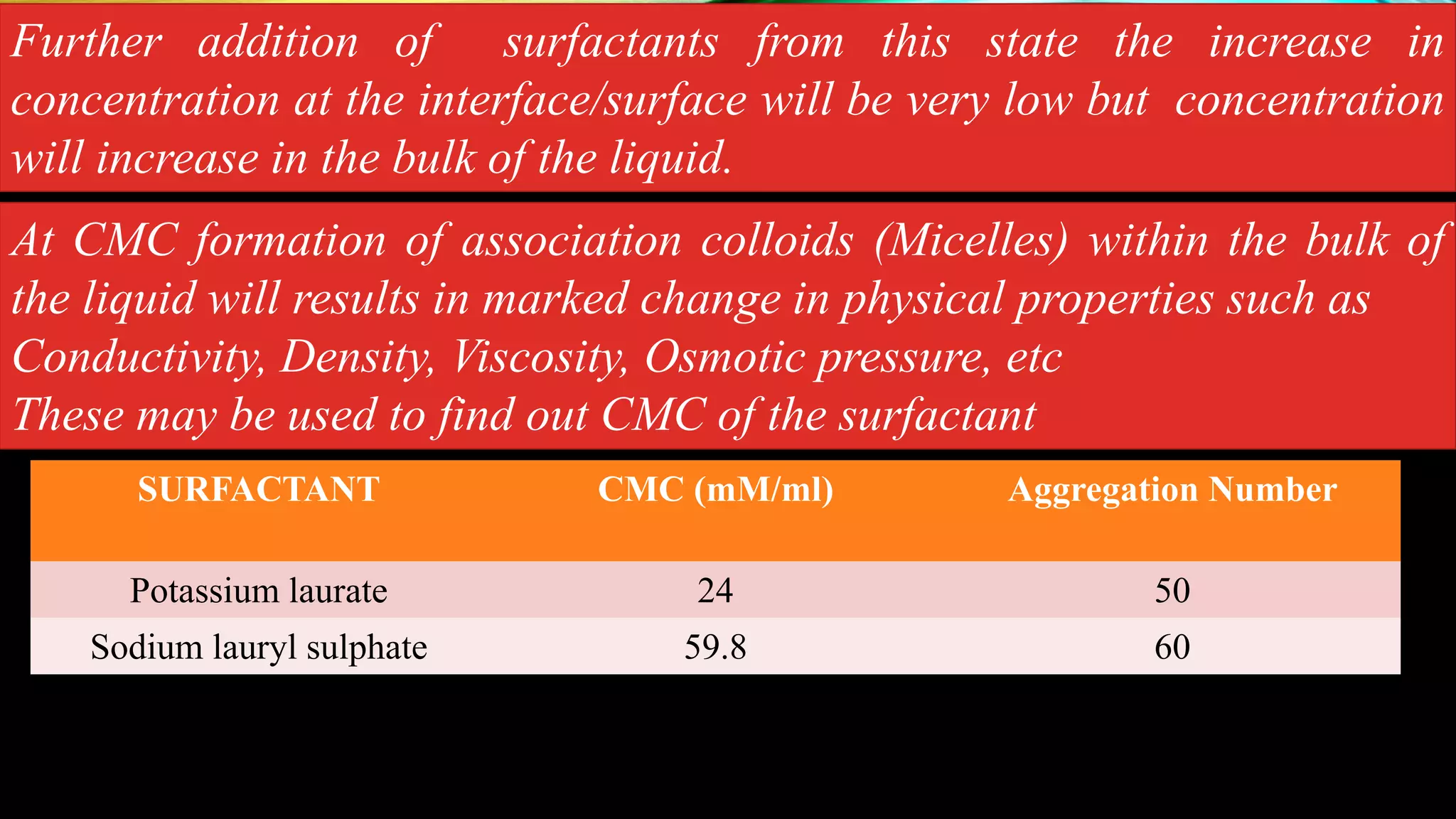
At CMC formation of association colloids (Micelles) within the bulk of
the liquid will results in marked change in physical properties such as
Conductivity, Density, Viscosity, Osmotic pressure, etc
These may be used to find out CMC of the surfactant
SURFACTANT CMC (mM/ml) Aggregation Number
Potassium laurate 24 50
Sodium lauryl sulphate 59.8 60
It ionises in aqueous solutions to yield a large anion and a
small cation
This anions are responsible for its action
Potassium stearate soap
 di(2-ethyl hexyl) sodium sulpho succinate
Sodium cetyl succinate
Sodium lauryl sulphate
They are mostly carboxylates
It ionises in aqueous solutions to yield a large cation and a
small anion
This cations are responsible for its action
Cetrimide (Cetyl trimethyl ammonium bromide)
They are Amines and Quaternary Ammonium salts
Mainly used as anti microbial agents and preservatives
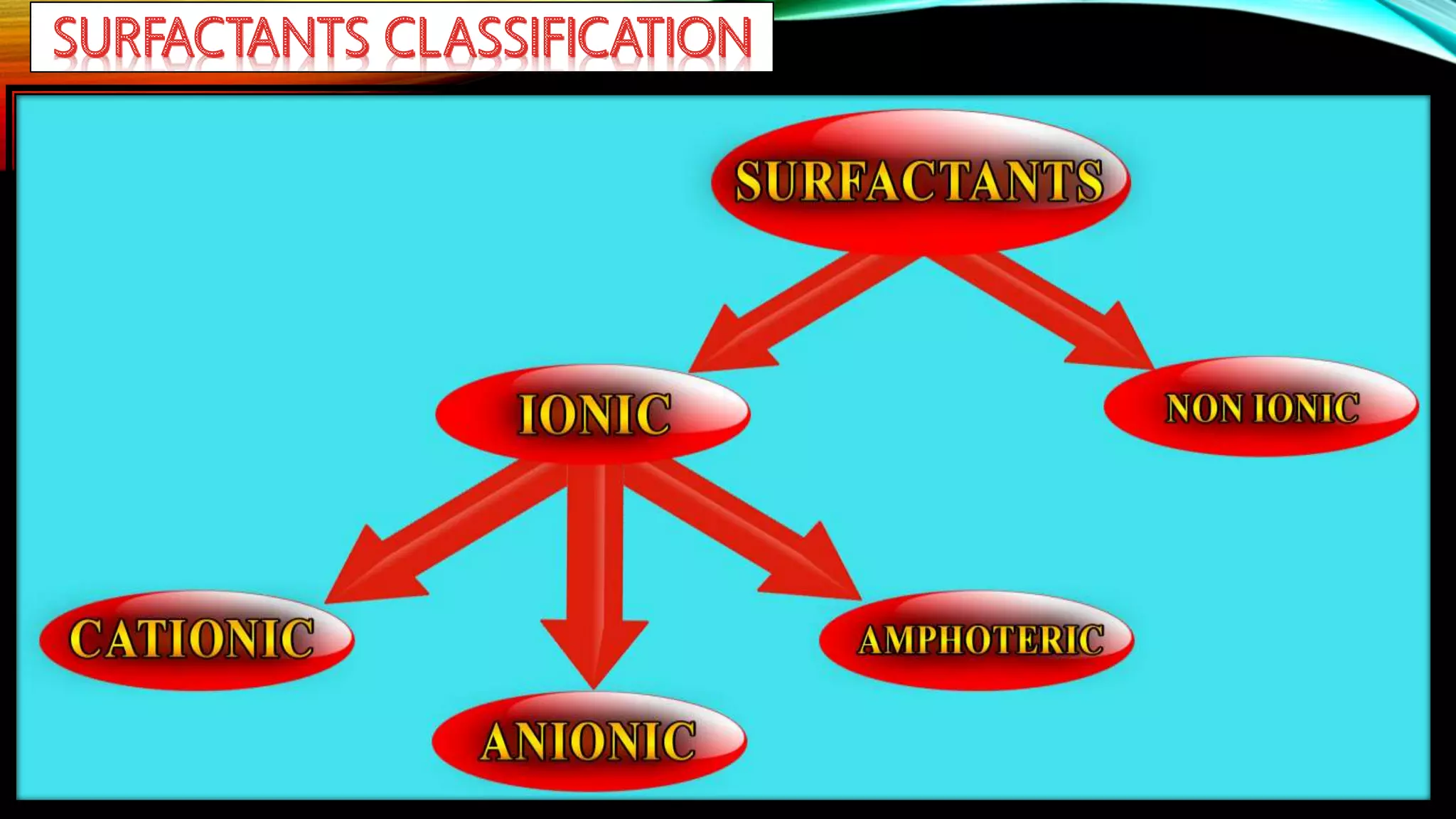
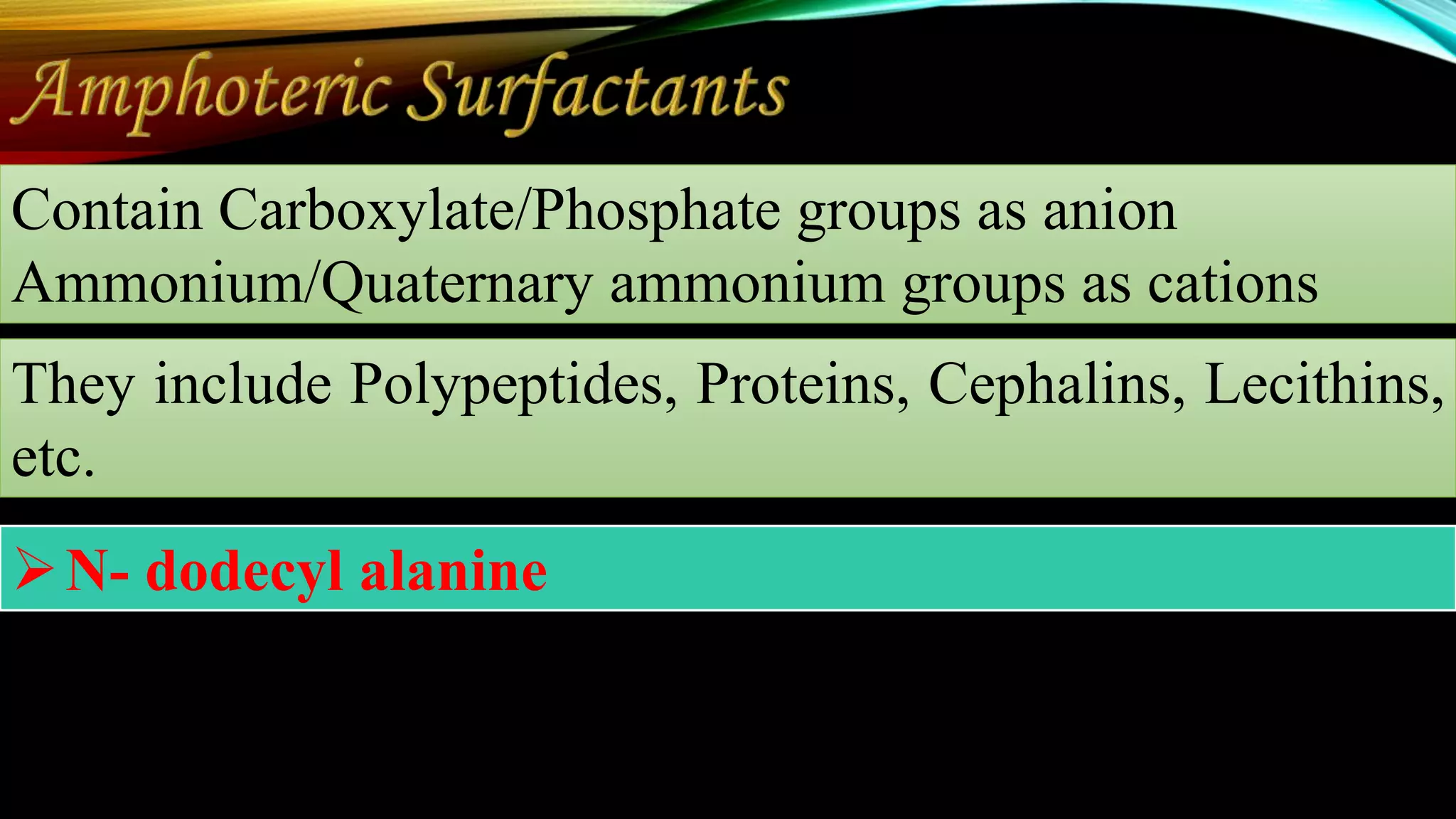
Contain Carboxylate/Phosphate groups as anion
Ammonium/Quaternary ammonium groups as cations
They include Polypeptides, Proteins, Cephalins, Lecithins,
etc.
N- dodecyl alanine
Widely used in pharmaceutical industries
Do not ionises in aqueous solutions
Polyoxy-ethylene sorbitan fatty acid esters
Tweens, Spans,etc
Hydrophilic Lipophilic Balance
Surfactants are amphiphiles which containing both Polar and Non polar groups
within a single molecule
The characteristics and applications of surfactants are based on the fraction of
polar or non polar groups present in the molecule
Balance between hydrophilic and lipophilic character is expressed in terms of
HLB values
HLB (Hydrophilic Lipophilic Balance) scale is an arbitrary scale (number
system)which indicates the extend of polar and non polar nature of a surfactant
HLB scale is described by Griffin in 1949
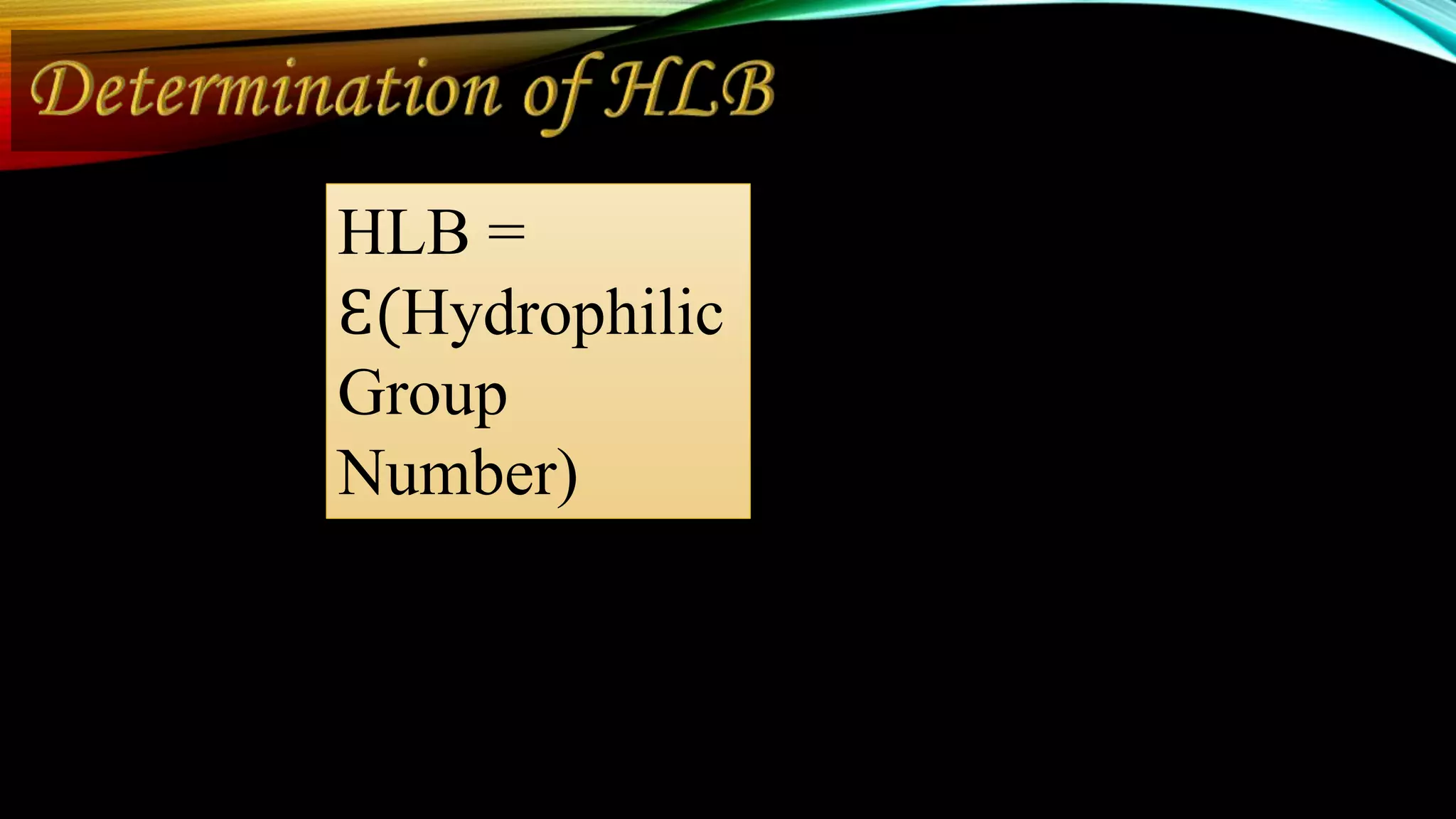
HLB =
Ԑ(Hydrophilic
Group
Number)
HLB = 𝐸+𝑃
5

SUFACTANTS : ADSORPTION AT LIQUID SURFACE/INTERFACE

  • 1.
  • 2.
    Adsorption is theadhesion of atom , ions or molecules from a gas, liquid, a dissolved solid to a surface. Certain solute molecules and ions when added to a liquid are partitioned in favour of surface or the interface This is termed as POSITIVE ADSORPTION Some other solute molecules or ions are partitioned in favour of bulk of the liquid This is termed as NEGATIVE ADSORPTION
  • 3.
    NEGATIVE ADSORPTION POSITIVEADSORPTION Molecules partitioned in favour of bulk Molecules partitioned in favour of surface/interface Increase in the surface tension Decrease in the surface tension Eg: Glucose, Sodium Chloride Eg: Tweens, Spans
  • 4.
    Solute molecules orions that are adsorbed at surface/interface and reduce the surface/interfacial tension are termed as SURFACTANTS (SURFACE ACTIVE AGENTS) Surfactant molecules are amphiphiles They contain a POLAR HEAD and a NON POLAR TAIL When a surfactant is added to water  Hydrophilic head will be oriented towards water  Lipophilic end will be oriented away from water Surfactant may be Hydrophilic if it is predominantly polar in nature and Lipophilic if it is predominantly non polar
  • 6.
    When same soluteis added to an immiscible system  Hydrophilic head will be oriented towards aqueous phase (away from oil)  Lipophilic end will be oriented towards oil phase (away from water)
  • 7.
    At lower concentrationsurfactant molecules will be distributed at the surface and the surface will not be completely filled As concentration increases the surface is filled up progressively and finally the surface will be saturated with surfactant with a marked decrease in the surface tension
  • 9.
    After the saturationof the surface of the liquid the molecules will move into the bulk of the liquid and associated into small aggregates called MICELLES Micelles formed are of spherical shape in colloidal dimension (0.001 - 0.5µm) Each micelle contains around 50 – 100 surfactant molecules
  • 10.
  • 11.
    In polar solventspolar groups of the surfactants will be oriented towards the aqueous phase and non polar groups will be oriented towards the centre of spherical structure of the micelle
  • 12.
    In non-polar solventsnon polar groups of the surfactants will be oriented towards the non aqueous phase (oil) and non groups will be oriented towards the centre of spherical structure of the micelle
  • 13.
    The lowest concentrationof the surfactant in bulk of the liquid, at which the formation of micelles starts is called CRITICAL MICELLAR CONCENTRATION CRITICALMICELLARCONCENTRATION Micelles are generally spherical in shape but they are believed to be rearrange to lamellar shape at higher concentration Initially the surfactant molecules are adsorbed at the liquid – air and liquid – container interfaces. With further addition of surfactant these interfaces become more and more crowded with the molecules until they are so tightly packed that further occupancy of requires excessive compression This state is called saturation adsorption
  • 14.
    Further addition ofsurfactants from this state the increase in concentration at the interface/surface will be very low but concentration will increase in the bulk of the liquid. At CMC formation of association colloids (Micelles) within the bulk of the liquid will results in marked change in physical properties such as Conductivity, Density, Viscosity, Osmotic pressure, etc These may be used to find out CMC of the surfactant SURFACTANT CMC (mM/ml) Aggregation Number Potassium laurate 24 50 Sodium lauryl sulphate 59.8 60
  • 16.
    It ionises inaqueous solutions to yield a large anion and a small cation This anions are responsible for its action Potassium stearate soap  di(2-ethyl hexyl) sodium sulpho succinate Sodium cetyl succinate Sodium lauryl sulphate They are mostly carboxylates
  • 17.
    It ionises inaqueous solutions to yield a large cation and a small anion This cations are responsible for its action Cetrimide (Cetyl trimethyl ammonium bromide) They are Amines and Quaternary Ammonium salts Mainly used as anti microbial agents and preservatives
  • 18.
    Contain Carboxylate/Phosphate groupsas anion Ammonium/Quaternary ammonium groups as cations They include Polypeptides, Proteins, Cephalins, Lecithins, etc. N- dodecyl alanine
  • 19.
    Widely used inpharmaceutical industries Do not ionises in aqueous solutions Polyoxy-ethylene sorbitan fatty acid esters Tweens, Spans,etc
  • 20.
  • 21.
    Surfactants are amphiphileswhich containing both Polar and Non polar groups within a single molecule The characteristics and applications of surfactants are based on the fraction of polar or non polar groups present in the molecule Balance between hydrophilic and lipophilic character is expressed in terms of HLB values HLB (Hydrophilic Lipophilic Balance) scale is an arbitrary scale (number system)which indicates the extend of polar and non polar nature of a surfactant HLB scale is described by Griffin in 1949
  • 22.
  • 23.