BIOLOGY FORM 5 5.1 : MENDEL’S EXPERIMENT PREPARED BY : NORSHAFIKA BINTI DAOD CLASS : 5 UTM
There are  similarities   and  differences  between parents and offspring Some characteristics are passed on from parents to offspring while others appear to be lost. Meaning : Inheritance :  transmission of traits from one   generation to to another generation by means of genetic codes Character/characteristic : a   distinctive   structural or functional feature determined by a gene or group of genes. Trait : specific characteristic that varies from one individual to another
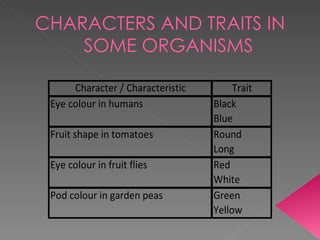
CHARACTERS AND TRAITS IN SOME ORGANISMS
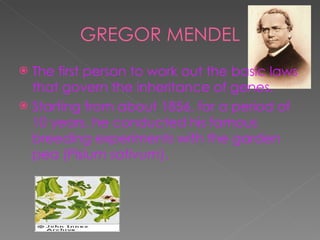
The first person to work out the basic laws that govern the inheritance of genes. Starting from about 1856, for a period of 10 years, he conducted his famous breeding experiments with the garden pea ( Pisium sativum ). GREGOR MENDEL
MENDEL’S   EXPERIMENT
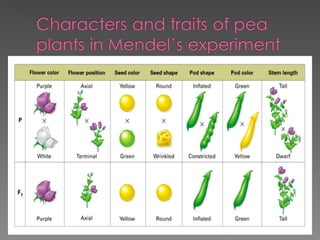
Mendel worked with the peas,  Pisum sativum  because: The pea flowers have both female & male parts : stamens & carpels. Many varieties of the pea plants which carry out self-pollination. Can be easily grown Have short cycle Pollination can easily controlled
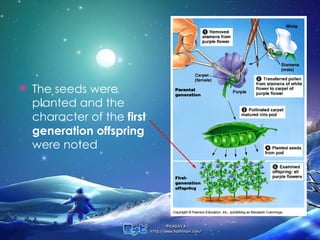
The seeds were planted and the character of the  first generation offspring  were noted
Mendel choose  pure-breeding pea plant  to study inheritance because: Plant that self fertilises All its offspring resemble the parent plant (has the same characters as the parents plant) Show the same traits as their parents Obtained after many generations of self-pollination
 
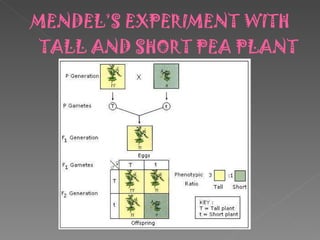
MENDEL’S EXPERIMENT WITH TALL AND SHORT PEA PLANT
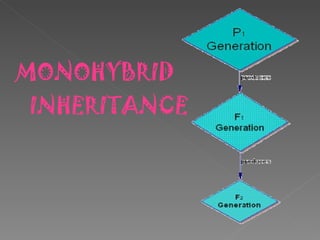
MONOHYBRID INHERITANCE
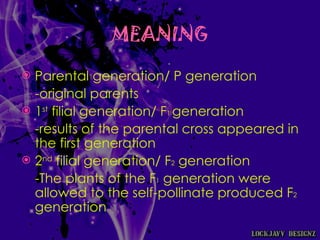
MEANING Parental generation/ P generation -original parents 1 st  filial generation/ F 1  generation -results of the parental cross appeared in the first generation 2 nd  filial generation/ F 2  generation -The plants of the F 1  generation were allowed to the self-pollinate produced F 2  generation
GENES AND ALLELES Hereditary factors described by Mendel are known as genes Genes: basic units of inheritance which occupy specific positions of chromosomes. Position of gene is called its locus Alleles: different forms of the same gene for a trait and occupy the same relative position on a pair of homologous chromosomes.
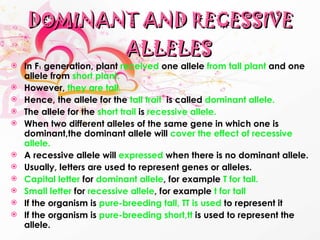
DOMINANT AND RECESSIVE ALLELES In F 1  generation, plant   received   one allele   from tall plant   and one allele from   short plant. However,   they are tall. Hence, the allele for the   tall trait   is called   dominant allele. The allele for the   short trail   is   recessive allele. When two different alleles of the same gene in which one is dominant,the dominant allele will   cover the effect of recessive allele. A recessive allele will   expressed   when there is no dominant allele. Usually, letters are used to represent genes or alleles. Capital letter  for  dominant allele , for example  T for tall. Small letter  for  recessive allele , for example  t for tall If the organism is  pure-breeding tall, TT is used  to represent it If the organism is  pure-breeding short,tt  is used to represent the allele.
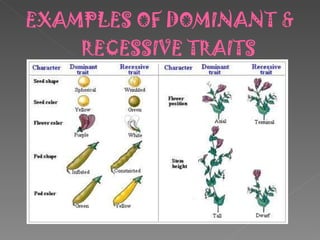
EXAMPLES OF DOMINANT & RECESSIVE TRAITS
PHENOTYPE AND GENOTYPE Phenotype : observable characteristic of the some organism like colour, size, form and structure Eg: tall, short Genotype : genetic composition of an organism and cannot be seen Eg: TT, tt, Tt
MONOZYGOTE AND HETEROZYGOTE In Mendel’s experiments,both pea plant in parental generation were pure-breeding. Therefore, the tall plant had two alleles for tallness(TT) The short plant had two alleles for shortness(tt) This called homozygote. The tall plant produced gametes which carried the allele T and and short plant which carried the allele t will produced all tall plant. They had one allele for tallness and one allele for shortness(Tt) This called heterozygote. Three quarters of the offspring in the F 2  generation were tall and one quarter was short. Hence, the phenotypic ratio is 3:1 The genotype of tall pea plant in F2 generation is TT and Tt while short pea plant is tt. Hence, the genotypic ratio is 1 TT : 2 Tt : 1 tt
MENDEL’S 1 ST  LAW OF INHERITANCE Monohybrid Cross:  -cross carried out by Mendel involves only one character Involves only one pair of alleles Mendel formulated his 1 st  Law of inheritance This called the Law of Segregation. It states: -The members of each pair of alleles separate or segregate during the formation of gametes only one allele can be carried in a single gamate. Monohybrid inheritance: -inheritance involving a single characteristic determined by one genes Dihybrid inheritance: -a cross which involves two pairs of alleles determining two characteristics
MENDEL’S 2 ND  LAW OF INHERITANCE It is called Law of Indipendent Assortment It states: - two or more pairs of alleles segregate independently of one another during the formation of gametes.
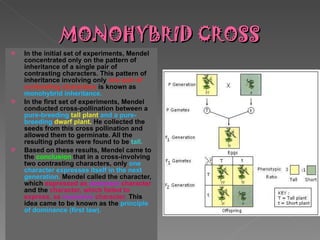
MONOHYBRID CROSS In the initial set of experiments, Mendel concentrated only on the pattern of inheritance of a single pair of contrasting characters. This pattern of inheritance involving only  one pair of contrasting characters  is known as  monohybrid inheritance. In the first set of experiments, Mendel conducted cross-pollination between a  pure-breeding  tall plant  and a pure-breeding  dwarf plant.  He collected the seeds from this cross pollination and allowed them to germinate. All the resulting plants were found to be  tall.   Based on these results, Mendel came to the  conclusion  that in a cross-involving two contrasting characters, only  one character expresses itself in the next generation.  Mendel called the character, which  expressed as  dominant  character  and the  character, which failed to express, as  recessive  character.  This idea came to be known as the  principle of dominance (first law).
DIHYBRID CROSS
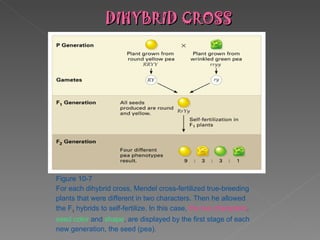
DIHYBRID CROSS Figure 10-7 For each dihybrid cross, Mendel cross-fertilized true-breeding plants that were different in two characters. Then he allowed the F 1  hybrids to self-fertilize. In this case,  the two characters ,  seed color  and  shape , are displayed by the first stage of each new generation, the seed (pea).
ANOTHER EXAMPLE
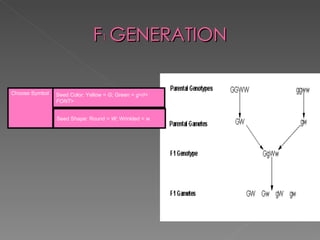
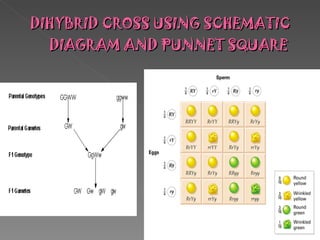
F 1  GENERATION Choose Symbol  Seed Color: Yellow =  G ; Green =  g</I< FONT>  Seed Shape: Round =  W ; Wrinkled =  w
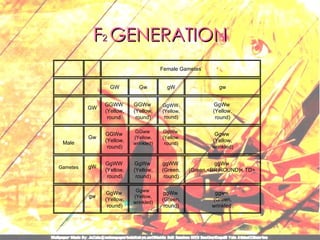
F 2  GENERATION     Female Gametes     GW Gw gW gw   GW GGWW  (Yellow, round ) GGWw  (Yellow, round) GgWW  (Yellow, round) GgWw  (Yellow, round) Male Gw GGWw  (Yellow, round) GGww  (Yellow, wrinkled) GgWw  (Yellow, round) Ggww  (Yellow, wrinkled) Gametes gW GgWW  (Yellow, round) GgWw  (Yellow, round) ggWW  (Green, round) ggWw  (Green,<BR)ROUND)< TD>    gw GgWw  (Yellow, round) Ggww  (Yellow, wrinkled) ggWw  (Green, round) ggww  (Green, wrinkled )
 
 
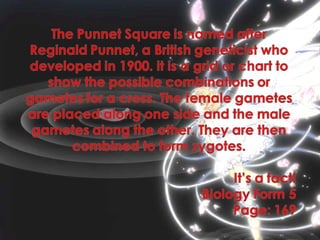
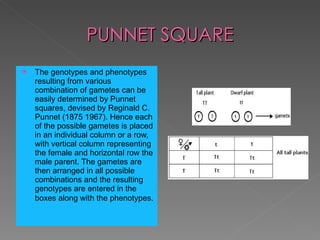
PUNNET SQUARE The genotypes and phenotypes resulting from various combination of gametes can be easily determined by Punnet squares, devised by Reginald C. Punnet (1875 1967). Hence each of the possible gametes is placed in an individual column or a row, with vertical column representing the female and horizontal row the male parent. The gametes are then arranged in all possible combinations and the resulting genotypes are entered in the boxes along with the phenotypes.
DIHYBRID CROSS USING SCHEMATIC DIAGRAM AND PUNNET SQUARE

5.1 mendel's experiments

  • 1.
    BIOLOGY FORM 55.1 : MENDEL’S EXPERIMENT PREPARED BY : NORSHAFIKA BINTI DAOD CLASS : 5 UTM
  • 2.
    There are similarities and differences between parents and offspring Some characteristics are passed on from parents to offspring while others appear to be lost. Meaning : Inheritance : transmission of traits from one generation to to another generation by means of genetic codes Character/characteristic : a distinctive structural or functional feature determined by a gene or group of genes. Trait : specific characteristic that varies from one individual to another
  • 3.
    CHARACTERS AND TRAITSIN SOME ORGANISMS
  • 4.
    The first personto work out the basic laws that govern the inheritance of genes. Starting from about 1856, for a period of 10 years, he conducted his famous breeding experiments with the garden pea ( Pisium sativum ). GREGOR MENDEL
  • 5.
    MENDEL’S EXPERIMENT
  • 6.
    Mendel worked withthe peas, Pisum sativum because: The pea flowers have both female & male parts : stamens & carpels. Many varieties of the pea plants which carry out self-pollination. Can be easily grown Have short cycle Pollination can easily controlled
  • 7.
    The seeds wereplanted and the character of the first generation offspring were noted
  • 8.
    Mendel choose pure-breeding pea plant to study inheritance because: Plant that self fertilises All its offspring resemble the parent plant (has the same characters as the parents plant) Show the same traits as their parents Obtained after many generations of self-pollination
  • 9.
  • 10.
    MENDEL’S EXPERIMENT WITHTALL AND SHORT PEA PLANT
  • 11.
  • 12.
    MEANING Parental generation/P generation -original parents 1 st filial generation/ F 1 generation -results of the parental cross appeared in the first generation 2 nd filial generation/ F 2 generation -The plants of the F 1 generation were allowed to the self-pollinate produced F 2 generation
  • 13.
    GENES AND ALLELESHereditary factors described by Mendel are known as genes Genes: basic units of inheritance which occupy specific positions of chromosomes. Position of gene is called its locus Alleles: different forms of the same gene for a trait and occupy the same relative position on a pair of homologous chromosomes.
  • 14.
    DOMINANT AND RECESSIVEALLELES In F 1 generation, plant received one allele from tall plant and one allele from short plant. However, they are tall. Hence, the allele for the tall trait is called dominant allele. The allele for the short trail is recessive allele. When two different alleles of the same gene in which one is dominant,the dominant allele will cover the effect of recessive allele. A recessive allele will expressed when there is no dominant allele. Usually, letters are used to represent genes or alleles. Capital letter for dominant allele , for example T for tall. Small letter for recessive allele , for example t for tall If the organism is pure-breeding tall, TT is used to represent it If the organism is pure-breeding short,tt is used to represent the allele.
  • 15.
    EXAMPLES OF DOMINANT& RECESSIVE TRAITS
  • 16.
    PHENOTYPE AND GENOTYPEPhenotype : observable characteristic of the some organism like colour, size, form and structure Eg: tall, short Genotype : genetic composition of an organism and cannot be seen Eg: TT, tt, Tt
  • 17.
    MONOZYGOTE AND HETEROZYGOTEIn Mendel’s experiments,both pea plant in parental generation were pure-breeding. Therefore, the tall plant had two alleles for tallness(TT) The short plant had two alleles for shortness(tt) This called homozygote. The tall plant produced gametes which carried the allele T and and short plant which carried the allele t will produced all tall plant. They had one allele for tallness and one allele for shortness(Tt) This called heterozygote. Three quarters of the offspring in the F 2 generation were tall and one quarter was short. Hence, the phenotypic ratio is 3:1 The genotype of tall pea plant in F2 generation is TT and Tt while short pea plant is tt. Hence, the genotypic ratio is 1 TT : 2 Tt : 1 tt
  • 18.
    MENDEL’S 1 ST LAW OF INHERITANCE Monohybrid Cross: -cross carried out by Mendel involves only one character Involves only one pair of alleles Mendel formulated his 1 st Law of inheritance This called the Law of Segregation. It states: -The members of each pair of alleles separate or segregate during the formation of gametes only one allele can be carried in a single gamate. Monohybrid inheritance: -inheritance involving a single characteristic determined by one genes Dihybrid inheritance: -a cross which involves two pairs of alleles determining two characteristics
  • 19.
    MENDEL’S 2 ND LAW OF INHERITANCE It is called Law of Indipendent Assortment It states: - two or more pairs of alleles segregate independently of one another during the formation of gametes.
  • 20.
    MONOHYBRID CROSS Inthe initial set of experiments, Mendel concentrated only on the pattern of inheritance of a single pair of contrasting characters. This pattern of inheritance involving only one pair of contrasting characters is known as monohybrid inheritance. In the first set of experiments, Mendel conducted cross-pollination between a pure-breeding tall plant and a pure-breeding dwarf plant. He collected the seeds from this cross pollination and allowed them to germinate. All the resulting plants were found to be tall. Based on these results, Mendel came to the conclusion that in a cross-involving two contrasting characters, only one character expresses itself in the next generation. Mendel called the character, which expressed as dominant character and the character, which failed to express, as recessive character. This idea came to be known as the principle of dominance (first law).
  • 21.
  • 22.
    DIHYBRID CROSS Figure10-7 For each dihybrid cross, Mendel cross-fertilized true-breeding plants that were different in two characters. Then he allowed the F 1 hybrids to self-fertilize. In this case, the two characters , seed color and shape , are displayed by the first stage of each new generation, the seed (pea).
  • 23.
  • 24.
    F 1 GENERATION Choose Symbol Seed Color: Yellow = G ; Green = g</I< FONT> Seed Shape: Round = W ; Wrinkled = w
  • 25.
    F 2 GENERATION     Female Gametes     GW Gw gW gw   GW GGWW (Yellow, round ) GGWw (Yellow, round) GgWW (Yellow, round) GgWw (Yellow, round) Male Gw GGWw (Yellow, round) GGww (Yellow, wrinkled) GgWw (Yellow, round) Ggww (Yellow, wrinkled) Gametes gW GgWW (Yellow, round) GgWw (Yellow, round) ggWW (Green, round) ggWw (Green,<BR)ROUND)< TD>   gw GgWw (Yellow, round) Ggww (Yellow, wrinkled) ggWw (Green, round) ggww (Green, wrinkled )
  • 26.
  • 27.
  • 28.
    PUNNET SQUARE Thegenotypes and phenotypes resulting from various combination of gametes can be easily determined by Punnet squares, devised by Reginald C. Punnet (1875 1967). Hence each of the possible gametes is placed in an individual column or a row, with vertical column representing the female and horizontal row the male parent. The gametes are then arranged in all possible combinations and the resulting genotypes are entered in the boxes along with the phenotypes.
  • 29.
    DIHYBRID CROSS USINGSCHEMATIC DIAGRAM AND PUNNET SQUARE