




Starting in the Name Of ALLAH who is most Gracious and Merciful
Mendel’s Laws of Hereditary
Presented By: Mr. Abdur Rahman Khan M-Phill UST Bannu KP Pakistan
Presented To: Dr. Shoaib Ahmad
Content
• Introduction, What are the Mendel’s Law ?
• Who was Gregor Mendel?
• Mendel's Garden Peas, Pisum sativum
• Dominant and Recessive
• Gene and Allel
• States Two Laws
• Results of his work
• References
Introduction; what are the
Mendel´s laws?
•We could define Mendel´s
laws as the basic laws that
talks about the inheritance
of biological features that
every human being has.
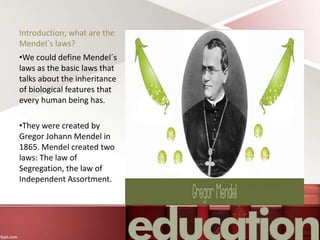
•They were created by
Gregor Johann Mendel in
1865. Mendel created two
laws: The law of
Segregation, the law of
Independent Assortment.
Who was Gregor Mendel?
• Gregor Johann Mendel was a really famous scientist
that discovered the basic laws of inheritance. They
were called Mendel´s laws. He was born on July
20th of 1822 in Austria and he died on January 6th
1884. He was a Catholic Augustinian.
• An Austrian scientist =research in a Czechoslovakia
monastery.
• Established the basis of modern genetic science.
• Objective = understand how physical traits are
passed from a parent to its offspring.
Continue
• He had previously studied science and mathematics
(including Statistics) at the University of Vienna.
Mendel’s knowledge of statistics later proved
valuable in his research on Heredity – the
transmission of characteristics from Parent to
Offspring.
• The theory of inheritance proposed by Mendel can
account for presence of differences among
members of a population generation after
generation.
• Mendel's work was unrecognized until 1990.
Mendel's Garden Peas, Pisum sativum
• Mendel did a statistical study (he had a mathematical
background).
• He prepared his experiments carefully and conducted
preliminary studies.
• He chose the garden pea, Pisum sativum, because peas
were easy to cultivate, had a short generation time, and
could be cross-pollinated.
• From many varieties, Mendel chose 22 true-breading
varieties for his experiments.
• True-breeding varieties had all offspring like the
parents and like each other.
Mendel's Garden Peas, Pisum sativum
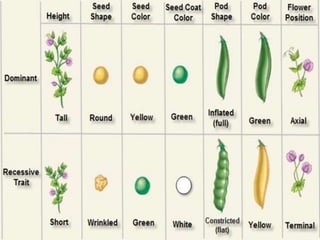
• Mendel studied seven (7) Traits or Characteristics.
Each characteristic occurred in Two Contrasting
Traits:
• Flower Color – purple or white
• Flower Position along Stem – axial or terminal
• Seed or Pea Color – yellow or green
• Seed Texture or Shape – round (smooth) or wrinkled
• Pod Color – green or yellow
• Pod Appearance or Shape – inflated or constricted
• Plant Height – long or short stems
Continue
• Mendel traced inheritance of individual traits and
kept careful records of numbers.
• He used his knowledge of Statistics to analyze his
observations of the Seven Characteristics.
Continue
• Mendel was able to document the traits of each
generation’s parents by carefully controlling how the
pea plants were Pollinated.
• Pollination occurs when pollen grains produced in the
Male Reproductive parts of a flower, the Anthers, are
transferred to the Female Reproductive part of the
flower, the Stigma.
• Self-Pollination occurs when pollen is transferred from
the Anthers of a flower to the Stigma of either the same
flower or a flower on the same plant.
• Cross-Pollination involves flowers of Two Separate
Plants.
• Pea Plants normally reproduce by Self-Pollination.
Concepts about
• Dominant are those characters which shows its self
in first generation or in offspring in expressive from
OR ability to mask the expression of a recessive
allele (Capital)
• Recessive characters are those characters which do
not shows or express its self in first generation or in
offspring at any stage OR masked by a dominant
allele.
• Homozygous- 2 identical alleles (TT, tt)
• Heterozygous- 2 different alleles (Tt)
Concepts about
• Genotype- genes of an organism = alleles received
during fertilization.
• Phenotype = the physical appearance of a trait in an
organism . e.g blue eyes, yellow flower.
• Genes – portions of DNA that determine traits.
• Alleles – Genetic factors that controls a trait.
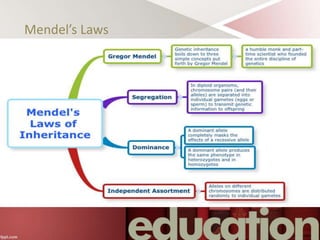
Mendel’s Laws
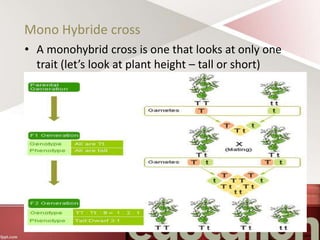
Mono Hybride cross
• A monohybrid cross is one that looks at only one
trait (let’s look at plant height – tall or short)
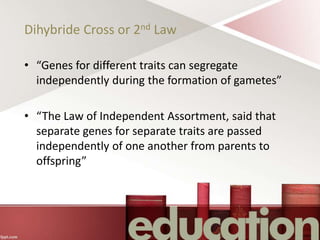
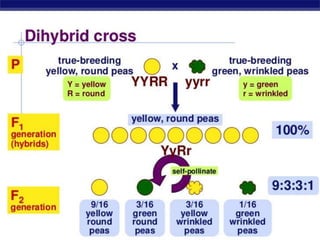
Dihybride Cross or 2nd Law
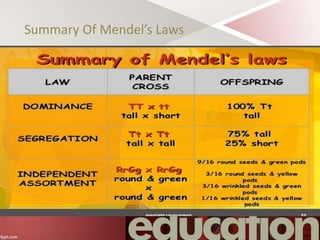
• “Genes for different traits can segregate
independently during the formation of gametes”
• “The Law of Independent Assortment, said that
separate genes for separate traits are passed
independently of one another from parents to
offspring”
Summary Of Mendel’s Laws
Mendel's Results and Conclusions
• Whenever Mendel crossed strains, one of P1Traits
failed to appear in the F1 plants. In every case, that
trait reappeared in a ratio of 3:1 in the F2
generation.
• He found that the F1 plants resembled only One of
the parents.
• Characteristic of the other parent reappeared in
about 1/4 of F2 plants; 3/4 of offspring resembled
the F1 plants.
As Viewed By Modern Genetics
• Most of Mendel’s findings agree with what now know about
Molecular Genetics - the Study of the Structure and Function
of Chromosomes and Genes.
• A Gene is a segment of DNA on a Chromosome that controls
a particular Hereditary Trait. Because Chromosomes occur in
Pairs, Genes Also occur in Pairs.
• Each of several Alternative forms of a Gene is called an
Allele. Mendel’s Factors are now called alleles.
• Letters are used to represent Alleles:
• Capital Letters refer to a Dominant ( A ) Allele that masks or
hides expression of a recessive allele.
• Lower Case ( a )refer to a Recessive Allele its expression is
masked by a dominant allele.
References
• Slide Share
https://www.slideshare.net/RafaGraciani/mendels-
third-law-law-of-independent-
assortment?qid=34804748-8c30-4ee0-8fce-
596a216867bc&v=&b=&from_search=10
• Wikipedia
https://en.wikipedia.org/wiki/Mendelian_inherita
nce#Law_of_Independent_Assortment
Slide Title
• Make Effective Presentations
• Using Awesome Backgrounds
• Engage your Audience
• Capture Audience Attention
Slide Title
Product A
• Feature 1
• Feature 2
• Feature 3
Product B
• Feature 1
• Feature 2
• Feature 3

Mendel law

  • 1.
    Starting in theName Of ALLAH who is most Gracious and Merciful
  • 2.
    Mendel’s Laws ofHereditary Presented By: Mr. Abdur Rahman Khan M-Phill UST Bannu KP Pakistan Presented To: Dr. Shoaib Ahmad
  • 3.
    Content • Introduction, Whatare the Mendel’s Law ? • Who was Gregor Mendel? • Mendel's Garden Peas, Pisum sativum • Dominant and Recessive • Gene and Allel • States Two Laws • Results of his work • References
  • 4.
    Introduction; what arethe Mendel´s laws? •We could define Mendel´s laws as the basic laws that talks about the inheritance of biological features that every human being has. •They were created by Gregor Johann Mendel in 1865. Mendel created two laws: The law of Segregation, the law of Independent Assortment.
  • 5.
    Who was GregorMendel? • Gregor Johann Mendel was a really famous scientist that discovered the basic laws of inheritance. They were called Mendel´s laws. He was born on July 20th of 1822 in Austria and he died on January 6th 1884. He was a Catholic Augustinian. • An Austrian scientist =research in a Czechoslovakia monastery. • Established the basis of modern genetic science. • Objective = understand how physical traits are passed from a parent to its offspring.
  • 6.
    Continue • He hadpreviously studied science and mathematics (including Statistics) at the University of Vienna. Mendel’s knowledge of statistics later proved valuable in his research on Heredity – the transmission of characteristics from Parent to Offspring. • The theory of inheritance proposed by Mendel can account for presence of differences among members of a population generation after generation. • Mendel's work was unrecognized until 1990.
  • 7.
    Mendel's Garden Peas,Pisum sativum • Mendel did a statistical study (he had a mathematical background). • He prepared his experiments carefully and conducted preliminary studies. • He chose the garden pea, Pisum sativum, because peas were easy to cultivate, had a short generation time, and could be cross-pollinated. • From many varieties, Mendel chose 22 true-breading varieties for his experiments. • True-breeding varieties had all offspring like the parents and like each other.
  • 8.
    Mendel's Garden Peas,Pisum sativum • Mendel studied seven (7) Traits or Characteristics. Each characteristic occurred in Two Contrasting Traits: • Flower Color – purple or white • Flower Position along Stem – axial or terminal • Seed or Pea Color – yellow or green • Seed Texture or Shape – round (smooth) or wrinkled • Pod Color – green or yellow • Pod Appearance or Shape – inflated or constricted • Plant Height – long or short stems
  • 10.
    Continue • Mendel tracedinheritance of individual traits and kept careful records of numbers. • He used his knowledge of Statistics to analyze his observations of the Seven Characteristics.
  • 11.
    Continue • Mendel wasable to document the traits of each generation’s parents by carefully controlling how the pea plants were Pollinated. • Pollination occurs when pollen grains produced in the Male Reproductive parts of a flower, the Anthers, are transferred to the Female Reproductive part of the flower, the Stigma. • Self-Pollination occurs when pollen is transferred from the Anthers of a flower to the Stigma of either the same flower or a flower on the same plant. • Cross-Pollination involves flowers of Two Separate Plants. • Pea Plants normally reproduce by Self-Pollination.
  • 12.
    Concepts about • Dominantare those characters which shows its self in first generation or in offspring in expressive from OR ability to mask the expression of a recessive allele (Capital) • Recessive characters are those characters which do not shows or express its self in first generation or in offspring at any stage OR masked by a dominant allele. • Homozygous- 2 identical alleles (TT, tt) • Heterozygous- 2 different alleles (Tt)
  • 13.
    Concepts about • Genotype-genes of an organism = alleles received during fertilization. • Phenotype = the physical appearance of a trait in an organism . e.g blue eyes, yellow flower. • Genes – portions of DNA that determine traits. • Alleles – Genetic factors that controls a trait.
  • 14.
  • 15.
    Mono Hybride cross •A monohybrid cross is one that looks at only one trait (let’s look at plant height – tall or short)
  • 16.
    Dihybride Cross or2nd Law • “Genes for different traits can segregate independently during the formation of gametes” • “The Law of Independent Assortment, said that separate genes for separate traits are passed independently of one another from parents to offspring”
  • 18.
  • 19.
    Mendel's Results andConclusions • Whenever Mendel crossed strains, one of P1Traits failed to appear in the F1 plants. In every case, that trait reappeared in a ratio of 3:1 in the F2 generation. • He found that the F1 plants resembled only One of the parents. • Characteristic of the other parent reappeared in about 1/4 of F2 plants; 3/4 of offspring resembled the F1 plants.
  • 20.
    As Viewed ByModern Genetics • Most of Mendel’s findings agree with what now know about Molecular Genetics - the Study of the Structure and Function of Chromosomes and Genes. • A Gene is a segment of DNA on a Chromosome that controls a particular Hereditary Trait. Because Chromosomes occur in Pairs, Genes Also occur in Pairs. • Each of several Alternative forms of a Gene is called an Allele. Mendel’s Factors are now called alleles. • Letters are used to represent Alleles: • Capital Letters refer to a Dominant ( A ) Allele that masks or hides expression of a recessive allele. • Lower Case ( a )refer to a Recessive Allele its expression is masked by a dominant allele.
  • 21.
  • 23.
    Slide Title • MakeEffective Presentations • Using Awesome Backgrounds • Engage your Audience • Capture Audience Attention
  • 24.
    Slide Title Product A •Feature 1 • Feature 2 • Feature 3 Product B • Feature 1 • Feature 2 • Feature 3