CHAPTER 2: AMPLITUDE MODULATION
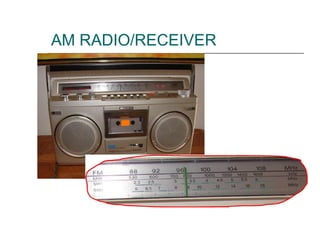
AM RADIO/RECEIVER
TOPICS Need for Modulation Principles of AM Modulation Index and Signal Power AM Circuits Single Sideband Suppressed Carrier (SSBSC) SSB Circuits
NEED FOR MODULATION It is because modulation makes the information  signal more compatible   with the medium. Modulation =  Imposing information at low frequency onto a higher frequency signal. A technique for transmitting information efficiently from one place to another. Simplest form of modulation is the amplitude modulation.
PRINCIPLES OF AMPLITUDE MODULATION
PRINCIPLES OF AM AM is defined as: Amplitude of carrier frequency   change  proportionately to the  value of the  modulation signal. Advantages: Simple  modulator circuits Cheap  :low-quality form of modulation used for commercial broadcasting of audio & video signal. Disadvantages: Poor performance  due to noise Inefficient  use of transmitter power. Application: 2 way radio communications, broadcasting, aircraft comm. & citizen band (CB) radio.
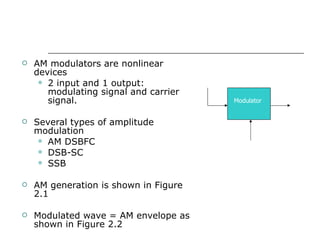
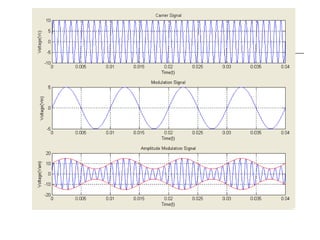
AM modulators are nonlinear devices 2 input and 1 output: modulating signal and carrier signal. Several types of amplitude modulation AM DSBFC DSB-SC SSB AM generation is shown in Figure 2.1 Modulated wave = AM envelope as shown in Figure 2.2 Figure 2.1: Block diagram of Amplitude Modulation Information,  V m (t) Carrier,  V c (t) Modulator V AM  (t)
Figure 2.2 AM signal with the envelope
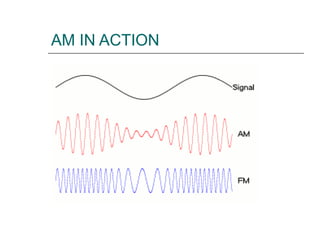
AM IN ACTION
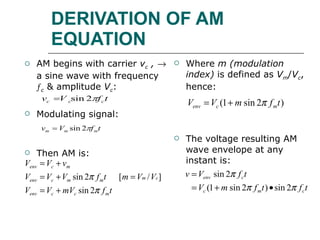
AM begins with carrier  v c  ,    a sine wave with frequency   c  & amplitude  V c : Modulating signal: Then AM is: DERIVATION OF AM EQUATION Where  m (modulation index)  is defined as  V m / V c , hence: The voltage resulting AM wave envelope at any instant is:
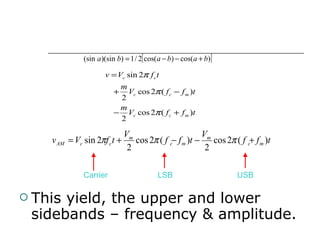
This yield, the upper and lower sidebands – frequency & amplitude. Using Trigo ID Carrier LSB USB
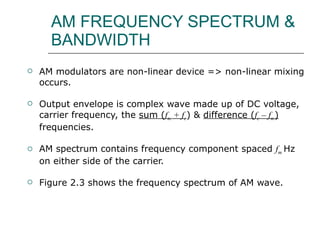
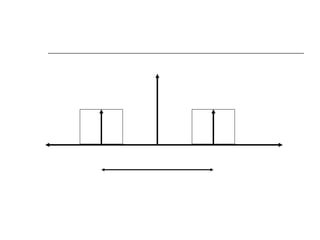
AM FREQUENCY SPECTRUM & BANDWIDTH AM modulators are non-linear device => non-linear mixing occurs. Output envelope is complex wave made up of DC voltage, carrier frequency, the  sum ( f m  + f c ) &  difference ( f c  – f m )  frequencies. AM spectrum contains frequency component spaced  f m   Hz on either side of the carrier. Figure 2.3 shows the frequency spectrum of AM wave.
Figure 2.3: Frequency spectrum for AM wave f c f c  + f m f c  - f m Bandwidth = 2f m V c V m  /2 V m  /2
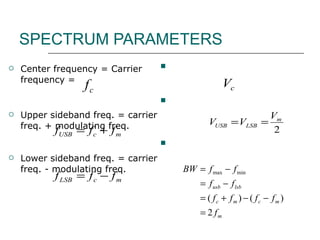
SPECTRUM PARAMETERS  Center frequency = Carrier frequency =  Upper sideband freq. = carrier freq. + modulating freq. Lower sideband freq. = carrier freq. - modulating freq. Center frequency peak amplitude: Upper and lower sideband voltages: Bandwidth = Maximum freq. - minimum freq.
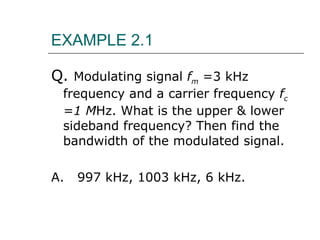
EXAMPLE 2.1 Q.  Modulating signal  f m  =3 kHz frequency and a carrier frequency  f c  =1 M Hz. What is the upper & lower sideband frequency? Then find the bandwidth of the modulated signal. A.  997 kHz, 1003 kHz, 6 kHz.
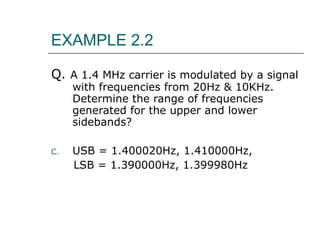
EXAMPLE 2.2 Q.  A 1.4 MHz carrier is modulated by a signal with frequencies from 20Hz & 10KHz. Determine the range of frequencies generated for the upper and lower sidebands? USB = 1.400020Hz, 1.410000Hz,  LSB = 1.390000Hz, 1.399980Hz

Chapter 2 amplitude_modulation

  • 1.
  • 2.
  • 3.
    TOPICS Need forModulation Principles of AM Modulation Index and Signal Power AM Circuits Single Sideband Suppressed Carrier (SSBSC) SSB Circuits
  • 4.
    NEED FOR MODULATIONIt is because modulation makes the information signal more compatible with the medium. Modulation = Imposing information at low frequency onto a higher frequency signal. A technique for transmitting information efficiently from one place to another. Simplest form of modulation is the amplitude modulation.
  • 5.
  • 6.
    PRINCIPLES OF AMAM is defined as: Amplitude of carrier frequency change proportionately to the value of the modulation signal. Advantages: Simple modulator circuits Cheap :low-quality form of modulation used for commercial broadcasting of audio & video signal. Disadvantages: Poor performance due to noise Inefficient use of transmitter power. Application: 2 way radio communications, broadcasting, aircraft comm. & citizen band (CB) radio.
  • 7.
    AM modulators arenonlinear devices 2 input and 1 output: modulating signal and carrier signal. Several types of amplitude modulation AM DSBFC DSB-SC SSB AM generation is shown in Figure 2.1 Modulated wave = AM envelope as shown in Figure 2.2 Figure 2.1: Block diagram of Amplitude Modulation Information, V m (t) Carrier, V c (t) Modulator V AM (t)
  • 8.
    Figure 2.2 AMsignal with the envelope
  • 9.
  • 10.
    AM begins withcarrier v c ,  a sine wave with frequency  c & amplitude V c : Modulating signal: Then AM is: DERIVATION OF AM EQUATION Where m (modulation index) is defined as V m / V c , hence: The voltage resulting AM wave envelope at any instant is:
  • 11.
    This yield, theupper and lower sidebands – frequency & amplitude. Using Trigo ID Carrier LSB USB
  • 12.
    AM FREQUENCY SPECTRUM& BANDWIDTH AM modulators are non-linear device => non-linear mixing occurs. Output envelope is complex wave made up of DC voltage, carrier frequency, the sum ( f m + f c ) & difference ( f c – f m ) frequencies. AM spectrum contains frequency component spaced f m Hz on either side of the carrier. Figure 2.3 shows the frequency spectrum of AM wave.
  • 14.
    Figure 2.3: Frequencyspectrum for AM wave f c f c + f m f c - f m Bandwidth = 2f m V c V m /2 V m /2
  • 15.
    SPECTRUM PARAMETERS Center frequency = Carrier frequency = Upper sideband freq. = carrier freq. + modulating freq. Lower sideband freq. = carrier freq. - modulating freq. Center frequency peak amplitude: Upper and lower sideband voltages: Bandwidth = Maximum freq. - minimum freq.
  • 16.
    EXAMPLE 2.1 Q. Modulating signal f m =3 kHz frequency and a carrier frequency f c =1 M Hz. What is the upper & lower sideband frequency? Then find the bandwidth of the modulated signal. A. 997 kHz, 1003 kHz, 6 kHz.
  • 17.
    EXAMPLE 2.2 Q. A 1.4 MHz carrier is modulated by a signal with frequencies from 20Hz & 10KHz. Determine the range of frequencies generated for the upper and lower sidebands? USB = 1.400020Hz, 1.410000Hz, LSB = 1.390000Hz, 1.399980Hz