Electrical Power Systems
Synchronous Generator
By: Mubarek Kurt
 A synchronous machine rotates at a constant speed in the steady
state.
 Unlike induction machines, the rotating air gap field and the rotor
in the synchronous machine rotate at the same speed, called the
synchronous speed.
 Sync. Machine are used primarily as generators of electrical power
(Hydro, nuclear or thermal power stations).
 Like most rotating machines, a synchronous machine can also
operate as both a generator and a motor.
MubarekKurt
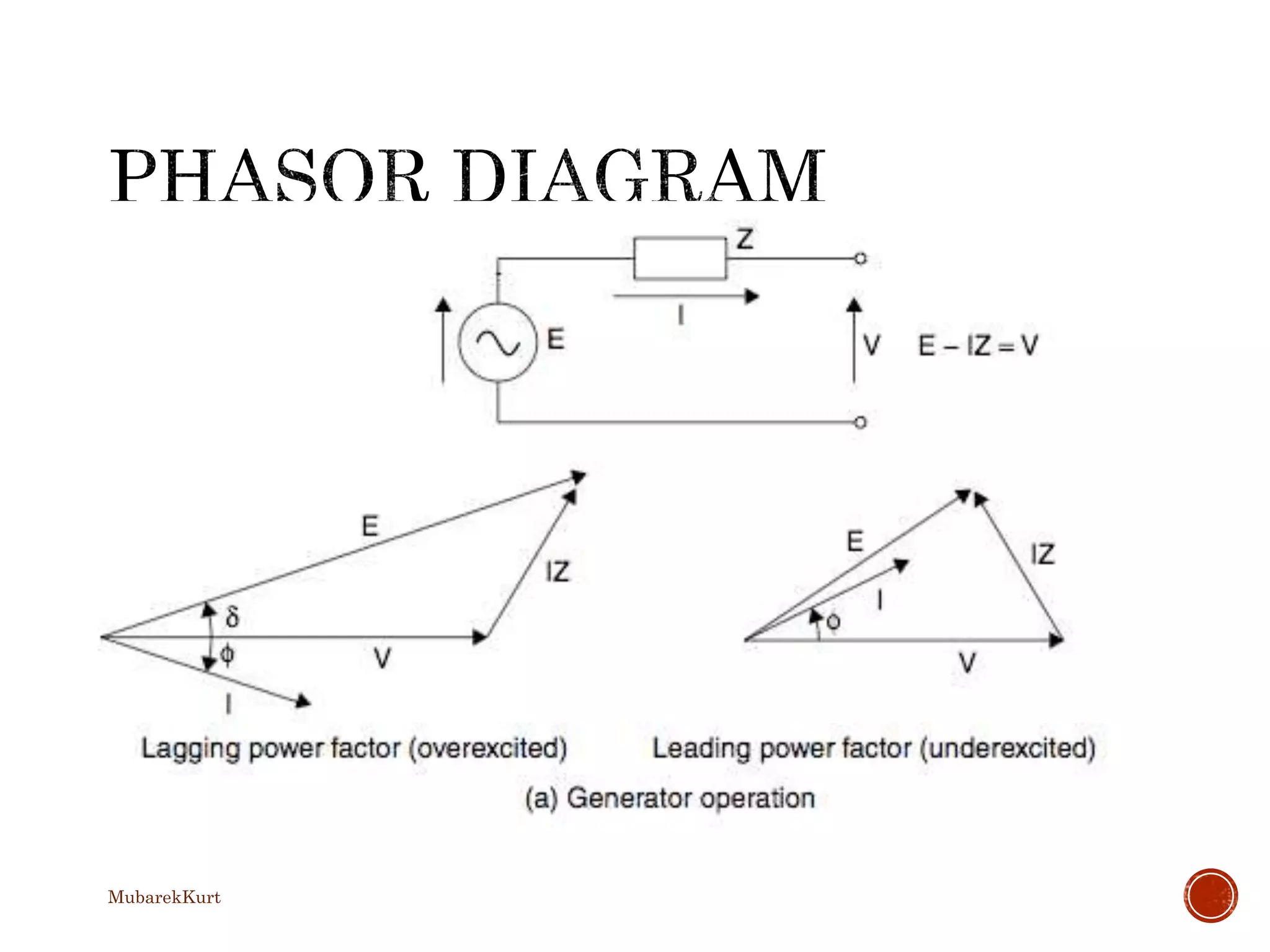
 An important feature of a synchronous motor is that it can
draw either lagging or leading reactive current from ac supply
system.
 Its rotor poles are excited by a DC current and its stator
winding (or armature winding) are connected to the AC supply.
MubarekKurt
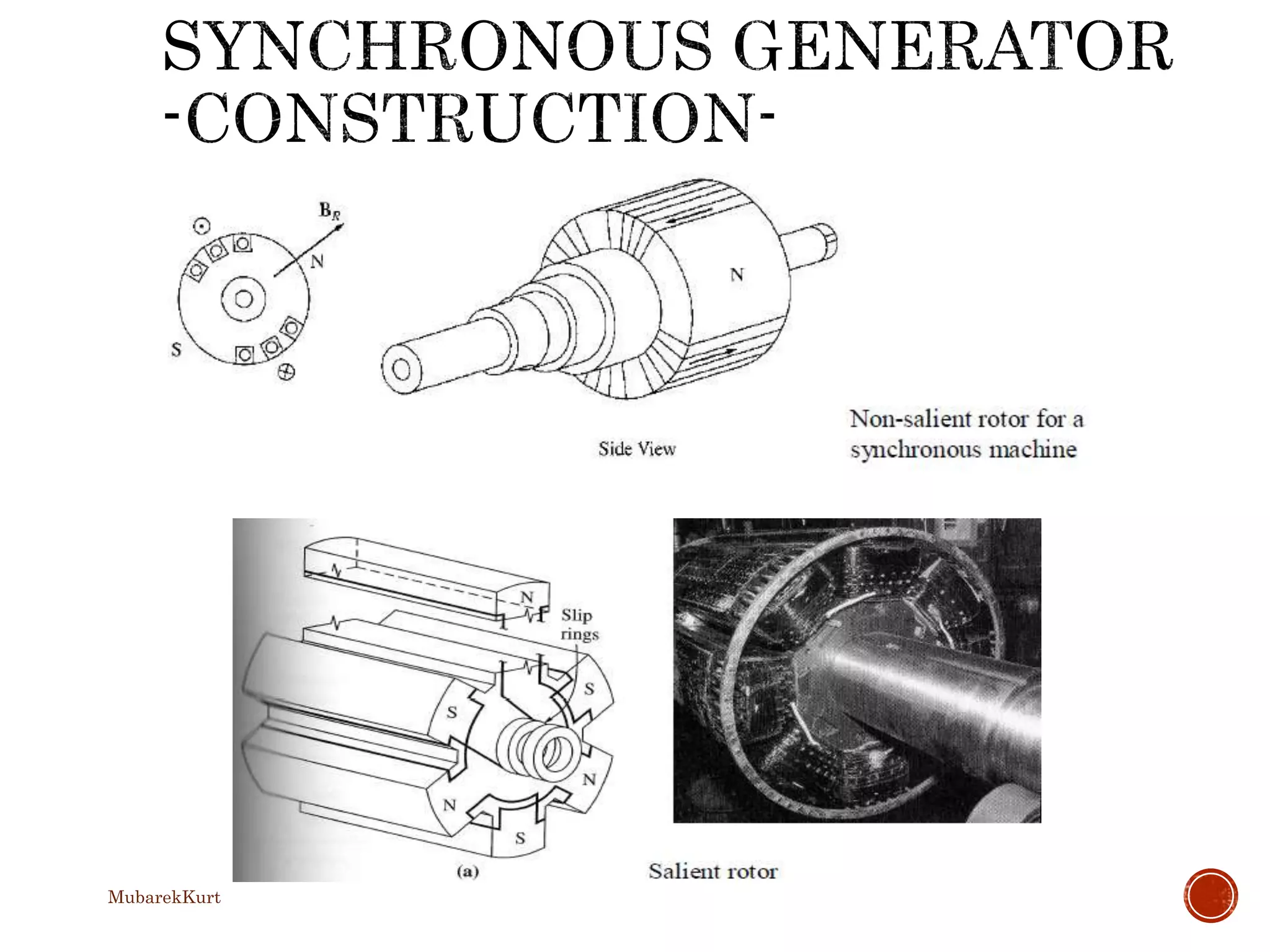
 The stator of the 3 phase sync. Machine has a 3 phase
distributed winding similar to that of the 3 phase induction
machine.
 The stator winding, which is connected to the ac supply
system, is sometimes called the armature winding. It is
designed for high voltage and current.
 The rotor has a winding called the field winding, which carries
direct current. The field winding on the rotating on the
structure is normally fed from an external dc source through
slip rings and brushes.
MubarekKurt
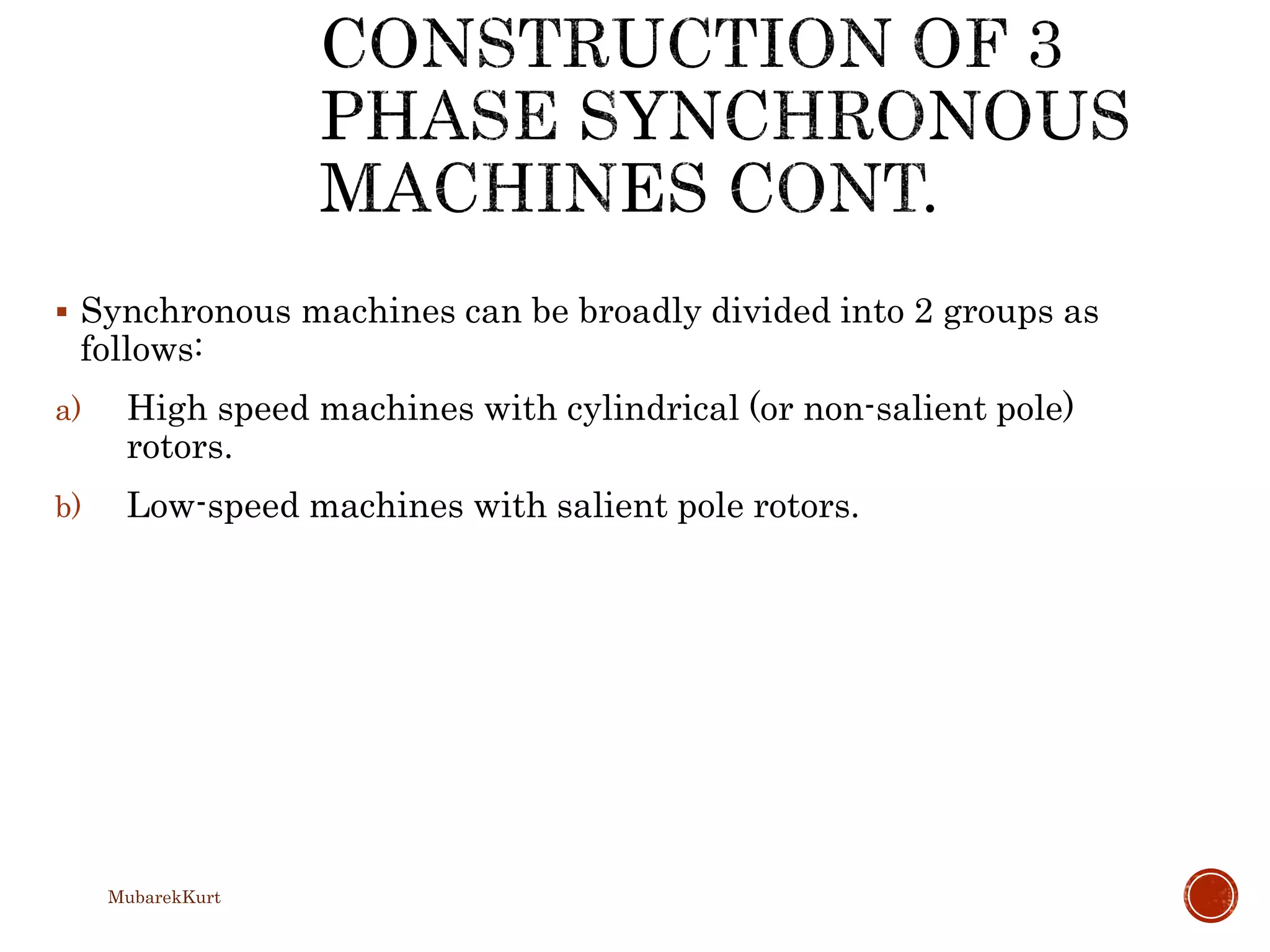
 Synchronous machines can be broadly divided into 2 groups as
follows:
a) High speed machines with cylindrical (or non-salient pole)
rotors.
b) Low-speed machines with salient pole rotors.
MubarekKurt
MubarekKurt
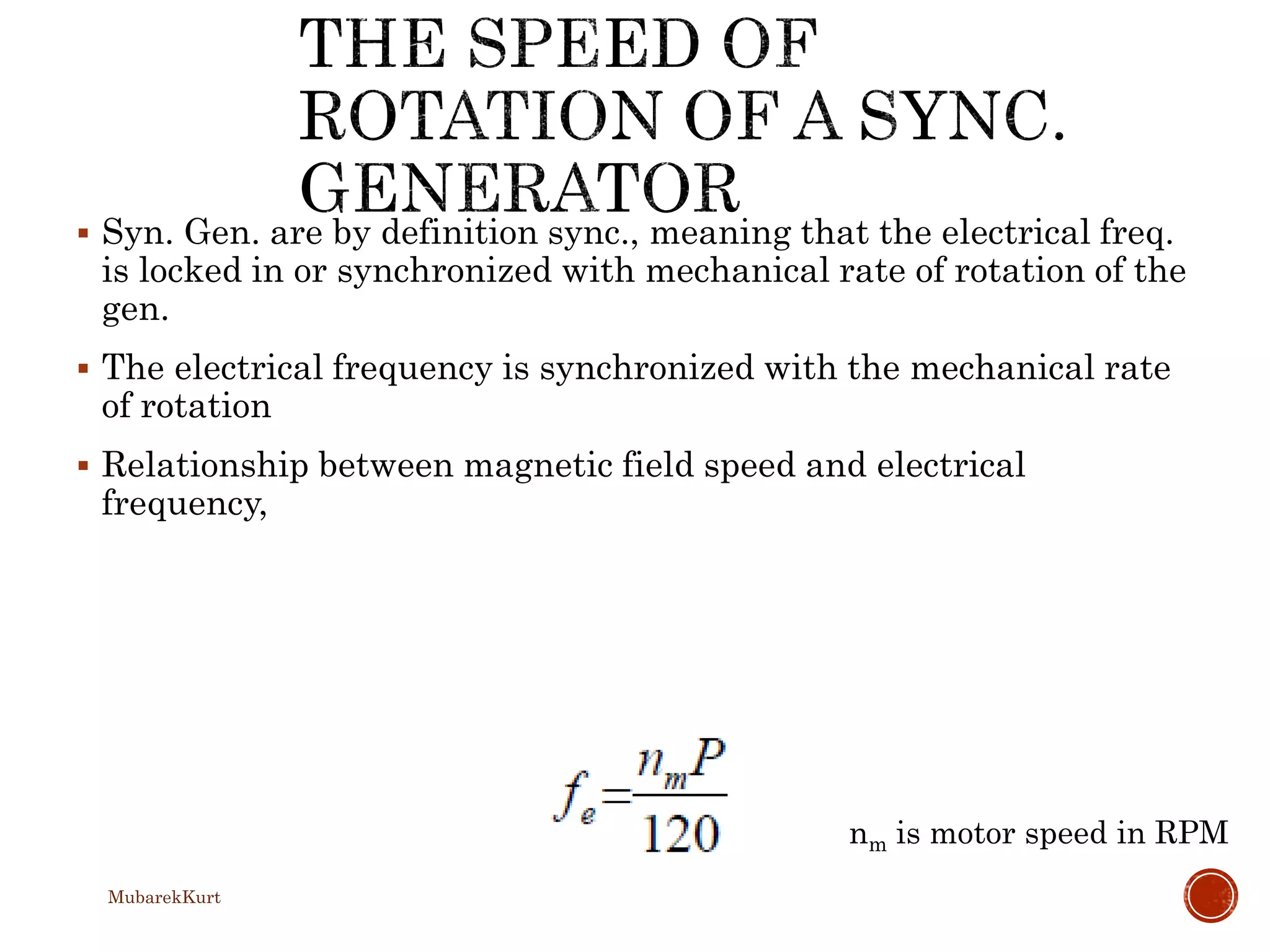
 Syn. Gen. are by definition sync., meaning that the electrical freq.
is locked in or synchronized with mechanical rate of rotation of the
gen.
 The electrical frequency is synchronized with the mechanical rate
of rotation
 Relationship between magnetic field speed and electrical
frequency,
nm is motor speed in RPM
MubarekKurt
 Determine the rotor speed in RPM of the following 3 phase
synchronous machines
a) f=60Hz, number of poles=6
b) f=50Hz, number of poles=12
c) f=400Hz, number of poles=4
MubarekKurt
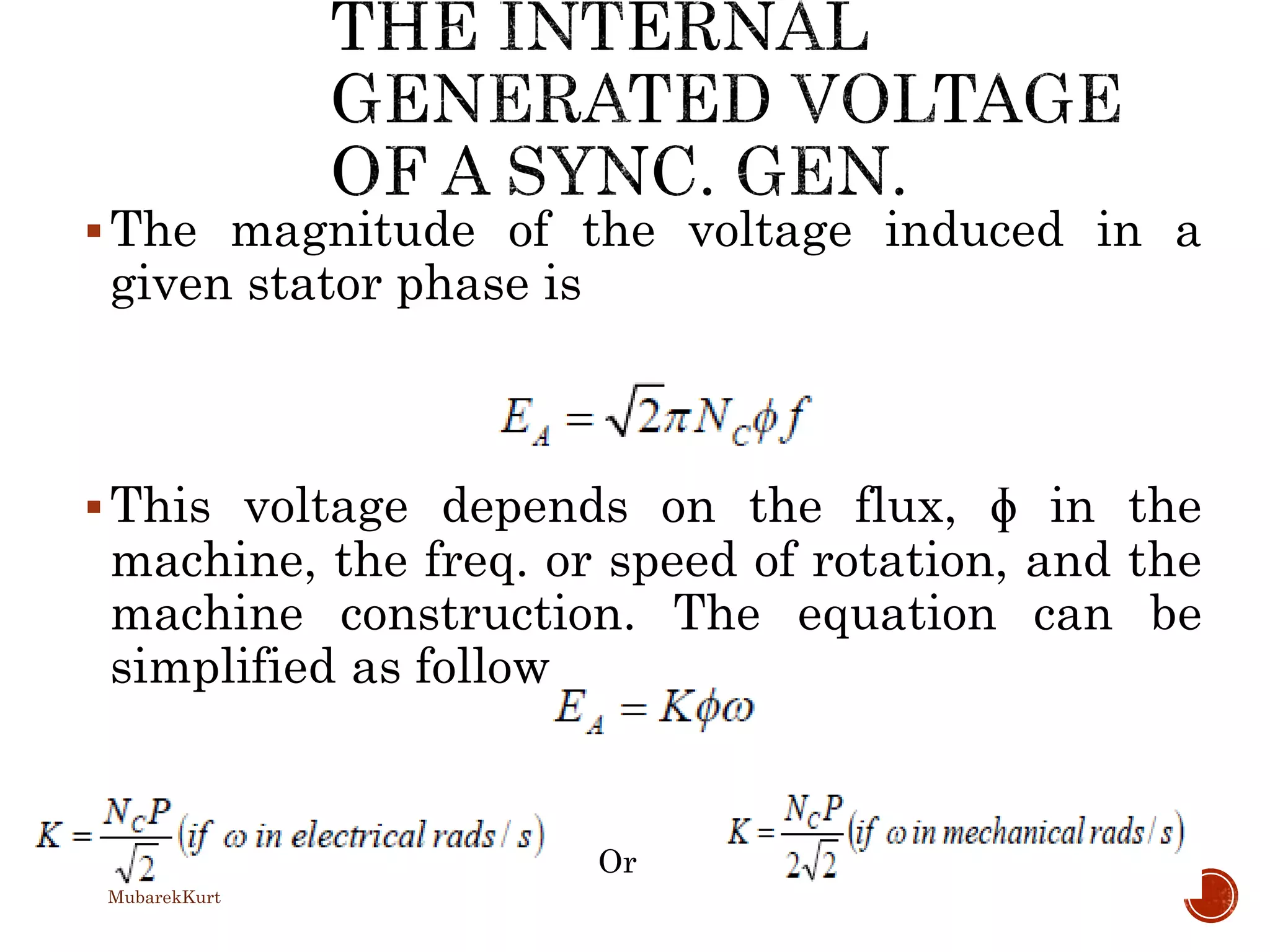
The magnitude of the voltage induced in a
given stator phase is
This voltage depends on the flux, ɸ in the
machine, the freq. or speed of rotation, and the
machine construction. The equation can be
simplified as follow
Or
MubarekKurt
• The voltage, Ea is not usually the voltage that
appears at the terminals, Vt of the generator.
• In fact, the only time the internal voltage Ea is
the same as the output voltage, Vt of a phase is
when there is no armature current flowing in
the machine.
• There are some factors that cause the diff.
between Ea and Vt
a) The distortion of the air gap magnetic field by
he current flowing in the stator, called
Armature reaction
b) Self inductance of the armature coilMubarekKurt
 We will explore the effects of the first three factors and derive
a machine model from them.
 The effect of a salient pole shape on the operation of a sync.
Machine will be ignored; in other words, all the machine in
this note are assumed to have non-salient or cyclindrical
rotors.
MubarekKurt
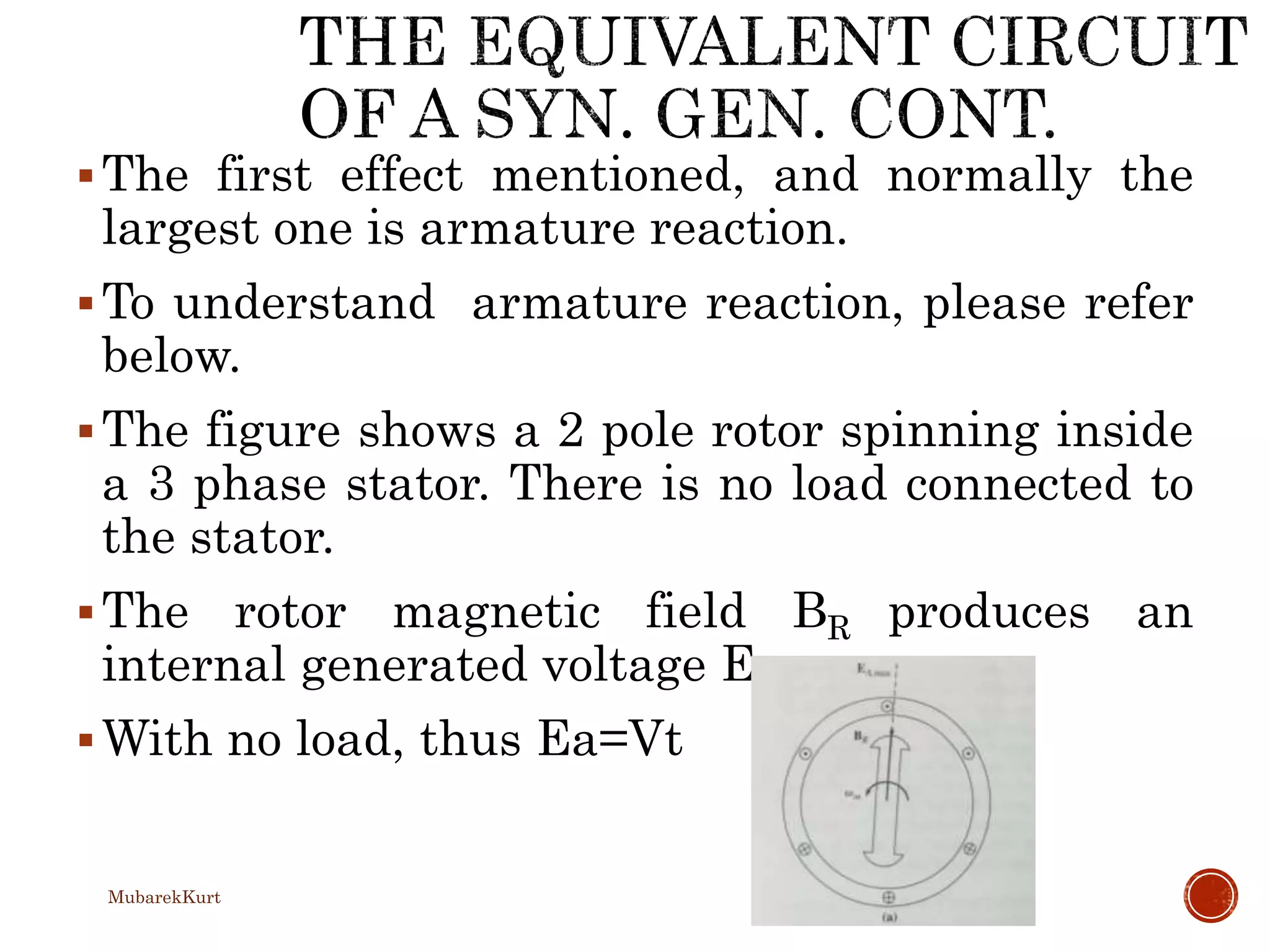
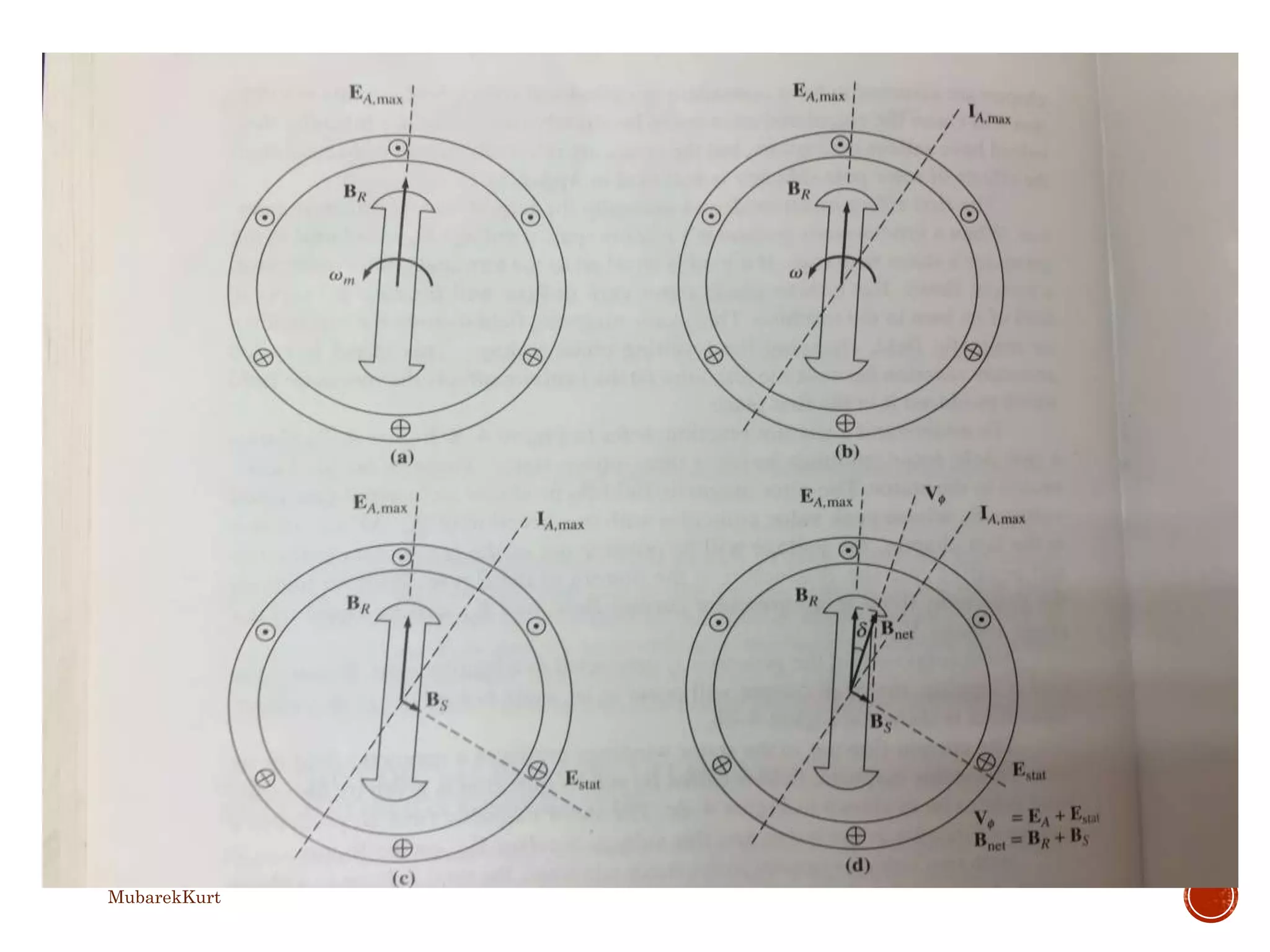
The first effect mentioned, and normally the
largest one is armature reaction.
To understand armature reaction, please refer
below.
The figure shows a 2 pole rotor spinning inside
a 3 phase stator. There is no load connected to
the stator.
The rotor magnetic field BR produces an
internal generated voltage Ea.
With no load, thus Ea=Vt
MubarekKurt
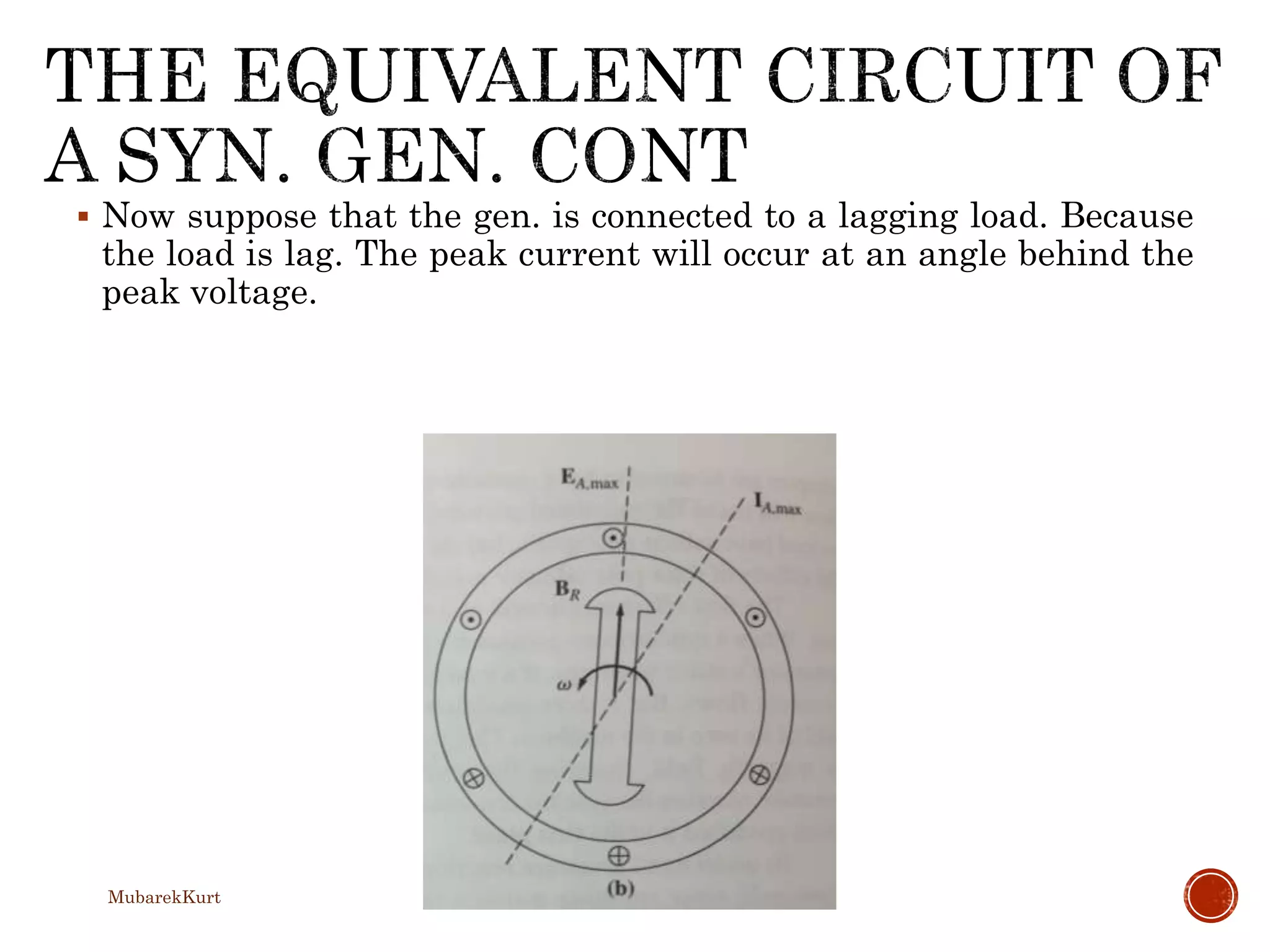
 Now suppose that the gen. is connected to a lagging load. Because
the load is lag. The peak current will occur at an angle behind the
peak voltage.
MubarekKurt
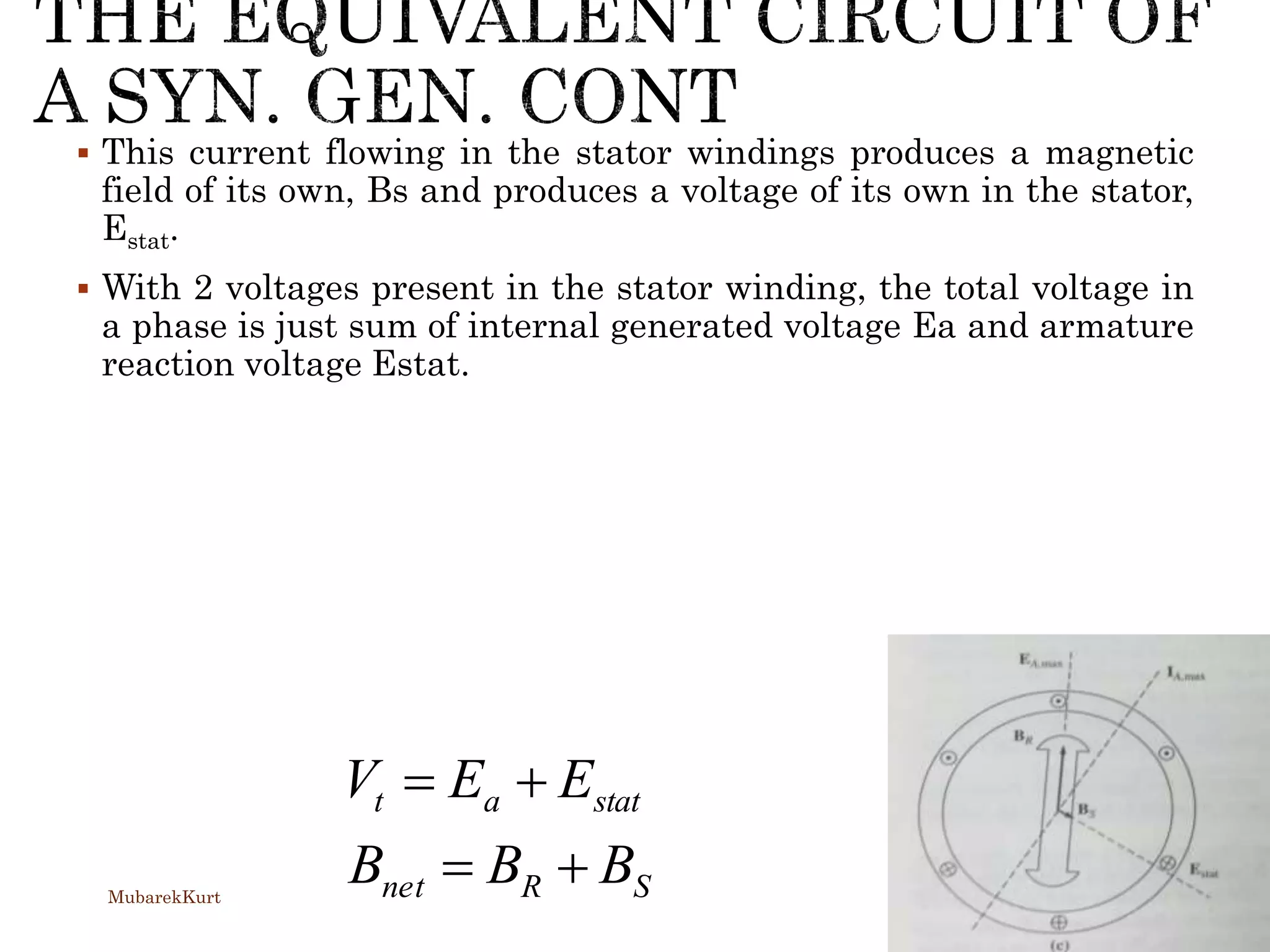
 This current flowing in the stator windings produces a magnetic
field of its own, Bs and produces a voltage of its own in the stator,
Estat.
 With 2 voltages present in the stator winding, the total voltage in
a phase is just sum of internal generated voltage Ea and armature
reaction voltage Estat.
SRnet
statat
BBB
EEV


MubarekKurt
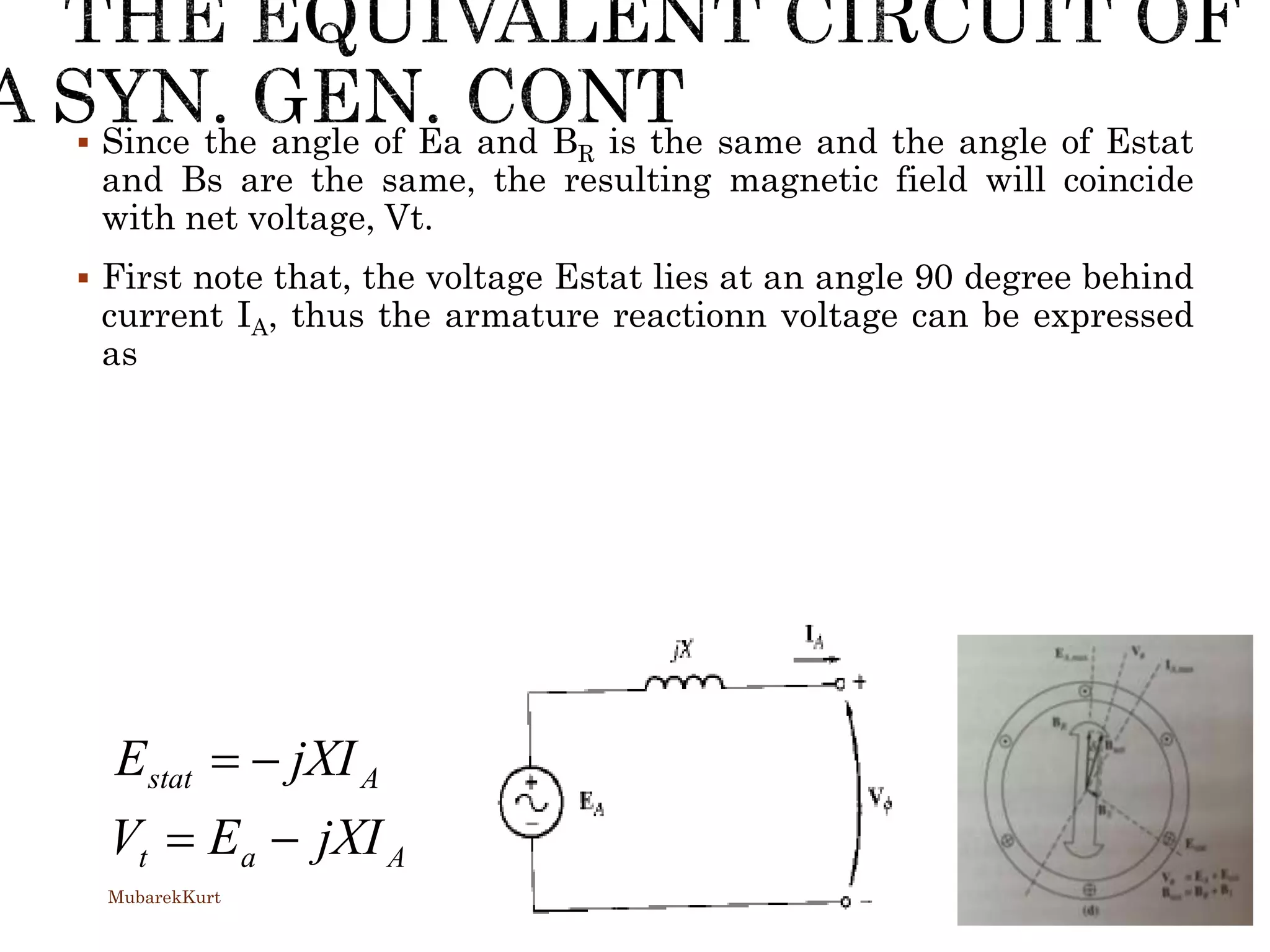
 Since the angle of Ea and BR is the same and the angle of Estat
and Bs are the same, the resulting magnetic field will coincide
with net voltage, Vt.
 First note that, the voltage Estat lies at an angle 90 degree behind
current IA, thus the armature reactionn voltage can be expressed
as
Aat
Astat
jXIEV
jXIE


MubarekKurt
MubarekKurt
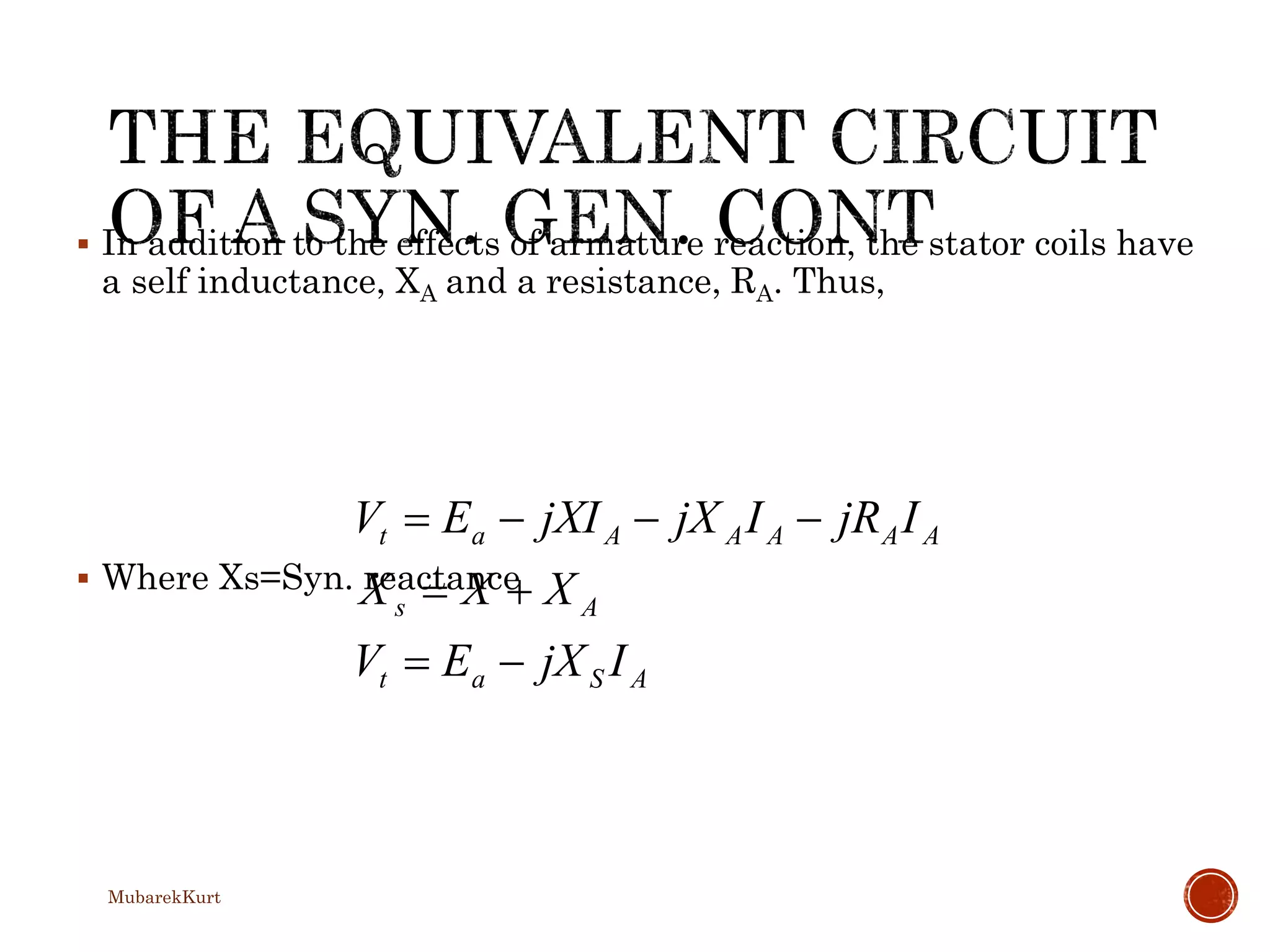
 In addition to the effects of armature reaction, the stator coils have
a self inductance, XA and a resistance, RA. Thus,
 Where Xs=Syn. reactance
ASat
As
AAAAAat
IjXEV
XXX
IjRIjXjXIEV



MubarekKurt
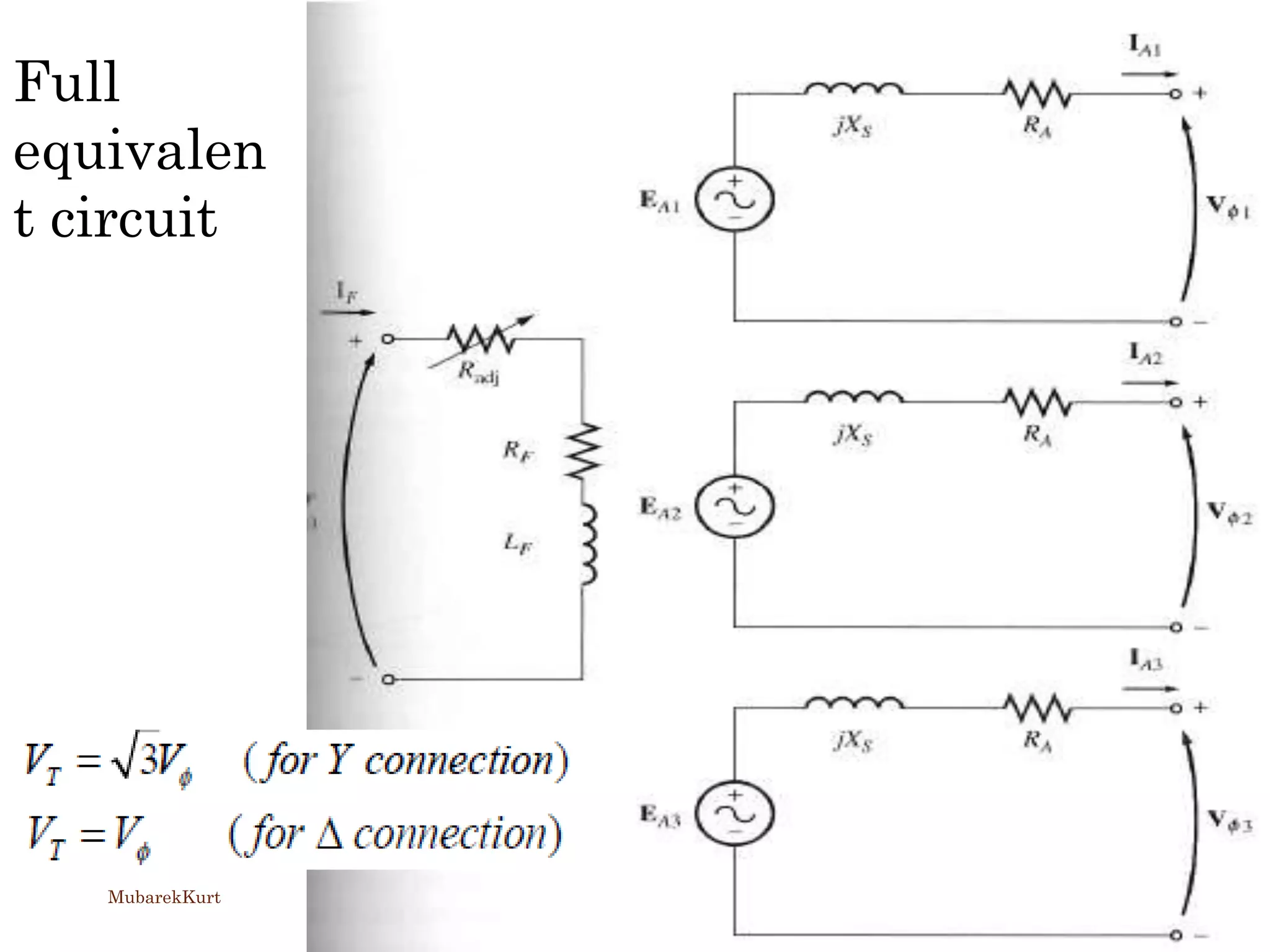
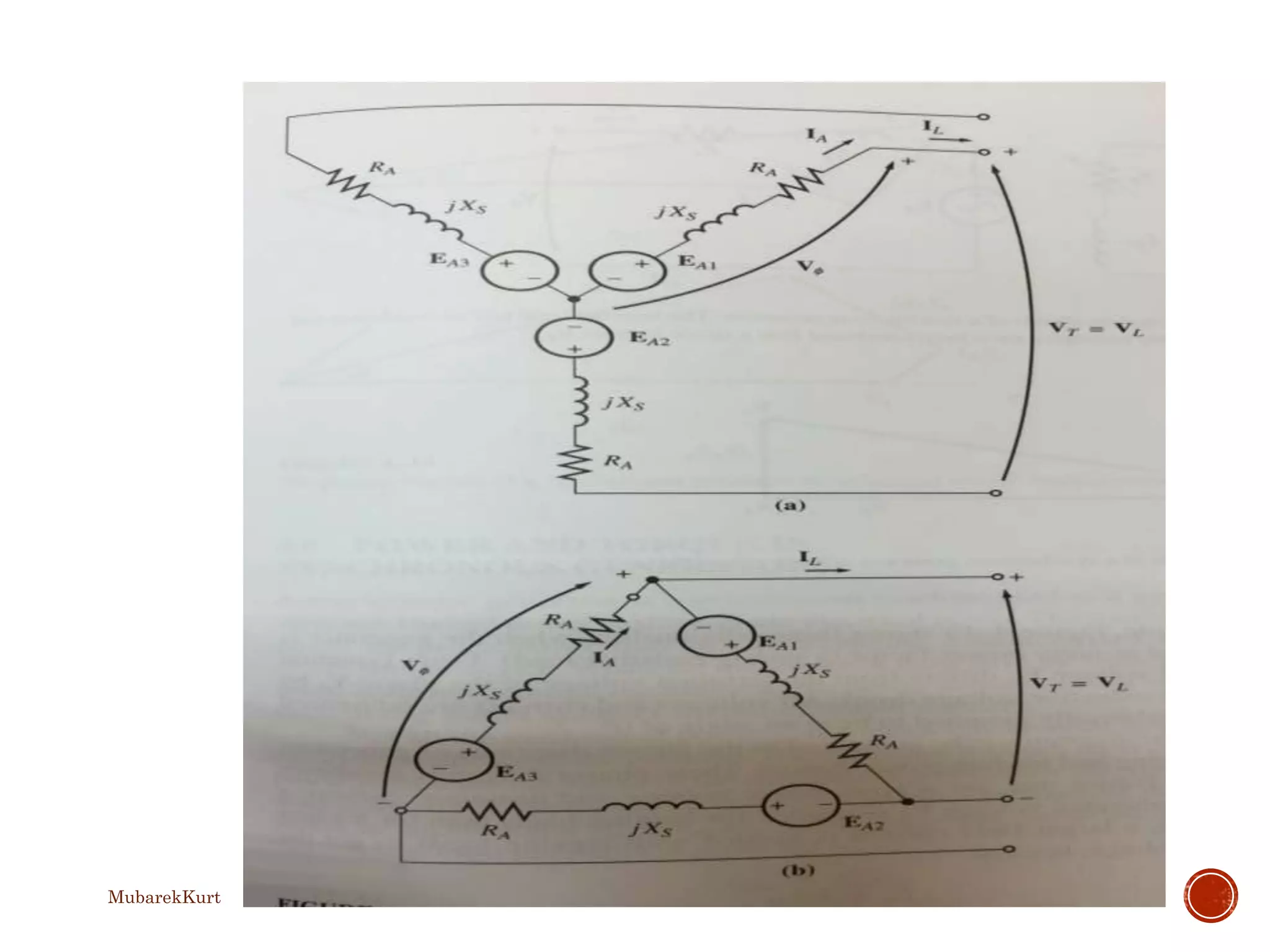
Full
equivalen
t circuit
MubarekKurt
MubarekKurt
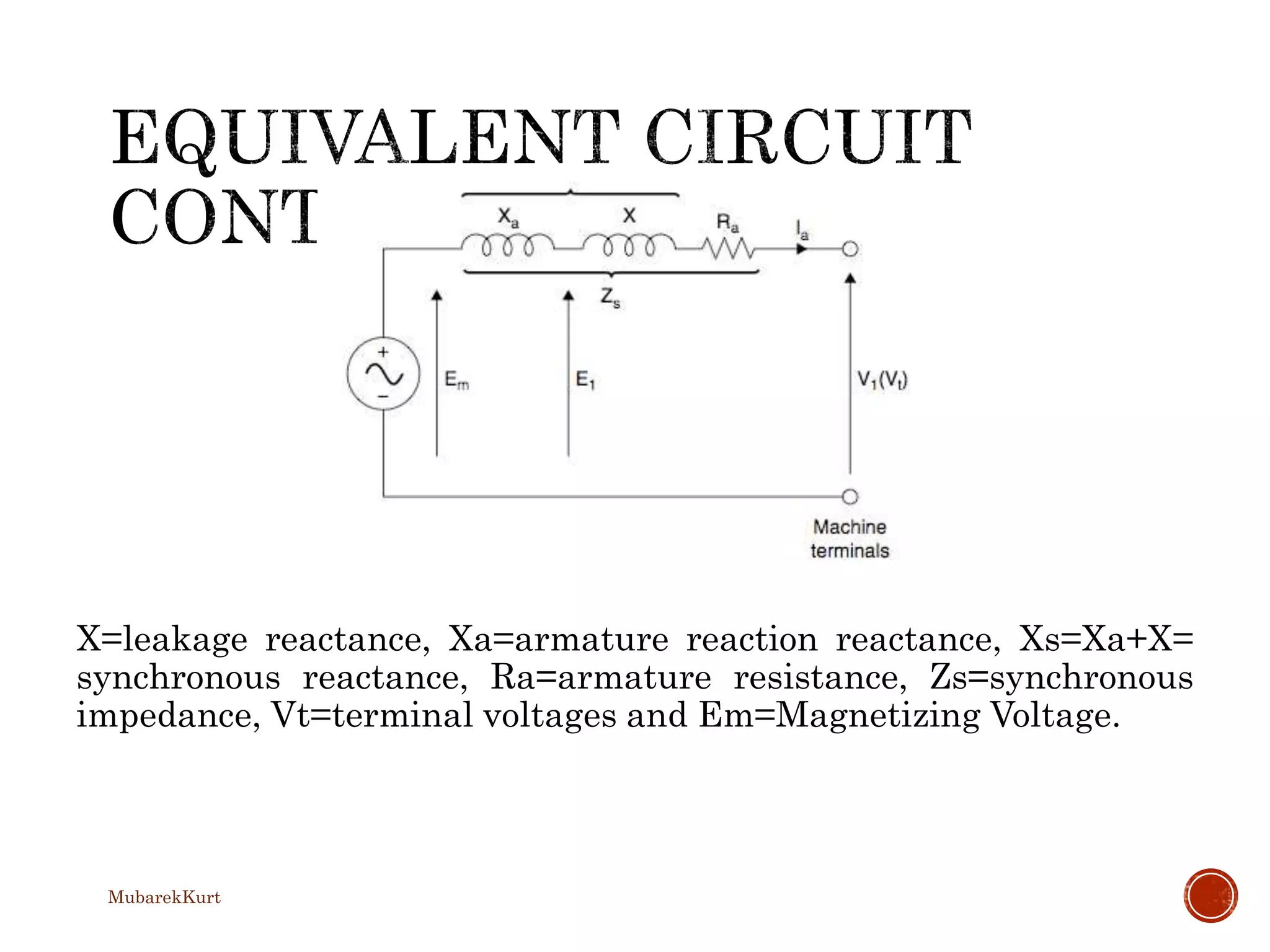
X=leakage reactance, Xa=armature reaction reactance, Xs=Xa+X=
synchronous reactance, Ra=armature resistance, Zs=synchronous
impedance, Vt=terminal voltages and Em=Magnetizing Voltage.
MubarekKurt
MubarekKurt
MubarekKurt
MubarekKurt
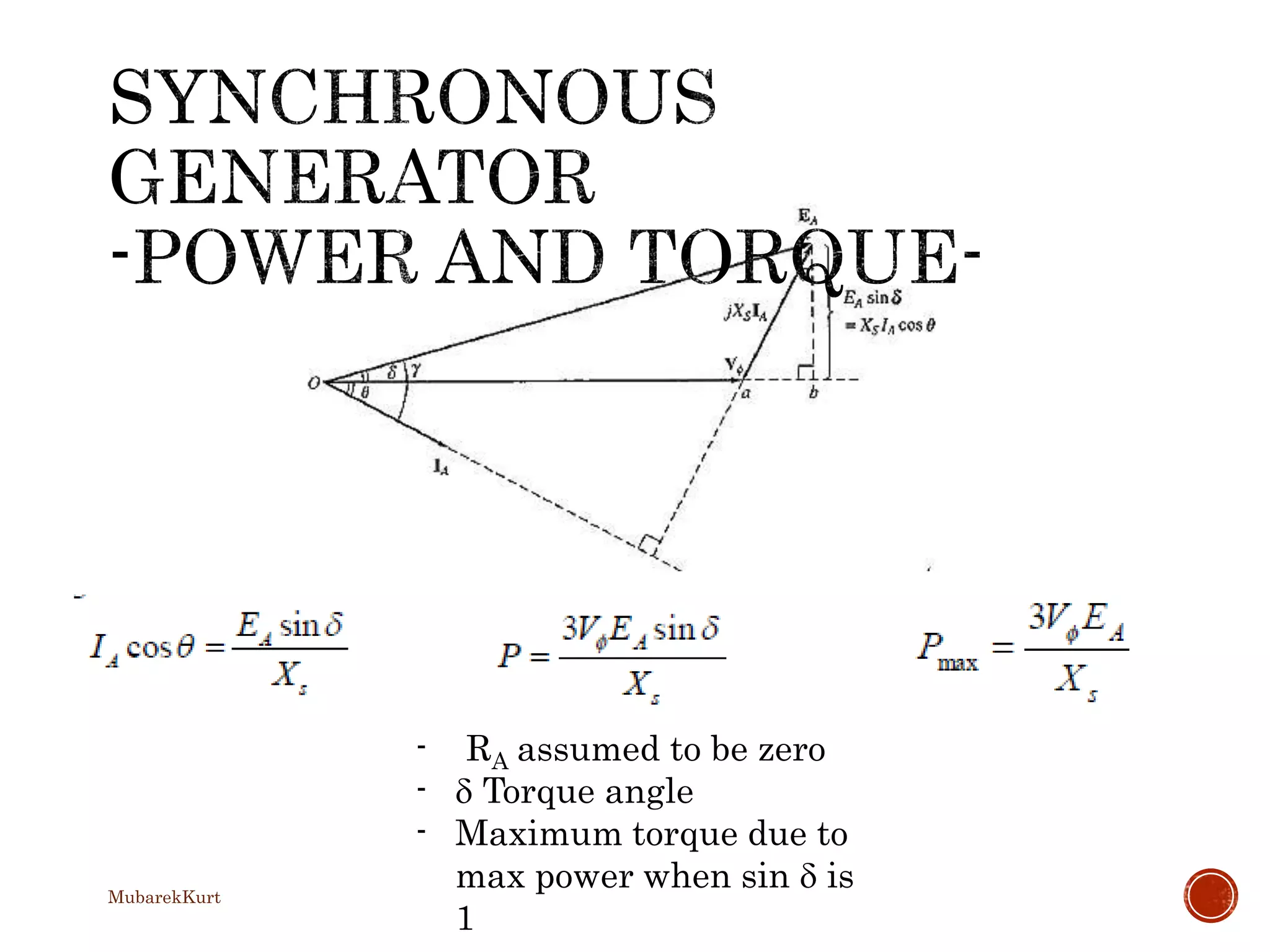
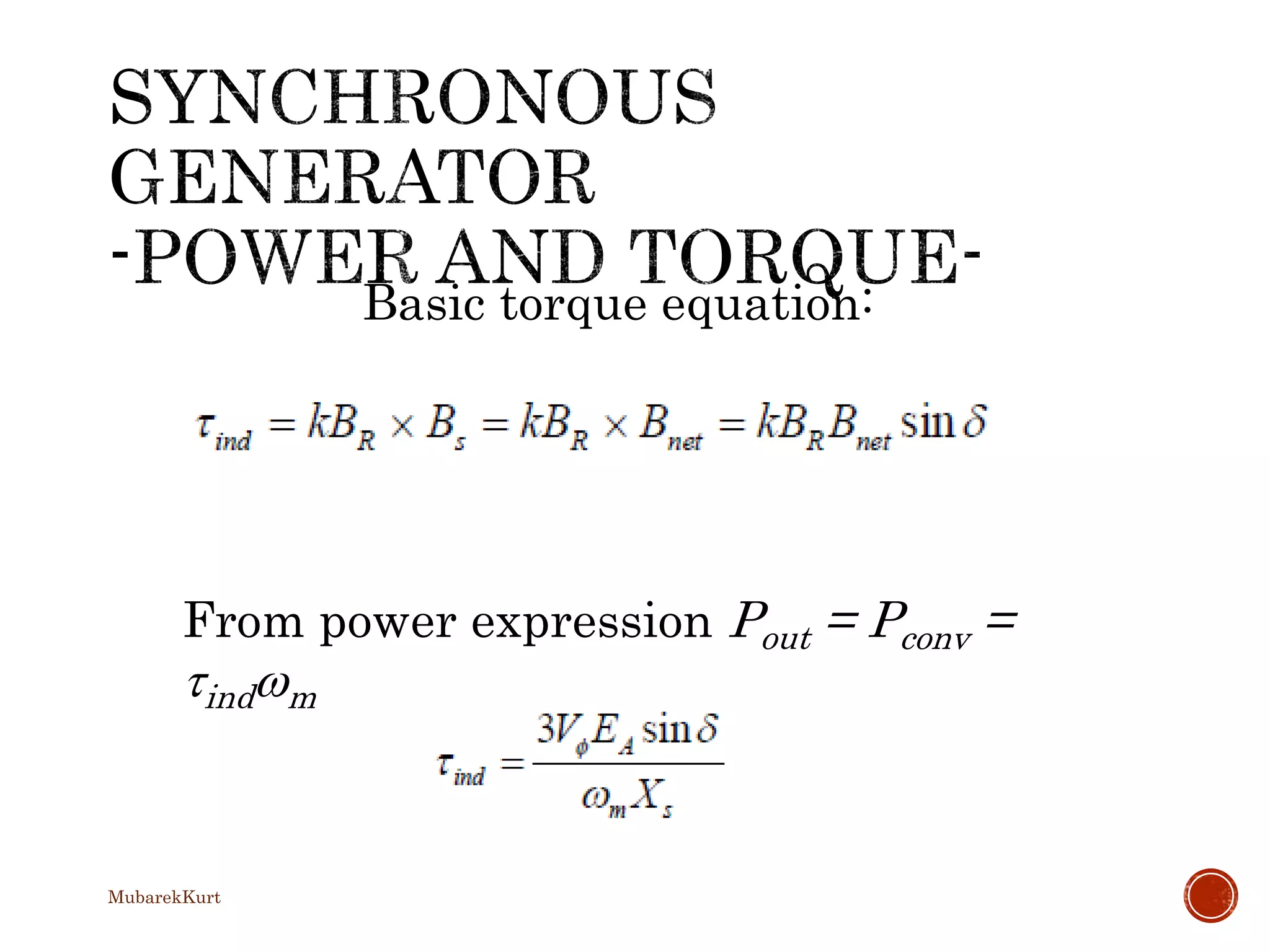
- RA assumed to be zero
-  Torque angle
- Maximum torque due to
max power when sin  is
1
MubarekKurt
Basic torque equation:
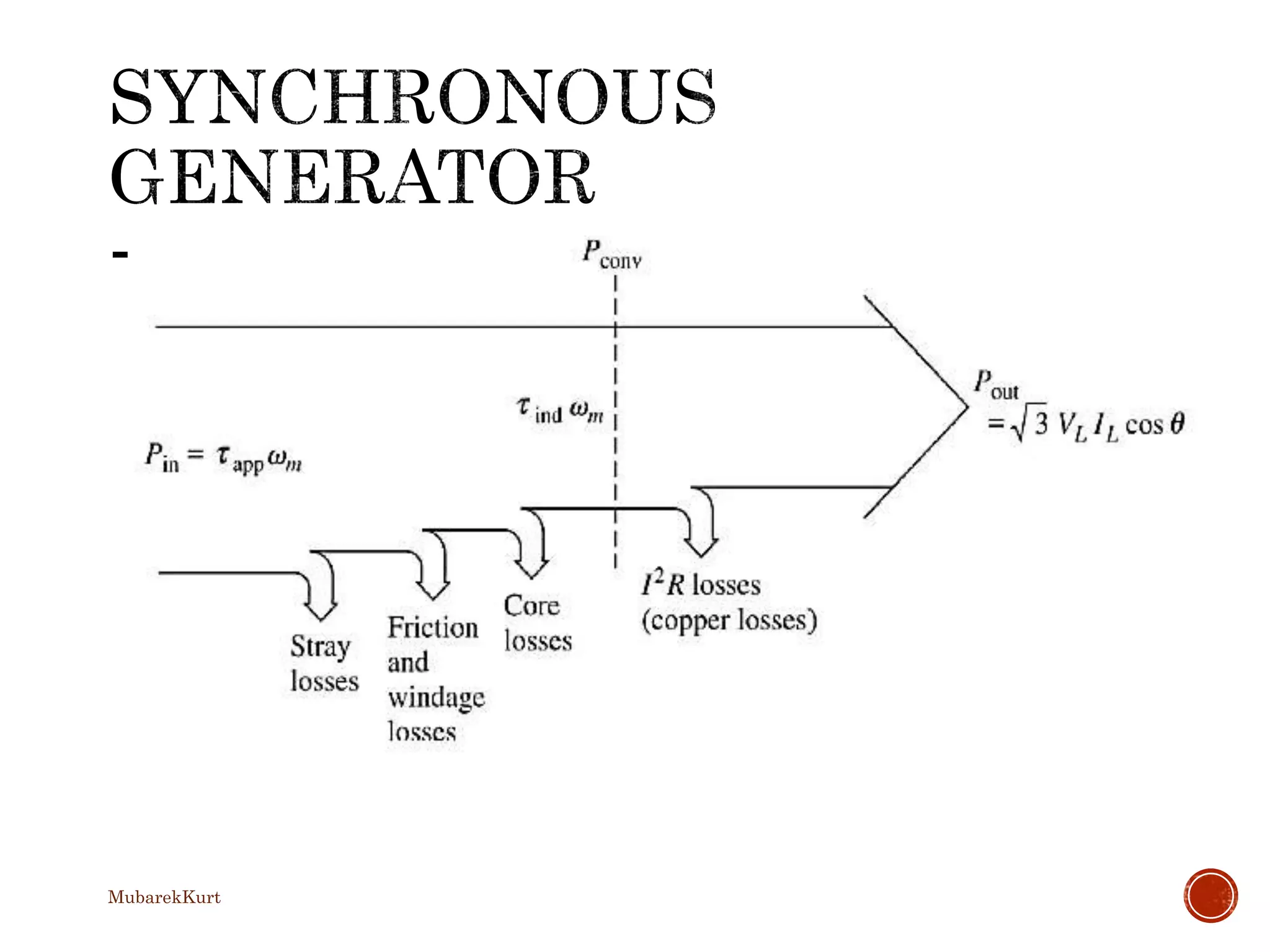
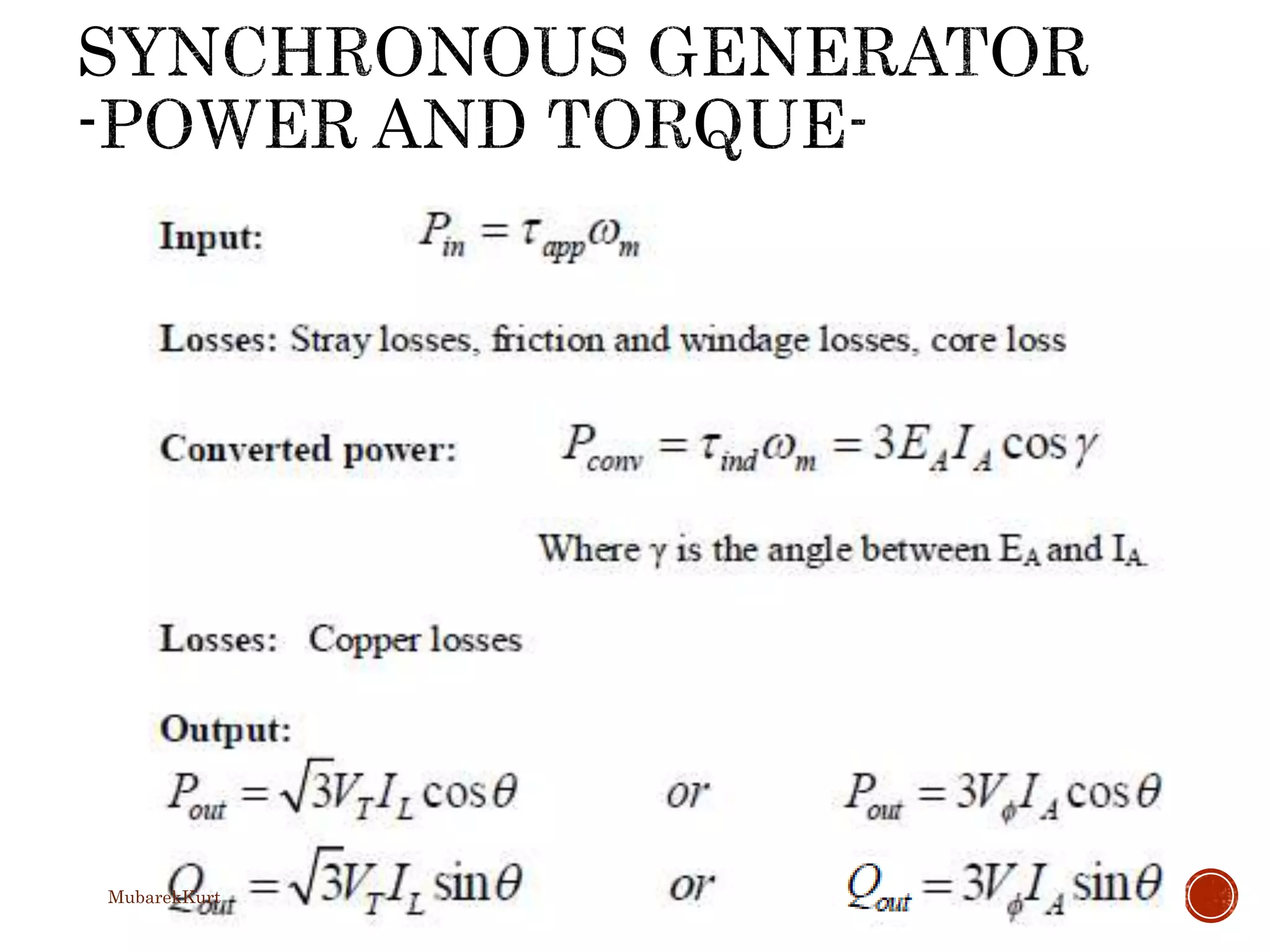
From power expression Pout = Pconv =
indm
MubarekKurt
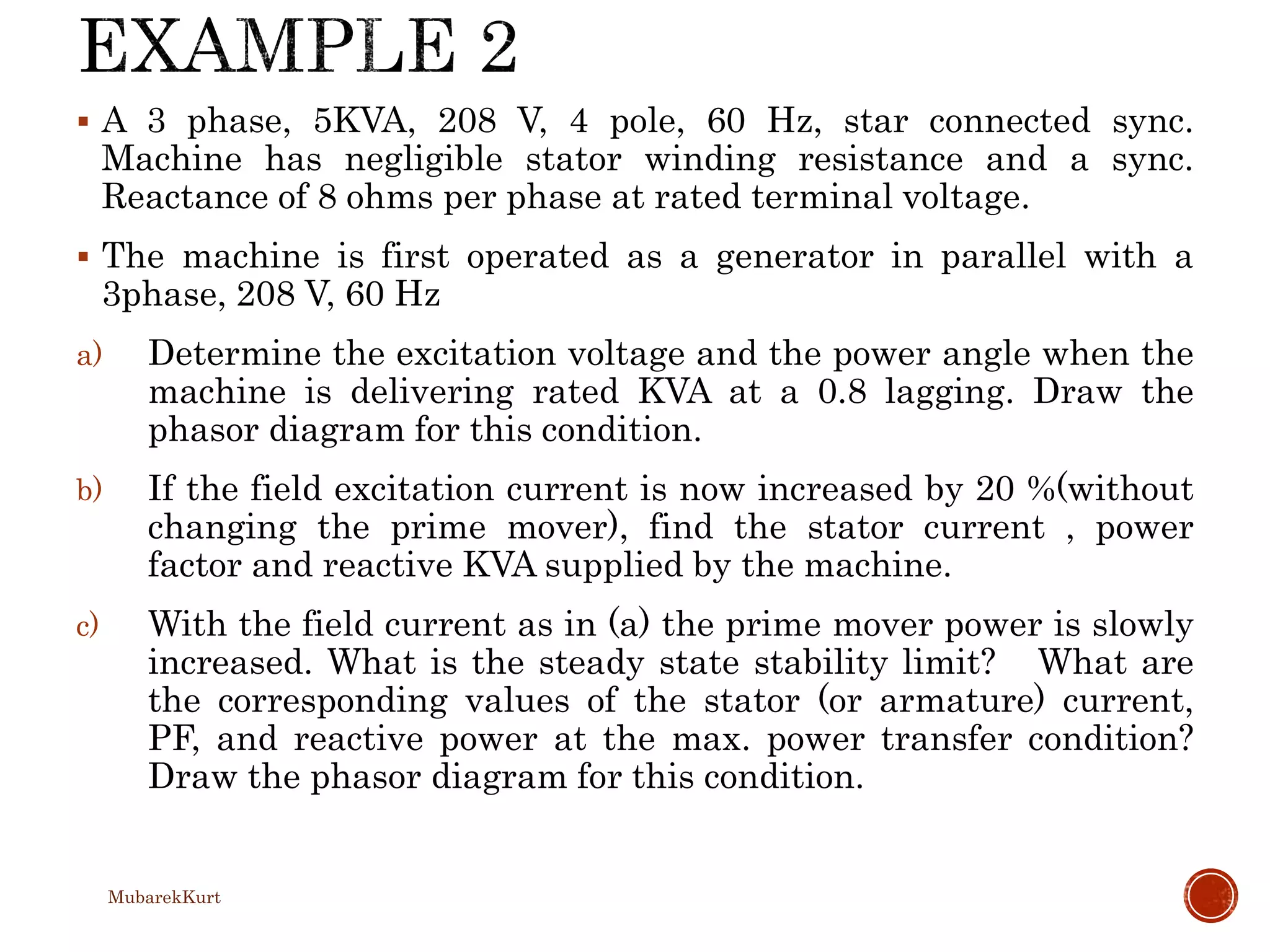
 A 3 phase, 5KVA, 208 V, 4 pole, 60 Hz, star connected sync.
Machine has negligible stator winding resistance and a sync.
Reactance of 8 ohms per phase at rated terminal voltage.
 The machine is first operated as a generator in parallel with a
3phase, 208 V, 60 Hz
a) Determine the excitation voltage and the power angle when the
machine is delivering rated KVA at a 0.8 lagging. Draw the
phasor diagram for this condition.
b) If the field excitation current is now increased by 20 %(without
changing the prime mover), find the stator current , power
factor and reactive KVA supplied by the machine.
c) With the field current as in (a) the prime mover power is slowly
increased. What is the steady state stability limit? What are
the corresponding values of the stator (or armature) current,
PF, and reactive power at the max. power transfer condition?
Draw the phasor diagram for this condition.
MubarekKurt
Purpose of test is to determine these parameters:
a) Field current and flux relationship (and therefore between the
field current and Ea)
b) Synchronous reactance
c) Armature resistance
Open circuit and short circuit tests should be performed in order to
get all parameters
MubarekKurt
Procedures:
1) Generators is rotated at the rated speed
2) No load is connected at the terminals and field current, If is
set to zero.
3) Field current is increased from 0 to maximum and the
terminal Voltage Vt is measured at each step along the way.
With terminal open IA=0, Ea=Vt
4) Record values and plot graph of the terminal voltage and
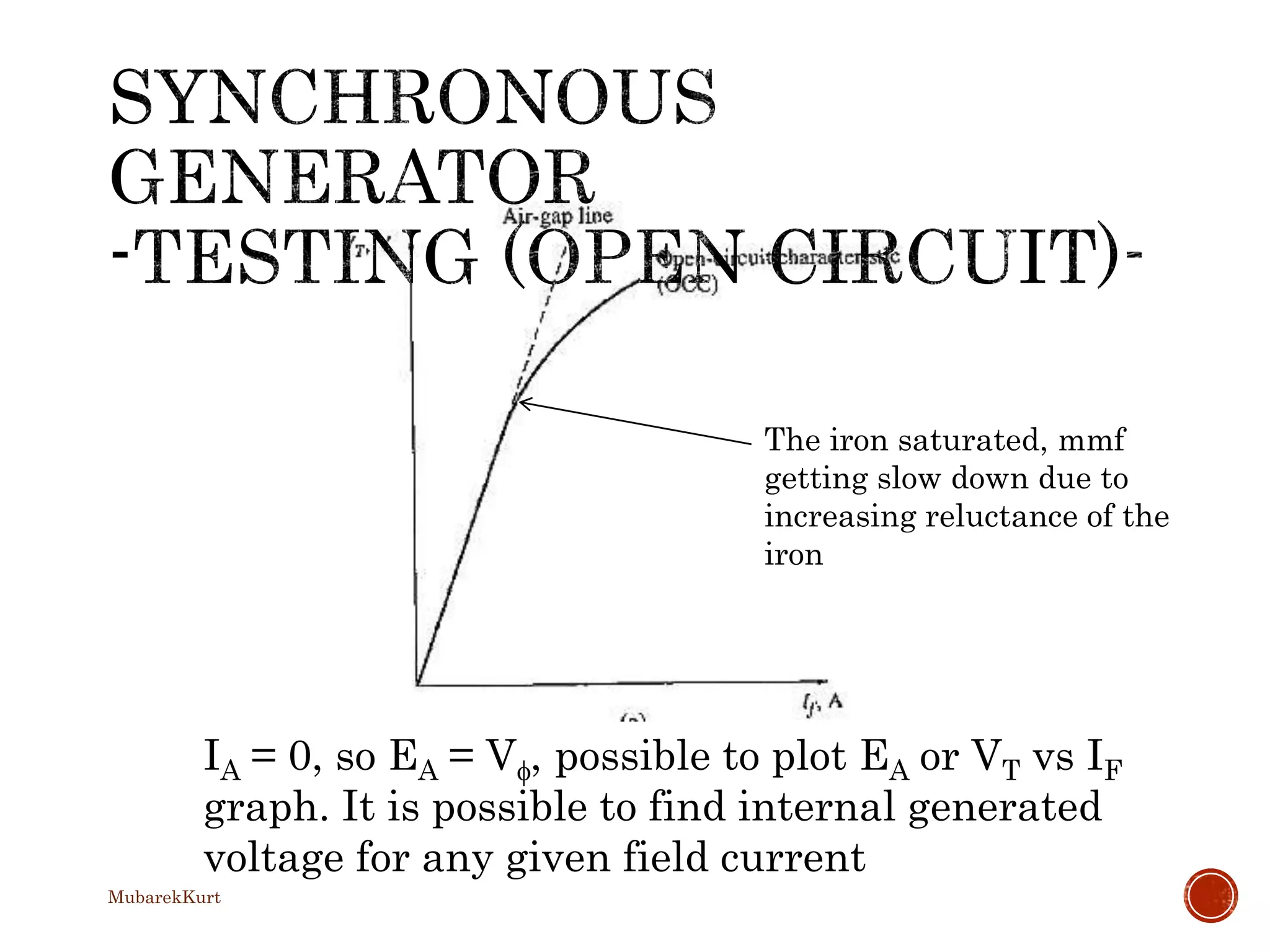
field current value. This plot is called open circuit
characteristic (OCC) of a generator.
MubarekKurt
IA = 0, so EA = V, possible to plot EA or VT vs IF
graph. It is possible to find internal generated
voltage for any given field current
The iron saturated, mmf
getting slow down due to
increasing reluctance of the
iron
MubarekKurt
Procedures of short circuit test:
1) Generator is rotated at rated speed
2) Adjust field current to 0
3) Short circuit the terminals through a set of ammeters.
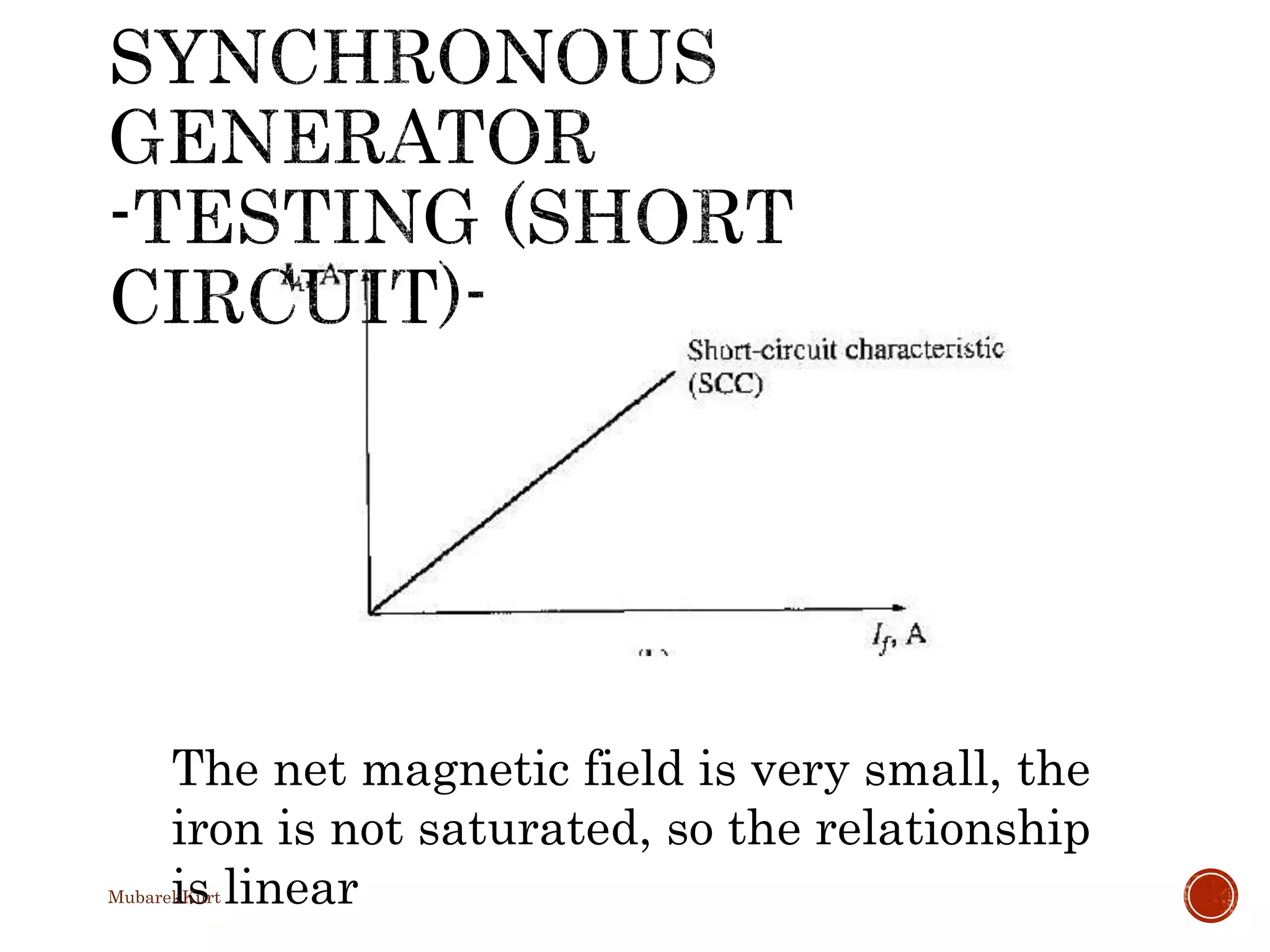
4) Measure armature current, Ia or line current as the field
current is increased and plot the graph. This graph is
known as short-circuit characteristic (SCC).
MubarekKurt
The net magnetic field is very small, the
iron is not saturated, so the relationship
is linearMubarekKurt
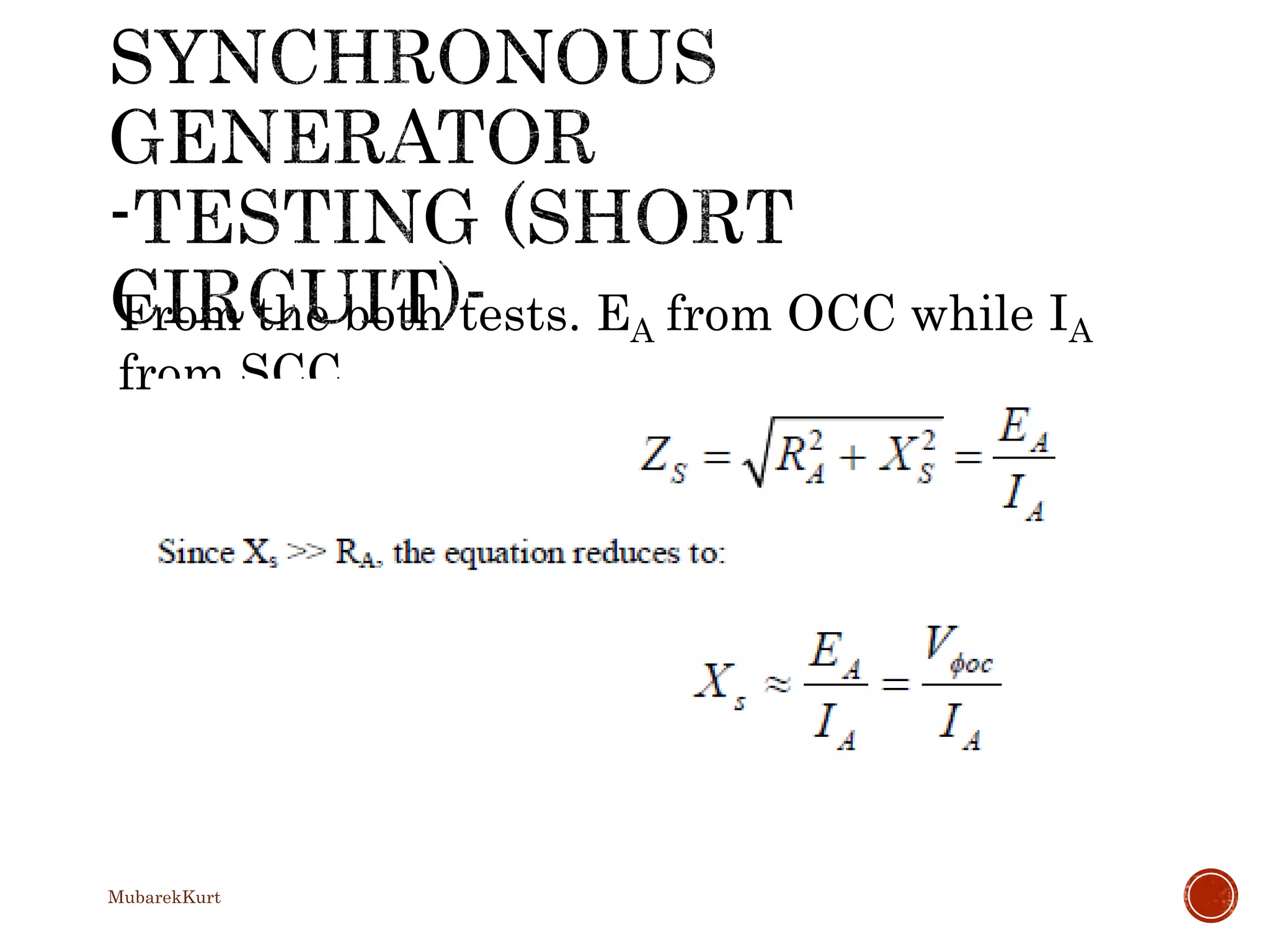
From the both tests. EA from OCC while IA
from SCC
MubarekKurt
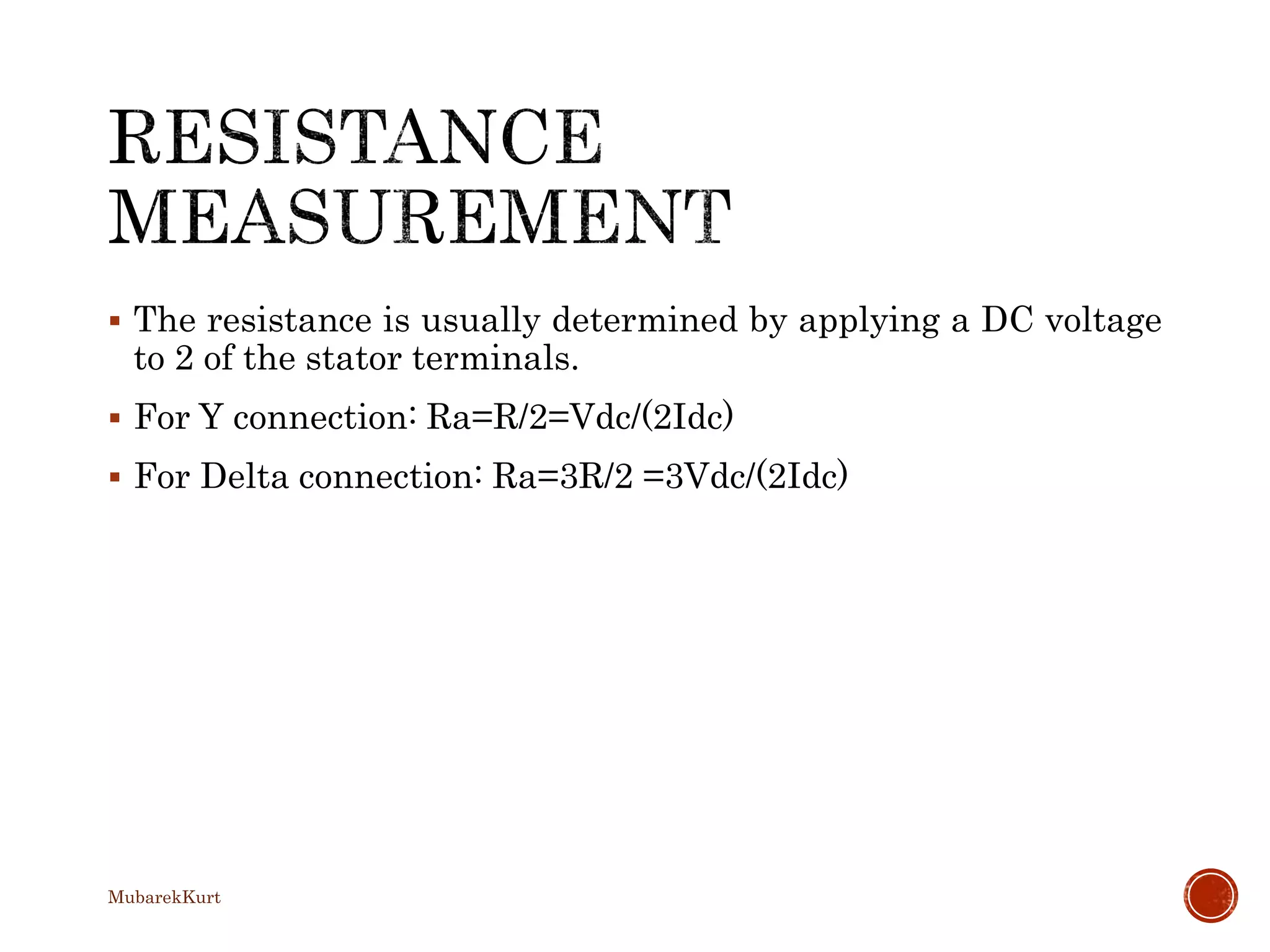
 The resistance is usually determined by applying a DC voltage
to 2 of the stator terminals.
 For Y connection: Ra=R/2=Vdc/(2Idc)
 For Delta connection: Ra=3R/2 =3Vdc/(2Idc)
MubarekKurt
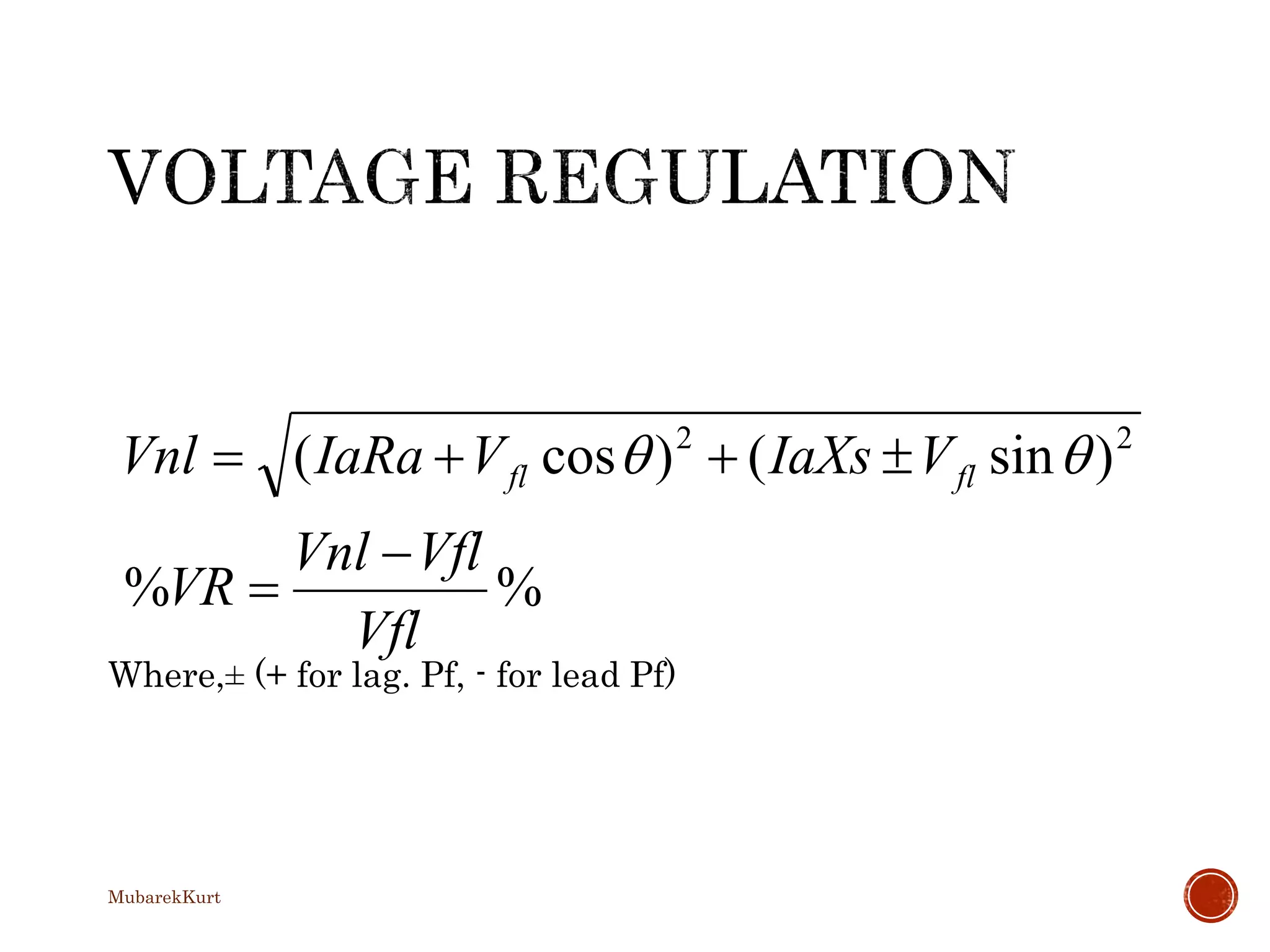
Where,± (+ for lag. Pf, - for lead Pf)
%%
)sin()cos( 22
Vfl
VflVnl
VR
VIaXsVIaRaVnl flfl


 
MubarekKurt
 A 3 phase syn. Gen. rated at 50 kVA, 220 V, 60 Hz is Y
connected. The test results are given below. Find Ra, Zs and
Xs.
 Resistance test: V=2, I=22
 SCT: I1=I2=I3=rated current, If=22 A
 OCT: If=22 A, V=95 V
MubarekKurt
 A 200kVA, 480 V, 50 Hz, Y-connected syn. Gen. with a rated
field current of 5 A was tested, and the following data were
taken:
 Vt,oc at the rated If was measured to be 540 V.
 IL,sc at the rated If was found to be 300 A.
 When a dc voltage of 10 V was applied to 2 of the terminals, a
current of 25 A was measured. Find Ra & Xs
MubarekKurt
A 2300-V 1000-kVA 0.8-PF-lagging 60-Hz two-pole Y-connected
synchronous generator has a synchronous reactance of 1.1 Ω and an
armature resistance of 0.15 Ω. At 60 Hz, its friction and windage
losses are 24 kW, and its core losses are 18 kW. The field circuit has
a dc voltage of 200 V, and the maximum IF is 10 A. The resistance of
the field circuit is adjustable over the range from 20 to 200 Ω. The
OCC of this generator is shown in Figure.
(a) How much field current is required to make VT equal to 2300 V
when the generator is running at no load?
(b) What is the internal generated voltage of this machine at rated
conditions?
(c) How much field current is required to make VT equal to 2300 V
when the generator is running at rated conditions?
(d) How much power and torque must the generator’s prime mover
be capable of supplying?
(e) Construct a capability curve for this generator.
MubarekKurt
MubarekKurt
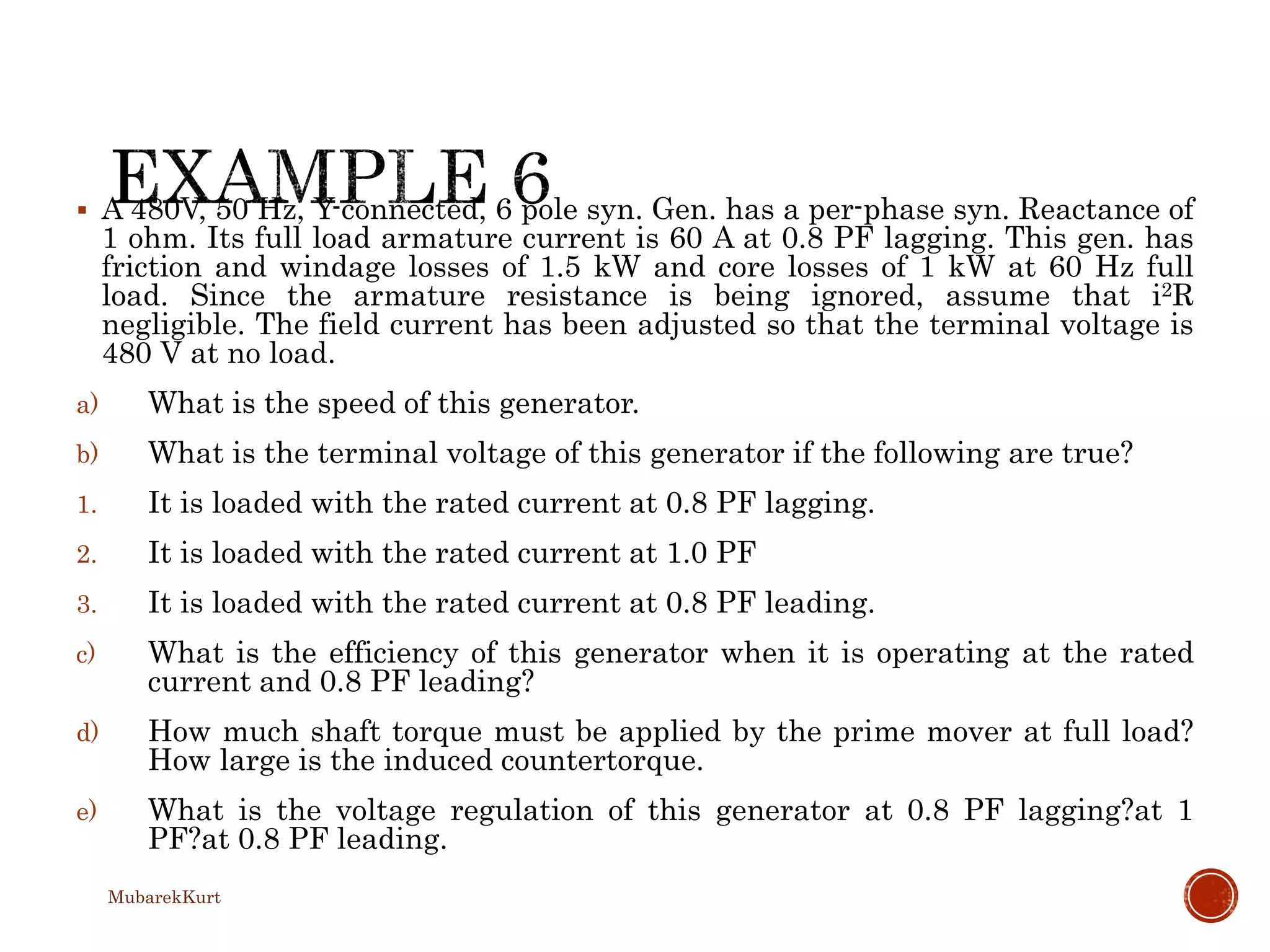
 A 480V, 50 Hz, Y-connected, 6 pole syn. Gen. has a per-phase syn. Reactance of
1 ohm. Its full load armature current is 60 A at 0.8 PF lagging. This gen. has
friction and windage losses of 1.5 kW and core losses of 1 kW at 60 Hz full
load. Since the armature resistance is being ignored, assume that i2R
negligible. The field current has been adjusted so that the terminal voltage is
480 V at no load.
a) What is the speed of this generator.
b) What is the terminal voltage of this generator if the following are true?
1. It is loaded with the rated current at 0.8 PF lagging.
2. It is loaded with the rated current at 1.0 PF
3. It is loaded with the rated current at 0.8 PF leading.
c) What is the efficiency of this generator when it is operating at the rated
current and 0.8 PF leading?
d) How much shaft torque must be applied by the prime mover at full load?
How large is the induced countertorque.
e) What is the voltage regulation of this generator at 0.8 PF lagging?at 1
PF?at 0.8 PF leading.
MubarekKurt
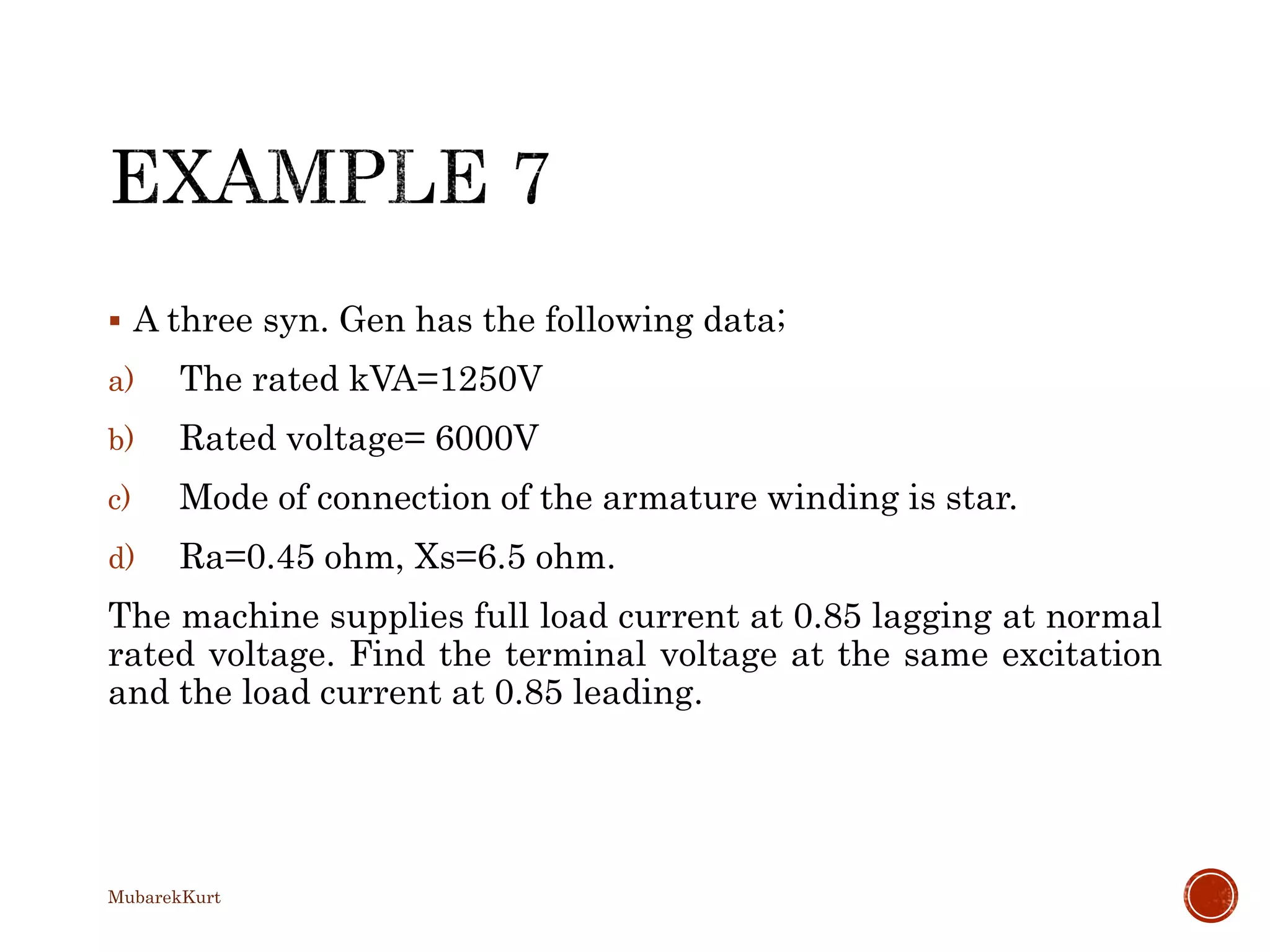
 A three syn. Gen has the following data;
a) The rated kVA=1250V
b) Rated voltage= 6000V
c) Mode of connection of the armature winding is star.
d) Ra=0.45 ohm, Xs=6.5 ohm.
The machine supplies full load current at 0.85 lagging at normal
rated voltage. Find the terminal voltage at the same excitation
and the load current at 0.85 leading.
MubarekKurt
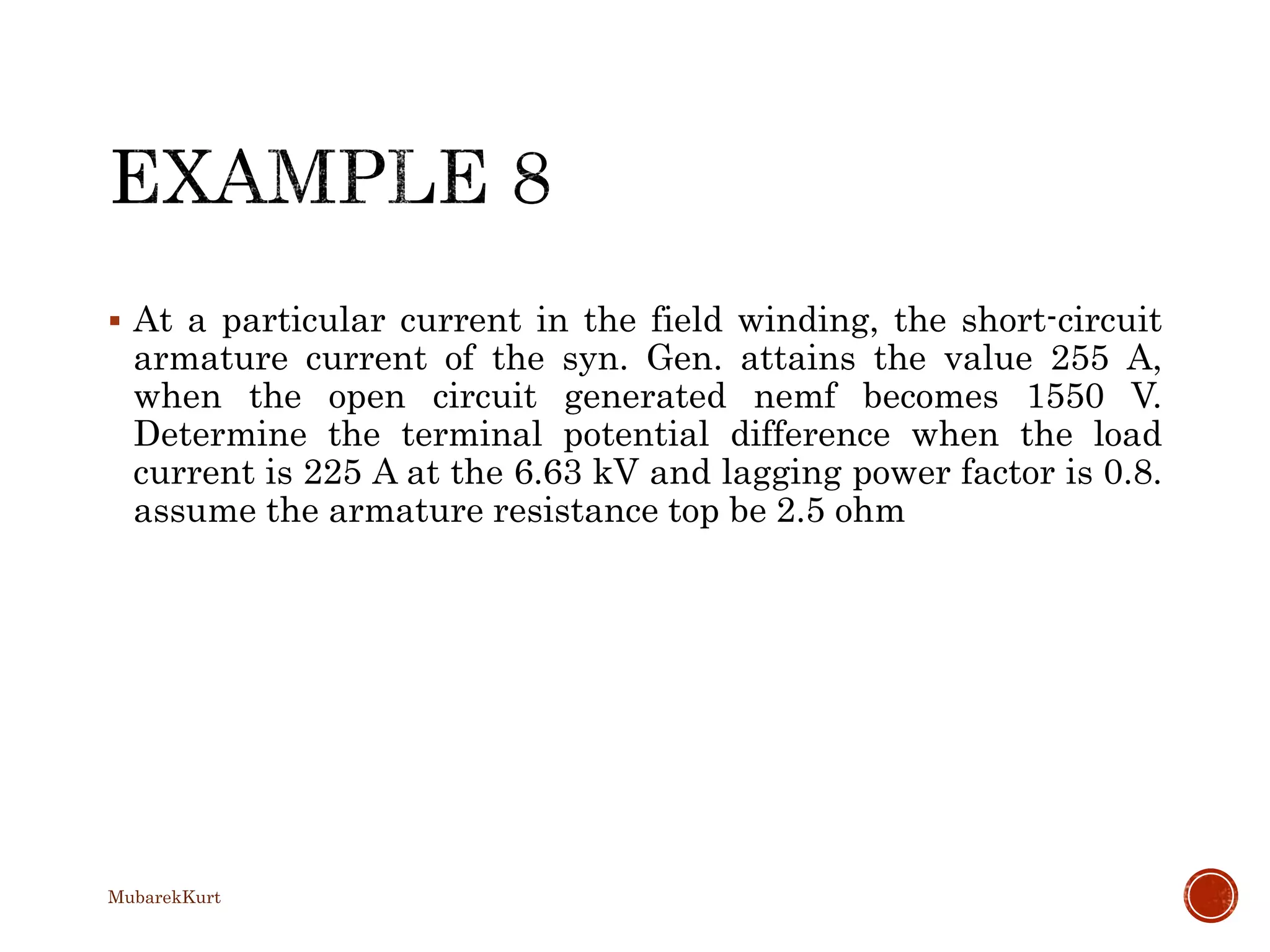
 At a particular current in the field winding, the short-circuit
armature current of the syn. Gen. attains the value 255 A,
when the open circuit generated nemf becomes 1550 V.
Determine the terminal potential difference when the load
current is 225 A at the 6.63 kV and lagging power factor is 0.8.
assume the armature resistance top be 2.5 ohm
MubarekKurt
 A 1000 kVA, 1200 V 3 phase alternator is Y connected. Its
resistance per phase is 0.12 ohm and the reactance per phase
is 1.5 ohm, Find its voltage regulation if it supplies rates load
at:
a) PF=1
b) PF=0.9 lagging
c) PF = 0.9 Leading
d) What would the no-load line voltage be in part (c)
MubarekKurt
 Repeat previous example but the alternator is delta connected
MubarekKurt
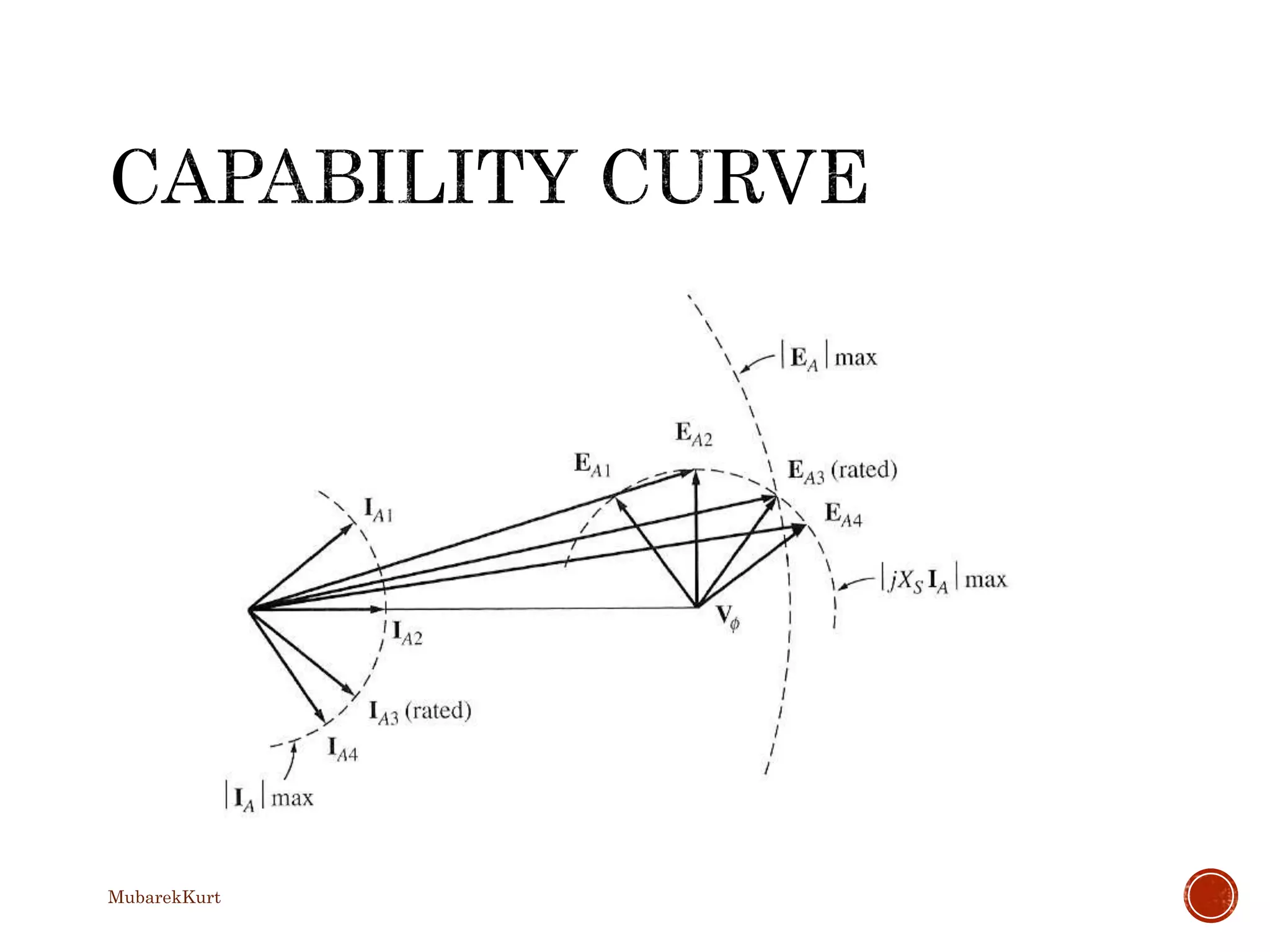
 There are 2 factors that determine the power limits of electric
machines.
 One is mechanical torque on the shaft of the machine, and the
other is the heating of the machine’s windings.
 In all practical syn. Motors and generators, the shaft is strong
enough mechanically to handle a much larger steady state
power than the machine is rated for, so the practical steady
state limits are set by heating in the machine windings.
MubarekKurt
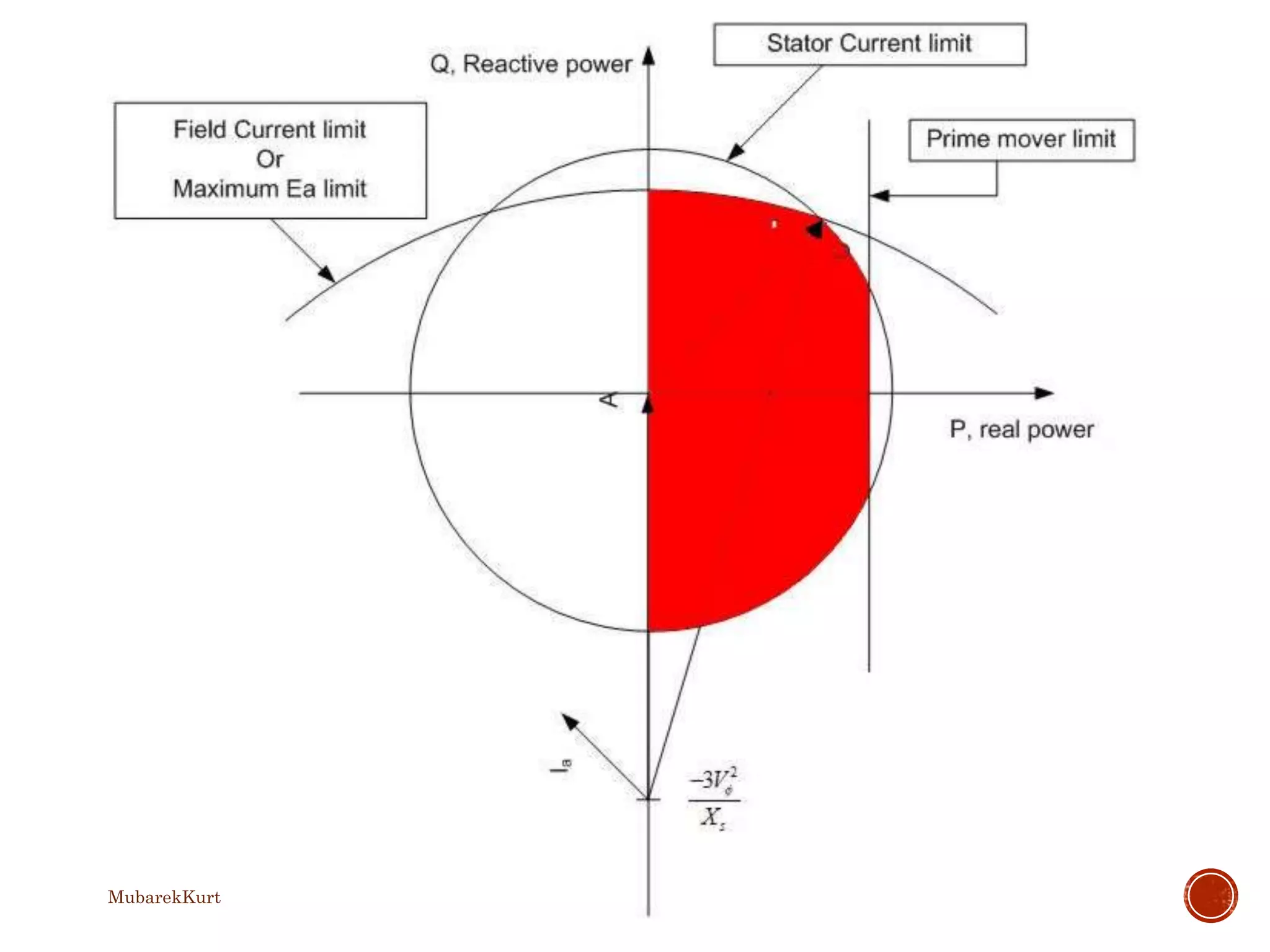
 The stator and rotor heat limits, together with any external
limits on a syn. Gen. can be expressed in graphical form by a
gen. capability diagram.
 A capability diagram is a plot of complex power, S=P+jQ. It is
derived from the phasor diagram of the generator., assuming
that the V is constant at the machine rated voltage.
MubarekKurt
MubarekKurt
Problem statement;
 Notice that for some possible current angles the required EA
exceeds EA,max. If the generator were operated at the rated
armature current and these power factors, the field winding would
burn up.
 Based upon these limits, there is a need to plot the capability of
the synchronous generator. This is so that it can be shown
graphically the limits of the generator.
 A capability diagram is a plot of complex power S=P+jQ. The
capability curve can be derived back from the voltage phasor of the
synchronous generator.
MubarekKurt
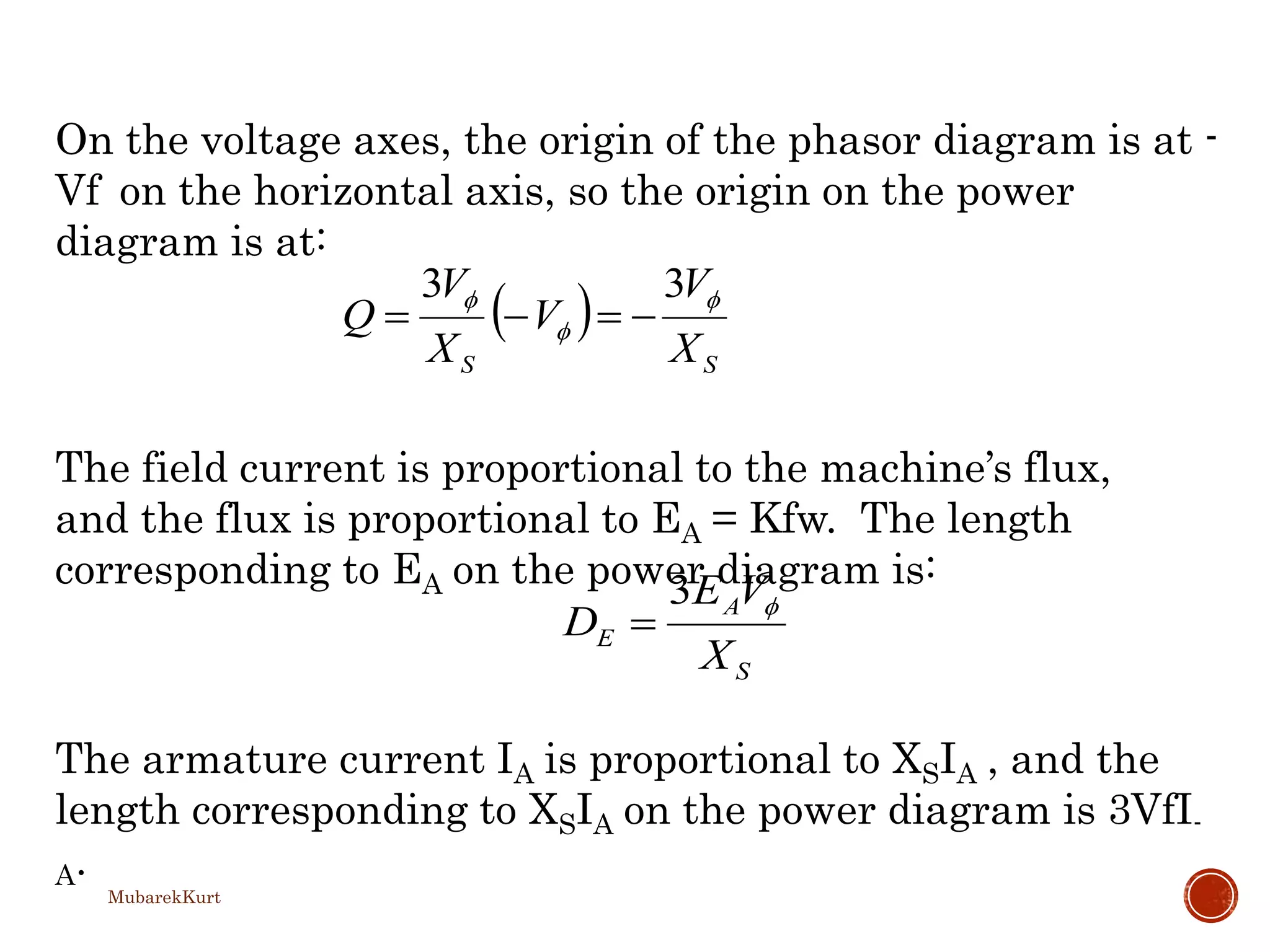
 
SS X
V
V
X
V
Q 

 33

S
A
E
X
VE
D 3

On the voltage axes, the origin of the phasor diagram is at -
Vf on the horizontal axis, so the origin on the power
diagram is at:
The field current is proportional to the machine’s flux,
and the flux is proportional to EA = Kfw. The length
corresponding to EA on the power diagram is:
The armature current IA is proportional to XSIA , and the
length corresponding to XSIA on the power diagram is 3VfI-
A.
MubarekKurt
MubarekKurt
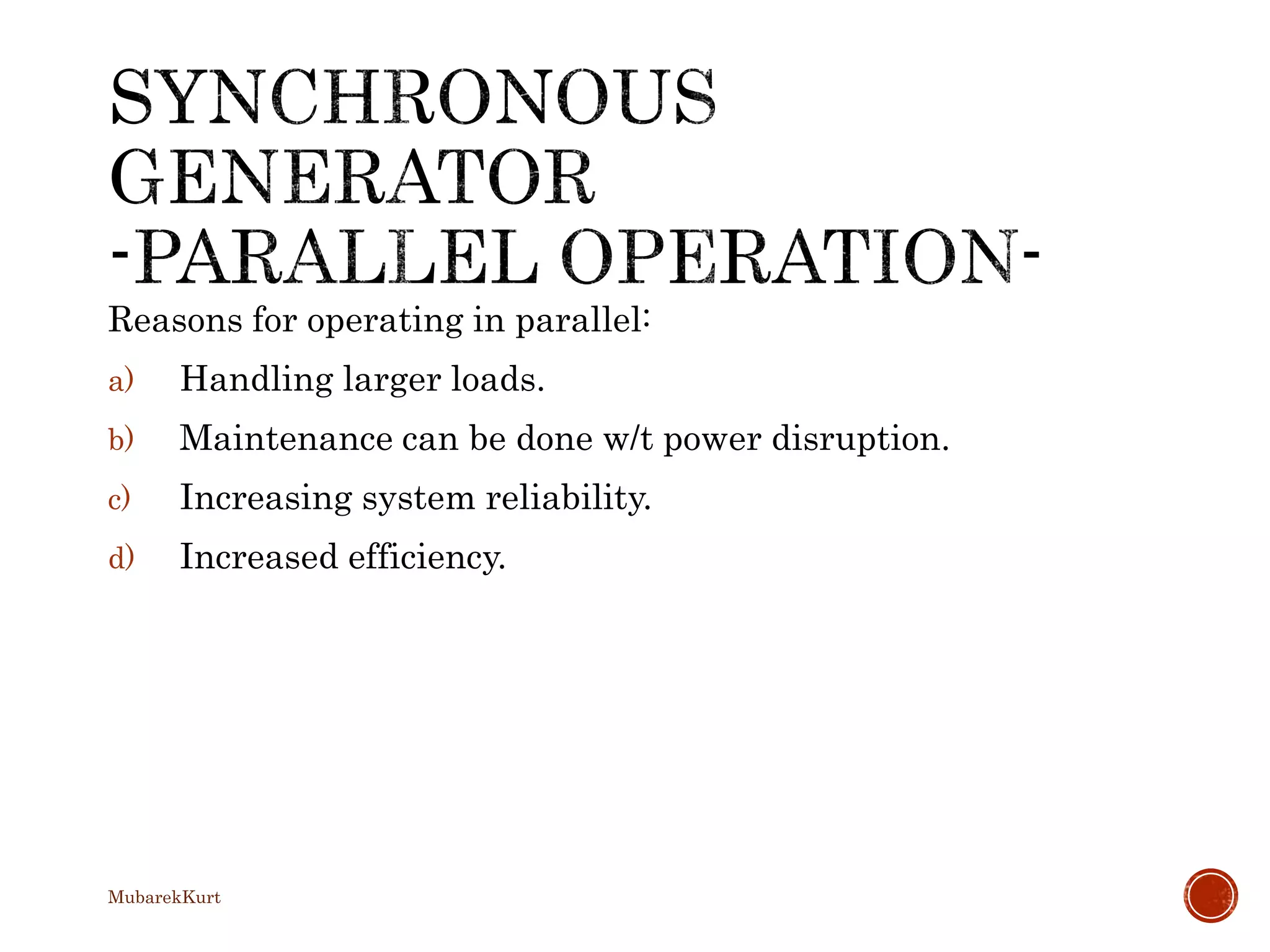
Reasons for operating in parallel:
a) Handling larger loads.
b) Maintenance can be done w/t power disruption.
c) Increasing system reliability.
d) Increased efficiency.
MubarekKurt
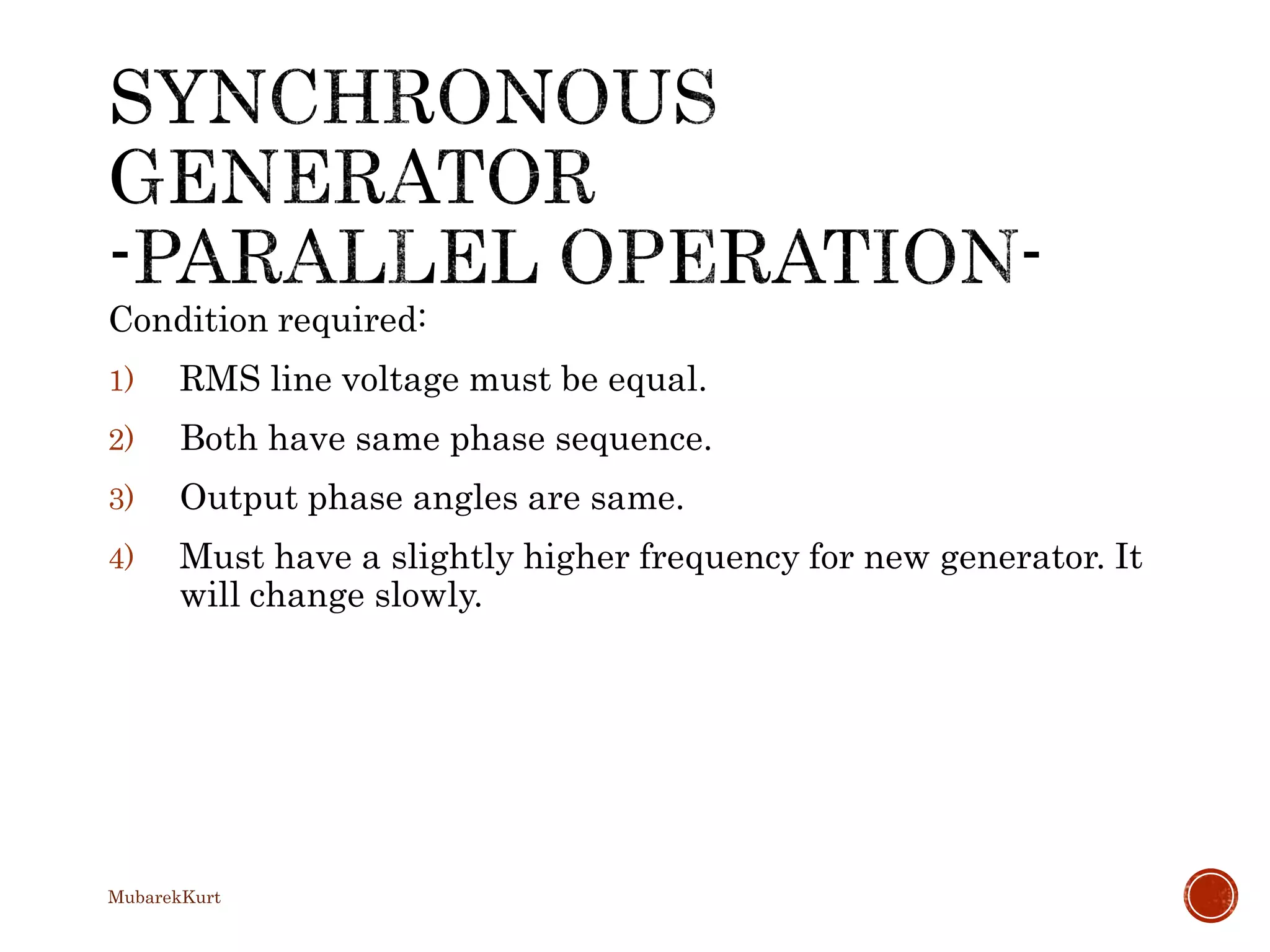
Condition required:
1) RMS line voltage must be equal.
2) Both have same phase sequence.
3) Output phase angles are same.
4) Must have a slightly higher frequency for new generator. It
will change slowly.
MubarekKurt
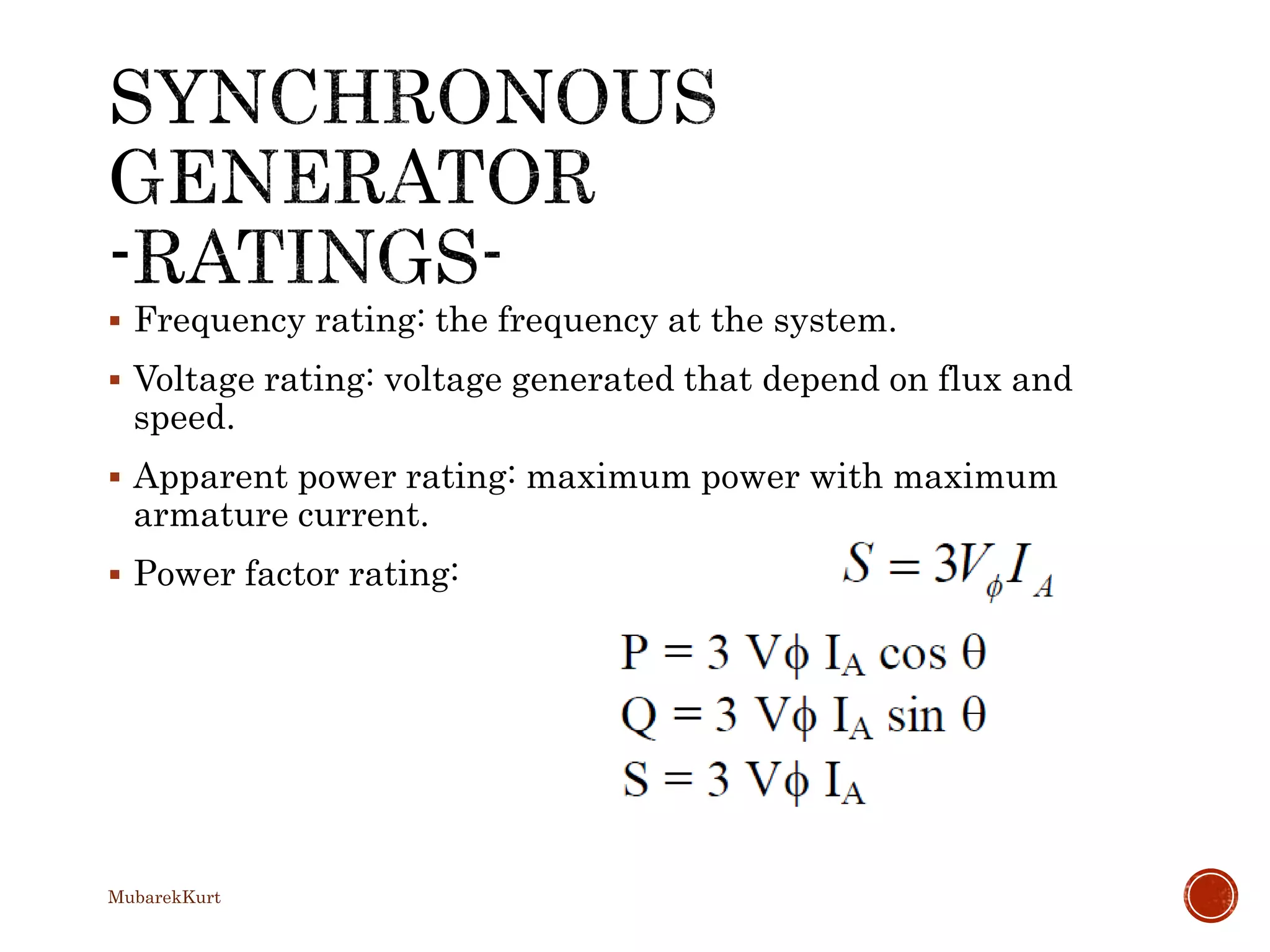
 Frequency rating: the frequency at the system.
 Voltage rating: voltage generated that depend on flux and
speed.
 Apparent power rating: maximum power with maximum
armature current.
 Power factor rating:
MubarekKurt
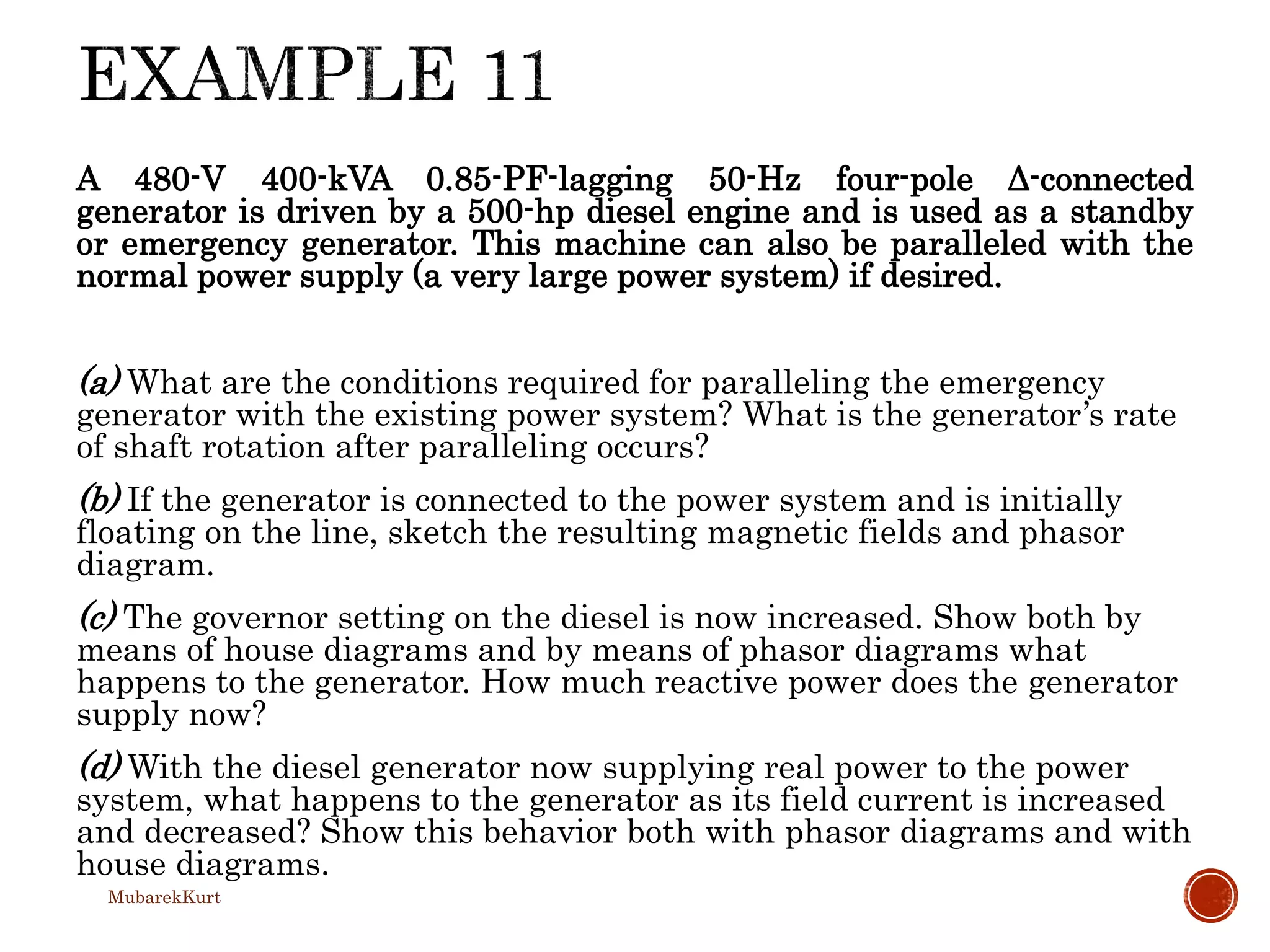
A 480-V 400-kVA 0.85-PF-lagging 50-Hz four-pole Δ-connected
generator is driven by a 500-hp diesel engine and is used as a standby
or emergency generator. This machine can also be paralleled with the
normal power supply (a very large power system) if desired.
(a) What are the conditions required for paralleling the emergency
generator with the existing power system? What is the generator’s rate
of shaft rotation after paralleling occurs?
(b) If the generator is connected to the power system and is initially
floating on the line, sketch the resulting magnetic fields and phasor
diagram.
(c) The governor setting on the diesel is now increased. Show both by
means of house diagrams and by means of phasor diagrams what
happens to the generator. How much reactive power does the generator
supply now?
(d) With the diesel generator now supplying real power to the power
system, what happens to the generator as its field current is increased
and decreased? Show this behavior both with phasor diagrams and with
house diagrams.
MubarekKurt
A 13.8-kV 10-MVA 0.8-PF-lagging 60-Hz two-pole Y-connected
steam-turbine generator has a synchronous reactance of 12 Ω per
phase and an armature resistance of 1.5 Ω per phase. This
generator is operating in parallel with a large power system
(infinite bus).
(a) What is the magnitude of EA at rated conditions?
(b) What is the torque angle of the generator at rated conditions?
(c) If the field current is constant, what is the maximum power
possible out of this generator? How much reserve power or torque
does this generator have at full load?
(d) At the absolute maximum power possible, how much reactive
power will this generator be supplying or consuming? Sketch the
corresponding phasor diagram. (Assume IF is still unchanged.)
MubarekKurt

Electrical Power Systems Synchronous Generator

  • 1.
    Electrical Power Systems SynchronousGenerator By: Mubarek Kurt
  • 2.
     A synchronousmachine rotates at a constant speed in the steady state.  Unlike induction machines, the rotating air gap field and the rotor in the synchronous machine rotate at the same speed, called the synchronous speed.  Sync. Machine are used primarily as generators of electrical power (Hydro, nuclear or thermal power stations).  Like most rotating machines, a synchronous machine can also operate as both a generator and a motor. MubarekKurt
  • 3.
     An importantfeature of a synchronous motor is that it can draw either lagging or leading reactive current from ac supply system.  Its rotor poles are excited by a DC current and its stator winding (or armature winding) are connected to the AC supply. MubarekKurt
  • 4.
     The statorof the 3 phase sync. Machine has a 3 phase distributed winding similar to that of the 3 phase induction machine.  The stator winding, which is connected to the ac supply system, is sometimes called the armature winding. It is designed for high voltage and current.  The rotor has a winding called the field winding, which carries direct current. The field winding on the rotating on the structure is normally fed from an external dc source through slip rings and brushes. MubarekKurt
  • 5.
     Synchronous machinescan be broadly divided into 2 groups as follows: a) High speed machines with cylindrical (or non-salient pole) rotors. b) Low-speed machines with salient pole rotors. MubarekKurt
  • 6.
  • 7.
     Syn. Gen.are by definition sync., meaning that the electrical freq. is locked in or synchronized with mechanical rate of rotation of the gen.  The electrical frequency is synchronized with the mechanical rate of rotation  Relationship between magnetic field speed and electrical frequency, nm is motor speed in RPM MubarekKurt
  • 8.
     Determine therotor speed in RPM of the following 3 phase synchronous machines a) f=60Hz, number of poles=6 b) f=50Hz, number of poles=12 c) f=400Hz, number of poles=4 MubarekKurt
  • 9.
    The magnitude ofthe voltage induced in a given stator phase is This voltage depends on the flux, ɸ in the machine, the freq. or speed of rotation, and the machine construction. The equation can be simplified as follow Or MubarekKurt
  • 10.
    • The voltage,Ea is not usually the voltage that appears at the terminals, Vt of the generator. • In fact, the only time the internal voltage Ea is the same as the output voltage, Vt of a phase is when there is no armature current flowing in the machine. • There are some factors that cause the diff. between Ea and Vt a) The distortion of the air gap magnetic field by he current flowing in the stator, called Armature reaction b) Self inductance of the armature coilMubarekKurt
  • 11.
     We willexplore the effects of the first three factors and derive a machine model from them.  The effect of a salient pole shape on the operation of a sync. Machine will be ignored; in other words, all the machine in this note are assumed to have non-salient or cyclindrical rotors. MubarekKurt
  • 12.
    The first effectmentioned, and normally the largest one is armature reaction. To understand armature reaction, please refer below. The figure shows a 2 pole rotor spinning inside a 3 phase stator. There is no load connected to the stator. The rotor magnetic field BR produces an internal generated voltage Ea. With no load, thus Ea=Vt MubarekKurt
  • 13.
     Now supposethat the gen. is connected to a lagging load. Because the load is lag. The peak current will occur at an angle behind the peak voltage. MubarekKurt
  • 14.
     This currentflowing in the stator windings produces a magnetic field of its own, Bs and produces a voltage of its own in the stator, Estat.  With 2 voltages present in the stator winding, the total voltage in a phase is just sum of internal generated voltage Ea and armature reaction voltage Estat. SRnet statat BBB EEV   MubarekKurt
  • 15.
     Since theangle of Ea and BR is the same and the angle of Estat and Bs are the same, the resulting magnetic field will coincide with net voltage, Vt.  First note that, the voltage Estat lies at an angle 90 degree behind current IA, thus the armature reactionn voltage can be expressed as Aat Astat jXIEV jXIE   MubarekKurt
  • 16.
  • 17.
     In additionto the effects of armature reaction, the stator coils have a self inductance, XA and a resistance, RA. Thus,  Where Xs=Syn. reactance ASat As AAAAAat IjXEV XXX IjRIjXjXIEV    MubarekKurt
  • 18.
  • 19.
  • 20.
    X=leakage reactance, Xa=armaturereaction reactance, Xs=Xa+X= synchronous reactance, Ra=armature resistance, Zs=synchronous impedance, Vt=terminal voltages and Em=Magnetizing Voltage. MubarekKurt
  • 21.
  • 22.
  • 23.
  • 24.
    - RA assumedto be zero -  Torque angle - Maximum torque due to max power when sin  is 1 MubarekKurt
  • 25.
    Basic torque equation: Frompower expression Pout = Pconv = indm MubarekKurt
  • 26.
     A 3phase, 5KVA, 208 V, 4 pole, 60 Hz, star connected sync. Machine has negligible stator winding resistance and a sync. Reactance of 8 ohms per phase at rated terminal voltage.  The machine is first operated as a generator in parallel with a 3phase, 208 V, 60 Hz a) Determine the excitation voltage and the power angle when the machine is delivering rated KVA at a 0.8 lagging. Draw the phasor diagram for this condition. b) If the field excitation current is now increased by 20 %(without changing the prime mover), find the stator current , power factor and reactive KVA supplied by the machine. c) With the field current as in (a) the prime mover power is slowly increased. What is the steady state stability limit? What are the corresponding values of the stator (or armature) current, PF, and reactive power at the max. power transfer condition? Draw the phasor diagram for this condition. MubarekKurt
  • 27.
    Purpose of testis to determine these parameters: a) Field current and flux relationship (and therefore between the field current and Ea) b) Synchronous reactance c) Armature resistance Open circuit and short circuit tests should be performed in order to get all parameters MubarekKurt
  • 28.
    Procedures: 1) Generators isrotated at the rated speed 2) No load is connected at the terminals and field current, If is set to zero. 3) Field current is increased from 0 to maximum and the terminal Voltage Vt is measured at each step along the way. With terminal open IA=0, Ea=Vt 4) Record values and plot graph of the terminal voltage and field current value. This plot is called open circuit characteristic (OCC) of a generator. MubarekKurt
  • 29.
    IA = 0,so EA = V, possible to plot EA or VT vs IF graph. It is possible to find internal generated voltage for any given field current The iron saturated, mmf getting slow down due to increasing reluctance of the iron MubarekKurt
  • 30.
    Procedures of shortcircuit test: 1) Generator is rotated at rated speed 2) Adjust field current to 0 3) Short circuit the terminals through a set of ammeters. 4) Measure armature current, Ia or line current as the field current is increased and plot the graph. This graph is known as short-circuit characteristic (SCC). MubarekKurt
  • 31.
    The net magneticfield is very small, the iron is not saturated, so the relationship is linearMubarekKurt
  • 32.
    From the bothtests. EA from OCC while IA from SCC MubarekKurt
  • 33.
     The resistanceis usually determined by applying a DC voltage to 2 of the stator terminals.  For Y connection: Ra=R/2=Vdc/(2Idc)  For Delta connection: Ra=3R/2 =3Vdc/(2Idc) MubarekKurt
  • 34.
    Where,± (+ forlag. Pf, - for lead Pf) %% )sin()cos( 22 Vfl VflVnl VR VIaXsVIaRaVnl flfl     MubarekKurt
  • 35.
     A 3phase syn. Gen. rated at 50 kVA, 220 V, 60 Hz is Y connected. The test results are given below. Find Ra, Zs and Xs.  Resistance test: V=2, I=22  SCT: I1=I2=I3=rated current, If=22 A  OCT: If=22 A, V=95 V MubarekKurt
  • 36.
     A 200kVA,480 V, 50 Hz, Y-connected syn. Gen. with a rated field current of 5 A was tested, and the following data were taken:  Vt,oc at the rated If was measured to be 540 V.  IL,sc at the rated If was found to be 300 A.  When a dc voltage of 10 V was applied to 2 of the terminals, a current of 25 A was measured. Find Ra & Xs MubarekKurt
  • 37.
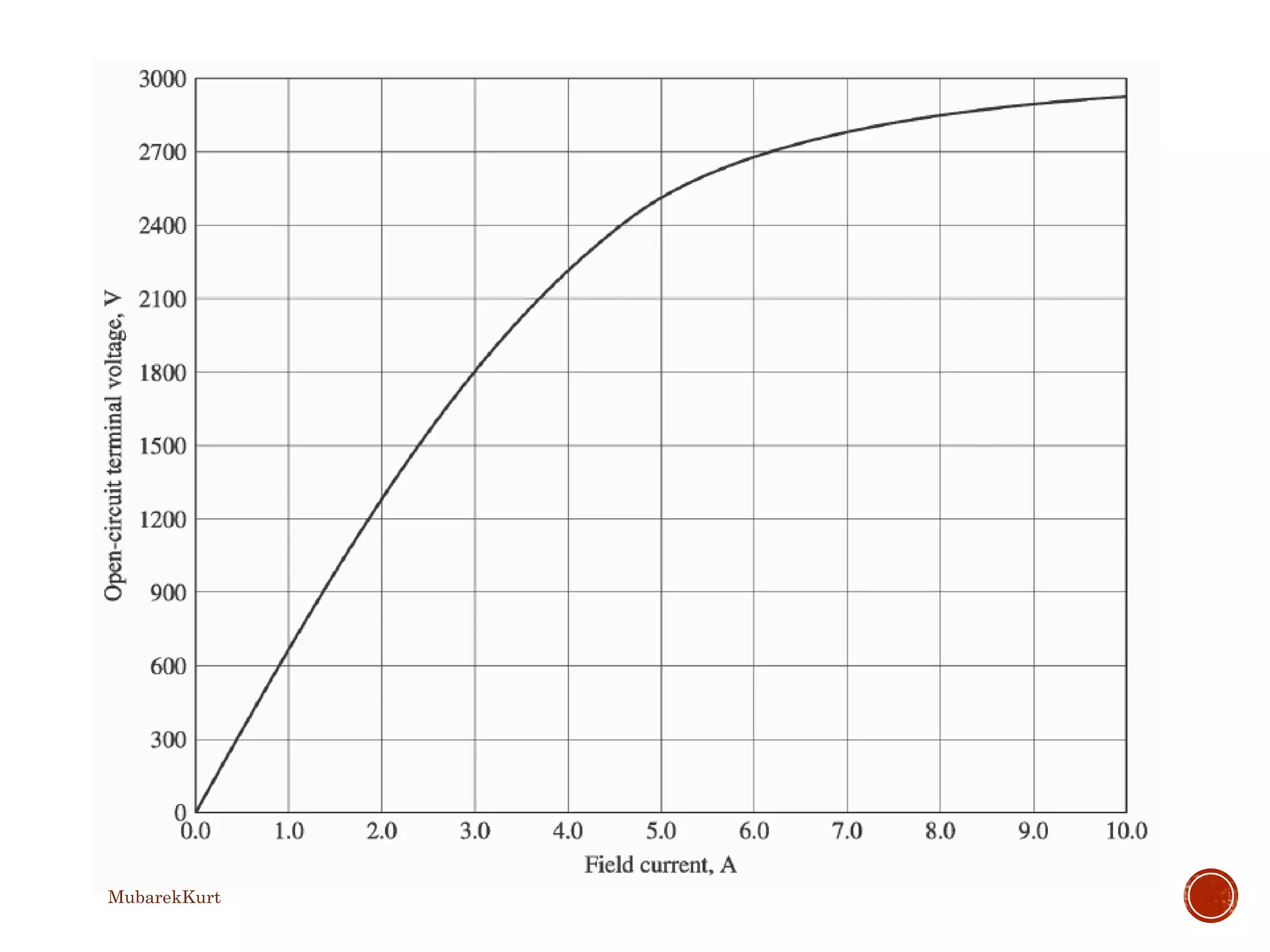
    A 2300-V 1000-kVA0.8-PF-lagging 60-Hz two-pole Y-connected synchronous generator has a synchronous reactance of 1.1 Ω and an armature resistance of 0.15 Ω. At 60 Hz, its friction and windage losses are 24 kW, and its core losses are 18 kW. The field circuit has a dc voltage of 200 V, and the maximum IF is 10 A. The resistance of the field circuit is adjustable over the range from 20 to 200 Ω. The OCC of this generator is shown in Figure. (a) How much field current is required to make VT equal to 2300 V when the generator is running at no load? (b) What is the internal generated voltage of this machine at rated conditions? (c) How much field current is required to make VT equal to 2300 V when the generator is running at rated conditions? (d) How much power and torque must the generator’s prime mover be capable of supplying? (e) Construct a capability curve for this generator. MubarekKurt
  • 38.
  • 39.
     A 480V,50 Hz, Y-connected, 6 pole syn. Gen. has a per-phase syn. Reactance of 1 ohm. Its full load armature current is 60 A at 0.8 PF lagging. This gen. has friction and windage losses of 1.5 kW and core losses of 1 kW at 60 Hz full load. Since the armature resistance is being ignored, assume that i2R negligible. The field current has been adjusted so that the terminal voltage is 480 V at no load. a) What is the speed of this generator. b) What is the terminal voltage of this generator if the following are true? 1. It is loaded with the rated current at 0.8 PF lagging. 2. It is loaded with the rated current at 1.0 PF 3. It is loaded with the rated current at 0.8 PF leading. c) What is the efficiency of this generator when it is operating at the rated current and 0.8 PF leading? d) How much shaft torque must be applied by the prime mover at full load? How large is the induced countertorque. e) What is the voltage regulation of this generator at 0.8 PF lagging?at 1 PF?at 0.8 PF leading. MubarekKurt
  • 40.
     A threesyn. Gen has the following data; a) The rated kVA=1250V b) Rated voltage= 6000V c) Mode of connection of the armature winding is star. d) Ra=0.45 ohm, Xs=6.5 ohm. The machine supplies full load current at 0.85 lagging at normal rated voltage. Find the terminal voltage at the same excitation and the load current at 0.85 leading. MubarekKurt
  • 41.
     At aparticular current in the field winding, the short-circuit armature current of the syn. Gen. attains the value 255 A, when the open circuit generated nemf becomes 1550 V. Determine the terminal potential difference when the load current is 225 A at the 6.63 kV and lagging power factor is 0.8. assume the armature resistance top be 2.5 ohm MubarekKurt
  • 42.
     A 1000kVA, 1200 V 3 phase alternator is Y connected. Its resistance per phase is 0.12 ohm and the reactance per phase is 1.5 ohm, Find its voltage regulation if it supplies rates load at: a) PF=1 b) PF=0.9 lagging c) PF = 0.9 Leading d) What would the no-load line voltage be in part (c) MubarekKurt
  • 43.
     Repeat previousexample but the alternator is delta connected MubarekKurt
  • 44.
     There are2 factors that determine the power limits of electric machines.  One is mechanical torque on the shaft of the machine, and the other is the heating of the machine’s windings.  In all practical syn. Motors and generators, the shaft is strong enough mechanically to handle a much larger steady state power than the machine is rated for, so the practical steady state limits are set by heating in the machine windings. MubarekKurt
  • 45.
     The statorand rotor heat limits, together with any external limits on a syn. Gen. can be expressed in graphical form by a gen. capability diagram.  A capability diagram is a plot of complex power, S=P+jQ. It is derived from the phasor diagram of the generator., assuming that the V is constant at the machine rated voltage. MubarekKurt
  • 46.
  • 47.
    Problem statement;  Noticethat for some possible current angles the required EA exceeds EA,max. If the generator were operated at the rated armature current and these power factors, the field winding would burn up.  Based upon these limits, there is a need to plot the capability of the synchronous generator. This is so that it can be shown graphically the limits of the generator.  A capability diagram is a plot of complex power S=P+jQ. The capability curve can be derived back from the voltage phasor of the synchronous generator. MubarekKurt
  • 48.
      SS X V V X V Q   33  S A E X VE D 3  On the voltage axes, the origin of the phasor diagram is at - Vf on the horizontal axis, so the origin on the power diagram is at: The field current is proportional to the machine’s flux, and the flux is proportional to EA = Kfw. The length corresponding to EA on the power diagram is: The armature current IA is proportional to XSIA , and the length corresponding to XSIA on the power diagram is 3VfI- A. MubarekKurt
  • 49.
  • 50.
    Reasons for operatingin parallel: a) Handling larger loads. b) Maintenance can be done w/t power disruption. c) Increasing system reliability. d) Increased efficiency. MubarekKurt
  • 51.
    Condition required: 1) RMSline voltage must be equal. 2) Both have same phase sequence. 3) Output phase angles are same. 4) Must have a slightly higher frequency for new generator. It will change slowly. MubarekKurt
  • 52.
     Frequency rating:the frequency at the system.  Voltage rating: voltage generated that depend on flux and speed.  Apparent power rating: maximum power with maximum armature current.  Power factor rating: MubarekKurt
  • 53.
    A 480-V 400-kVA0.85-PF-lagging 50-Hz four-pole Δ-connected generator is driven by a 500-hp diesel engine and is used as a standby or emergency generator. This machine can also be paralleled with the normal power supply (a very large power system) if desired. (a) What are the conditions required for paralleling the emergency generator with the existing power system? What is the generator’s rate of shaft rotation after paralleling occurs? (b) If the generator is connected to the power system and is initially floating on the line, sketch the resulting magnetic fields and phasor diagram. (c) The governor setting on the diesel is now increased. Show both by means of house diagrams and by means of phasor diagrams what happens to the generator. How much reactive power does the generator supply now? (d) With the diesel generator now supplying real power to the power system, what happens to the generator as its field current is increased and decreased? Show this behavior both with phasor diagrams and with house diagrams. MubarekKurt
  • 54.
    A 13.8-kV 10-MVA0.8-PF-lagging 60-Hz two-pole Y-connected steam-turbine generator has a synchronous reactance of 12 Ω per phase and an armature resistance of 1.5 Ω per phase. This generator is operating in parallel with a large power system (infinite bus). (a) What is the magnitude of EA at rated conditions? (b) What is the torque angle of the generator at rated conditions? (c) If the field current is constant, what is the maximum power possible out of this generator? How much reserve power or torque does this generator have at full load? (d) At the absolute maximum power possible, how much reactive power will this generator be supplying or consuming? Sketch the corresponding phasor diagram. (Assume IF is still unchanged.) MubarekKurt