Chapter 2 – Analog Control System (cont.) Reduction of Multiple Subsystem System Response – Poles/ Zeros, Second Order System, Steady State Error, Stability Analysis
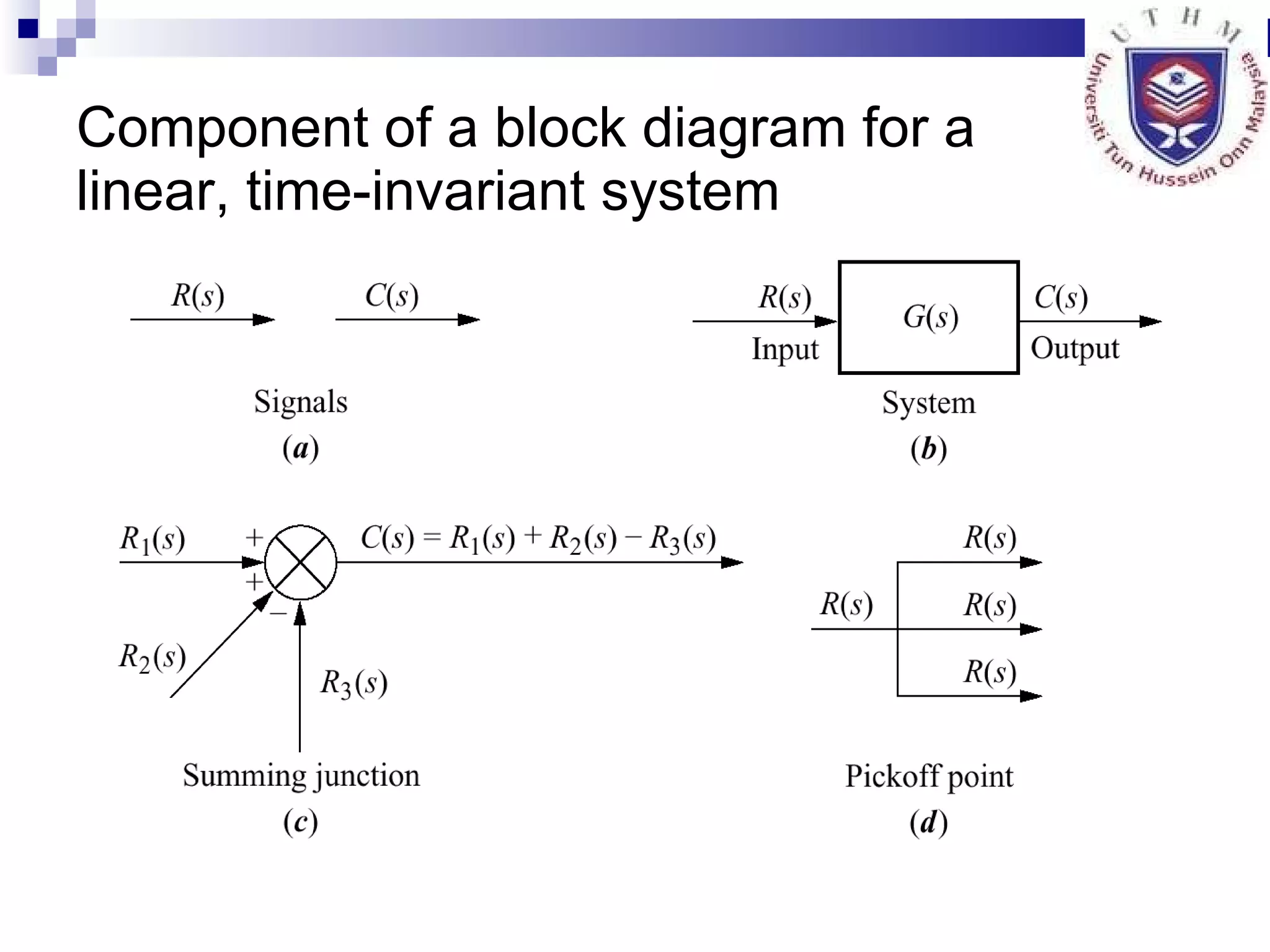
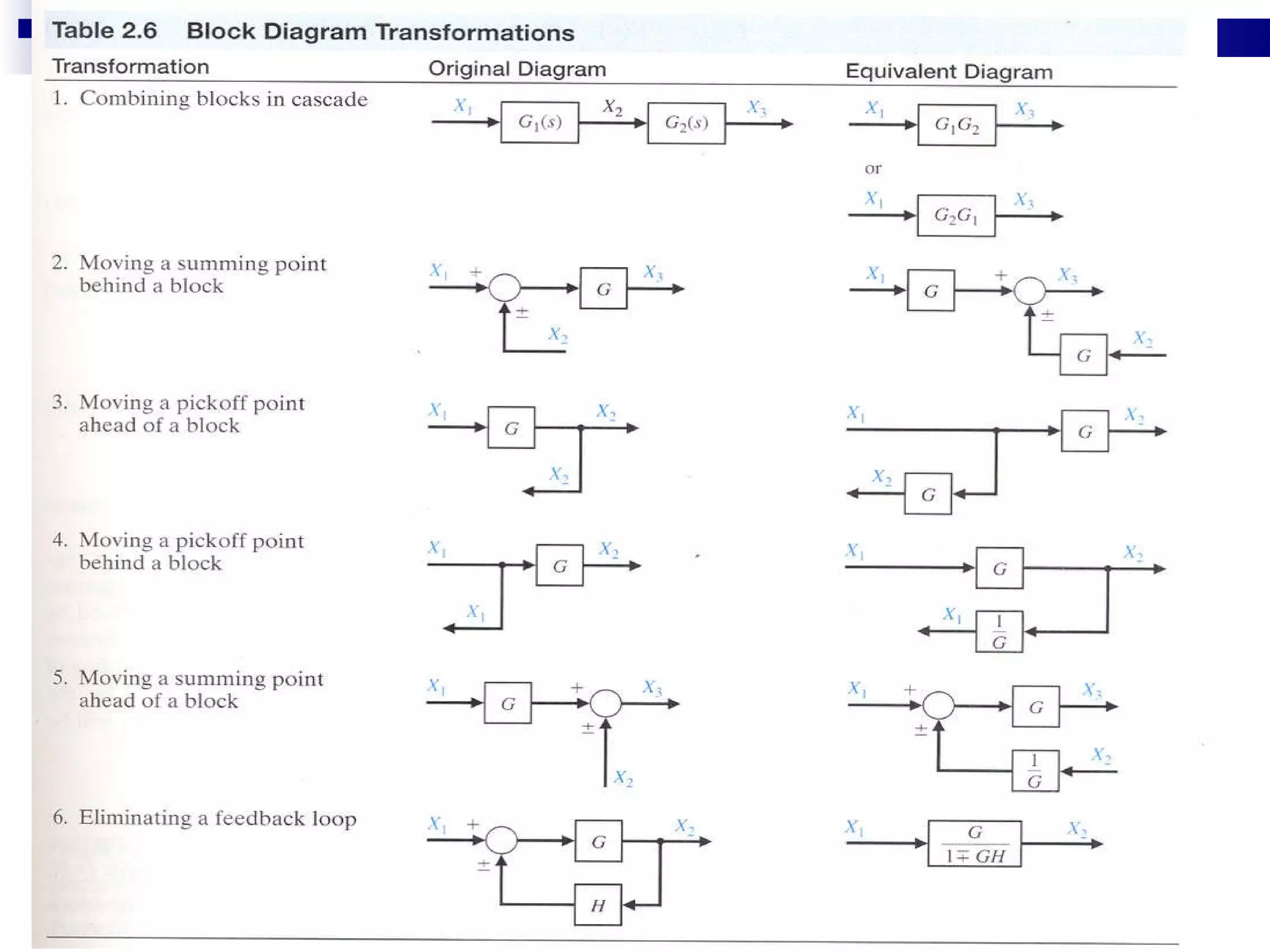
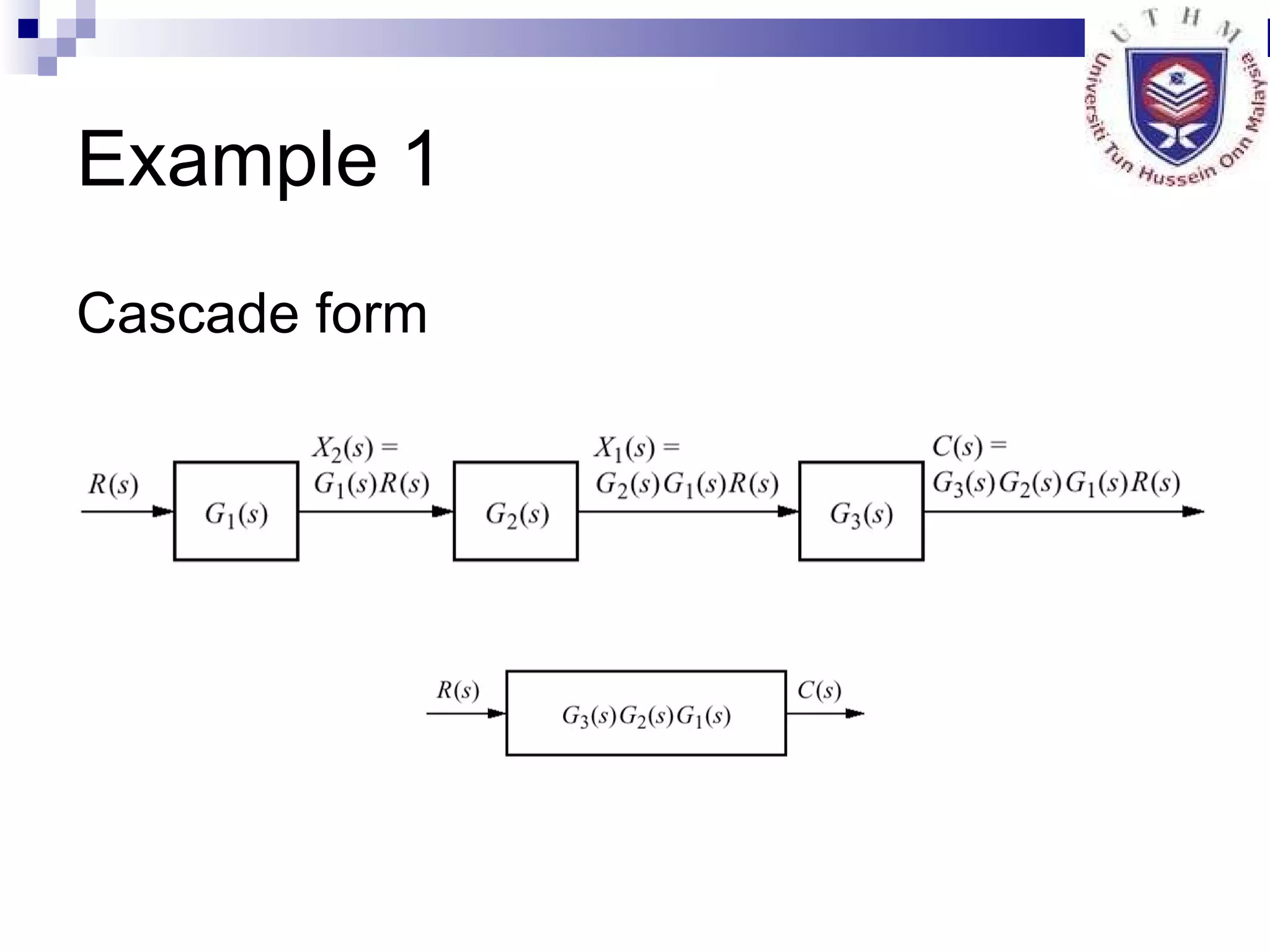
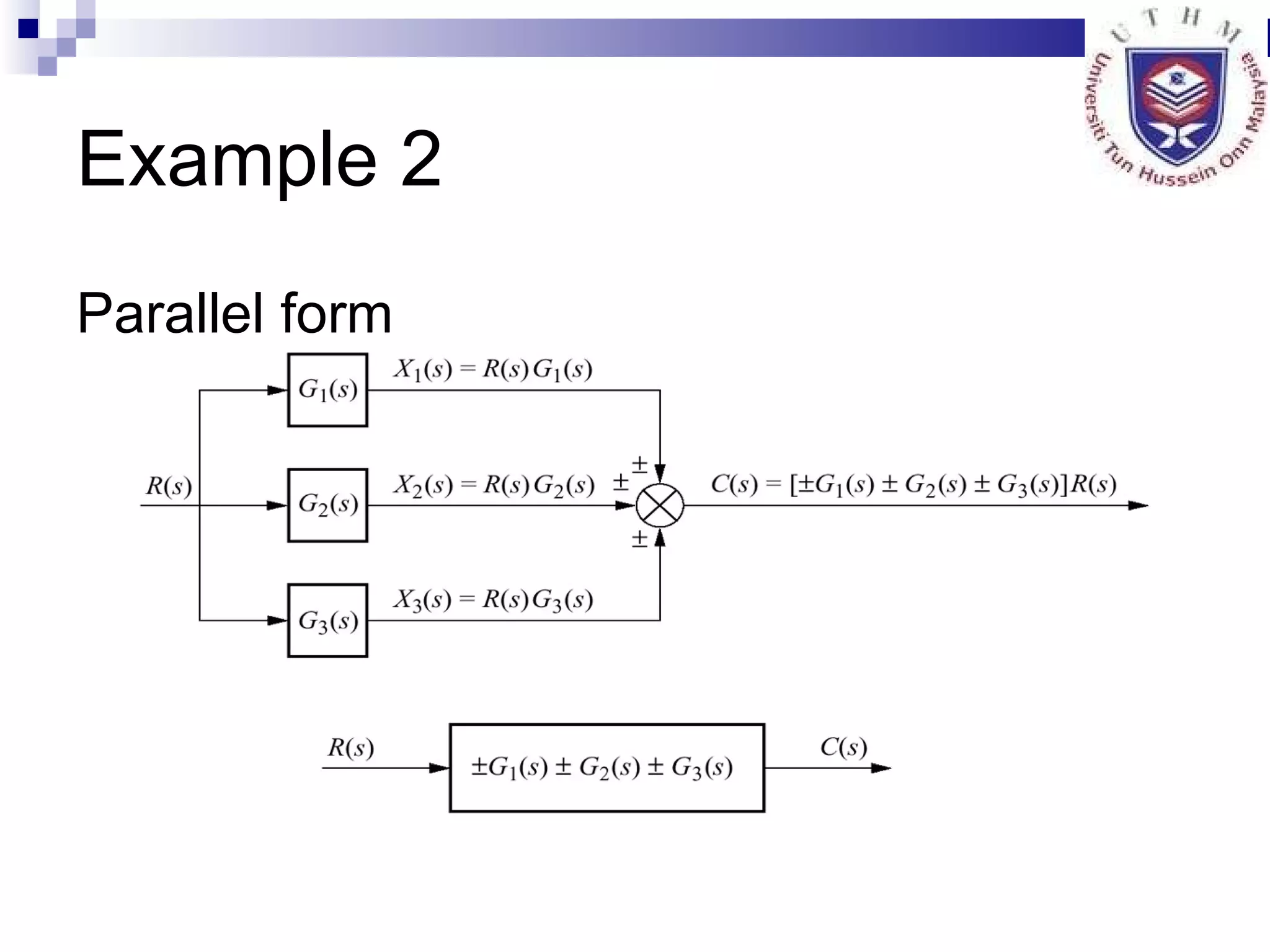
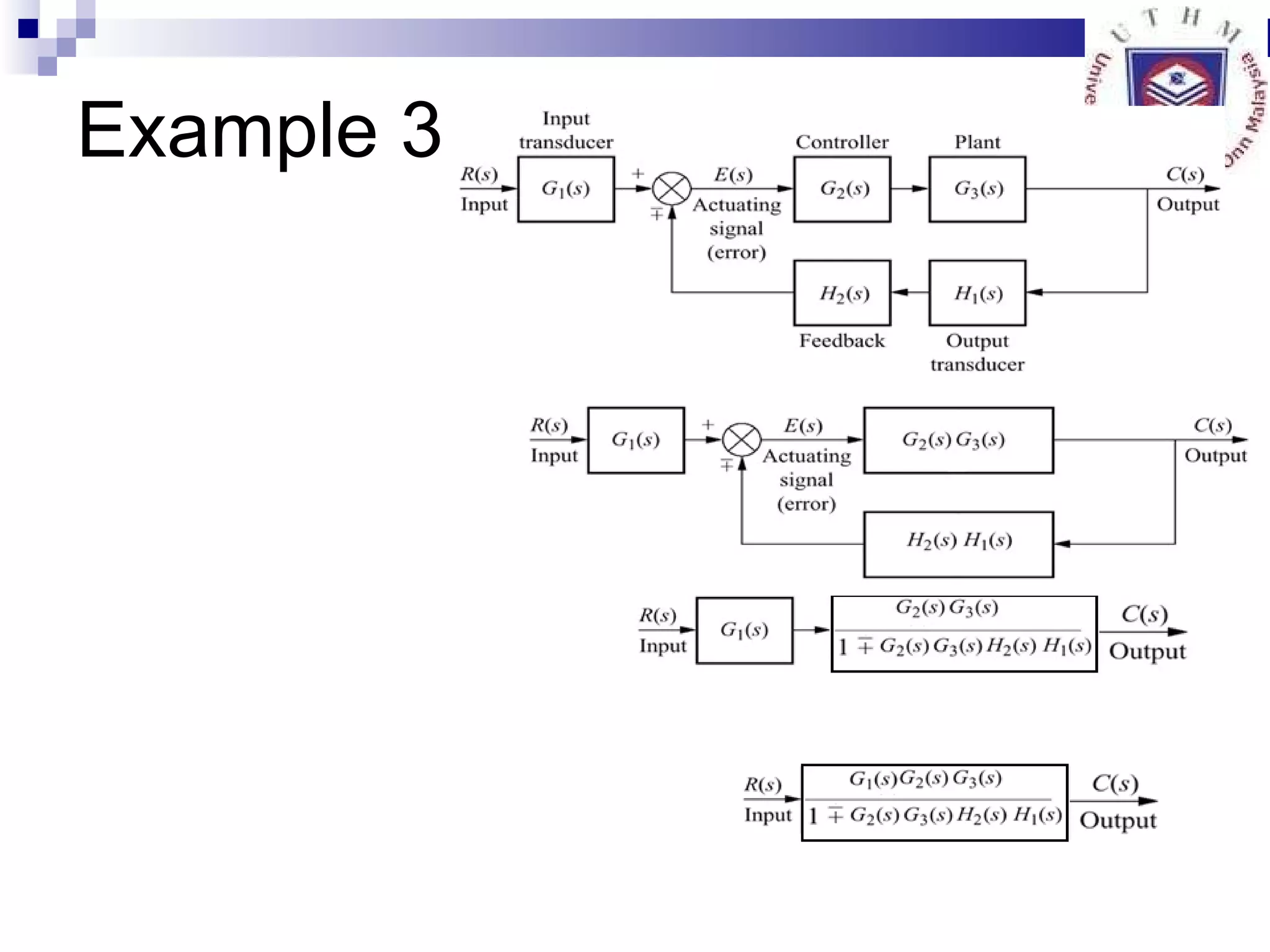
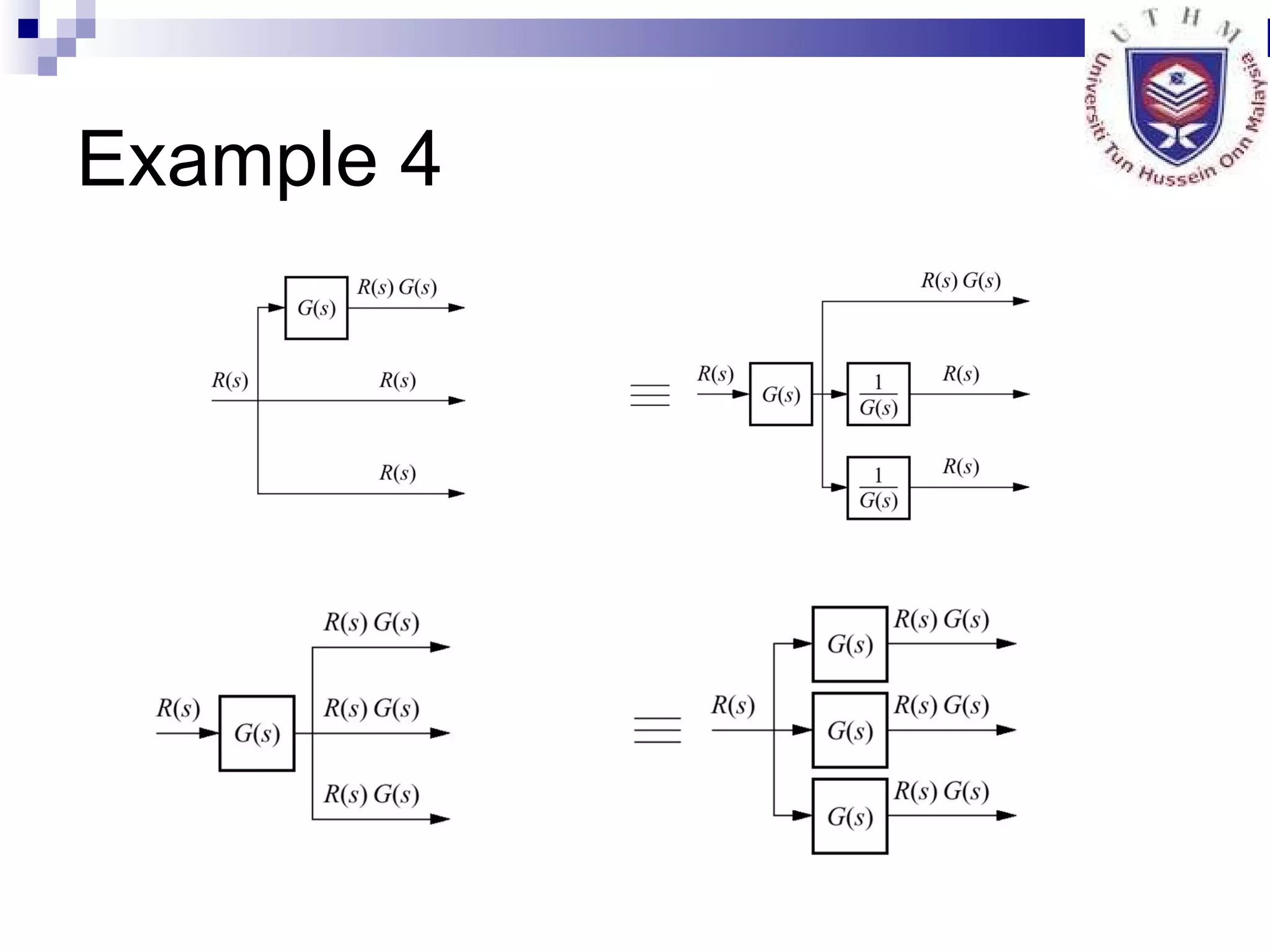
7. Reduction of Multiple Subsystem Subsystem is represented as a block with an input, output and transfer function. Many systems are composed of multiple subsystems. When multiple subsystem are interconnected, new element must be added like summing junction and pickoff points. The main purpose of reduction multiple subsystem is to reduce more complicated systems to a single block.
Component of a block diagram for a  linear, time-invariant system
 
Example 1 Cascade form
Example 2 Parallel form
Example 3
Example 4
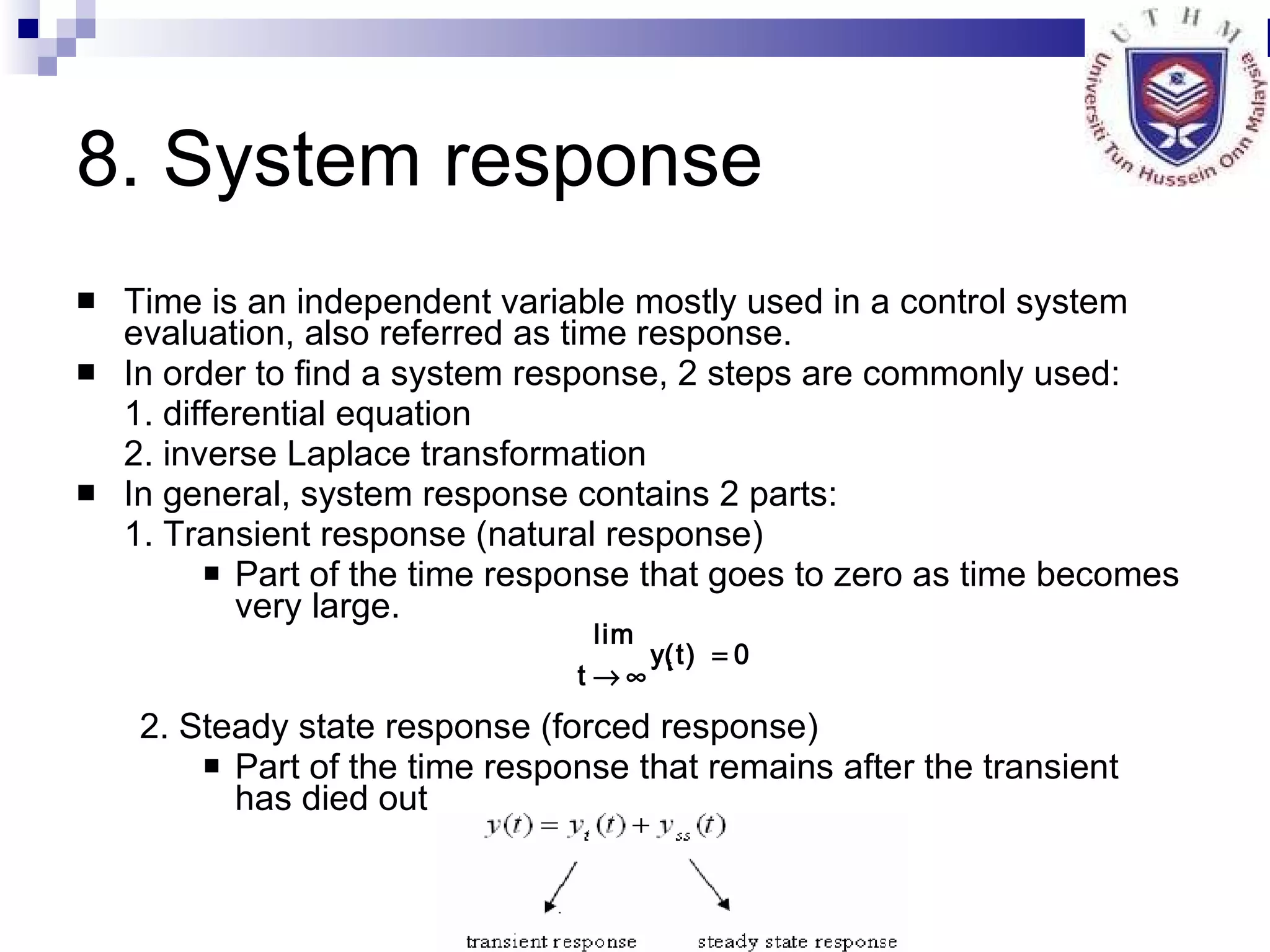
8. System response Time is an independent variable mostly used in a control system evaluation, also referred as time response. In order to find a system response, 2 steps are commonly used: 1. differential equation 2. inverse Laplace transformation In general, system response contains 2 parts: 1. Transient response (natural response)   Part of the time response that goes to zero as time becomes very large.   2. Steady state response (forced response)  Part of the time response that remains after the transient has died out
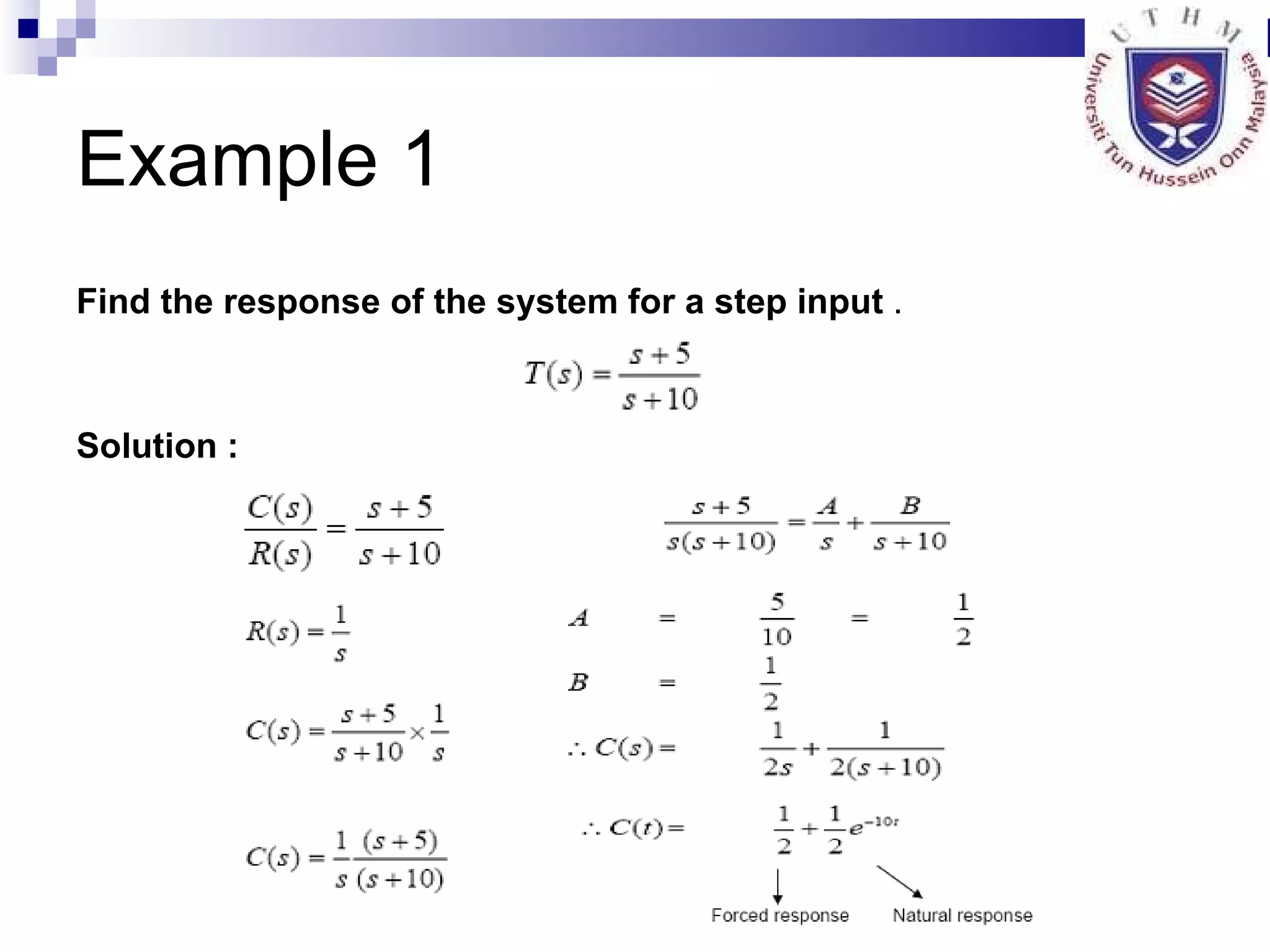
Example 1 Find the response of the system for a step input  . Solution :
Poles, Zeros and System Response Poles is the values of the Laplace transform variable( s ) that cause the transfer function to become  infinite  or any roots of the  denominator  of the transfer function . Zeros is the values of the Laplace transform variable( s ) that cause the transfer function to become  zero , or any roots of the  numerator  of the transfer function .
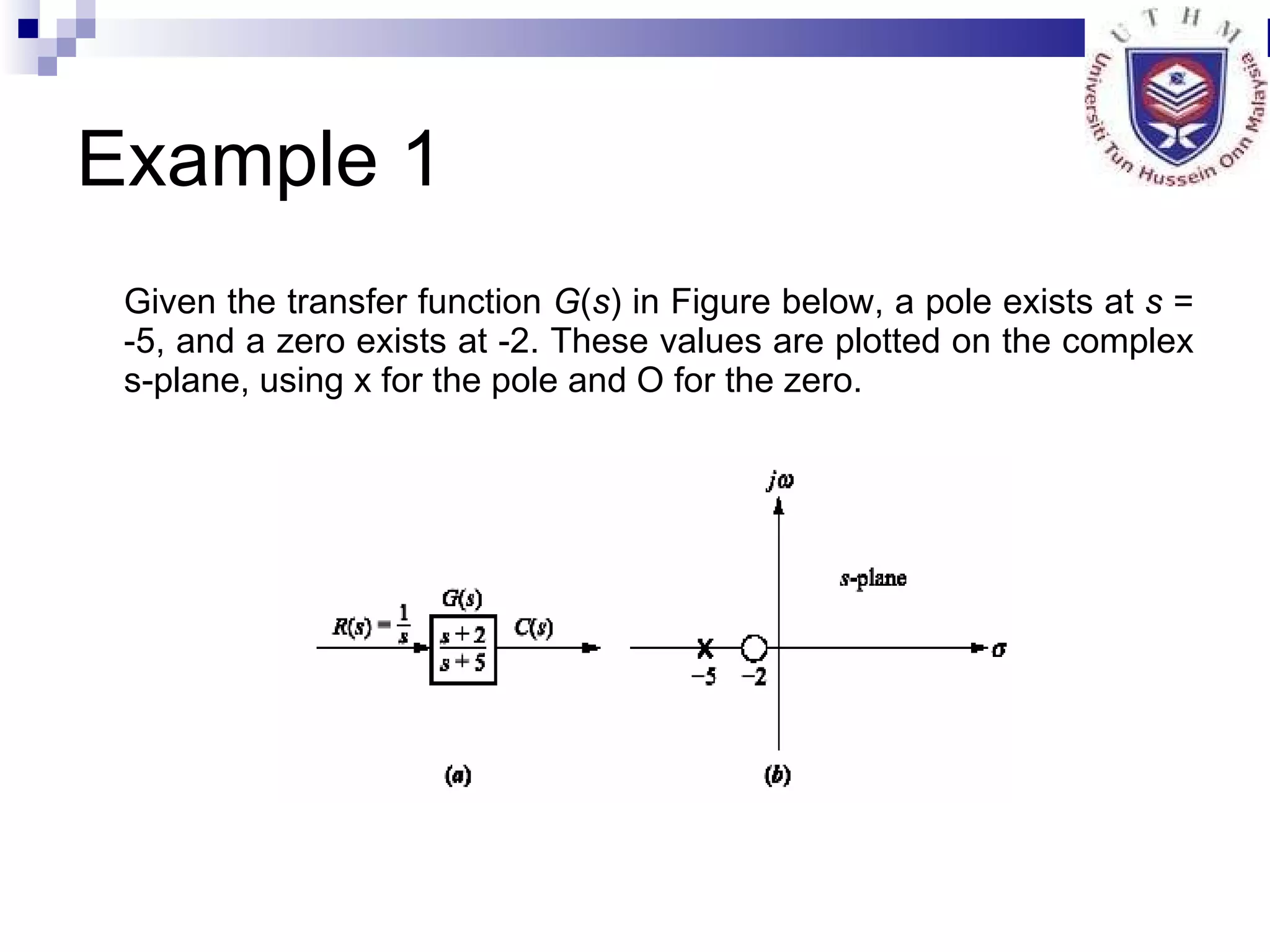
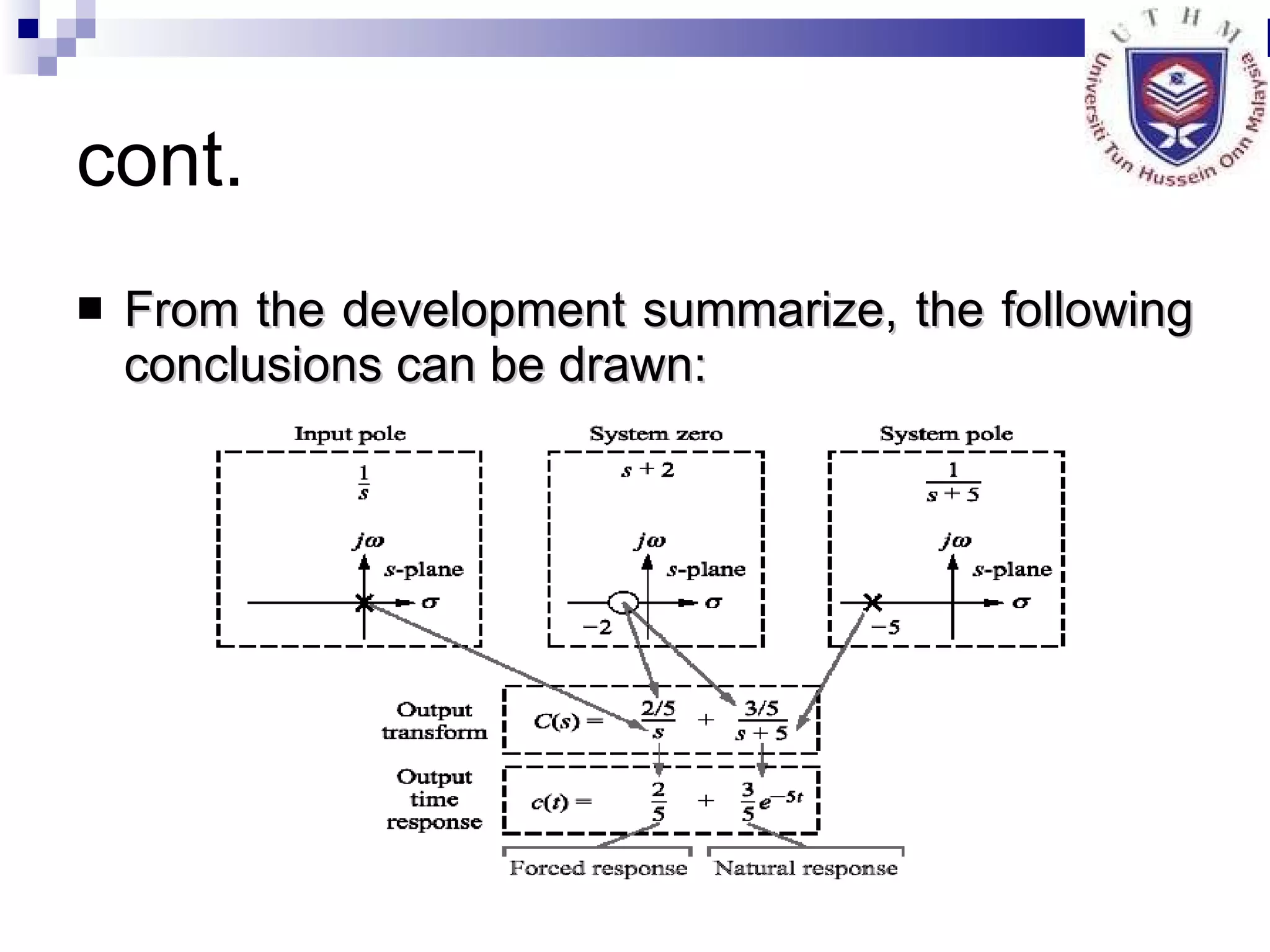
Example 1 Given the transfer function  G ( s ) in Figure below, a pole exists at  s  = -5, and a zero exists at -2. These values are plotted on the complex s-plane, using  x  for the pole and  О   for the zero.
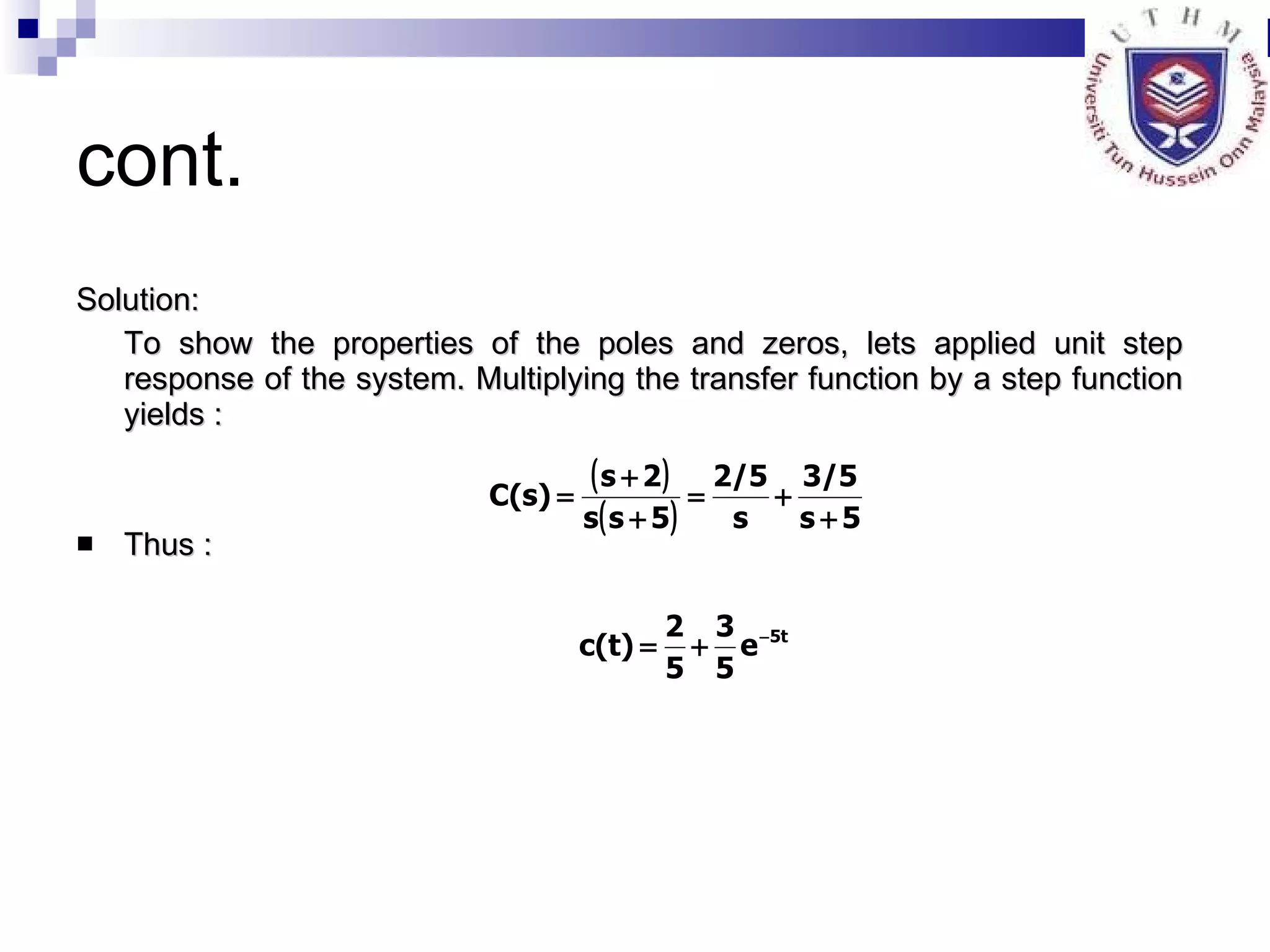
cont. Solution: To show the properties of the poles and zeros, lets applied unit step response of the system. Multiplying the transfer function by a step function yields : Thus :
cont. From the development summarize, the following conclusions can be drawn:
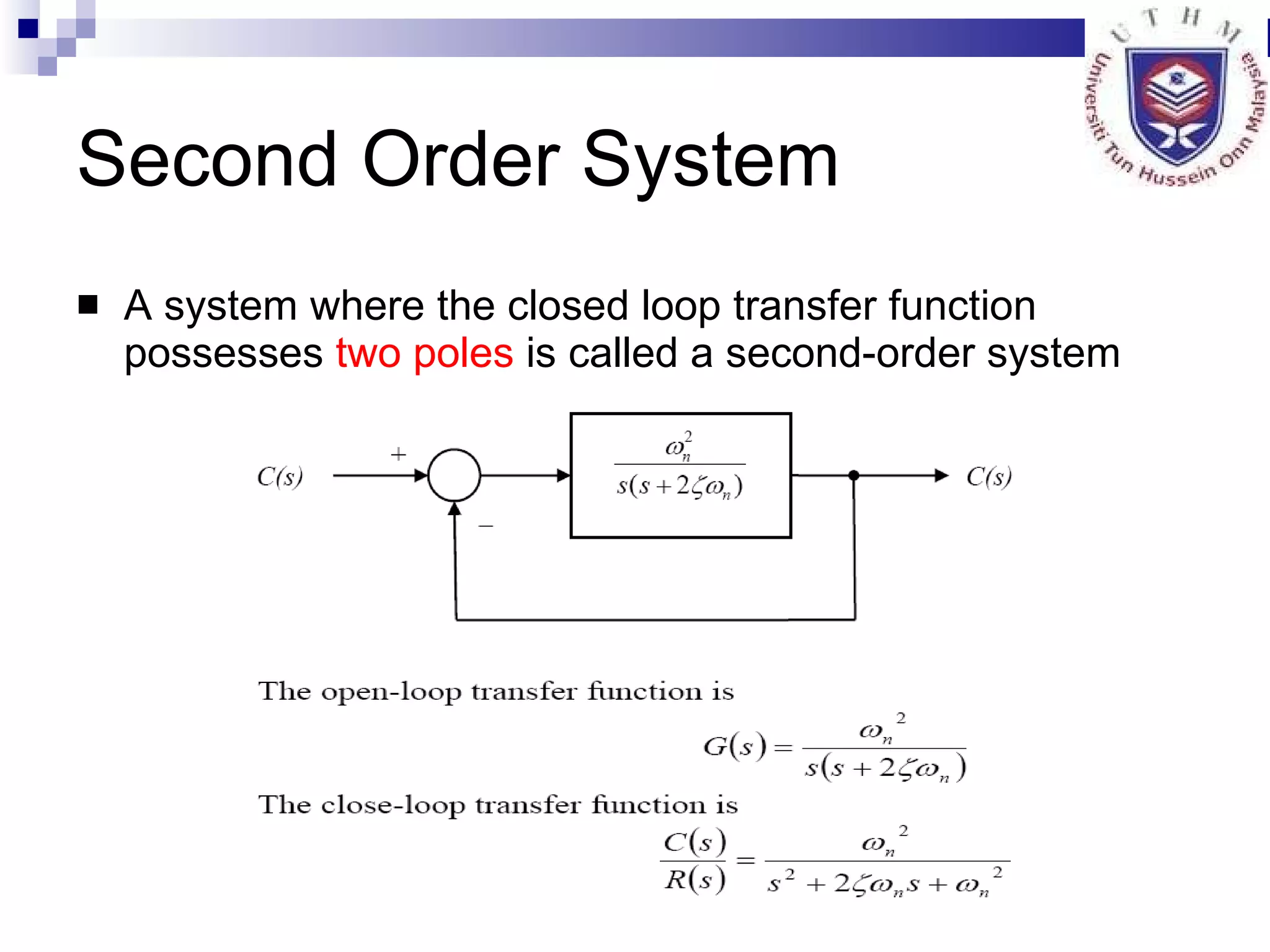
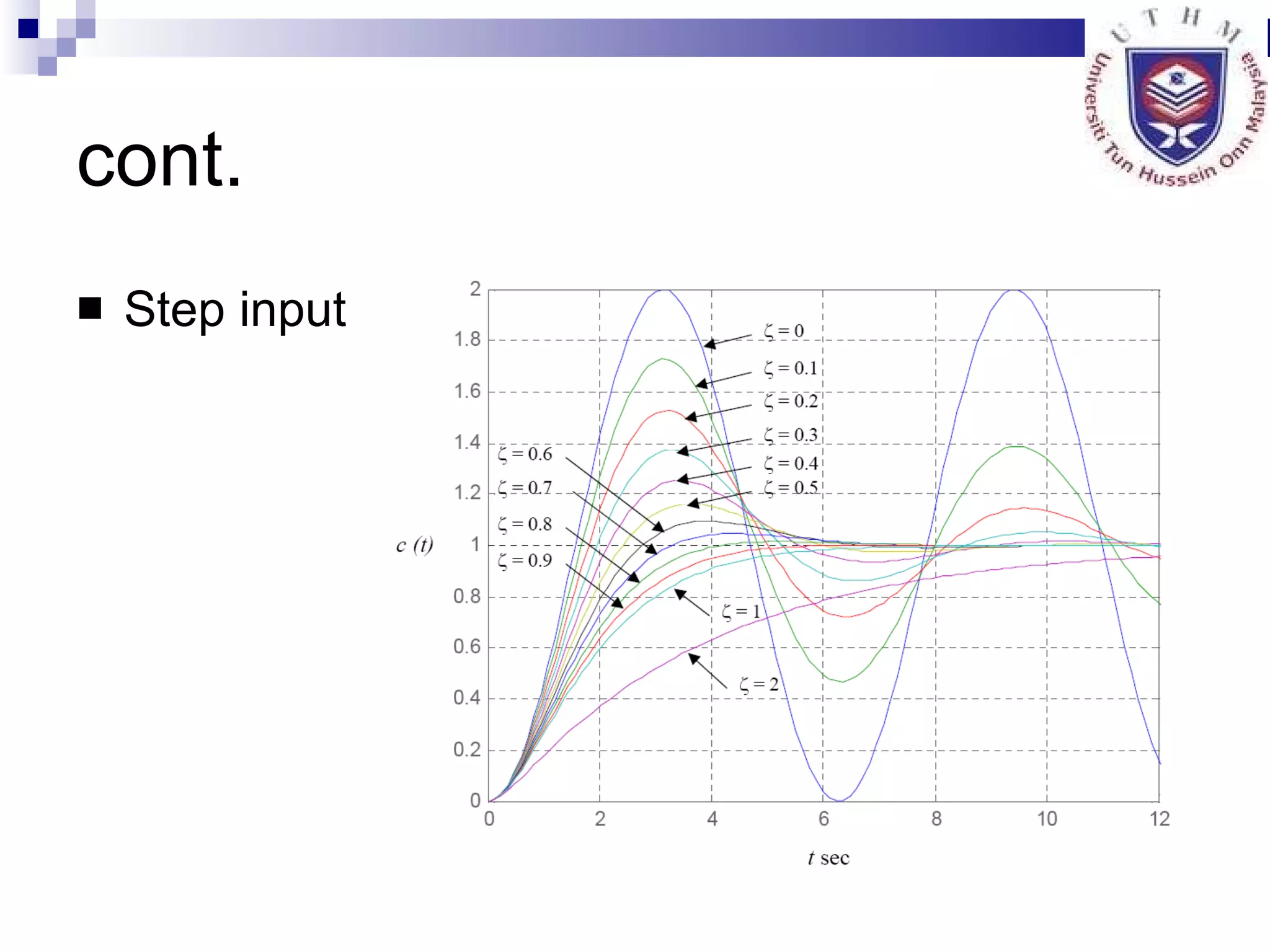
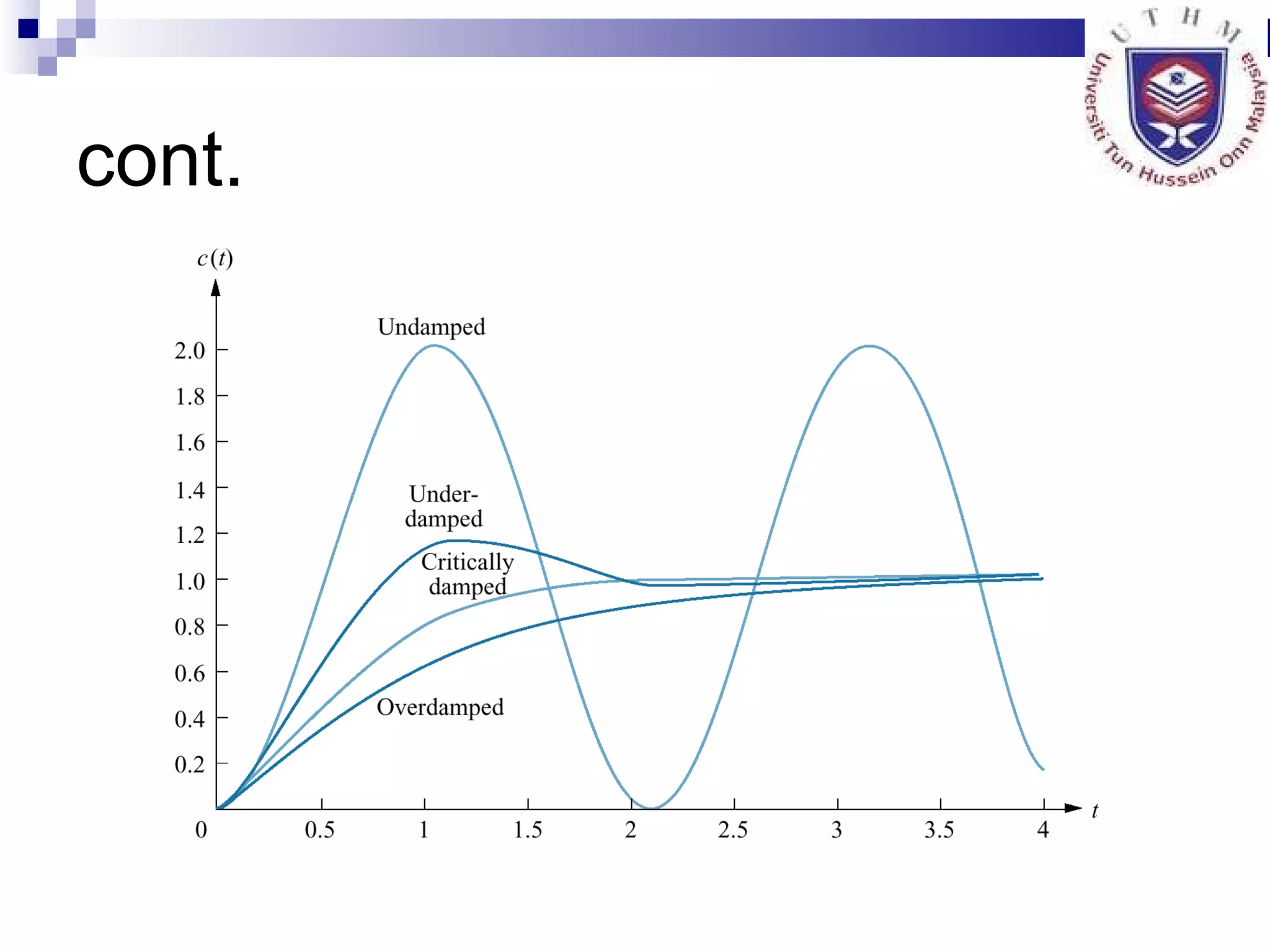
Second Order System A system where the closed loop transfer function possesses  two poles  is called a second-order system
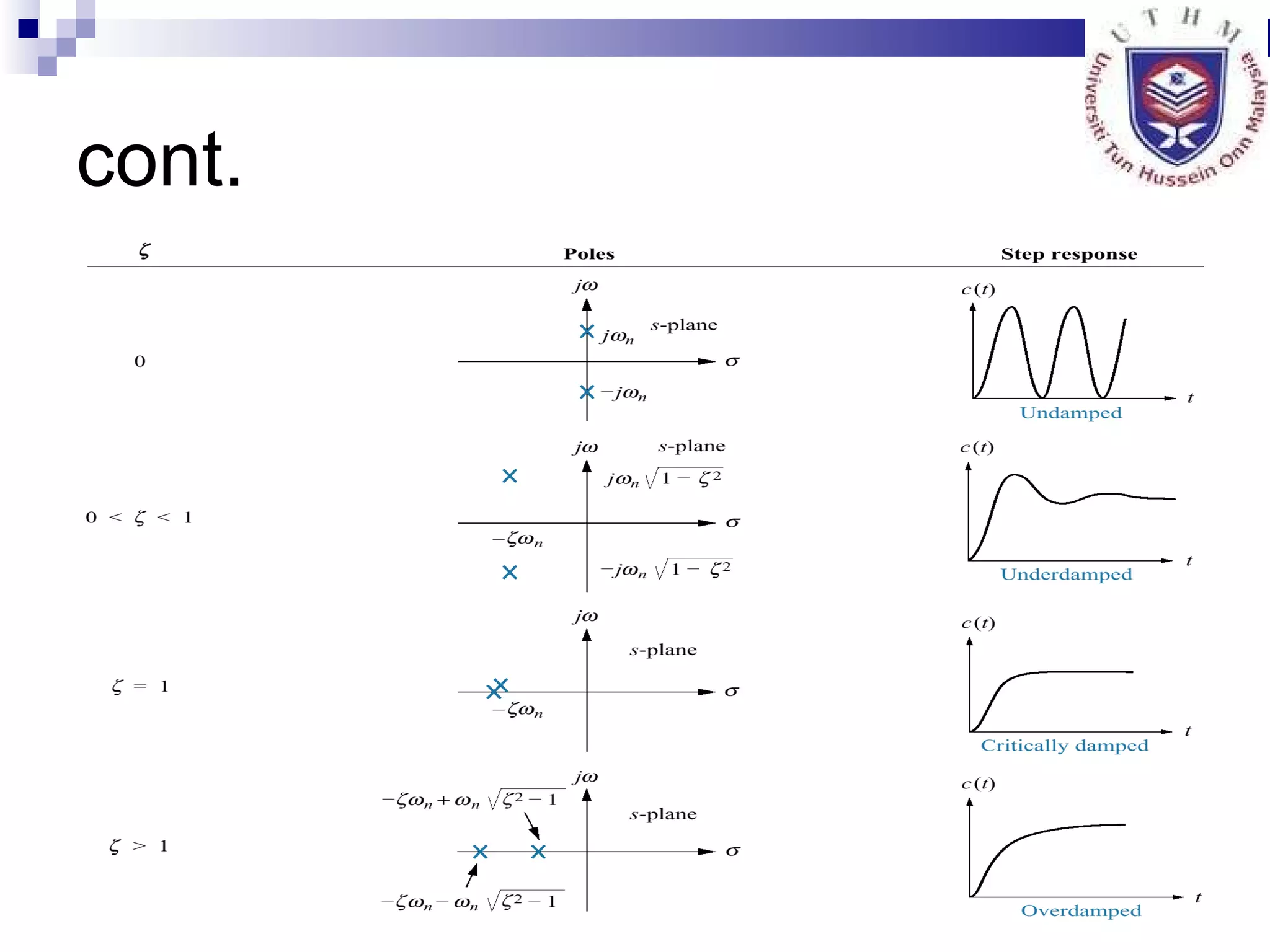
cont.
cont. Step input
cont.
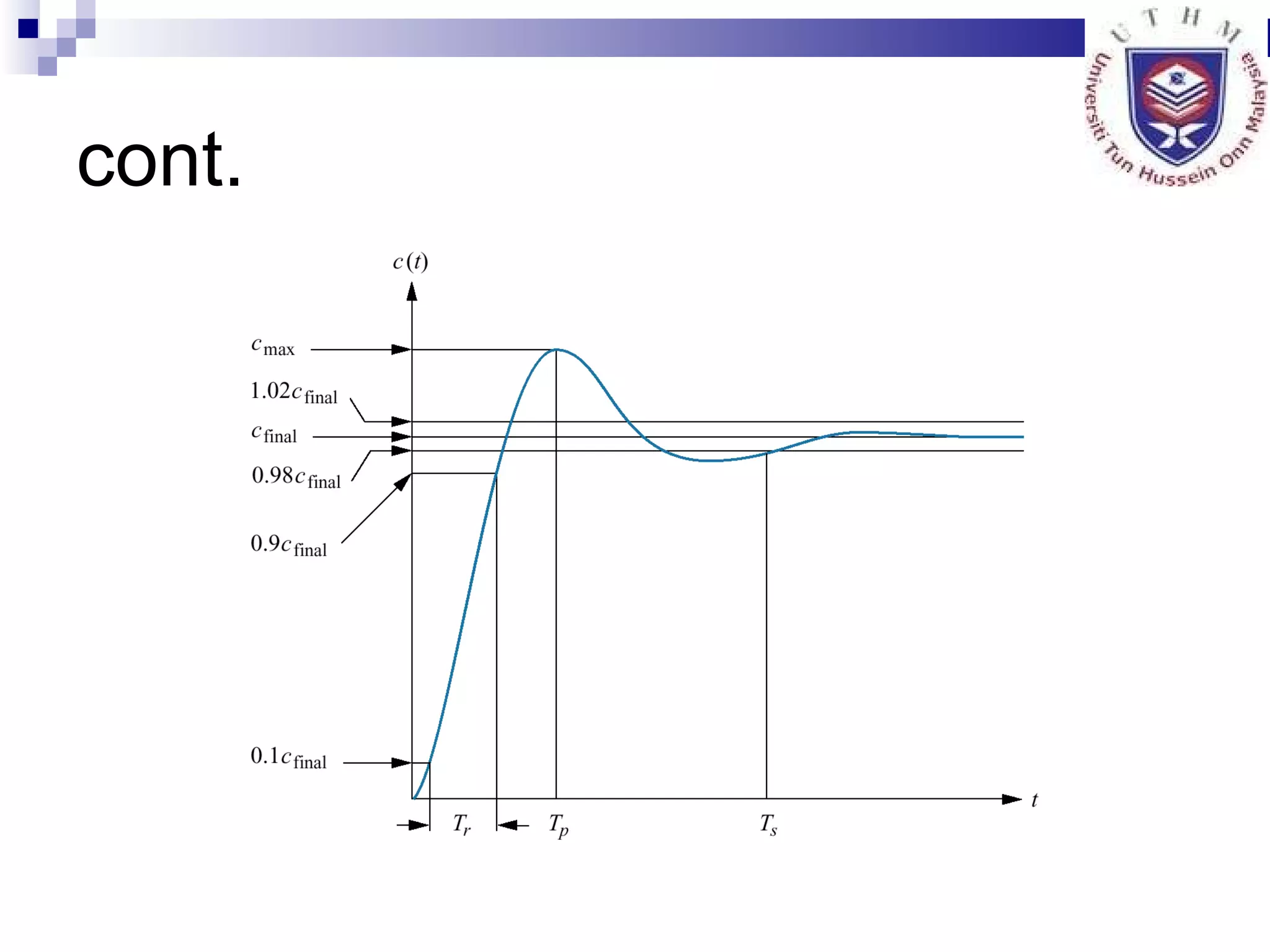
cont.
cont.
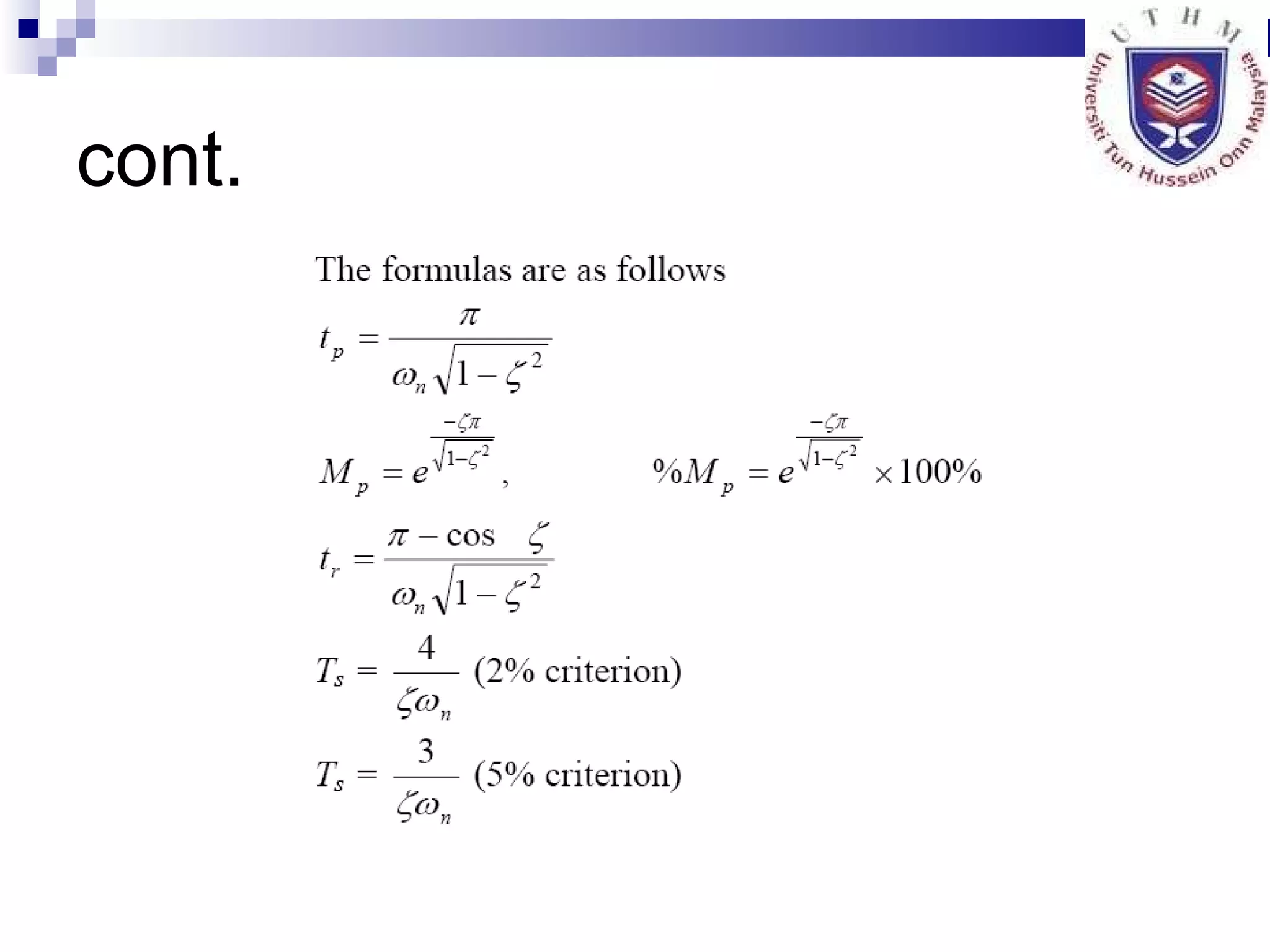
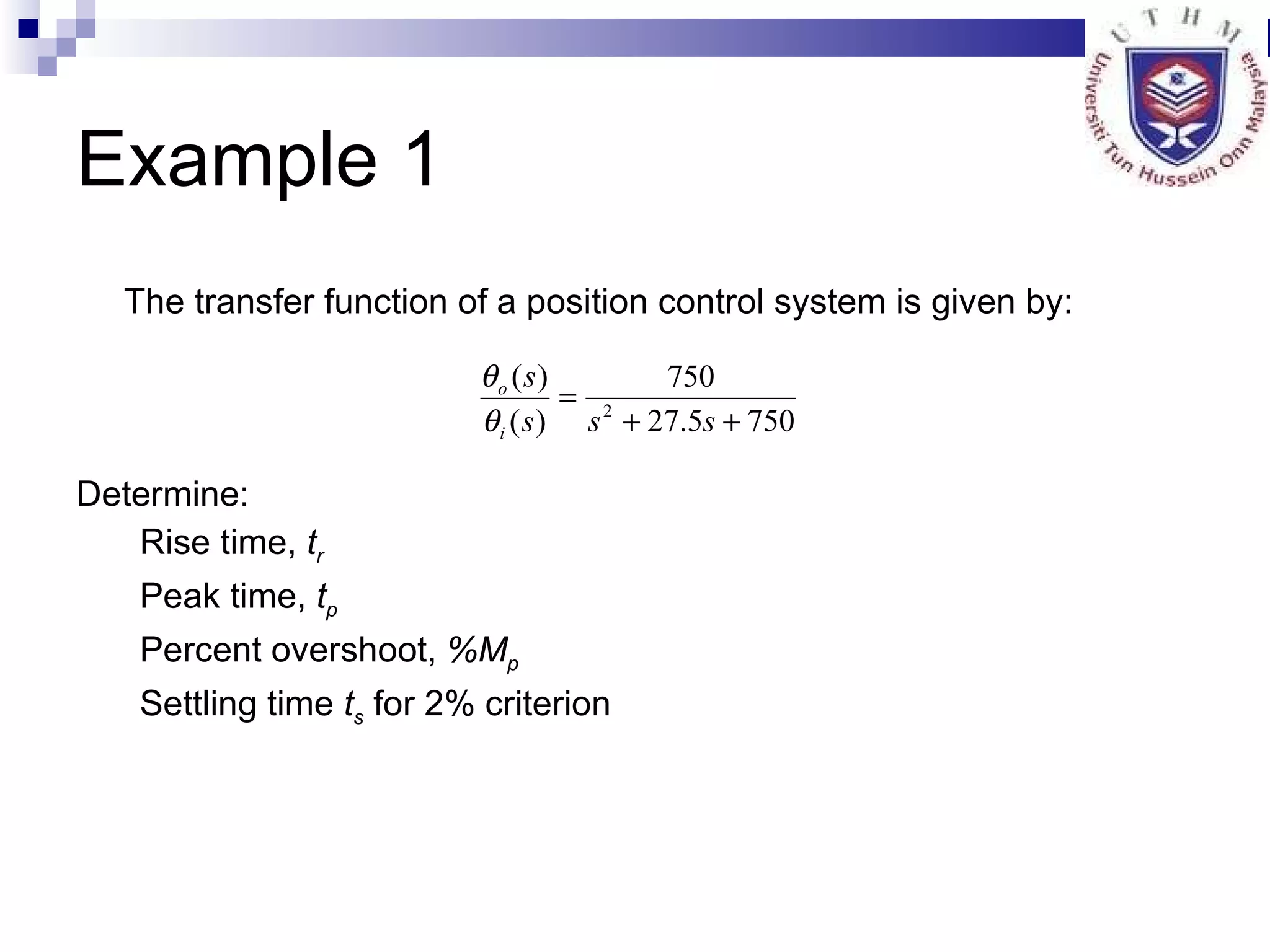
Example 1 The transfer function of a position control system is given by: Determine: Rise time,  t r   Peak time,  t p Percent overshoot,  %M p   Settling time  t s  for 2% criterion
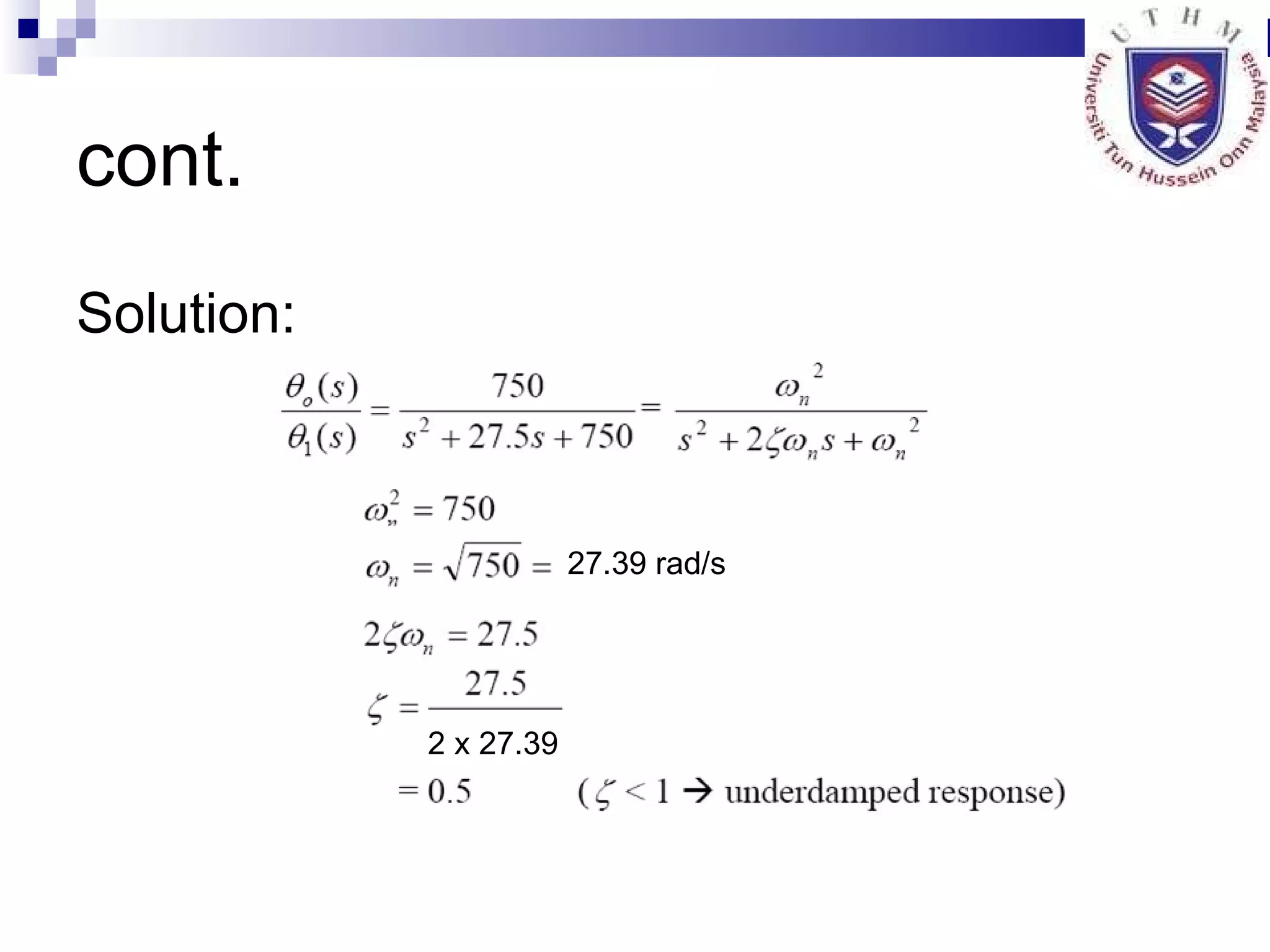
cont. Solution: 27.39 rad/s 2 x 27.39
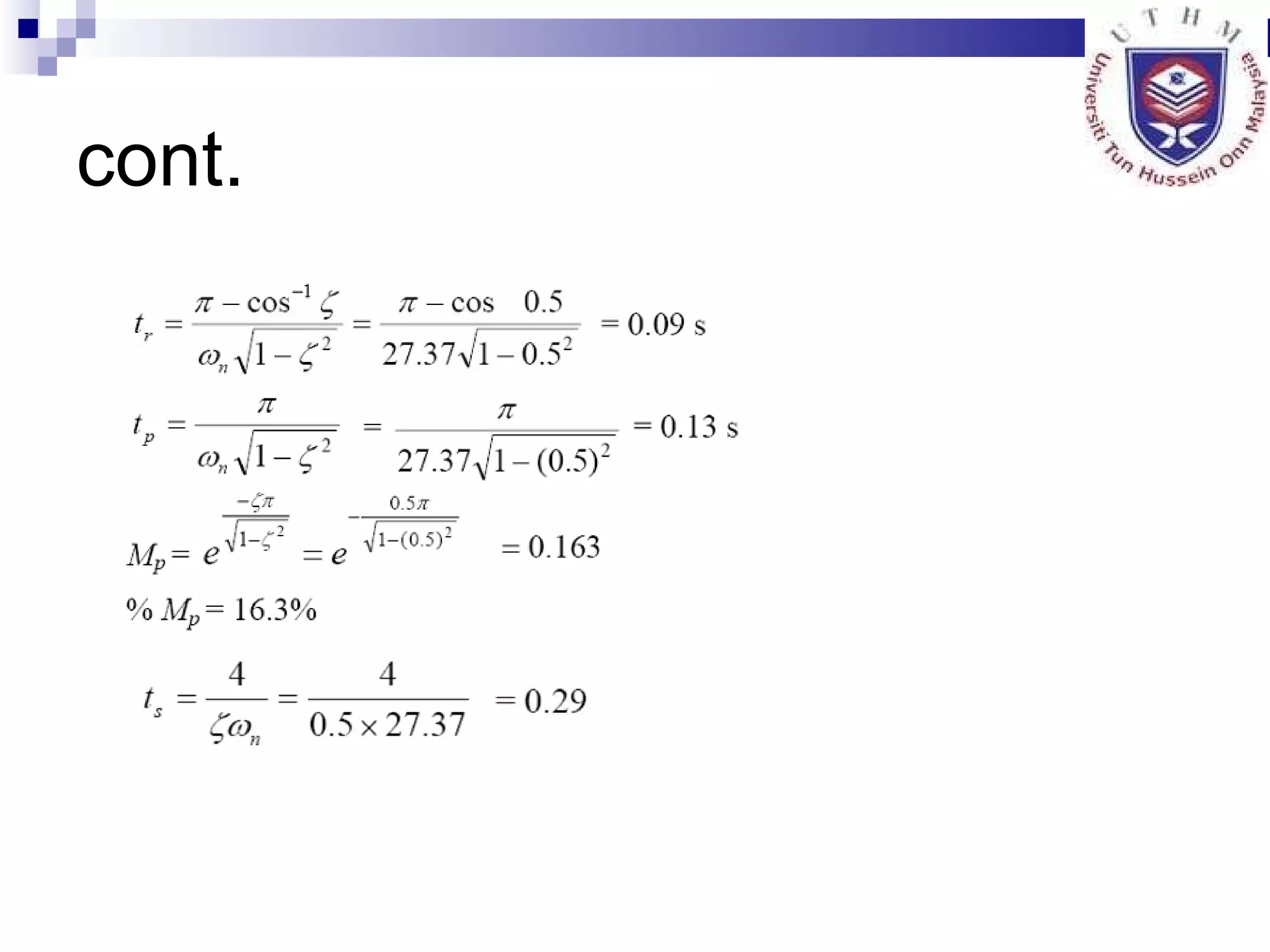
cont.
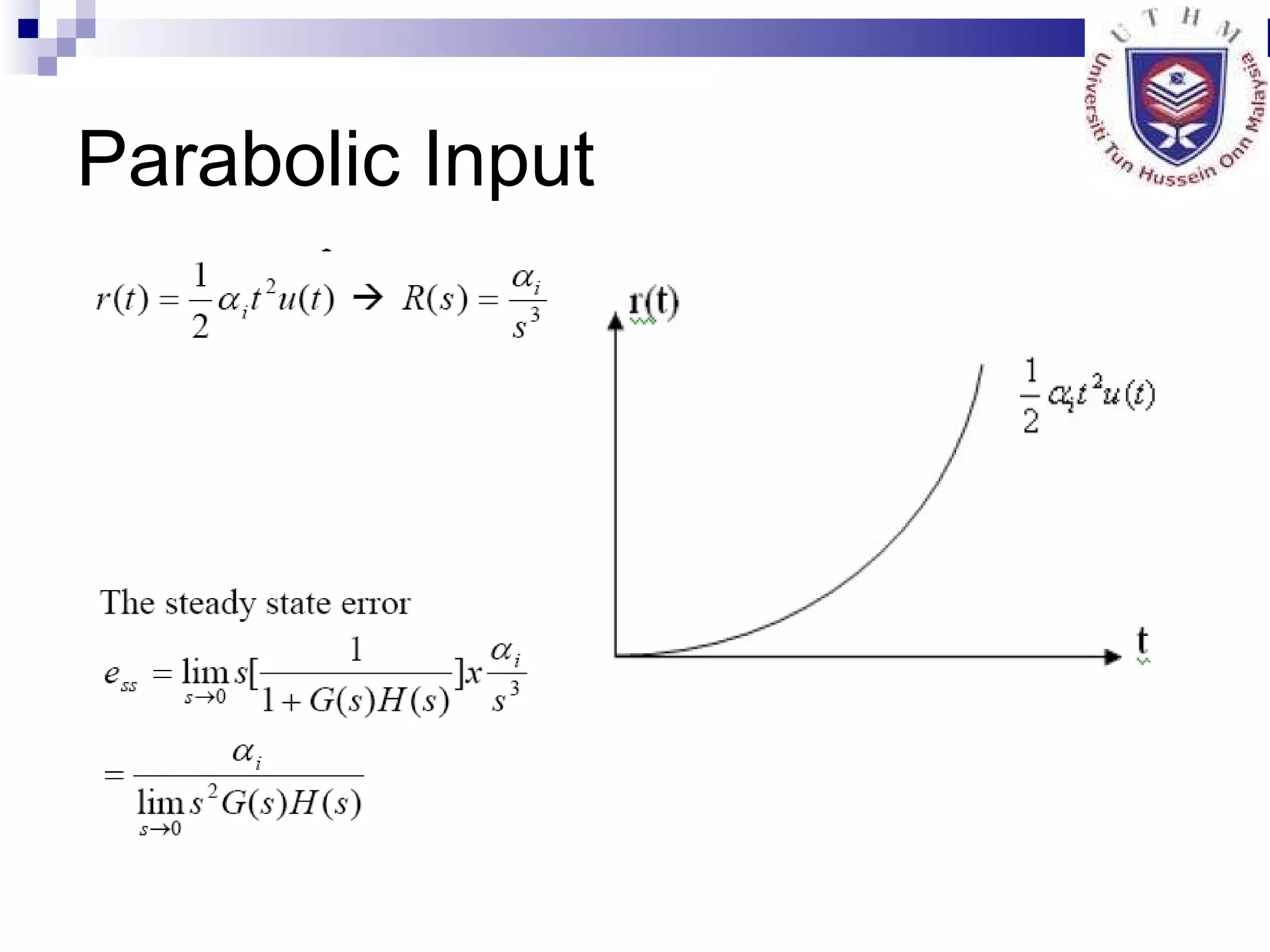
Steady State Error Steady-state error is the difference between the input and the output for prescribed test input as t      . Test inputs used for steady-state error analysis are: Step Input Ramp Input Parabolic Input
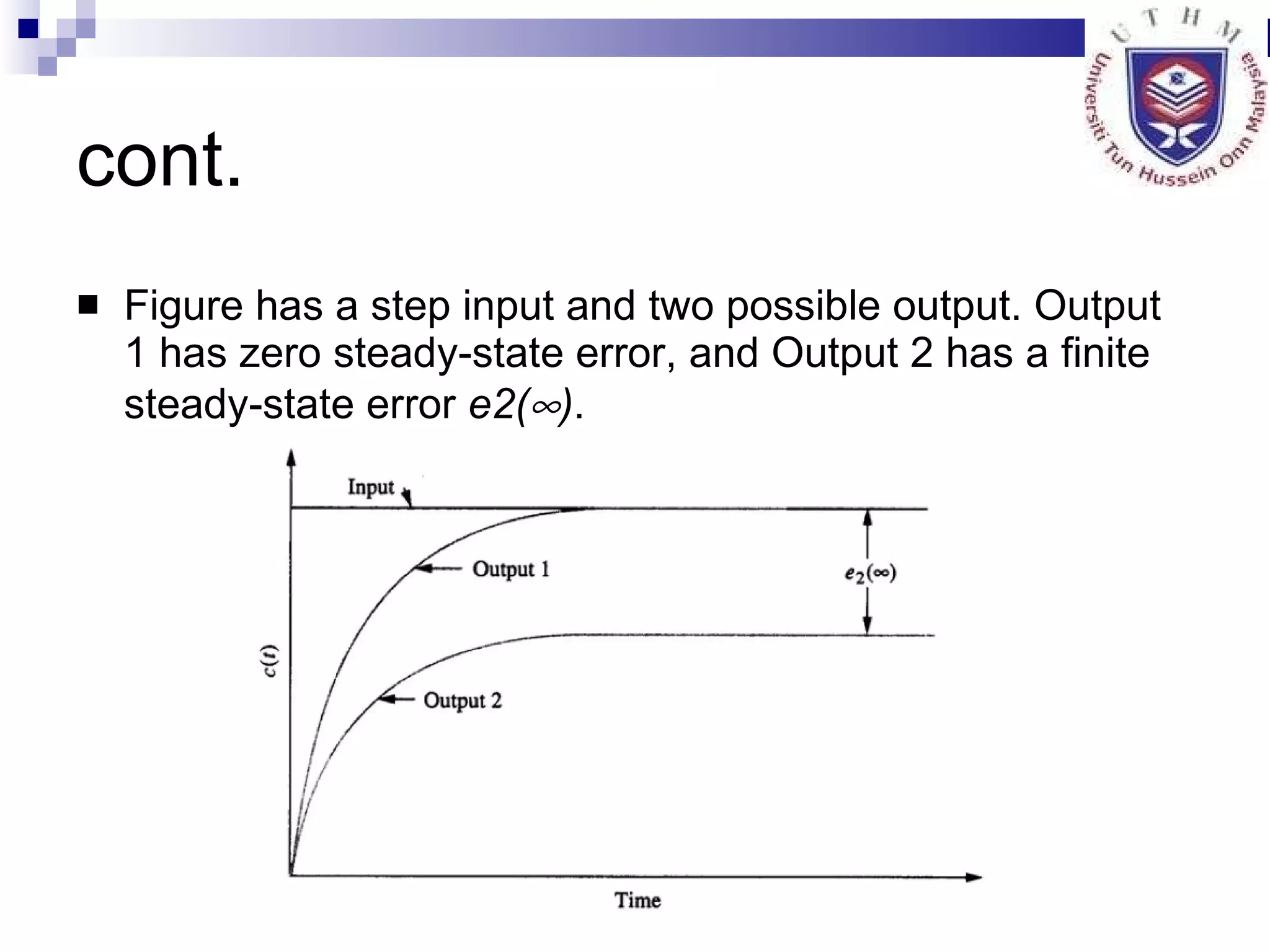
cont. Figure has a step input and two possible output. Output 1 has zero steady-state error, and Output 2 has a finite steady-state error  e2(  ) .
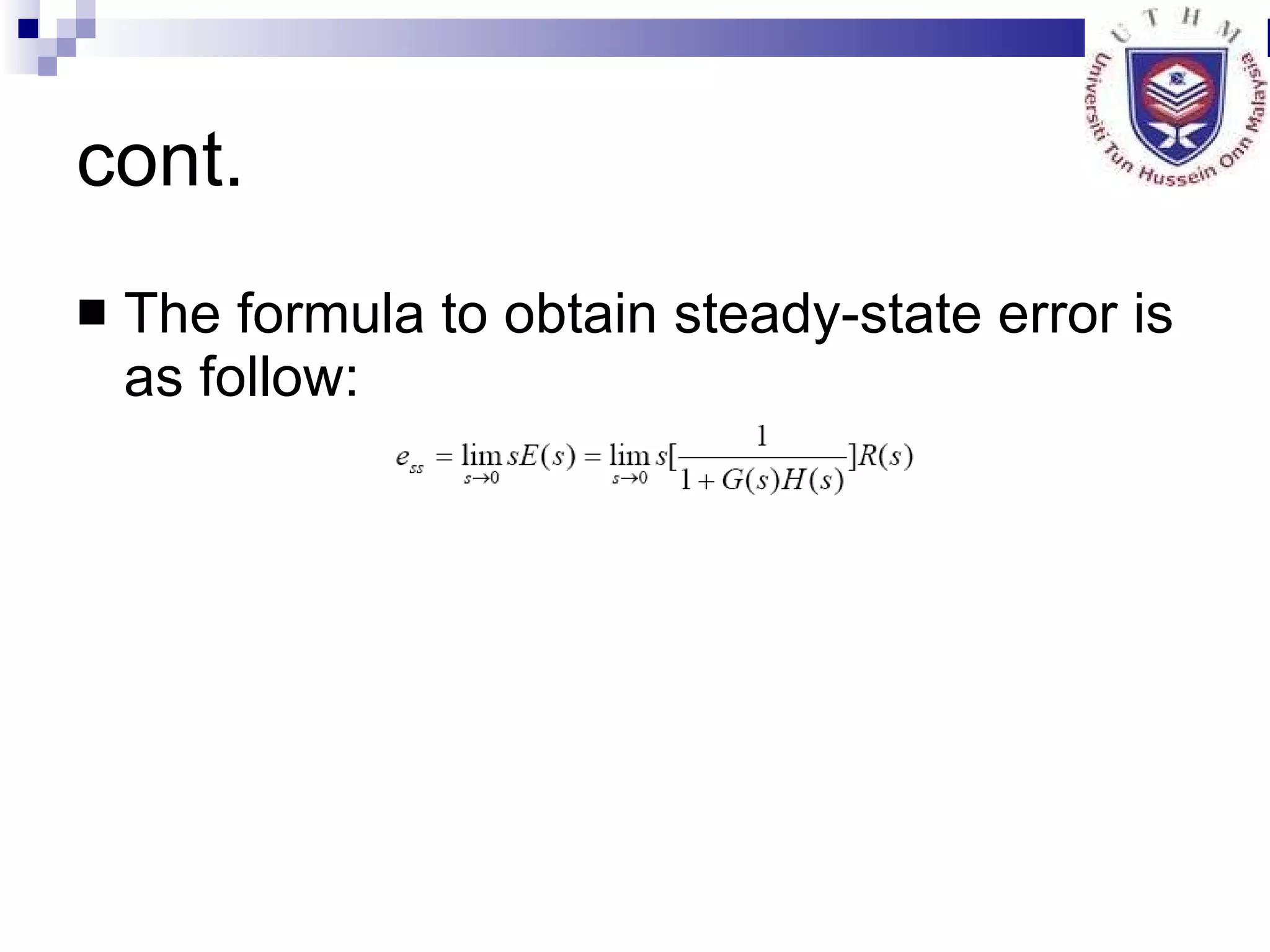
cont. The formula to obtain steady-state error is as follow:
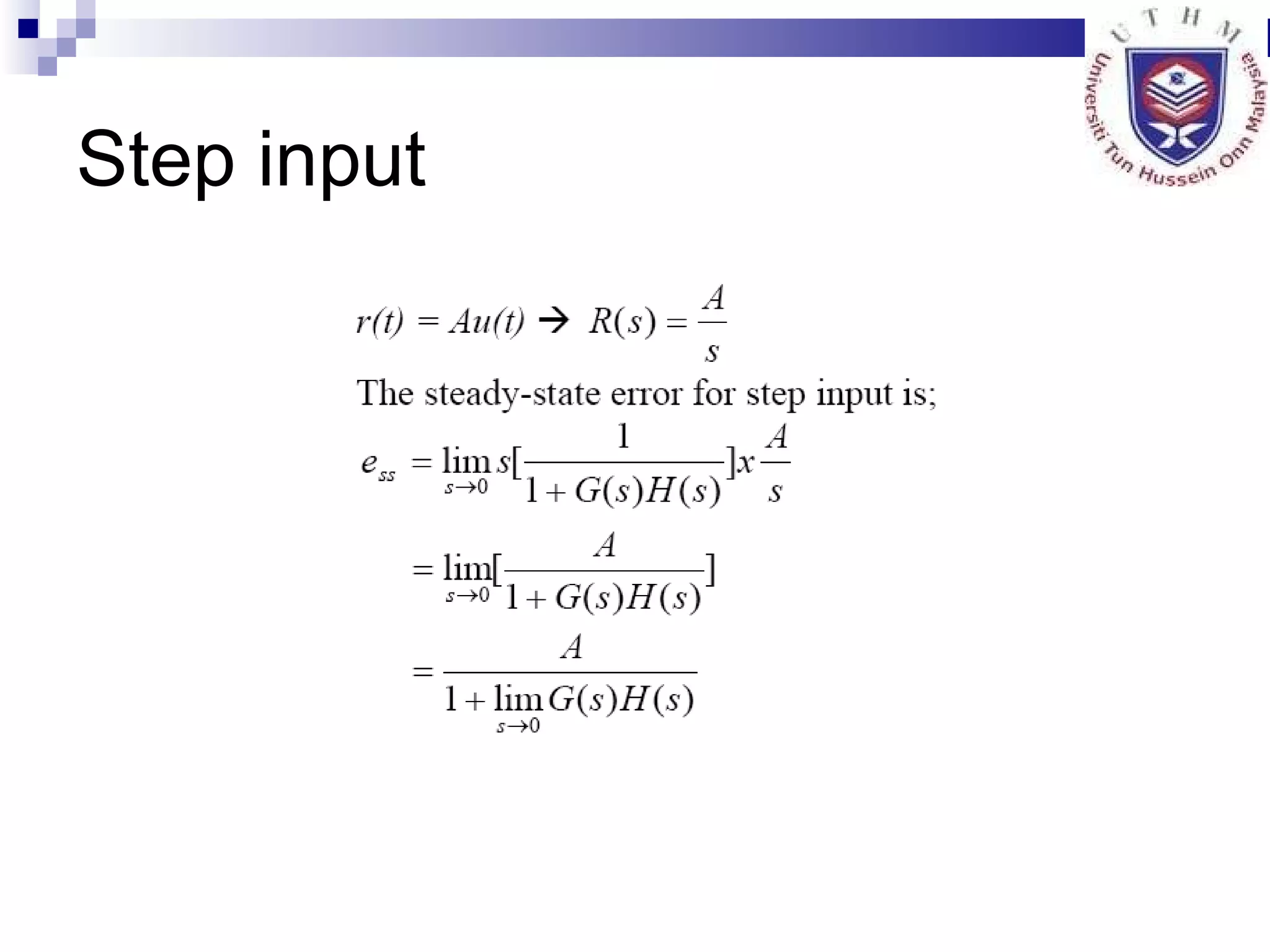
Step input
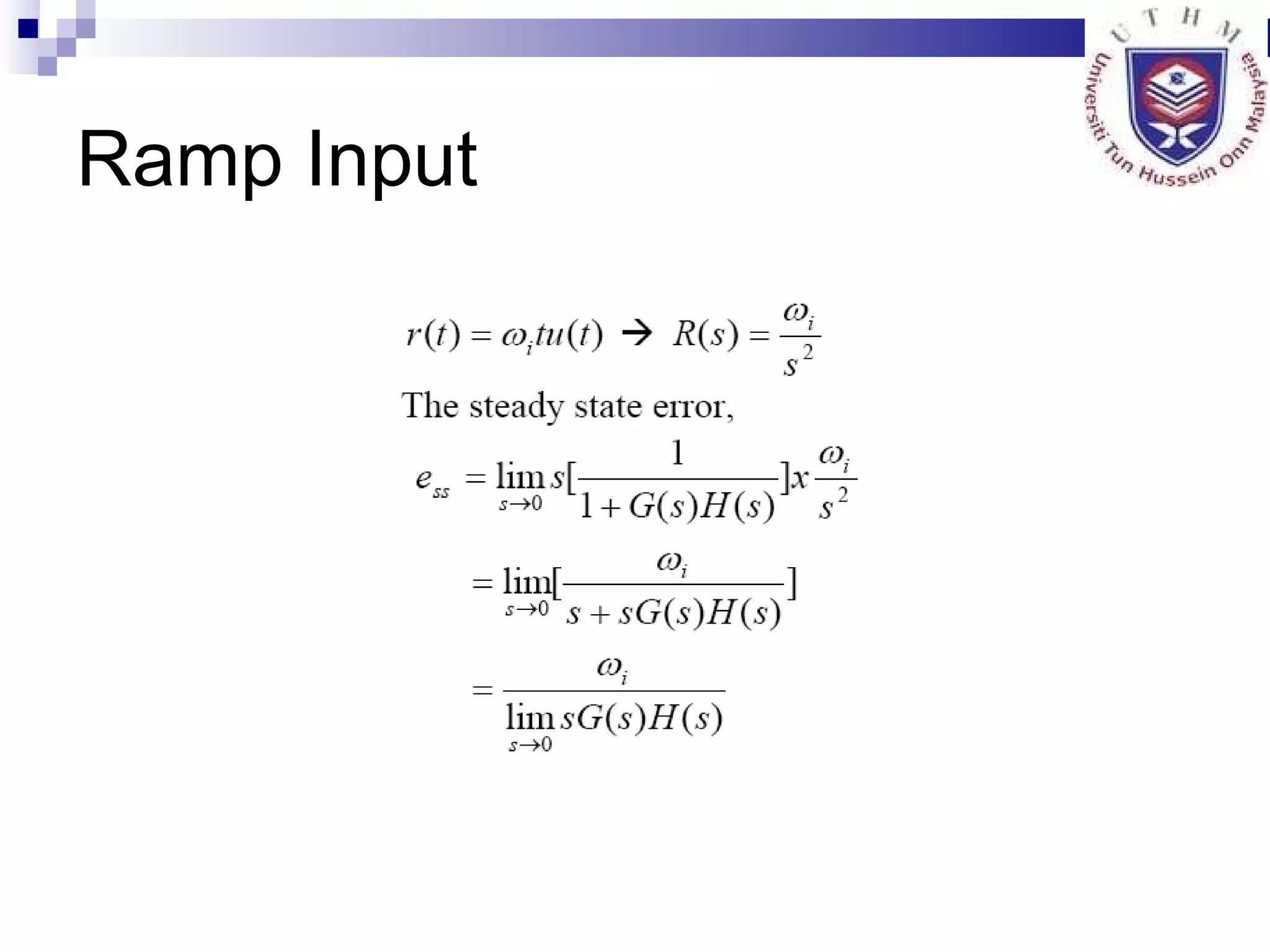
Ramp Input
Parabolic Input
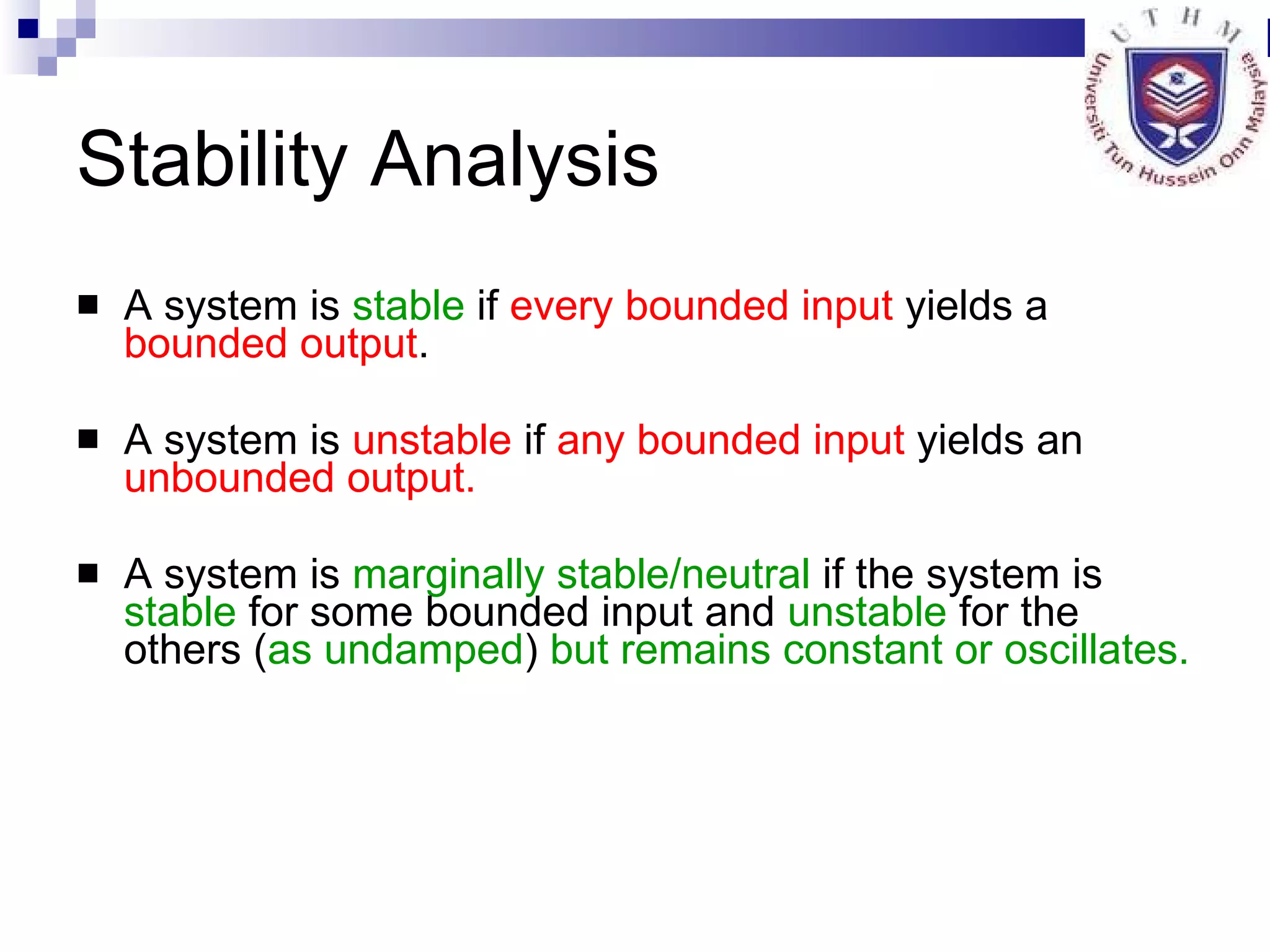
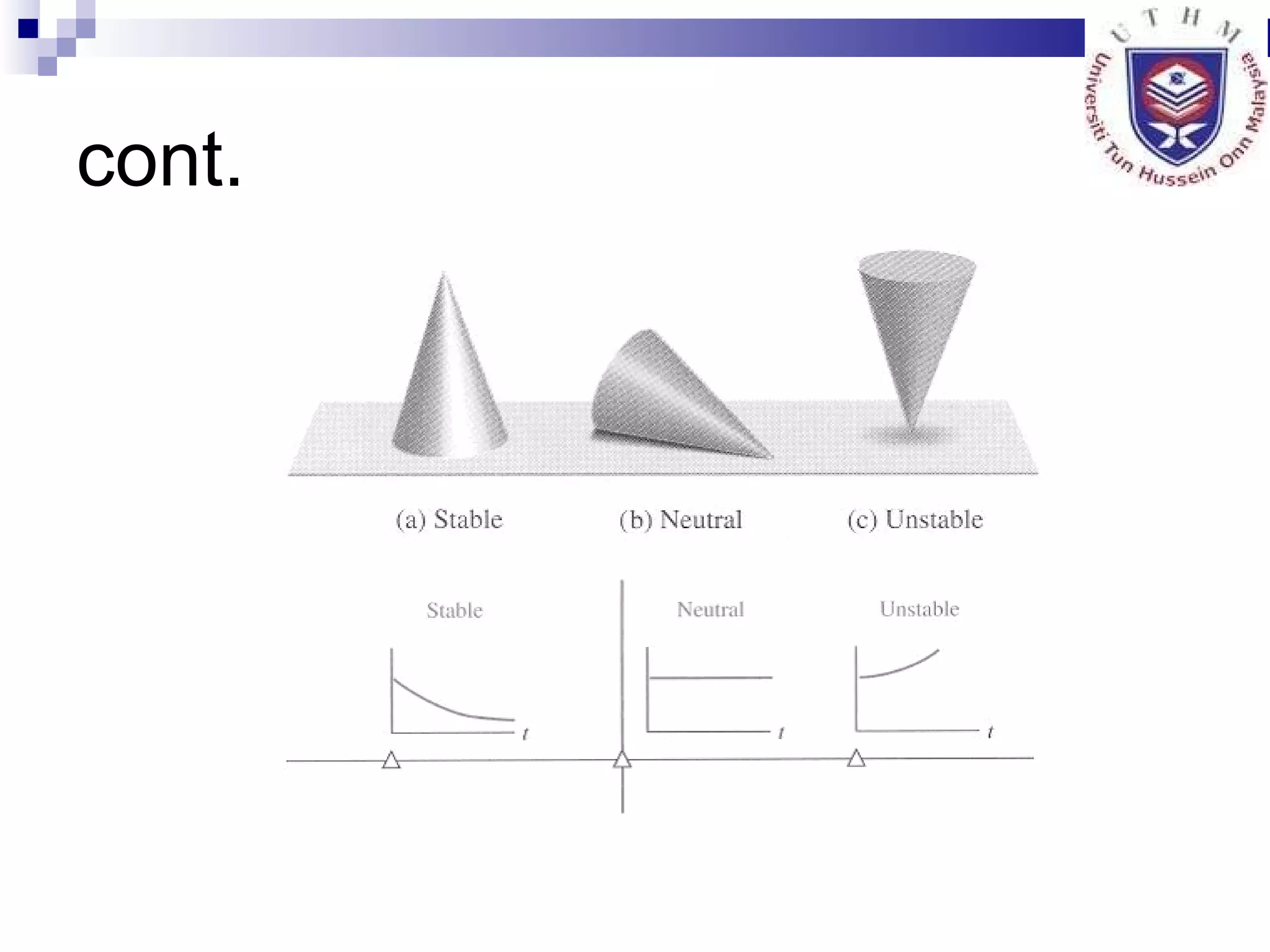
Stability Analysis A system is  stable  if  every bounded input  yields a  bounded output . A system is  unstable  if  any bounded   input  yields an  unbounded output. A system is  marginally stable/neutral  if the system is  stable  for some bounded input and  unstable  for the others ( as undamped )  but remains constant or oscillates.
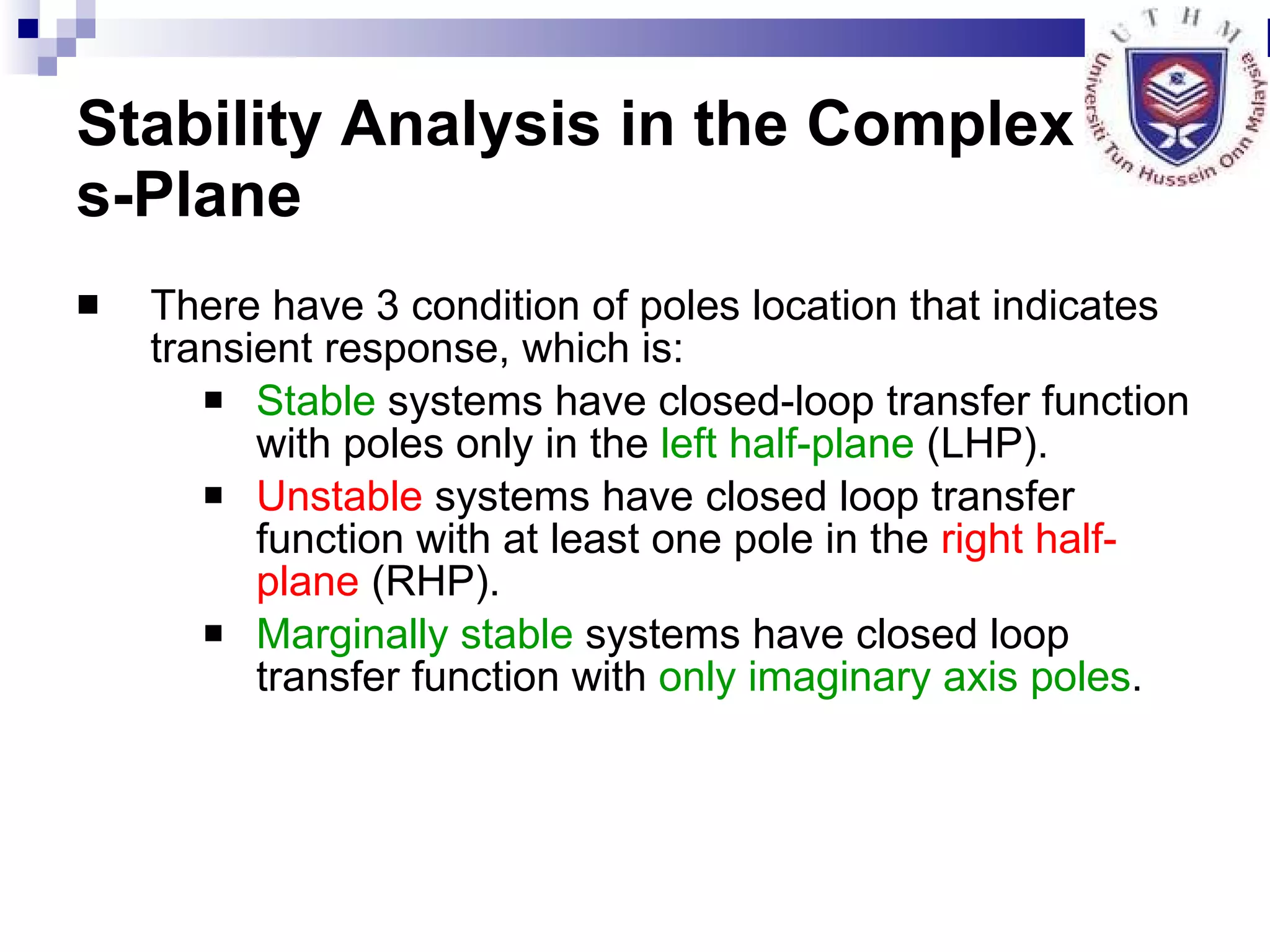
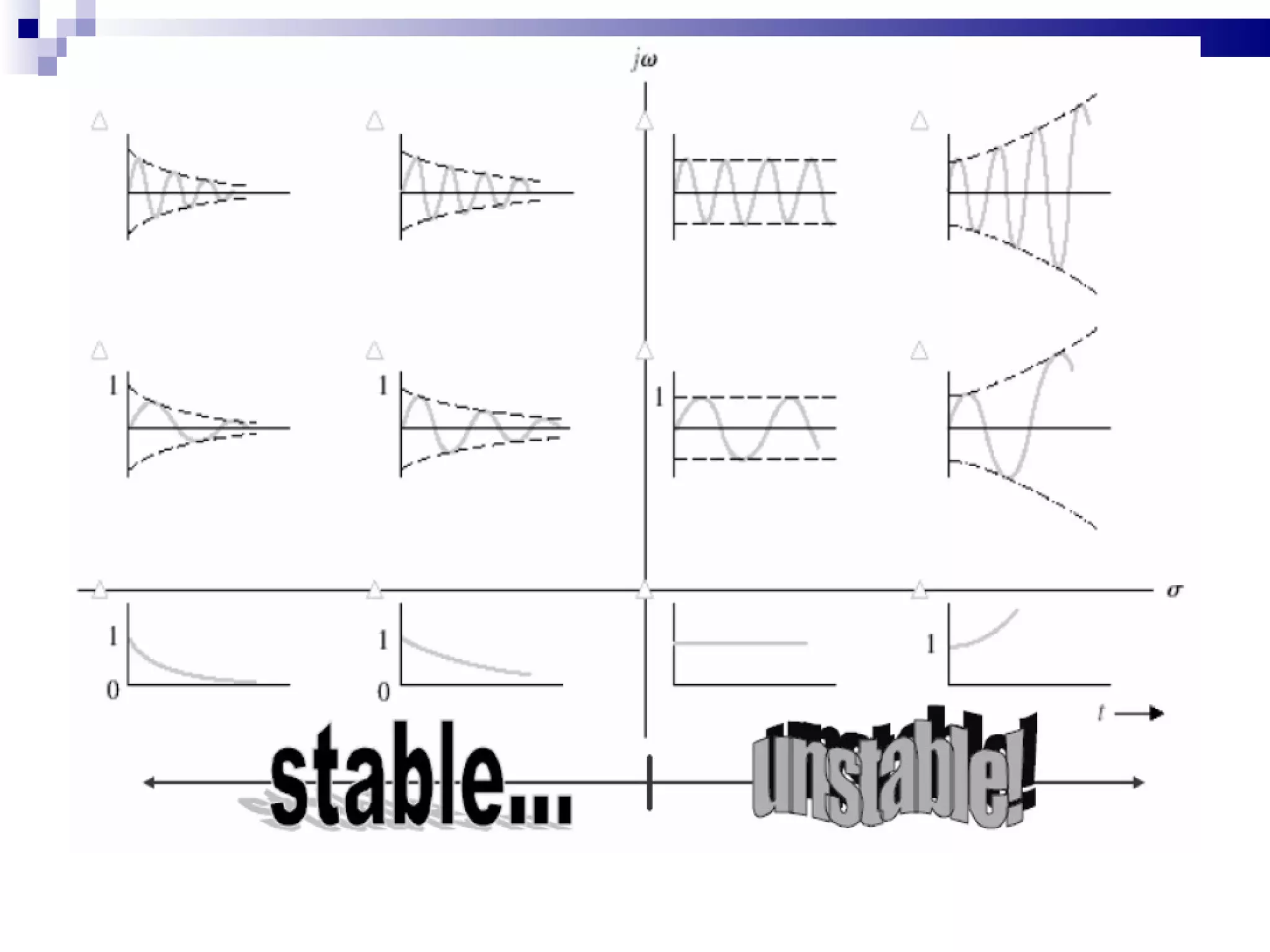
Stability Analysis in the Complex  s-Plane There have 3 condition of poles location that indicates transient response, which is: Stable  systems have closed-loop transfer function with poles only in the  left half-plane  (LHP). Unstable  systems have closed loop transfer function with at least one pole in the  right half-plane  (RHP). Marginally stable  systems have closed loop transfer function with  only imaginary axis poles .
cont.
 
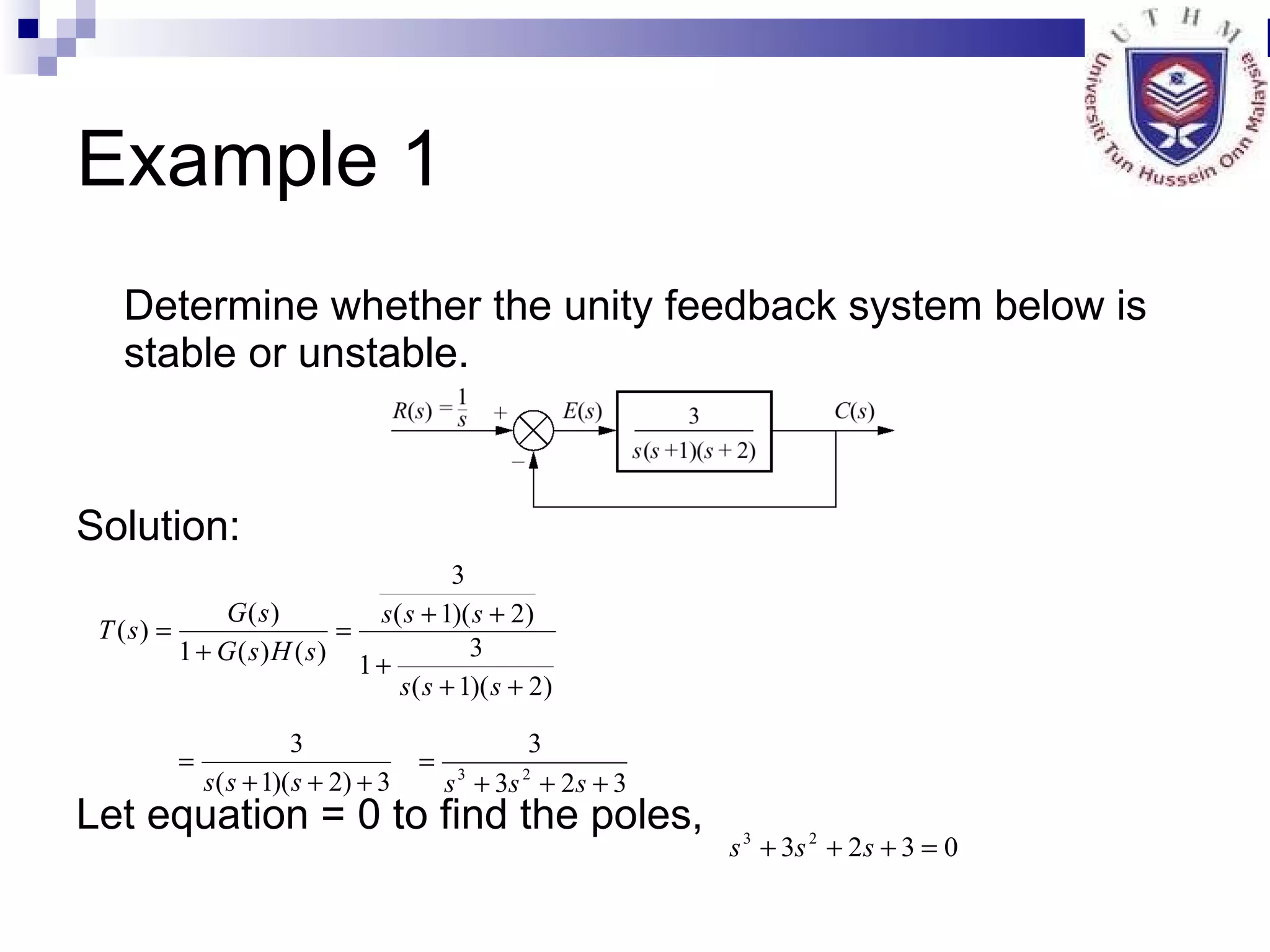
Example 1 Determine whether the unity feedback system below is stable or unstable. Solution: Let equation = 0 to find the poles,
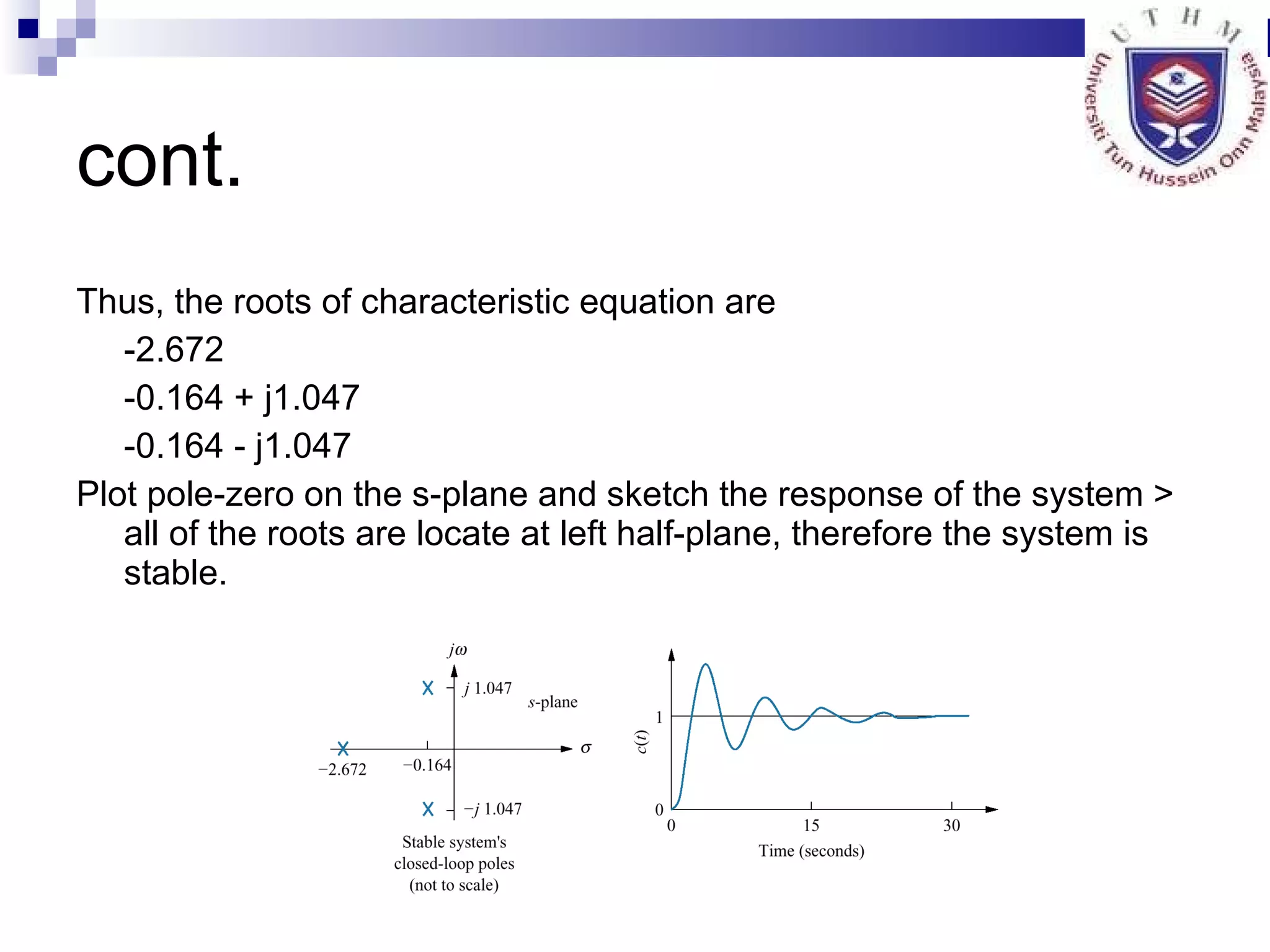
cont. Thus, the roots of characteristic equation are -2.672 -0.164 + j1.047 -0.164 - j1.047 Plot pole-zero on the s-plane and sketch the response of the system > all of the roots are locate at left half-plane, therefore the system is stable.
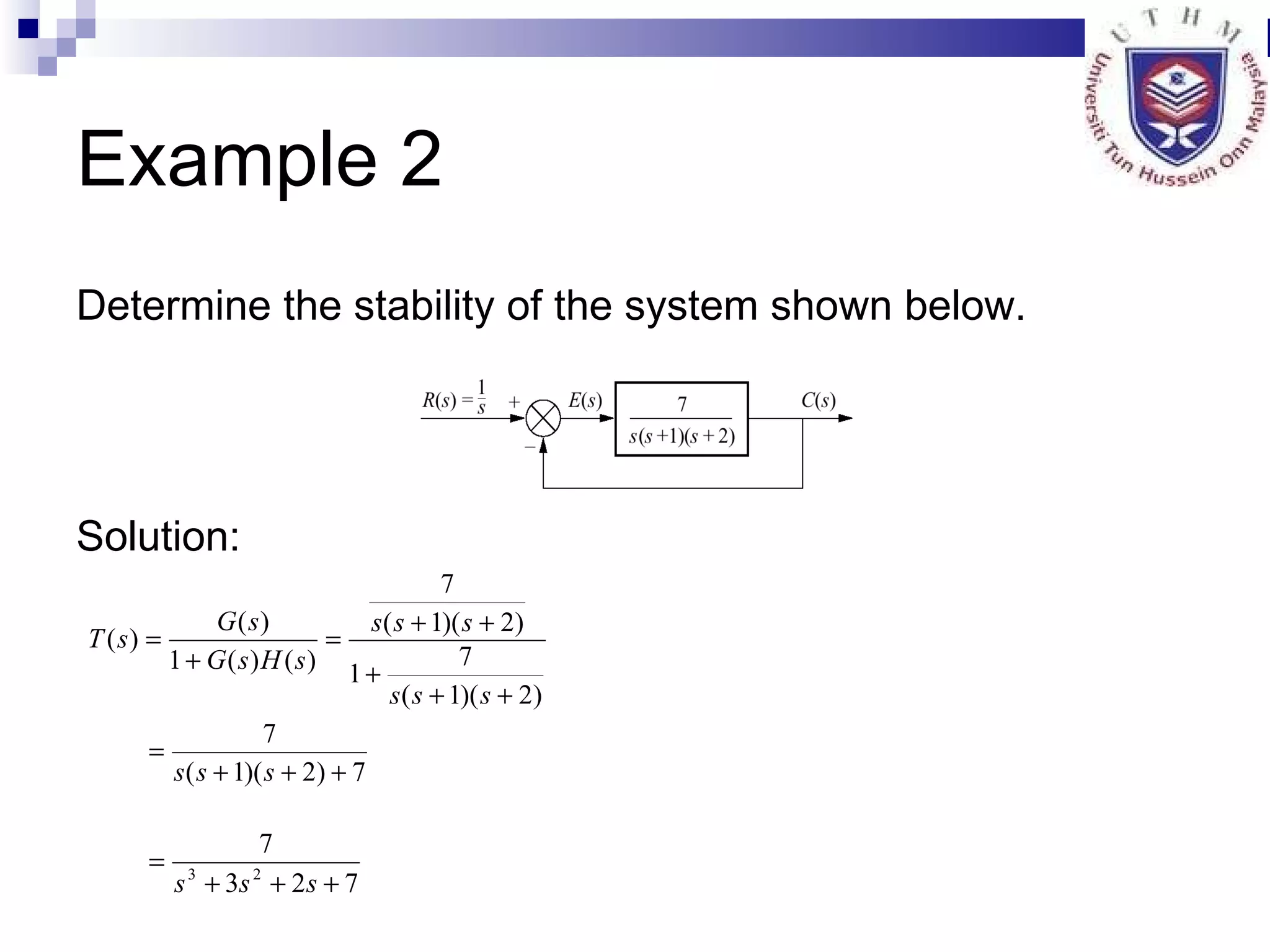
Example 2 Determine the stability of the system shown below. Solution:
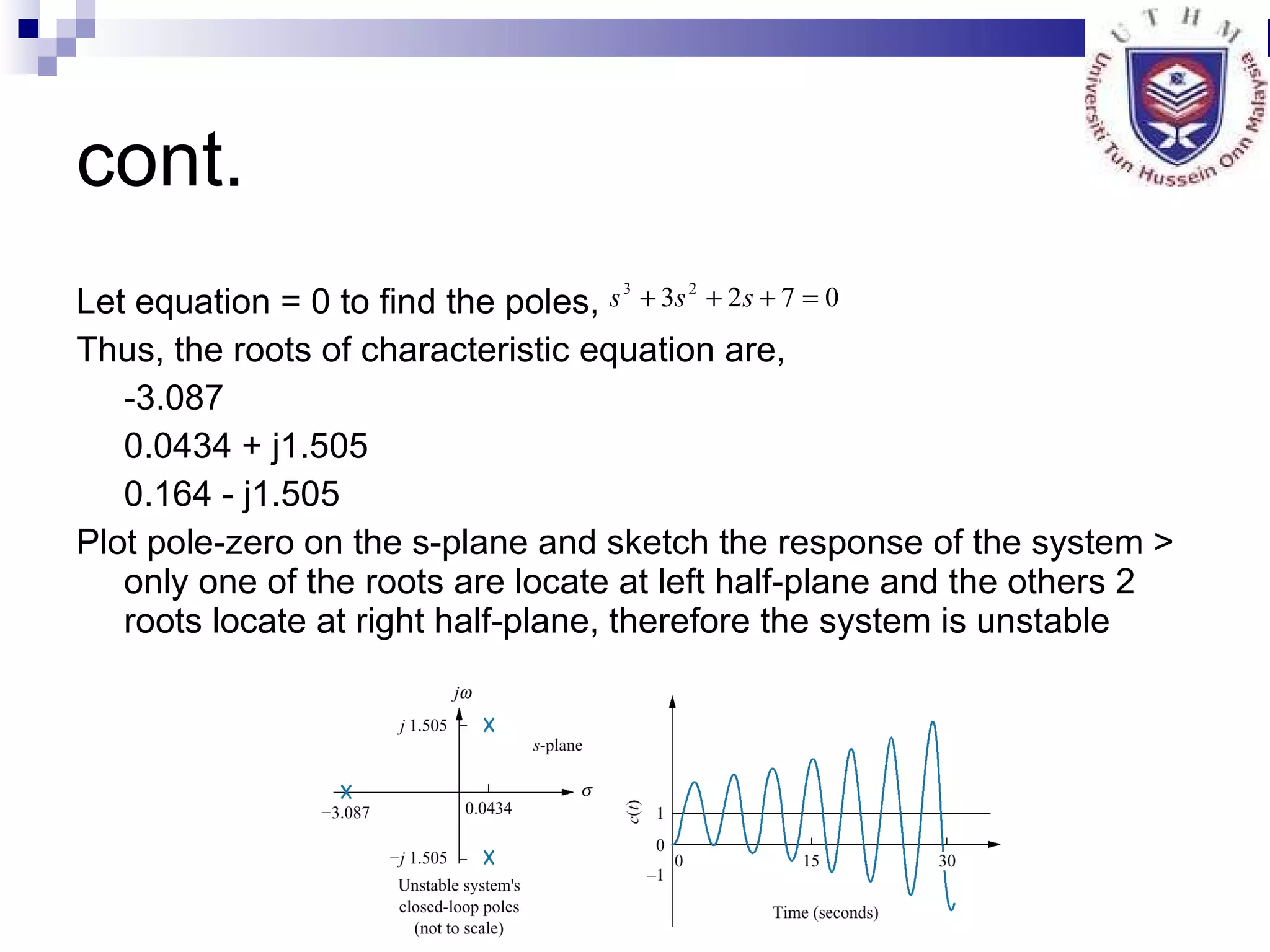
cont. Let equation = 0 to find the poles, Thus, the roots of characteristic equation are, -3.087 0.0434 + j1.505 0.164 - j1.505 Plot pole-zero on the s-plane and sketch the response of the system > only one of the roots are locate at left half-plane and the others 2 roots locate at right half-plane, therefore the system is unstable

Meeting w6 chapter 2 part 3

  • 1.
    Chapter 2 –Analog Control System (cont.) Reduction of Multiple Subsystem System Response – Poles/ Zeros, Second Order System, Steady State Error, Stability Analysis
  • 2.
    7. Reduction ofMultiple Subsystem Subsystem is represented as a block with an input, output and transfer function. Many systems are composed of multiple subsystems. When multiple subsystem are interconnected, new element must be added like summing junction and pickoff points. The main purpose of reduction multiple subsystem is to reduce more complicated systems to a single block.
  • 3.
    Component of ablock diagram for a linear, time-invariant system
  • 4.
  • 5.
  • 6.
  • 7.
  • 8.
  • 9.
    8. System responseTime is an independent variable mostly used in a control system evaluation, also referred as time response. In order to find a system response, 2 steps are commonly used: 1. differential equation 2. inverse Laplace transformation In general, system response contains 2 parts: 1. Transient response (natural response) Part of the time response that goes to zero as time becomes very large. 2. Steady state response (forced response) Part of the time response that remains after the transient has died out
  • 10.
    Example 1 Findthe response of the system for a step input . Solution :
  • 11.
    Poles, Zeros andSystem Response Poles is the values of the Laplace transform variable( s ) that cause the transfer function to become infinite or any roots of the denominator of the transfer function . Zeros is the values of the Laplace transform variable( s ) that cause the transfer function to become zero , or any roots of the numerator of the transfer function .
  • 12.
    Example 1 Giventhe transfer function G ( s ) in Figure below, a pole exists at s = -5, and a zero exists at -2. These values are plotted on the complex s-plane, using x for the pole and О for the zero.
  • 13.
    cont. Solution: Toshow the properties of the poles and zeros, lets applied unit step response of the system. Multiplying the transfer function by a step function yields : Thus :
  • 14.
    cont. From thedevelopment summarize, the following conclusions can be drawn:
  • 15.
    Second Order SystemA system where the closed loop transfer function possesses two poles is called a second-order system
  • 16.
  • 17.
  • 18.
  • 19.
  • 20.
  • 21.
    Example 1 Thetransfer function of a position control system is given by: Determine: Rise time, t r Peak time, t p Percent overshoot, %M p Settling time t s for 2% criterion
  • 22.
    cont. Solution: 27.39rad/s 2 x 27.39
  • 23.
  • 24.
    Steady State ErrorSteady-state error is the difference between the input and the output for prescribed test input as t   . Test inputs used for steady-state error analysis are: Step Input Ramp Input Parabolic Input
  • 25.
    cont. Figure hasa step input and two possible output. Output 1 has zero steady-state error, and Output 2 has a finite steady-state error e2(  ) .
  • 26.
    cont. The formulato obtain steady-state error is as follow:
  • 27.
  • 28.
  • 29.
  • 30.
    Stability Analysis Asystem is stable if every bounded input yields a bounded output . A system is unstable if any bounded input yields an unbounded output. A system is marginally stable/neutral if the system is stable for some bounded input and unstable for the others ( as undamped ) but remains constant or oscillates.
  • 31.
    Stability Analysis inthe Complex s-Plane There have 3 condition of poles location that indicates transient response, which is: Stable systems have closed-loop transfer function with poles only in the left half-plane (LHP). Unstable systems have closed loop transfer function with at least one pole in the right half-plane (RHP). Marginally stable systems have closed loop transfer function with only imaginary axis poles .
  • 32.
  • 33.
  • 34.
    Example 1 Determinewhether the unity feedback system below is stable or unstable. Solution: Let equation = 0 to find the poles,
  • 35.
    cont. Thus, theroots of characteristic equation are -2.672 -0.164 + j1.047 -0.164 - j1.047 Plot pole-zero on the s-plane and sketch the response of the system > all of the roots are locate at left half-plane, therefore the system is stable.
  • 36.
    Example 2 Determinethe stability of the system shown below. Solution:
  • 37.
    cont. Let equation= 0 to find the poles, Thus, the roots of characteristic equation are, -3.087 0.0434 + j1.505 0.164 - j1.505 Plot pole-zero on the s-plane and sketch the response of the system > only one of the roots are locate at left half-plane and the others 2 roots locate at right half-plane, therefore the system is unstable