Chapter 1 – Overview of Control System Eddy Irwan Shah Bin Saadon Dept. of Electrical Engineering PPD, UTHM [email_address] 019-7017679
Outline: Introduction Control System Concept Type of Control System  Control System Classification Control System Design
1. Intro – Objective  After completing this chapter, student will be able to : Define  the basic features and configurations of control systems Describe the open/closed-loop control system Learn control system applications Describe a general process for designing a control system
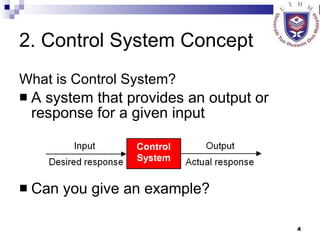
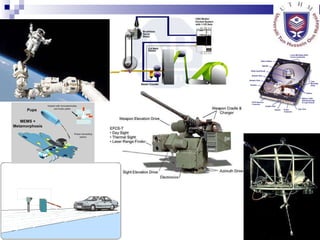
2. Control System Concept What is Control System? A system that provides an output or response for a given input Can you give an example?
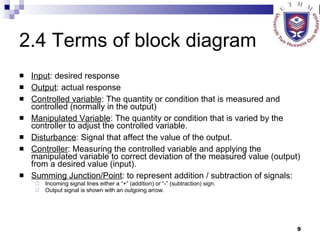
2.1 What is System? Definition : A  combination of components or subsystems that act together and perform a certain objectives.  Systems interact with their environment across a separating boundary.  The interaction is defined in terms of variables. System inputs System outputs Environmental disturbance
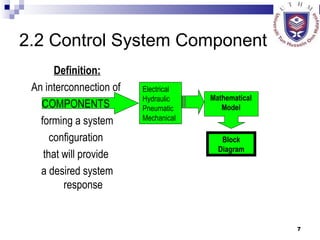
2.2 Control System Component Definition: An interconnection of  COMPONENTS  forming a system configuration  that will provide  a desired system response Block Diagram Electrical Hydraulic Pneumatic  Mechanical Mathematical Model
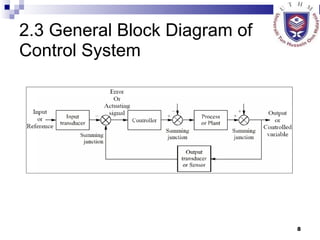
2.3 General Block Diagram of Control System
2.4 Terms of block diagram Input : desired response Output : actual response Controlled variable : The quantity or condition that is measured and controlled (normally in the output) Manipulated Variable : The quantity or condition that is varied by the controller to adjust the controlled variable. Disturbance : Signal that affect the value of the output. Controller : Measuring the controlled variable and applying the manipulated variable to correct deviation of the measured value (output) from a desired value (input). Summing Junction/Point : to represent addition / subtraction of signals:  Incoming signal lines either a “+” (addition) or “-” (subtraction) sign. Output signal is shown with an outgoing arrow.
3. Type of Control System The control system can be described into two configuration:  OPEN LOOP  and  CLOSED-LOOP
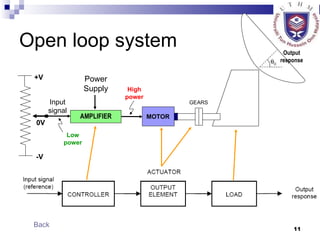
Open loop system  O Output response Back AMPLIFIER Power Supply High power +V -V 0V Input signal Low power MOTOR GEARS
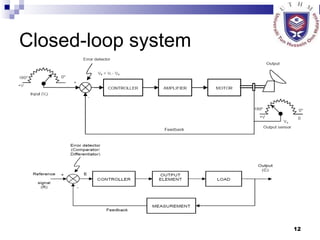
Closed-loop system
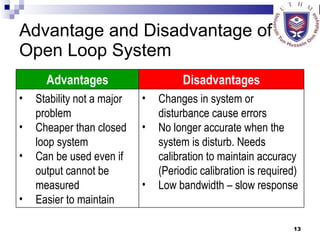
Advantage and Disadvantage of Open Loop System Advantages Disadvantages Stability not a major problem Cheaper than closed loop system Can be used even if output cannot be measured Easier to maintain Changes in system or disturbance cause errors No longer accurate when the system is disturb. Needs calibration to maintain accuracy (Periodic calibration is required) Low bandwidth – slow response
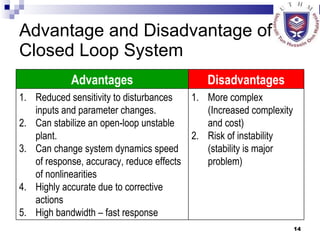
Advantage and Disadvantage of Closed Loop System Advantages Disadvantages Reduced sensitivity to disturbances inputs and parameter changes. Can stabilize an open-loop unstable plant. Can change system dynamics speed of response, accuracy, reduce effects of nonlinearities Highly accurate due to corrective actions High bandwidth – fast response More complex (Increased complexity and cost) Risk of instability (stability is major problem)
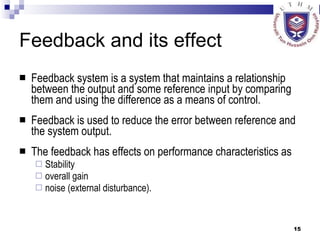
Feedback and its effect Feedback system is a system that maintains a relationship between the output and some reference input by comparing them and using the difference as a means of control.  Feedback is used to reduce the error between reference and the system output.  The feedback has effects on performance characteristics as  Stability overall gain noise (external disturbance).
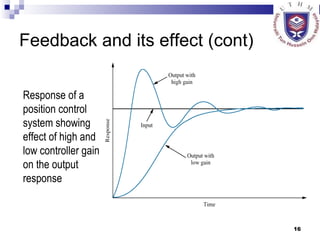
Feedback and its effect (cont) Response of a position control system showing effect of high and low controller gain on the output response
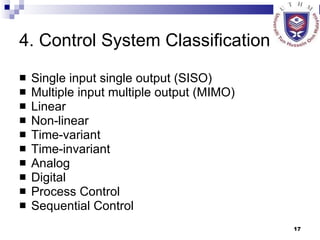
4. Control System Classification  Single input single output (SISO) Multiple input multiple output (MIMO) Linear Non-linear Time-variant Time-invariant Analog Digital Process Control  Sequential Control
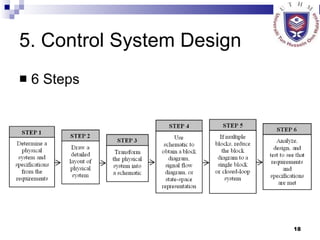
5. Control System Design 6 Steps
Summary of today’s lesson? You have learn: The definition of control system. The components of control system. Block diagram. Type of control system. How to design a control system.
Activity # 1 (1 hour) Form a group of 5 persons. Select one sector from the list on the next slide. According to the design steps, describe the system operation. You are not designing the system but you are doing ‘reverse engineering’. Explain you work in 10 minutes presentation on the next class. A tutorial class next Friday is for a discussion for this activity. This activity carries 5% of your total marks.

Meeting w1 chapter 1

  • 1.
    Chapter 1 –Overview of Control System Eddy Irwan Shah Bin Saadon Dept. of Electrical Engineering PPD, UTHM [email_address] 019-7017679
  • 2.
    Outline: Introduction ControlSystem Concept Type of Control System Control System Classification Control System Design
  • 3.
    1. Intro –Objective After completing this chapter, student will be able to : Define the basic features and configurations of control systems Describe the open/closed-loop control system Learn control system applications Describe a general process for designing a control system
  • 4.
    2. Control SystemConcept What is Control System? A system that provides an output or response for a given input Can you give an example?
  • 6.
    2.1 What isSystem? Definition : A combination of components or subsystems that act together and perform a certain objectives. Systems interact with their environment across a separating boundary. The interaction is defined in terms of variables. System inputs System outputs Environmental disturbance
  • 7.
    2.2 Control SystemComponent Definition: An interconnection of COMPONENTS forming a system configuration that will provide a desired system response Block Diagram Electrical Hydraulic Pneumatic Mechanical Mathematical Model
  • 8.
    2.3 General BlockDiagram of Control System
  • 9.
    2.4 Terms ofblock diagram Input : desired response Output : actual response Controlled variable : The quantity or condition that is measured and controlled (normally in the output) Manipulated Variable : The quantity or condition that is varied by the controller to adjust the controlled variable. Disturbance : Signal that affect the value of the output. Controller : Measuring the controlled variable and applying the manipulated variable to correct deviation of the measured value (output) from a desired value (input). Summing Junction/Point : to represent addition / subtraction of signals: Incoming signal lines either a “+” (addition) or “-” (subtraction) sign. Output signal is shown with an outgoing arrow.
  • 10.
    3. Type ofControl System The control system can be described into two configuration: OPEN LOOP and CLOSED-LOOP
  • 11.
    Open loop system O Output response Back AMPLIFIER Power Supply High power +V -V 0V Input signal Low power MOTOR GEARS
  • 12.
  • 13.
    Advantage and Disadvantageof Open Loop System Advantages Disadvantages Stability not a major problem Cheaper than closed loop system Can be used even if output cannot be measured Easier to maintain Changes in system or disturbance cause errors No longer accurate when the system is disturb. Needs calibration to maintain accuracy (Periodic calibration is required) Low bandwidth – slow response
  • 14.
    Advantage and Disadvantageof Closed Loop System Advantages Disadvantages Reduced sensitivity to disturbances inputs and parameter changes. Can stabilize an open-loop unstable plant. Can change system dynamics speed of response, accuracy, reduce effects of nonlinearities Highly accurate due to corrective actions High bandwidth – fast response More complex (Increased complexity and cost) Risk of instability (stability is major problem)
  • 15.
    Feedback and itseffect Feedback system is a system that maintains a relationship between the output and some reference input by comparing them and using the difference as a means of control. Feedback is used to reduce the error between reference and the system output. The feedback has effects on performance characteristics as Stability overall gain noise (external disturbance).
  • 16.
    Feedback and itseffect (cont) Response of a position control system showing effect of high and low controller gain on the output response
  • 17.
    4. Control SystemClassification Single input single output (SISO) Multiple input multiple output (MIMO) Linear Non-linear Time-variant Time-invariant Analog Digital Process Control Sequential Control
  • 18.
    5. Control SystemDesign 6 Steps
  • 19.
    Summary of today’slesson? You have learn: The definition of control system. The components of control system. Block diagram. Type of control system. How to design a control system.
  • 20.
    Activity # 1(1 hour) Form a group of 5 persons. Select one sector from the list on the next slide. According to the design steps, describe the system operation. You are not designing the system but you are doing ‘reverse engineering’. Explain you work in 10 minutes presentation on the next class. A tutorial class next Friday is for a discussion for this activity. This activity carries 5% of your total marks.