Week 10 Data 
Presentation System 
Control System Engineering 
PE-3032 
Prof. CHARLTON S. INAO 
Defence Engineering College, 
Debre Zeit , Ethiopia
Electromechanical System 
Transfer Functions 
• Systems that are hybrids of electrical and 
mechanical variables is the electromechanical 
systems. 
• Other applications for systems with 
electromechanical components are robot 
controls, sun and star trackers, and computer 
tape and disk-drive position controls.
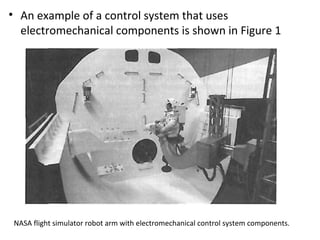
• An example of a control system that uses 
electromechanical components is shown in Figure 1 
NASA flight simulator robot arm with electromechanical control system components.
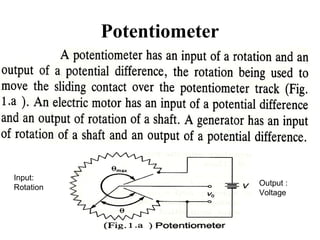
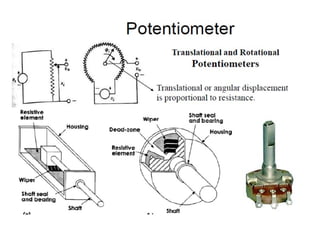
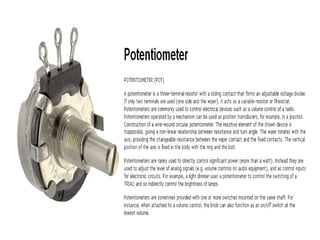
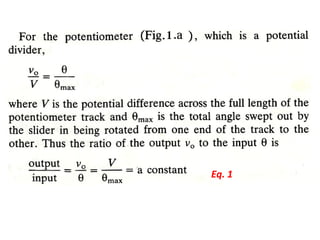
Potentiometer 
Input: 
Rotation Output : 
Voltage
Eq. 1
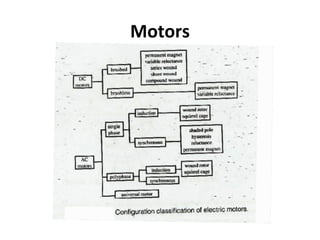
Motors
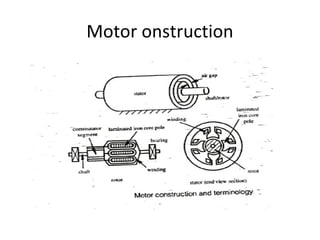
Motor onstruction
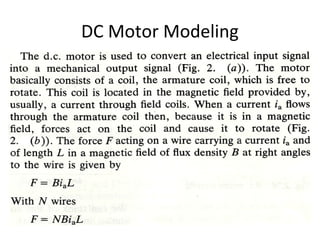
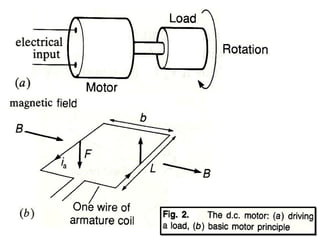
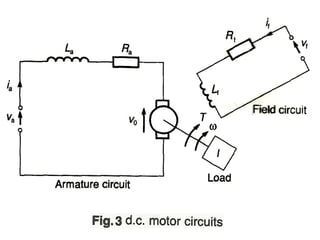
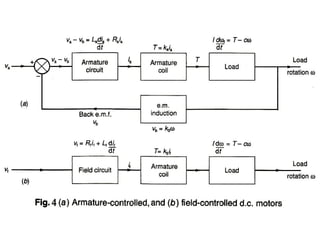
DC Motor Modeling
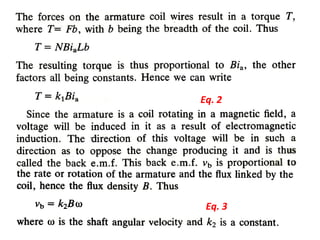
Eq. 2 
Eq. 3
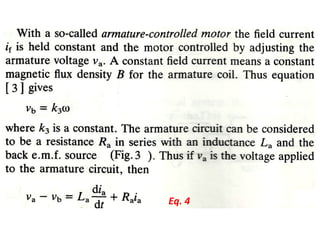
Eq. 4
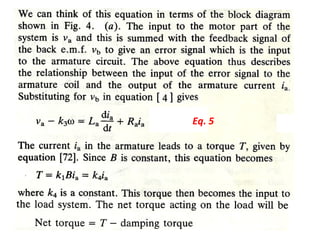
Eq. 5
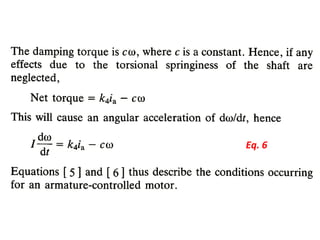
Eq. 6
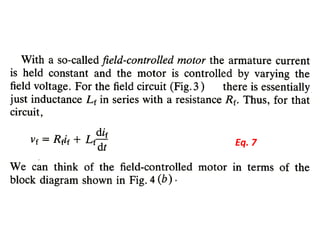
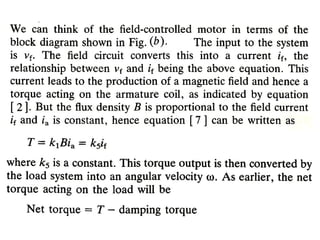
Eq. 7
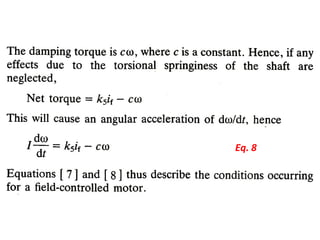
Eq. 8
Modeling 
of 
Thermal Systems
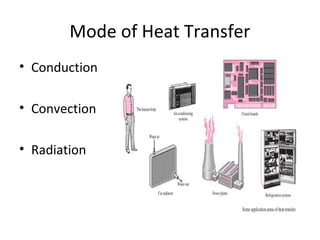
Mode of Heat Transfer 
• Conduction 
• Convection 
• Radiation
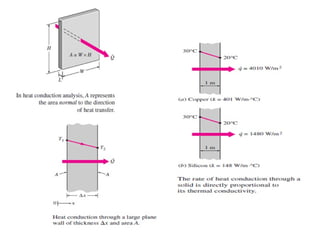
Conduction 
Conduction is the transfer of energy from the more energetic 
particles of a substance to the adjacent less energetic ones as a 
result of interactions between the particles. Conduction can take 
place in solids, liquids, or gases. 
In gases and liquids, conduction is due to the collisions and 
diffusion of the molecules during their random motion. In solids, it 
is due to the combination of vibrations of the molecules in a lattice 
and the energy transport by free electrons. 
A cold canned drink in a warm room, for example, eventually 
warms up to the room temperature as a result of heat transfer 
from the room to the drink through the aluminum can by 
conduction.
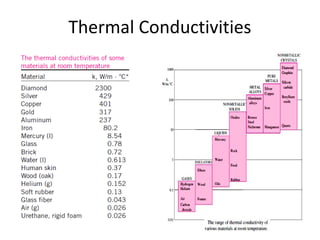
Thermal Conductivities
CONVECTION 
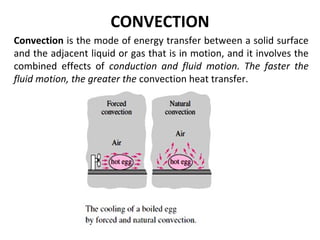
Convection is the mode of energy transfer between a solid surface 
and the adjacent liquid or gas that is in motion, and it involves the 
combined effects of conduction and fluid motion. The faster the 
fluid motion, the greater the convection heat transfer.
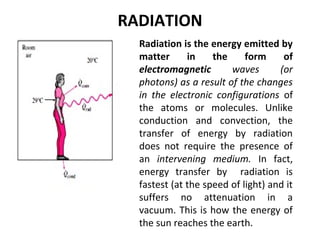
RADIATION 
Radiation is the energy emitted by 
matter in the form of 
electromagnetic waves (or 
photons) as a result of the changes 
in the electronic configurations of 
the atoms or molecules. Unlike 
conduction and convection, the 
transfer of energy by radiation 
does not require the presence of 
an intervening medium. In fact, 
energy transfer by radiation is 
fastest (at the speed of light) and it 
suffers no attenuation in a 
vacuum. This is how the energy of 
the sun reaches the earth.
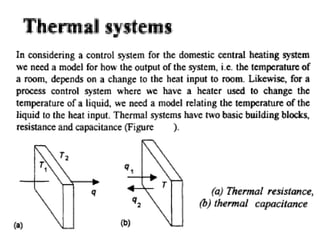
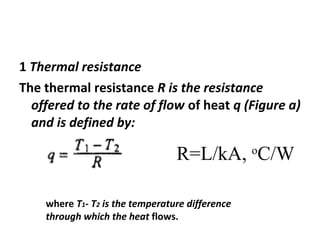
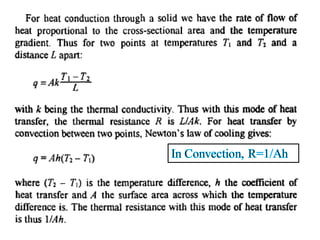
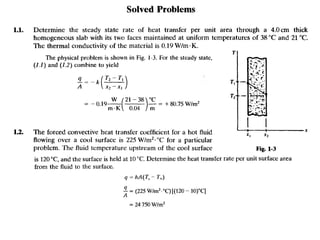
1 Thermal resistance 
The thermal resistance R is the resistance 
offered to the rate of flow of heat q (Figure a) 
and is defined by: 
R=L/kA, oC/W 
where T1- T2 is the temperature difference 
through which the heat flows.
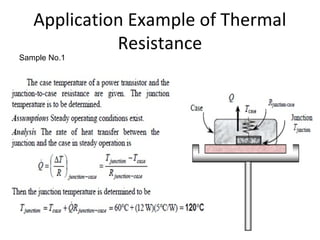
Application Example of Thermal 
Resistance 
Sample No.1
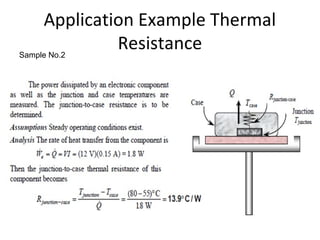
Application Example Thermal 
Resistance 
Sample No.2
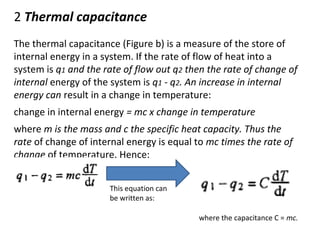
2 Thermal capacitance 
The thermal capacitance (Figure b) is a measure of the store of 
internal energy in a system. If the rate of flow of heat into a 
system is q1 and the rate of flow out q2 then the rate of change of 
internal energy of the system is q1 - q2. An increase in internal 
energy can result in a change in temperature: 
change in internal energy = mc x change in temperature 
where m is the mass and c the specific heat capacity. Thus the 
rate of change of internal energy is equal to mc times the rate of 
change of temperature. Hence: 
This equation can 
be written as: 
where the capacitance C = mc.
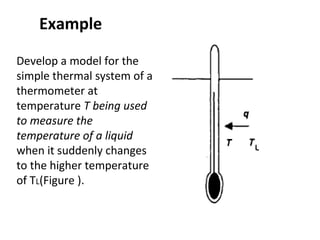
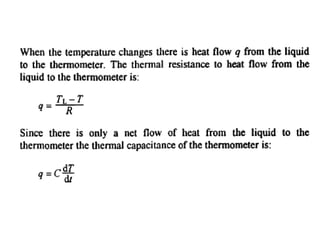
Example 
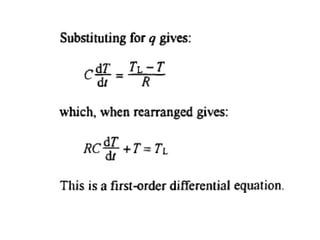
Develop a model for the 
simple thermal system of a 
thermometer at 
temperature T being used 
to measure the 
temperature of a liquid 
when it suddenly changes 
to the higher temperature 
of TL(Figure ).
Example 
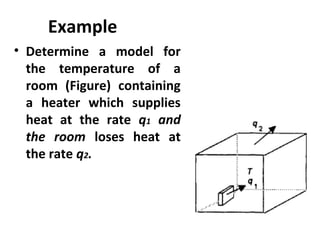
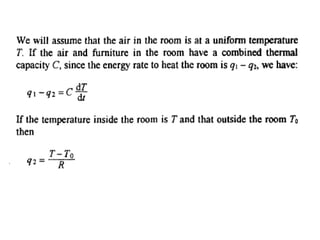
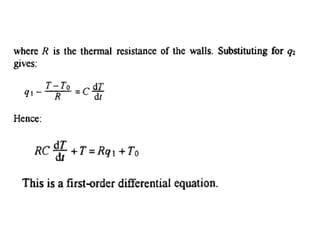
• Determine a model for 
the temperature of a 
room (Figure) containing 
a heater which supplies 
heat at the rate q1 and 
the room loses heat at 
the rate q2.
Week 10 part 4 electromechanical and thermal

Week 10 part 4 electromechanical and thermal

  • 1.
    Week 10 Data Presentation System Control System Engineering PE-3032 Prof. CHARLTON S. INAO Defence Engineering College, Debre Zeit , Ethiopia
  • 2.
    Electromechanical System TransferFunctions • Systems that are hybrids of electrical and mechanical variables is the electromechanical systems. • Other applications for systems with electromechanical components are robot controls, sun and star trackers, and computer tape and disk-drive position controls.
  • 3.
    • An exampleof a control system that uses electromechanical components is shown in Figure 1 NASA flight simulator robot arm with electromechanical control system components.
  • 4.
  • 7.
  • 8.
  • 9.
  • 10.
  • 12.
  • 13.
  • 15.
  • 17.
  • 18.
  • 20.
  • 21.
  • 22.
    Mode of HeatTransfer • Conduction • Convection • Radiation
  • 23.
    Conduction Conduction isthe transfer of energy from the more energetic particles of a substance to the adjacent less energetic ones as a result of interactions between the particles. Conduction can take place in solids, liquids, or gases. In gases and liquids, conduction is due to the collisions and diffusion of the molecules during their random motion. In solids, it is due to the combination of vibrations of the molecules in a lattice and the energy transport by free electrons. A cold canned drink in a warm room, for example, eventually warms up to the room temperature as a result of heat transfer from the room to the drink through the aluminum can by conduction.
  • 25.
  • 26.
    CONVECTION Convection isthe mode of energy transfer between a solid surface and the adjacent liquid or gas that is in motion, and it involves the combined effects of conduction and fluid motion. The faster the fluid motion, the greater the convection heat transfer.
  • 27.
    RADIATION Radiation isthe energy emitted by matter in the form of electromagnetic waves (or photons) as a result of the changes in the electronic configurations of the atoms or molecules. Unlike conduction and convection, the transfer of energy by radiation does not require the presence of an intervening medium. In fact, energy transfer by radiation is fastest (at the speed of light) and it suffers no attenuation in a vacuum. This is how the energy of the sun reaches the earth.
  • 29.
    1 Thermal resistance The thermal resistance R is the resistance offered to the rate of flow of heat q (Figure a) and is defined by: R=L/kA, oC/W where T1- T2 is the temperature difference through which the heat flows.
  • 31.
    Application Example ofThermal Resistance Sample No.1
  • 32.
    Application Example Thermal Resistance Sample No.2
  • 34.
    2 Thermal capacitance The thermal capacitance (Figure b) is a measure of the store of internal energy in a system. If the rate of flow of heat into a system is q1 and the rate of flow out q2 then the rate of change of internal energy of the system is q1 - q2. An increase in internal energy can result in a change in temperature: change in internal energy = mc x change in temperature where m is the mass and c the specific heat capacity. Thus the rate of change of internal energy is equal to mc times the rate of change of temperature. Hence: This equation can be written as: where the capacitance C = mc.
  • 35.
    Example Develop amodel for the simple thermal system of a thermometer at temperature T being used to measure the temperature of a liquid when it suddenly changes to the higher temperature of TL(Figure ).
  • 38.
    Example • Determinea model for the temperature of a room (Figure) containing a heater which supplies heat at the rate q1 and the room loses heat at the rate q2.