ZIKRULLAH
CENTRAL VENOUS LINE
CENTRAL VENOUS CANNULATION
Central venous cannulation is the
placement of a catheter in a vein that
leads directly to the heart, e.g.;
internal jugular vein subclavian vein
etc.
Indications for central venous Cannulation
 Central venous pressure monitoring
 Pulmonary artery catheterization and monitoring
 Transvenous cardiac pacing
 Temporary hemodialysis
 Drug administration
Vasoactive drugs
Hyperalimentation [TPN]
Chemotherapy
Drugs irritating to peripheral veins
Prolonged antibiotic therapy
 Rapid infusion of fluids (through large cannulas)
Trauma
Major surgery
 Aspiration of air emboli
 Inadequate peripheral intravenous access
 Sampling site for repeated blood testing
CONTRAINDICATIONS TO CENTRAL
VENOUS CANNULATION
A. Renal cell tumor extension into right atrium.
B. Large tricuspid valve vegetations.
C. Anticoagulant therapy.
D. Severe coagulopathy – femoral preferred
E. Previous ipsilateral end arterectomy.
F. IVC filter - in case femoral is planned
G. Ipsilateral AV fistula
SITES
1) Internal jugular vein
2) Subclavian vein
3) External jugular vein
4) Femoral vein
5) Axillary vein
6) Basilic vein,cephalic vein (peripherally inserted
catheters)
CHOICE OF SITES
 Easy cannulation – basilic v.;Internal jugular v.
 Long term use – subclavian v. Internal jugular v.
 Success rate ( pulmonary artery catheterization)
internal jugular v.;Subclavian v.
 Complications – basilic v. ; External jugular v.
DIFFERENT METHODS OF INSERTION
 Catheter over the
needle
 Catheter over
guidewire (Seldinger
technique).
 Catheter through the
cannula.
EQUIPMENTS
 Tilting table
 Sterile pack and antiseptic solution
 Local anaesthetic
 Appropriate CV catheter for age/route/purpose
 Syringes and needles
 Saline
 Suture material
 Sterile dressing
 Facility for chest X-ray if available
INTERNAL JUGULAR VEIN
CANNULATION
 Most commonly chosen;
Consistent and predictable anatomic
location,
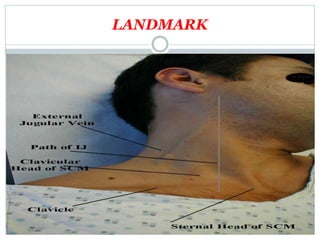
Palpable surface landmarks,
Short, straight and valveless course to
SVC and right atrium.
LANDMARK
ANATOMY
INTERNAL JUGULAR APPROACH
 APPROACHES
ANTERIOR
CENTRAL-Common
POSTERIOR
COMMON APPROACHES AND LANDMARKS
INTERNAL
JUGULAR
POSITION NEEDLE
INSERTION
ANGLE OF
NEEDLE
ANTERIOR -Trendelenburg
-Head turned to
opposite side
Anterior border of
SCM midway
between angle of
mandible & clavicle
Advance needle
towards medial
aspect of ipsilateral
nipple at 30-45˚
MIDDLE -Trendelenburg
-Head turned to
opposite side
Apex of the triangle
formed by the two
heads of SCM
Advance needle
towards ipsilateral
nipple at 30-45˚
POSTERIOR -Trendelenburg
-Head turned to
opposite side
1cm above the point
where external
jugular vein crosses
lateral edge of SCM
Advance needle
towards sternal
notch at 30˚
PT IS PLACED IN A TRENDELENBURG
POSITION
CLEAN THE AREA UNDER STRICT
STERILE PRECAUTION
 TURN THE HEAD
SLIGHTLY TO LEFT
( 20-30 degrees)
 GENTLY PALPATE
THE CAROTID
ARTERY
 Infiltrate the skin at the
level of cricoid with local
anaesthetic
 25 g locator needle at 30
degree angle to skin in
sagittal plane
 At the medial border of
lateral head of sternomastoid
pointing towards the
ipsilateral nipple
 Negative pressure to be
maintained in syringe
 IJV is encountered at a
depth of 2-4 cm
 Blood splash may not
occur until the needle
is withdrawn
 Once IJV is located,
18G needle is placed
immediately adjacent
to locator needle
 Continuous aspiration
technique employed
 Once position
confirmed a guide-
wire is placed through
it ;not more than 18
cms
 Monitor pulse & ECG
tracing
Remove the needle
over guide-wire
 A dilator is introduced
and removed
 Catheter is threaded
over the guide-wire to a
depth of 12-15 cms
 Monitor pulse & ECG
tracing
 Guide-wire is withdrawn
 Aspirate blood from catheter
 Attach a three-way connector & tubing
 Suture in place and apply sterile dressing
 Get x-ray chest to rule out pneumothorax and
to localize tip of catheter.
SUBCLAVIAN VEIN CANNULATION
 Infra-clavicular and supra-clavicular approach,
 Position – head down with head turned towards
contralateral side ; rolled up sheet between
shoulder blades longitudinally ; arms by side
assistant giving traction to arm of same side,
COMMON APPROACHES AND
LANDMARKS
SUBCLAVIAN
POSITION NEEDLE
INSERTION
ANGLE OF
NEEDLE
INFRACLAVICULAR -Trendelenburg
-Head turned to
opposite side
-Ipsilateral arm
adducted
2 cm inferior to
midportion of the
clavicle, ”walk”
down clavicle and
advance just deep
to the clavicle
Advance the needle
under the clavicle
towards the sternal
notch
SUPRACLAVICULAR -Trendelenburg
-Head turned to
opposite side
-Ipsilateral arm
adducted
Just above the
clavicle , lateral to
the clavicular head
of the SCM
Advance the needle
at a 45˚ angle, just
under the clavicle
towards the
contralateral nipple
INFRA CLAVICULAR APPROACH
STEPS
 Local infiltration 1-2
cms below inferior
border of clavicle in
midclavicular line,
 18 G needle inserted at
infiltrated site 2 cm
inferior to midportion
of the clavicle, ”walk”
down clavicle and
advance just deep to the
clavicle
 Advance the needle
under the clavicle
towards the sternal notch
 Needle is kept horizontal
at all times (10 degree
upward bend on needle
adjacent to hub maybe
applied)
 Continuous aspiration
technique applied
STEPS
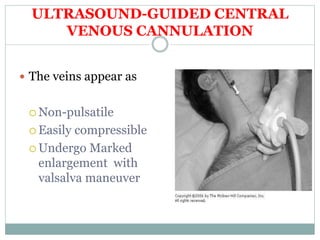
ULTRASOUND-GUIDED CENTRAL
VENOUS CANNULATION
 The veins appear as
 Non-pulsatile
 Easily compressible
 Undergo Marked
enlargement with
valsalva maneuver
APPEARANCE
INSERTION OF THE NEEDLE-
visual confirmation
GUIDEWIRE INSERTED UNER
DIRECT VISION
 Advantages of USG guided CVP cannultion
 Easy identification of any variation in anatomy
 Direct visualization of important structures
 Decreases the rate of complications.
 Ensures faster placement of central catheters
 Indirect calculation of CVP
through physical
examination of the neck
veins is a fundamental
aspect of cardiovascular
assessment, but the bedside
diagnosis of low, normal, or
high CVP is often
inaccurate, particularly in
critically ill patients.
CVP MEASURMENT
PROCEDURE FOR CVP MEASUREMENT IS
 ZERO MANOMETER AT THE
LEVEL OF RT. ATRIUM
[level of the 4th intercostal space
in the mid-axillary line while the
patient is lying supine]
 FILL MANOMETER WITH
SALINE USING A THREE
WAY TAP
 CLOSE OFF TAP FROM
SOLUTION BAG
 OPEN TAP TO PATIENT
 OBSERVE FALLING
FLUID IN MANOMETER
 RECORD MEAN LEVEL
PERIPHERALLY INSERTED CENTRAL
CATHETER
 Originally used by cardiologists,
adapted for intensivist usage.
 Inserted via basilic or cephalic veins in
the ante-cubital fossa
 The catheter is advanced upto the
central veins
 Conflicting studies regarding
superiority as compared to centrally
inserted catheters
ADVANTAGES AND DISADVANTAGES OF PERIPHERALLY
INSERTED CENTRL CATHETERS
 ADVANTAGES
 Easy placement
 Faster
 Long lasting
 Low infection
 Ambulatory
 Low cost
 Low complications
 DISADVANTAGES
 CVP monitoring
inadequate
 Inadequate for rapid bolus
injections
 Inadequate for
resuscitation
COMPLICATION
 Early
 Arterial puncture- 10%
 Pneumothorax- 1-3%
 Bleeding
 Cardiac arrhythmias
 Injury to the thoracic duct
 Injury to surrounding
nerves
 Air embolism - 0.1%
 Catheter embolus
 Late
 Venous thrombosis
 Cardiac perforation
and tamponade
 Infection
 Hydrothorax
THANX

Central venous cannulation

  • 1.
  • 2.
    CENTRAL VENOUS CANNULATION Centralvenous cannulation is the placement of a catheter in a vein that leads directly to the heart, e.g.; internal jugular vein subclavian vein etc.
  • 3.
    Indications for centralvenous Cannulation  Central venous pressure monitoring  Pulmonary artery catheterization and monitoring  Transvenous cardiac pacing  Temporary hemodialysis  Drug administration Vasoactive drugs Hyperalimentation [TPN] Chemotherapy Drugs irritating to peripheral veins Prolonged antibiotic therapy
  • 4.
     Rapid infusionof fluids (through large cannulas) Trauma Major surgery  Aspiration of air emboli  Inadequate peripheral intravenous access  Sampling site for repeated blood testing
  • 5.
    CONTRAINDICATIONS TO CENTRAL VENOUSCANNULATION A. Renal cell tumor extension into right atrium. B. Large tricuspid valve vegetations. C. Anticoagulant therapy. D. Severe coagulopathy – femoral preferred E. Previous ipsilateral end arterectomy. F. IVC filter - in case femoral is planned G. Ipsilateral AV fistula
  • 6.
    SITES 1) Internal jugularvein 2) Subclavian vein 3) External jugular vein 4) Femoral vein 5) Axillary vein 6) Basilic vein,cephalic vein (peripherally inserted catheters)
  • 7.
    CHOICE OF SITES Easy cannulation – basilic v.;Internal jugular v.  Long term use – subclavian v. Internal jugular v.  Success rate ( pulmonary artery catheterization) internal jugular v.;Subclavian v.  Complications – basilic v. ; External jugular v.
  • 8.
    DIFFERENT METHODS OFINSERTION  Catheter over the needle  Catheter over guidewire (Seldinger technique).  Catheter through the cannula.
  • 9.
    EQUIPMENTS  Tilting table Sterile pack and antiseptic solution  Local anaesthetic  Appropriate CV catheter for age/route/purpose  Syringes and needles  Saline  Suture material  Sterile dressing  Facility for chest X-ray if available
  • 11.
    INTERNAL JUGULAR VEIN CANNULATION Most commonly chosen; Consistent and predictable anatomic location, Palpable surface landmarks, Short, straight and valveless course to SVC and right atrium.
  • 12.
  • 13.
  • 14.
    INTERNAL JUGULAR APPROACH APPROACHES ANTERIOR CENTRAL-Common POSTERIOR
  • 15.
    COMMON APPROACHES ANDLANDMARKS INTERNAL JUGULAR POSITION NEEDLE INSERTION ANGLE OF NEEDLE ANTERIOR -Trendelenburg -Head turned to opposite side Anterior border of SCM midway between angle of mandible & clavicle Advance needle towards medial aspect of ipsilateral nipple at 30-45˚ MIDDLE -Trendelenburg -Head turned to opposite side Apex of the triangle formed by the two heads of SCM Advance needle towards ipsilateral nipple at 30-45˚ POSTERIOR -Trendelenburg -Head turned to opposite side 1cm above the point where external jugular vein crosses lateral edge of SCM Advance needle towards sternal notch at 30˚
  • 16.
    PT IS PLACEDIN A TRENDELENBURG POSITION
  • 17.
    CLEAN THE AREAUNDER STRICT STERILE PRECAUTION
  • 18.
     TURN THEHEAD SLIGHTLY TO LEFT ( 20-30 degrees)  GENTLY PALPATE THE CAROTID ARTERY
  • 19.
     Infiltrate theskin at the level of cricoid with local anaesthetic  25 g locator needle at 30 degree angle to skin in sagittal plane  At the medial border of lateral head of sternomastoid pointing towards the ipsilateral nipple
  • 20.
     Negative pressureto be maintained in syringe  IJV is encountered at a depth of 2-4 cm  Blood splash may not occur until the needle is withdrawn
  • 21.
     Once IJVis located, 18G needle is placed immediately adjacent to locator needle  Continuous aspiration technique employed
  • 22.
     Once position confirmeda guide- wire is placed through it ;not more than 18 cms  Monitor pulse & ECG tracing Remove the needle over guide-wire
  • 23.
     A dilatoris introduced and removed  Catheter is threaded over the guide-wire to a depth of 12-15 cms  Monitor pulse & ECG tracing  Guide-wire is withdrawn
  • 24.
     Aspirate bloodfrom catheter  Attach a three-way connector & tubing  Suture in place and apply sterile dressing  Get x-ray chest to rule out pneumothorax and to localize tip of catheter.
  • 25.
    SUBCLAVIAN VEIN CANNULATION Infra-clavicular and supra-clavicular approach,  Position – head down with head turned towards contralateral side ; rolled up sheet between shoulder blades longitudinally ; arms by side assistant giving traction to arm of same side,
  • 26.
    COMMON APPROACHES AND LANDMARKS SUBCLAVIAN POSITIONNEEDLE INSERTION ANGLE OF NEEDLE INFRACLAVICULAR -Trendelenburg -Head turned to opposite side -Ipsilateral arm adducted 2 cm inferior to midportion of the clavicle, ”walk” down clavicle and advance just deep to the clavicle Advance the needle under the clavicle towards the sternal notch SUPRACLAVICULAR -Trendelenburg -Head turned to opposite side -Ipsilateral arm adducted Just above the clavicle , lateral to the clavicular head of the SCM Advance the needle at a 45˚ angle, just under the clavicle towards the contralateral nipple
  • 27.
  • 28.
    STEPS  Local infiltration1-2 cms below inferior border of clavicle in midclavicular line,  18 G needle inserted at infiltrated site 2 cm inferior to midportion of the clavicle, ”walk” down clavicle and advance just deep to the clavicle
  • 29.
     Advance theneedle under the clavicle towards the sternal notch  Needle is kept horizontal at all times (10 degree upward bend on needle adjacent to hub maybe applied)  Continuous aspiration technique applied
  • 30.
  • 31.
    ULTRASOUND-GUIDED CENTRAL VENOUS CANNULATION The veins appear as  Non-pulsatile  Easily compressible  Undergo Marked enlargement with valsalva maneuver
  • 32.
  • 33.
    INSERTION OF THENEEDLE- visual confirmation
  • 34.
  • 35.
     Advantages ofUSG guided CVP cannultion  Easy identification of any variation in anatomy  Direct visualization of important structures  Decreases the rate of complications.  Ensures faster placement of central catheters
  • 37.
     Indirect calculationof CVP through physical examination of the neck veins is a fundamental aspect of cardiovascular assessment, but the bedside diagnosis of low, normal, or high CVP is often inaccurate, particularly in critically ill patients. CVP MEASURMENT
  • 38.
    PROCEDURE FOR CVPMEASUREMENT IS  ZERO MANOMETER AT THE LEVEL OF RT. ATRIUM [level of the 4th intercostal space in the mid-axillary line while the patient is lying supine]  FILL MANOMETER WITH SALINE USING A THREE WAY TAP
  • 39.
     CLOSE OFFTAP FROM SOLUTION BAG  OPEN TAP TO PATIENT  OBSERVE FALLING FLUID IN MANOMETER  RECORD MEAN LEVEL
  • 40.
    PERIPHERALLY INSERTED CENTRAL CATHETER Originally used by cardiologists, adapted for intensivist usage.  Inserted via basilic or cephalic veins in the ante-cubital fossa  The catheter is advanced upto the central veins  Conflicting studies regarding superiority as compared to centrally inserted catheters
  • 41.
    ADVANTAGES AND DISADVANTAGESOF PERIPHERALLY INSERTED CENTRL CATHETERS  ADVANTAGES  Easy placement  Faster  Long lasting  Low infection  Ambulatory  Low cost  Low complications  DISADVANTAGES  CVP monitoring inadequate  Inadequate for rapid bolus injections  Inadequate for resuscitation
  • 42.
    COMPLICATION  Early  Arterialpuncture- 10%  Pneumothorax- 1-3%  Bleeding  Cardiac arrhythmias  Injury to the thoracic duct  Injury to surrounding nerves  Air embolism - 0.1%  Catheter embolus  Late  Venous thrombosis  Cardiac perforation and tamponade  Infection  Hydrothorax
  • 43.