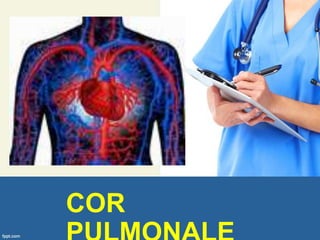
COR
OBJECTIVES
• review the anatomy and
  physiology of the respiratory
  system
• review the anatomy and
  physiology of the cardiovascular
  system
• interpret the term cor pulmonale
• describe the etiology of cor
  pulmonale
OBJECTIVES CONTINUED…...
   • discuss the pathogenesis involved
     in the disease process
   • examine the clinical manifestations
     closely
   • differentiate the various diagnostic
     measures
   • explain the medical management
OBJECTIVES CONTINUED…...
   • identify the surgical management
     of cor pulmonale
   • distinguish the nursing
     management for cor pulmonale
     including the nursing diagnosis
   • obtain knowledge on the prognosis
     of cor pulmonale
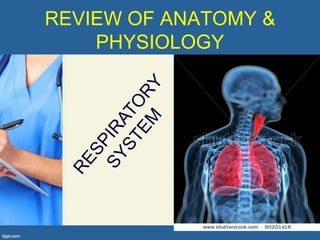
REVIEW OF ANATOMY &
    PHYSIOLOGY
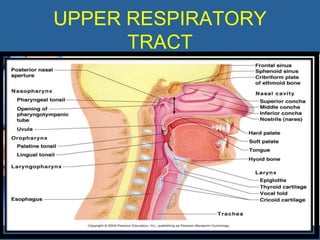
UPPER RESPIRATORY
      TRACT
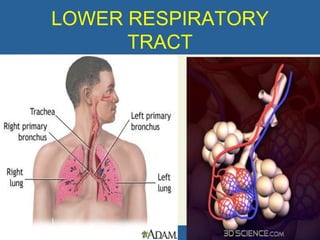
LOWER RESPIRATORY
      TRACT
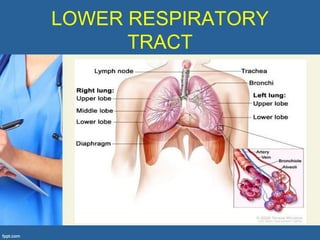
LOWER RESPIRATORY
      TRACT
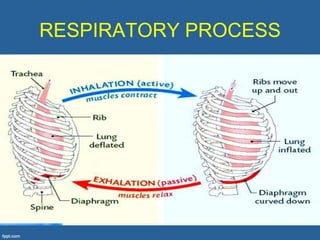
RESPIRATORY PROCESS
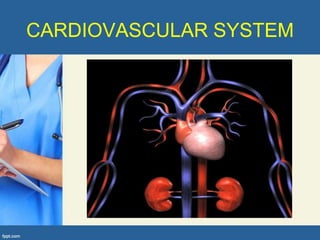
CARDIOVASCULAR SYSTEM
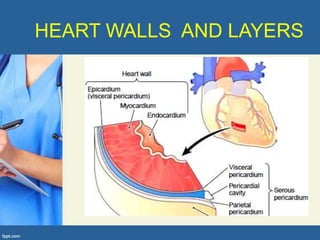
HEART WALLS AND LAYERS
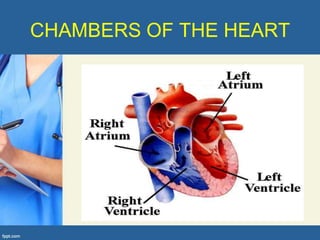
CHAMBERS OF THE HEART
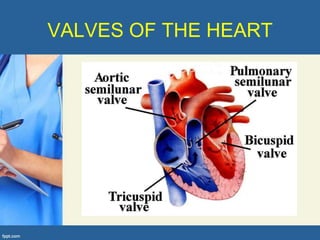
VALVES OF THE HEART
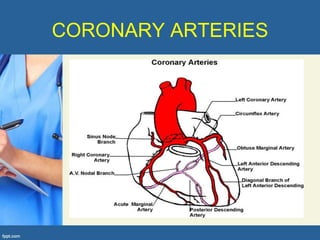
CORONARY ARTERIES
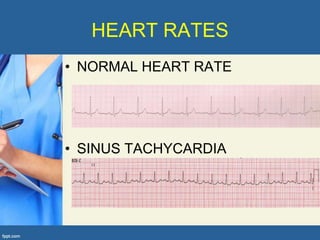
HEART RATES
• NORMAL HEART RATE


• SINUS TACHYCARDIA
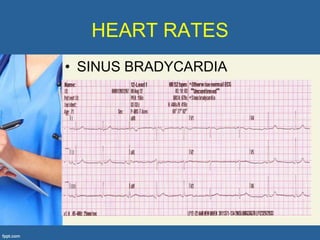
HEART RATES
• SINUS BRADYCARDIA
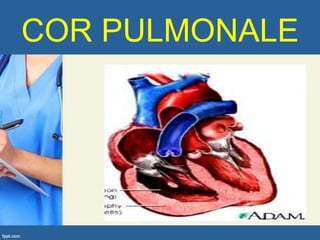
COR PULMONALE
DEFINITION
It is the hypertrophy of the right
  ventricle resulting from diseases
  affecting the function and/or
  structure of the lung, except when
  these pulmonary alterations are the
  result of diseases that primarily
  affect the left side of the heart or
  congenital heart disease(WHO,
  1963)
DEFINITION
 It is the enlargement of the right
ventricle secondary to diseases of
the lung , thorax, or pulmonary
circulation. Pulmonary
hypertension is usually a pre-
existing condition in the individual
with cor pulmonale. The most
common cause is COPD. (lewis)
DEFINITION

It is a condition in which the right
   ventricle of the heart enlarges (with or
   without right sided heart failure) as a
   result of diseases that affect the
   structure or function of the lung or its
   vasculature
ETIOLOGY
• Conditions that restrict or
  compromise ventilatory function,
  leading to hypoxemia or acidosis e.g.
  deformities of the thoracic cage,
  massive obesity
• Conditions that reduce the pulmonary
  vascular bed e.g. primary idiopathic
  pulmonary arterial hypertension,
  pulmonary embolus
ETIOLOGY
• Disorders involving nervous system,
  respiratory muscles, chest wall ,
  and pulmonary arterial tree may
  also be responsible for cor
  pulmonale
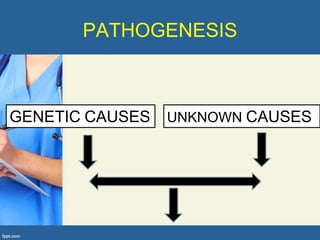
PATHOGENESIS


GENETIC CAUSES   UNKNOWN CAUSES
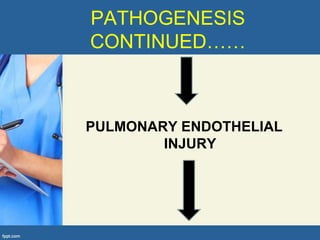
PATHOGENESIS
CONTINUED……


PULMONARY ENDOTHELIAL
        INJURY
PATHOGENESIS
CONTINUED……


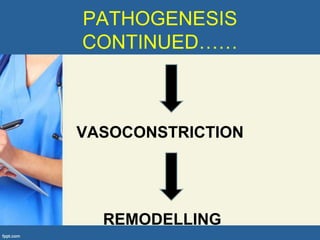
VASOCONSTRICTION


  REMODELLING
PATHOGENESIS
CONTINUED……


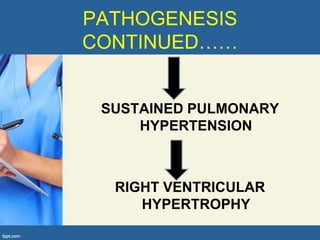
 SUSTAINED PULMONARY
     HYPERTENSION


  RIGHT VENTRICULAR
     HYPERTROPHY
PATHOGENESIS
CONTINUED……


 COR PULMONALE
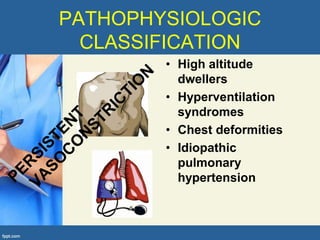
PATHOPHYSIOLOGIC
  CLASSIFICATION
        • High altitude
          dwellers
        • Hyperventilation
          syndromes
        • Chest deformities
        • Idiopathic
          pulmonary
          hypertension
PATHOPHYSIOLOGIC
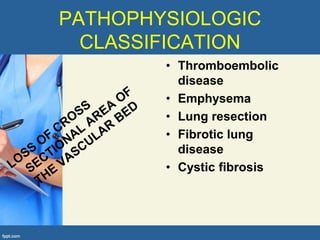
  CLASSIFICATION
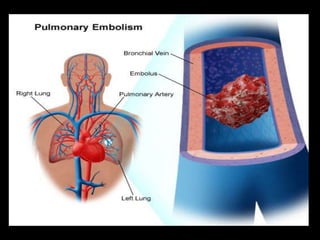
        • Thromboembolic
          disease
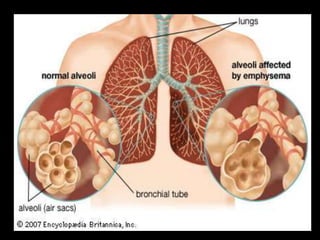
        • Emphysema
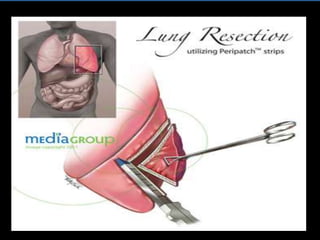
        • Lung resection
        • Fibrotic lung
          disease
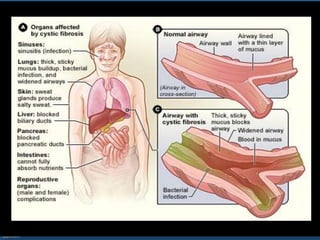
        • Cystic fibrosis
PATHOPHYSIOLOGIC
  CLASSIFICATION
        • Extrinsic
          compression of the
          pulmonary veins
        • Fibrosing
          mediastinitis
        • Adenopathy or
          tumors
        • Pulmonary
        veno-occlusive
          disease
PATHOPHYSIOLOGIC
  CLASSIFICATION
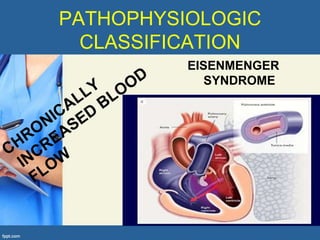
          EISENMENGER
             SYNDROME
PATHOPHYSIOLOGIC
  CLASSIFICATION
        • Primary pulmonary
          hypertension
        • Secondry
          pulmonary
          hypertension
        • Collagen vascular
          diseases
        • Cystic fibrosis
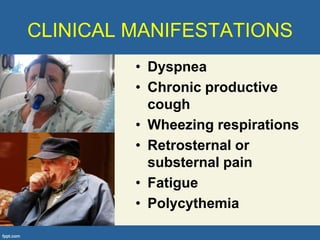
CLINICAL MANIFESTATIONS
         • Dyspnea
         • Chronic productive
           cough
         • Wheezing respirations
         • Retrosternal or
           substernal pain
         • Fatigue
         • Polycythemia
CLINICAL MANIFESTATIONS
   If heart failure accompanies cor
      pulmonale additional
      manifestations such as
   • Peripheral edema
   • Weight gain
   • Distended neck veins
   • Full bounding pulse
   • Enlarged liver
CLINICAL MANIFESTATIONS
   •   Palpitation
   •   Atypical chest pain
   •   Swelling of the lower extremities
   •   Dizziness and even syncope
DIAGNOSIS
• HISTORY COLLECTION
DIAGNOSIS
• PHYSICAL EXAMINATION
DIAGNOSIS
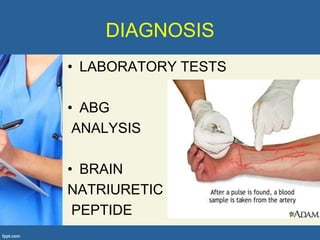
• LABORATORY TESTS

• ABG
 ANALYSIS

• BRAIN
NATRIURETIC
 PEPTIDE
DIAGNOSIS

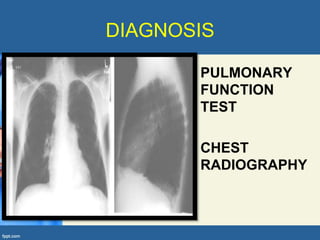
      • PULMONARY
        FUNCTION
        TEST

      • CHEST
        RADIOGRAPHY
DIAGNOSIS
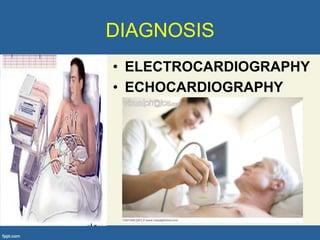
• ELECTROCARDIOGRAPHY
• ECHOCARDIOGRAPHY
DIAGNOSIS
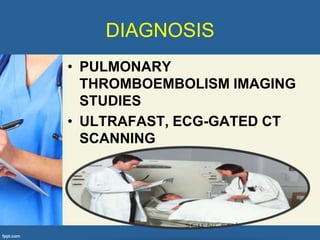
• PULMONARY
  THROMBOEMBOLISM IMAGING
  STUDIES
• ULTRAFAST, ECG-GATED CT
  SCANNING
DIAGNOSIS
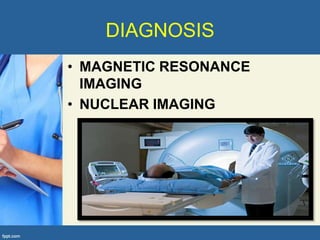
• MAGNETIC RESONANCE
  IMAGING
• NUCLEAR IMAGING
DIAGNOSIS
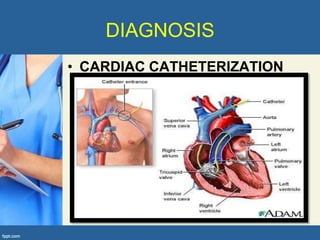
• CARDIAC CATHETERIZATION
DIAGNOSIS
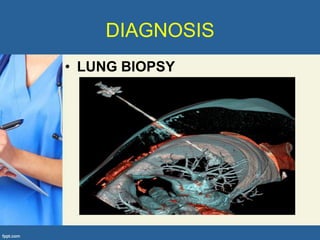
• LUNG BIOPSY
MEDICAL MANAGEMENT
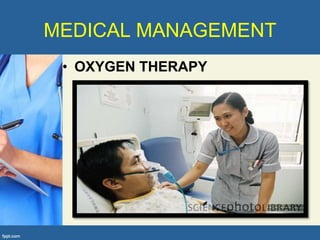
 • OXYGEN THERAPY
MEDICAL MANAGEMENT
 •   PHARMACOTHERAPY
 •   DIURETIC AGENTS
 •   VASODIALATORS
 •   BETA SELECTIVE AGONISTS
 •   CARDIAC GLYCOSIDES
 •   THEOPHYLLINE
 •   WARFARIN
SURGICAL MANAGEMENT
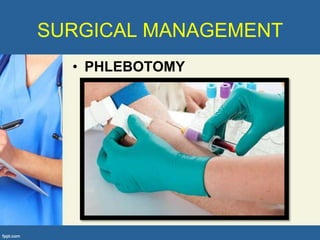
  • PHLEBOTOMY
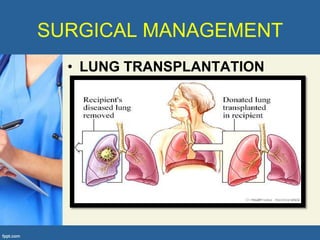
SURGICAL MANAGEMENT
  • LUNG TRANSPLANTATION
NURSING MANAGEMENT
NURSING DIAGNOSIS
• Decreased cardiac output related
  to restricted cardiac muscle
  contractility as evidenced by
  echocardiographic finding
• Impaired gas exchange related to
  expiratory airflow obstruction as
  evidenced by decreased oxygen
  saturation levels
NURSING DIAGNOSIS
• Impaired tissue perfusion related to
  decreased cardiac contractility and
  expiratory airflow obstruction as
  evidenced by increased capillary
  refilling time >3 seconds
• Activity intolerance related to
  decreased cardiac activity and
  laboured respirations as evidenced
  by difficulty in performing activities
  of daily living
NURSING DIAGNOSIS
 • Fatigue related to decreased
   cardiac activity and laboured
   respirations as evidenced by
   difficulty in performing activities of
   daily living
 • Anxiety related to breathlessness
   as evidenced by patient`s
   verbalization and facial
   expressions
NURSING DIAGNOSIS
• Imbalanced nutrition :less than
  body requirement related to
  breathlessness as evidenced by
  weight loss
• Disturbed sleep pattern related to
  shortness of breath as evidenced
  by presence of dark circles around
  the eyes
JOURNAL PRESENTATIONS
   • A Case Report of Cor
     Pulmonale in a Woman Without
     Exposure to Tobacco Smoke:
     An Example of the Risks of
     Indoor Wood Burning
   Alexander R. Opotowsky, MD,
     MPH, Rajesh Vedanthan, MD,
     MPH, and Joseph J. Mamlin, MD
JOURNAL PRESENTATIONS
  • Chronic Cor Pulmonale in Delhi :
    A Study of 127 Cases
  • S. PADMAVATI and S. N.
    PATHAK
ASSIGNMENT
1.The accessory muscles of
  respiration includes
a)scalene muscles
b) sternocleidoid muscle
c) trapezius and pectoralis muscle
d) a, b and c
ASSIGNMENT
• The most significant change in
  ECG readings for a patient with
  cor pulmonale is in
 a) Pwave
 b) QRS complex
c) ST segment
 d) T wave
ASSIGNMENT
• An example of cardiac glycoside
a)Digitalis
b) nifidipine
c) theophylline
d) Lasix
ASSIGNMENT
The area of heart mainly affected
 in cor pulmonale is
a)Left side of heart
b) apex of the heart
c) right side of the heart
d) septum of the heart
REFERENCES
• Mason R.J, Braaddus V.C.Murray
  and Nadel`s :Textbook of
  Respiratory Medicine. 5th edn.
  Philadelphia:Saunders;2010.
• George R.B,Light R.W.
  Chestmedicine:Essentials of
  Pulmonary and Critical Care
  Medicine. 4th edn .
  Philadelphia:Lippincott;2000.
REFERENCES
• Fauci AS, Braunwald E, Kasper
  DL, Hauser SL, Longo DL,
  Jameson JL, et al., editors.
  Harrison’s principles of internal
  medicine. 17th ed. New York:
  McGraw Hill; 2008
• Crawform M.H.Current Diagnosis
  and Treatment in cardiology. 2nd
  edn . New York: McGraw Hill;2003.
REFERENCES
• Michael H.C,Paulus
  W.J.Cardiology. 3rd
  edn.Philadelphia:Elsevier;2010.
• Johnson J.Y.Brunner anD
  Suddharth`s:Textbook of Medical
  Surgical Nursing. 11th edn.
  Philadelphia:Lippincott;2008.
REFERENCES
• Padmavati S, Pathak S.N. Chronic
  Cor Pulmonale in Delhi. American
  Heart Association[Internet].aug
  28.2012.available from
  http://circ.ahajournals.org/
• Kings E.S, Mandel J.Cor
  pulmonale[internet].july
  9,2012.Available at
  www.uptodate.com
REFERENCES
• Opotowsky a.r, Vedanthan .R,
  Mamlin J.J. A Case Report of Cor
  Pulmonale in a Woman Without
  Exposure to Tobacco Smoke: An
  Example of the Risks of Indoor
  Wood Burning.The Medscape
  journal of
  Medicine[internet].January
  29,2008.available from
  www.pubmed.com
Cor pulmonale

Cor pulmonale