Mechanical
Ventilation
MUSKAN RASTOGI
Index
 Introduction
 Physiology of normal breathing v/s mechanical ventilation
 Indication
 Goals
 Principles of mechanical ventilation
 Types of
 Modes of ventilators
 Settings of ventilators
 Adverse effects of
2
Introduction
• Ventilation can be defined as the process
of exchange of air between the lungs and
the ambient air
• In the clinical setting, a machine known as
a mechanical ventilator is used to perform
this function on patients faced with serious
respiratory illness.
3
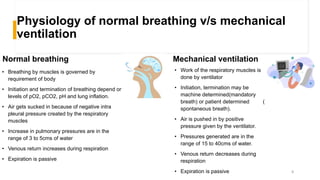
Physiology of normal breathing v/s mechanical
ventilation
Normal breathing
• Breathing by muscles is governed by
requirement of body
• Initiation and termination of breathing depend on
levels of pO2, pCO2, pH and lung inflation.
• Air gets sucked in because of negative intra
pleural pressure created by the respiratory
muscles
• Increase in pulmonary pressures are in the
range of 3 to 5cms of water
• Venous return increases during respiration
• Expiration is passive
Mechanical ventilation
• Work of the respiratory muscles is
done by ventilator
• Initiation, termination may be
machine determined(mandatory
breath) or patient determined (
spontaneous breath).
• Air is pushed in by positive
pressure given by the ventilator.
• Pressures generated are in the
range of 15 to 40cms of water.
• Venous return decreases during
respiration
• Expiration is passive 4
Indications
• Acute Respiratory Failure
• Hypoxemia
• Neuromuscular disorders
• Pulmonary edema
• Over sedations
• Reduce ICP
• Stabilize the chest wall
• Aspiration
• ARDS
• Pulmonary embolism
5
GOALS
Provide adequate
(not perfect)
oxygenation and
ventilation
1
Reduce our
patient’s work of
breathing
2
Minimize the damage
to the lung caused by
the ventilator known
as ventilator induced
lung injury (VILI).
3
Improve cardiac function
• Decreases preload
• Decreases afterload
• Decreases metabolic
demand
4
6
Principles of mechanical ventilation
A ventilator is machine that generates the pressure necessary to cause
a flow of gas that increases the volume of the lungs
The 3 variables involved are-
Pressure
Volume
Flow
One can be fixed or predetermined and the other two will depend on the
compliance of the lungs and the chest wall and the resistance offered by
the airways.
7
TYPES OF MECHANICAL VENTILATION
Mechanical ventilation
Invasive ventilation Non-invasive ventilation
8
Ventilatory support that is given
through endo-tracheal intubation or
tracheostomy is called as invasive
mechanical ventilation.
Ventilatory support that is given without
establishing endo-tracheal intubation or
tracheostomy is called non-invasive
mechanical ventilation
Parts of ventilator
9
Settings
• Mechanical Ventilator Settings regulates the
rate, depth and other characteristics of
ventilation.
• Settings are based on the patient’s status i.e.,
ABGs, Body weight, level of consciousness
and muscle strength.
Main settings are-
• Trigger – what initiates a breath
• Target – what the vent is trying to achieve
• Cycle – what causes the breath to end
10
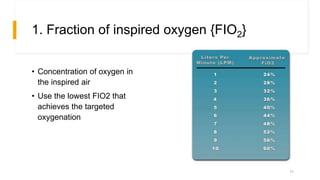
1. Fraction of inspired oxygen {FIO2}
• Concentration of oxygen in
the inspired air
• Use the lowest FIO2 that
achieves the targeted
oxygenation
11
2. Respiratory Rate[RR]
• Spontaneous breaths taken by
the patient
• 10-20 breaths per minute
12
3. Inspiratory: Expiratory(I:E) Ratio
• Ratio of duration of inspiration to expiration
• Normal: longer expiratory phase than inspiratory
phase(1:2,1:3)
• Inverse Ratios provide a longer inspiratory
phase(1:1,2:1,3:1,4:1)
• Reduced I:E allows more time for exhalation and
reduces breath stacking
• Used for patients who have obstructive airway
disease with acute respiratory acidosis
13
4. Minute ventilation(VE)
• Volume of gas exchanged
per minute
• 5-10L/minute
14
5. Peak Flow Rate[PFR]
• Maximum flow delivered by ventilator during inspiration
15
6. Peak inspiratory pressure {PIP}
• Highest proximal airway
pressure reached during
inspiration
• Target PIP is <35 cm H2O
• Low PIP may result in
hypoventilation; High PIP
may cause lung damage
16
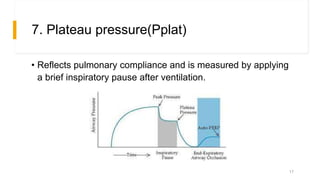
7. Plateau pressure(Pplat)
• Reflects pulmonary compliance and is measured by applying
a brief inspiratory pause after ventilation.
17
8. Positive End Expiratory Pressure{PEEP}
• Pressure remaining in the lungs at the end
expiration.
• Used to keep alveoli open and “recruit”
more alveoli to improve oxygenation for
patients.
• High levels may cause barotrauma,
increased intracranial pressure, and
decreased cardiac output.
• 3-10cm H2O
18
9. Pressure support (PS)
• Provides additional
pressure during inspiration
to ensure a larger tidal
volume with minimal
patient effort
• Used to help overcome the
work of breathing through
ventilator tubing
• 8-20cm H2O
19
10. Tidal Volume {VT}
• Volume of gas
exchanged with each
breath
• 6-8mL/kg of ideal body
weight [IBW] to prevent
barotrauma
20
MODES OF
VENTILATION
Traditionally, physiotherapists have been involved in the respiratory care of patients on mechanical ventilation in
ICU.The respiratory care involves optimisation of ventilation, airway clearance, prevention of pulmonary complications,
and hastening weaning from mechanical ventilation.
Techniques used by physiotherapy to help improve patient breathing and wean patients off ventilators may include:
• Suctioning
• Postural drainage
• Central lavage (Paediatrics)
• Percussion
• Vibrations
22
Continuous Mandatory Ventilation (CMV)
• In this mode the ventilator provides a mechanical breath on a preset timing. Patient respiratory efforts are ignored.
• Trigger –Ventilator initiates all breaths
• Patient can not initiate
• Target – Volume
• Cycle – Time
• e.g. Settings - Mode: CMV
• Rate 10; Vt 700cc
• FIO2 0.5; PEEP 5.0
• vent gives cc each
• patient gets zero extra breaths (even if tries)
• very uncomfortable for patient
• only used if patient paralyzed (i.e. in O.R.)
23
Assist Control (Volume Control)
• In this mode the ventilator provides a mechanical breath with either a pre-set tidal
volume or peak pressure every time the patient initiates a breath.
• Trigger – machine and patient
• Target – volume
• Settings-Mode: VC
• Rate 10; Vt 700cc
• FIO2 0.5; PEEP 5.0
• e.g. vent gives cc each
• patient initiates 6 bpm – vent provides 700cc
24
Synchronized Intermittent Mandatory Ventilation
(SIMV)
• In this mode the ventilator provides a pre-set mechanical breath (pressure or volume limited) every specified number of seconds
(determined by dividing the respiratory rate into 60 - thus a respiratory rate of 12 results in a 5 second cycle time). Within that cycle
time the ventilator waits for the patient to initiate a breath using either a pressure or flow sensor. When the ventilator senses the first
patient breathing attempt within the cycle, it delivers the preset ventilator breath. If the patient fails to initiate a breath, the ventilator
delivers a mechanical breath at the end of the breath cycle. SIMV is frequently employed as a method of decreasing ventilatory
support (weaning) by turning down the rate, which requires the patient to take additional breaths beyond the SIMV triggered breath.
• Trigger – ventilator and patient
• Target – ventilator breaths = set volume
• patient breaths = patient effort
• Settings-Mode: SIMV
• Rate 10; Vt 700cc
• FIO2 0.5; PEEP 5.0
• e.g. vent gives cc each
patient takes cc each
25
Pressure Control (PC) Trigger – ventilator and
patient
• Target – Pressure (above PEEP)
• Settings – Mode: PC
• Rate 10; Pressure 24 cm H2O
• FIO2 0.5; PEEP 5
• e.g. vent gives 10 bpm to a peak Paw = 29
• pt takes 6 bpm targeted to peak Paw =29
26
Pressure Support Ventilation (PSV)
• When a patient attempts to breath spontaneously through an endotracheal tube, the narrowed diameter of the
airway results in higher resistance to airflow, and thus a higher work of breathing. PSV was developed as a method
to decrease the work of breathing in-between ventilator mandated breaths by providing an elevated pressure
triggered by spontaneous breathing that "supports" ventilation during inspiration
• Trigger – patient only
• Target - pressure
• Cycle – patient flow decrease
• Settings – Mode: PSV = 14 cm H2O
• FIO2 0.4; PEEP 5
• e.g. pt takes 18 Vt = 500cc
• machine gives zero breaths
9/4/20XX Presentation Title 27
Completely Unassisted Breaths
• Trigger – patient
• Cycle – patient effort ceases
• Settings: CPAP 5; FIO2 0.4
• e.g. patient takes cc each
9/4/20XX Presentation Title 28
Continuous Positive Airway Pressure (CPAP)
• A continuous level of elevated pressure is
provided through the patient circuit to
maintain adequate oxygenation, decrease
the work of breathing, and decrease the
work of the heart (such as in left-sided
heart failure — CHF).
• Note that no cycling of ventilator pressures
occurs, and the patient must initiate all
breaths. In addition, no additional pressure
above the CPAP pressure is provided
during those breaths. CPAP may be used
invasively through an endotracheal tube or
tracheostomy or noninvasively with a face
mask or nasal prongs.
29
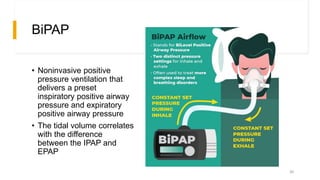
BiPAP
• Noninvasive positive
pressure ventilation that
delivers a preset
inspiratory positive airway
pressure and expiratory
positive airway pressure
• The tidal volume correlates
with the difference
between the IPAP and
EPAP
30
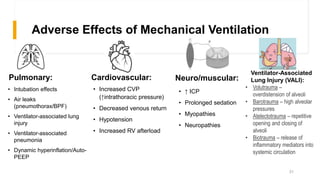
Adverse Effects of Mechanical Ventilation
Pulmonary:
• Intubation effects
• Air leaks
(pneumothorax/BPF)
• Ventilator-associated lung
injury
• Ventilator-associated
pneumonia
• Dynamic hyperinflation/Auto-
PEEP
Cardiovascular:
• Increased CVP
(↑intrathoracic pressure)
• Decreased venous return
• Hypotension
• Increased RV afterload
31
Neuro/muscular:
• ↑ ICP
• Prolonged sedation
• Myopathies
• Neuropathies
Ventilator-Associated
Lung Injury (VALI):
• Volutrauma –
overdistension of alveoli
• Barotrauma – high alveolar
pressures
• Atelectotrauma – repetitive
opening and closing of
alveoli
• Biotrauma – release of
inflammatory mediators into
systemic circulation
Procedure of Weaning patient
Weaning is gradual reduction of ventilation. A new systematic review suggests that noninvasive ventilation
after early extubation helps in reducing the total days spent on invasive mechanical ventilation; also, the
patients spending less time on invasive ventilation had lower rates of ventilator-associated-pneumonia. In
some cases, this process is rapid and uneventful; however, for some patients the process may be
prolonged for days or weeks. Weaning is a term that is used in two separate ways. Firstly, it implies the
termination of mechanical ventilation and secondly the removal of any artificial airway.
When to wean
• Normalised I:E ratio
• Reducing FiO2 (usually <0.5)
• No requirement for high PEEP
• Appropriate underlying respiratory rate
• Appropriate tidal volume with moderate airway pressures
32
Physiotherapy Role in Mechanical Ventilation
and Weaning
Traditionally, physiotherapists have been involved in the respiratory care of patients on mechanical
ventilation in ICU. The respiratory care involves optimization of ventilation, airway clearance,
prevention of pulmonary complications, and hastening weaning from mechanical ventilation.
Techniques used by physiotherapy to help improve patient breathing and wean patients off
ventilators may include:
• Suctioning
• Postural drainage
• Central lavage (Pediatrics)
• Percussion
• Vibrations
33

Mechanical ventilation and physiotherapy management @Dr.Muskan Rastogi (PT) BPT,MPT(OBG)

  • 1.
  • 2.
    Index  Introduction  Physiologyof normal breathing v/s mechanical ventilation  Indication  Goals  Principles of mechanical ventilation  Types of  Modes of ventilators  Settings of ventilators  Adverse effects of 2
  • 3.
    Introduction • Ventilation canbe defined as the process of exchange of air between the lungs and the ambient air • In the clinical setting, a machine known as a mechanical ventilator is used to perform this function on patients faced with serious respiratory illness. 3
  • 4.
    Physiology of normalbreathing v/s mechanical ventilation Normal breathing • Breathing by muscles is governed by requirement of body • Initiation and termination of breathing depend on levels of pO2, pCO2, pH and lung inflation. • Air gets sucked in because of negative intra pleural pressure created by the respiratory muscles • Increase in pulmonary pressures are in the range of 3 to 5cms of water • Venous return increases during respiration • Expiration is passive Mechanical ventilation • Work of the respiratory muscles is done by ventilator • Initiation, termination may be machine determined(mandatory breath) or patient determined ( spontaneous breath). • Air is pushed in by positive pressure given by the ventilator. • Pressures generated are in the range of 15 to 40cms of water. • Venous return decreases during respiration • Expiration is passive 4
  • 5.
    Indications • Acute RespiratoryFailure • Hypoxemia • Neuromuscular disorders • Pulmonary edema • Over sedations • Reduce ICP • Stabilize the chest wall • Aspiration • ARDS • Pulmonary embolism 5
  • 6.
    GOALS Provide adequate (not perfect) oxygenationand ventilation 1 Reduce our patient’s work of breathing 2 Minimize the damage to the lung caused by the ventilator known as ventilator induced lung injury (VILI). 3 Improve cardiac function • Decreases preload • Decreases afterload • Decreases metabolic demand 4 6
  • 7.
    Principles of mechanicalventilation A ventilator is machine that generates the pressure necessary to cause a flow of gas that increases the volume of the lungs The 3 variables involved are- Pressure Volume Flow One can be fixed or predetermined and the other two will depend on the compliance of the lungs and the chest wall and the resistance offered by the airways. 7
  • 8.
    TYPES OF MECHANICALVENTILATION Mechanical ventilation Invasive ventilation Non-invasive ventilation 8 Ventilatory support that is given through endo-tracheal intubation or tracheostomy is called as invasive mechanical ventilation. Ventilatory support that is given without establishing endo-tracheal intubation or tracheostomy is called non-invasive mechanical ventilation
  • 9.
  • 10.
    Settings • Mechanical VentilatorSettings regulates the rate, depth and other characteristics of ventilation. • Settings are based on the patient’s status i.e., ABGs, Body weight, level of consciousness and muscle strength. Main settings are- • Trigger – what initiates a breath • Target – what the vent is trying to achieve • Cycle – what causes the breath to end 10
  • 11.
    1. Fraction ofinspired oxygen {FIO2} • Concentration of oxygen in the inspired air • Use the lowest FIO2 that achieves the targeted oxygenation 11
  • 12.
    2. Respiratory Rate[RR] •Spontaneous breaths taken by the patient • 10-20 breaths per minute 12
  • 13.
    3. Inspiratory: Expiratory(I:E)Ratio • Ratio of duration of inspiration to expiration • Normal: longer expiratory phase than inspiratory phase(1:2,1:3) • Inverse Ratios provide a longer inspiratory phase(1:1,2:1,3:1,4:1) • Reduced I:E allows more time for exhalation and reduces breath stacking • Used for patients who have obstructive airway disease with acute respiratory acidosis 13
  • 14.
    4. Minute ventilation(VE) •Volume of gas exchanged per minute • 5-10L/minute 14
  • 15.
    5. Peak FlowRate[PFR] • Maximum flow delivered by ventilator during inspiration 15
  • 16.
    6. Peak inspiratorypressure {PIP} • Highest proximal airway pressure reached during inspiration • Target PIP is <35 cm H2O • Low PIP may result in hypoventilation; High PIP may cause lung damage 16
  • 17.
    7. Plateau pressure(Pplat) •Reflects pulmonary compliance and is measured by applying a brief inspiratory pause after ventilation. 17
  • 18.
    8. Positive EndExpiratory Pressure{PEEP} • Pressure remaining in the lungs at the end expiration. • Used to keep alveoli open and “recruit” more alveoli to improve oxygenation for patients. • High levels may cause barotrauma, increased intracranial pressure, and decreased cardiac output. • 3-10cm H2O 18
  • 19.
    9. Pressure support(PS) • Provides additional pressure during inspiration to ensure a larger tidal volume with minimal patient effort • Used to help overcome the work of breathing through ventilator tubing • 8-20cm H2O 19
  • 20.
    10. Tidal Volume{VT} • Volume of gas exchanged with each breath • 6-8mL/kg of ideal body weight [IBW] to prevent barotrauma 20
  • 21.
  • 22.
    Traditionally, physiotherapists havebeen involved in the respiratory care of patients on mechanical ventilation in ICU.The respiratory care involves optimisation of ventilation, airway clearance, prevention of pulmonary complications, and hastening weaning from mechanical ventilation. Techniques used by physiotherapy to help improve patient breathing and wean patients off ventilators may include: • Suctioning • Postural drainage • Central lavage (Paediatrics) • Percussion • Vibrations 22
  • 23.
    Continuous Mandatory Ventilation(CMV) • In this mode the ventilator provides a mechanical breath on a preset timing. Patient respiratory efforts are ignored. • Trigger –Ventilator initiates all breaths • Patient can not initiate • Target – Volume • Cycle – Time • e.g. Settings - Mode: CMV • Rate 10; Vt 700cc • FIO2 0.5; PEEP 5.0 • vent gives cc each • patient gets zero extra breaths (even if tries) • very uncomfortable for patient • only used if patient paralyzed (i.e. in O.R.) 23
  • 24.
    Assist Control (VolumeControl) • In this mode the ventilator provides a mechanical breath with either a pre-set tidal volume or peak pressure every time the patient initiates a breath. • Trigger – machine and patient • Target – volume • Settings-Mode: VC • Rate 10; Vt 700cc • FIO2 0.5; PEEP 5.0 • e.g. vent gives cc each • patient initiates 6 bpm – vent provides 700cc 24
  • 25.
    Synchronized Intermittent MandatoryVentilation (SIMV) • In this mode the ventilator provides a pre-set mechanical breath (pressure or volume limited) every specified number of seconds (determined by dividing the respiratory rate into 60 - thus a respiratory rate of 12 results in a 5 second cycle time). Within that cycle time the ventilator waits for the patient to initiate a breath using either a pressure or flow sensor. When the ventilator senses the first patient breathing attempt within the cycle, it delivers the preset ventilator breath. If the patient fails to initiate a breath, the ventilator delivers a mechanical breath at the end of the breath cycle. SIMV is frequently employed as a method of decreasing ventilatory support (weaning) by turning down the rate, which requires the patient to take additional breaths beyond the SIMV triggered breath. • Trigger – ventilator and patient • Target – ventilator breaths = set volume • patient breaths = patient effort • Settings-Mode: SIMV • Rate 10; Vt 700cc • FIO2 0.5; PEEP 5.0 • e.g. vent gives cc each patient takes cc each 25
  • 26.
    Pressure Control (PC)Trigger – ventilator and patient • Target – Pressure (above PEEP) • Settings – Mode: PC • Rate 10; Pressure 24 cm H2O • FIO2 0.5; PEEP 5 • e.g. vent gives 10 bpm to a peak Paw = 29 • pt takes 6 bpm targeted to peak Paw =29 26
  • 27.
    Pressure Support Ventilation(PSV) • When a patient attempts to breath spontaneously through an endotracheal tube, the narrowed diameter of the airway results in higher resistance to airflow, and thus a higher work of breathing. PSV was developed as a method to decrease the work of breathing in-between ventilator mandated breaths by providing an elevated pressure triggered by spontaneous breathing that "supports" ventilation during inspiration • Trigger – patient only • Target - pressure • Cycle – patient flow decrease • Settings – Mode: PSV = 14 cm H2O • FIO2 0.4; PEEP 5 • e.g. pt takes 18 Vt = 500cc • machine gives zero breaths 9/4/20XX Presentation Title 27
  • 28.
    Completely Unassisted Breaths •Trigger – patient • Cycle – patient effort ceases • Settings: CPAP 5; FIO2 0.4 • e.g. patient takes cc each 9/4/20XX Presentation Title 28
  • 29.
    Continuous Positive AirwayPressure (CPAP) • A continuous level of elevated pressure is provided through the patient circuit to maintain adequate oxygenation, decrease the work of breathing, and decrease the work of the heart (such as in left-sided heart failure — CHF). • Note that no cycling of ventilator pressures occurs, and the patient must initiate all breaths. In addition, no additional pressure above the CPAP pressure is provided during those breaths. CPAP may be used invasively through an endotracheal tube or tracheostomy or noninvasively with a face mask or nasal prongs. 29
  • 30.
    BiPAP • Noninvasive positive pressureventilation that delivers a preset inspiratory positive airway pressure and expiratory positive airway pressure • The tidal volume correlates with the difference between the IPAP and EPAP 30
  • 31.
    Adverse Effects ofMechanical Ventilation Pulmonary: • Intubation effects • Air leaks (pneumothorax/BPF) • Ventilator-associated lung injury • Ventilator-associated pneumonia • Dynamic hyperinflation/Auto- PEEP Cardiovascular: • Increased CVP (↑intrathoracic pressure) • Decreased venous return • Hypotension • Increased RV afterload 31 Neuro/muscular: • ↑ ICP • Prolonged sedation • Myopathies • Neuropathies Ventilator-Associated Lung Injury (VALI): • Volutrauma – overdistension of alveoli • Barotrauma – high alveolar pressures • Atelectotrauma – repetitive opening and closing of alveoli • Biotrauma – release of inflammatory mediators into systemic circulation
  • 32.
    Procedure of Weaningpatient Weaning is gradual reduction of ventilation. A new systematic review suggests that noninvasive ventilation after early extubation helps in reducing the total days spent on invasive mechanical ventilation; also, the patients spending less time on invasive ventilation had lower rates of ventilator-associated-pneumonia. In some cases, this process is rapid and uneventful; however, for some patients the process may be prolonged for days or weeks. Weaning is a term that is used in two separate ways. Firstly, it implies the termination of mechanical ventilation and secondly the removal of any artificial airway. When to wean • Normalised I:E ratio • Reducing FiO2 (usually <0.5) • No requirement for high PEEP • Appropriate underlying respiratory rate • Appropriate tidal volume with moderate airway pressures 32
  • 33.
    Physiotherapy Role inMechanical Ventilation and Weaning Traditionally, physiotherapists have been involved in the respiratory care of patients on mechanical ventilation in ICU. The respiratory care involves optimization of ventilation, airway clearance, prevention of pulmonary complications, and hastening weaning from mechanical ventilation. Techniques used by physiotherapy to help improve patient breathing and wean patients off ventilators may include: • Suctioning • Postural drainage • Central lavage (Pediatrics) • Percussion • Vibrations 33

Editor's Notes

  • #2  ID=d924773e-9a16-4d6d-9803-8cb819e99682 Recipe=text_billboard Type=TextOnly Variant=0 FamilyID=AccentBoxWalbaum_Zero