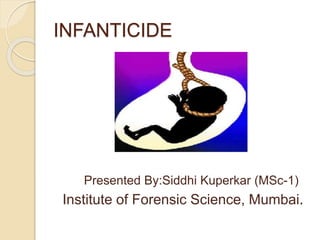
INFANTICIDE
Presented By:Siddhi Kuperkar (MSc-1)
Institute of Forensic Science, Mumbai.
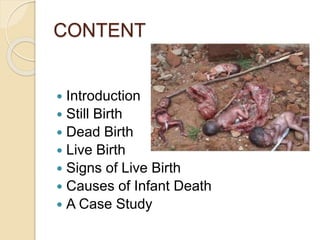
CONTENT
 Introduction
 Still Birth
 Dead Birth
 Live Birth
 Signs of Live Birth
 Causes of Infant Death
 A Case Study
 Infanticide is unlawful destruction of a
child under the age of one year by
anyone.
 Filicide is killing of child older than 24
hours by its own parents.
1. Maternal Filicide
2. Paternal Filicide
 Feticide is the killing of fetus at any
time prior to birth.
 Neonaticide is killing of an infant
within 24 hours of birth.
STILL BIRTH
 A stillborn child is one which is born after
28th week of pregnancy and which did
not breathe or show any other signs of
life at any time after being completely
born.
 Salient Features :
1) Sudden Antenatal Death Syndrome (SADS)
2) The child was alive in utero.
3) Frequently occurs among immature male
children.
4) Incidence
5) Causes
Causes
 Prematurity
 Birth Trauma
 Placental abnormalities
 Toxaemias of Pregnancy
 Erythroblastosis foetalis
DEAD BIRTH
 A deadborn child is one, which has
died in utero, and shows one of the
following signs after it is completely
born.
1) Maceration
2) Rigor Mortis
3) Putrefaction
4) Adipocere
5) Mummification
Maceration
 Process of “Aseptic Autolysis”
 Remains in utero – 3 to 4 days in liquor
amnii, without air.
 If air present – Putrefaction
 Features
1. Earliest sign – Reddening of skin with
peeling and slippage (12 hrs)
2. Robert’s sign - Presence of gas in great
vessels (aorta – 12 hrs)
3. Body – soft, flaccid, flattens out when
placed on level surface
4. Sweetish, disagreeable odour
5. Large blebs – with serous or
serosanguinous fluid
6. Abdomen distended, bones flexible
readily detachable, joints abnormally
mobile
7. Viscera – soft oedematous and lose
their morphology (lungs and uterus)
8. Umbilical cord – red, smooth, thickened,
and soft
9. Skull bones seperated
10. Brains has greyish – red pulpy
appearance
11.Collapse of vertibral column appears
 Spalding sign – Appears 2days after
death. Overlapping of fetal skull bones
Maceration
Mummification
Putrefaction
• The foetus is alive, complete birth?
OR
• at least one part of its body comes out of the
mother’s body?
Sign Of Live Birth
As Recognised By Civil Law
a.Cry of the baby - Vagitus vaginalis
and
Vagitus uterinus
b. Movement of any part of body
c. Sneezing and yawning
d. Heartbeat
LIVE BIRTH
SIGNS OF LIVE BIRTH
 Shape of the Chest
• Before respiration – Flat
• After respiration – Drum shaped
 Position of Diaphragm
• Before respiration – at level of 4th or 5th rib
• After respiration – at level of 6th or 7th rib
 Lungs
• Radiography of lungs
• Microscopic Examination
• Test for fetal lung maturity
Difference between Lungs of Infant BEFORE and
AFTER Respiration
SR.
NO.
POINTS BEFORE RESPIRATION AFTER RESPIRATION
1 Volume Normal or Small Larger and cover the
heart
2 Margins Sharp Rounded
3 Consistency Dense, Firm, non-
crepitant
Soft, spongy, elastic,
crepitant
4 Color Uniformly reddish-brown
or bluish-red
Mottled or Marbled
appearance
5 Blood in Lung
Beds
Normal Twice than normal
6 Weight 1/70 of body weight 1/35 of body weight
7 Air vesicles Not Inflated Inflated
8 Section Little frothless blood
exudes on pressure
Abundant frothy blood
exudes on section
9 Floatation Whole and parts sink in
water
Expanded areas or
whole float in water
 Examination of Lungs
• Static Test or Fodere’s Test
• Ploucquet’s Test
• Hydrostatic Test (Raygat’s Test)
 Changes in Stomach and Intestines
• Breaslau’s second life Test
• Presence of milk/honey in stomach
 Changes in Ear
• Wredin’s Test
 Other Signs
• Blood
• Meconium
• Caput Succedaneum
• Skin
• Umbilical Cord
• Placenta
• Circulation
CAUSES OF
INFANT
DEATH
NATURAL UNNATURAL
ACCIDENTAL
DURING
BIRTH
AFTER
BIRTH
CRIMINAL
ACTS OF
COMMISSION
ACTS OF
OMISSION
NATURAL CAUSES
 Prematurity
 Birth Trauma
 Neonatal infection
 Post maturity
 Pre-ecclamptic toxemia
 Congenital malformation
 Intrapartum asphyxia
 ABO and Rh-incompatibility
 Early seperation of placenta
 SIDS
Congenital
Malformation
Post Maturity
Neonatal Infection
UNNATURAL CAUSES
ACCIDENTAL
During Birth
• Prolonged Labor
• Prolapsed cord or Pressure on cord
• Twisting of cord around neck or knobs of the cord
• Injuries to the mother
• Death of mother
After Birth
• Asphyxia
• Precipitate Labor
Twisting of
the Cord
round the
neck
Knots of
the Cord
CRIMINAL
Act of Commission
• Strangulation
• Suffocation
• Drowning
• Burning
• Fractures and Dislocation of cervical
vertebrae
• Wounds
• Poisoning
• Blunt head Injury
Act of Omission or Neglect
The following Acts of Omission amount
to crime:
Failure to
• Proper assistance during labor
• Tie cord
• Clear air passage
• Exposure to heat /cold
• Proper food
Abandoning of Infants : Section 317 of
IPC
If the father or mother of a child under
the age of 12 years, or anyone having a
care of such child, leaves such a child in
any place with the intention of abandoning
the child, shall be punished with
imprisonment upto 7 years.
Concealment of Birth : Section 318 of IPC
Whoever, secretly buries or otherwise
disposes of the dead body of child,
whether such child dies before or after or
during its birth, intentionally conceals the
birth of such child, shall be punished with
A Case Study
 On 6/5/2011 Mrs.Seetha was admitted in
government maternity hospital where she
gave birth to a female child at 5.43 pm. On
the same day between 9.30 pm and 10 pm
the baby was found dead. The treating
Obstetrician, Dr Shobha Nagesh complained
to the Peenya police about the suspicious
death of the baby. A case was booked U/S
174 ‗C‘ Crpc and the requisition for autopsy
was given by police.
 On perusal of history, hospital case records,
autopsy findings and histopathological report,
cause of death was opined as ―Death is due
to combined effect of manual strangulation
and blunt injuries to the head, chest and
abdomen sustained (Homicidal in manner)”.
References
 https://www.slideshare.net [Infanticide
and Child Abuse]
 https://www.slideshare.net [Infant Death
1]
 https://studylib.net [Infanticide [PPT] ]
 The Essentials of Forensic Medicine and
Toxicology by Dr. KS Narayan Reddy
 Infanticide - Handbook of Forensic
Medicine and Toxicology
 Textbook of Forensic Medicine &
Toxicology by Nageshkumar G Rao
 Case Study -
file:///H:/Infanticide%20Case%20Study.p
df
Infanticide
Infanticide

Infanticide

  • 1.
    INFANTICIDE Presented By:Siddhi Kuperkar(MSc-1) Institute of Forensic Science, Mumbai.
  • 2.
    CONTENT  Introduction  StillBirth  Dead Birth  Live Birth  Signs of Live Birth  Causes of Infant Death  A Case Study
  • 3.
     Infanticide isunlawful destruction of a child under the age of one year by anyone.  Filicide is killing of child older than 24 hours by its own parents. 1. Maternal Filicide 2. Paternal Filicide  Feticide is the killing of fetus at any time prior to birth.  Neonaticide is killing of an infant within 24 hours of birth.
  • 4.
    STILL BIRTH  Astillborn child is one which is born after 28th week of pregnancy and which did not breathe or show any other signs of life at any time after being completely born.  Salient Features : 1) Sudden Antenatal Death Syndrome (SADS) 2) The child was alive in utero. 3) Frequently occurs among immature male children. 4) Incidence 5) Causes
  • 5.
    Causes  Prematurity  BirthTrauma  Placental abnormalities  Toxaemias of Pregnancy  Erythroblastosis foetalis
  • 6.
    DEAD BIRTH  Adeadborn child is one, which has died in utero, and shows one of the following signs after it is completely born. 1) Maceration 2) Rigor Mortis 3) Putrefaction 4) Adipocere 5) Mummification
  • 7.
    Maceration  Process of“Aseptic Autolysis”  Remains in utero – 3 to 4 days in liquor amnii, without air.  If air present – Putrefaction  Features 1. Earliest sign – Reddening of skin with peeling and slippage (12 hrs) 2. Robert’s sign - Presence of gas in great vessels (aorta – 12 hrs) 3. Body – soft, flaccid, flattens out when placed on level surface 4. Sweetish, disagreeable odour 5. Large blebs – with serous or serosanguinous fluid
  • 8.
    6. Abdomen distended,bones flexible readily detachable, joints abnormally mobile 7. Viscera – soft oedematous and lose their morphology (lungs and uterus) 8. Umbilical cord – red, smooth, thickened, and soft 9. Skull bones seperated 10. Brains has greyish – red pulpy appearance 11.Collapse of vertibral column appears  Spalding sign – Appears 2days after death. Overlapping of fetal skull bones
  • 9.
  • 10.
    • The foetusis alive, complete birth? OR • at least one part of its body comes out of the mother’s body? Sign Of Live Birth As Recognised By Civil Law a.Cry of the baby - Vagitus vaginalis and Vagitus uterinus b. Movement of any part of body c. Sneezing and yawning d. Heartbeat LIVE BIRTH
  • 11.
    SIGNS OF LIVEBIRTH  Shape of the Chest • Before respiration – Flat • After respiration – Drum shaped  Position of Diaphragm • Before respiration – at level of 4th or 5th rib • After respiration – at level of 6th or 7th rib  Lungs • Radiography of lungs • Microscopic Examination • Test for fetal lung maturity
  • 12.
    Difference between Lungsof Infant BEFORE and AFTER Respiration SR. NO. POINTS BEFORE RESPIRATION AFTER RESPIRATION 1 Volume Normal or Small Larger and cover the heart 2 Margins Sharp Rounded 3 Consistency Dense, Firm, non- crepitant Soft, spongy, elastic, crepitant 4 Color Uniformly reddish-brown or bluish-red Mottled or Marbled appearance 5 Blood in Lung Beds Normal Twice than normal 6 Weight 1/70 of body weight 1/35 of body weight 7 Air vesicles Not Inflated Inflated 8 Section Little frothless blood exudes on pressure Abundant frothy blood exudes on section 9 Floatation Whole and parts sink in water Expanded areas or whole float in water
  • 13.
     Examination ofLungs • Static Test or Fodere’s Test • Ploucquet’s Test • Hydrostatic Test (Raygat’s Test)  Changes in Stomach and Intestines • Breaslau’s second life Test • Presence of milk/honey in stomach  Changes in Ear • Wredin’s Test  Other Signs • Blood • Meconium • Caput Succedaneum • Skin • Umbilical Cord • Placenta • Circulation
  • 16.
  • 17.
    NATURAL CAUSES  Prematurity Birth Trauma  Neonatal infection  Post maturity  Pre-ecclamptic toxemia  Congenital malformation  Intrapartum asphyxia  ABO and Rh-incompatibility  Early seperation of placenta  SIDS
  • 18.
  • 19.
    UNNATURAL CAUSES ACCIDENTAL During Birth •Prolonged Labor • Prolapsed cord or Pressure on cord • Twisting of cord around neck or knobs of the cord • Injuries to the mother • Death of mother After Birth • Asphyxia • Precipitate Labor
  • 20.
    Twisting of the Cord roundthe neck Knots of the Cord
  • 21.
    CRIMINAL Act of Commission •Strangulation • Suffocation • Drowning • Burning • Fractures and Dislocation of cervical vertebrae • Wounds • Poisoning • Blunt head Injury
  • 22.
    Act of Omissionor Neglect The following Acts of Omission amount to crime: Failure to • Proper assistance during labor • Tie cord • Clear air passage • Exposure to heat /cold • Proper food
  • 23.
    Abandoning of Infants: Section 317 of IPC If the father or mother of a child under the age of 12 years, or anyone having a care of such child, leaves such a child in any place with the intention of abandoning the child, shall be punished with imprisonment upto 7 years. Concealment of Birth : Section 318 of IPC Whoever, secretly buries or otherwise disposes of the dead body of child, whether such child dies before or after or during its birth, intentionally conceals the birth of such child, shall be punished with
  • 24.
    A Case Study On 6/5/2011 Mrs.Seetha was admitted in government maternity hospital where she gave birth to a female child at 5.43 pm. On the same day between 9.30 pm and 10 pm the baby was found dead. The treating Obstetrician, Dr Shobha Nagesh complained to the Peenya police about the suspicious death of the baby. A case was booked U/S 174 ‗C‘ Crpc and the requisition for autopsy was given by police.  On perusal of history, hospital case records, autopsy findings and histopathological report, cause of death was opined as ―Death is due to combined effect of manual strangulation and blunt injuries to the head, chest and abdomen sustained (Homicidal in manner)”.
  • 26.
    References  https://www.slideshare.net [Infanticide andChild Abuse]  https://www.slideshare.net [Infant Death 1]  https://studylib.net [Infanticide [PPT] ]  The Essentials of Forensic Medicine and Toxicology by Dr. KS Narayan Reddy  Infanticide - Handbook of Forensic Medicine and Toxicology  Textbook of Forensic Medicine & Toxicology by Nageshkumar G Rao  Case Study - file:///H:/Infanticide%20Case%20Study.p df