MECHANICAL INJURIES
Copyright©medicalstudies.in
• INJURY:
– It is defined as any harm, whatever illegally
caused to any person in body, mind,
reputation or property (Sec. 44 IPC)
• MECHANICAL INJURY:
– It is defined as injuries produced by any
physical violence.
– A wound is a break of the natural continuity of
any of the tissues of the living body.
Copyright©medicalstudies.in
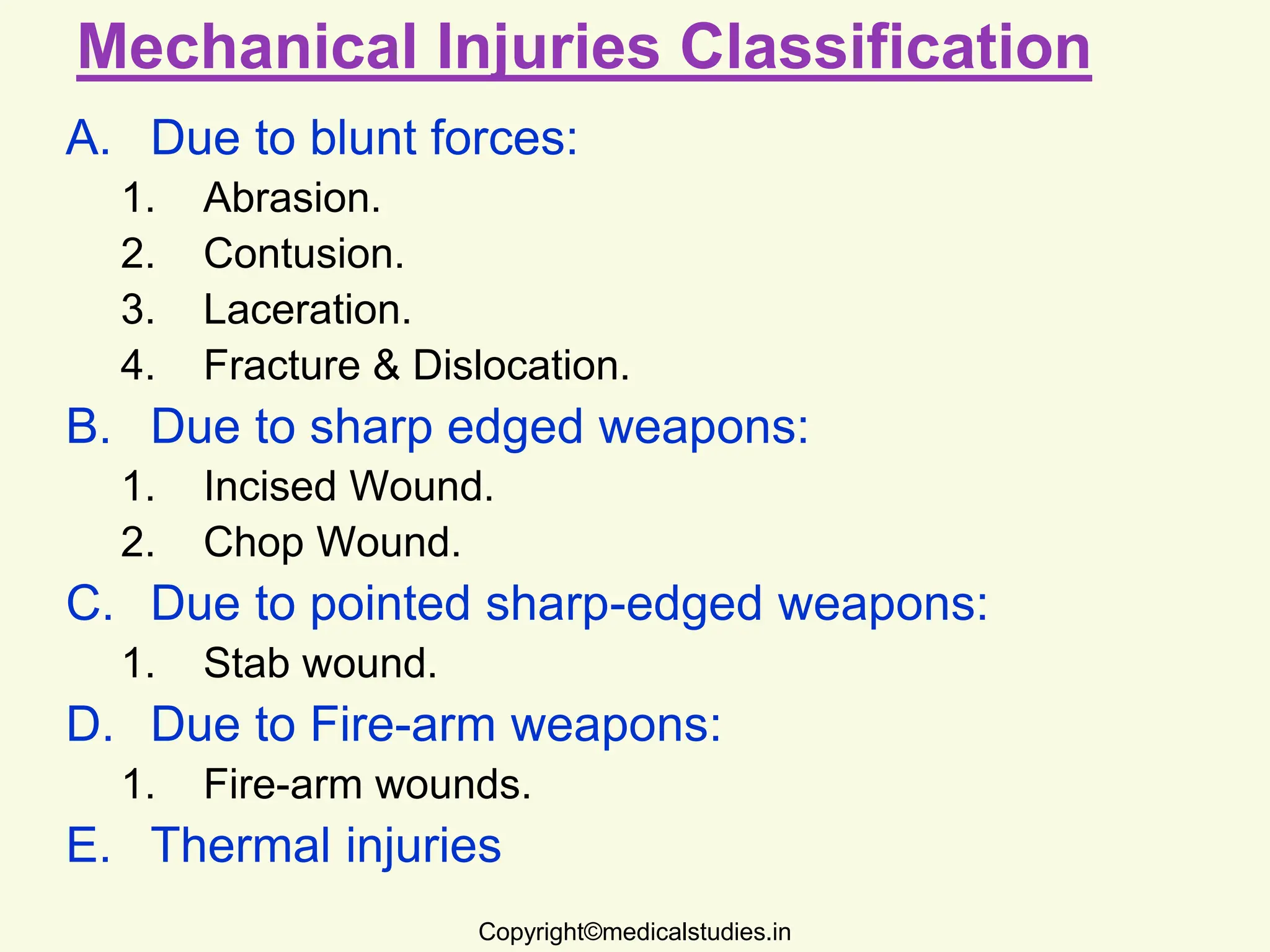
Mechanical Injuries Classification
A. Due to blunt forces:
1. Abrasion.
2. Contusion.
3. Laceration.
4. Fracture & Dislocation.
B. Due to sharp edged weapons:
1. Incised Wound.
2. Chop Wound.
C. Due to pointed sharp-edged weapons:
1. Stab wound.
D. Due to Fire-arm weapons:
1. Fire-arm wounds.
E. Thermal injuries
Copyright©medicalstudies.in
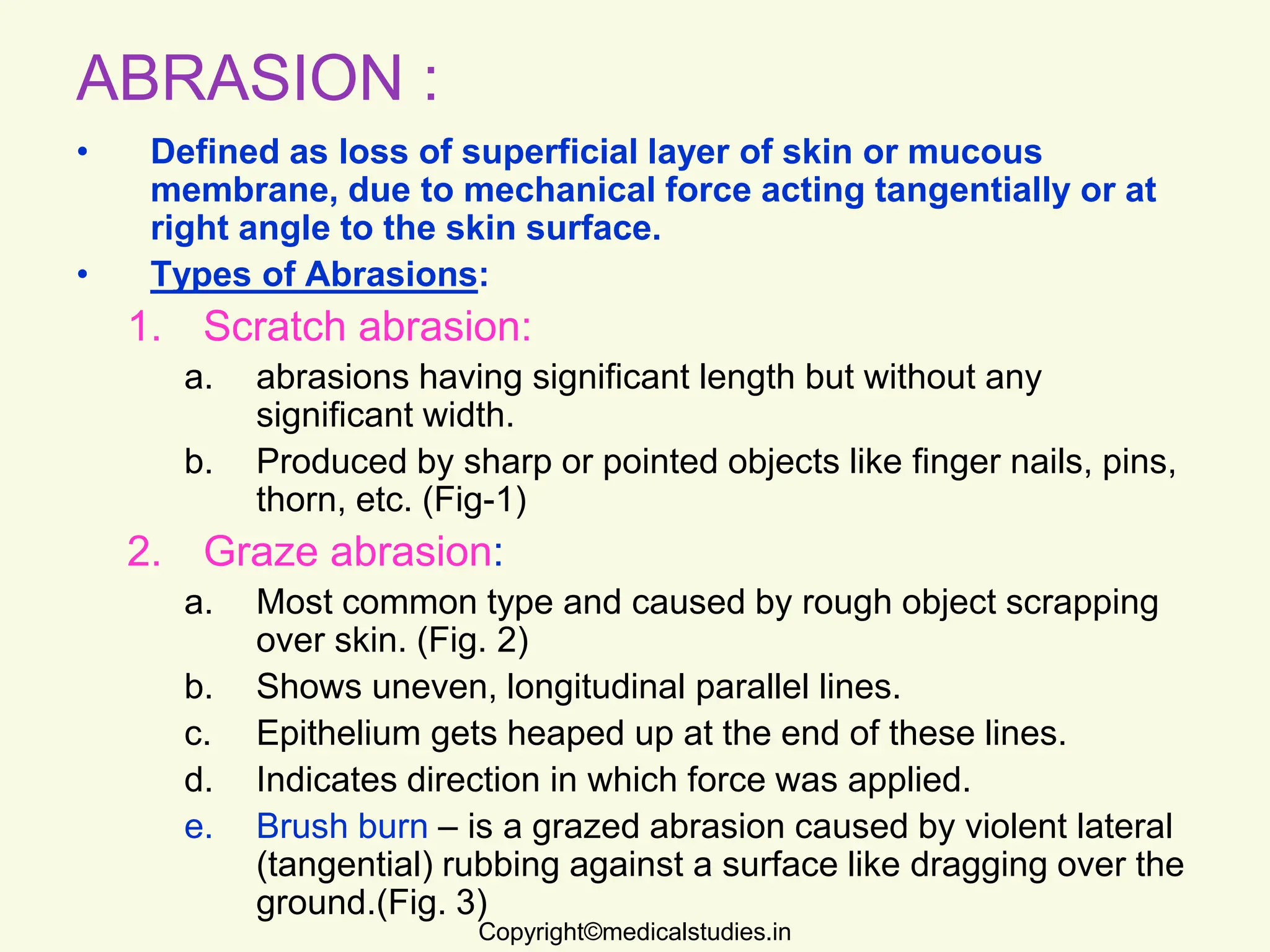
ABRASION :
• Defined as loss of superficial layer of skin or mucous
membrane, due to mechanical force acting tangentially or at
right angle to the skin surface.
• Types of Abrasions:
1. Scratch abrasion:
a. abrasions having significant length but without any
significant width.
b. Produced by sharp or pointed objects like finger nails, pins,
thorn, etc. (Fig-1)
2. Graze abrasion:
a. Most common type and caused by rough object scrapping
over skin. (Fig. 2)
b. Shows uneven, longitudinal parallel lines.
c. Epithelium gets heaped up at the end of these lines.
d. Indicates direction in which force was applied.
e. Brush burn – is a grazed abrasion caused by violent lateral
(tangential) rubbing against a surface like dragging over the
ground.(Fig. 3)
Copyright©medicalstudies.in
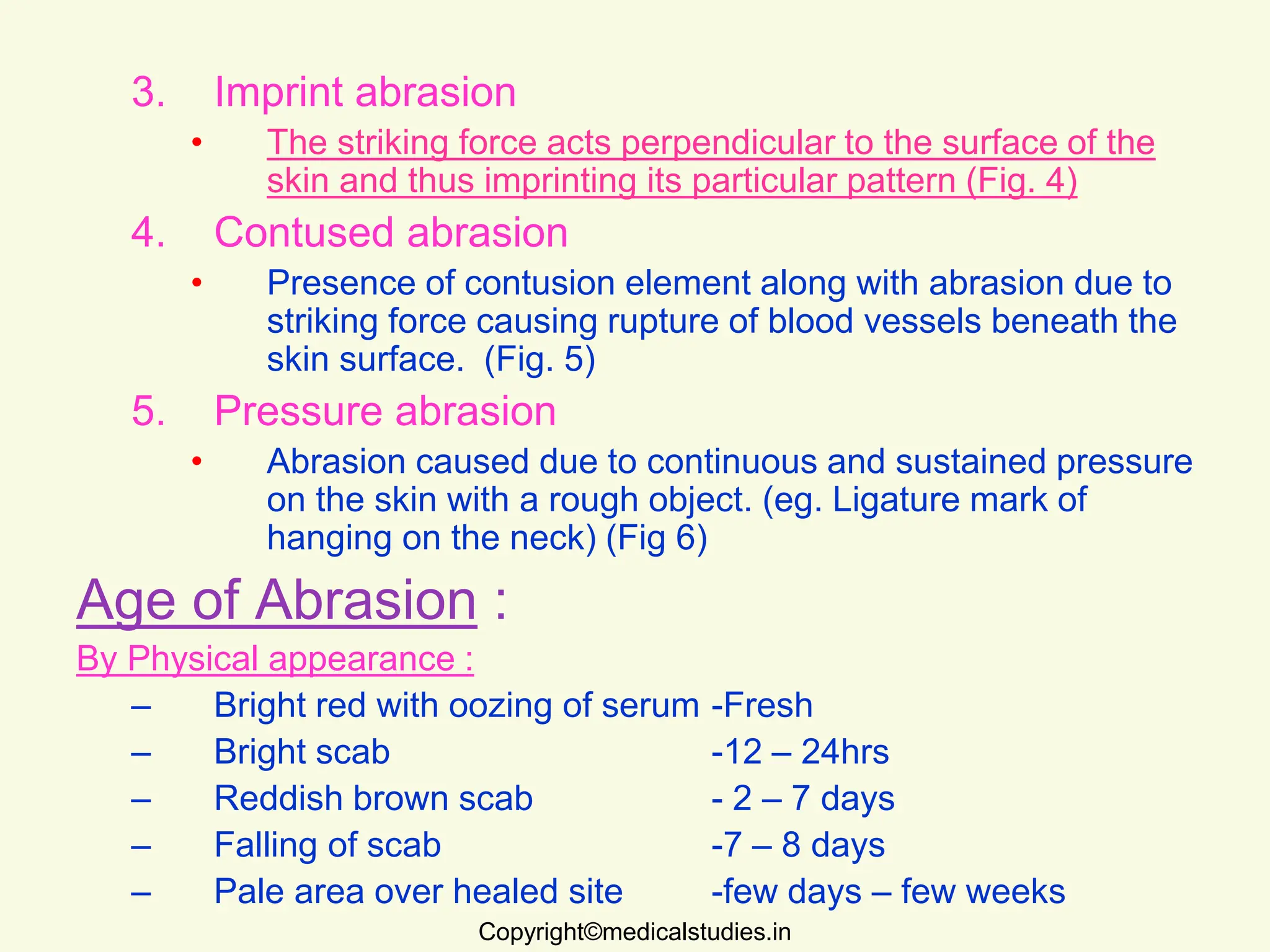
3. Imprint abrasion
• The striking force acts perpendicular to the surface of the
skin and thus imprinting its particular pattern (Fig. 4)
4. Contused abrasion
• Presence of contusion element along with abrasion due to
striking force causing rupture of blood vessels beneath the
skin surface. (Fig. 5)
5. Pressure abrasion
• Abrasion caused due to continuous and sustained pressure
on the skin with a rough object. (eg. Ligature mark of
hanging on the neck) (Fig 6)
Age of Abrasion :
By Physical appearance :
– Bright red with oozing of serum -Fresh
– Bright scab -12 – 24hrs
– Reddish brown scab - 2 – 7 days
– Falling of scab -7 – 8 days
– Pale area over healed site -few days – few weeks
Copyright©medicalstudies.in
• By Histological Examination :
– Infiltration of polymorphs in perivascular area(by 4 – 6 hrs)
– Formation of 3 zones (by 12 hrs)
• Surface zone – Fibrin & RBC
• Middle zone – Polymorphonuclear cells
• Deeper zone – Damaged & abnormally staining cells
– Well formed scab with marginal epithelial regeneration
(by 48 hrs)
– Complete coverage of abrasion with epithelium (by 4 – 5
days)
– Sub-epithelial granulation tissue formation (by 5 – 8 days)
– Reticulin fibres seen (by 8th day)
– Collagen fibres seen (by 9 – 12 days)
Copyright©medicalstudies.in
Medico-legal Importance:
– Site of impact & direction of force.
– Sometimes only external sign of severe internal
injuries.
– Patterned bruise connects to alleged weapon of
offence.
– Age of injury connects to alleged time of assault.
– Throttling – Crescentic nail scratch marks over neck.
– Sexual assault – nail scratch marks on female private
parts.
– Smothering – abrasions over oral & nasal orifices.
– Sign of struggling.
– Dirt / grease – connects injury to alleged scene of
offence.
D/D – Ant bite marks, Excoriated skin due to fecal
mater, and pressure sores, etc.
Copyright©medicalstudies.in
CONTUSION :
• It is defined as an effusion of blood into tissues due to
rupture of blood vessels caused by blunt force impact.
• There is a painful swelling & crushing of sub-cutaneous
tissue but continuity of superficial tissue is maintained
• If associated with abrasion – Abraded contusion.
• If a large vessel is involved : Haematoma formation.
• Size varies from pinhead (petechial bruise) to medium
collections (echymosses), to larger collection but is not
fixed because of continuous extravassation.
• Factors influencing :
– In loose and vascular tissues (face, vulva, scrotum, etc), even
slight trauma leads to a contusion.
– In firm tissues, comparatively smaller contusions form.
– Children & Old persons, bruise easily.
– Fatty persons and ladies bruise more easily.
– In diseased conditions of arteries, bruise occurs more readily.
Copyright©medicalstudies.in
• Internal bruise may be formed underneath the impact
site. (Fig 7)
• Ectopic – Impact elsewhere, bruise collection at other
site, e.g. Black Eye. (Fig 8)
• Patterned Bruise, where an imprint of the causative
agent is produced, such as parallel bruise, caused due
to assault with a rod or bamboo stick. (Fig 9)
• During writing in the report, the size is denoted in 2
dimensions, because it is not possible to measure the
depth in living persons.
• In ante-mortem bruises, there will be swelling, damage
to epithelium, extravasations, and coagulation of the
blood, which are absent in postmortem bruises.
• Microscopic examination shows presence of tissue
reaction beyond the area of impact with emigration of
WBC in case of ante-mortem bruises.
Copyright©medicalstudies.in
Ageing of Contusion :
• Aided by the colour change following
degradation of RBC at injured site.
• Red in colour - Fresh
• Blue in colour - By Day 1
• Brownish colour - 1 – 3 Days
• Greenish in colour- 4 – 6 Days
• Yellowish colour - 7 – 8 Days
• Disappearance - By End of 2 weeks
Note : Sub-conjunctival hemorrhage does not
show these changes.
Copyright©medicalstudies.in
• Differences between Hypostasis & Bruise:
– Differs as to Cause, Site, Appearance, Epidermis
status, Margins, Color, effect of incision and effects
of pressure.
• Differences between True & False Bruise:
– Differs as to Cause, Site, Color, Shape, Margins,
Inflammation, Contents, Itching, Vesicles, and
Chemical test.
Medico-legal Importance:
1. Patterned bruise links injury to causative agent.
2. Degree of violence can be assessed by the size of the bruise.
3. Age of injury links injury to alleged time of assault.
4. Sexual assault shows bruising on the thighs.
5. Cause of death can be known.
6. Artificial bruise.
Copyright©medicalstudies.in
LACERATION :
• Mechanical Injury caused by application of
blunt force on a broader area resulting in
crushing or stretching, beyond its elasticity
limit, thereby producing tears / splits of the
affected part.
• Usually seen due to blow by blunt force
objects, falls on hard surface, machinery
injuries, traffic accident injuries, etc.
• When there is bleeding into adjacent tissues, it
is called as ‘Contused Laceration’.
• When extensive bruising & laceration of
deeper tissues, it is called as ‘Crush Injury’.
• These injuries are 3-Dimensional.
Copyright©medicalstudies.in
1.Split Laceration:
• Occurs due to crushing of skin between two hard
objects.
• Incised looking lacerated injury, in which
laceration is produced without extensive skin
crushing.
• Produced due to blunt force impact on skin close
to the bone immediately underneath, thereby
producing a linear splitting of the tissues, which
looks like an incised wound.
• Sites include Forehead, Chin, Shin of leg, Scalp,
Eyebrows etc. (Fig 10)
Various types :
Copyright©medicalstudies.in
2. Stretch Laceration:
• Here skin gets overstretched,thereby detaching a
loose flap of skin from the underneath fascia.
(Fig 11)
• The flap indicates the direction of the force
acting, which indicates the direction of the
vehicle movement.
• Examples seen in run-over injuries due to a
motor vehicle.
3. Avulsion Laceration:
• Here, a great shearing force acts on the affected
surface at an acute angle which leads to
complete detachment of a flap of skin from the
underlying deep fascia or bone.
• There may be crushing of underlying tissues.
Copyright©medicalstudies.in
• Separated skin shows extensive abrasion from
rotational friction effect of the tyres, with one portion
still in continuity with intact skin.
• Seen in run-over injury by heavy motor vehicles.
(Fig 12)
4. Cut Laceration:
• In this type, there is an impact with irregular cutting
weapon with low sharpness of its edges.
• Skin gets stretched at the middle of impact with the
sharp edge leading to splitting of skin having rough
irregular edges.
• Skin edges may be abraded or contused.
• Examples include injury with a broken glass,
animals attacks, like bear mauling) (Fig 13)
5. Tearing Laceration:
• Similar to overstretching effect produced due to
impact against irregular semi-sharp objects.
Copyright©medicalstudies.in
General Features of Lacerated Injuries
• Margins are irregular, ragged and uneven.
• Edges of laceration are undermined.
• Deeper tissues are unevenly divided with tags of tissues
at the bottom of wound bridging across margins, which
consists of nerves, blood vessels, elastic and connective
tissue fibers. This forms the basis of distinguishing an
incised wound from an incised looking lacerated wound.
• Hair bulbs are crushed and may be driven deep into the
wound.
• Hemorrhage is less because of crushing of blood
vessels irregularly, except in scalp injury.
• Foreign matter may be found in the wound.
• Shape and size may not correspond with the weapon.
Copyright©medicalstudies.in
• Determination of age is difficult because of intervening
infection and healing with secondary intention.
• Complications developing includes severe or fatal
hemorrhage, infection, dysfunctional part and pulmonary
/ systemic fat embolism.
Medico-legal Importance:
– Type of laceration may indicate the type of weapon
used.
– Foreign body found in the wound may link the scene
of crime.
– Age of the wound may be determined provided
healing occurs without any complications.
Copyright©medicalstudies.in
INCISED INJURY :
• It is defined as a type of mechanical injury
produced by a sharp edged weapon, where
there is clean cut separation of skin or deeper
tissue without loss of substance. (Fig 14)
• Situation where seen are:
– When striking the body with a sharp weapon.
– Drawing the weapon like slashing.
– Using the sharp edged weapon like a saw.
• Characters:
– Margins have clean cut edges, well defined and
everted.
– Edged free from abrasion or contusion.
– Depth of wound does not show tissue bridging.
– Width is greater than the edge of weapon because of
retraction of the wound margins.
Copyright©medicalstudies.in
– Length of the wound is greater than width or depth.
– There is no relation to cutting edge of the weapon to the length
of wound.
– The wound is usually spindle shaped.
– There is significant hemorrhage because of clean cutting of the
blood vessel with spurting of blood.
– The wound has got a head and a tail thus indicating the direction
of force.
– Bevelling cuts may occur when the cutting edge strikes the skin
surface obliquely.
• Variants :
– Chop Wounds – Cutting injury by heavy cutting weapon, like
butcher’s knife. Here the margins are contused. (Fig. 15)
– Lacerated looking Incised wound – seen over area where skin is
attached loosely to underlying tissue like scrotum, axilla, etc.
– Defense wound – Incised wound got during defending self from
the assault. They denote homicidal intention. Seen usually on
palm, forearm, head or back. (Fig 16)
Copyright©medicalstudies.in
Ageing of Incised Wounds :
• Red with clotted blood - Fresh
• Blood with lymph scab & leucocyte infiltration - 12 Hrs.
• Neo-vascularisation - 24 Hrs.
• Fibroblastic Infiltration - 36 Hrs.
• Healing of wound with linear scar formation - 3 – 5 Days.
• Complete scar formation - By 6th Day.
Note: If infection supervenes, the aging of the wound will differ
due to delayed healing.
-Self – inflicted Incised wound – Incised wounds made
intentionally on the body surface to gain advantage or
putting a false allegation. Normally they are present on
the accessible areas of the body and are not very
serious or deep. (Fig. – 17) (Fig. – 18)
Copyright©medicalstudies.in
Medico-legal Importance:
• Wounds indicate nature of weapon used.
• Age of the wound can be known.
• Direction of force can be known from the wound.
• Position and character of wound may indicate mode of
death like suicide, homicide or accident.
Difference between Suicidal & Homicidal Cut throat injury:
• It can be known from its Situation / Level / Direction /
Number / Edges / Hesitation cuts / Tailing / Severity /
Wounds in other areas / Defense wound / Hands /
Weapon / Vessels / Blood stains / Clothes /
Circumstances, etc. (Fig. – 19) (Fig. – 20)
Copyright©medicalstudies.in
STAB INJURY (Punctured wound)
• Mechanical Injury produced when force is
delivered along the long axis of a narrow or
pointed objects, penetrating skin and underlying
tissues. (Fig 16)
• Weapons causing : Knife, Sword, Needle, Screw
driver, Spear, Arrow, etc.
• Types :
– Penetrating wound : single point of entry with weapon
getting lodged in body cavity.
– Perforating wound : through and through puncture
wound where weapon enters on one side and comes
out the opposite side thus having entry wound and
exit wound.
Copyright©medicalstudies.in
Characteristic of Stab wound:
• Margins :
– Clean cut edges.
– Usually no abrasion / bruising of margins except in full
penetration of weapon.
– If cutting edge is blunt – abraded and ragged
margins.
– Symmetrical entry wound if knife hits perpendicularly.
– If knife strikes at an angle, an abrasion may be found
opposite to direction of force / penetration. (Fig)
• Length :
– Slightly less than width of weapon because of
stretching of skin and later retraction.
– If knife is completely withdrawn, with dragging against
one end, it produces tailing with a superficial cut. (Fig)
Copyright©medicalstudies.in
• Width :
– Maximum possible width can be approximately
determined if edges of gaping wound are
approximated together.
• Depth :
– It is greater than width and length of entry wound.
– Usually equal to or less than length of blade except in
abdominal injury.
– Mobility of internal organs are to be taken into
consideration.
– In a living person, it should be determined in OT
during wound repair.
– In a cadaver, anatomical relation of surface to internal
organs are not same as in standing posture when
person was alive, which is to be given consideration.
– Factors influencing:
• Condition of knife : sharp pointed and edge leads to greater
depth of wound.
Copyright©medicalstudies.in
• Resistance of tissue : Skin is relatively resistant.
• Clothing : Heavy clothing may require greater force to
produce the same depth.
• Speed of thrust : Greater thrust produces more depth.
• Angle of thrust : More perpendicular to the surface, more
depth of the wound.
– Radio-opaque dye injected into wound and X-ray
taken will reveal depth of track.
• Shape :
– Dependant on shape of weapon, direction of thrust,
cleavage direction, etc.
– Stab wound running parallel to cleavage lines, will be
narrow and slit shaped.
– Stab wound cutting perpendicular to cleavage lines
will produce a gapping wound.
– Unusual shaped wound like ‘L’ or ‘V’ shape does not
indicate two stab wounds but due to movement or
twisting of blade during withdrawal motion.
– In closed scissors, ‘Z’ shaped wound.
Copyright©medicalstudies.in
• Direction :
– Knife acting on skin at an angle produces beveling.
– If perforating stab wound, description should be made
in the order of describing entrance wound first, then
track and exit wound at the last.
– If penetrating wound, describe entrance wound first,
then depth, direction of wound and then specific
termination.
Complications :
– Hemorrhage.
– Infection.
– Air embolism.
– Pneumothorax.
– Asphyxia.
Copyright©medicalstudies.in
• Concealed puncture wound : Puncture wound caused on
concealed parts like nostrils, fontanelles, axilla, vagina,
rectum, etc. Careful examination is necessary in such
cases.
• Incised stab wound : Starts with incised wound and ends
with a stab wound.
• Hara-kiri : A type of suicide in which the person stabs
himself and takes out his internal organs or he attempts
to fall over the pointed weapon. Sudden evisceration of
organs leads to immediate cardiac collapse.
Examination of Stab Injury case:
• Identification / labeling of cuts and damage of clothing.
• Distribution of blood stain.
• Removal of clothing layer by layer.
• Identification and labeling of injuries with respect to
position, location, description, direction, depth, internal
organs injury, foreign bodies found, etc.
Copyright©medicalstudies.in
Examination of weapon:
• Length, width, thickness of blade. (Fig)
• Single edged or double edged.
• Tapering.
• Nature of back edge.
• Grooving, serration, forking of blade.
• Sharpness of tip.
Medico-legal Importance:
1. Shape – Class and type of weapon. (Fig)
2. Depth – Force of penetration.
3. Direction – Relative position of assailant and victim.
4. Age of injury – Timing of assault.
5. Position and number – indicates manner of production
like suicide, homicide, or accident.
6. Foreign body – links scene of crime and also to
weapon.
Copyright©medicalstudies.in
Thank You !
Copyright©medicalstudies.in

MECHANICAL INJURIES helth relateddata and information.pptx

  • 1.
  • 2.
    • INJURY: – Itis defined as any harm, whatever illegally caused to any person in body, mind, reputation or property (Sec. 44 IPC) • MECHANICAL INJURY: – It is defined as injuries produced by any physical violence. – A wound is a break of the natural continuity of any of the tissues of the living body. Copyright©medicalstudies.in
  • 3.
    Mechanical Injuries Classification A.Due to blunt forces: 1. Abrasion. 2. Contusion. 3. Laceration. 4. Fracture & Dislocation. B. Due to sharp edged weapons: 1. Incised Wound. 2. Chop Wound. C. Due to pointed sharp-edged weapons: 1. Stab wound. D. Due to Fire-arm weapons: 1. Fire-arm wounds. E. Thermal injuries Copyright©medicalstudies.in
  • 4.
    ABRASION : • Definedas loss of superficial layer of skin or mucous membrane, due to mechanical force acting tangentially or at right angle to the skin surface. • Types of Abrasions: 1. Scratch abrasion: a. abrasions having significant length but without any significant width. b. Produced by sharp or pointed objects like finger nails, pins, thorn, etc. (Fig-1) 2. Graze abrasion: a. Most common type and caused by rough object scrapping over skin. (Fig. 2) b. Shows uneven, longitudinal parallel lines. c. Epithelium gets heaped up at the end of these lines. d. Indicates direction in which force was applied. e. Brush burn – is a grazed abrasion caused by violent lateral (tangential) rubbing against a surface like dragging over the ground.(Fig. 3) Copyright©medicalstudies.in
  • 5.
    3. Imprint abrasion •The striking force acts perpendicular to the surface of the skin and thus imprinting its particular pattern (Fig. 4) 4. Contused abrasion • Presence of contusion element along with abrasion due to striking force causing rupture of blood vessels beneath the skin surface. (Fig. 5) 5. Pressure abrasion • Abrasion caused due to continuous and sustained pressure on the skin with a rough object. (eg. Ligature mark of hanging on the neck) (Fig 6) Age of Abrasion : By Physical appearance : – Bright red with oozing of serum -Fresh – Bright scab -12 – 24hrs – Reddish brown scab - 2 – 7 days – Falling of scab -7 – 8 days – Pale area over healed site -few days – few weeks Copyright©medicalstudies.in
  • 6.
    • By HistologicalExamination : – Infiltration of polymorphs in perivascular area(by 4 – 6 hrs) – Formation of 3 zones (by 12 hrs) • Surface zone – Fibrin & RBC • Middle zone – Polymorphonuclear cells • Deeper zone – Damaged & abnormally staining cells – Well formed scab with marginal epithelial regeneration (by 48 hrs) – Complete coverage of abrasion with epithelium (by 4 – 5 days) – Sub-epithelial granulation tissue formation (by 5 – 8 days) – Reticulin fibres seen (by 8th day) – Collagen fibres seen (by 9 – 12 days) Copyright©medicalstudies.in
  • 7.
    Medico-legal Importance: – Siteof impact & direction of force. – Sometimes only external sign of severe internal injuries. – Patterned bruise connects to alleged weapon of offence. – Age of injury connects to alleged time of assault. – Throttling – Crescentic nail scratch marks over neck. – Sexual assault – nail scratch marks on female private parts. – Smothering – abrasions over oral & nasal orifices. – Sign of struggling. – Dirt / grease – connects injury to alleged scene of offence. D/D – Ant bite marks, Excoriated skin due to fecal mater, and pressure sores, etc. Copyright©medicalstudies.in
  • 8.
    CONTUSION : • Itis defined as an effusion of blood into tissues due to rupture of blood vessels caused by blunt force impact. • There is a painful swelling & crushing of sub-cutaneous tissue but continuity of superficial tissue is maintained • If associated with abrasion – Abraded contusion. • If a large vessel is involved : Haematoma formation. • Size varies from pinhead (petechial bruise) to medium collections (echymosses), to larger collection but is not fixed because of continuous extravassation. • Factors influencing : – In loose and vascular tissues (face, vulva, scrotum, etc), even slight trauma leads to a contusion. – In firm tissues, comparatively smaller contusions form. – Children & Old persons, bruise easily. – Fatty persons and ladies bruise more easily. – In diseased conditions of arteries, bruise occurs more readily. Copyright©medicalstudies.in
  • 9.
    • Internal bruisemay be formed underneath the impact site. (Fig 7) • Ectopic – Impact elsewhere, bruise collection at other site, e.g. Black Eye. (Fig 8) • Patterned Bruise, where an imprint of the causative agent is produced, such as parallel bruise, caused due to assault with a rod or bamboo stick. (Fig 9) • During writing in the report, the size is denoted in 2 dimensions, because it is not possible to measure the depth in living persons. • In ante-mortem bruises, there will be swelling, damage to epithelium, extravasations, and coagulation of the blood, which are absent in postmortem bruises. • Microscopic examination shows presence of tissue reaction beyond the area of impact with emigration of WBC in case of ante-mortem bruises. Copyright©medicalstudies.in
  • 10.
    Ageing of Contusion: • Aided by the colour change following degradation of RBC at injured site. • Red in colour - Fresh • Blue in colour - By Day 1 • Brownish colour - 1 – 3 Days • Greenish in colour- 4 – 6 Days • Yellowish colour - 7 – 8 Days • Disappearance - By End of 2 weeks Note : Sub-conjunctival hemorrhage does not show these changes. Copyright©medicalstudies.in
  • 11.
    • Differences betweenHypostasis & Bruise: – Differs as to Cause, Site, Appearance, Epidermis status, Margins, Color, effect of incision and effects of pressure. • Differences between True & False Bruise: – Differs as to Cause, Site, Color, Shape, Margins, Inflammation, Contents, Itching, Vesicles, and Chemical test. Medico-legal Importance: 1. Patterned bruise links injury to causative agent. 2. Degree of violence can be assessed by the size of the bruise. 3. Age of injury links injury to alleged time of assault. 4. Sexual assault shows bruising on the thighs. 5. Cause of death can be known. 6. Artificial bruise. Copyright©medicalstudies.in
  • 12.
    LACERATION : • MechanicalInjury caused by application of blunt force on a broader area resulting in crushing or stretching, beyond its elasticity limit, thereby producing tears / splits of the affected part. • Usually seen due to blow by blunt force objects, falls on hard surface, machinery injuries, traffic accident injuries, etc. • When there is bleeding into adjacent tissues, it is called as ‘Contused Laceration’. • When extensive bruising & laceration of deeper tissues, it is called as ‘Crush Injury’. • These injuries are 3-Dimensional. Copyright©medicalstudies.in
  • 13.
    1.Split Laceration: • Occursdue to crushing of skin between two hard objects. • Incised looking lacerated injury, in which laceration is produced without extensive skin crushing. • Produced due to blunt force impact on skin close to the bone immediately underneath, thereby producing a linear splitting of the tissues, which looks like an incised wound. • Sites include Forehead, Chin, Shin of leg, Scalp, Eyebrows etc. (Fig 10) Various types : Copyright©medicalstudies.in
  • 14.
    2. Stretch Laceration: •Here skin gets overstretched,thereby detaching a loose flap of skin from the underneath fascia. (Fig 11) • The flap indicates the direction of the force acting, which indicates the direction of the vehicle movement. • Examples seen in run-over injuries due to a motor vehicle. 3. Avulsion Laceration: • Here, a great shearing force acts on the affected surface at an acute angle which leads to complete detachment of a flap of skin from the underlying deep fascia or bone. • There may be crushing of underlying tissues. Copyright©medicalstudies.in
  • 15.
    • Separated skinshows extensive abrasion from rotational friction effect of the tyres, with one portion still in continuity with intact skin. • Seen in run-over injury by heavy motor vehicles. (Fig 12) 4. Cut Laceration: • In this type, there is an impact with irregular cutting weapon with low sharpness of its edges. • Skin gets stretched at the middle of impact with the sharp edge leading to splitting of skin having rough irregular edges. • Skin edges may be abraded or contused. • Examples include injury with a broken glass, animals attacks, like bear mauling) (Fig 13) 5. Tearing Laceration: • Similar to overstretching effect produced due to impact against irregular semi-sharp objects. Copyright©medicalstudies.in
  • 16.
    General Features ofLacerated Injuries • Margins are irregular, ragged and uneven. • Edges of laceration are undermined. • Deeper tissues are unevenly divided with tags of tissues at the bottom of wound bridging across margins, which consists of nerves, blood vessels, elastic and connective tissue fibers. This forms the basis of distinguishing an incised wound from an incised looking lacerated wound. • Hair bulbs are crushed and may be driven deep into the wound. • Hemorrhage is less because of crushing of blood vessels irregularly, except in scalp injury. • Foreign matter may be found in the wound. • Shape and size may not correspond with the weapon. Copyright©medicalstudies.in
  • 17.
    • Determination ofage is difficult because of intervening infection and healing with secondary intention. • Complications developing includes severe or fatal hemorrhage, infection, dysfunctional part and pulmonary / systemic fat embolism. Medico-legal Importance: – Type of laceration may indicate the type of weapon used. – Foreign body found in the wound may link the scene of crime. – Age of the wound may be determined provided healing occurs without any complications. Copyright©medicalstudies.in
  • 18.
    INCISED INJURY : •It is defined as a type of mechanical injury produced by a sharp edged weapon, where there is clean cut separation of skin or deeper tissue without loss of substance. (Fig 14) • Situation where seen are: – When striking the body with a sharp weapon. – Drawing the weapon like slashing. – Using the sharp edged weapon like a saw. • Characters: – Margins have clean cut edges, well defined and everted. – Edged free from abrasion or contusion. – Depth of wound does not show tissue bridging. – Width is greater than the edge of weapon because of retraction of the wound margins. Copyright©medicalstudies.in
  • 19.
    – Length ofthe wound is greater than width or depth. – There is no relation to cutting edge of the weapon to the length of wound. – The wound is usually spindle shaped. – There is significant hemorrhage because of clean cutting of the blood vessel with spurting of blood. – The wound has got a head and a tail thus indicating the direction of force. – Bevelling cuts may occur when the cutting edge strikes the skin surface obliquely. • Variants : – Chop Wounds – Cutting injury by heavy cutting weapon, like butcher’s knife. Here the margins are contused. (Fig. 15) – Lacerated looking Incised wound – seen over area where skin is attached loosely to underlying tissue like scrotum, axilla, etc. – Defense wound – Incised wound got during defending self from the assault. They denote homicidal intention. Seen usually on palm, forearm, head or back. (Fig 16) Copyright©medicalstudies.in
  • 20.
    Ageing of IncisedWounds : • Red with clotted blood - Fresh • Blood with lymph scab & leucocyte infiltration - 12 Hrs. • Neo-vascularisation - 24 Hrs. • Fibroblastic Infiltration - 36 Hrs. • Healing of wound with linear scar formation - 3 – 5 Days. • Complete scar formation - By 6th Day. Note: If infection supervenes, the aging of the wound will differ due to delayed healing. -Self – inflicted Incised wound – Incised wounds made intentionally on the body surface to gain advantage or putting a false allegation. Normally they are present on the accessible areas of the body and are not very serious or deep. (Fig. – 17) (Fig. – 18) Copyright©medicalstudies.in
  • 21.
    Medico-legal Importance: • Woundsindicate nature of weapon used. • Age of the wound can be known. • Direction of force can be known from the wound. • Position and character of wound may indicate mode of death like suicide, homicide or accident. Difference between Suicidal & Homicidal Cut throat injury: • It can be known from its Situation / Level / Direction / Number / Edges / Hesitation cuts / Tailing / Severity / Wounds in other areas / Defense wound / Hands / Weapon / Vessels / Blood stains / Clothes / Circumstances, etc. (Fig. – 19) (Fig. – 20) Copyright©medicalstudies.in
  • 22.
    STAB INJURY (Puncturedwound) • Mechanical Injury produced when force is delivered along the long axis of a narrow or pointed objects, penetrating skin and underlying tissues. (Fig 16) • Weapons causing : Knife, Sword, Needle, Screw driver, Spear, Arrow, etc. • Types : – Penetrating wound : single point of entry with weapon getting lodged in body cavity. – Perforating wound : through and through puncture wound where weapon enters on one side and comes out the opposite side thus having entry wound and exit wound. Copyright©medicalstudies.in
  • 23.
    Characteristic of Stabwound: • Margins : – Clean cut edges. – Usually no abrasion / bruising of margins except in full penetration of weapon. – If cutting edge is blunt – abraded and ragged margins. – Symmetrical entry wound if knife hits perpendicularly. – If knife strikes at an angle, an abrasion may be found opposite to direction of force / penetration. (Fig) • Length : – Slightly less than width of weapon because of stretching of skin and later retraction. – If knife is completely withdrawn, with dragging against one end, it produces tailing with a superficial cut. (Fig) Copyright©medicalstudies.in
  • 24.
    • Width : –Maximum possible width can be approximately determined if edges of gaping wound are approximated together. • Depth : – It is greater than width and length of entry wound. – Usually equal to or less than length of blade except in abdominal injury. – Mobility of internal organs are to be taken into consideration. – In a living person, it should be determined in OT during wound repair. – In a cadaver, anatomical relation of surface to internal organs are not same as in standing posture when person was alive, which is to be given consideration. – Factors influencing: • Condition of knife : sharp pointed and edge leads to greater depth of wound. Copyright©medicalstudies.in
  • 25.
    • Resistance oftissue : Skin is relatively resistant. • Clothing : Heavy clothing may require greater force to produce the same depth. • Speed of thrust : Greater thrust produces more depth. • Angle of thrust : More perpendicular to the surface, more depth of the wound. – Radio-opaque dye injected into wound and X-ray taken will reveal depth of track. • Shape : – Dependant on shape of weapon, direction of thrust, cleavage direction, etc. – Stab wound running parallel to cleavage lines, will be narrow and slit shaped. – Stab wound cutting perpendicular to cleavage lines will produce a gapping wound. – Unusual shaped wound like ‘L’ or ‘V’ shape does not indicate two stab wounds but due to movement or twisting of blade during withdrawal motion. – In closed scissors, ‘Z’ shaped wound. Copyright©medicalstudies.in
  • 26.
    • Direction : –Knife acting on skin at an angle produces beveling. – If perforating stab wound, description should be made in the order of describing entrance wound first, then track and exit wound at the last. – If penetrating wound, describe entrance wound first, then depth, direction of wound and then specific termination. Complications : – Hemorrhage. – Infection. – Air embolism. – Pneumothorax. – Asphyxia. Copyright©medicalstudies.in
  • 27.
    • Concealed puncturewound : Puncture wound caused on concealed parts like nostrils, fontanelles, axilla, vagina, rectum, etc. Careful examination is necessary in such cases. • Incised stab wound : Starts with incised wound and ends with a stab wound. • Hara-kiri : A type of suicide in which the person stabs himself and takes out his internal organs or he attempts to fall over the pointed weapon. Sudden evisceration of organs leads to immediate cardiac collapse. Examination of Stab Injury case: • Identification / labeling of cuts and damage of clothing. • Distribution of blood stain. • Removal of clothing layer by layer. • Identification and labeling of injuries with respect to position, location, description, direction, depth, internal organs injury, foreign bodies found, etc. Copyright©medicalstudies.in
  • 28.
    Examination of weapon: •Length, width, thickness of blade. (Fig) • Single edged or double edged. • Tapering. • Nature of back edge. • Grooving, serration, forking of blade. • Sharpness of tip. Medico-legal Importance: 1. Shape – Class and type of weapon. (Fig) 2. Depth – Force of penetration. 3. Direction – Relative position of assailant and victim. 4. Age of injury – Timing of assault. 5. Position and number – indicates manner of production like suicide, homicide, or accident. 6. Foreign body – links scene of crime and also to weapon. Copyright©medicalstudies.in
  • 29.
  • 30.
  • 31.
  • 32.
  • 33.
  • 34.
  • 35.
  • 36.
  • 37.
  • 38.
  • 39.
  • 40.
  • 41.
  • 42.
  • 43.
  • 44.
  • 45.
  • 46.
  • 47.
  • 48.
  • 49.
  • 50.
  • 51.
  • 52.
  • 53.
  • 54.
  • 55.
  • 56.
  • 57.