



MECHANICAL
INJURIES
Dr. Sunil Duchania
MBBS (MAMC), MD (LHMC)
Certification in Medical Negligence in India
Founder- Forensic Extracts
Founder- SABAL Medico legal Consultancy
Former President RDA LHMC, Delhi
Vice-President FORDA, India
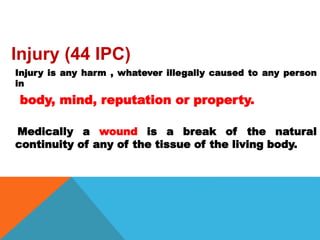
Injury (44 IPC)
Injury is any harm , whatever illegally caused to any person
in
body, mind, reputation or property.
Medically a wound is a break of the natural
continuity of any of the tissue of the living body.
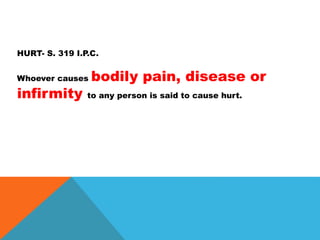
HURT- S. 319 I.P.C.
Whoever causes bodily pain, disease or
infirmity to any person is said to cause hurt.
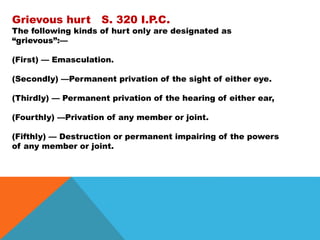
Grievous hurt S. 320 I.P.C.
The following kinds of hurt only are designated as
“grievous”:—
(First) — Emasculation.
(Secondly) —Permanent privation of the sight of either eye.
(Thirdly) — Permanent privation of the hearing of either ear,
(Fourthly) —Privation of any member or joint.
(Fifthly) — Destruction or permanent impairing of the powers
of any member or joint.
(Sixthly) — Permanent disfiguration of the head or face.
(Seventhly) —Fracture or dislocation of a bone or tooth.
(Eighthly) —Any hurt which endangers life or which causes the
sufferer to be during the space of twenty days in severe bodily pain,
or unable to follow his ordinary pursuits.
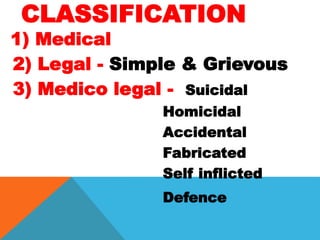
CLASSIFICATION
1) Medical
2) Legal - Simple & Grievous
3) Medico legal - Suicidal
Homicidal
Accidental
Fabricated
Self inflicted
Defence
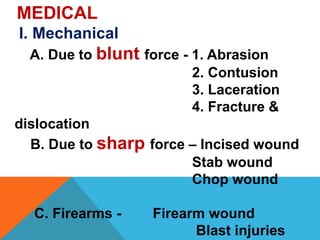
MEDICAL
I. Mechanical
A. Due to blunt force - 1. Abrasion
2. Contusion
3. Laceration
4. Fracture &
dislocation
B. Due to sharp force – Incised wound
Stab wound
Chop wound
C. Firearms - Firearm wound
Blast injuries
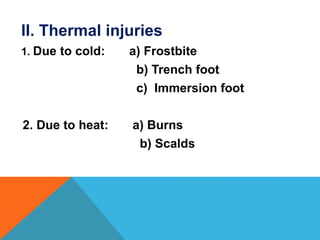
II. Thermal injuries
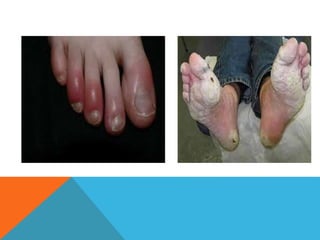
1. Due to cold: a) Frostbite
b) Trench foot
c) Immersion foot
2. Due to heat: a) Burns
b) Scalds
III. Chemical injuries- a) Corrosive acids
b) Corrosive alkalis
V. Physical injuries - Electricity
Lightening
Radiation
Radioactive substances
V. Explosions
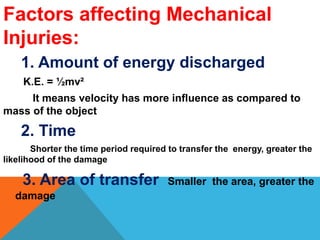
Factors affecting Mechanical
Injuries:
1. Amount of energy discharged
K.E. = ½mv²
It means velocity has more influence as compared to
mass of the object
2. Time
Shorter the time period required to transfer the energy, greater the
likelihood of the damage
3. Area of transfer Smaller the area, greater the
damage
4. Elasticity and plasticity
The less elastic and plastic the tissue, the greater
the damage
ABRASION
Definition
 Abrasion is destruction of the skin, which usually
involves the superficial layers of the epidermis
only.
 They heal without scar formation
Types
1. Scratches
2. Grazes
3. Pressure abrasion
4. Impact abrasion
5. Patterned abrasion
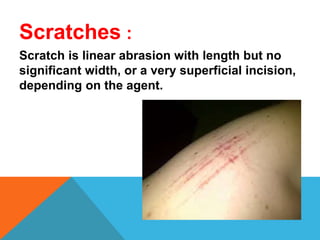
Scratches :
Scratch is linear abrasion with length but no
significant width, or a very superficial incision,
depending on the agent.
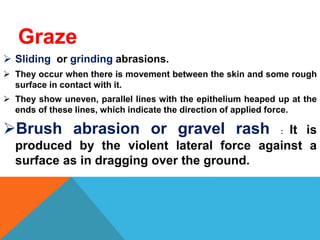
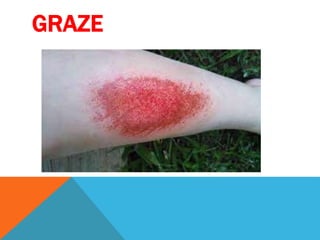
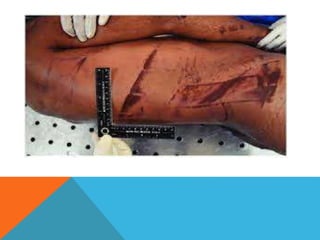
Graze
 Sliding or grinding abrasions.
 They occur when there is movement between the skin and some rough
surface in contact with it.
 They show uneven, parallel lines with the epithelium heaped up at the
ends of these lines, which indicate the direction of applied force.
Brush abrasion or gravel rash : It is
produced by the violent lateral force against a
surface as in dragging over the ground.
GRAZE
Pressure abrasions
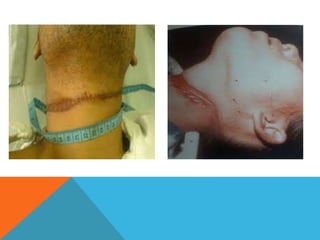
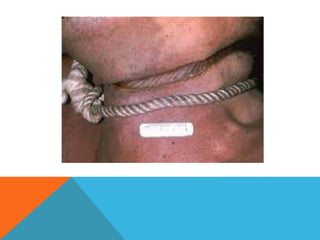
 They are caused by crushing of the superficial layers of the
epidermis and are associated with bruise of the
surrounded area.
 If force is applied at an angle of 90º, then pressure abrasion
is produced.
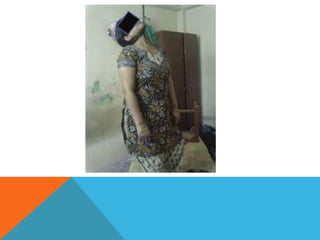
e.g. Ligature mark in hanging and strangulation
Impact abrasion
Caused by impact with a rough object , when the
force is applied at or near a right angle to the skin
surface . The abrasion is slightly depressed below
the surface, unless there is local oedema or there is
bulging due to underlying contusion
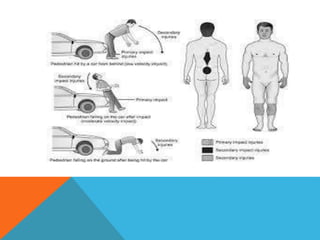
e.g. When a person is knocked down by a car, the
pattern of the radiator grille, a headlamp rim, or
the tread of tyre
Patterned abrasions
Impact abrasion and Pressure abrasion
reproduce the pattern of the object
causing it and are called patterned
abrasions.
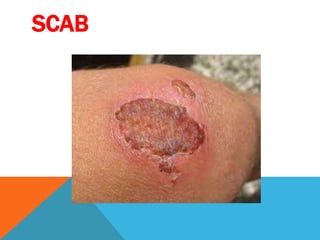
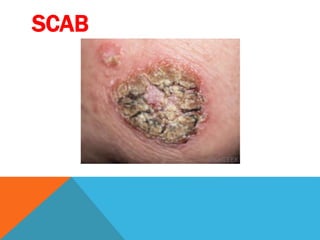
Age of the abrasion :
 Abrasion heals from periphery to centre.
 Age can be determined by colour change and by
histologically
 Fresh – Bright red
 12-24 hrs- lymph and blood dries up leaving a bright red
scab
 2-3 days- reddish brown scab
 4-7 days- dark brown to brownish black scab
 -Epithelium grows & covers the defect
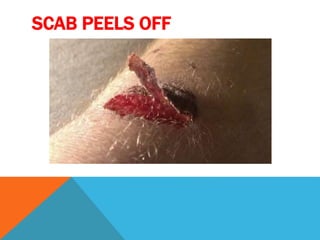
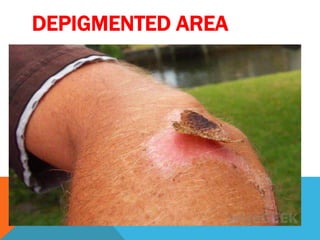
 After 7 days- scab dries, and falls off leaving depigmented
area below.
SCAB
SCAB
SCAB PEELS OFF
DEPIGMENTED AREA
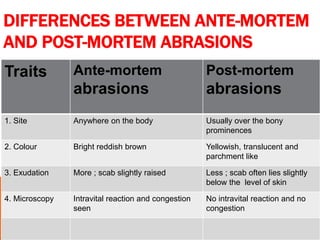
DIFFERENCES BETWEEN ANTE-MORTEM
AND POST-MORTEM ABRASIONS
Traits Ante-mortem
abrasions
Post-mortem
abrasions
1. Site Anywhere on the body Usually over the bony
prominences
2. Colour Bright reddish brown Yellowish, translucent and
parchment like
3. Exudation More ; scab slightly raised Less ; scab often lies slightly
below the level of skin
4. Microscopy Intravital reaction and congestion
seen
No intravital reaction and no
congestion
Circumstances of injuries:
 Usually seen in accidents and assaults
 Rare in suicide
 Sometimes hysterical women may produce abrasion over
accessible areas to fabricate the false charge of assault
 Abrasion on the face or body of assailant indicate the
struggle
 Person collapsing due to heart attack may fall forward and
shows abrasion on the front part of the body
 The alcoholic person may fall backwards and abrasions
will be seen on occiput.
Medico legal importance
 Gives idea about the site of impact and direction
of force.
 Only external sign of severe internal injury.
 Patterned abrasion can identify the weapon
causing it.
 Age of injury can be determined by colour
changes
 Scene of crime can be determined by the presence
of dirt, dust, grease etc.
Distribution of injuries show the Character and
manner of injury :-
In throttling: crescentic abrasion are seen on neck
In smothering: abrasion are seen on mouth and
nostril
In rape: abrasion are seen on the breasts, genitals,
inner side of thigh, and around the anus
Sign of struggle: abrasion on face of the assailant
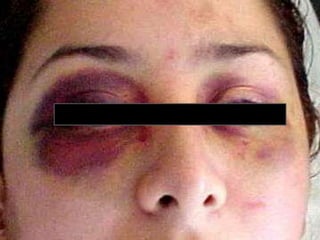
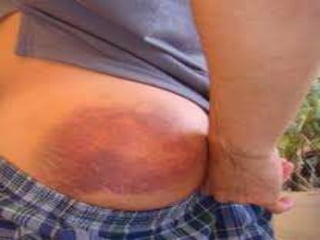
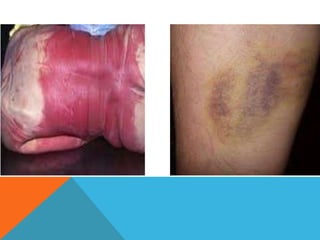
CONTUSION
CONTUSION
Definition:
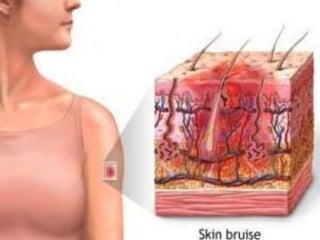
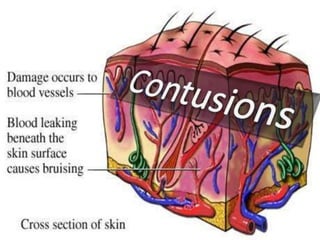
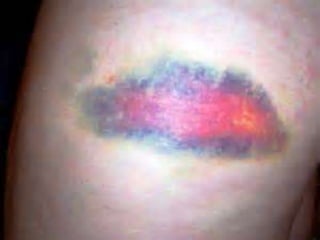
A contusion is an effusion of blood into
the tissues, due to the rupture of blood
vessel, caused by blunt trauma.
 Contusion is present in skin and internal organs .
 Most contusion are present in the subcutaneous
tissues above the deep fascia.
 In contusion, there is painful swelling and rearing
of subcutaneous tissues usually without the
destruction of skin.
 A bruise is lighter in colour in centre because
extravasated blood is pushed outward by the
impact.
 Size of bruise is slightly larger than the surface of
the agent which caused it as the blood continues
to escape into the area.
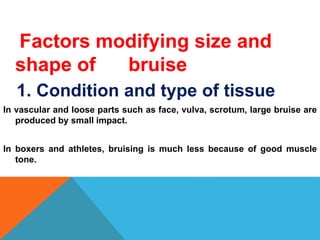
Factors modifying size and
shape of bruise
1. Condition and type of tissue
In vascular and loose parts such as face, vulva, scrotum, large bruise are
produced by small impact.
In boxers and athletes, bruising is much less because of good muscle
tone.
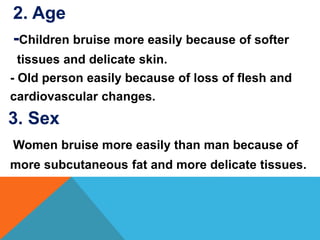
2. Age
-Children bruise more easily because of softer
tissues and delicate skin.
- Old person easily because of loss of flesh and
cardiovascular changes.
3. Sex
Women bruise more easily than man because of
more subcutaneous fat and more delicate tissues.
4. Colour of skin
More clearly seen in fair-skinned persons than those with
dark skin.
5. Natural diseases
Prominent bruising occurs easily even with small
trauma in persons with diseases like haemophilia,
scurvy, Vit.K deficiency, arteriosclerosis etc.
6. Gravity shifting of the blood
A deep bruise, especially that due to the
crushing of the tissue against the bone may
take a long time to become visible and may
not appear below the actual point of impact. It
is Known as ‘Ectopic bruising or ‘Migratory
bruising’
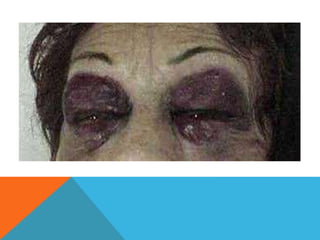
Examples of Migratory bruising
1. Black eye may be caused by -
I. Direct trauma
II. Blunt impact to forehead
III. Fracture of floor of anterior cranial fossa
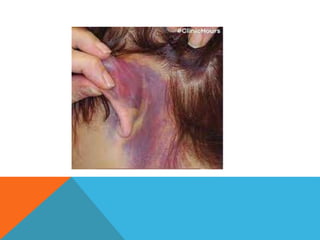
2. A bruise behind ear indicates the basal fracture
(Battle’s sign)
3. Bruise in neck due to fracture in jaw
4. Bruise in thigh due to fracture in pelvis
5. Bruise on ankle due to blow on calf of leg
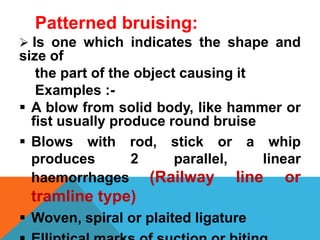
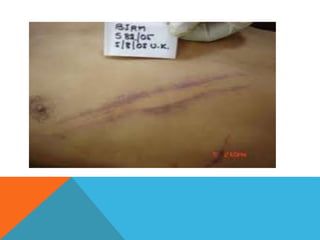
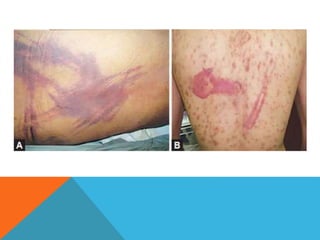
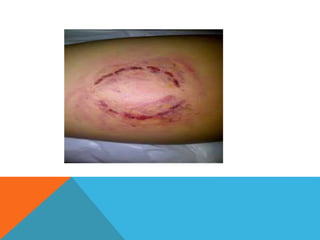
Patterned bruising:
 Is one which indicates the shape and
size of
the part of the object causing it
Examples :-
 A blow from solid body, like hammer or
fist usually produce round bruise
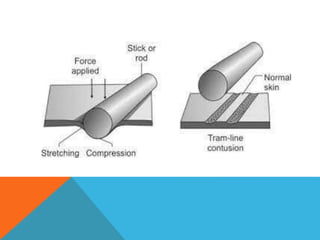
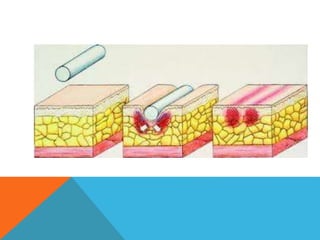
 Blows with rod, stick or a whip
produces 2 parallel, linear
haemorrhages (Railway line or
tramline type)
 Woven, spiral or plaited ligature
Delayed bruising
 A superficial bruising may appear immediately as dark-red
swelling.
 A deep bruise may take several hours and deeper
extravasation of blood may not appear.
 So, one more examination should be carried out 48 hrs
after the first examination.
DEEP TISSUE AND ORGAN
CONTUSIONS
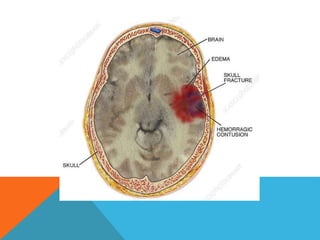
 They are seen only during autopsy
 Contusion of brain may initiate the enough swelling which gradually
increases due to acid accumulation leading to confusion, coma and
death
 Contusion in vital centres which control the respiration and BP may be
fatal even with small trauma
 Contusion of heart may cause arrhythmia or stoppage of cardiac action
and death
 Contusion of other organ may cause the rupture of that organ and
bleeding into the body cavity and death
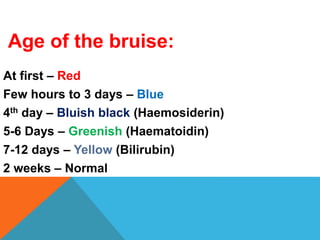
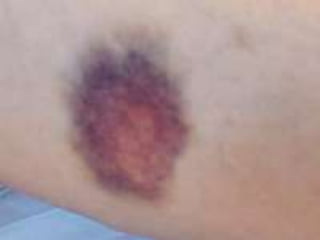
Age of the bruise:
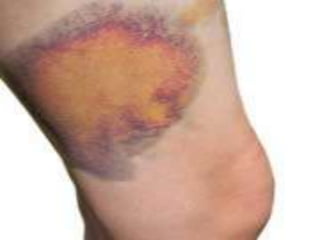
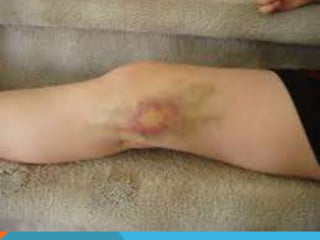
At first – Red
Few hours to 3 days – Blue
4th day – Bluish black (Haemosiderin)
5-6 Days – Greenish (Haematoidin)
7-12 days – Yellow (Bilirubin)
2 weeks – Normal
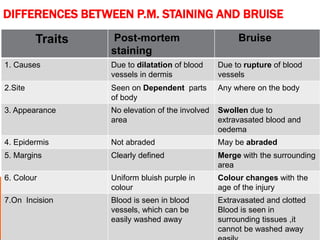
DIFFERENCES BETWEEN P.M. STAINING AND BRUISE
Traits Post-mortem
staining
Bruise
1. Causes Due to dilatation of blood
vessels in dermis
Due to rupture of blood
vessels
2.Site Seen on Dependent parts
of body
Any where on the body
3. Appearance No elevation of the involved
area
Swollen due to
extravasated blood and
oedema
4. Epidermis Not abraded May be abraded
5. Margins Clearly defined Merge with the surrounding
area
6. Colour Uniform bluish purple in
colour
Colour changes with the
age of the injury
7.On Incision Blood is seen in blood
vessels, which can be
easily washed away
Extravasated and clotted
Blood is seen in
surrounding tissues ,it
cannot be washed away
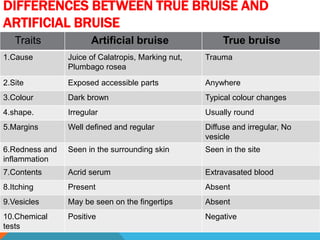
DIFFERENCES BETWEEN TRUE BRUISE AND
ARTIFICIAL BRUISE
Traits Artificial bruise True bruise
1.Cause Juice of Calatropis, Marking nut,
Plumbago rosea
Trauma
2.Site Exposed accessible parts Anywhere
3.Colour Dark brown Typical colour changes
4.shape. Irregular Usually round
5.Margins Well defined and regular Diffuse and irregular, No
vesicle
6.Redness and
inflammation
Seen in the surrounding skin Seen in the site
7.Contents Acrid serum Extravasated blood
8.Itching Present Absent
9.Vesicles May be seen on the fingertips Absent
10.Chemical
tests
Positive Negative
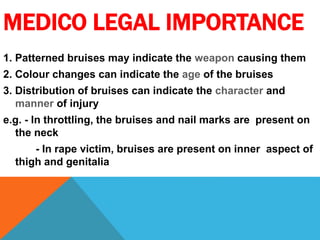
MEDICO LEGAL IMPORTANCE
1. Patterned bruises may indicate the weapon causing them
2. Colour changes can indicate the age of the bruises
3. Distribution of bruises can indicate the character and
manner of injury
e.g. - In throttling, the bruises and nail marks are present on
the neck
- In rape victim, bruises are present on inner aspect of
thigh and genitalia
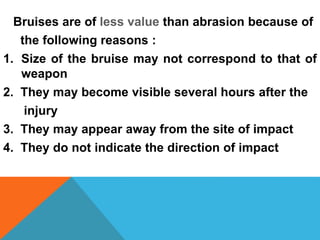
Bruises are of less value than abrasion because of
the following reasons :
1. Size of the bruise may not correspond to that of
weapon
2. They may become visible several hours after the
injury
3. They may appear away from the site of impact
4. They do not indicate the direction of impact
Complications
1. A contusion may contain 20-30 ml blood. Multiple contusion
can cause death due to shock and internal haemorrhage.
2. Gangrene and death of tissue
3. Pooled blood serves as the reservoir of infection like
clostridium bacteria.
4. Pulmonary fat embolism in rare cases
Question
s
1. Pressure abrasion is caused by:
• Violent impact
• Rupture of superficial layer of skin
• Caused by scrapping of skin
• Crushing of superficial layer of
skin
2. Greenish colouration in contusion
is due to:
• Hemosiderin
• Hematoidin
• Bilirubin
• Biliverdin
3. Friction burn is due to:
• Mechanical injury
• Electrical injury
• Fire arm injury
• Thermal injury
4. Abrasion completely heals
in _____ days.
• 1day
• 3days
• 7days
• 10days
5. A contusion can be
differentiated from post-mortem
staining by:
• Diaphanous test
• Gettler’s test
• Icard test
• Incision test
6. Black eye is :
• An injury to eye ball
• An injury to cornea
• Contusion
• Black pigmentation of
eyelids
7. Brush burn is due to
• Burn by dry heat
• Burn by wet heat
• Burn by electric heat
• Abrasion
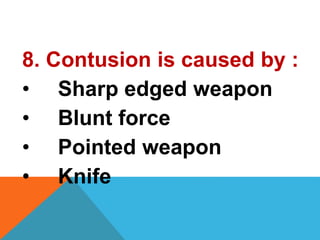
8. Contusion is caused by :
• Sharp edged weapon
• Blunt force
• Pointed weapon
• Knife
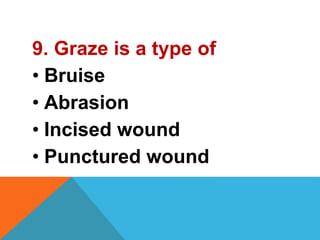
9. Graze is a type of
• Bruise
• Abrasion
• Incised wound
• Punctured wound
Thankyou

Abrasion and Contusions.pptx

  • 1.
    MECHANICAL INJURIES Dr. Sunil Duchania MBBS(MAMC), MD (LHMC) Certification in Medical Negligence in India Founder- Forensic Extracts Founder- SABAL Medico legal Consultancy Former President RDA LHMC, Delhi Vice-President FORDA, India
  • 2.
    Injury (44 IPC) Injuryis any harm , whatever illegally caused to any person in body, mind, reputation or property. Medically a wound is a break of the natural continuity of any of the tissue of the living body.
  • 3.
    HURT- S. 319I.P.C. Whoever causes bodily pain, disease or infirmity to any person is said to cause hurt.
  • 4.
    Grievous hurt S.320 I.P.C. The following kinds of hurt only are designated as “grievous”:— (First) — Emasculation. (Secondly) —Permanent privation of the sight of either eye. (Thirdly) — Permanent privation of the hearing of either ear, (Fourthly) —Privation of any member or joint. (Fifthly) — Destruction or permanent impairing of the powers of any member or joint.
  • 5.
    (Sixthly) — Permanentdisfiguration of the head or face. (Seventhly) —Fracture or dislocation of a bone or tooth. (Eighthly) —Any hurt which endangers life or which causes the sufferer to be during the space of twenty days in severe bodily pain, or unable to follow his ordinary pursuits.
  • 6.
    CLASSIFICATION 1) Medical 2) Legal- Simple & Grievous 3) Medico legal - Suicidal Homicidal Accidental Fabricated Self inflicted Defence
  • 7.
    MEDICAL I. Mechanical A. Dueto blunt force - 1. Abrasion 2. Contusion 3. Laceration 4. Fracture & dislocation B. Due to sharp force – Incised wound Stab wound Chop wound C. Firearms - Firearm wound Blast injuries
  • 8.
    II. Thermal injuries 1.Due to cold: a) Frostbite b) Trench foot c) Immersion foot 2. Due to heat: a) Burns b) Scalds
  • 10.
    III. Chemical injuries-a) Corrosive acids b) Corrosive alkalis V. Physical injuries - Electricity Lightening Radiation Radioactive substances V. Explosions
  • 11.
    Factors affecting Mechanical Injuries: 1.Amount of energy discharged K.E. = ½mv² It means velocity has more influence as compared to mass of the object 2. Time Shorter the time period required to transfer the energy, greater the likelihood of the damage 3. Area of transfer Smaller the area, greater the damage
  • 12.
    4. Elasticity andplasticity The less elastic and plastic the tissue, the greater the damage
  • 13.
  • 14.
    Definition  Abrasion isdestruction of the skin, which usually involves the superficial layers of the epidermis only.  They heal without scar formation
  • 15.
    Types 1. Scratches 2. Grazes 3.Pressure abrasion 4. Impact abrasion 5. Patterned abrasion
  • 16.
    Scratches : Scratch islinear abrasion with length but no significant width, or a very superficial incision, depending on the agent.
  • 17.
    Graze  Sliding orgrinding abrasions.  They occur when there is movement between the skin and some rough surface in contact with it.  They show uneven, parallel lines with the epithelium heaped up at the ends of these lines, which indicate the direction of applied force. Brush abrasion or gravel rash : It is produced by the violent lateral force against a surface as in dragging over the ground.
  • 18.
  • 19.
    Pressure abrasions  Theyare caused by crushing of the superficial layers of the epidermis and are associated with bruise of the surrounded area.  If force is applied at an angle of 90º, then pressure abrasion is produced. e.g. Ligature mark in hanging and strangulation
  • 23.
    Impact abrasion Caused byimpact with a rough object , when the force is applied at or near a right angle to the skin surface . The abrasion is slightly depressed below the surface, unless there is local oedema or there is bulging due to underlying contusion e.g. When a person is knocked down by a car, the pattern of the radiator grille, a headlamp rim, or the tread of tyre
  • 26.
    Patterned abrasions Impact abrasionand Pressure abrasion reproduce the pattern of the object causing it and are called patterned abrasions.
  • 27.
    Age of theabrasion :  Abrasion heals from periphery to centre.  Age can be determined by colour change and by histologically  Fresh – Bright red  12-24 hrs- lymph and blood dries up leaving a bright red scab  2-3 days- reddish brown scab  4-7 days- dark brown to brownish black scab  -Epithelium grows & covers the defect  After 7 days- scab dries, and falls off leaving depigmented area below.
  • 28.
  • 29.
  • 30.
  • 31.
  • 32.
    DIFFERENCES BETWEEN ANTE-MORTEM ANDPOST-MORTEM ABRASIONS Traits Ante-mortem abrasions Post-mortem abrasions 1. Site Anywhere on the body Usually over the bony prominences 2. Colour Bright reddish brown Yellowish, translucent and parchment like 3. Exudation More ; scab slightly raised Less ; scab often lies slightly below the level of skin 4. Microscopy Intravital reaction and congestion seen No intravital reaction and no congestion
  • 33.
    Circumstances of injuries: Usually seen in accidents and assaults  Rare in suicide  Sometimes hysterical women may produce abrasion over accessible areas to fabricate the false charge of assault  Abrasion on the face or body of assailant indicate the struggle  Person collapsing due to heart attack may fall forward and shows abrasion on the front part of the body  The alcoholic person may fall backwards and abrasions will be seen on occiput.
  • 34.
    Medico legal importance Gives idea about the site of impact and direction of force.  Only external sign of severe internal injury.  Patterned abrasion can identify the weapon causing it.  Age of injury can be determined by colour changes  Scene of crime can be determined by the presence of dirt, dust, grease etc.
  • 35.
    Distribution of injuriesshow the Character and manner of injury :- In throttling: crescentic abrasion are seen on neck In smothering: abrasion are seen on mouth and nostril In rape: abrasion are seen on the breasts, genitals, inner side of thigh, and around the anus Sign of struggle: abrasion on face of the assailant
  • 36.
  • 37.
    CONTUSION Definition: A contusion isan effusion of blood into the tissues, due to the rupture of blood vessel, caused by blunt trauma.
  • 38.
     Contusion ispresent in skin and internal organs .  Most contusion are present in the subcutaneous tissues above the deep fascia.  In contusion, there is painful swelling and rearing of subcutaneous tissues usually without the destruction of skin.
  • 39.
     A bruiseis lighter in colour in centre because extravasated blood is pushed outward by the impact.  Size of bruise is slightly larger than the surface of the agent which caused it as the blood continues to escape into the area.
  • 44.
    Factors modifying sizeand shape of bruise 1. Condition and type of tissue In vascular and loose parts such as face, vulva, scrotum, large bruise are produced by small impact. In boxers and athletes, bruising is much less because of good muscle tone.
  • 45.
    2. Age -Children bruisemore easily because of softer tissues and delicate skin. - Old person easily because of loss of flesh and cardiovascular changes. 3. Sex Women bruise more easily than man because of more subcutaneous fat and more delicate tissues.
  • 46.
    4. Colour ofskin More clearly seen in fair-skinned persons than those with dark skin. 5. Natural diseases Prominent bruising occurs easily even with small trauma in persons with diseases like haemophilia, scurvy, Vit.K deficiency, arteriosclerosis etc.
  • 47.
    6. Gravity shiftingof the blood A deep bruise, especially that due to the crushing of the tissue against the bone may take a long time to become visible and may not appear below the actual point of impact. It is Known as ‘Ectopic bruising or ‘Migratory bruising’
  • 48.
    Examples of Migratorybruising 1. Black eye may be caused by - I. Direct trauma II. Blunt impact to forehead III. Fracture of floor of anterior cranial fossa 2. A bruise behind ear indicates the basal fracture (Battle’s sign) 3. Bruise in neck due to fracture in jaw 4. Bruise in thigh due to fracture in pelvis 5. Bruise on ankle due to blow on calf of leg
  • 52.
    Patterned bruising:  Isone which indicates the shape and size of the part of the object causing it Examples :-  A blow from solid body, like hammer or fist usually produce round bruise  Blows with rod, stick or a whip produces 2 parallel, linear haemorrhages (Railway line or tramline type)  Woven, spiral or plaited ligature
  • 58.
    Delayed bruising  Asuperficial bruising may appear immediately as dark-red swelling.  A deep bruise may take several hours and deeper extravasation of blood may not appear.  So, one more examination should be carried out 48 hrs after the first examination.
  • 59.
    DEEP TISSUE ANDORGAN CONTUSIONS  They are seen only during autopsy  Contusion of brain may initiate the enough swelling which gradually increases due to acid accumulation leading to confusion, coma and death  Contusion in vital centres which control the respiration and BP may be fatal even with small trauma  Contusion of heart may cause arrhythmia or stoppage of cardiac action and death  Contusion of other organ may cause the rupture of that organ and bleeding into the body cavity and death
  • 61.
    Age of thebruise: At first – Red Few hours to 3 days – Blue 4th day – Bluish black (Haemosiderin) 5-6 Days – Greenish (Haematoidin) 7-12 days – Yellow (Bilirubin) 2 weeks – Normal
  • 66.
    DIFFERENCES BETWEEN P.M.STAINING AND BRUISE Traits Post-mortem staining Bruise 1. Causes Due to dilatation of blood vessels in dermis Due to rupture of blood vessels 2.Site Seen on Dependent parts of body Any where on the body 3. Appearance No elevation of the involved area Swollen due to extravasated blood and oedema 4. Epidermis Not abraded May be abraded 5. Margins Clearly defined Merge with the surrounding area 6. Colour Uniform bluish purple in colour Colour changes with the age of the injury 7.On Incision Blood is seen in blood vessels, which can be easily washed away Extravasated and clotted Blood is seen in surrounding tissues ,it cannot be washed away
  • 68.
    DIFFERENCES BETWEEN TRUEBRUISE AND ARTIFICIAL BRUISE Traits Artificial bruise True bruise 1.Cause Juice of Calatropis, Marking nut, Plumbago rosea Trauma 2.Site Exposed accessible parts Anywhere 3.Colour Dark brown Typical colour changes 4.shape. Irregular Usually round 5.Margins Well defined and regular Diffuse and irregular, No vesicle 6.Redness and inflammation Seen in the surrounding skin Seen in the site 7.Contents Acrid serum Extravasated blood 8.Itching Present Absent 9.Vesicles May be seen on the fingertips Absent 10.Chemical tests Positive Negative
  • 69.
    MEDICO LEGAL IMPORTANCE 1.Patterned bruises may indicate the weapon causing them 2. Colour changes can indicate the age of the bruises 3. Distribution of bruises can indicate the character and manner of injury e.g. - In throttling, the bruises and nail marks are present on the neck - In rape victim, bruises are present on inner aspect of thigh and genitalia
  • 70.
    Bruises are ofless value than abrasion because of the following reasons : 1. Size of the bruise may not correspond to that of weapon 2. They may become visible several hours after the injury 3. They may appear away from the site of impact 4. They do not indicate the direction of impact
  • 71.
    Complications 1. A contusionmay contain 20-30 ml blood. Multiple contusion can cause death due to shock and internal haemorrhage. 2. Gangrene and death of tissue 3. Pooled blood serves as the reservoir of infection like clostridium bacteria. 4. Pulmonary fat embolism in rare cases
  • 72.
  • 73.
    1. Pressure abrasionis caused by: • Violent impact • Rupture of superficial layer of skin • Caused by scrapping of skin • Crushing of superficial layer of skin
  • 74.
    2. Greenish colourationin contusion is due to: • Hemosiderin • Hematoidin • Bilirubin • Biliverdin
  • 75.
    3. Friction burnis due to: • Mechanical injury • Electrical injury • Fire arm injury • Thermal injury
  • 76.
    4. Abrasion completelyheals in _____ days. • 1day • 3days • 7days • 10days
  • 77.
    5. A contusioncan be differentiated from post-mortem staining by: • Diaphanous test • Gettler’s test • Icard test • Incision test
  • 78.
    6. Black eyeis : • An injury to eye ball • An injury to cornea • Contusion • Black pigmentation of eyelids
  • 79.
    7. Brush burnis due to • Burn by dry heat • Burn by wet heat • Burn by electric heat • Abrasion
  • 80.
    8. Contusion iscaused by : • Sharp edged weapon • Blunt force • Pointed weapon • Knife
  • 81.
    9. Graze isa type of • Bruise • Abrasion • Incised wound • Punctured wound
  • 82.