INCISED
WOUND
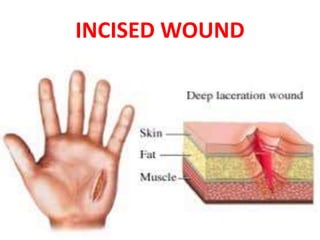
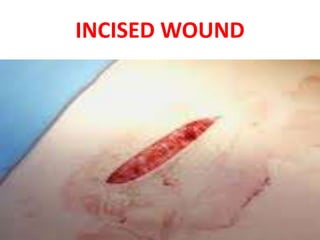
INCISED WOUND
An incised wound is a clean cut through the
tissues, caused by sharp edged weapons.
The wound is longer than it is deep.
The force is delivered over a very narrow area,
corresponding with the cutting edge of the
blade.
INCISED WOUND
INCISED WOUND
Causes
Striking the body with the edge of sharp cutting
weapon.
By drawing the weapon, against the body surface.
By using the weapon like a saw in which case there
may be more than one cut in the skin at the
beginning of the wound which merge into one at
the end.
Characters
1. Margins
The edges are clean cut, well defined and usually
everted.
The edges may be inverted, if a thin layer of
muscle fibres is adherent to the skin as in the
scrotum.
Contusion and abrasion are absent.
2. Width
Width is greater than the thickness of the edge
of the blade, due to retraction of the divided
tissues.
3.Length
The length is greater than its width and depth,
and has no relation to the cutting edge of the
weapon .
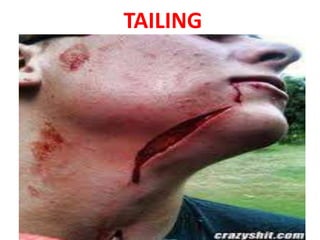
There may be superficial tail at the termination
known as tailing of the wound which indicates the
direction.
4. Shape
It is spindle shaped due to greater retraction of the
edges in the centre.
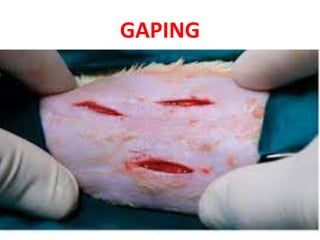
Gaping is greater if the underlying muscle fibres
have been cut transversely or obliquely and less if
cut longitudinally.
The wound may take zig- zag course if the skin is
loosely attached as in axillary folds because the skin
is pushed in front of the blade before it is cut.
If blade is curved, the edge will be crescentic.
If surface is convex such as occiput or buttocks,
then also shape will be crescentic.
GAPING
5.Haemorrhage
More bleeding due to cutting of vessels.
6.Direction
Incised wound are deeper at the beginning,
known as head of the wound .
Towards the end of the cut the wound
becomes increasingly shallow, known as the
tailing of the wound. It indicates the direction.
TAILING
7. Bevelling cut
• If the blade of weapon enters obliquely , the
wound will have a bevelled margin on one side
with undermining on the other side, indicating the
direction from which the blade entered.
• Bevelling can be produced by sharp weapon only.
• It is usually homicidal and indicates the relative
position of assailant and victim.
Age of the Incised Wound
Fresh: Haematoma formation.
12 hours: Edges are red swollen and adherent
with blood and lymph; leucocytic infiltration.
24 hours: A continuous layer of endothelial
covers the surface, overlying this a crust or scab
of dried clot is seen.
Histopathology
Few minutes: Dilatation of capillaries and
margination and emigration of the neutrophils.
12 hours: Reactive changes in fibroblasts,
monocyte appear in exudate, leucocyte
infiltration.
15 hours: Monocyte undergo mitotic division
24 hours: Epithelium begins to grow at the edges.
72 hours: Neutrophils are replaced by
macrophages. Granulation tissue formed.
4-5 days: New fibrils are formed.
One week: Soft, reddish scar in small wounds.
In healing by secondary intension, inflammatory
reaction is more intense and much large amount
of granulation tissue is formed.
Wound produced by glass are lacerated but
resemble incised and stab wound.
WOUNDS BY GLASS
Medico-legal importance
They indicates the nature of the weapon.
Age of the injury can be determined.
They give idea about the direction of the force.
Position and character of wound may indicate
mode of production i.e. suicide, accident,
homicide.
Circumstances
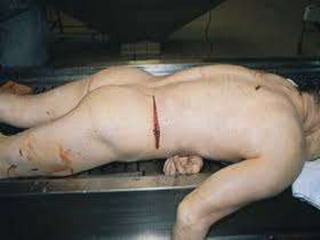
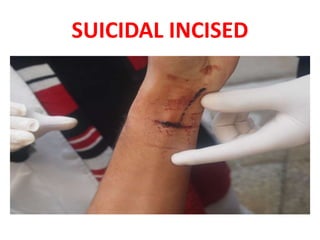
1.Suicide
They are multiple and parallel.
They are uniform in depth and direction.
They are relatively minor.
The fatal wound are present on accessible areas .
Hesitation cuts or tentative cuts or trial wounds:
they are multiple small, and superficial involving
only the skin and are seen at the beginning of
the incised wound.
SUICIDAL INCISED
2. Homicidal
 They are usually multiple and can occur in any
region of the body. Wounds on the chest are
present over the wide area and are more
horizontal.
The direction is from below upwards.
Wounds on the inaccessible parts are usually
homicidal.
Wounds on nose and genitals are usually
homicidal.
3. Accidental
Common in the home or at the workshop and of
minor nature.
They may be produced by knife, razor, etc.
In decomposed body it is difficult to differentiate
between laceration and incised wounds.
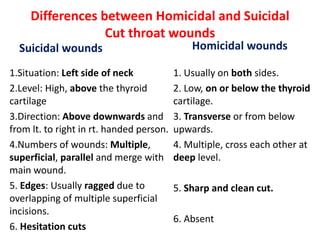
Differences between Homicidal and Suicidal
Cut throat wounds
Suicidal wounds
1.Situation: Left side of neck
2.Level: High, above the thyroid
cartilage
3.Direction: Above downwards and
from lt. to right in rt. handed person.
4.Numbers of wounds: Multiple,
superficial, parallel and merge with
main wound.
5. Edges: Usually ragged due to
overlapping of multiple superficial
incisions.
6. Hesitation cuts
Homicidal wounds
1. Usually on both sides.
2. Low, on or below the thyroid
cartilage.
3. Transverse or from below
upwards.
4. Multiple, cross each other at
deep level.
5. Sharp and clean cut.
6. Absent
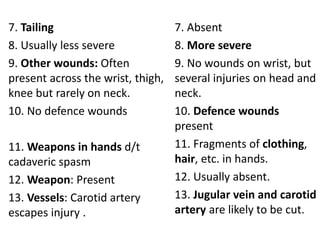
7. Tailing
8. Usually less severe
9. Other wounds: Often
present across the wrist, thigh,
knee but rarely on neck.
10. No defence wounds
11. Weapons in hands d/t
cadaveric spasm
12. Weapon: Present
13. Vessels: Carotid artery
escapes injury .
7. Absent
8. More severe
9. No wounds on wrist, but
several injuries on head and
neck.
10. Defence wounds
present
11. Fragments of clothing,
hair, etc. in hands.
12. Usually absent.
13. Jugular vein and carotid
artery are likely to be cut.
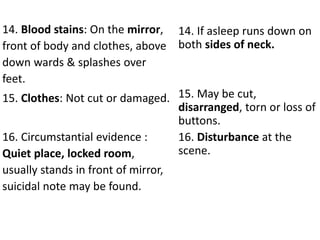
14. Blood stains: On the mirror,
front of body and clothes, above
down wards & splashes over
feet.
15. Clothes: Not cut or damaged.
16. Circumstantial evidence :
Quiet place, locked room,
usually stands in front of mirror,
suicidal note may be found.
14. If asleep runs down on
both sides of neck.
15. May be cut,
disarranged, torn or loss of
buttons.
16. Disturbance at the
scene.
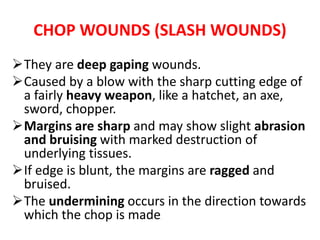
CHOP WOUNDS (SLASH WOUNDS)
They are deep gaping wounds.
Caused by a blow with the sharp cutting edge of
a fairly heavy weapon, like a hatchet, an axe,
sword, chopper.
Margins are sharp and may show slight abrasion
and bruising with marked destruction of
underlying tissues.
If edge is blunt, the margins are ragged and
bruised.
The undermining occurs in the direction towards
which the chop is made.
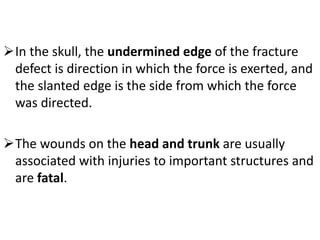
In the skull, the undermined edge of the fracture
defect is direction in which the force is exerted, and
the slanted edge is the side from which the force
was directed.
The wounds on the head and trunk are usually
associated with injuries to important structures and
are fatal.
Most of these injuries are homicidal
Accidental injuries can be caused by power
fans, airplane propellers.
Suicidal chop wound are rare.
Questions on incised wound
Question 1.
Depth of incised wound is greatest at the point of:
• Entry of weapon.
• Exit of weapon
• Away from weapon
• Any of the above
Question 2.
One of the following feature of incised wound
indicates direction of wound :
• Edge
• Tailing.
• Gapping
• Bevelling
Question 3.
Hesitation cuts are characterised by :
• Direction of wound
• Caused by small weapon
• Present over accessible part
• All of the above.
Question 4.
Incised wound over genitalia are mostly :
• Suicidal
• Homicidal.
• Accidental
• PM artefact
Question 5.
Incised looking wound are found over all except :
• Abdomen
• Head.
• Shin
• Face
Question 6.
Tentative cuts are features of :
• Homicidal
• Suicidal.
• Accidental
• Grievous injury
Question 7.
A curved weapon like sickle can produced :
a. Stab wound
b. Incised wound
c. Both a & b
d. Lacerated wound
Question 8.
A clean incised wound heals by :
• Primary intention.
• Secondary intention
• Excessive scarring
• No scarring
Question 9.
Incised looking wound is in fact :
• An incised wound
• An lacerated wound.
• A firearm injury
• Not a wound
Question 10.
Maximum bleeding is seen in :
• Lacerated wound
• Incised wound.
• Abrasion
• Bruise

mi_incised_wound.ppt

  • 1.
  • 2.
    INCISED WOUND An incisedwound is a clean cut through the tissues, caused by sharp edged weapons. The wound is longer than it is deep. The force is delivered over a very narrow area, corresponding with the cutting edge of the blade.
  • 3.
  • 4.
  • 5.
    Causes Striking the bodywith the edge of sharp cutting weapon. By drawing the weapon, against the body surface. By using the weapon like a saw in which case there may be more than one cut in the skin at the beginning of the wound which merge into one at the end.
  • 6.
    Characters 1. Margins The edgesare clean cut, well defined and usually everted. The edges may be inverted, if a thin layer of muscle fibres is adherent to the skin as in the scrotum. Contusion and abrasion are absent.
  • 8.
    2. Width Width isgreater than the thickness of the edge of the blade, due to retraction of the divided tissues. 3.Length The length is greater than its width and depth, and has no relation to the cutting edge of the weapon . There may be superficial tail at the termination known as tailing of the wound which indicates the direction.
  • 9.
    4. Shape It isspindle shaped due to greater retraction of the edges in the centre. Gaping is greater if the underlying muscle fibres have been cut transversely or obliquely and less if cut longitudinally. The wound may take zig- zag course if the skin is loosely attached as in axillary folds because the skin is pushed in front of the blade before it is cut. If blade is curved, the edge will be crescentic. If surface is convex such as occiput or buttocks, then also shape will be crescentic.
  • 10.
  • 11.
    5.Haemorrhage More bleeding dueto cutting of vessels. 6.Direction Incised wound are deeper at the beginning, known as head of the wound . Towards the end of the cut the wound becomes increasingly shallow, known as the tailing of the wound. It indicates the direction.
  • 12.
  • 13.
    7. Bevelling cut •If the blade of weapon enters obliquely , the wound will have a bevelled margin on one side with undermining on the other side, indicating the direction from which the blade entered. • Bevelling can be produced by sharp weapon only. • It is usually homicidal and indicates the relative position of assailant and victim.
  • 14.
    Age of theIncised Wound Fresh: Haematoma formation. 12 hours: Edges are red swollen and adherent with blood and lymph; leucocytic infiltration. 24 hours: A continuous layer of endothelial covers the surface, overlying this a crust or scab of dried clot is seen.
  • 15.
    Histopathology Few minutes: Dilatationof capillaries and margination and emigration of the neutrophils. 12 hours: Reactive changes in fibroblasts, monocyte appear in exudate, leucocyte infiltration. 15 hours: Monocyte undergo mitotic division 24 hours: Epithelium begins to grow at the edges.
  • 16.
    72 hours: Neutrophilsare replaced by macrophages. Granulation tissue formed. 4-5 days: New fibrils are formed. One week: Soft, reddish scar in small wounds. In healing by secondary intension, inflammatory reaction is more intense and much large amount of granulation tissue is formed.
  • 17.
    Wound produced byglass are lacerated but resemble incised and stab wound. WOUNDS BY GLASS
  • 18.
    Medico-legal importance They indicatesthe nature of the weapon. Age of the injury can be determined. They give idea about the direction of the force. Position and character of wound may indicate mode of production i.e. suicide, accident, homicide.
  • 19.
    Circumstances 1.Suicide They are multipleand parallel. They are uniform in depth and direction. They are relatively minor. The fatal wound are present on accessible areas . Hesitation cuts or tentative cuts or trial wounds: they are multiple small, and superficial involving only the skin and are seen at the beginning of the incised wound.
  • 20.
  • 21.
    2. Homicidal  Theyare usually multiple and can occur in any region of the body. Wounds on the chest are present over the wide area and are more horizontal. The direction is from below upwards. Wounds on the inaccessible parts are usually homicidal. Wounds on nose and genitals are usually homicidal.
  • 22.
    3. Accidental Common inthe home or at the workshop and of minor nature. They may be produced by knife, razor, etc. In decomposed body it is difficult to differentiate between laceration and incised wounds.
  • 23.
    Differences between Homicidaland Suicidal Cut throat wounds Suicidal wounds 1.Situation: Left side of neck 2.Level: High, above the thyroid cartilage 3.Direction: Above downwards and from lt. to right in rt. handed person. 4.Numbers of wounds: Multiple, superficial, parallel and merge with main wound. 5. Edges: Usually ragged due to overlapping of multiple superficial incisions. 6. Hesitation cuts Homicidal wounds 1. Usually on both sides. 2. Low, on or below the thyroid cartilage. 3. Transverse or from below upwards. 4. Multiple, cross each other at deep level. 5. Sharp and clean cut. 6. Absent
  • 24.
    7. Tailing 8. Usuallyless severe 9. Other wounds: Often present across the wrist, thigh, knee but rarely on neck. 10. No defence wounds 11. Weapons in hands d/t cadaveric spasm 12. Weapon: Present 13. Vessels: Carotid artery escapes injury . 7. Absent 8. More severe 9. No wounds on wrist, but several injuries on head and neck. 10. Defence wounds present 11. Fragments of clothing, hair, etc. in hands. 12. Usually absent. 13. Jugular vein and carotid artery are likely to be cut.
  • 25.
    14. Blood stains:On the mirror, front of body and clothes, above down wards & splashes over feet. 15. Clothes: Not cut or damaged. 16. Circumstantial evidence : Quiet place, locked room, usually stands in front of mirror, suicidal note may be found. 14. If asleep runs down on both sides of neck. 15. May be cut, disarranged, torn or loss of buttons. 16. Disturbance at the scene.
  • 26.
    CHOP WOUNDS (SLASHWOUNDS) They are deep gaping wounds. Caused by a blow with the sharp cutting edge of a fairly heavy weapon, like a hatchet, an axe, sword, chopper. Margins are sharp and may show slight abrasion and bruising with marked destruction of underlying tissues. If edge is blunt, the margins are ragged and bruised. The undermining occurs in the direction towards which the chop is made.
  • 27.
    In the skull,the undermined edge of the fracture defect is direction in which the force is exerted, and the slanted edge is the side from which the force was directed. The wounds on the head and trunk are usually associated with injuries to important structures and are fatal.
  • 28.
    Most of theseinjuries are homicidal Accidental injuries can be caused by power fans, airplane propellers. Suicidal chop wound are rare.
  • 29.
    Questions on incisedwound Question 1. Depth of incised wound is greatest at the point of: • Entry of weapon. • Exit of weapon • Away from weapon • Any of the above
  • 30.
    Question 2. One ofthe following feature of incised wound indicates direction of wound : • Edge • Tailing. • Gapping • Bevelling
  • 31.
    Question 3. Hesitation cutsare characterised by : • Direction of wound • Caused by small weapon • Present over accessible part • All of the above.
  • 32.
    Question 4. Incised woundover genitalia are mostly : • Suicidal • Homicidal. • Accidental • PM artefact
  • 33.
    Question 5. Incised lookingwound are found over all except : • Abdomen • Head. • Shin • Face
  • 34.
    Question 6. Tentative cutsare features of : • Homicidal • Suicidal. • Accidental • Grievous injury
  • 35.
    Question 7. A curvedweapon like sickle can produced : a. Stab wound b. Incised wound c. Both a & b d. Lacerated wound
  • 36.
    Question 8. A cleanincised wound heals by : • Primary intention. • Secondary intention • Excessive scarring • No scarring
  • 37.
    Question 9. Incised lookingwound is in fact : • An incised wound • An lacerated wound. • A firearm injury • Not a wound
  • 38.
    Question 10. Maximum bleedingis seen in : • Lacerated wound • Incised wound. • Abrasion • Bruise