SixSigma
BY – PPT4U
SUB - MSA
SixSigma
MEASUREMENT SYSTEM
SixSigma
Definition :-
To Analyze the effect of errors(factors) involved in
measurement.
 Measurement :- Measurement is a process by which
we can assign a numerical value to characteristics of a
product.
 System:- System is the collection of Operations,
procedures, Gauge and equipment's to assign a
number to the characteristics being measured.
 Analysis:- Analysis is a study of system that effect the
process.
SixSigma
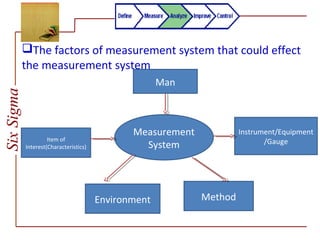
The factors of measurement system that could effect
the measurement system
Measurement
System
Man
MethodEnvironment
Instrument/Equipment
/GaugeItem of
Interest(Characteristics)
SixSigma
1. Item of Interest :-Product which is being measured for a characteristics
(Mass, Volume, Temp, Length, Width etc.)
2.Man :- The person who will check/ verify the product called Appraiser
in this study.
3.Instruments :-The device by which we assign a numerical value for a
product characteristics.
4. Method :- The procedure by which we check the product
characteristics , Handling of Instrument, Specific place where Verification
will be Done.
SixSigma
5. Environment :- The conditions in which we conduct the
measurement process may be :-
a) Temperature & Humidity level of environment where
measurement is being conduct.
b) Lightening
c) Vibrations
SixSigma
The parameters of the measurement process
are
Input : Component to be
measured
Process factors : Equipment, Inspector
etc.
Output : Measured value
SixSigma
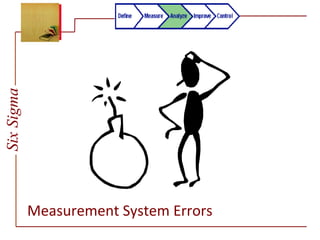
Measurement System Errors
SixSigma
Repeatability
Reproducibility
SixSigma
REPEATABILITY
The variation in measurements obtained
With one measuring instrument
When used several times
By one appraiser
While measuring the identical characteristics
On the same part
SixSigma
REPRODUCIBILITY
 The variation in the average of the measurements made
 By different appraisers
 Using the same measuring equipment.
 While measuring the identical characteristics
 On the same part
SixSigma
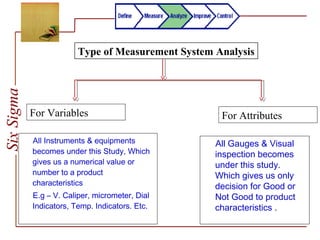
All Instruments & equipments
becomes under this Study, Which
gives us a numerical value or
number to a product
characteristics
E.g – V. Caliper, micrometer, Dial
Indicators, Temp. Indicators. Etc.
Type of Measurement System Analysis
All Gauges & Visual
inspection becomes
under this study.
Which gives us only
decision for Good or
Not Good to product
characteristics .
For AttributesFor Variables
SixSigma
GAGE REPEATIBILTY AND
REPRODUCIBILITY STUDY- (GAGE R & R
STUDY)
SixSigma
Appraisers should be selected from those who normally
operate the instrument.
Sample parts must be selected from the process and they
should represent its entire operating range.
Instrument must have a discrimination (resolution) that
allows at least one-tenth of the expected process variation of
the characteristic.
The measurement method is well defined.
Measurements should be made in a random order.
SixSigma
Conducting the R & R Study
Select ten parts from the process at random, preferably
one part from every days production.
Identify them with a serial number that cannot be
observed by the appraisers.
Select tow or three appraisers, who normally operate the
measuring system.
Measure the parts randomly so that all the appraisers
measure all the parts for two or three times (trial).
Record the observations
SixSigma
1.   Select two or three appraisers who use the measurement system.
2.     Obtain a sample of 10 parts that represent actual or expected range of
process variation.
3.     Number parts 1 through 10 so that numbers are not visible to appraisers.
4.     Identify and Mark the place where measurement to be taken to eliminate
within part variation
5.     Measure 10 parts in random order by appraiser A, with an observer
recording results.
6.     Repeat step 5 with other appraisers conceal other appraisers readings.
7.     Repeat step 5 and 6 using a different random order of measurement.
8.  Calculate the average and ranges for all readings for each appraiser.
9  Using attached GR&R report, enter part averages and range averages.
10.   Calculate repeatability - equipment variation.
11.   Calculate reproducibility - appraiser variation.
12.   Calculate GR&R and convert to percentage.
13.   Calculate part variation and convert to percentage.
14.   Calculate total variation.
Gauge R&R Study Steps:
SixSigma
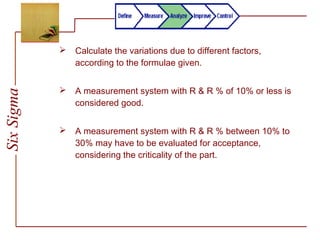
 Calculate the variations due to different factors,
according to the formulae given.
 A measurement system with R & R % of 10% or less is
considered good.
 A measurement system with R & R % between 10% to
30% may have to be evaluated for acceptance,
considering the criticality of the part.
SixSigma
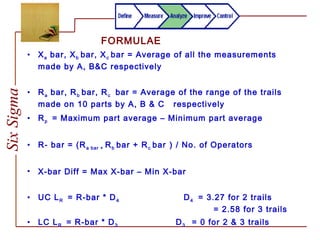
FORMULAE
• Xa bar, Xb bar, Xc bar = Average of all the measurements
made by A, B&C respectively
• Ra bar, Rb bar, Rc bar = Average of the range of the trails
made on 10 parts by A, B & C respectively
• Rp = Maximum part average – Minimum part average
• R- bar = (Ra bar + Rb bar + Rc bar ) / No. of Operators
• X-bar Diff = Max X-bar – Min X-bar
• UC LR = R-bar * D4 D4 = 3.27 for 2 trails
= 2.58 for 3 trails
• LC LR = R-bar * D3 D3 = 0 for 2 & 3 trails
SixSigma
 Homogenize the data for Range
 Calculate R-bar, X-bar Diff and Rp only after
homogenizing
 Equipment Variation (EV) = R-bar * K1
(K1 = 4.56 for 2 trails
= 3.05 for 3 trails)
 Appraiser Variation (AV)
= SQRT { (X-bar Diff * K2 )2
– [ EV2
/ (nr)]}
(K2 = 3.65 for 2 operators
= 2.70 for 3 operators)
SixSigma
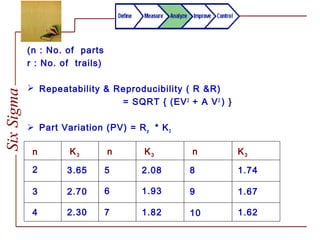
(n : No. of parts
r : No. of trails)
 Repeatability & Reproducibility ( R &R)
= SQRT { (EV2
+ A V2
) }
 Part Variation (PV) = Rp * K3
n K3 n K3 n K3
2
3
4
3.65
2.70
2.30
5
6
7
2.08
1.93
1.82
8
9
10
1.74
1.67
1.62
SixSigma
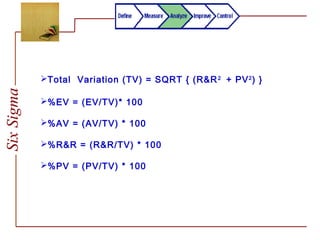
Total Variation (TV) = SQRT { (R&R2
+ PV2
) }
%EV = (EV/TV)* 100
%AV = (AV/TV) * 100
%R&R = (R&R/TV) * 100
%PV = (PV/TV) * 100
SixSigma
11.0 Attribute Gage Study (Alternate) Method
 
a. Method of conducting Study
1. Obtain 50 components which are 50% OK, 25% marginally ok and 25% marginally 
not    OK.
2. Identify the components with numbers and note master readings in the Attribute 
Study   data sheet.
3. Select the appraisers for giving the decision (A,B & C)
4. Using the appraiser ‘A’, carryout the trial ‘A1’ and carryout the same with appraiser 
‘B’ & ‘C’ for the trials ‘B1’ & ‘C1’
5.  Repeat the step 4 for the trials A2,A3,B2,B3,C2&C3 for the appraiser’s A,B &
SixSigma

Measurement system analysis

  • 1.
  • 2.
  • 3.
    SixSigma Definition :- To Analyzethe effect of errors(factors) involved in measurement.  Measurement :- Measurement is a process by which we can assign a numerical value to characteristics of a product.  System:- System is the collection of Operations, procedures, Gauge and equipment's to assign a number to the characteristics being measured.  Analysis:- Analysis is a study of system that effect the process.
  • 4.
    SixSigma The factors ofmeasurement system that could effect the measurement system Measurement System Man MethodEnvironment Instrument/Equipment /GaugeItem of Interest(Characteristics)
  • 5.
    SixSigma 1. Item ofInterest :-Product which is being measured for a characteristics (Mass, Volume, Temp, Length, Width etc.) 2.Man :- The person who will check/ verify the product called Appraiser in this study. 3.Instruments :-The device by which we assign a numerical value for a product characteristics. 4. Method :- The procedure by which we check the product characteristics , Handling of Instrument, Specific place where Verification will be Done.
  • 6.
    SixSigma 5. Environment :-The conditions in which we conduct the measurement process may be :- a) Temperature & Humidity level of environment where measurement is being conduct. b) Lightening c) Vibrations
  • 7.
    SixSigma The parameters ofthe measurement process are Input : Component to be measured Process factors : Equipment, Inspector etc. Output : Measured value
  • 8.
  • 9.
  • 10.
    SixSigma REPEATABILITY The variation inmeasurements obtained With one measuring instrument When used several times By one appraiser While measuring the identical characteristics On the same part
  • 11.
    SixSigma REPRODUCIBILITY  The variationin the average of the measurements made  By different appraisers  Using the same measuring equipment.  While measuring the identical characteristics  On the same part
  • 12.
    SixSigma All Instruments &equipments becomes under this Study, Which gives us a numerical value or number to a product characteristics E.g – V. Caliper, micrometer, Dial Indicators, Temp. Indicators. Etc. Type of Measurement System Analysis All Gauges & Visual inspection becomes under this study. Which gives us only decision for Good or Not Good to product characteristics . For AttributesFor Variables
  • 13.
  • 14.
    SixSigma Appraisers should beselected from those who normally operate the instrument. Sample parts must be selected from the process and they should represent its entire operating range. Instrument must have a discrimination (resolution) that allows at least one-tenth of the expected process variation of the characteristic. The measurement method is well defined. Measurements should be made in a random order.
  • 15.
    SixSigma Conducting the R& R Study Select ten parts from the process at random, preferably one part from every days production. Identify them with a serial number that cannot be observed by the appraisers. Select tow or three appraisers, who normally operate the measuring system. Measure the parts randomly so that all the appraisers measure all the parts for two or three times (trial). Record the observations
  • 16.
    SixSigma 1.   Select twoor three appraisers who use the measurement system. 2.     Obtain a sample of 10 parts that represent actual or expected range of process variation. 3.     Number parts 1 through 10 so that numbers are not visible to appraisers. 4.     Identify and Mark the place where measurement to be taken to eliminate within part variation 5.     Measure 10 parts in random order by appraiser A, with an observer recording results. 6.     Repeat step 5 with other appraisers conceal other appraisers readings. 7.     Repeat step 5 and 6 using a different random order of measurement. 8.  Calculate the average and ranges for all readings for each appraiser. 9  Using attached GR&R report, enter part averages and range averages. 10.   Calculate repeatability - equipment variation. 11.   Calculate reproducibility - appraiser variation. 12.   Calculate GR&R and convert to percentage. 13.   Calculate part variation and convert to percentage. 14.   Calculate total variation. Gauge R&R Study Steps:
  • 17.
    SixSigma  Calculate thevariations due to different factors, according to the formulae given.  A measurement system with R & R % of 10% or less is considered good.  A measurement system with R & R % between 10% to 30% may have to be evaluated for acceptance, considering the criticality of the part.
  • 18.
    SixSigma FORMULAE • Xa bar,Xb bar, Xc bar = Average of all the measurements made by A, B&C respectively • Ra bar, Rb bar, Rc bar = Average of the range of the trails made on 10 parts by A, B & C respectively • Rp = Maximum part average – Minimum part average • R- bar = (Ra bar + Rb bar + Rc bar ) / No. of Operators • X-bar Diff = Max X-bar – Min X-bar • UC LR = R-bar * D4 D4 = 3.27 for 2 trails = 2.58 for 3 trails • LC LR = R-bar * D3 D3 = 0 for 2 & 3 trails
  • 19.
    SixSigma  Homogenize thedata for Range  Calculate R-bar, X-bar Diff and Rp only after homogenizing  Equipment Variation (EV) = R-bar * K1 (K1 = 4.56 for 2 trails = 3.05 for 3 trails)  Appraiser Variation (AV) = SQRT { (X-bar Diff * K2 )2 – [ EV2 / (nr)]} (K2 = 3.65 for 2 operators = 2.70 for 3 operators)
  • 20.
    SixSigma (n : No.of parts r : No. of trails)  Repeatability & Reproducibility ( R &R) = SQRT { (EV2 + A V2 ) }  Part Variation (PV) = Rp * K3 n K3 n K3 n K3 2 3 4 3.65 2.70 2.30 5 6 7 2.08 1.93 1.82 8 9 10 1.74 1.67 1.62
  • 21.
    SixSigma Total Variation (TV)= SQRT { (R&R2 + PV2 ) } %EV = (EV/TV)* 100 %AV = (AV/TV) * 100 %R&R = (R&R/TV) * 100 %PV = (PV/TV) * 100
  • 22.
    SixSigma 11.0 Attribute GageStudy (Alternate) Method   a. Method of conducting Study 1. Obtain 50 components which are 50% OK, 25% marginally ok and 25% marginally  not    OK. 2. Identify the components with numbers and note master readings in the Attribute  Study   data sheet. 3. Select the appraisers for giving the decision (A,B & C) 4. Using the appraiser ‘A’, carryout the trial ‘A1’ and carryout the same with appraiser  ‘B’ & ‘C’ for the trials ‘B1’ & ‘C1’ 5.  Repeat the step 4 for the trials A2,A3,B2,B3,C2&C3 for the appraiser’s A,B &
  • 23.