FAILURE MODE AND EFFECTS ANALYSIS  (FMEA)Non-commercial use only without written permission.  Any unauthorized use is prohibited.Author – Jason R Bower
Knowledge BaseRisk AssessmentWHAT IS FMEA?IT’S CRITICAL!!!!!Quality ControlContinuous Improvement
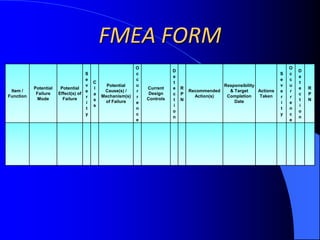
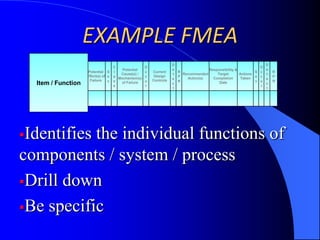
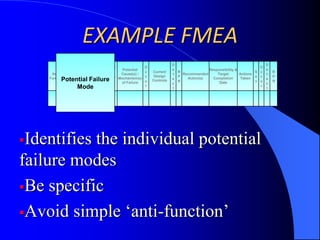
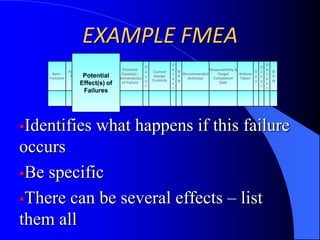
WHAT IS FMEA?Analysis of potential failuresClassification of failures by severity of the effects, how often they occur and how easily can they be detected
Definition of controls to prevent failures
What do we need to do next?FMEA HISTORYOriginally developed in the 1940’s for the US military
Utilized in the Apollo space program to minimize failures of expensive prototypes
Ford formally brought it into the automotive industry in the 1970’s after the Pinto “thermal events”FMEA HISTORYNow adopted as part of APQP (Advanced Product Quality Planning)
Required elements of PPAP (Production Part Approval Process)
Design Element #4
Process Element #6
Integrated into QS-9000 & ISO/TS 16949BENEFITS OF FMEAReduces costs
Field failure
Scrap
Prioritizes risk
Engineering / manufacturing knowledge baseBENEFITS OF FMEAPrevents failures before they happen
Identifies critical aspects of designs and processes
Identifies controls needed
Identifies where to focus
Essential to Continuous Improvement
Essential to QualityTYPES OF FMEASDesign (DFMEA)
Process (PFMEA)
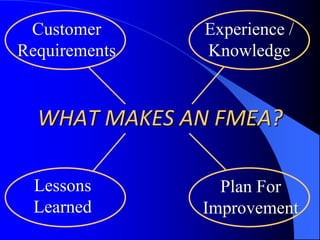
Other less common (Concept, System, Service, etc.)Customer RequirementsExperience / KnowledgeWHAT MAKES AN FMEA?Lessons LearnedPlan For Improvement
WHERE IT ALL FITS
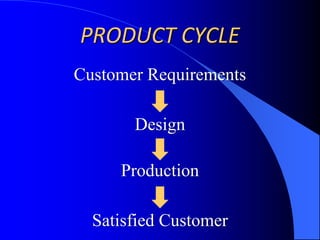
PRODUCT CYCLECustomer RequirementsDesignProductionSatisfied Customer
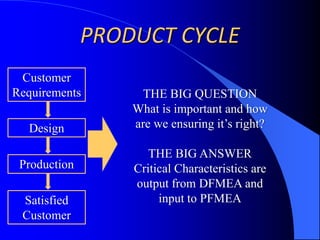
PRODUCT CYCLECustomer RequirementsTHE BIG QUESTIONWhat is important and how are we ensuring it’s right?THE BIG ANSWERCritical Characteristics are output from DFMEA and input to PFMEADesignProductionSatisfied Customer
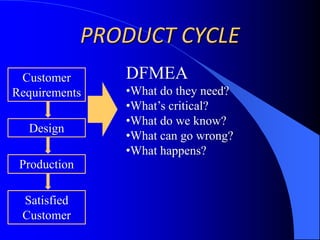
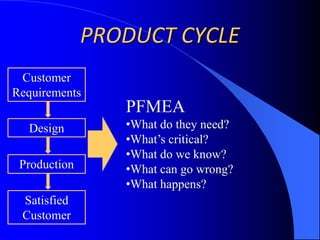
PRODUCT CYCLEDFMEAWhat do they need?
What’s critical?
What do we know?
What can go wrong?
What happens?Customer RequirementsDesignProductionSatisfied Customer
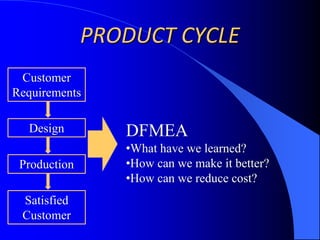
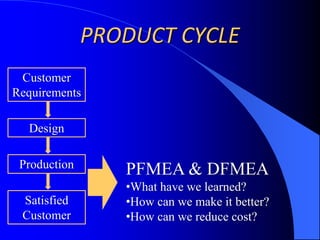
PRODUCT CYCLECustomer RequirementsDFMEAWhat have we learned?
How can we make it better?

FMEA Introduction.ppt