Measurement System Analysis   (MSA)
What is MSA ? MSA implies assessing the existing measurement system for any measurement errors in the way various metrics in a process are measured. Eg: Quality, OCR, Compliance, Customer Satisfaction and so on.. Measurement value = True Value +  Measurement Error
What are the causes of Measurement Error ? Accuracy:   Difference between the average of observed values and standard values Linearity:   Consistency of the measurement system across its entire range Repeatability:   Variation observed if the same appraiser is asked to measure repeatedly the same unit with the same measuring equipment / methodology Reproducibility:   Variation observed if two or more appraisers measure the same unit with same measuring equipment / methodology Stability:   Variation which occurs with time.  It is observed if the same appraiser measures the same unit with the same measuring equipment / methodology over an extended period
Why MSA ? MSA helps to highlight both accuracy (target focused) and precision (variation focused) of the measurement gage / system MSA gives better understanding of the process MSA assesses and corrects reasons for variations displayed by the Quality Appraisers while measuring Quality of the process MSA helps in comparing the performance of one Appraiser against another MSA helps in taking immediate corrective action against the faultering QAs
How to conduct MSA ? 1. We will use  Minitab  as a tool for conducting MSA   2.  MSA can be done on: Continuous data:  Eg: Percentage score, Actual time taken, actual cost, dimension, % completes, number of errors, etc Discrete Data:   Eg: Pass / Fail, Good / Bad, Present / Absent, In / out etc,.. 3.  Gage:   For Continuous data - Gage R&R is conducted and for Discrete data – Attribute R&R is conducted
Illustration: Assume we want to measure the variation of Quality scores given by the QAs in the process, the variation within the QAs themselves, the outliers within the QAs and whether the measurement system is accurate.  The upper process tolerance is 100% and lower process tolerance is 0%.  Confidence Interval is 99% Find the above results using MSA through Minitab?
Step 1:   3 QAs are given 3 cases each to analyze and mark the case on Quality.  These 3 cases are the same and assessed twice by Appraiser 1, Appraiser 2 and Appraiser 3  .  The cases are scored in isolation and without discussion amongst the QAs Step 2: Enter the case score recorded in Minitab worksheet as attached herein: Step 3:  Identify Gage to be used – Gage R&R as continuous data
Step 4:   Go to Stat – Quality Tools – Gage Study – Gage R&R study (crossed) Step 5:  Enter the data as displayed below:
Step 6:   Two windows crop up: Sessions window Charts window For this exercise attached herein are the above mentioned: Step 7:  Analyze the above and arrive at an inference
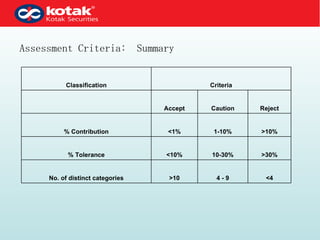
Assessment Criteria:  Summary <4 4 - 9 >10 No. of distinct categories >30% 10-30% <10% % Tolerance >10% 1-10% <1% % Contribution Reject Caution Accept   Criteria Classification
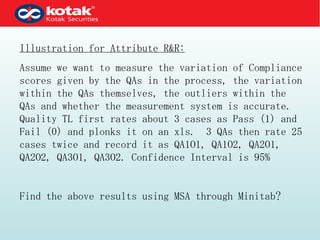
Illustration for Attribute R&R: Assume we want to measure the variation of Compliance scores given by the QAs in the process, the variation within the QAs themselves, the outliers within the QAs and whether the measurement system is accurate. Quality TL first rates about 3 cases as Pass (1) and Fail (0) and plonks it on an xls.  3 QAs then rate 25 cases twice and record it as QA1O1, QA1O2, QA2O1, QA2O2, QA3O1, QA3O2. Confidence Interval is 95% Find the above results using MSA through Minitab?
Step 1:  Record all observations and plonk the results on Minitab worksheet as below: Step 2:  Identify Gage to be used – Attribute R&R as discreet data Step 3:   Go to Stat – Quality Tools – Attribute Agreement Analysis
Step 4:  Identify Gage to be used – Attribute R&R as discreet data Step 5:   Go to Stat – Quality Tools – Attribute Agreement Analysis and enter the data as shown below:
Step 6:   Two windows crop up: Sessions window Charts window For this exercise attached herein are the above mentioned: Step 7:  Analyze the above and arrive at an inference
Do’s for MSA: Prepare MSA Checklist Collect data separately with each appraiser to avoid interference Randomize readings Use Minitab tools to analyze data Do MSA by ANOVA method as it gives more information Analyze the result based on criteria decided for acceptance Conclusions should include analyses by all applicable tools and not only by Gage / Attribute R&R study
Questions ???

Measurement system analysis

  • 1.
  • 2.
    What is MSA? MSA implies assessing the existing measurement system for any measurement errors in the way various metrics in a process are measured. Eg: Quality, OCR, Compliance, Customer Satisfaction and so on.. Measurement value = True Value + Measurement Error
  • 3.
    What are thecauses of Measurement Error ? Accuracy: Difference between the average of observed values and standard values Linearity: Consistency of the measurement system across its entire range Repeatability: Variation observed if the same appraiser is asked to measure repeatedly the same unit with the same measuring equipment / methodology Reproducibility: Variation observed if two or more appraisers measure the same unit with same measuring equipment / methodology Stability: Variation which occurs with time. It is observed if the same appraiser measures the same unit with the same measuring equipment / methodology over an extended period
  • 4.
    Why MSA ?MSA helps to highlight both accuracy (target focused) and precision (variation focused) of the measurement gage / system MSA gives better understanding of the process MSA assesses and corrects reasons for variations displayed by the Quality Appraisers while measuring Quality of the process MSA helps in comparing the performance of one Appraiser against another MSA helps in taking immediate corrective action against the faultering QAs
  • 5.
    How to conductMSA ? 1. We will use Minitab as a tool for conducting MSA 2. MSA can be done on: Continuous data: Eg: Percentage score, Actual time taken, actual cost, dimension, % completes, number of errors, etc Discrete Data: Eg: Pass / Fail, Good / Bad, Present / Absent, In / out etc,.. 3. Gage: For Continuous data - Gage R&R is conducted and for Discrete data – Attribute R&R is conducted
  • 6.
    Illustration: Assume wewant to measure the variation of Quality scores given by the QAs in the process, the variation within the QAs themselves, the outliers within the QAs and whether the measurement system is accurate. The upper process tolerance is 100% and lower process tolerance is 0%. Confidence Interval is 99% Find the above results using MSA through Minitab?
  • 7.
    Step 1: 3 QAs are given 3 cases each to analyze and mark the case on Quality. These 3 cases are the same and assessed twice by Appraiser 1, Appraiser 2 and Appraiser 3 . The cases are scored in isolation and without discussion amongst the QAs Step 2: Enter the case score recorded in Minitab worksheet as attached herein: Step 3: Identify Gage to be used – Gage R&R as continuous data
  • 8.
    Step 4: Go to Stat – Quality Tools – Gage Study – Gage R&R study (crossed) Step 5: Enter the data as displayed below:
  • 9.
    Step 6: Two windows crop up: Sessions window Charts window For this exercise attached herein are the above mentioned: Step 7: Analyze the above and arrive at an inference
  • 10.
    Assessment Criteria: Summary <4 4 - 9 >10 No. of distinct categories >30% 10-30% <10% % Tolerance >10% 1-10% <1% % Contribution Reject Caution Accept   Criteria Classification
  • 11.
    Illustration for AttributeR&R: Assume we want to measure the variation of Compliance scores given by the QAs in the process, the variation within the QAs themselves, the outliers within the QAs and whether the measurement system is accurate. Quality TL first rates about 3 cases as Pass (1) and Fail (0) and plonks it on an xls. 3 QAs then rate 25 cases twice and record it as QA1O1, QA1O2, QA2O1, QA2O2, QA3O1, QA3O2. Confidence Interval is 95% Find the above results using MSA through Minitab?
  • 12.
    Step 1: Record all observations and plonk the results on Minitab worksheet as below: Step 2: Identify Gage to be used – Attribute R&R as discreet data Step 3: Go to Stat – Quality Tools – Attribute Agreement Analysis
  • 13.
    Step 4: Identify Gage to be used – Attribute R&R as discreet data Step 5: Go to Stat – Quality Tools – Attribute Agreement Analysis and enter the data as shown below:
  • 14.
    Step 6: Two windows crop up: Sessions window Charts window For this exercise attached herein are the above mentioned: Step 7: Analyze the above and arrive at an inference
  • 15.
    Do’s for MSA:Prepare MSA Checklist Collect data separately with each appraiser to avoid interference Randomize readings Use Minitab tools to analyze data Do MSA by ANOVA method as it gives more information Analyze the result based on criteria decided for acceptance Conclusions should include analyses by all applicable tools and not only by Gage / Attribute R&R study
  • 16.