Statistics and Probability • PRINCESS P. DIPASUPIL
• Special ScienceTeacher I
Statistics and Probability • PRINCESS P. DIPASUPIL
• Special ScienceTeacher I
Probability Distribution of a
RandomVariable
Statistics and Probability
PRINCESS P. DIPASUPIL
Special ScienceTeacher I
Statistics and Probability • PRINCESS P. DIPASUPIL
• Special ScienceTeacher I
PROBABILITY
DISTRIBUTION
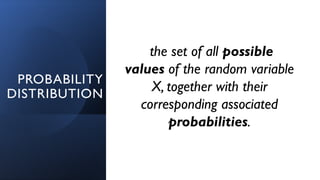
the set of all possible
values of the random variable
X, together with their
corresponding associated
probabilities.
Statistics and Probability • PRINCESS P. DIPASUPIL
• Special ScienceTeacher I
PROBABILITY
DISTRIBUTION
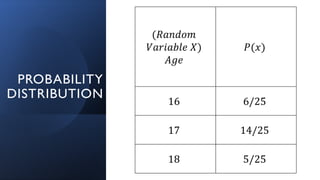
(𝑅𝑎𝑛𝑑𝑜𝑚
𝑉𝑎𝑟𝑖𝑎𝑏𝑙𝑒 𝑋)
𝐴𝑔𝑒
𝑃(𝑥)
16 6/25
17 14/25
18 5/25
Statistics and Probability • PRINCESS P. DIPASUPIL
• Special ScienceTeacher I
PROBABILITY
DISTRIBUTION
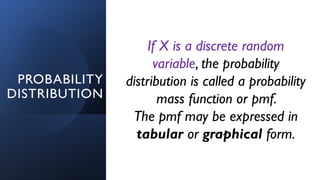
If X is a discrete random
variable, the probability
distribution is called a probability
mass function or pmf.
The pmf may be expressed in
tabular or graphical form.
Statistics and Probability • PRINCESS P. DIPASUPIL
• Special ScienceTeacher I
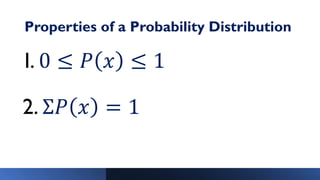
Properties of a Probability Distribution
I. 0 ≤ 𝑃 𝑥 ≤ 1
2. Σ𝑃 𝑥 = 1
Statistics and Probability • PRINCESS P. DIPASUPIL
• Special ScienceTeacher I
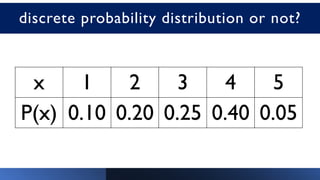
discrete probability distribution or not?
x 1 2 3 4 5
P(x) 0.10 0.20 0.25 0.40 0.05
Statistics and Probability • PRINCESS P. DIPASUPIL
• Special ScienceTeacher I
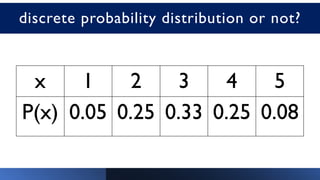
discrete probability distribution or not?
x 1 2 3 4 5
P(x) 0.05 0.25 0.33 0.25 0.08
Statistics and Probability • PRINCESS P. DIPASUPIL
• Special ScienceTeacher I
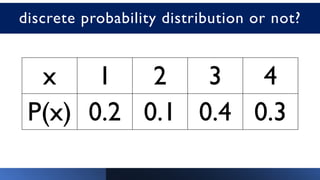
discrete probability distribution or not?
x 1 2 3 4
P(x) 0.2 0.1 0.4 0.3
Statistics and Probability • PRINCESS P. DIPASUPIL
• Special ScienceTeacher I
discrete probability distribution or not?
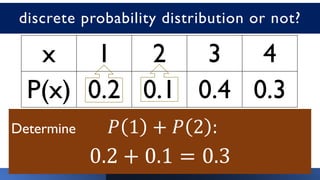
x 1 2 3 4
P(x) 0.2 0.1 0.4 0.3
Determine 𝑃 1 + 𝑃 2 :
0.2 + 0.1 = 0.3
Statistics and Probability • PRINCESS P. DIPASUPIL
• Special ScienceTeacher I
discrete probability distribution or not?
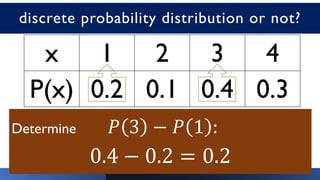
Determine 𝑃 3 − 𝑃 1 :
0.4 − 0.2 = 0.2
x 1 2 3 4
P(x) 0.2 0.1 0.4 0.3
Statistics and Probability • PRINCESS P. DIPASUPIL
• Special ScienceTeacher I
discrete probability distribution or not?
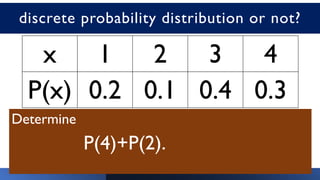
Determine
P(4)+P(2).
x 1 2 3 4
P(x) 0.2 0.1 0.4 0.3
Statistics and Probability • PRINCESS P. DIPASUPIL
• Special ScienceTeacher I
The spinner below is divided into
12 sections. Let X be the score
where the arrow will stop
(numbered as 1, 2, 3, 4, 5).
Find the probability that the
arrow will stop at 1, 2, 3, 4, and 5.
Construct the discrete
probability distribution of the
random variable X and its
corresponding histogram.
Statistics and Probability • PRINCESS P. DIPASUPIL
• Special ScienceTeacher I
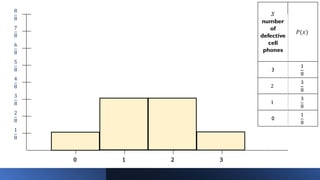
Suppose three cell phones are tested at random.We
want to find out the number of defective cell phones
that occur.Thus, to each outcome in the sample space
we shall assign a value.These are 0, 1, 2, or 3. If there is
no defective cell phone, we assign the number 0; if
there is one defective cell phone, we assign the number
1; if there are two defective cell phones, we assign the
number 2; and 3, if there are three defective cell
phones.The number of defective cell phones is a
random variable.The possible values of this random
variable are 0,1,2, and 3.
Statistics and Probability • PRINCESS P. DIPASUPIL
• Special ScienceTeacher I
Let D = defective CP
N = non-defective CP
X = (the random variable)
number of defective cell
phones
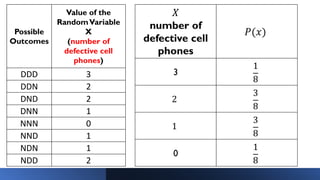
Possible
Outcomes
Value of the
RandomVariable X
(number of defective cell
phones)
DDD 3
DDN 2
DND 2
DNN 1
NNN 0
NND 1
NDN 1
NDD 2
Statistics and Probability • PRINCESS P. DIPASUPIL
• Special ScienceTeacher I
𝑋
number of
defective cell
phones
𝑃(𝑥)
3
1
8
2
3
8
1
3
8
0
1
8
Possible
Outcomes
Value of the
RandomVariable
X
(number of
defective cell
phones)
DDD 3
DDN 2
DND 2
DNN 1
NNN 0
NND 1
NDN 1
NDD 2
Statistics and Probability • PRINCESS P. DIPASUPIL
• Special ScienceTeacher I
𝑋
number
of
defective
cell
phones
𝑃(𝑥)
3
1
8
2
3
8
1
3
8
0
1
8
8
8
7
8
6
8
5
8
4
8
3
8
2
8
1
8
0 1 2 3
Statistics and Probability • PRINCESS P. DIPASUPIL
• Special ScienceTeacher I
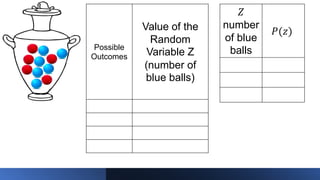
Two balls are drawn in
succession without
replacement from an urn
containing 5 red balls and 6
blue balls. Let Z be the
random variable
representing the number of
blue balls. Find the values of
the random variable Z.
Statistics and Probability • PRINCESS P. DIPASUPIL
• Special ScienceTeacher I
Possible
Outcomes
Value of the
Random
Variable Z
(number of
blue balls)
𝑍
number
of blue
balls
𝑃(𝑧)
Statistics and Probability • PRINCESS P. DIPASUPIL
• Special ScienceTeacher I
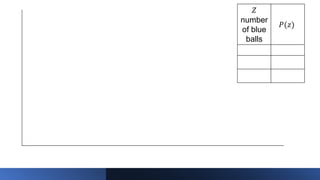
𝑍
number
of blue
balls
𝑃(𝑧)
Statistics and Probability • PRINCESS P. DIPASUPIL
• Special ScienceTeacher I
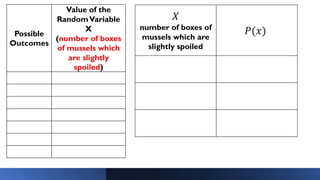
A shipment of five boxes of mussels (tahong)
contains two that are slightly spoiled. If a retailer
receives three of these boxes of mussels at
random, list the elements of the sample space
using the letters S and F for spoiled and fresh
mussels, respectively.To each sample point, assign a
value x of the random variable X representing the
number of boxes of mussels purchased by the
retailer which are slightly spoiled.
Statistics and Probability • PRINCESS P. DIPASUPIL
• Special ScienceTeacher I
𝑋
number of boxes of
mussels which are
slightly spoiled
𝑃(𝑥)
Possible
Outcomes
Value of the
RandomVariable
X
(number of boxes
of mussels which
are slightly
spoiled)
Statistics and Probability • PRINCESS P. DIPASUPIL
• Special ScienceTeacher I
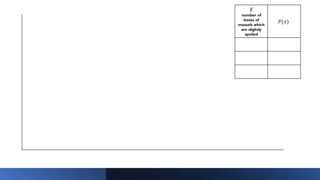
𝑋
number of
boxes of
mussels which
are slightly
spoiled
𝑃(𝑥)

Probability Distribution (Discrete Random Variable)

  • 1.
    Statistics and Probability• PRINCESS P. DIPASUPIL • Special ScienceTeacher I Statistics and Probability • PRINCESS P. DIPASUPIL • Special ScienceTeacher I Probability Distribution of a RandomVariable Statistics and Probability PRINCESS P. DIPASUPIL Special ScienceTeacher I
  • 2.
    Statistics and Probability• PRINCESS P. DIPASUPIL • Special ScienceTeacher I PROBABILITY DISTRIBUTION the set of all possible values of the random variable X, together with their corresponding associated probabilities.
  • 3.
    Statistics and Probability• PRINCESS P. DIPASUPIL • Special ScienceTeacher I PROBABILITY DISTRIBUTION (𝑅𝑎𝑛𝑑𝑜𝑚 𝑉𝑎𝑟𝑖𝑎𝑏𝑙𝑒 𝑋) 𝐴𝑔𝑒 𝑃(𝑥) 16 6/25 17 14/25 18 5/25
  • 4.
    Statistics and Probability• PRINCESS P. DIPASUPIL • Special ScienceTeacher I PROBABILITY DISTRIBUTION If X is a discrete random variable, the probability distribution is called a probability mass function or pmf. The pmf may be expressed in tabular or graphical form.
  • 5.
    Statistics and Probability• PRINCESS P. DIPASUPIL • Special ScienceTeacher I Properties of a Probability Distribution I. 0 ≤ 𝑃 𝑥 ≤ 1 2. Σ𝑃 𝑥 = 1
  • 6.
    Statistics and Probability• PRINCESS P. DIPASUPIL • Special ScienceTeacher I discrete probability distribution or not? x 1 2 3 4 5 P(x) 0.10 0.20 0.25 0.40 0.05
  • 7.
    Statistics and Probability• PRINCESS P. DIPASUPIL • Special ScienceTeacher I discrete probability distribution or not? x 1 2 3 4 5 P(x) 0.05 0.25 0.33 0.25 0.08
  • 8.
    Statistics and Probability• PRINCESS P. DIPASUPIL • Special ScienceTeacher I discrete probability distribution or not? x 1 2 3 4 P(x) 0.2 0.1 0.4 0.3
  • 9.
    Statistics and Probability• PRINCESS P. DIPASUPIL • Special ScienceTeacher I discrete probability distribution or not? x 1 2 3 4 P(x) 0.2 0.1 0.4 0.3 Determine 𝑃 1 + 𝑃 2 : 0.2 + 0.1 = 0.3
  • 10.
    Statistics and Probability• PRINCESS P. DIPASUPIL • Special ScienceTeacher I discrete probability distribution or not? Determine 𝑃 3 − 𝑃 1 : 0.4 − 0.2 = 0.2 x 1 2 3 4 P(x) 0.2 0.1 0.4 0.3
  • 11.
    Statistics and Probability• PRINCESS P. DIPASUPIL • Special ScienceTeacher I discrete probability distribution or not? Determine P(4)+P(2). x 1 2 3 4 P(x) 0.2 0.1 0.4 0.3
  • 12.
    Statistics and Probability• PRINCESS P. DIPASUPIL • Special ScienceTeacher I The spinner below is divided into 12 sections. Let X be the score where the arrow will stop (numbered as 1, 2, 3, 4, 5). Find the probability that the arrow will stop at 1, 2, 3, 4, and 5. Construct the discrete probability distribution of the random variable X and its corresponding histogram.
  • 13.
    Statistics and Probability• PRINCESS P. DIPASUPIL • Special ScienceTeacher I Suppose three cell phones are tested at random.We want to find out the number of defective cell phones that occur.Thus, to each outcome in the sample space we shall assign a value.These are 0, 1, 2, or 3. If there is no defective cell phone, we assign the number 0; if there is one defective cell phone, we assign the number 1; if there are two defective cell phones, we assign the number 2; and 3, if there are three defective cell phones.The number of defective cell phones is a random variable.The possible values of this random variable are 0,1,2, and 3.
  • 14.
    Statistics and Probability• PRINCESS P. DIPASUPIL • Special ScienceTeacher I Let D = defective CP N = non-defective CP X = (the random variable) number of defective cell phones Possible Outcomes Value of the RandomVariable X (number of defective cell phones) DDD 3 DDN 2 DND 2 DNN 1 NNN 0 NND 1 NDN 1 NDD 2
  • 15.
    Statistics and Probability• PRINCESS P. DIPASUPIL • Special ScienceTeacher I 𝑋 number of defective cell phones 𝑃(𝑥) 3 1 8 2 3 8 1 3 8 0 1 8 Possible Outcomes Value of the RandomVariable X (number of defective cell phones) DDD 3 DDN 2 DND 2 DNN 1 NNN 0 NND 1 NDN 1 NDD 2
  • 16.
    Statistics and Probability• PRINCESS P. DIPASUPIL • Special ScienceTeacher I 𝑋 number of defective cell phones 𝑃(𝑥) 3 1 8 2 3 8 1 3 8 0 1 8 8 8 7 8 6 8 5 8 4 8 3 8 2 8 1 8 0 1 2 3
  • 17.
    Statistics and Probability• PRINCESS P. DIPASUPIL • Special ScienceTeacher I Two balls are drawn in succession without replacement from an urn containing 5 red balls and 6 blue balls. Let Z be the random variable representing the number of blue balls. Find the values of the random variable Z.
  • 18.
    Statistics and Probability• PRINCESS P. DIPASUPIL • Special ScienceTeacher I Possible Outcomes Value of the Random Variable Z (number of blue balls) 𝑍 number of blue balls 𝑃(𝑧)
  • 19.
    Statistics and Probability• PRINCESS P. DIPASUPIL • Special ScienceTeacher I 𝑍 number of blue balls 𝑃(𝑧)
  • 20.
    Statistics and Probability• PRINCESS P. DIPASUPIL • Special ScienceTeacher I A shipment of five boxes of mussels (tahong) contains two that are slightly spoiled. If a retailer receives three of these boxes of mussels at random, list the elements of the sample space using the letters S and F for spoiled and fresh mussels, respectively.To each sample point, assign a value x of the random variable X representing the number of boxes of mussels purchased by the retailer which are slightly spoiled.
  • 21.
    Statistics and Probability• PRINCESS P. DIPASUPIL • Special ScienceTeacher I 𝑋 number of boxes of mussels which are slightly spoiled 𝑃(𝑥) Possible Outcomes Value of the RandomVariable X (number of boxes of mussels which are slightly spoiled)
  • 22.
    Statistics and Probability• PRINCESS P. DIPASUPIL • Special ScienceTeacher I 𝑋 number of boxes of mussels which are slightly spoiled 𝑃(𝑥)