One-to-one
Functions
General Mathematics - Week 4
Definition
The function f is one-to-one if
for any 𝒙𝟏, 𝒙𝟐 in the domain of
f, then 𝒇 𝒙𝟏 ≠ 𝒇 𝒙𝟐 . That is,
the same y-value is never
paired with two different x-
values.
Determine whether the
given relation is a
function. If it is a
function, determine
whether it is one-to-one
or not.
Determine
whether the
given relation is
a function. If it
is a function,
determine
whether it is
one-to-one or
not.
 The relation pairing an
SSS member to his or her
SSS number.
Solution:
Each SSS member is assigned
to a unique SSS number. Thus,
the relation is a function.
Further, two different
members cannot be assigned
the same SSS number. Thus,
the function is one-to-one.
Determine
whether the
given relation is
a function. If it
is a function,
determine
whether it is
one-to-one or
not.
 The relation pairing a real
number to its square.
Solution:
Each real number has a
unique perfect square. Thus,
the relation is a function.
However, two different real
numbers such as 2 and -2 may
have the same square. Thus,
the function is not one-to-one.
Determine whether the given relation
is a function. If it is a function,
determine whether it is one-to-one or
not.
 The relation pairing an airport to
its airport code.
Each real number has a unique perfect
square. Thus, the relation is a function.
However, two different real numbers
such as 2 and -2 may have the same
square. Thus, the function is not one-
to-one.
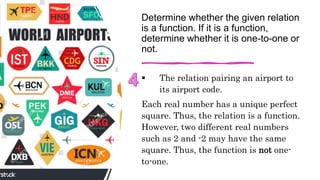
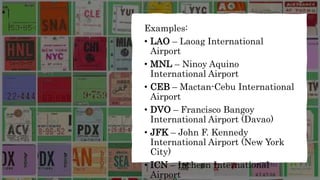
Examples:
• LAO – Laoag International
Airport
• MNL – Ninoy Aquino
International Airport
• CEB – Mactan-Cebu International
Airport
• DVO – Francisco Bangoy
International Airport (Davao)
• JFK – John F. Kennedy
International Airport (New York
City)
• ICN – Incheon International
Airport
Determine
whether the
given relation is
a function. If it
is a function,
determine
whether it is
one-to-one or
not.
 The relation pairing an
airport to its airport code.
Solution:
Since each airport has a
unique airport code, then the
relation is a function. Also,
since no two airports share the
same airport code, then the
function is one-to-one.
Determine
whether the
given relation is
a function. If it
is a function,
determine
whether it is
one-to-one or
not.
 The relation pairing an
airport to its airport code.
Solution:
Since each airport has a
unique airport code, then the
relation is a function. Also,
since no two airports share the
same airport code, then the
function is one-to-one.
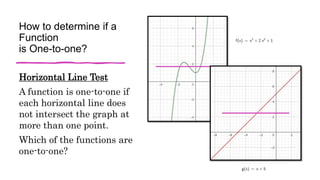
How to determine if a
Function
is One-to-one?
Horizontal Line Test
A function is one-to-one if
each horizontal line does
not intersect the graph at
more than one point.
Which of the functions are
one-to-one?
Inverse of
One-to-one
Functions
General Mathematics - Week 4
Definition
Let f be a one-to-one function
with domain A and range B. then
the inverse of f, denoted by 𝑓−1
,
is a function with domain B and
range A defined by 𝑓−1
𝑦 = 𝑥 if
and only if 𝑓 𝑥 = 𝑦 for any y in
B.
To find the inverse of a
one-to-one function:
a) Write the function in the form y =
f(x);
b) Interchange the x and y
variables;
c) Solve for y in terms of x.
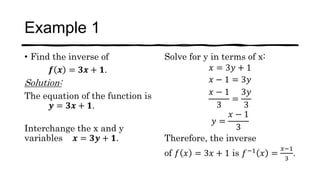
Example 1
• Find the inverse of
𝒇 𝒙 = 𝟑𝒙 + 𝟏.
Solution:
The equation of the function is
𝒚 = 𝟑𝒙 + 𝟏.
Interchange the x and y
variables 𝒙 = 𝟑𝒚 + 𝟏.
Solve for y in terms of x:
𝑥 = 3𝑦 + 1
𝑥 − 1 = 3𝑦
𝑥 − 1
3
=
3𝑦
3
𝑦 =
𝑥 − 1
3
Therefore, the inverse
of 𝑓 𝑥 = 3𝑥 + 1 is 𝑓−1
𝑥 =
𝑥−1
3
.
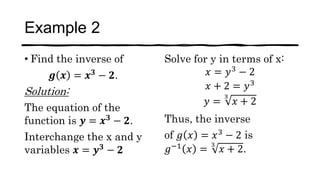
Example 2
• Find the inverse of
𝒈 𝒙 = 𝒙𝟑
− 𝟐.
Solution:
The equation of the
function is 𝒚 = 𝒙𝟑
− 𝟐.
Interchange the x and y
variables 𝒙 = 𝒚𝟑
− 𝟐
Solve for y in terms of x:
𝑥 = 𝑦3
− 2
𝑥 + 2 = 𝑦3
𝑦 =
3
𝑥 + 2
Thus, the inverse
of 𝑔 𝑥 = 𝑥3
− 2 is
𝑔−1
𝑥 =
3
𝑥 + 2.
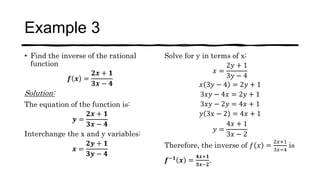
Example 3
• Find the inverse of the rational
function
𝒇 𝒙 =
𝟐𝒙 + 𝟏
𝟑𝒙 − 𝟒
Solution:
The equation of the function is:
𝒚 =
𝟐𝒙 + 𝟏
𝟑𝒙 − 𝟒
Interchange the x and y variables:
𝒙 =
𝟐𝒚 + 𝟏
𝟑𝒚 − 𝟒
Solve for y in terms of x:
𝑥 =
2𝑦 + 1
3𝑦 − 4
𝑥 3𝑦 − 4 = 2𝑦 + 1
3𝑥𝑦 − 4𝑥 = 2𝑦 + 1
3𝑥𝑦 − 2𝑦 = 4𝑥 + 1
𝑦 3𝑥 − 2 = 4𝑥 + 1
𝑦 =
4𝑥 + 1
3𝑥 − 2
Therefore, the inverse of 𝑓 𝑥 =
2𝑥+1
3𝑥−4
is
𝒇−𝟏
𝒙 =
𝟒𝒙+𝟏
𝟑𝒙−𝟐
.
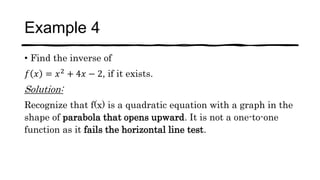
Example 4
• Find the inverse of
𝑓 𝑥 = 𝑥2 + 4𝑥 − 2, if it exists.
Solution:
Recognize that f(x) is a quadratic equation with a graph in the
shape of parabola that opens upward. It is not a one-to-one
function as it fails the horizontal line test.
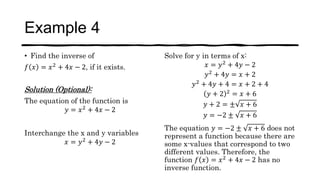
Example 4
• Find the inverse of
𝑓 𝑥 = 𝑥2 + 4𝑥 − 2, if it exists.
Solution (Optional):
The equation of the function is
𝑦 = 𝑥2
+ 4𝑥 − 2
Interchange the x and y variables
𝑥 = 𝑦2
+ 4𝑦 − 2
Solve for y in terms of x:
𝑥 = 𝑦2
+ 4𝑦 − 2
𝑦2
+ 4𝑦 = 𝑥 + 2
𝑦2 + 4𝑦 + 4 = 𝑥 + 2 + 4
𝑦 + 2 2
= 𝑥 + 6
𝑦 + 2 = ± 𝑥 + 6
𝑦 = −2 ± 𝑥 + 6
The equation 𝑦 = −2 ± 𝑥 + 6 does not
represent a function because there are
some x-values that correspond to two
different values. Therefore, the
function 𝑓 𝑥 = 𝑥2
+ 4𝑥 − 2 has no
inverse function.
Representations of
Inverse Functions
General Mathematics - Week 4
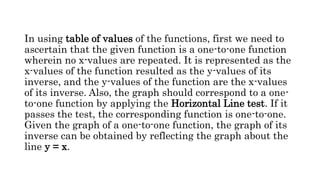
In using table of values of the functions, first we need to
ascertain that the given function is a one-to-one function
wherein no x-values are repeated. It is represented as the
x-values of the function resulted as the y-values of its
inverse, and the y-values of the function are the x-values
of its inverse. Also, the graph should correspond to a one-
to-one function by applying the Horizontal Line test. If it
passes the test, the corresponding function is one-to-one.
Given the graph of a one-to-one function, the graph of its
inverse can be obtained by reflecting the graph about the
line y = x.
Domain and
Range of Inverse
Functions
General Mathematics - Week 4
To determine the domain and range of an
inverse function:
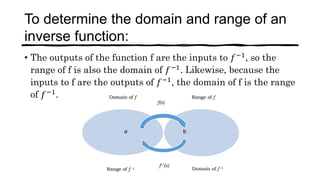
• The outputs of the function f are the inputs to 𝑓−1, so the
range of f is also the domain of 𝑓−1. Likewise, because the
inputs to f are the outputs of 𝑓−1, the domain of f is the range
of 𝑓−1.
To determine the domain and range of an
inverse function:
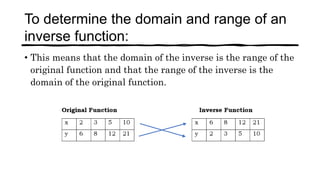
• This means that the domain of the inverse is the range of the
original function and that the range of the inverse is the
domain of the original function.
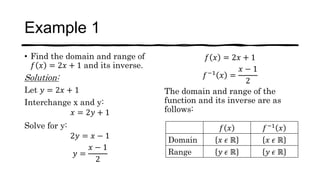
Example 1
• Find the domain and range of
𝑓 𝑥 = 2𝑥 + 1 and its inverse.
Solution:
Let 𝑦 = 2𝑥 + 1
Interchange x and y:
𝑥 = 2𝑦 + 1
Solve for y:
2𝑦 = 𝑥 − 1
𝑦 =
𝑥 − 1
2
𝑓 𝑥 = 2𝑥 + 1
𝑓−1
𝑥 =
𝑥 − 1
2
The domain and range of the
function and its inverse are as
follows:
𝑓 𝑥 𝑓−1 𝑥
Domain 𝑥 𝜖 ℝ 𝑥 𝜖 ℝ
Range 𝑦 𝜖 ℝ 𝑦 𝜖 ℝ
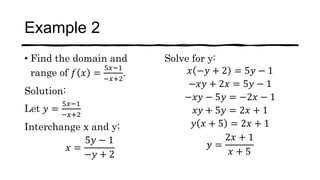
Example 2
• Find the domain and
range of 𝑓 𝑥 =
5𝑥−1
−𝑥+2
.
Solution:
Let 𝑦 =
5𝑥−1
−𝑥+2
Interchange x and y:
𝑥 =
5𝑦 − 1
−𝑦 + 2
Solve for y:
𝑥 −𝑦 + 2 = 5𝑦 − 1
−𝑥𝑦 + 2𝑥 = 5𝑦 − 1
−𝑥𝑦 − 5𝑦 = −2𝑥 − 1
𝑥𝑦 + 5𝑦 = 2𝑥 + 1
𝑦 𝑥 + 5 = 2𝑥 + 1
𝑦 =
2𝑥 + 1
𝑥 + 5
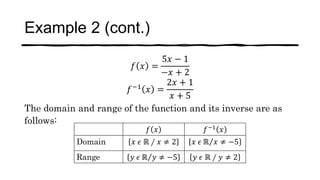
Example 2 (cont.)
𝑓 𝑥 =
5𝑥 − 1
−𝑥 + 2
𝑓−1 𝑥 =
2𝑥 + 1
𝑥 + 5
The domain and range of the function and its inverse are as
follows:
𝑓 𝑥 𝑓−1 𝑥
Domain 𝑥 𝜖 ℝ ∕ 𝑥 ≠ 2 𝑥 𝜖 ℝ 𝑥 ≠ −5
Range 𝑦 𝜖 ℝ 𝑦 ≠ −5 𝑦 𝜖 ℝ ∕ 𝑦 ≠ 2

One-to-one Functions.pptx

  • 1.
  • 2.
    Definition The function fis one-to-one if for any 𝒙𝟏, 𝒙𝟐 in the domain of f, then 𝒇 𝒙𝟏 ≠ 𝒇 𝒙𝟐 . That is, the same y-value is never paired with two different x- values.
  • 3.
    Determine whether the givenrelation is a function. If it is a function, determine whether it is one-to-one or not.
  • 4.
    Determine whether the given relationis a function. If it is a function, determine whether it is one-to-one or not.  The relation pairing an SSS member to his or her SSS number. Solution: Each SSS member is assigned to a unique SSS number. Thus, the relation is a function. Further, two different members cannot be assigned the same SSS number. Thus, the function is one-to-one.
  • 5.
    Determine whether the given relationis a function. If it is a function, determine whether it is one-to-one or not.  The relation pairing a real number to its square. Solution: Each real number has a unique perfect square. Thus, the relation is a function. However, two different real numbers such as 2 and -2 may have the same square. Thus, the function is not one-to-one.
  • 6.
    Determine whether thegiven relation is a function. If it is a function, determine whether it is one-to-one or not.  The relation pairing an airport to its airport code. Each real number has a unique perfect square. Thus, the relation is a function. However, two different real numbers such as 2 and -2 may have the same square. Thus, the function is not one- to-one.
  • 7.
    Examples: • LAO –Laoag International Airport • MNL – Ninoy Aquino International Airport • CEB – Mactan-Cebu International Airport • DVO – Francisco Bangoy International Airport (Davao) • JFK – John F. Kennedy International Airport (New York City) • ICN – Incheon International Airport
  • 8.
    Determine whether the given relationis a function. If it is a function, determine whether it is one-to-one or not.  The relation pairing an airport to its airport code. Solution: Since each airport has a unique airport code, then the relation is a function. Also, since no two airports share the same airport code, then the function is one-to-one.
  • 9.
    Determine whether the given relationis a function. If it is a function, determine whether it is one-to-one or not.  The relation pairing an airport to its airport code. Solution: Since each airport has a unique airport code, then the relation is a function. Also, since no two airports share the same airport code, then the function is one-to-one.
  • 10.
    How to determineif a Function is One-to-one? Horizontal Line Test A function is one-to-one if each horizontal line does not intersect the graph at more than one point. Which of the functions are one-to-one?
  • 11.
  • 12.
    Definition Let f bea one-to-one function with domain A and range B. then the inverse of f, denoted by 𝑓−1 , is a function with domain B and range A defined by 𝑓−1 𝑦 = 𝑥 if and only if 𝑓 𝑥 = 𝑦 for any y in B.
  • 13.
    To find theinverse of a one-to-one function: a) Write the function in the form y = f(x); b) Interchange the x and y variables; c) Solve for y in terms of x.
  • 14.
    Example 1 • Findthe inverse of 𝒇 𝒙 = 𝟑𝒙 + 𝟏. Solution: The equation of the function is 𝒚 = 𝟑𝒙 + 𝟏. Interchange the x and y variables 𝒙 = 𝟑𝒚 + 𝟏. Solve for y in terms of x: 𝑥 = 3𝑦 + 1 𝑥 − 1 = 3𝑦 𝑥 − 1 3 = 3𝑦 3 𝑦 = 𝑥 − 1 3 Therefore, the inverse of 𝑓 𝑥 = 3𝑥 + 1 is 𝑓−1 𝑥 = 𝑥−1 3 .
  • 15.
    Example 2 • Findthe inverse of 𝒈 𝒙 = 𝒙𝟑 − 𝟐. Solution: The equation of the function is 𝒚 = 𝒙𝟑 − 𝟐. Interchange the x and y variables 𝒙 = 𝒚𝟑 − 𝟐 Solve for y in terms of x: 𝑥 = 𝑦3 − 2 𝑥 + 2 = 𝑦3 𝑦 = 3 𝑥 + 2 Thus, the inverse of 𝑔 𝑥 = 𝑥3 − 2 is 𝑔−1 𝑥 = 3 𝑥 + 2.
  • 16.
    Example 3 • Findthe inverse of the rational function 𝒇 𝒙 = 𝟐𝒙 + 𝟏 𝟑𝒙 − 𝟒 Solution: The equation of the function is: 𝒚 = 𝟐𝒙 + 𝟏 𝟑𝒙 − 𝟒 Interchange the x and y variables: 𝒙 = 𝟐𝒚 + 𝟏 𝟑𝒚 − 𝟒 Solve for y in terms of x: 𝑥 = 2𝑦 + 1 3𝑦 − 4 𝑥 3𝑦 − 4 = 2𝑦 + 1 3𝑥𝑦 − 4𝑥 = 2𝑦 + 1 3𝑥𝑦 − 2𝑦 = 4𝑥 + 1 𝑦 3𝑥 − 2 = 4𝑥 + 1 𝑦 = 4𝑥 + 1 3𝑥 − 2 Therefore, the inverse of 𝑓 𝑥 = 2𝑥+1 3𝑥−4 is 𝒇−𝟏 𝒙 = 𝟒𝒙+𝟏 𝟑𝒙−𝟐 .
  • 17.
    Example 4 • Findthe inverse of 𝑓 𝑥 = 𝑥2 + 4𝑥 − 2, if it exists. Solution: Recognize that f(x) is a quadratic equation with a graph in the shape of parabola that opens upward. It is not a one-to-one function as it fails the horizontal line test.
  • 18.
    Example 4 • Findthe inverse of 𝑓 𝑥 = 𝑥2 + 4𝑥 − 2, if it exists. Solution (Optional): The equation of the function is 𝑦 = 𝑥2 + 4𝑥 − 2 Interchange the x and y variables 𝑥 = 𝑦2 + 4𝑦 − 2 Solve for y in terms of x: 𝑥 = 𝑦2 + 4𝑦 − 2 𝑦2 + 4𝑦 = 𝑥 + 2 𝑦2 + 4𝑦 + 4 = 𝑥 + 2 + 4 𝑦 + 2 2 = 𝑥 + 6 𝑦 + 2 = ± 𝑥 + 6 𝑦 = −2 ± 𝑥 + 6 The equation 𝑦 = −2 ± 𝑥 + 6 does not represent a function because there are some x-values that correspond to two different values. Therefore, the function 𝑓 𝑥 = 𝑥2 + 4𝑥 − 2 has no inverse function.
  • 19.
  • 20.
    In using tableof values of the functions, first we need to ascertain that the given function is a one-to-one function wherein no x-values are repeated. It is represented as the x-values of the function resulted as the y-values of its inverse, and the y-values of the function are the x-values of its inverse. Also, the graph should correspond to a one- to-one function by applying the Horizontal Line test. If it passes the test, the corresponding function is one-to-one. Given the graph of a one-to-one function, the graph of its inverse can be obtained by reflecting the graph about the line y = x.
  • 25.
    Domain and Range ofInverse Functions General Mathematics - Week 4
  • 26.
    To determine thedomain and range of an inverse function: • The outputs of the function f are the inputs to 𝑓−1, so the range of f is also the domain of 𝑓−1. Likewise, because the inputs to f are the outputs of 𝑓−1, the domain of f is the range of 𝑓−1.
  • 27.
    To determine thedomain and range of an inverse function: • This means that the domain of the inverse is the range of the original function and that the range of the inverse is the domain of the original function.
  • 28.
    Example 1 • Findthe domain and range of 𝑓 𝑥 = 2𝑥 + 1 and its inverse. Solution: Let 𝑦 = 2𝑥 + 1 Interchange x and y: 𝑥 = 2𝑦 + 1 Solve for y: 2𝑦 = 𝑥 − 1 𝑦 = 𝑥 − 1 2 𝑓 𝑥 = 2𝑥 + 1 𝑓−1 𝑥 = 𝑥 − 1 2 The domain and range of the function and its inverse are as follows: 𝑓 𝑥 𝑓−1 𝑥 Domain 𝑥 𝜖 ℝ 𝑥 𝜖 ℝ Range 𝑦 𝜖 ℝ 𝑦 𝜖 ℝ
  • 29.
    Example 2 • Findthe domain and range of 𝑓 𝑥 = 5𝑥−1 −𝑥+2 . Solution: Let 𝑦 = 5𝑥−1 −𝑥+2 Interchange x and y: 𝑥 = 5𝑦 − 1 −𝑦 + 2 Solve for y: 𝑥 −𝑦 + 2 = 5𝑦 − 1 −𝑥𝑦 + 2𝑥 = 5𝑦 − 1 −𝑥𝑦 − 5𝑦 = −2𝑥 − 1 𝑥𝑦 + 5𝑦 = 2𝑥 + 1 𝑦 𝑥 + 5 = 2𝑥 + 1 𝑦 = 2𝑥 + 1 𝑥 + 5
  • 30.
    Example 2 (cont.) 𝑓𝑥 = 5𝑥 − 1 −𝑥 + 2 𝑓−1 𝑥 = 2𝑥 + 1 𝑥 + 5 The domain and range of the function and its inverse are as follows: 𝑓 𝑥 𝑓−1 𝑥 Domain 𝑥 𝜖 ℝ ∕ 𝑥 ≠ 2 𝑥 𝜖 ℝ 𝑥 ≠ −5 Range 𝑦 𝜖 ℝ 𝑦 ≠ −5 𝑦 𝜖 ℝ ∕ 𝑦 ≠ 2

Editor's Notes

  • #13 A function has an inverse if and only if it is one-to-one.
  • #20 In using table of values of the functions, first we need to ascertain that the given function is a one-to-one function wherein no x-values are repeated. It is represented as the x-values of the function resulted as the y-values of its inverse, and the y-values of the function are the x-values of its inverse. Also, the graph should correspond to a one-to-one function by applying the Horizontal Line test. If it passes the test, the corresponding function is one-to-one. Given the graph of a one-to-one function, the graph of its inverse can be obtained by reflecting the graph about the line y = x.