Mathematics
Class: IX
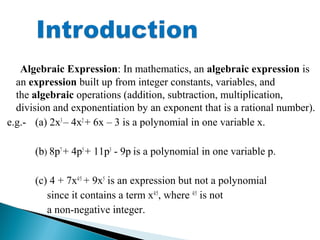
Algebraic Expression: In mathematics, an algebraic expression is
an expression built up from integer constants, variables, and
the algebraic operations (addition, subtraction, multiplication,
division and exponentiation by an exponent that is a rational number).
e.g.- (a) 2x3
– 4x2
+ 6x – 3 is a polynomial in one variable x.
(b) 8p7
+ 4p5
+ 11p3
- 9p is a polynomial in one variable p.
(c) 4 + 7x4/5
+ 9x5
is an expression but not a polynomial
since it contains a term x4/5
, where 4/5
is not
a non-negative integer.
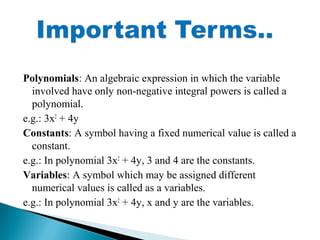
Polynomials: An algebraic expression in which the variable
involved have only non-negative integral powers is called a
polynomial.
e.g.: 3x2
+ 4y
Constants: A symbol having a fixed numerical value is called a
constant.
e.g.: In polynomial 3x2
+ 4y, 3 and 4 are the constants.
Variables: A symbol which may be assigned different
numerical values is called as a variables.
e.g.: In polynomial 3x2
+ 4y, x and y are the variables.
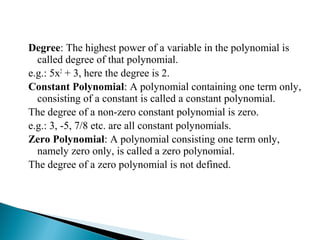
Degree: The highest power of a variable in the polynomial is
called degree of that polynomial.
e.g.: 5x2
+ 3, here the degree is 2.
Constant Polynomial: A polynomial containing one term only,
consisting of a constant is called a constant polynomial.
The degree of a non-zero constant polynomial is zero.
e.g.: 3, -5, 7/8 etc. are all constant polynomials.
Zero Polynomial: A polynomial consisting one term only,
namely zero only, is called a zero polynomial.
The degree of a zero polynomial is not defined.
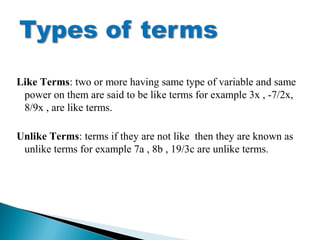
Like Terms: two or more having same type of variable and same
power on them are said to be like terms for example 3x , -7/2x,
8/9x , are like terms.
Unlike Terms: terms if they are not like then they are known as
unlike terms for example 7a , 8b , 19/3c are unlike terms.
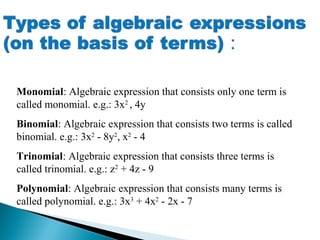
Monomial: Algebraic expression that consists only one term is
called monomial. e.g.: 3x2
, 4y
Binomial: Algebraic expression that consists two terms is called
binomial. e.g.: 3x2
- 8y2
, x2
- 4
Trinomial: Algebraic expression that consists three terms is
called trinomial. e.g.: z2
+ 4z - 9
Polynomial: Algebraic expression that consists many terms is
called polynomial. e.g.: 3x3
+ 4x2
- 2x - 7
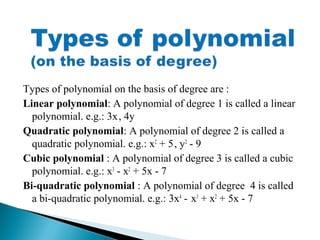
Types of polynomial on the basis of degree are :
Linear polynomial: A polynomial of degree 1 is called a linear
polynomial. e.g.: 3x, 4y
Quadratic polynomial: A polynomial of degree 2 is called a
quadratic polynomial. e.g.: x2
+ 5, y2
- 9
Cubic polynomial : A polynomial of degree 3 is called a cubic
polynomial. e.g.: x3
- x2
+ 5x - 7
Bi-quadratic polynomial : A polynomial of degree 4 is called
a bi-quadratic polynomial. e.g.: 3x4
- x3
+ x2
+ 5x - 7
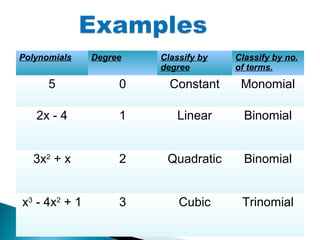
Polynomials Degree Classify by
degree
Classify by no.
of terms.
5 0 Constant Monomial
2x - 4 1 Linear Binomial
3x2
+ x 2 Quadratic Binomial
x3
- 4x2
+ 1 3 Cubic Trinomial
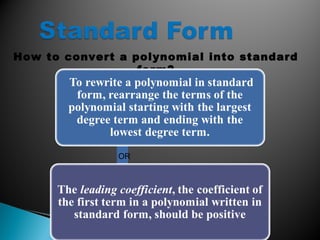
How to convert a polynomial into standard
form?
OR
Let f(x) be a polynomial of degree n > 1 and let a be any real number.
When f(x) is divided by (x-a) , then the remainder is f(a).
PROOF Suppose when f(x) is divided by (x-a), the quotient is g(x) and the remainder
is r(x).
Then, degree r(x) < degree (x-a)
degree r(x) < 1 [ therefore, degree (x-a)=1]
degree r(x) = 0
r(x) is constant, equal to r (say)
Thus, when f(x) is divided by (x-a), then the quotient is g(x) and the remainder is r.
Therefore, f(x) = (x-a) x g(x) + r (i)
Putting x=a in equation (i), we get r = f(a)
Thus, when f(x) is divided by (x-a), then the remainder is f(a).
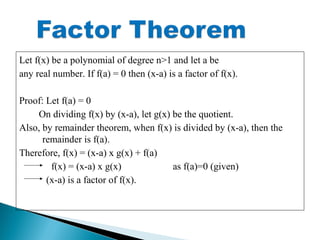
Let f(x) be a polynomial of degree n>1 and let a be
any real number. If f(a) = 0 then (x-a) is a factor of f(x).
Proof: Let f(a) = 0
On dividing f(x) by (x-a), let g(x) be the quotient.
Also, by remainder theorem, when f(x) is divided by (x-a), then the
remainder is f(a).
Therefore, f(x) = (x-a) x g(x) + f(a)
f(x) = (x-a) x g(x) as f(a)=0 (given)
(x-a) is a factor of f(x).
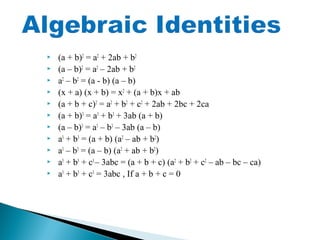
 (a + b)2
= a2
+ 2ab + b2
 (a – b)2
= a2
– 2ab + b2
 a2
– b2
= (a - b) (a – b)
 (x + a) (x + b) = x2
+ (a + b)x + ab
 (a + b + c)2
= a2
+ b2
+ c2
+ 2ab + 2bc + 2ca
 (a + b)3
= a3
+ b3
+ 3ab (a + b)
 (a – b)3
= a3
– b3
– 3ab (a – b)
 a3
+ b3
= (a + b) (a2
– ab + b2
)
 a3
– b3
= (a – b) (a2
+ ab + b2
)
 a3
+ b3
+ c3
– 3abc = (a + b + c) (a2
+ b2
+ c2
– ab – bc – ca)
 a3
+ b3
+ c3
= 3abc , If a + b + c = 0
THANKS

IX polynomial

  • 1.
  • 2.
    Algebraic Expression: Inmathematics, an algebraic expression is an expression built up from integer constants, variables, and the algebraic operations (addition, subtraction, multiplication, division and exponentiation by an exponent that is a rational number). e.g.- (a) 2x3 – 4x2 + 6x – 3 is a polynomial in one variable x. (b) 8p7 + 4p5 + 11p3 - 9p is a polynomial in one variable p. (c) 4 + 7x4/5 + 9x5 is an expression but not a polynomial since it contains a term x4/5 , where 4/5 is not a non-negative integer.
  • 3.
    Polynomials: An algebraicexpression in which the variable involved have only non-negative integral powers is called a polynomial. e.g.: 3x2 + 4y Constants: A symbol having a fixed numerical value is called a constant. e.g.: In polynomial 3x2 + 4y, 3 and 4 are the constants. Variables: A symbol which may be assigned different numerical values is called as a variables. e.g.: In polynomial 3x2 + 4y, x and y are the variables.
  • 4.
    Degree: The highestpower of a variable in the polynomial is called degree of that polynomial. e.g.: 5x2 + 3, here the degree is 2. Constant Polynomial: A polynomial containing one term only, consisting of a constant is called a constant polynomial. The degree of a non-zero constant polynomial is zero. e.g.: 3, -5, 7/8 etc. are all constant polynomials. Zero Polynomial: A polynomial consisting one term only, namely zero only, is called a zero polynomial. The degree of a zero polynomial is not defined.
  • 5.
    Like Terms: twoor more having same type of variable and same power on them are said to be like terms for example 3x , -7/2x, 8/9x , are like terms. Unlike Terms: terms if they are not like then they are known as unlike terms for example 7a , 8b , 19/3c are unlike terms.
  • 6.
    Monomial: Algebraic expressionthat consists only one term is called monomial. e.g.: 3x2 , 4y Binomial: Algebraic expression that consists two terms is called binomial. e.g.: 3x2 - 8y2 , x2 - 4 Trinomial: Algebraic expression that consists three terms is called trinomial. e.g.: z2 + 4z - 9 Polynomial: Algebraic expression that consists many terms is called polynomial. e.g.: 3x3 + 4x2 - 2x - 7
  • 7.
    Types of polynomialon the basis of degree are : Linear polynomial: A polynomial of degree 1 is called a linear polynomial. e.g.: 3x, 4y Quadratic polynomial: A polynomial of degree 2 is called a quadratic polynomial. e.g.: x2 + 5, y2 - 9 Cubic polynomial : A polynomial of degree 3 is called a cubic polynomial. e.g.: x3 - x2 + 5x - 7 Bi-quadratic polynomial : A polynomial of degree 4 is called a bi-quadratic polynomial. e.g.: 3x4 - x3 + x2 + 5x - 7
  • 8.
    Polynomials Degree Classifyby degree Classify by no. of terms. 5 0 Constant Monomial 2x - 4 1 Linear Binomial 3x2 + x 2 Quadratic Binomial x3 - 4x2 + 1 3 Cubic Trinomial
  • 9.
    How to converta polynomial into standard form? OR
  • 10.
    Let f(x) bea polynomial of degree n > 1 and let a be any real number. When f(x) is divided by (x-a) , then the remainder is f(a). PROOF Suppose when f(x) is divided by (x-a), the quotient is g(x) and the remainder is r(x). Then, degree r(x) < degree (x-a) degree r(x) < 1 [ therefore, degree (x-a)=1] degree r(x) = 0 r(x) is constant, equal to r (say) Thus, when f(x) is divided by (x-a), then the quotient is g(x) and the remainder is r. Therefore, f(x) = (x-a) x g(x) + r (i) Putting x=a in equation (i), we get r = f(a) Thus, when f(x) is divided by (x-a), then the remainder is f(a).
  • 11.
    Let f(x) bea polynomial of degree n>1 and let a be any real number. If f(a) = 0 then (x-a) is a factor of f(x). Proof: Let f(a) = 0 On dividing f(x) by (x-a), let g(x) be the quotient. Also, by remainder theorem, when f(x) is divided by (x-a), then the remainder is f(a). Therefore, f(x) = (x-a) x g(x) + f(a) f(x) = (x-a) x g(x) as f(a)=0 (given) (x-a) is a factor of f(x).
  • 12.
     (a +b)2 = a2 + 2ab + b2  (a – b)2 = a2 – 2ab + b2  a2 – b2 = (a - b) (a – b)  (x + a) (x + b) = x2 + (a + b)x + ab  (a + b + c)2 = a2 + b2 + c2 + 2ab + 2bc + 2ca  (a + b)3 = a3 + b3 + 3ab (a + b)  (a – b)3 = a3 – b3 – 3ab (a – b)  a3 + b3 = (a + b) (a2 – ab + b2 )  a3 – b3 = (a – b) (a2 + ab + b2 )  a3 + b3 + c3 – 3abc = (a + b + c) (a2 + b2 + c2 – ab – bc – ca)  a3 + b3 + c3 = 3abc , If a + b + c = 0
  • 13.