STATISTICS AND
PROBABILITY
A B C D E F G H I J K
1
2
3
4
5
6
7
8
9
10
11
12
13
14
15
16
At the end of this lesson, the learner should be able to:
• correctly construct a probability mass function of a given discrete
random variable;
• accurately graph values and probabilities of a discrete random variable
in a histogram; and
• accurately illustrate discrete random variables in real-life situations.
Objectives – Unit 2 Lesson 1: Probability Mass Function of a
Discrete Random Variable
What is Probability Mass
Function Discrete Random
Variable?
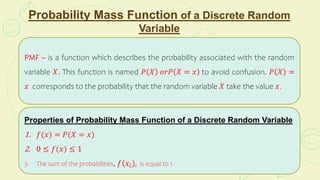
Properties of Probability Mass Function of a Discrete Random Variable
1. 𝑓(𝑥) = 𝑃(𝑋 = 𝑥)
2. 0 ≤ 𝑓(𝑥) ≤ 1
3. The sum of the probabilities, 𝑓 𝑥𝑖 , is equal to 1.
Probability Mass Function of a Discrete Random
Variable
PMF – is a function which describes the probability associated with the random
variable 𝑋. This function is named 𝑃 𝑋 𝑜𝑟𝑃 𝑋 = 𝑥 to avoid confusion. 𝑃 𝑋 =
𝑥 corresponds to the probability that the random variable 𝑋 take the value 𝑥.
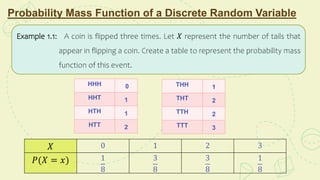
Example 1: A coin is flipped three times. Let 𝑋 represent the number of tails that
appear in flipping a coin.
Probability Mass Function of a Discrete Random Variable
C
O
I
N
Head
Head Head
Tale
Tale Head
Tale
Tale
Head Head
Tale
Tale Head
Tale
HHH 0
HHT 1
HTH 1
HTT 2
THH 1
THT 2
TTH 2
TTT 3
X = 0, 1, 2, 3
𝑋 0 1 2 3
𝑃(𝑋 = 𝑥) 1
8
3
8
3
8
1
8
Example 1.1: A coin is flipped three times. Let 𝑋 represent the number of tails that
appear in flipping a coin. Create a table to represent the probability mass
function of this event.
Probability Mass Function of a Discrete Random Variable
HHH 0
HHT 1
HTH 1
HTT 2
THH 1
THT 2
TTH 2
TTT 3
𝑋 0 1 2 3
𝑃(𝑋 = 𝑥) 1
8
3
8
3
8
1
8
Example 1.2: A coin is flipped three times. Let 𝑋 represent the number of tails that
appear in flipping a coin. Find the probability mass function of
𝑋.
Probability Mass Function of a Discrete Random Variable
Therefore, 𝑃 𝑋 = 0 =
1
8
, 𝑃 𝑋 = 1 =
3
8
, 𝑃 𝑋 = 2 =
3
8
and 𝑃 𝑋 = 3 =
1
8
.
Example 2: A coin and a die are thrown once, at the same time given that for the
coin the head is represented by number 1 while the tail is represented by
number 2. If R is the random variable that represents the sum of the
results, what are the possible values of R?
Probability Mass Function of a Discrete Random Variable
1 1
1 2
1 3
1 4
1 5
1 6
2
3
4
5
6
7
2 1
2 2
2 3
2 4
2 5
2 6
3
4
5
6
7
8
R= 2, 3, 4, 5,
6, 7 & 8
Example 2.1: A coin and a die are thrown once, at the same time given that for the
coin the head is represented by number 1 while the tail is represented
by number 2. If R is the random variable that represents the sum of the
results, create a table to represent the probability mass function of this
event.
Probability Mass Function of a Discrete Random Variable
1 1
1 2
1 3
1 4
1 5
1 6
2
3
4
5
6
7
2 1
2 2
2 3
2 4
2 5
2 6
3
4
5
6
7
8
R = 2, 3, 4, 5, 6, 7 & 8
𝑹 𝟐 𝟑 𝟒 𝟓 𝟔 𝟕 𝟖
𝑷(𝑹 = 𝒓) 𝟏
𝟏𝟐
𝟐
𝟏𝟐
𝟐
𝟏𝟐
𝟐
𝟏𝟐
𝟐
𝟏𝟐
𝟐
𝟏𝟐
𝟏
𝟏𝟐
Example 2.2: A coin and a die are thrown once, at the same time given that for the
coin the head is represented by number 1 while the tail is represented
by number 2. If R is the random variable that represents the sum of the
results, find the probability mass function of R.
Probability Mass Function of a Discrete Random Variable
𝑹 𝟐 𝟑 𝟒 𝟓 𝟔 𝟕 𝟖
𝑷(𝑹 = 𝒓) 𝟏
𝟏𝟐
𝟐
𝟏𝟐
𝟐
𝟏𝟐
𝟐
𝟏𝟐
𝟐
𝟏𝟐
𝟐
𝟏𝟐
𝟏
𝟏𝟐
Therefore, 𝑃 𝑅 = 2 =
1
12
, 𝑃 𝑅 = 3 =
2
12
, 𝑃 𝑅 = 4 =
2
12
, 𝑃 𝑅 = 5 =
2
12
,
𝑃 𝑅 = 6 =
2
12
, 𝑃 𝑅 = 7 =
2
12
and 𝑃 𝑅 = 8 =
1
12
.
What is Histogram?
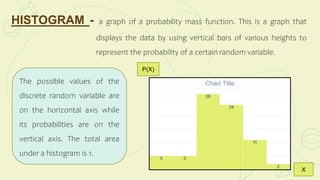
The possible values of the
discrete random variable are
on the horizontal axis while
its probabilities are on the
vertical axis. The total area
under a histogram is 1.
HISTOGRAM - a graph of a probability mass function. This is a graph that
displays the data by using vertical bars of various heights to
represent the probability of a certain random variable.
X
P(X)
𝑋 0 1 2 3
𝑃(𝑋 = 𝑥) 1
8
3
8
3
8
1
8
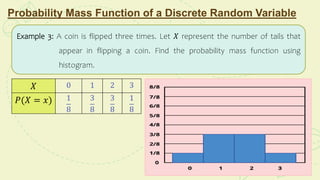
Example 3: A coin is flipped three times. Let 𝑋 represent the number of tails that
appear in flipping a coin. Find the probability mass function using
histogram.
Probability Mass Function of a Discrete Random Variable
Example 4: A coin and a die are thrown once, at the same time given that for the
coin the head is represented by number 1 while the tail is represented by
number 2. If R is the random variable that represents the sum of the
results, Find the probability mass function using histogram.
Probability Mass Function of a Discrete Random Variable
𝑹 𝟐 𝟑 𝟒 𝟓 𝟔 𝟕 𝟖
𝑷(𝑹 = 𝒓) 𝟏
𝟏𝟐
𝟐
𝟏𝟐
𝟐
𝟏𝟐
𝟐
𝟏𝟐
𝟐
𝟏𝟐
𝟐
𝟏𝟐
𝟏
𝟏𝟐
0
0.02
0.04
0.06
0.08
0.1
0.12
0.14
0.16
0.18
2 3 4 5 6 7 8
R
Example 5: Two coins are tossed. Let 𝑆 be the number of heads that occur. Construct the
probability distribution for the random variable 𝑆 and its corresponding histogram.
HH 2
HT 1
TH 1
TT 0
S = 0, 1, 2
C
O
I
N
Head
Head
Tale
Tale
Head
Tale 𝑺 𝟎 𝟏 𝟐
𝑷(𝑺 = 𝒔) 𝟏
𝟒
𝟐
𝟒
𝟏
𝟒
𝑆 0 1 2
𝑃(𝑆 = 𝑠) 1
4
2
4
1
4
P(S)
S
Example 6: A certain university has a lab with six computers reserved for students specializing in a
certain subject. Assume that X represents the number of these computers that are in use at a
particular time of a day. The probability distribution of X is given below. Find the probability that at
least 3 computers are in use at a particular time of the day.
𝑋 0 1 2 3 4 5 6
𝑃(𝑋 = 𝑥) 0.10 0.10 0.15 0.25 0.25 0.10 0.05
Solution:
𝑃 𝑋 ≥ 3 = 𝑃 𝑋 = 3 + 𝑃 𝑋 = 4 + 𝑃 𝑋 = 5 + 𝑃(𝑋 = 6)
𝑃 𝑋 ≥ 3 = 0.25 + 0.25 + 0.10 + 0.05
𝑷 𝑿 ≥ 𝟑 = 𝟎. 𝟔𝟓
Thus, there is 65% chance are at least 3
computers are in use if we visit it in a particular
time of day.
TRY IT!
Toss a pair of dice. Winnings are equal to the difference of the
numbers on the two dice. Let M denote the winnings after
playing the game once.
a) Find the possible values of M.
b) Find the probability mass function of M.
c) Construct its corresponding histogram.
1 1
1 2
1 3
1 4
1 5
1 6
4 1
4 2
4 3
4 4
4 5
4 6
2 1
2 2
2 3
2 4
2 5
2 6
5 1
5 2
5 3
5 4
5 5
5 6
3 1
3 2
3 3
3 4
3 5
3 6
6 1
6 2
6 3
6 4
6 5
6 6
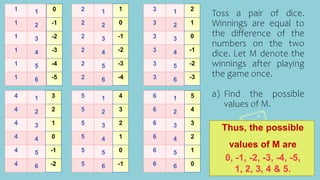
Thus, the possible
values of M are
0, -1, -2, -3, -4, -5,
1, 2, 3, 4 & 5.
0
-1
-2
-3
-4
-5
3
2
1
0
-1
-2
1
0
-1
-2
-3
-4
4
3
2
1
0
-1
2
1
0
-1
-2
-3
5
4
3
2
1
0
Toss a pair of dice.
Winnings are equal to
the difference of the
numbers on the two
dice. Let M denote the
winnings after playing
the game once.
a) Find the possible
values of M.
Toss a pair of dice. Winnings are equal to the difference of the numbers on the
two dice. Let M denote the winnings after playing the game once.
b) Find the probability mass
function of M. Thus, the possible values of M are
0, -1, -2, -3, -4, -5, 1, 2, 3, 4 & 5.
-5 1
-4 2
-3 3
-2 4
2 4
3 3
4 2
5 1
𝑴 -5 -4 -3 -2 -1 0 1 2 3 4 5
𝑷(𝑴) 1/36 2/36 3/36 4/36 5/36 6/36 5/36 4/36 3/36 2/36 1/36
-1 5
0 6
1 5
𝑃 𝑀 = −4 =
2
36
𝑃 𝑀 = −5 =
1
36
𝑃 𝑀 = −2 =
4
36
𝑃 𝑀 = −3 =
3
36
𝑃 𝑀 = 0 =
6
36
𝑃 𝑀 = −1 =
5
36
𝑃 𝑀 = 2 =
4
36
𝑃 𝑀 = 1 =
5
36
𝑃 𝑀 = 3 =
3
36
𝑃 𝑀 = 5 =
1
36
𝑃 𝑀 = 4 =
2
36
A B C D E F G H I J K
1
2
3
4
5
6
7
8
9
10
11
12
13
14
15
16
Check your To Do’s on your Quipper Account, answer the
assignment entitled Probability Mass Function of a Discrete
Random Variable.
Online Quiz:

Unit2.Lesson1.pptx

  • 1.
  • 2.
    A B CD E F G H I J K 1 2 3 4 5 6 7 8 9 10 11 12 13 14 15 16 At the end of this lesson, the learner should be able to: • correctly construct a probability mass function of a given discrete random variable; • accurately graph values and probabilities of a discrete random variable in a histogram; and • accurately illustrate discrete random variables in real-life situations. Objectives – Unit 2 Lesson 1: Probability Mass Function of a Discrete Random Variable
  • 3.
    What is ProbabilityMass Function Discrete Random Variable?
  • 4.
    Properties of ProbabilityMass Function of a Discrete Random Variable 1. 𝑓(𝑥) = 𝑃(𝑋 = 𝑥) 2. 0 ≤ 𝑓(𝑥) ≤ 1 3. The sum of the probabilities, 𝑓 𝑥𝑖 , is equal to 1. Probability Mass Function of a Discrete Random Variable PMF – is a function which describes the probability associated with the random variable 𝑋. This function is named 𝑃 𝑋 𝑜𝑟𝑃 𝑋 = 𝑥 to avoid confusion. 𝑃 𝑋 = 𝑥 corresponds to the probability that the random variable 𝑋 take the value 𝑥.
  • 5.
    Example 1: Acoin is flipped three times. Let 𝑋 represent the number of tails that appear in flipping a coin. Probability Mass Function of a Discrete Random Variable C O I N Head Head Head Tale Tale Head Tale Tale Head Head Tale Tale Head Tale HHH 0 HHT 1 HTH 1 HTT 2 THH 1 THT 2 TTH 2 TTT 3 X = 0, 1, 2, 3
  • 6.
    𝑋 0 12 3 𝑃(𝑋 = 𝑥) 1 8 3 8 3 8 1 8 Example 1.1: A coin is flipped three times. Let 𝑋 represent the number of tails that appear in flipping a coin. Create a table to represent the probability mass function of this event. Probability Mass Function of a Discrete Random Variable HHH 0 HHT 1 HTH 1 HTT 2 THH 1 THT 2 TTH 2 TTT 3
  • 7.
    𝑋 0 12 3 𝑃(𝑋 = 𝑥) 1 8 3 8 3 8 1 8 Example 1.2: A coin is flipped three times. Let 𝑋 represent the number of tails that appear in flipping a coin. Find the probability mass function of 𝑋. Probability Mass Function of a Discrete Random Variable Therefore, 𝑃 𝑋 = 0 = 1 8 , 𝑃 𝑋 = 1 = 3 8 , 𝑃 𝑋 = 2 = 3 8 and 𝑃 𝑋 = 3 = 1 8 .
  • 8.
    Example 2: Acoin and a die are thrown once, at the same time given that for the coin the head is represented by number 1 while the tail is represented by number 2. If R is the random variable that represents the sum of the results, what are the possible values of R? Probability Mass Function of a Discrete Random Variable 1 1 1 2 1 3 1 4 1 5 1 6 2 3 4 5 6 7 2 1 2 2 2 3 2 4 2 5 2 6 3 4 5 6 7 8 R= 2, 3, 4, 5, 6, 7 & 8
  • 9.
    Example 2.1: Acoin and a die are thrown once, at the same time given that for the coin the head is represented by number 1 while the tail is represented by number 2. If R is the random variable that represents the sum of the results, create a table to represent the probability mass function of this event. Probability Mass Function of a Discrete Random Variable 1 1 1 2 1 3 1 4 1 5 1 6 2 3 4 5 6 7 2 1 2 2 2 3 2 4 2 5 2 6 3 4 5 6 7 8 R = 2, 3, 4, 5, 6, 7 & 8 𝑹 𝟐 𝟑 𝟒 𝟓 𝟔 𝟕 𝟖 𝑷(𝑹 = 𝒓) 𝟏 𝟏𝟐 𝟐 𝟏𝟐 𝟐 𝟏𝟐 𝟐 𝟏𝟐 𝟐 𝟏𝟐 𝟐 𝟏𝟐 𝟏 𝟏𝟐
  • 10.
    Example 2.2: Acoin and a die are thrown once, at the same time given that for the coin the head is represented by number 1 while the tail is represented by number 2. If R is the random variable that represents the sum of the results, find the probability mass function of R. Probability Mass Function of a Discrete Random Variable 𝑹 𝟐 𝟑 𝟒 𝟓 𝟔 𝟕 𝟖 𝑷(𝑹 = 𝒓) 𝟏 𝟏𝟐 𝟐 𝟏𝟐 𝟐 𝟏𝟐 𝟐 𝟏𝟐 𝟐 𝟏𝟐 𝟐 𝟏𝟐 𝟏 𝟏𝟐 Therefore, 𝑃 𝑅 = 2 = 1 12 , 𝑃 𝑅 = 3 = 2 12 , 𝑃 𝑅 = 4 = 2 12 , 𝑃 𝑅 = 5 = 2 12 , 𝑃 𝑅 = 6 = 2 12 , 𝑃 𝑅 = 7 = 2 12 and 𝑃 𝑅 = 8 = 1 12 .
  • 11.
  • 12.
    The possible valuesof the discrete random variable are on the horizontal axis while its probabilities are on the vertical axis. The total area under a histogram is 1. HISTOGRAM - a graph of a probability mass function. This is a graph that displays the data by using vertical bars of various heights to represent the probability of a certain random variable. X P(X)
  • 13.
    𝑋 0 12 3 𝑃(𝑋 = 𝑥) 1 8 3 8 3 8 1 8 Example 3: A coin is flipped three times. Let 𝑋 represent the number of tails that appear in flipping a coin. Find the probability mass function using histogram. Probability Mass Function of a Discrete Random Variable
  • 14.
    Example 4: Acoin and a die are thrown once, at the same time given that for the coin the head is represented by number 1 while the tail is represented by number 2. If R is the random variable that represents the sum of the results, Find the probability mass function using histogram. Probability Mass Function of a Discrete Random Variable 𝑹 𝟐 𝟑 𝟒 𝟓 𝟔 𝟕 𝟖 𝑷(𝑹 = 𝒓) 𝟏 𝟏𝟐 𝟐 𝟏𝟐 𝟐 𝟏𝟐 𝟐 𝟏𝟐 𝟐 𝟏𝟐 𝟐 𝟏𝟐 𝟏 𝟏𝟐 0 0.02 0.04 0.06 0.08 0.1 0.12 0.14 0.16 0.18 2 3 4 5 6 7 8 R
  • 15.
    Example 5: Twocoins are tossed. Let 𝑆 be the number of heads that occur. Construct the probability distribution for the random variable 𝑆 and its corresponding histogram. HH 2 HT 1 TH 1 TT 0 S = 0, 1, 2 C O I N Head Head Tale Tale Head Tale 𝑺 𝟎 𝟏 𝟐 𝑷(𝑺 = 𝒔) 𝟏 𝟒 𝟐 𝟒 𝟏 𝟒
  • 16.
    𝑆 0 12 𝑃(𝑆 = 𝑠) 1 4 2 4 1 4 P(S) S
  • 17.
    Example 6: Acertain university has a lab with six computers reserved for students specializing in a certain subject. Assume that X represents the number of these computers that are in use at a particular time of a day. The probability distribution of X is given below. Find the probability that at least 3 computers are in use at a particular time of the day. 𝑋 0 1 2 3 4 5 6 𝑃(𝑋 = 𝑥) 0.10 0.10 0.15 0.25 0.25 0.10 0.05 Solution: 𝑃 𝑋 ≥ 3 = 𝑃 𝑋 = 3 + 𝑃 𝑋 = 4 + 𝑃 𝑋 = 5 + 𝑃(𝑋 = 6) 𝑃 𝑋 ≥ 3 = 0.25 + 0.25 + 0.10 + 0.05 𝑷 𝑿 ≥ 𝟑 = 𝟎. 𝟔𝟓 Thus, there is 65% chance are at least 3 computers are in use if we visit it in a particular time of day.
  • 21.
    TRY IT! Toss apair of dice. Winnings are equal to the difference of the numbers on the two dice. Let M denote the winnings after playing the game once. a) Find the possible values of M. b) Find the probability mass function of M. c) Construct its corresponding histogram.
  • 22.
    1 1 1 2 13 1 4 1 5 1 6 4 1 4 2 4 3 4 4 4 5 4 6 2 1 2 2 2 3 2 4 2 5 2 6 5 1 5 2 5 3 5 4 5 5 5 6 3 1 3 2 3 3 3 4 3 5 3 6 6 1 6 2 6 3 6 4 6 5 6 6 Thus, the possible values of M are 0, -1, -2, -3, -4, -5, 1, 2, 3, 4 & 5. 0 -1 -2 -3 -4 -5 3 2 1 0 -1 -2 1 0 -1 -2 -3 -4 4 3 2 1 0 -1 2 1 0 -1 -2 -3 5 4 3 2 1 0 Toss a pair of dice. Winnings are equal to the difference of the numbers on the two dice. Let M denote the winnings after playing the game once. a) Find the possible values of M.
  • 23.
    Toss a pairof dice. Winnings are equal to the difference of the numbers on the two dice. Let M denote the winnings after playing the game once. b) Find the probability mass function of M. Thus, the possible values of M are 0, -1, -2, -3, -4, -5, 1, 2, 3, 4 & 5. -5 1 -4 2 -3 3 -2 4 2 4 3 3 4 2 5 1 𝑴 -5 -4 -3 -2 -1 0 1 2 3 4 5 𝑷(𝑴) 1/36 2/36 3/36 4/36 5/36 6/36 5/36 4/36 3/36 2/36 1/36 -1 5 0 6 1 5
  • 24.
    𝑃 𝑀 =−4 = 2 36 𝑃 𝑀 = −5 = 1 36 𝑃 𝑀 = −2 = 4 36 𝑃 𝑀 = −3 = 3 36 𝑃 𝑀 = 0 = 6 36 𝑃 𝑀 = −1 = 5 36 𝑃 𝑀 = 2 = 4 36 𝑃 𝑀 = 1 = 5 36 𝑃 𝑀 = 3 = 3 36 𝑃 𝑀 = 5 = 1 36 𝑃 𝑀 = 4 = 2 36
  • 25.
    A B CD E F G H I J K 1 2 3 4 5 6 7 8 9 10 11 12 13 14 15 16 Check your To Do’s on your Quipper Account, answer the assignment entitled Probability Mass Function of a Discrete Random Variable. Online Quiz: