Cartesian Coordinates
Cartesian coordinates can be used to pinpoint where you are on a map or
graph.

Cartesian Coordinates
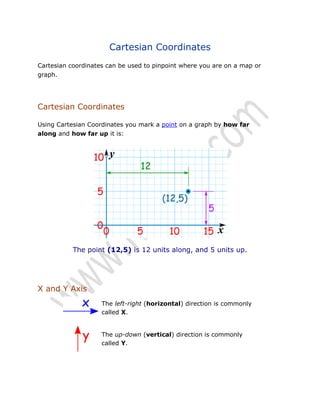
Using Cartesian Coordinates you mark a point on a graph by how far
along and how far up it is:

The point (12,5) is 12 units along, and 5 units up.

X and Y Axis
The left-right (horizontal) direction is commonly
called X.
The up-down (vertical) direction is commonly
called Y.
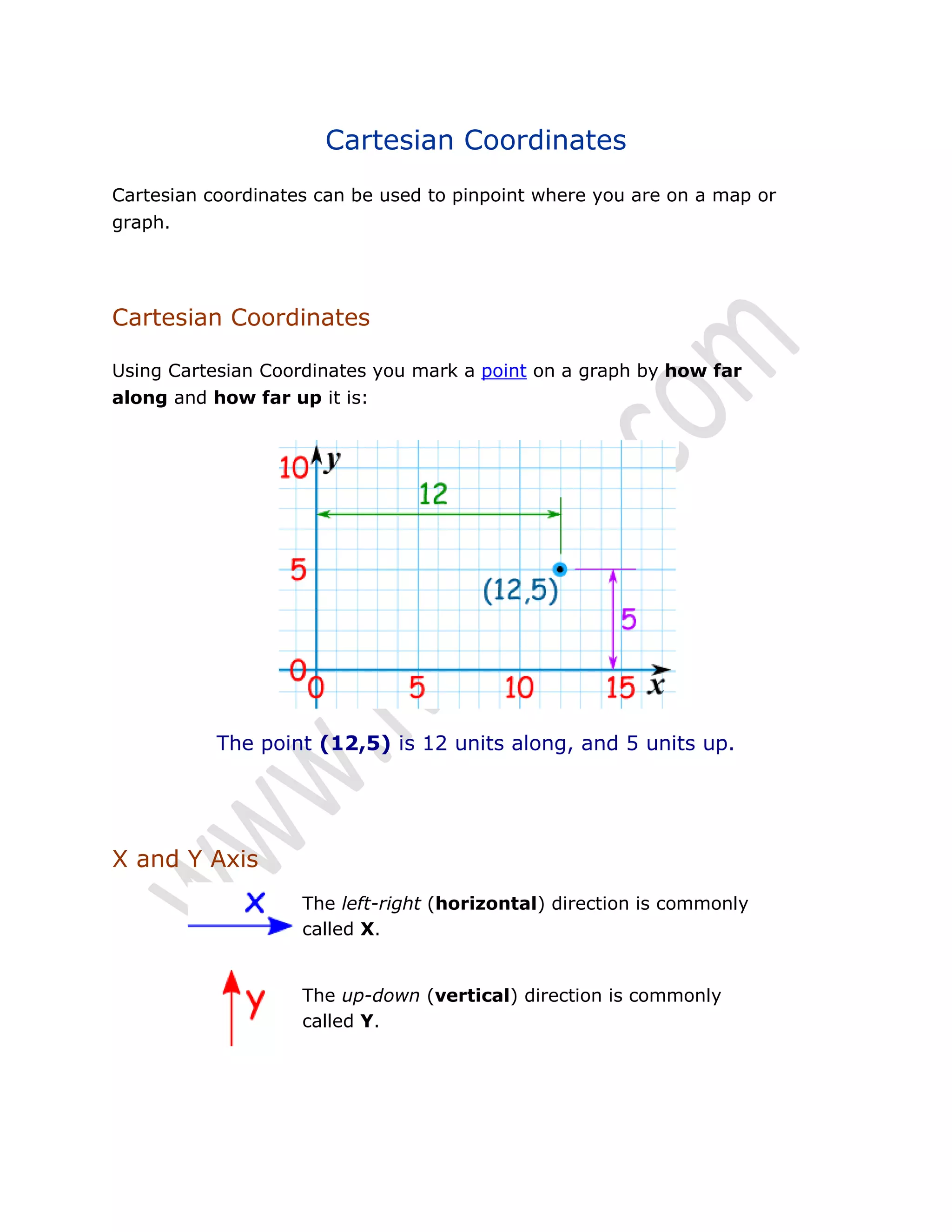
Put them together on a graph ...
... and you are ready to go

Where they cross over is the "0" point,
you measure everything from there.



The X Axis runs horizontally through zero
The Y Axis runs vertically through zero

Axis: The reference line from which distances are measured.
The plural of Axis is Axes, and is pronounced ax-eez

Example:

Point (6,4) is
6 units across (in the x direction), and
4 units up (in the y direction)
So (6,4) means:

Go along 6 and then go up 4 then "plot the dot".
Gradient (Slope) of a Straight Line
The Gradient (also called Slope) of a straight line shows how steep a straight
line is.

Calculate
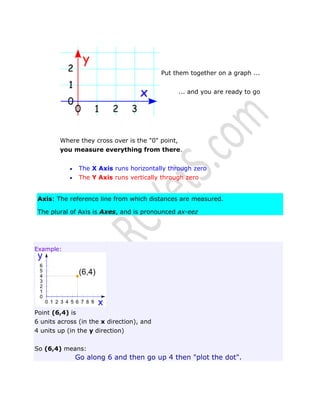
The method to calculate the Gradient is:
Divide the change in height by the change in horizontal distance

Gradient
=

Change in
Y
Change in
X

Examples:
3
The Gradient of this line =

=

3

1

So the Gradient is equal to 1
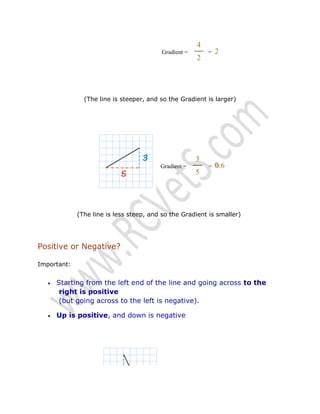
4
Gradient =

2

=

2

(The line is steeper, and so the Gradient is larger)

3
Gradient =

5

=

0.6

(The line is less steep, and so the Gradient is smaller)

Positive or Negative?
Important:


Starting from the left end of the line and going across to the
right is positive
(but going across to the left is negative).



Up is positive, and down is negative
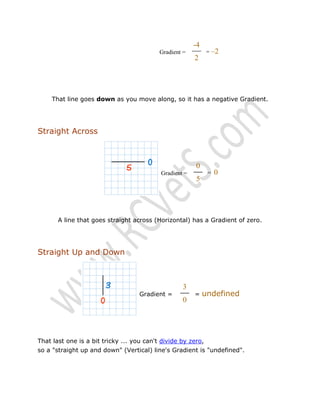
-4
Gradient =

= –2

2

That line goes down as you move along, so it has a negative Gradient.

Straight Across

0
Gradient =

=

5

0

A line that goes straight across (Horizontal) has a Gradient of zero.

Straight Up and Down

Gradient =

3
0

=

undefined

That last one is a bit tricky ... you can't divide by zero,
so a "straight up and down" (Vertical) line's Gradient is "undefined".
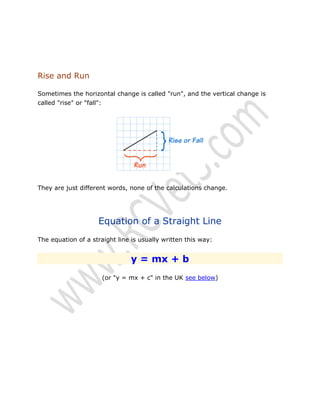
Rise and Run
Sometimes the horizontal change is called "run", and the vertical change is
called "rise" or "fall":

They are just different words, none of the calculations change.

Equation of a Straight Line
The equation of a straight line is usually written this way:

y = mx + b
(or "y = mx + c" in the UK see below)
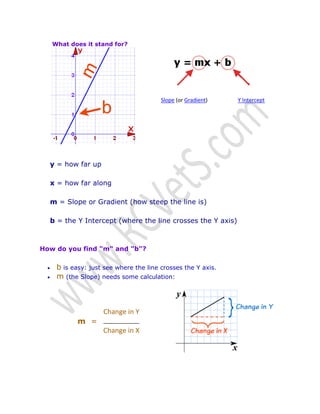
What does it stand for?

Slope (or Gradient)

y = how far up
x = how far along
m = Slope or Gradient (how steep the line is)
b = the Y Intercept (where the line crosses the Y axis)

How do you find "m" and "b"?



b is easy: just see where the line crosses the Y axis.
m (the Slope) needs some calculation:

Change in Y
m =
Change in X

Y Intercept
Knowing this we can work out the equation of a straight line:

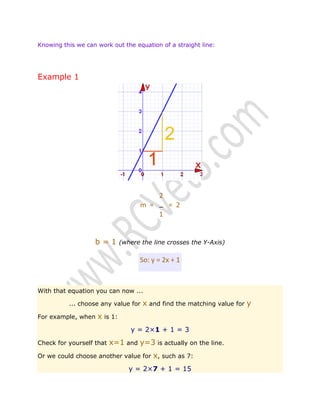
Example 1

2
m =

= 2
1

b=1

(where the line crosses the Y-Axis)

So: y = 2x + 1

With that equation you can now ...
... choose any value for
For example, when

x and find the matching value for y

x is 1:
y = 2×1 + 1 = 3

Check for yourself that

x=1 and y=3 is actually on the line.

Or we could choose another value for

x, such as 7:

y = 2×7 + 1 = 15
And so when

x=7 you will have y=15

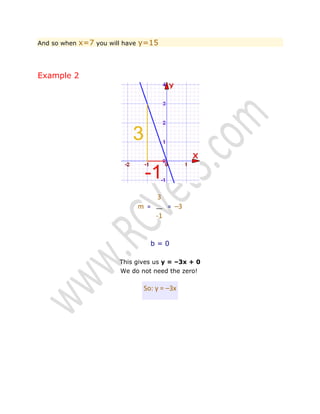
Example 2

3
m =

= –3

-1

b=0
This gives us y = –3x + 0
We do not need the zero!

So: y = –3x
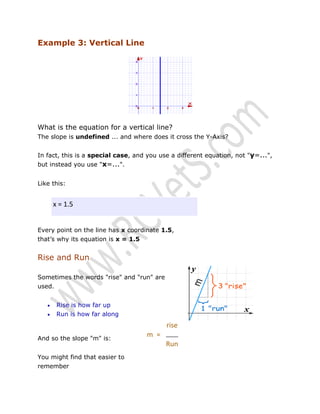
Example 3: Vertical Line

What is the equation for a vertical line?
The slope is undefined ... and where does it cross the Y-Axis?
In fact, this is a special case, and you use a different equation, not "y=...",
but instead you use "x=...".
Like this:

x = 1.5
Every point on the line has x coordinate 1.5,
that’s why its equation is x = 1.5

Rise and Run
Sometimes the words "rise" and "run" are
used.



Rise is how far up
Run is how far along

rise
And so the slope "m" is:
You might find that easier to
remember

m =
Run
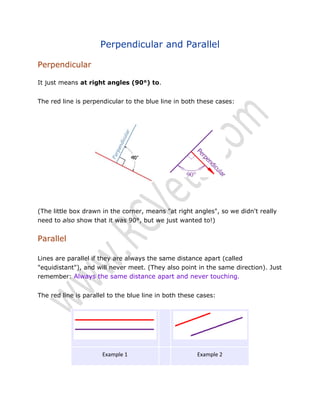
Perpendicular and Parallel
Perpendicular
It just means at right angles (90°) to.
The red line is perpendicular to the blue line in both these cases:

(The little box drawn in the corner, means "at right angles", so we didn't really
need to also show that it was 90°, but we just wanted to!)

Parallel
Lines are parallel if they are always the same distance apart (called
"equidistant"), and will never meet. (They also point in the same direction). Just
remember: Always the same distance apart and never touching.
The red line is parallel to the blue line in both these cases:

Example 1

Example 2
Perpendicular to Parallel
Question: What is the difference between perpendicular and parallel?
Answer: 90 degrees (a right angle)
That's right, if you rotate a perpendicular line by 90° it will become parallel (but
not if it touches!), and the other way around.

Perpendicular ...

Rotate One Line 90°

... Parallel !

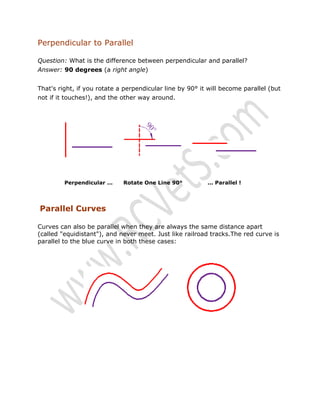
Parallel Curves
Curves can also be parallel when they are always the same distance apart
(called "equidistant"), and never meet. Just like railroad tracks.The red curve is
parallel to the blue curve in both these cases:
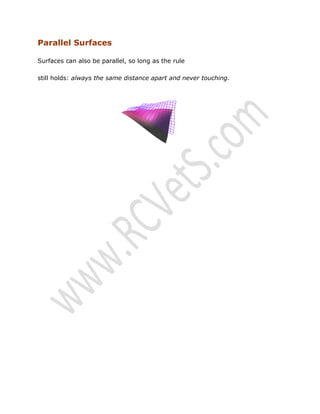
Parallel Surfaces
Surfaces can also be parallel, so long as the rule
still holds: always the same distance apart and never touching.

Math Lecture 11 (Cartesian Coordinates)

  • 1.
    Cartesian Coordinates Cartesian coordinatescan be used to pinpoint where you are on a map or graph. Cartesian Coordinates Using Cartesian Coordinates you mark a point on a graph by how far along and how far up it is: The point (12,5) is 12 units along, and 5 units up. X and Y Axis The left-right (horizontal) direction is commonly called X. The up-down (vertical) direction is commonly called Y.
  • 2.
    Put them togetheron a graph ... ... and you are ready to go Where they cross over is the "0" point, you measure everything from there.   The X Axis runs horizontally through zero The Y Axis runs vertically through zero Axis: The reference line from which distances are measured. The plural of Axis is Axes, and is pronounced ax-eez Example: Point (6,4) is 6 units across (in the x direction), and 4 units up (in the y direction) So (6,4) means: Go along 6 and then go up 4 then "plot the dot".
  • 3.
    Gradient (Slope) ofa Straight Line The Gradient (also called Slope) of a straight line shows how steep a straight line is. Calculate The method to calculate the Gradient is: Divide the change in height by the change in horizontal distance Gradient = Change in Y Change in X Examples: 3 The Gradient of this line = = 3 1 So the Gradient is equal to 1
  • 4.
    4 Gradient = 2 = 2 (The lineis steeper, and so the Gradient is larger) 3 Gradient = 5 = 0.6 (The line is less steep, and so the Gradient is smaller) Positive or Negative? Important:  Starting from the left end of the line and going across to the right is positive (but going across to the left is negative).  Up is positive, and down is negative
  • 5.
    -4 Gradient = = –2 2 Thatline goes down as you move along, so it has a negative Gradient. Straight Across 0 Gradient = = 5 0 A line that goes straight across (Horizontal) has a Gradient of zero. Straight Up and Down Gradient = 3 0 = undefined That last one is a bit tricky ... you can't divide by zero, so a "straight up and down" (Vertical) line's Gradient is "undefined".
  • 6.
    Rise and Run Sometimesthe horizontal change is called "run", and the vertical change is called "rise" or "fall": They are just different words, none of the calculations change. Equation of a Straight Line The equation of a straight line is usually written this way: y = mx + b (or "y = mx + c" in the UK see below)
  • 7.
    What does itstand for? Slope (or Gradient) y = how far up x = how far along m = Slope or Gradient (how steep the line is) b = the Y Intercept (where the line crosses the Y axis) How do you find "m" and "b"?   b is easy: just see where the line crosses the Y axis. m (the Slope) needs some calculation: Change in Y m = Change in X Y Intercept
  • 8.
    Knowing this wecan work out the equation of a straight line: Example 1 2 m = = 2 1 b=1 (where the line crosses the Y-Axis) So: y = 2x + 1 With that equation you can now ... ... choose any value for For example, when x and find the matching value for y x is 1: y = 2×1 + 1 = 3 Check for yourself that x=1 and y=3 is actually on the line. Or we could choose another value for x, such as 7: y = 2×7 + 1 = 15
  • 9.
    And so when x=7you will have y=15 Example 2 3 m = = –3 -1 b=0 This gives us y = –3x + 0 We do not need the zero! So: y = –3x
  • 10.
    Example 3: VerticalLine What is the equation for a vertical line? The slope is undefined ... and where does it cross the Y-Axis? In fact, this is a special case, and you use a different equation, not "y=...", but instead you use "x=...". Like this: x = 1.5 Every point on the line has x coordinate 1.5, that’s why its equation is x = 1.5 Rise and Run Sometimes the words "rise" and "run" are used.   Rise is how far up Run is how far along rise And so the slope "m" is: You might find that easier to remember m = Run
  • 11.
    Perpendicular and Parallel Perpendicular Itjust means at right angles (90°) to. The red line is perpendicular to the blue line in both these cases: (The little box drawn in the corner, means "at right angles", so we didn't really need to also show that it was 90°, but we just wanted to!) Parallel Lines are parallel if they are always the same distance apart (called "equidistant"), and will never meet. (They also point in the same direction). Just remember: Always the same distance apart and never touching. The red line is parallel to the blue line in both these cases: Example 1 Example 2
  • 12.
    Perpendicular to Parallel Question:What is the difference between perpendicular and parallel? Answer: 90 degrees (a right angle) That's right, if you rotate a perpendicular line by 90° it will become parallel (but not if it touches!), and the other way around. Perpendicular ... Rotate One Line 90° ... Parallel ! Parallel Curves Curves can also be parallel when they are always the same distance apart (called "equidistant"), and never meet. Just like railroad tracks.The red curve is parallel to the blue curve in both these cases:
  • 13.
    Parallel Surfaces Surfaces canalso be parallel, so long as the rule still holds: always the same distance apart and never touching.