5.4 Solving Right Triangles
Chapter 5 Trigonometric Functions
Concepts and Objectives
⚫ Solve a right triangle given an angle and a side or two
sides.
⚫ Solve problems involving angles of elevation and
depression.
Solving Right Triangles
⚫ To solve a triangle means to find all of the missing
measures of the angles and sides.
⚫ There are two types of problems: right triangles with
⚫ a side and an angle or
⚫ two sides
⚫ We will use the trig ratios to find the missing pieces. The
key is to match the information we have and need to find
with a corresponding trig ratio.
Solving Right Triangles (cont.)
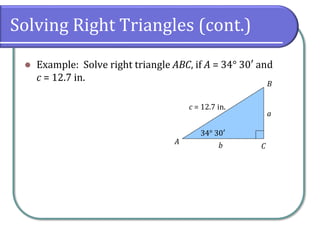
⚫ Example: Solve right triangle ABC, if A = 34° 30′ and
c = 12.7 in.
c = 12.7 in.
34° 30′
A
B
C
a
b
Solving Right Triangles (cont.)
⚫ Example: Solve right triangle ABC, if A = 34° 30′ and
c = 12.7 in.
c = 12.7 in.
34° 30′
A
B
C
a
b
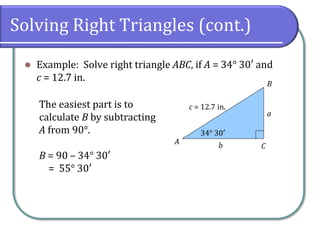
The easiest part is to
calculate B by subtracting
A from 90°.
B = 90 – 34° 30′
= 55° 30′
Solving Right Triangles (cont.)
⚫ Example: Solve right triangle ABC, if A = 34° 30′ and
c = 12.7 in.
c = 12.7 in.
34° 30′
A
B
C
a
b
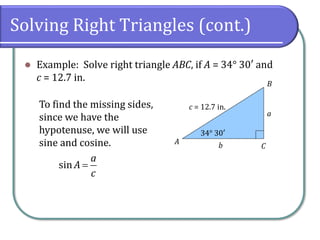
To find the missing sides,
since we have the
hypotenuse, we will use
sine and cosine.
sin
a
A
c
=
Solving Right Triangles (cont.)
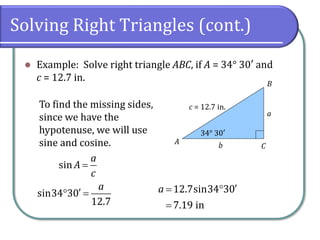
⚫ Example: Solve right triangle ABC, if A = 34° 30′ and
c = 12.7 in.
c = 12.7 in.
34° 30′
A
B
C
a
b
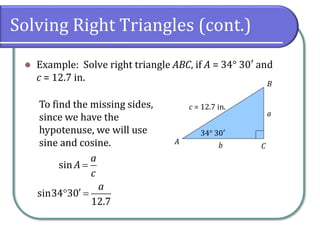
To find the missing sides,
since we have the
hypotenuse, we will use
sine and cosine.
sin
a
A
c
=
sin34 30
12.7
a
 =
Solving Right Triangles (cont.)
⚫ Example: Solve right triangle ABC, if A = 34° 30′ and
c = 12.7 in.
c = 12.7 in.
34° 30′
A
B
C
a
b
To find the missing sides,
since we have the
hypotenuse, we will use
sine and cosine.
sin
a
A
c
=
sin34 30
12.7
a
 = 12.7sin34 30
7.19 in
a = 
=
Solving Right Triangles (cont.)
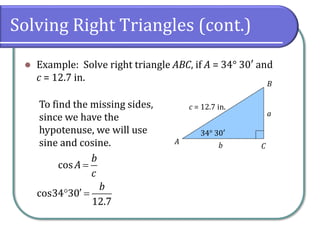
⚫ Example: Solve right triangle ABC, if A = 34° 30′ and
c = 12.7 in.
c = 12.7 in.
34° 30′
A
B
C
a
b
To find the missing sides,
since we have the
hypotenuse, we will use
sine and cosine.
cos
b
A
c
=
cos34 30
12.7
b
 =
Solving Right Triangles (cont.)
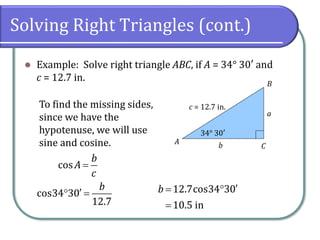
⚫ Example: Solve right triangle ABC, if A = 34° 30′ and
c = 12.7 in.
c = 12.7 in.
34° 30′
A
B
C
a
b
To find the missing sides,
since we have the
hypotenuse, we will use
sine and cosine.
cos
b
A
c
=
cos34 30
12.7
b
 = 12.7cos34 30
10.5 in
b = 
=
Solving Right Triangles (cont.)
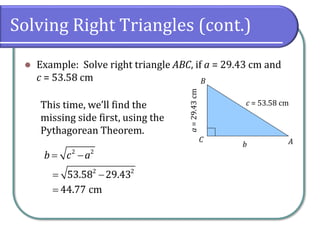
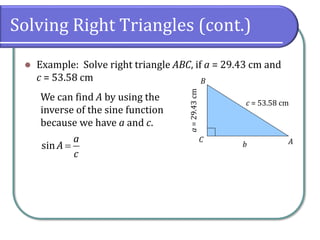
⚫ Example: Solve right triangle ABC, if a = 29.43 cm and
c = 53.58 cm
c = 53.58 cm
a=29.43cm
A
B
C
b
This time, we’ll find the
missing side first, using the
Pythagorean Theorem.
2 2
b c a= −
2 2
53.58 29.43= −
44.77 cm=
Solving Right Triangles (cont.)
⚫ Example: Solve right triangle ABC, if a = 29.43 cm and
c = 53.58 cm
c = 53.58 cm
a=29.43cm
A
B
C
b
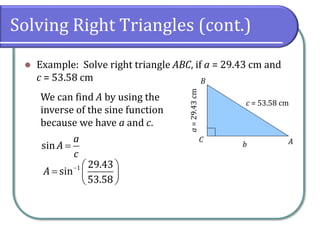
We can find A by using the
inverse of the sine function
because we have a and c.
sin
a
A
c
=
Solving Right Triangles (cont.)
⚫ Example: Solve right triangle ABC, if a = 29.43 cm and
c = 53.58 cm
c = 53.58 cm
a=29.43cm
A
B
C
b
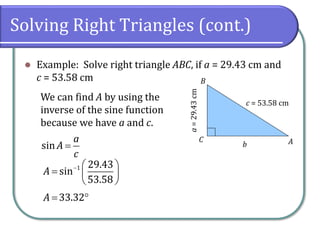
We can find A by using the
inverse of the sine function
because we have a and c.
sin
a
A
c
=
1 29.43
sin
53.58
A −  
=  
 
Solving Right Triangles (cont.)
⚫ Example: Solve right triangle ABC, if a = 29.43 cm and
c = 53.58 cm
c = 53.58 cm
a=29.43cm
A
B
C
b
We can find A by using the
inverse of the sine function
because we have a and c.
sin
a
A
c
=
1 29.43
sin
53.58
A −  
=  
 
33.32A = 
Solving Right Triangles (cont.)
⚫ Example: Solve right triangle ABC, if a = 29.43 cm and
c = 53.58 cm
c = 53.58 cm
a=29.43cm
A
B
C
b
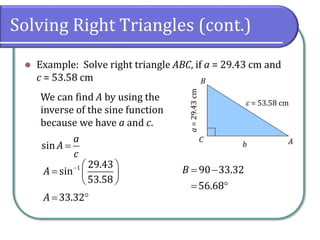
We can find A by using the
inverse of the sine function
because we have a and c.
sin
a
A
c
=
1 29.43
sin
53.58
A −  
=  
 
33.32A = 
90 33.32
56.68
B = −
= 
Elevation and Depression
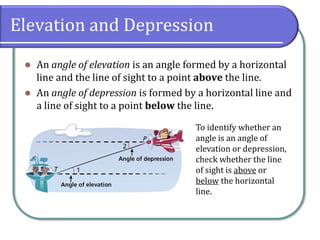
⚫ An angle of elevation is an angle formed by a horizontal
line and the line of sight to a point above the line.
⚫ An angle of depression is formed by a horizontal line and
a line of sight to a point below the line.
To identify whether an
angle is an angle of
elevation or depression,
check whether the line
of sight is above or
below the horizontal
line.
Elevation and Depression (cont.)
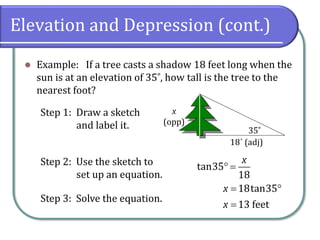
⚫ Example: If a tree casts a shadow 18 feet long when the
sun is at an elevation of 35˚, how tall is the tree to the
nearest foot?
Elevation and Depression (cont.)
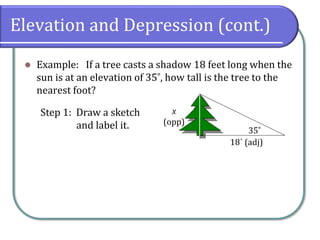
⚫ Example: If a tree casts a shadow 18 feet long when the
sun is at an elevation of 35˚, how tall is the tree to the
nearest foot?
35˚
18´ (adj)
x
(opp)
Step 1: Draw a sketch
and label it.
Elevation and Depression (cont.)
⚫ Example: If a tree casts a shadow 18 feet long when the
sun is at an elevation of 35˚, how tall is the tree to the
nearest foot?
35˚
18´ (adj)
x
(opp)
tan35
18
x
 =
Step 1: Draw a sketch
and label it.
Step 2: Use the sketch to
set up an equation.
Elevation and Depression (cont.)
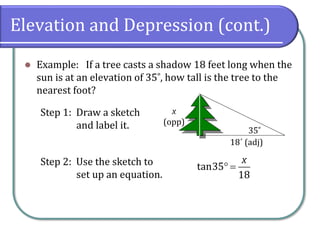
⚫ Example: If a tree casts a shadow 18 feet long when the
sun is at an elevation of 35˚, how tall is the tree to the
nearest foot?
35˚
18´ (adj)
x
(opp)
tan35
18
x
 =
Step 1: Draw a sketch
and label it.
18tan35
13 feet
x
x
= 
=
Step 2: Use the sketch to
set up an equation.
Step 3: Solve the equation.
Elevation and Depression (cont.)
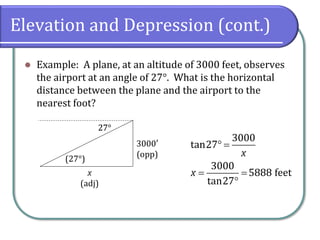
⚫ Example: A plane, at an altitude of 3000 feet, observes
the airport at an angle of 27°. What is the horizontal
distance between the plane and the airport to the
nearest foot?
Elevation and Depression (cont.)
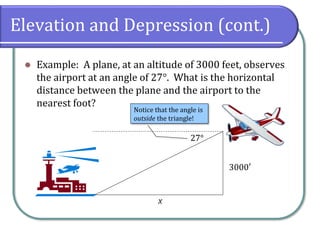
⚫ Example: A plane, at an altitude of 3000 feet, observes
the airport at an angle of 27°. What is the horizontal
distance between the plane and the airport to the
nearest foot?
27°
3000′
x
Notice that the angle is
outside the triangle!
Elevation and Depression (cont.)
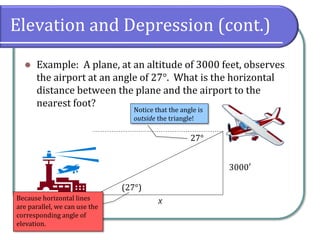
⚫ Example: A plane, at an altitude of 3000 feet, observes
the airport at an angle of 27°. What is the horizontal
distance between the plane and the airport to the
nearest foot?
27°
3000′
x
Notice that the angle is
outside the triangle!
Because horizontal lines
are parallel, we can use the
corresponding angle of
elevation.
(27°)
Elevation and Depression (cont.)
⚫ Example: A plane, at an altitude of 3000 feet, observes
the airport at an angle of 27°. What is the horizontal
distance between the plane and the airport to the
nearest foot?
27°
3000′
(opp)
x
(adj)
(27°)
3000
tan27
x
 =
3000
5888 feet
tan27
x = =

Classwork
⚫ College Algebra
⚫ Page 538: 6-12, page 513: 54-62, page 501: 74-86 (all
evens)

5.4 Solving Right Triangles

  • 1.
    5.4 Solving RightTriangles Chapter 5 Trigonometric Functions
  • 2.
    Concepts and Objectives ⚫Solve a right triangle given an angle and a side or two sides. ⚫ Solve problems involving angles of elevation and depression.
  • 3.
    Solving Right Triangles ⚫To solve a triangle means to find all of the missing measures of the angles and sides. ⚫ There are two types of problems: right triangles with ⚫ a side and an angle or ⚫ two sides ⚫ We will use the trig ratios to find the missing pieces. The key is to match the information we have and need to find with a corresponding trig ratio.
  • 4.
    Solving Right Triangles(cont.) ⚫ Example: Solve right triangle ABC, if A = 34° 30′ and c = 12.7 in. c = 12.7 in. 34° 30′ A B C a b
  • 5.
    Solving Right Triangles(cont.) ⚫ Example: Solve right triangle ABC, if A = 34° 30′ and c = 12.7 in. c = 12.7 in. 34° 30′ A B C a b The easiest part is to calculate B by subtracting A from 90°. B = 90 – 34° 30′ = 55° 30′
  • 6.
    Solving Right Triangles(cont.) ⚫ Example: Solve right triangle ABC, if A = 34° 30′ and c = 12.7 in. c = 12.7 in. 34° 30′ A B C a b To find the missing sides, since we have the hypotenuse, we will use sine and cosine. sin a A c =
  • 7.
    Solving Right Triangles(cont.) ⚫ Example: Solve right triangle ABC, if A = 34° 30′ and c = 12.7 in. c = 12.7 in. 34° 30′ A B C a b To find the missing sides, since we have the hypotenuse, we will use sine and cosine. sin a A c = sin34 30 12.7 a  =
  • 8.
    Solving Right Triangles(cont.) ⚫ Example: Solve right triangle ABC, if A = 34° 30′ and c = 12.7 in. c = 12.7 in. 34° 30′ A B C a b To find the missing sides, since we have the hypotenuse, we will use sine and cosine. sin a A c = sin34 30 12.7 a  = 12.7sin34 30 7.19 in a =  =
  • 9.
    Solving Right Triangles(cont.) ⚫ Example: Solve right triangle ABC, if A = 34° 30′ and c = 12.7 in. c = 12.7 in. 34° 30′ A B C a b To find the missing sides, since we have the hypotenuse, we will use sine and cosine. cos b A c = cos34 30 12.7 b  =
  • 10.
    Solving Right Triangles(cont.) ⚫ Example: Solve right triangle ABC, if A = 34° 30′ and c = 12.7 in. c = 12.7 in. 34° 30′ A B C a b To find the missing sides, since we have the hypotenuse, we will use sine and cosine. cos b A c = cos34 30 12.7 b  = 12.7cos34 30 10.5 in b =  =
  • 11.
    Solving Right Triangles(cont.) ⚫ Example: Solve right triangle ABC, if a = 29.43 cm and c = 53.58 cm c = 53.58 cm a=29.43cm A B C b This time, we’ll find the missing side first, using the Pythagorean Theorem. 2 2 b c a= − 2 2 53.58 29.43= − 44.77 cm=
  • 12.
    Solving Right Triangles(cont.) ⚫ Example: Solve right triangle ABC, if a = 29.43 cm and c = 53.58 cm c = 53.58 cm a=29.43cm A B C b We can find A by using the inverse of the sine function because we have a and c. sin a A c =
  • 13.
    Solving Right Triangles(cont.) ⚫ Example: Solve right triangle ABC, if a = 29.43 cm and c = 53.58 cm c = 53.58 cm a=29.43cm A B C b We can find A by using the inverse of the sine function because we have a and c. sin a A c = 1 29.43 sin 53.58 A −   =    
  • 14.
    Solving Right Triangles(cont.) ⚫ Example: Solve right triangle ABC, if a = 29.43 cm and c = 53.58 cm c = 53.58 cm a=29.43cm A B C b We can find A by using the inverse of the sine function because we have a and c. sin a A c = 1 29.43 sin 53.58 A −   =     33.32A = 
  • 15.
    Solving Right Triangles(cont.) ⚫ Example: Solve right triangle ABC, if a = 29.43 cm and c = 53.58 cm c = 53.58 cm a=29.43cm A B C b We can find A by using the inverse of the sine function because we have a and c. sin a A c = 1 29.43 sin 53.58 A −   =     33.32A =  90 33.32 56.68 B = − = 
  • 16.
    Elevation and Depression ⚫An angle of elevation is an angle formed by a horizontal line and the line of sight to a point above the line. ⚫ An angle of depression is formed by a horizontal line and a line of sight to a point below the line. To identify whether an angle is an angle of elevation or depression, check whether the line of sight is above or below the horizontal line.
  • 17.
    Elevation and Depression(cont.) ⚫ Example: If a tree casts a shadow 18 feet long when the sun is at an elevation of 35˚, how tall is the tree to the nearest foot?
  • 18.
    Elevation and Depression(cont.) ⚫ Example: If a tree casts a shadow 18 feet long when the sun is at an elevation of 35˚, how tall is the tree to the nearest foot? 35˚ 18´ (adj) x (opp) Step 1: Draw a sketch and label it.
  • 19.
    Elevation and Depression(cont.) ⚫ Example: If a tree casts a shadow 18 feet long when the sun is at an elevation of 35˚, how tall is the tree to the nearest foot? 35˚ 18´ (adj) x (opp) tan35 18 x  = Step 1: Draw a sketch and label it. Step 2: Use the sketch to set up an equation.
  • 20.
    Elevation and Depression(cont.) ⚫ Example: If a tree casts a shadow 18 feet long when the sun is at an elevation of 35˚, how tall is the tree to the nearest foot? 35˚ 18´ (adj) x (opp) tan35 18 x  = Step 1: Draw a sketch and label it. 18tan35 13 feet x x =  = Step 2: Use the sketch to set up an equation. Step 3: Solve the equation.
  • 21.
    Elevation and Depression(cont.) ⚫ Example: A plane, at an altitude of 3000 feet, observes the airport at an angle of 27°. What is the horizontal distance between the plane and the airport to the nearest foot?
  • 22.
    Elevation and Depression(cont.) ⚫ Example: A plane, at an altitude of 3000 feet, observes the airport at an angle of 27°. What is the horizontal distance between the plane and the airport to the nearest foot? 27° 3000′ x Notice that the angle is outside the triangle!
  • 23.
    Elevation and Depression(cont.) ⚫ Example: A plane, at an altitude of 3000 feet, observes the airport at an angle of 27°. What is the horizontal distance between the plane and the airport to the nearest foot? 27° 3000′ x Notice that the angle is outside the triangle! Because horizontal lines are parallel, we can use the corresponding angle of elevation. (27°)
  • 24.
    Elevation and Depression(cont.) ⚫ Example: A plane, at an altitude of 3000 feet, observes the airport at an angle of 27°. What is the horizontal distance between the plane and the airport to the nearest foot? 27° 3000′ (opp) x (adj) (27°) 3000 tan27 x  = 3000 5888 feet tan27 x = = 
  • 25.
    Classwork ⚫ College Algebra ⚫Page 538: 6-12, page 513: 54-62, page 501: 74-86 (all evens)