Beginning Calculus
- Chain Rule and Higher Derivatives -
Shahrizal Shamsuddin Norashiqin Mohd Idrus
Department of Mathematics,
FSMT - UPSI
(LECTURE SLIDES SERIES)
VillaRINO DoMath, FSMT-UPSI
(D4) Chain Rule and Higher Derivatives 1 / 11
The Chain Rule Higher Derivatives
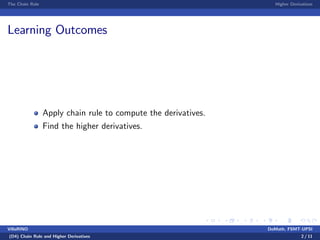
Learning Outcomes
Apply chain rule to compute the derivatives.
Find the higher derivatives.
VillaRINO DoMath, FSMT-UPSI
(D4) Chain Rule and Higher Derivatives 2 / 11
The Chain Rule Higher Derivatives
The Chain Rule
De…nition 1
If g is di¤erentiable at x and f is di¤erentiable at g (x) , then f g is
di¤erentiable at x and
(f g)0
(x) = f 0
[g (x)] g0
(x) (1)
(f g) (x) = f [g (x)] is considered as the "outside function" and
g (x) is the "inside function".
The derivative of (f g) (x) is the derivative of the outside function
multiply the derivative of the inside function.
In Leibniz notation, if y = f (u) and u = g (x) are both
di¤erentiable functions, then
dy
dx
=
dy
du
du
dx
(2)
VillaRINO DoMath, FSMT-UPSI
(D4) Chain Rule and Higher Derivatives 3 / 11
The Chain Rule Higher Derivatives
Example
Let h (x) = x3 1
100
. Note that:
h (x) = (f g) (x) = f [g (x)]
where f (x) = x100 is the outside function and g (x) = x3 1 is the
inside function. So,
h0
(x) = (f g)0
(x)
= f 0
[g (x)] g0
(x)
= 100 x3
1
99
3x2
= 300x2
x3
1
99
VillaRINO DoMath, FSMT-UPSI
(D4) Chain Rule and Higher Derivatives 4 / 11
The Chain Rule Higher Derivatives
Example - continue
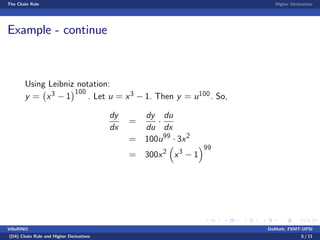
Using Leibniz notation:
y = x3 1
100
. Let u = x3 1. Then y = u100. So,
dy
dx
=
dy
du
du
dx
= 100u99
3x2
= 300x2
x3
1
99
VillaRINO DoMath, FSMT-UPSI
(D4) Chain Rule and Higher Derivatives 5 / 11
The Chain Rule Higher Derivatives
Example
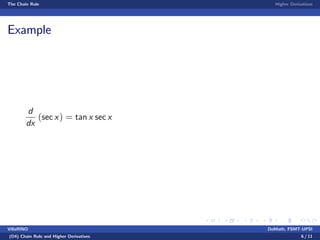
d
dx
(sec x) = tan x sec x
VillaRINO DoMath, FSMT-UPSI
(D4) Chain Rule and Higher Derivatives 6 / 11
The Chain Rule Higher Derivatives
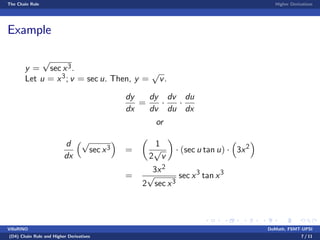
Example
y =
p
sec x3.
Let u = x3; v = sec u. Then, y =
p
v.
dy
dx
=
dy
dv
dv
du
du
dx
or
d
dx
p
sec x3 =
1
2
p
v
(sec u tan u) 3x2
=
3x2
2
p
sec x3
sec x3
tan x3
VillaRINO DoMath, FSMT-UPSI
(D4) Chain Rule and Higher Derivatives 7 / 11
The Chain Rule Higher Derivatives
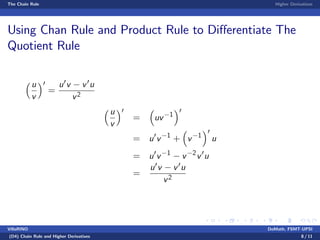
Using Chan Rule and Product Rule to Di¤erentiate The
Quotient Rule
u
v
0
=
u0v v0u
v2
u
v
0
= uv 1
0
= u0
v 1
+ v 1
0
u
= u0
v 1
v 2
v0
u
=
u0v v0u
v2
VillaRINO DoMath, FSMT-UPSI
(D4) Chain Rule and Higher Derivatives 8 / 11
The Chain Rule Higher Derivatives
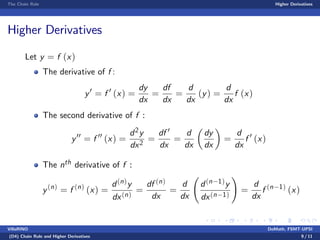
Higher Derivatives
Let y = f (x)
The derivative of f :
y0
= f 0
(x) =
dy
dx
=
df
dx
=
d
dx
(y) =
d
dx
f (x)
The second derivative of f :
y00
= f 00
(x) =
d2y
dx2
=
df 0
dx
=
d
dx
dy
dx
=
d
dx
f 0
(x)
The nth derivative of f :
y(n)
= f (n)
(x) =
d(n)y
dx(n)
=
df (n)
dx
=
d
dx
d(n 1)y
dx(n 1)
!
=
d
dx
f (n 1)
(x)
VillaRINO DoMath, FSMT-UPSI
(D4) Chain Rule and Higher Derivatives 9 / 11
The Chain Rule Higher Derivatives
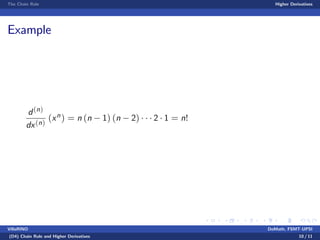
Example
d(n)
dx(n)
(xn) = n (n 1) (n 2) 2 1 = n!
VillaRINO DoMath, FSMT-UPSI
(D4) Chain Rule and Higher Derivatives 10 / 11
The Chain Rule Higher Derivatives
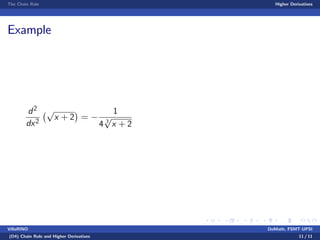
Example
d2
dx2
p
x + 2 =
1
4 3
p
x + 2
VillaRINO DoMath, FSMT-UPSI
(D4) Chain Rule and Higher Derivatives 11 / 11

Benginning Calculus Lecture notes 5 - chain rule

  • 1.
    Beginning Calculus - ChainRule and Higher Derivatives - Shahrizal Shamsuddin Norashiqin Mohd Idrus Department of Mathematics, FSMT - UPSI (LECTURE SLIDES SERIES) VillaRINO DoMath, FSMT-UPSI (D4) Chain Rule and Higher Derivatives 1 / 11
  • 2.
    The Chain RuleHigher Derivatives Learning Outcomes Apply chain rule to compute the derivatives. Find the higher derivatives. VillaRINO DoMath, FSMT-UPSI (D4) Chain Rule and Higher Derivatives 2 / 11
  • 3.
    The Chain RuleHigher Derivatives The Chain Rule De…nition 1 If g is di¤erentiable at x and f is di¤erentiable at g (x) , then f g is di¤erentiable at x and (f g)0 (x) = f 0 [g (x)] g0 (x) (1) (f g) (x) = f [g (x)] is considered as the "outside function" and g (x) is the "inside function". The derivative of (f g) (x) is the derivative of the outside function multiply the derivative of the inside function. In Leibniz notation, if y = f (u) and u = g (x) are both di¤erentiable functions, then dy dx = dy du du dx (2) VillaRINO DoMath, FSMT-UPSI (D4) Chain Rule and Higher Derivatives 3 / 11
  • 4.
    The Chain RuleHigher Derivatives Example Let h (x) = x3 1 100 . Note that: h (x) = (f g) (x) = f [g (x)] where f (x) = x100 is the outside function and g (x) = x3 1 is the inside function. So, h0 (x) = (f g)0 (x) = f 0 [g (x)] g0 (x) = 100 x3 1 99 3x2 = 300x2 x3 1 99 VillaRINO DoMath, FSMT-UPSI (D4) Chain Rule and Higher Derivatives 4 / 11
  • 5.
    The Chain RuleHigher Derivatives Example - continue Using Leibniz notation: y = x3 1 100 . Let u = x3 1. Then y = u100. So, dy dx = dy du du dx = 100u99 3x2 = 300x2 x3 1 99 VillaRINO DoMath, FSMT-UPSI (D4) Chain Rule and Higher Derivatives 5 / 11
  • 6.
    The Chain RuleHigher Derivatives Example d dx (sec x) = tan x sec x VillaRINO DoMath, FSMT-UPSI (D4) Chain Rule and Higher Derivatives 6 / 11
  • 7.
    The Chain RuleHigher Derivatives Example y = p sec x3. Let u = x3; v = sec u. Then, y = p v. dy dx = dy dv dv du du dx or d dx p sec x3 = 1 2 p v (sec u tan u) 3x2 = 3x2 2 p sec x3 sec x3 tan x3 VillaRINO DoMath, FSMT-UPSI (D4) Chain Rule and Higher Derivatives 7 / 11
  • 8.
    The Chain RuleHigher Derivatives Using Chan Rule and Product Rule to Di¤erentiate The Quotient Rule u v 0 = u0v v0u v2 u v 0 = uv 1 0 = u0 v 1 + v 1 0 u = u0 v 1 v 2 v0 u = u0v v0u v2 VillaRINO DoMath, FSMT-UPSI (D4) Chain Rule and Higher Derivatives 8 / 11
  • 9.
    The Chain RuleHigher Derivatives Higher Derivatives Let y = f (x) The derivative of f : y0 = f 0 (x) = dy dx = df dx = d dx (y) = d dx f (x) The second derivative of f : y00 = f 00 (x) = d2y dx2 = df 0 dx = d dx dy dx = d dx f 0 (x) The nth derivative of f : y(n) = f (n) (x) = d(n)y dx(n) = df (n) dx = d dx d(n 1)y dx(n 1) ! = d dx f (n 1) (x) VillaRINO DoMath, FSMT-UPSI (D4) Chain Rule and Higher Derivatives 9 / 11
  • 10.
    The Chain RuleHigher Derivatives Example d(n) dx(n) (xn) = n (n 1) (n 2) 2 1 = n! VillaRINO DoMath, FSMT-UPSI (D4) Chain Rule and Higher Derivatives 10 / 11
  • 11.
    The Chain RuleHigher Derivatives Example d2 dx2 p x + 2 = 1 4 3 p x + 2 VillaRINO DoMath, FSMT-UPSI (D4) Chain Rule and Higher Derivatives 11 / 11