1.7 Inequalities
Chapter 1 Equations and Inequalities
Concepts and Objectives
 Solve linear and quadratic inequalities
 Solve three-part inequalities
 Find the break-even point
 Solve rational inequalities
Inequalities
 An inequality states that one expression is greater than,
greater than or equal to, less than, or less than or equal
to another expression.
 As with equations, a value of the variable for which the
inequality is true is a solution of the inequality; the set of
all solutions is the solution set of the inequality.
 Inequalities are solved in the same manner equations
are solved with one difference—you must reverse the
direction of the symbol when multiplying or dividing by
a negative number.
Linear Inequalities
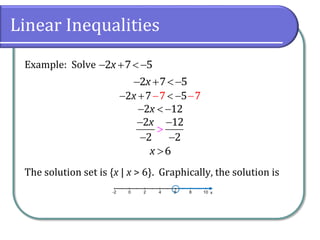
Example: Solve   2 7 5x
Linear Inequalities
Example: Solve
The solution set is {x | x > 6}. Graphically, the solution is
  2 7 5x
  2 7 5x
7 72 7 5x   
  2 12x

 
 
2 12
2 2
x
6x
Intervals
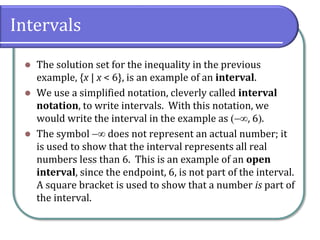
 The solution set for the inequality in the previous
example, {x | x < 6}, is an example of an interval.
 We use a simplified notation, cleverly called interval
notation, to write intervals. With this notation, we
would write the interval in the example as , 6.
 The symbol  does not represent an actual number; it
is used to show that the interval represents all real
numbers less than 6. This is an example of an open
interval, since the endpoint, 6, is not part of the interval.
A square bracket is used to show that a number is part of
the interval.
Intervals (cont.)
ba
ba
ba ba
ba
ba
Name of
Interval
Notation
Inequality
Description
Number Line Representation
finite, open
(a, b) a < x < b
finite, closed
[a, b] a  x  b
finite, half-
open
(a, b]
[a, b)
a < x  b
a  x < b
infinite, open
(a, )
(-, b)
a < x < 
- < x < b
infinite,
closed
[a, )
(-, b]
a  x < 
-< x  b
ba
ba
ba
ba
b
a
b
a
Compound Inequalities
 Three-part or Compound Inequalities are solved by
working with all three expressions at the same time.
 The middle expression is between the outer expressions.
 Example: Solve   1 6 8 4x
Compound Inequalities (cont.)
 Example: Solve
The solution set is the interval
  1 6 8 4x
81 88 86 4x    
 9 6 12x
6 6 6
9 6 12x
 
 
3
2
2
x
 
  
3
,2
2
Break-Even
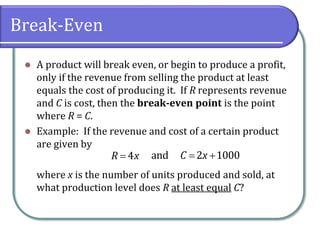
 A product will break even, or begin to produce a profit,
only if the revenue from selling the product at least
equals the cost of producing it. If R represents revenue
and C is cost, then the break-even point is the point
where R = C.
 Example: If the revenue and cost of a certain product
are given by
where x is the number of units produced and sold, at
what production level does R at least equal C?
4R x and 2 1000C x 
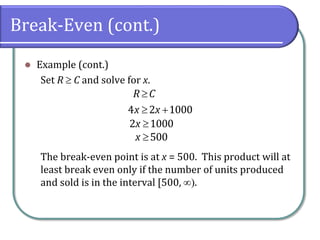
Break-Even (cont.)
 Example (cont.)
Set R  C and solve for x.
The break-even point is at x = 500. This product will at
least break even only if the number of units produced
and sold is in the interval [500, .
4 2 1000
R C
x x

 
2 1000x 
500x 
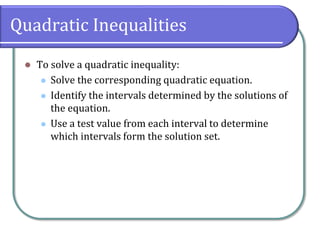
Quadratic Inequalities
 To solve a quadratic inequality:
 Solve the corresponding quadratic equation.
 Identify the intervals determined by the solutions of
the equation.
 Use a test value from each interval to determine
which intervals form the solution set.
Quadratic Inequalities (cont.)
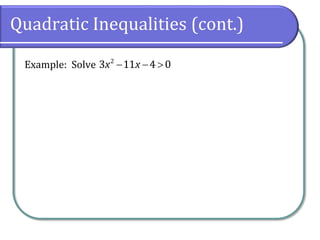
Example: Solve   2
3 11 4 0x x
Quadratic Inequalities (cont.)
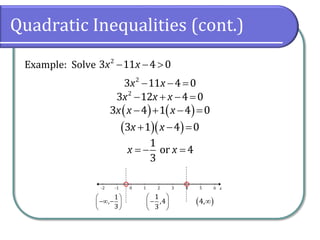
Example: Solve   2
3 11 4 0x x
  2
3 11 4 0x x
   2
3 12 4 0x x x
      3 4 1 4 0x x x
    3 1 4 0x x
  
1
or 4
3
x x
 
  
 
1
,
3
 
 
 
1
,4
3
 4,
Quadratic Inequalities (cont.)
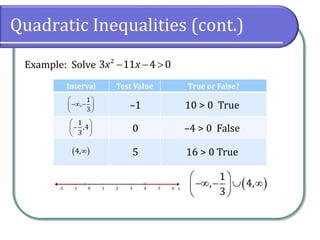
Example: Solve   2
3 11 4 0x x
Interval Test Value True or False?
 
  
 
1
,
3
 
 
 
1
,4
3
 4,
–1
0
5
10 > 0 True
–4 > 0 False
16 > 0 True
  
    
 
1
, 4,
3
Rational Inequalities
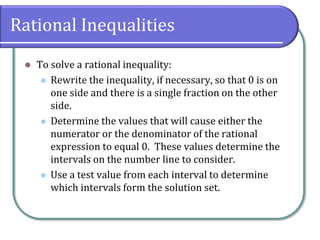
 To solve a rational inequality:
 Rewrite the inequality, if necessary, so that 0 is on
one side and there is a single fraction on the other
side.
 Determine the values that will cause either the
numerator or the denominator of the rational
expression to equal 0. These values determine the
intervals on the number line to consider.
 Use a test value from each interval to determine
which intervals form the solution set.
Rational Inequalities (cont.)
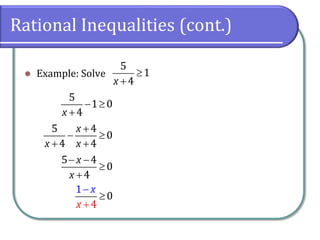
 Example: Solve
5
1
4x


5
1 0
4x
 

5 4
0
4 4
x
x x

 
 
5 4
0
4
x
x
 


1
4
0
x
x



Rational Inequalities (cont.)
 Example: Solve
5
1
4x


5
1 0
4x
 

5 4
0
4 4
x
x x

 
 
5 4
0
4
x
x
 


1
4
0
x
x



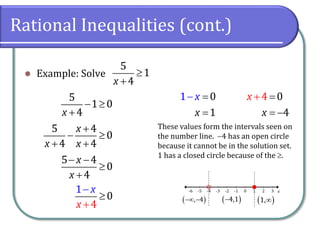
1 0
1x
x 

0
4
4
x
x 
 
 , 4   4,1  1,
These values form the intervals seen on
the number line. 4 has an open circle
because it cannot be in the solution set.
1 has a closed circle because of the .
Rational Inequalities (cont.)
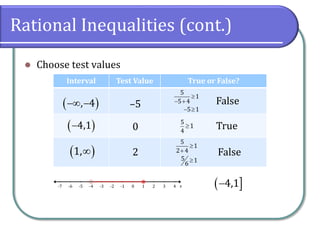
 Choose test values
Interval Test Value True or False?
 , 4 
 4,1
 1,
–5
0
2
False
True
False
 4,1
5
1
5 4
5 1

 
 
5
4
1
5
1
2 4
5 1
6



Classwork
 1.7 Assignment (College Algebra)
 Page 155: 14-38 (even), pg. 143: 36-68 (4),
pg. 130: 40-48 (even)
 1.7 Classwork Check
 Quiz 1.6

1.7 Inequalities

  • 1.
    1.7 Inequalities Chapter 1Equations and Inequalities
  • 2.
    Concepts and Objectives Solve linear and quadratic inequalities  Solve three-part inequalities  Find the break-even point  Solve rational inequalities
  • 3.
    Inequalities  An inequalitystates that one expression is greater than, greater than or equal to, less than, or less than or equal to another expression.  As with equations, a value of the variable for which the inequality is true is a solution of the inequality; the set of all solutions is the solution set of the inequality.  Inequalities are solved in the same manner equations are solved with one difference—you must reverse the direction of the symbol when multiplying or dividing by a negative number.
  • 4.
  • 5.
    Linear Inequalities Example: Solve Thesolution set is {x | x > 6}. Graphically, the solution is   2 7 5x   2 7 5x 7 72 7 5x      2 12x      2 12 2 2 x 6x
  • 6.
    Intervals  The solutionset for the inequality in the previous example, {x | x < 6}, is an example of an interval.  We use a simplified notation, cleverly called interval notation, to write intervals. With this notation, we would write the interval in the example as , 6.  The symbol  does not represent an actual number; it is used to show that the interval represents all real numbers less than 6. This is an example of an open interval, since the endpoint, 6, is not part of the interval. A square bracket is used to show that a number is part of the interval.
  • 7.
    Intervals (cont.) ba ba ba ba ba ba Nameof Interval Notation Inequality Description Number Line Representation finite, open (a, b) a < x < b finite, closed [a, b] a  x  b finite, half- open (a, b] [a, b) a < x  b a  x < b infinite, open (a, ) (-, b) a < x <  - < x < b infinite, closed [a, ) (-, b] a  x <  -< x  b ba ba ba ba b a b a
  • 8.
    Compound Inequalities  Three-partor Compound Inequalities are solved by working with all three expressions at the same time.  The middle expression is between the outer expressions.  Example: Solve   1 6 8 4x
  • 9.
    Compound Inequalities (cont.) Example: Solve The solution set is the interval   1 6 8 4x 81 88 86 4x      9 6 12x 6 6 6 9 6 12x     3 2 2 x      3 ,2 2
  • 10.
    Break-Even  A productwill break even, or begin to produce a profit, only if the revenue from selling the product at least equals the cost of producing it. If R represents revenue and C is cost, then the break-even point is the point where R = C.  Example: If the revenue and cost of a certain product are given by where x is the number of units produced and sold, at what production level does R at least equal C? 4R x and 2 1000C x 
  • 11.
    Break-Even (cont.)  Example(cont.) Set R  C and solve for x. The break-even point is at x = 500. This product will at least break even only if the number of units produced and sold is in the interval [500, . 4 2 1000 R C x x    2 1000x  500x 
  • 12.
    Quadratic Inequalities  Tosolve a quadratic inequality:  Solve the corresponding quadratic equation.  Identify the intervals determined by the solutions of the equation.  Use a test value from each interval to determine which intervals form the solution set.
  • 13.
    Quadratic Inequalities (cont.) Example:Solve   2 3 11 4 0x x
  • 14.
    Quadratic Inequalities (cont.) Example:Solve   2 3 11 4 0x x   2 3 11 4 0x x    2 3 12 4 0x x x       3 4 1 4 0x x x     3 1 4 0x x    1 or 4 3 x x        1 , 3       1 ,4 3  4,
  • 15.
    Quadratic Inequalities (cont.) Example:Solve   2 3 11 4 0x x Interval Test Value True or False?        1 , 3       1 ,4 3  4, –1 0 5 10 > 0 True –4 > 0 False 16 > 0 True           1 , 4, 3
  • 16.
    Rational Inequalities  Tosolve a rational inequality:  Rewrite the inequality, if necessary, so that 0 is on one side and there is a single fraction on the other side.  Determine the values that will cause either the numerator or the denominator of the rational expression to equal 0. These values determine the intervals on the number line to consider.  Use a test value from each interval to determine which intervals form the solution set.
  • 17.
    Rational Inequalities (cont.) Example: Solve 5 1 4x   5 1 0 4x    5 4 0 4 4 x x x      5 4 0 4 x x     1 4 0 x x   
  • 18.
    Rational Inequalities (cont.) Example: Solve 5 1 4x   5 1 0 4x    5 4 0 4 4 x x x      5 4 0 4 x x     1 4 0 x x    1 0 1x x   0 4 4 x x     , 4   4,1  1, These values form the intervals seen on the number line. 4 has an open circle because it cannot be in the solution set. 1 has a closed circle because of the .
  • 19.
    Rational Inequalities (cont.) Choose test values Interval Test Value True or False?  , 4   4,1  1, –5 0 2 False True False  4,1 5 1 5 4 5 1      5 4 1 5 1 2 4 5 1 6   
  • 20.
    Classwork  1.7 Assignment(College Algebra)  Page 155: 14-38 (even), pg. 143: 36-68 (4), pg. 130: 40-48 (even)  1.7 Classwork Check  Quiz 1.6