Graphing Quadratic Functions
MA.912.A.2.6 Identify and graph functions
MA.912.A.7.6 Identify the axis of symmetry,
vertex, domain, range, and intercept(s) for a
given parabola
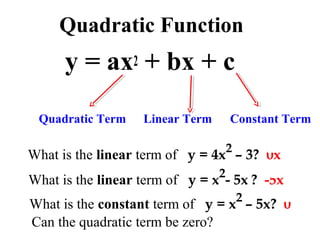
Quadratic Function
y = ax2 + bx + c
Quadratic Term Linear Term Constant Term
What is the linear term of y = 4x2
– 3? 0x
What is the linear term of y = x2
- 5x ? -5x
What is the constant term of y = x2
– 5x? 0
Can the quadratic term be zero? No!
Quadratic Functions
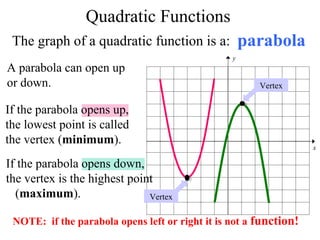
The graph of a quadratic function is a:
A parabola can open up
or down.
If the parabola opens up,
the lowest point is called
the vertex (minimum).
If the parabola opens down,
the vertex is the highest point
(maximum).
NOTE: if the parabola opens left or right it is not a function!
y
x
Vertex
Vertex
parabola
y = ax2
+ bx + c
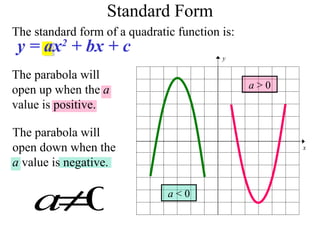
The parabola will
open down when the
a value is negative.
The parabola will
open up when the a
value is positive.
Standard Form
y
x
The standard form of a quadratic function is:
a > 0
a < 0
a≠0
y
x
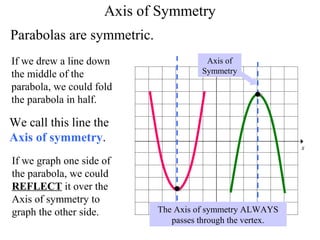
Axis of
Symmetry
Axis of Symmetry
Parabolas are symmetric.
If we drew a line down
the middle of the
parabola, we could fold
the parabola in half.
We call this line the
Axis of symmetry.
The Axis of symmetry ALWAYS
passes through the vertex.
If we graph one side of
the parabola, we could
REFLECT it over the
Axis of symmetry to
graph the other side.
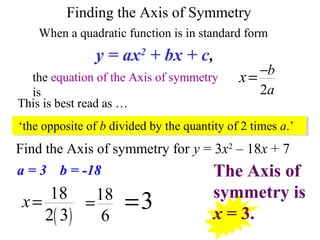
Find the Axis of symmetry for y = 3x2
– 18x + 7
Finding the Axis of Symmetry
When a quadratic function is in standard form
the equation of the Axis of symmetry
is
y = ax2
+ bx + c,
2
b
a
x −
=
This is best read as …
‘the opposite of b divided by the quantity of 2 times a.’
( )
18
2 3
x= 18
6
= 3=
The Axis of
symmetry is
x = 3.
a = 3 b = -18
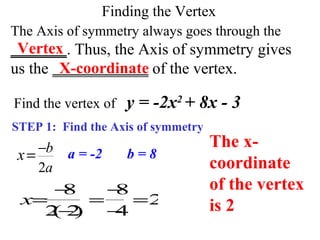
Finding the Vertex
The Axis of symmetry always goes through the
_______. Thus, the Axis of symmetry gives
us the ____________ of the vertex.
STEP 1: Find the Axis of symmetry
Vertex
Find the vertex of y = -2x2
+ 8x - 3
2
b
a
x −
= a = -2 b = 8
x=
−8
2(−2)
=
−8
−4
=2
X-coordinate
The x-
coordinate
of the vertex
is 2
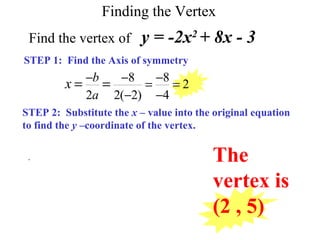
Finding the Vertex
STEP 1: Find the Axis of symmetry
STEP 2: Substitute the x – value into the original equation
to find the y –coordinate of the vertex.
8 8
2
2 2( 2) 4
b
a
x − − −
= =
− −
= =
The
vertex is
(2 , 5)
Find the vertex of y = -2x2
+ 8x - 3
y = −2 2( )
2
+8 2( )− 3
= −2 4( )+16 − 3
= −8+16 −3
= 5
Graphing a Quadratic Function
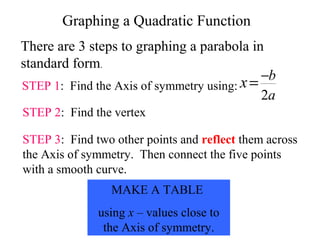
There are 3 steps to graphing a parabola in
standard form.
STEP 1: Find the Axis of symmetry using:
STEP 2: Find the vertex
STEP 3: Find two other points and reflect them across
the Axis of symmetry. Then connect the five points
with a smooth curve.
MAKE A TABLE
using x – values close to
the Axis of symmetry.
2
b
a
x −
=
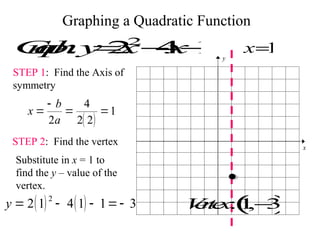
STEP 1: Find the Axis of
symmetry
( )
4
1
2 2 2
b
x
a
-
= = =
y
x
Graph:y=2x2
−4x−1
Graphing a Quadratic Function
STEP 2: Find the vertex
Substitute in x = 1 to
find the y – value of the
vertex.
( ) ( )2
2 1 4 1 1 3y = - - =- Vertex:1,−3( )
x=1
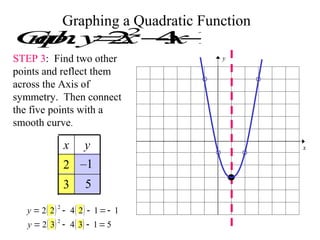
5
–1
( ) ( )2
2 3 4 3 1 5y = - - =
STEP 3: Find two other
points and reflect them
across the Axis of
symmetry. Then connect
the five points with a
smooth curve.
y
x
( ) ( )2
2 2 4 2 1 1y = - - =-
3
2
yx
Graphing a Quadratic Function
Graph:y=2x2
−4x−1
y
x
Y-intercept of a Quadratic Function
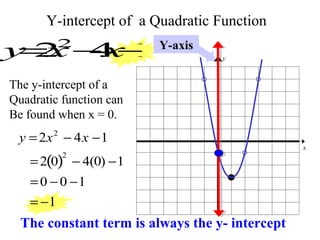
y=2x2
−4x−1Y-axis
The y-intercept of a
Quadratic function can
Be found when x = 0.
y =2x2
− 4x −1
=2 0( )2
− 4(0) −1
=0 −0 −1
= −1
The constant term is always the y- intercept
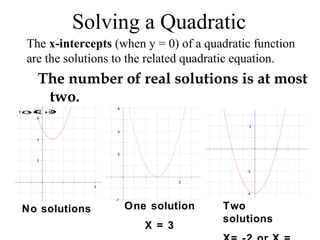
The number of real solutions is at most
two.
Solving a Quadratic
No solutions
6
4
2
-2
5
f x()= x2-2 ⋅x( )+5
6
4
2
-2
5
2
-2
-4
-5 5
One solution
X = 3
Two
solutions
The x-intercepts (when y = 0) of a quadratic function
are the solutions to the related quadratic equation.
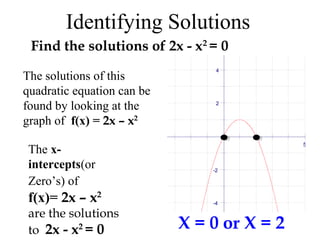
Identifying Solutions
4
2
-2
-4
5
X = 0 or X = 2
Find the solutions of 2x - x2
= 0
The solutions of this
quadratic equation can be
found by looking at the
graph of f(x) = 2x – x2
The x-
intercepts(or
Zero’s) of
f(x)= 2x – x2
are the solutions
to 2x - x2
= 0

Graphing Quadratics

  • 1.
    Graphing Quadratic Functions MA.912.A.2.6Identify and graph functions MA.912.A.7.6 Identify the axis of symmetry, vertex, domain, range, and intercept(s) for a given parabola
  • 2.
    Quadratic Function y =ax2 + bx + c Quadratic Term Linear Term Constant Term What is the linear term of y = 4x2 – 3? 0x What is the linear term of y = x2 - 5x ? -5x What is the constant term of y = x2 – 5x? 0 Can the quadratic term be zero? No!
  • 3.
    Quadratic Functions The graphof a quadratic function is a: A parabola can open up or down. If the parabola opens up, the lowest point is called the vertex (minimum). If the parabola opens down, the vertex is the highest point (maximum). NOTE: if the parabola opens left or right it is not a function! y x Vertex Vertex parabola
  • 4.
    y = ax2 +bx + c The parabola will open down when the a value is negative. The parabola will open up when the a value is positive. Standard Form y x The standard form of a quadratic function is: a > 0 a < 0 a≠0
  • 5.
    y x Axis of Symmetry Axis ofSymmetry Parabolas are symmetric. If we drew a line down the middle of the parabola, we could fold the parabola in half. We call this line the Axis of symmetry. The Axis of symmetry ALWAYS passes through the vertex. If we graph one side of the parabola, we could REFLECT it over the Axis of symmetry to graph the other side.
  • 6.
    Find the Axisof symmetry for y = 3x2 – 18x + 7 Finding the Axis of Symmetry When a quadratic function is in standard form the equation of the Axis of symmetry is y = ax2 + bx + c, 2 b a x − = This is best read as … ‘the opposite of b divided by the quantity of 2 times a.’ ( ) 18 2 3 x= 18 6 = 3= The Axis of symmetry is x = 3. a = 3 b = -18
  • 7.
    Finding the Vertex TheAxis of symmetry always goes through the _______. Thus, the Axis of symmetry gives us the ____________ of the vertex. STEP 1: Find the Axis of symmetry Vertex Find the vertex of y = -2x2 + 8x - 3 2 b a x − = a = -2 b = 8 x= −8 2(−2) = −8 −4 =2 X-coordinate The x- coordinate of the vertex is 2
  • 8.
    Finding the Vertex STEP1: Find the Axis of symmetry STEP 2: Substitute the x – value into the original equation to find the y –coordinate of the vertex. 8 8 2 2 2( 2) 4 b a x − − − = = − − = = The vertex is (2 , 5) Find the vertex of y = -2x2 + 8x - 3 y = −2 2( ) 2 +8 2( )− 3 = −2 4( )+16 − 3 = −8+16 −3 = 5
  • 9.
    Graphing a QuadraticFunction There are 3 steps to graphing a parabola in standard form. STEP 1: Find the Axis of symmetry using: STEP 2: Find the vertex STEP 3: Find two other points and reflect them across the Axis of symmetry. Then connect the five points with a smooth curve. MAKE A TABLE using x – values close to the Axis of symmetry. 2 b a x − =
  • 10.
    STEP 1: Findthe Axis of symmetry ( ) 4 1 2 2 2 b x a - = = = y x Graph:y=2x2 −4x−1 Graphing a Quadratic Function STEP 2: Find the vertex Substitute in x = 1 to find the y – value of the vertex. ( ) ( )2 2 1 4 1 1 3y = - - =- Vertex:1,−3( ) x=1
  • 11.
    5 –1 ( ) ()2 2 3 4 3 1 5y = - - = STEP 3: Find two other points and reflect them across the Axis of symmetry. Then connect the five points with a smooth curve. y x ( ) ( )2 2 2 4 2 1 1y = - - =- 3 2 yx Graphing a Quadratic Function Graph:y=2x2 −4x−1
  • 12.
    y x Y-intercept of aQuadratic Function y=2x2 −4x−1Y-axis The y-intercept of a Quadratic function can Be found when x = 0. y =2x2 − 4x −1 =2 0( )2 − 4(0) −1 =0 −0 −1 = −1 The constant term is always the y- intercept
  • 13.
    The number ofreal solutions is at most two. Solving a Quadratic No solutions 6 4 2 -2 5 f x()= x2-2 ⋅x( )+5 6 4 2 -2 5 2 -2 -4 -5 5 One solution X = 3 Two solutions The x-intercepts (when y = 0) of a quadratic function are the solutions to the related quadratic equation.
  • 14.
    Identifying Solutions 4 2 -2 -4 5 X =0 or X = 2 Find the solutions of 2x - x2 = 0 The solutions of this quadratic equation can be found by looking at the graph of f(x) = 2x – x2 The x- intercepts(or Zero’s) of f(x)= 2x – x2 are the solutions to 2x - x2 = 0

Editor's Notes

  • #3 Ask students “Why is ‘a’ not allowed to be zero? Would the function still be quadratic?
  • #4 Let students know that in Algebra I we concentrate only on parabolas that are functions; In Algebra II, they will study parabolas that open left or right.
  • #5 Remind students that if ‘a’ = 0 you would not have a quadratic function.
  • #7 Discuss with the students that the line of symmetry of a quadratic function (parabola that opens up or down) is always a vertical line, therefore has the equation x =#. Ask “Does this parabola open up or down?
  • #14 Remind students that x-intercepts are found by setting y = 0 therefore the related equation would be ax 2 +bx+c=0. Also state that since the highest degree of a quadratic is 2, then there are at most 2 solutions. For the first graph ask “why are there no solutions?”-- there are no solutions because the parabola does not intercept the x-axis. 2 nd and 3 rd graph ask students to state the solutions. Additional Vocab may be itroduced: The x-intercepts are solutions, zero’s or roots of the equation.
  • #15 Point out to students that the function can also be written as y = -x 2 +2x.