1
Sr. Manager(Prod)
National fertilizers Ltd, India,
An Expert for www.ureaknowhow.com
Fellow of Institution of Engineers India
2
INTRODUCTIONINTRODUCTION
Materials plays very important role in any
industry
Selection of material is vital at design
stage itself
Wrong selection of material may lead to
catastrophic failures and outage of plants
& even loss of Human lives
Right selection of material leads to long
life of plant
3
MAIN TOPICS
CLASSIFICATION OF MATERIALS
TYPES OF MATERIALS USED AT
VIJAIPUR
TYPES OF STEELS
SPECIAL MATERIALS IN USE
 NEW DEVELOPMENT
MATERIALS FOR UREA SERVICE
4
CLASSIFICATION OF MATERIALS
C A R B O N S T E E L
L O W T E M P E R A T U R E C A R B O N S T E E L
A L L O Y S T E E L
S T A IN L E S S S T E E L
F E R R O U S
A L U M IN IU M
Z IR C O N IU M
C O P P E R
W H IT E M E T A L
N O N -F E R R O U S
M E T A L L IC
T E F L O N
R U B B E R
W O O D
N O N -M E T A L L IC
5
MATERIALS
• There is a wide variety of materials use to
construct process equipment. The type of
material selected depends on its
compatibility with process conditions and
cost.
• The materials of choice can be divided
into the following general categories
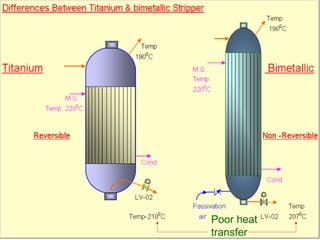
6
METALS
• The metals used in the process industries
can be generally divided into two groups,
ferrous and nonferrous. Ferrous metals
are arbitrarily defined as those containing
at least 50% iron.
• As a group they far exceed any other
group of metal alloys used in the process
industry.
7
FERROUS ALLOYS
• The reason for popularity of ferrous alloys
is their relatively low cost, ready
availability and good workability. Ferrous
alloys are subdivided into cast irons,
carbon steels , low alloy steels, and
stainless steels.
• There are also tool steels, but these will
not be discussed as they are of limited
used in the process industry.
8
CAST IRON
• Cast iron are iron alloys that have greater than 1.5%
Carbon content. These are four types.
1 .GRAY CAST IRON.-This type is used in applications
such as construction equipment requiring vibration
damping and wear resistance. Its gray appearance is
caused by the graphite particles spread through out its
mass. Gray cast iron has a low tensile strength and is
brittle, and it should not be used in high pressure
process vessels.
2. WHITE CAST IRON.-White cast iron has a much lower
silicon content than gray cast iron. No graphite particles
exist in its microstructure, and any carbon in the cast iron
is combined with iron in the form of iron carbide(Fe3C).
The metal is hard, extremely abrasive, brittle .
9
Contd.
3. DUCTILE CAST IRON.-
When ductile cast iron is manufactured, small spherical
nodules of graphite are produced in its microstrure.This cause
it to be ductile rather than brittle. Ductile cast iron is used for
high strength pipes, valve bodies, pump casing, compressor
casings, crankshaft and machine tools.
4..WROUGHT CAST IRON
Prior to the nineteenth century, wrought iron was the only form
of iron used. It is basically pure iron low in the carbon but with
a few percent of slag remaining in the form of an iron silicate.
The slag form a fibrous structure within the wrought iron that
gives it excellent shock, vibration, and corrosion resistance.
wrought iron can be used for water pipe, air brake pipes, and
engine bolts.
10
IRON CARBON EQUILIBRIUM DIAGRAM
TEMPERATURE
TEMPERATURE
11
IRON CARBON EQUILIBRIUM DIAGRAM
12
PROPERTIES
STRENGTH
HARDNESS
DUTILITY
TOUGHNESS
13
STRENGTH
THE RESISTANCE OFFERED BY
MATERIAL ON APPLICATION OF
EXTERNAL FORCE IS CALLED
STRENGTH
HARDNESS
HARDNESS IS RESISTANCE
OFFERED BY MATERIAL TO
INDENTATION
14
HARDNESS & ITS MEASURMENTSHARDNESS & ITS MEASURMENTS
• Several indentation method, give hardness
value in terms of absolute units, briefly a given
load is applied to a specimen for a specific
time ,removed and the area of indentation is
then measured.
• HARDNESS = Load
• Area(kg/mm2
).
1.Brinnel Hardness Test.
2. Vickers or Diamond pyramid hardness(DPH).
3. Rockwell Hardness Test.
15
Indenter
Specimen
surface
h1 h2
Pre load
Pre load
Main Load
+
d
D
I
Brinnel
Vickers Or
DPH
Knop
Indentation shapes for various indentation hardness test method
Measuring sequence in Rockwell Hardness Test
HV=1.8544F/D2
.BH= F
( ΠD)(D-√D2
-d2
)
F=Load
16
DUCTILITY
• IT IS A MEASURE OF THE AMOUNT OF
PLASTIC DEFORMATION A MATERIAL
CAN TAKE UNDER TENSILE FORCE
WITHOUT FRACTURE
• RATIO OF ELONGATION OF MATERIAL
AT FRACTURE TO ORIGINAL LENGTH
• BRITTLENESS IS THE PROPERTY
OPPOSITE TO DUCTILITY
17
TOUGHNESS
• THE AMOUNT OF ENERGY ABSORBED
BY A MATERIAL AT THE TIME OF
FACTURE UNDER IMPACT LOADING
• IT IS CAPACITY TO TAKE IMPACT
LOAD
18
ROLE OF DIFFERENT ELEMENTS USED
IN STEEL ALLOYS
1.CHROMIUM(Cr):
“It is strong Carbide former and form complex series of
carbides compound of chromium and iron.”
(a)It is essential for formation of passive film
to resist corrosion.
(b)It helps to raise the critical Temperature of steel.
(c)It improves hardness and wear resistance.
2.NICKEL:
(a)It improves toughness,ductility and ease in
welding.
(b)It improves resistance to Fatigue failure.
(c)It is austenitic stabilizer.
19
3.MOLYBDENUM:
(a)It increases corrosion resistance in presence of
chlorides.
(b)It prevents Pitting and Crevice corrosion.
4.CARBON:
(a)It permits the hardenability by heat treatment.
(b)It gives the strength at high temperatures.
20
5.NITROGEN:
(a)It enhances pitting resistance.
(b)It is a supplement of Carbon in Low Carbon Steels.
(c)It improves Pitting and Crevice Corrosion resistance.
6.MANGANESE:
(a)It prevents to form Iron Sulphide which is harmful
in steels.
(b)It promotes forgeability of steel.
21
Copper
• Increases strength up to about 12 %.
Higher concentration cause
brittleness. Copper improve the
elevated temperature properties and
machinability. Used in concentration
of about 0.5% or less, produces a
tenacious self sealing oxide film on a
metal surface.
22
7.PHOSPHORUS:
1.IT IS ADDED IN LOW CARBON STEELS UPTO
0.12%.IT DISSOLVES IN FERRITE AND INCREASES
STRENGTH AND HARDNESS.
2.IT IMPROVES THE MACHINABILITY.
8.SILICON
1.IT IS ADDED IN STEELS AS ADEOXIDISER DURING
CASTING OF IGNOTS.
2.IT DISSOLVES IN FERRITE INCREASING STRENGTH
AND HARDNESS WITHOUT LOWERING THE DUCTILITY
23
CARBON STEEL
• The characteristic difference between cast
iron and carbon steel is the carbon
content.
• Carbon steel has less than 1.5 % carbon.
• It is easy to fabricate and has better
strength than cast iron.
• It is easier to weld than cast iron.
• The main disadvantage in using carbon
steel is its susceptibility to corrosion.
24
TYPES OF CARBON STEEL
LOW CARBON STEEL
MEDIUM CARBON STEEL
HIGH CARBON STEEL
25
LOW CARBON STEEL
CONTAIN UPTO 0.3% CARBON
KNOWN AS SOFT OR MILD STEEL
NOT RESPONSIVE TO HEAT TREATMENT
SCREW, NAIL, NUTS,BOLTS, WASHERS,
WIRE FRAMES
26
MEDIUM CARBON STEEL
 CONTAINS CARBON 0.3 TO 0.6%
 HARDER AND MORE TENSILE STRENGTH THEN
LOW CARBON STEEL
 BETTER MACHINIG QUALITIES AND MORE
RESPONSIVE TO HEAT TREATMENT
 SHAFTS, CONNECTING RODS, SPINDLES,
MACHINE PARTS
27
HIGH CARBON STEEL
CONTAINS 0.6% TO 1.7% CARBON
HIGHER TENSILE STRENGH AND HARDER
READILY RESPOND TO HEAT TREATMENT
HAND TOOLS, CHISELS, PUNCHES, FILES,
CUTTING TOOLS, RAIL ROAD WHEELS
28
MATERIALS FOR VARIOS
NETWORKS
NETWORK MATERIAL GRADE
COOLING
WATER, STEAM
CONDENSATE
CARBON
STEEL
API 5L Gr.B
STEAM UP TO
3750
C
CARBON
STEEL
ASTM A
106Gr.B
STEAM MORE
THAN 400 0
C
ALLOY
STEEL
ASTM A335
Gr.P11 & P22
29
STAINLESS STEEL
• “A steel that has 12% or more chromium is
considered a stainless steel.”
• “Another criterion defining a stainless steel is its
Passivity.”
• PASSIVITY.- “Passivity is the ability of a metal
to form an impervious surface coating which
inhibits corrosion resulting from the
electrochemical reaction of the metal with the
surrounding environment.”
• “Stainless Steels exhibit passivity in oxidizing
environment.”
30
Professional organization and their
Scope of Concern
Abbreviatio
n
organization Scope of
Concern
ASTM America
Society of
Testing & Material
Provides testing
procedures for a
wide variety of
material
ASME American society
of mechanical
engineers
Provides a list of
recommended
metal & welding
material
31
AISI American iron & steel
Institute
Provides standard
descriptions for cs
& alloy.
SAE Society of automotive
engineers
Provides a four
digit system and
alloy steels used
in high production
item
CDA Copper development
association
Instituted a
numerical system
for identifying
copper.
ANSI AmericanNational
Standard Institute
Provides safety &
design criteria
32
Corrosion as function of Chromium
• “Following figure
shows the corrosion
rate as a function
chromium content in
an iron chromium
alloy.”
Corrosion rate of
iron-Chromium
alloys exposed to an
intermittent water
spray at room
temperature
33
Effect of Chromium
Stainless steels are chromium containing steel alloys.
The minimum chromium content of the standardized
stainless steels is 10.5%. Chromium makes the steel 'stainless'
this means improved corrosion resistance,
as can be seen in the chart.
34
IRON-CHROMIUM PHASE
DIAGRAM
• Following figure shows the phase diagram
for iron chromium in all proportions.
• With chromium contents between 20 and
70% ,the “sigma” microstructure is formed.
• SIGMA MICROSTRUCTURE.- “This
microstructure is hard, brittle and poor
corrosion resistance.”
35
IRON CHROMIUM
PHASE DIAGRAM
TEMPERATUREIN0
C
2054266408711090131515381760
36
TYPES OF STAINLESS STEEL
• There are three general types of
stainless steel of interest to the
process engineer.
1. FERRITIC STAINLESS STEEL
2. AUSTENITIC STAINLESS STEEL
3. MARTENSITIC STAINLESS STEEL
37
FERRITIC STAINLESS STEEL
• Ferritic stainless steel has a
• carbon content of 0.2% or less.
• Chromium content 11-18% .
• Although it can not be heat treated and
has poor tensile and impact strength, it
better corrosion resistance than
martensitic stainless steel.
• It is suitable for use with strong oxidizing
acids such as Nitric acid.
38
IRON CHROMIUM PHASE DIAGRAM WITH CARBON 0.2%
FERRITIC S.S. Far from sigma
phase
39
FERRITIC STAINLESS STEEL
 HIGHLY RESISTANT TO STRESS CORROSION
CRACKING SHOW AN INCREASES AS RESULT
OF COLD WORK
 THEY ARE MEGNETIC, HAVE GOOD DUTILITY
READILY WELDABLE, NON MEGNETIC
 WELDING IS DIFFICULT
 SS 430(17% Cr) USED FOR AUTOMOTIVE TRIMS
AISI % C % Mn % P % S % Si % Cr
430 0.12 1.0 0.04 0.03 1.0 14 to 18
40
MARTENSITIC STAINLESS
STEEL
• Farritic stainless steel has a
• Carbon.-1.2% or less. and
• Chromium.-12-18%.
• It has better hardenability and strength
than does ferritic stainless steel.
• It is used as cladding to carbon steel for
some process vessels .
41
IRON –CHROMIUM PHASE
DIAGRAM FOR 1.0% CARBON
Martensitic S.S.
Far from
sigma phase
42
MARTENSITIC STAINLESS STEEL
(Chemical Requirements)
AISI % C % Mn % P % S % Si % Cr
410 0.15 1.0 0.04 0.03 1.0 11.5 to
13.5
420 0.15 1.0 0.04 0.03 1.0 12 to 14
43
AUSTENITIC STAINLESS STEEL
• “Austenitic stainless steel is a more complex
material because the addition of NICKEL (3.5 to
22%) allows it to retain its austenitic microstructure
at all temperature
• It has a high tensile strength and best impact
strength, ductility and corrosion resistance of all the
stainless steel over a very wide range of
temperatures.
• All stainless steels are susceptible to pitting from
exposure to high chloride concentration.
However,austanitic steel with high Molybdenum
content(1 to 3 %)have improve resistance to pitting.
44
Austenitic Steels in High Temperature Service
The austenitic alloys have a face centered cubic structure
which has a better corrosion resistance compared to the
ferritic steels. The austenitic structure is normally not stable
in irons below 700 C, but adding nickel to the steel makes
the austenitic phase stable down to room temperature.
These alloys are basically chromium nickel steels.
Chromium is used in these alloys to make the steel
corrosion resistant, whereas nickel stabilizes the even
more corrosion resistant austenitic structure. Silicon and
aluminum are added to increase the oxidation resistance.
Titanium and niobium, as well as boron, nitrogen, tungsten,
vanadium and cobalt can be added to increase the creep
strength due to precipitation strengthening. Manganese can
be used to substitute nickel as an austenite former.
45
Fe-Cr-Ni Ternary diagram for an
18% Cr alloy with the austenitic S.S
Austenitic S.S.
46
AUSTENETIC STAINLESS STTEEL
(Chemical Requirements)
AISI % C %
Mn
% Si % Cr % Ni % Mo
304 0.08 2 1.0 18 to 20 8 to 10.5 -
304L 0.03 2 1.0 18 to 20 8 to 10.5 -
309 0.2 2 1.0 22 to 24 12 to 15 -
310 0.2 2 1.0 24 to 26 19 to 22 -
47
AUSTENETIC STAINLESS STTEEL
(Chemical Requirements)
AISI % C %
Mn
% Si % Cr % Ni % Mo
316 0.08 2 1.0 16 to 18 10 to 14 2 to 3
316L 0.03 2 1.0 16 to 18 10 to 14 2 to 3
321 0.08 2 1.0 17 to 19 9 to 12 Ti >5xC
347 0.08 2 1.0 17 to 19 9 to 12 Nb >5xC
48
AUSTENETIC STAINLESS STTEEL
AISI USES
304 DM Water, Lube oil, waste water, CO2
304L VACUUM SECTION
309 Its filler wire & electrodes are used to weld
Carbon Steel with Austenitic Stainless Steel
316L M.P. & L.P. SECTIONS, HYDROLYSER
SECTION
49
MATERIALS FOR
CARBAMATE SERVICE
CARBAMTE IS HIGHLY CORROSIVE
IN NATURE AT HIGH PRESSURE &
TEMPERATURES
ALL OVER THE WORLD LICENSERS
OF UREA PLANTS ARE SEARCHING
OR COST EFFECTIVE & BETTER
CORROSION RESISTANT MATERIALS
50
MATERIALS FOR
CARBAMATE SERVICE
TITANIUM
ZIRCONIUM
316l MOD OR 316L UG OR 3RE60
2RE69 OR 25Cr.-22Ni.-2Mo. (UNS
S31050)
DUPLEX STEEL
51
TITANIUM
USED FOR LINING & TUBE MATERIAL OF
AMMONIA STRPPER IN SNAM PROGETTI’S
UREA PLANTS
 USED FOR LINING OF UREA REACTORS
OF TOYO PLANTS AT PANIPAT &
BHATINDA
ADVANTAGES :
PASSIVATION AIR IS NOT REQUIRED
STRIPPER BOTTOM TEMPERATURE
CANBE KEPT UPTO 210 0
C
52
TITANIUM
DISADVANTAGES :
IS NOT MAINTENANACE FRIENDLY
ERROSION OF TUBES ENDS RESULTING
IN BYPASSING
“Titanium & Zirconium Hexagonal
closed packed”
53
316L MOD & 2RE69
THESE ARE TAILOR MADE GRADES OF
AUSTENETIC STAINLESS STEEL TO SUIT
REQUIRED SPECIFICATIONS OF
PURCHASER
54
USES OF 316L MOD & 2RE69
316L MOD
• REACTOR LINING
• CARBAMTAE
SEPERATOR LINING
• H.P. SECTION PIPING
• CARBAMATE
CONDENSOR LINING
IN UREA-I
• TUBES OF
CARBAMTAE
CONDENSOR
2RE69
• AMMONIA STRIPPER
LINING
• CABAMATE
SEPERATOR LINING &
TUBES IN UREA-II
• ADDITIONAL
REACTOR TRAYS IN
UREA-I PLANT
55
CHEMICAL COMPOSITION
316L MOD & 2RE69
316L MOD
• CARBON : < .
02 %
• CHROMIUM : 18 %
• NICKLE : >13 %
• MOLY : 2-2.6 %
• MAGNESE : 1.5-2 %
• SILICON : 0.4 %
• SULPHUR : 0.01 %
• PHOSPHORUS :
0.015 %
• N MAX : 0.10 %
2RE69
CARBON : < .02 %
CHROMIUM : 24-26 %
NICKLE : 21-23 %
MOLY BEDNUM : 2-2.6 %
MAGNESE : 1.5-2 %
SILICON : 0.4 %
SULPHUR : 0.015 %
PHOSPHORUS : 0.02 %
N MAX : .1-.15%
56
316L MOD & 2RE69
METALLOGRAPHIC PROPERTIES :
 MATERIAL IN CONTACT WITH PROCESS FLUID
SHALL HAVE AUSTENITIC STRUCTURE
 FERRITE CONTENT SHALL NOT EXCEED 0.6%
EXCEPT FOR MANUAL WELDS, FOR WHICH 1%
IS ALLOWED
“SIGMA PHASE SHALL BE ABSENT”
 CHROMIUM CRABIDES MAY BE PRESENT IN
MINIMUM AMOUNTS ONLY
57
316L MOD & 2RE69
METALLOGRAPHIC PROPERTIES :
 MATERIAL SHALL PASS HUEY TEST & SHALL BR
PERFORMED ACORDING TO ASTM A262
PRACTICE ‘C’ AND MAXIMUM CORROSION RATE
ALLOWED SHALL BE:
TYPE OF
MATERIAL
CORROSION
RATE
MM/YEAR
DEPTH OF
ATTACK
MICRON
316L MOD
25-22-2
0.6
0.3
90
70
58
RATE OF CORROSION( as per Huey Test)
MATERIAL CORROSION RATE
MM/YEAR
ZIRCONIUM 0.005
TITANIUM 0.06
25-22-2 0.3
316L MOD 0.6
HUEY TEST-Metal sample is boiled in 65% HNO3
for 48 Hrs(5times) to estimate corrosion rate
1mm=40mils
(mpy)
59
ADVANTAGES
EXCELLENT ERROSION AND CORROSION
RESISTANT
COST EFFECTIVE
MAINTENANACE FRIENDLY
LIMITATIONS:
TEMPERATURE IS LIMITED TO 207 0
C
PASSIVATION AIR IS REQUIRED
60
MATERIAL OF CONSTRUCTION FOR
MAJOR EQUIPMENTS IN UREA
PLANT
1.REACTOR:
2.STRIPPER: LINE 1 (Retired)
(a)Liner--------------Ti
(b)Ferrules-----------2RE-69
(c)Tubes --------------Ti(3.5mm)
(d)Internals ----------2RE-69
(e)Shell --------------C S
(a)Shell ------------CS.
(b)Liner------------316LM
(c)Trays----------316L.
(d)Addl & Replaced Trays--------2 Re-69
61
STRIPPER
LINE- 1&2
(a)Top&Bottom Domes ----------2RE-69
(b)Tubes ----------------------------Bimetallic
2.0mm 2RE69 & 0.7mm Zr
(c)Ferrules --------------------------2RE-69
(d)Internals -------------------------2RE69
(e)Shell ------------------------------C S
62
Poor heat
transfer
63
3.CARBAMATE CONDENSER ( E-5)
(a) Tubes -----------------2 RE-69
(b)Dome ----------------Liners---316L
Liners(Replaced)---2RE-69
4.MV-2 --------------316L
5.MV-3
--------------304L
64
Construction :-
1. Kettle type construction
2. Carbamate + vapors inlet through a mixer
condenser ,Inlet and outlet passes
separated by Partition plates
3. Material of Construction
– Channel /tube sheet liner - 2 RE 69
– Tubes - 2 RE 69
– Partition plate - SS 316 L M
– Changed new petal - 2 Re -69
Carbamate Condenser
65
7.MV-6& -------------------304L
MV-7
8.Hydrolyser ---------------316L
9. C-2 -------------------------------304L
Contd.
6. Pre-Concentrator
E14 A –(Tube &Cell)----------------316L
E-14B(Tube)---------------------------304L
(Cell)----------------- ------------------CS.
66
ALLOY C P S Si Mn Cr Ni Mo N
304 0.08 0.045 0.030 1.0 2.0 18-20 8-10.5
304L 0.03 0.045 0.030 1.0 2.0 18-20 8-12
316 0.08 0.045 0.030 1.0 2.0 16-18 10-14 2-3
316L 0.03 0.045 0.030 1.0 2.0 16-18 10-14 2-3
316LN 0.02 0.015 0.010 0.40 1.70 17.5 14 2.6 0.18
2RE-69 0.02 0.015 0.010 0.40 1.70 25 22 2.1 0.12
HVD-1 0.05 CU-1.5 0.02 0.038 1.25 25.16 8.5 2.5
MATERIALS OF CONSTRUCTION(COMPOSION IN Wt%)
67
“DUPLEX” STAINLESS STEEL
• “A DULEX steel is characterized by a
microstructure containing both Ferritic
phase with a BCC crystallographic
structure and an Austenitic phase with a
FCC structure.”
• The Ferritic phase is normally 40-60%,
mainly introduced in the wrought alloys by
a careful balance of the critical alloying
elements.
68
BCC.-Body centered cubic “ High strength low ductility.”
e.g.-Ferrite(α-iron),Cr,V,Mo,W etc.
FCC-(Body centered cubic). “Low strength high ductility.”
e.g. Austenite( γ-iron),Al,Cu,Pb,Ag,Au,Ni,Pt etc.
HCP-(hexagonal closed packed) HCP metal are not
ductile as FCC metal
e.g.-Be,Mg,Zn,Cd,Co,Tl,Zr. Etc
The HCP cell consists three layers of atom The top
and bottom layers contain six atom at the corner of
the hexagonal and one atom at the centre of each
hexagonal. The middle layer contains three atoms
nestled between the atom of the top & bottom layers
hence the name close packed.
69
DUPLEX STEELS
MIXTURE OF AUSTENITE & FERRITE
HIGHER STRENGTH & BETTER
RESISTANCE TO CHLORIDES
Cr: 18-27%, Ni: 4-7%, Mo: 2-4%
70
DUPLEX STTEEL
(Chemical Requirements)
%
C
%
Mn
% Si % Cr % Ni % Mo
HVD-1
(EJ-1)
0.0
8
2 1.0 26 to
27
7 to 9 2 to 3
FR-
255
0.0
3
2 2.0 26 5 3
Cu 2 %
USE SPINDLES & SEATS OF UREA GRADE
VALVES( in Urea Plant EJ-1)
71
Stress Corrosion Cracking
A particular problem for the common austenitic
grades (e.g. 304 and 316) is stress corrosion cracking (SCC).
Like pitting corrosion this occurs in chloride environments, but
it is possible for SCC to take place with only traces of
chlorides, so long as the temperature is over about 60°C,
and so long as a tensile
stress is present in the steel, which
is very common. The ferritic grades are virtually immune
from this form of attack, and the duplex grades are highly
resistant. If SCC is likely to be a problem it would be
prudent to specify a grade from these branches
of the stainless family tree.
72
Types of Stress
• “Stresses occur in any material that is subject to a load
or applied force, Stress is the internal resistance, or
counterforce, of a material to the restoring effect of an
external force or load.” There are many types of stresses
,but they can all be generally classified in in one as six
categories-
1 .Residual stress,
2. structural stress.
3. pressure stress,
4. Flow stress,
5. Thermal and
6. Fatigue stress.
73
Residual Stresses
• “Residual stress are due to manufacturing
process that leave stress in a material. Welding
leaves residual stresses in the metal welded.
stress associated in welding are further
discussed later in this module.”
• STRUCTURAL STRESSES- “Structural stresses
are produced in the structural member because
of the weights they support. The weight provide
the loadings. These stresses found in the
building foundation and frame works, as well as
machinery parts.”
74
PRESSURE STRESSES
• “Pressure stresses are stresses induced in vessels
containing pressurized material. The loading is provided
by the same force producing the pressure. In a Reactor
facilities. The Reactor vessel is a prime example of
pressure vessel.”
• FLOW STRESSES -“Flow stresses occur when a mass
of flowing fluid induces a dynamic pressure on a conduit
wall. The force of the fluid striking the wall acts as the
load. This type of stress may be applied unsteady
fashion when flow rate fluctuate. Water hammer is a
example of transient flow.”
• FATIGUE STRESSES- “Fatigue stresses are due to
cyclic application of a stress." The stress could be due to
vibration or thermal cycling.”
75
‘THERMAL STRESSES”THERMAL STRESSES”
• “Thermal stresses exist whenever temperature
gradient are present in a material.” “Different
temperature produce different expansion and
subject material to internal stress." This type of
stress is particularly noticeable in mechanism
operating at high temperature that are cooled by
cold fluid.
• Example-Compressors intercoolers.
Practically in 41 stream E-27 tubes thermal
stresses cracking corrosion found in 1997.All the
tubes have been changed, after this SCC.
76
STRESS CORROSION
CRACKING
• Practical experience of 41-E-27 Tube
leakage was found in 1997,due to SCC.
• Based on practical experience in
combination with laboratory test a stress
corrosion cracking has been compiled to
make to make selection easier .,following
fig.
• It shows that even a very small amount (a
few ppm) of chloride may result in
cracking of austenitic grade like 304L and
316L.
77
Stress corrosion cracking (SCC) Resistance of various SS.in
oxygen bearing Neutral chloride solution . Testing time 1000 hrs.
applied stress equal to yield strength. Open circle mean no SCC
for SAF 2507.
78
Advantages of Duplex S.S.
• Good resistance to “chloride stress corrosion
cracking.”(CSCC).
• The duplex stainless steel also offer
resistance to general and pitting corrosion.
• Good resistance to erosion and abrasion.
• There are numerous cases where plant
equipment properly fabricated from duplex
SS has operated with full immunity in chloride
containing environment where types
304,304L, 316,316Lhave failed due to stress
corrosion cracking.
79
NEW DEVELOPMENT IN DUPLEX
• First generation duplex.-The first generation
duplex containing.-
• Cr-25 %.
• Ni-5 %, and
• Mo-1.5 % and Nitrogen ---Nil
• There is no Nitrogen. Because Carbon Content
upto 0.2%.There is a considerable loss in
corrosion resistance during welding
• Therefore ,a post weld heat treatment is required
to assure good prosperities.
80
SECOND GENRATION DUPLEX
• The second generation duplexes have low
carbon levels, assuring resistance to
irregular attack(IGA) The nitrogen
contents are usually more than 0.1%.in
addition to improving pitting and crevice
corrosion.
• Cr.----25 %,Ni.—5 %, Mo.-1.5 %.N- 0.1%.
81
THIRD GENERATION DUPLEX
• The third generation duplex contains
about 0.2% copper.
• Cr.-25 % Ni.-4.0 % Mo-Nil. Cu.-0.2%
• “A third generation developed in
SWEDON, has recently been introduced
Alloy 2304.” and SAFUREX.
• HVD-1 is also 3rd
generation Duplex S.S.
and developed by Snampogetti.
82
SUPERFERRITIES
• These are highly resistant to chloride
pitting and crevice corrosion. They have
found extensive applications as tubing for
power plant condensers, and heat
exchanger handling chloride solution,
such as Sea water. Having a ferrite
microstructure. They have a very high
resistance to CSCC. In addition they are
suitable for use in organic acids, dilute
reducing acids.
83
contd
• Alloy 29-4C(UNS S44735) containing-
• Cr -20 %
• Mo -4.0 %
• Alloy Sea –cure (UNS S44660)
• Cr-26 %
• Mo 3.0 %
• Ni1.0 %
84
DUPLEX DEVELOPED BY
STAMICARBON &TEC(ACES)
DP3 UREA
GRADE(DP12)
R4 UREA
GRADE(R5)
Cr 24.8-26 24-26
Ni 6.5-7.5 6.0-6.7
Mo 2.5-3.2 1.2-2.0
85
SAFUREX(STAMICARBON)
• Safurex is jointly developed by SANDVIK
& STAMICARBON and designated
SafurexTM.
can allow lower Oxygen content
for passivation.
86
Chemical composition and PRE No
for various Duplex & S.S.
Grade Cr Ni Mo N PRE Microstru
cture
2 Re 60(UG) 18.5 4.9 2.7 0.07 28 Duplex
SAF 2304 23 4.5 - 0.1 24 Duplex
SAF 2205 22 5.5 3.2 0.18 35 Duplex
87
Grade Cr Ni Mo N PRE Microstruc
ture
SAF 2507 25 7 4 0.3 43 Duplex
AISI 304L 18.5 10 - - 18 Austenitic
AISI 316L 17.5 13 2.1 - 24 Austenitic
Sanicro 28 27 31 3.5 - 38 Austenitic
Contd.
88
“Selection for Fabrication”
Again it is usually the case that grades are selected for
corrosion resistance and then consideration is given to how
the product can be fabricated. Fabrication should be considered
as early as possible in the grade selection process, as it greatly
influences the economics of the product.
Table lists some common
grades and compares their relative fabrication characteristics.
These comparisons are on arbitrary 1 to 10 scales,
with 10 indicating excellent fabrication by the particular method.
Table . Common Grades and Their Relative Fabrication
Characteristics
89
Grade Formability Machinability Weldability
303 1 8 * 1
304 8 5* 8
316 8 5* 8
416 1 10 1
430 4 6 2
2205 5 4 5
3CR12 5 6 6
* Improved Machinability versions of these grades offer higher
machinabilities in some products.
90
CORROSION RATE IN STRIPPER
1000 10000ppm O2
0.010.11.0
Corrosionratemm/yr
DUPLEX
316LS.S.
2RE 69
91
HOW TO GAUGE RESISTANCE
TO PITTING
• The resistance of a particular grade of
stainless steel to pitting and crevice
corrosion is indicated by its Pitting
Resistance Equivalent number or
PRE, as shown in table . The PRE
can be calculated from the
composition as:
PRE = %Cr + 3.3 %Mo + 16 %N
PRE is also known as LCR-Localized Corrosion Resistance
92
A higher PRE value , hower,cannot be used as a direct
selection criterion. For selection of material in chloride-
containing solution a diagram showing the critical pitting
temperature. Has to be used
93
Table. Pitting Resistance Equivalent Number or PRE for
Various Grades
Grade
Class PRE
3CR12 ferritic 11
430 ferritic 17
303 austenitic 18*
304/L austenitic 18
316/L austenitic 24
2205 duplex 34
904L austenitic 34
S31254 austenitic 43
S32750 duplex 43
S32520 duplex 43
*The calculated PRE for 303 is wrong, due to sulphur in
the composition.
94

Material technology

  • 1.
    1 Sr. Manager(Prod) National fertilizersLtd, India, An Expert for www.ureaknowhow.com Fellow of Institution of Engineers India
  • 2.
    2 INTRODUCTIONINTRODUCTION Materials plays veryimportant role in any industry Selection of material is vital at design stage itself Wrong selection of material may lead to catastrophic failures and outage of plants & even loss of Human lives Right selection of material leads to long life of plant
  • 3.
    3 MAIN TOPICS CLASSIFICATION OFMATERIALS TYPES OF MATERIALS USED AT VIJAIPUR TYPES OF STEELS SPECIAL MATERIALS IN USE  NEW DEVELOPMENT MATERIALS FOR UREA SERVICE
  • 4.
    4 CLASSIFICATION OF MATERIALS CA R B O N S T E E L L O W T E M P E R A T U R E C A R B O N S T E E L A L L O Y S T E E L S T A IN L E S S S T E E L F E R R O U S A L U M IN IU M Z IR C O N IU M C O P P E R W H IT E M E T A L N O N -F E R R O U S M E T A L L IC T E F L O N R U B B E R W O O D N O N -M E T A L L IC
  • 5.
    5 MATERIALS • There isa wide variety of materials use to construct process equipment. The type of material selected depends on its compatibility with process conditions and cost. • The materials of choice can be divided into the following general categories
  • 6.
    6 METALS • The metalsused in the process industries can be generally divided into two groups, ferrous and nonferrous. Ferrous metals are arbitrarily defined as those containing at least 50% iron. • As a group they far exceed any other group of metal alloys used in the process industry.
  • 7.
    7 FERROUS ALLOYS • Thereason for popularity of ferrous alloys is their relatively low cost, ready availability and good workability. Ferrous alloys are subdivided into cast irons, carbon steels , low alloy steels, and stainless steels. • There are also tool steels, but these will not be discussed as they are of limited used in the process industry.
  • 8.
    8 CAST IRON • Castiron are iron alloys that have greater than 1.5% Carbon content. These are four types. 1 .GRAY CAST IRON.-This type is used in applications such as construction equipment requiring vibration damping and wear resistance. Its gray appearance is caused by the graphite particles spread through out its mass. Gray cast iron has a low tensile strength and is brittle, and it should not be used in high pressure process vessels. 2. WHITE CAST IRON.-White cast iron has a much lower silicon content than gray cast iron. No graphite particles exist in its microstructure, and any carbon in the cast iron is combined with iron in the form of iron carbide(Fe3C). The metal is hard, extremely abrasive, brittle .
  • 9.
    9 Contd. 3. DUCTILE CASTIRON.- When ductile cast iron is manufactured, small spherical nodules of graphite are produced in its microstrure.This cause it to be ductile rather than brittle. Ductile cast iron is used for high strength pipes, valve bodies, pump casing, compressor casings, crankshaft and machine tools. 4..WROUGHT CAST IRON Prior to the nineteenth century, wrought iron was the only form of iron used. It is basically pure iron low in the carbon but with a few percent of slag remaining in the form of an iron silicate. The slag form a fibrous structure within the wrought iron that gives it excellent shock, vibration, and corrosion resistance. wrought iron can be used for water pipe, air brake pipes, and engine bolts.
  • 10.
    10 IRON CARBON EQUILIBRIUMDIAGRAM TEMPERATURE TEMPERATURE
  • 11.
  • 12.
  • 13.
    13 STRENGTH THE RESISTANCE OFFEREDBY MATERIAL ON APPLICATION OF EXTERNAL FORCE IS CALLED STRENGTH HARDNESS HARDNESS IS RESISTANCE OFFERED BY MATERIAL TO INDENTATION
  • 14.
    14 HARDNESS & ITSMEASURMENTSHARDNESS & ITS MEASURMENTS • Several indentation method, give hardness value in terms of absolute units, briefly a given load is applied to a specimen for a specific time ,removed and the area of indentation is then measured. • HARDNESS = Load • Area(kg/mm2 ). 1.Brinnel Hardness Test. 2. Vickers or Diamond pyramid hardness(DPH). 3. Rockwell Hardness Test.
  • 15.
    15 Indenter Specimen surface h1 h2 Pre load Preload Main Load + d D I Brinnel Vickers Or DPH Knop Indentation shapes for various indentation hardness test method Measuring sequence in Rockwell Hardness Test HV=1.8544F/D2 .BH= F ( ΠD)(D-√D2 -d2 ) F=Load
  • 16.
    16 DUCTILITY • IT ISA MEASURE OF THE AMOUNT OF PLASTIC DEFORMATION A MATERIAL CAN TAKE UNDER TENSILE FORCE WITHOUT FRACTURE • RATIO OF ELONGATION OF MATERIAL AT FRACTURE TO ORIGINAL LENGTH • BRITTLENESS IS THE PROPERTY OPPOSITE TO DUCTILITY
  • 17.
    17 TOUGHNESS • THE AMOUNTOF ENERGY ABSORBED BY A MATERIAL AT THE TIME OF FACTURE UNDER IMPACT LOADING • IT IS CAPACITY TO TAKE IMPACT LOAD
  • 18.
    18 ROLE OF DIFFERENTELEMENTS USED IN STEEL ALLOYS 1.CHROMIUM(Cr): “It is strong Carbide former and form complex series of carbides compound of chromium and iron.” (a)It is essential for formation of passive film to resist corrosion. (b)It helps to raise the critical Temperature of steel. (c)It improves hardness and wear resistance. 2.NICKEL: (a)It improves toughness,ductility and ease in welding. (b)It improves resistance to Fatigue failure. (c)It is austenitic stabilizer.
  • 19.
    19 3.MOLYBDENUM: (a)It increases corrosionresistance in presence of chlorides. (b)It prevents Pitting and Crevice corrosion. 4.CARBON: (a)It permits the hardenability by heat treatment. (b)It gives the strength at high temperatures.
  • 20.
    20 5.NITROGEN: (a)It enhances pittingresistance. (b)It is a supplement of Carbon in Low Carbon Steels. (c)It improves Pitting and Crevice Corrosion resistance. 6.MANGANESE: (a)It prevents to form Iron Sulphide which is harmful in steels. (b)It promotes forgeability of steel.
  • 21.
    21 Copper • Increases strengthup to about 12 %. Higher concentration cause brittleness. Copper improve the elevated temperature properties and machinability. Used in concentration of about 0.5% or less, produces a tenacious self sealing oxide film on a metal surface.
  • 22.
    22 7.PHOSPHORUS: 1.IT IS ADDEDIN LOW CARBON STEELS UPTO 0.12%.IT DISSOLVES IN FERRITE AND INCREASES STRENGTH AND HARDNESS. 2.IT IMPROVES THE MACHINABILITY. 8.SILICON 1.IT IS ADDED IN STEELS AS ADEOXIDISER DURING CASTING OF IGNOTS. 2.IT DISSOLVES IN FERRITE INCREASING STRENGTH AND HARDNESS WITHOUT LOWERING THE DUCTILITY
  • 23.
    23 CARBON STEEL • Thecharacteristic difference between cast iron and carbon steel is the carbon content. • Carbon steel has less than 1.5 % carbon. • It is easy to fabricate and has better strength than cast iron. • It is easier to weld than cast iron. • The main disadvantage in using carbon steel is its susceptibility to corrosion.
  • 24.
    24 TYPES OF CARBONSTEEL LOW CARBON STEEL MEDIUM CARBON STEEL HIGH CARBON STEEL
  • 25.
    25 LOW CARBON STEEL CONTAINUPTO 0.3% CARBON KNOWN AS SOFT OR MILD STEEL NOT RESPONSIVE TO HEAT TREATMENT SCREW, NAIL, NUTS,BOLTS, WASHERS, WIRE FRAMES
  • 26.
    26 MEDIUM CARBON STEEL CONTAINS CARBON 0.3 TO 0.6%  HARDER AND MORE TENSILE STRENGTH THEN LOW CARBON STEEL  BETTER MACHINIG QUALITIES AND MORE RESPONSIVE TO HEAT TREATMENT  SHAFTS, CONNECTING RODS, SPINDLES, MACHINE PARTS
  • 27.
    27 HIGH CARBON STEEL CONTAINS0.6% TO 1.7% CARBON HIGHER TENSILE STRENGH AND HARDER READILY RESPOND TO HEAT TREATMENT HAND TOOLS, CHISELS, PUNCHES, FILES, CUTTING TOOLS, RAIL ROAD WHEELS
  • 28.
    28 MATERIALS FOR VARIOS NETWORKS NETWORKMATERIAL GRADE COOLING WATER, STEAM CONDENSATE CARBON STEEL API 5L Gr.B STEAM UP TO 3750 C CARBON STEEL ASTM A 106Gr.B STEAM MORE THAN 400 0 C ALLOY STEEL ASTM A335 Gr.P11 & P22
  • 29.
    29 STAINLESS STEEL • “Asteel that has 12% or more chromium is considered a stainless steel.” • “Another criterion defining a stainless steel is its Passivity.” • PASSIVITY.- “Passivity is the ability of a metal to form an impervious surface coating which inhibits corrosion resulting from the electrochemical reaction of the metal with the surrounding environment.” • “Stainless Steels exhibit passivity in oxidizing environment.”
  • 30.
    30 Professional organization andtheir Scope of Concern Abbreviatio n organization Scope of Concern ASTM America Society of Testing & Material Provides testing procedures for a wide variety of material ASME American society of mechanical engineers Provides a list of recommended metal & welding material
  • 31.
    31 AISI American iron& steel Institute Provides standard descriptions for cs & alloy. SAE Society of automotive engineers Provides a four digit system and alloy steels used in high production item CDA Copper development association Instituted a numerical system for identifying copper. ANSI AmericanNational Standard Institute Provides safety & design criteria
  • 32.
    32 Corrosion as functionof Chromium • “Following figure shows the corrosion rate as a function chromium content in an iron chromium alloy.” Corrosion rate of iron-Chromium alloys exposed to an intermittent water spray at room temperature
  • 33.
    33 Effect of Chromium Stainlesssteels are chromium containing steel alloys. The minimum chromium content of the standardized stainless steels is 10.5%. Chromium makes the steel 'stainless' this means improved corrosion resistance, as can be seen in the chart.
  • 34.
    34 IRON-CHROMIUM PHASE DIAGRAM • Followingfigure shows the phase diagram for iron chromium in all proportions. • With chromium contents between 20 and 70% ,the “sigma” microstructure is formed. • SIGMA MICROSTRUCTURE.- “This microstructure is hard, brittle and poor corrosion resistance.”
  • 35.
  • 36.
    36 TYPES OF STAINLESSSTEEL • There are three general types of stainless steel of interest to the process engineer. 1. FERRITIC STAINLESS STEEL 2. AUSTENITIC STAINLESS STEEL 3. MARTENSITIC STAINLESS STEEL
  • 37.
    37 FERRITIC STAINLESS STEEL •Ferritic stainless steel has a • carbon content of 0.2% or less. • Chromium content 11-18% . • Although it can not be heat treated and has poor tensile and impact strength, it better corrosion resistance than martensitic stainless steel. • It is suitable for use with strong oxidizing acids such as Nitric acid.
  • 38.
    38 IRON CHROMIUM PHASEDIAGRAM WITH CARBON 0.2% FERRITIC S.S. Far from sigma phase
  • 39.
    39 FERRITIC STAINLESS STEEL HIGHLY RESISTANT TO STRESS CORROSION CRACKING SHOW AN INCREASES AS RESULT OF COLD WORK  THEY ARE MEGNETIC, HAVE GOOD DUTILITY READILY WELDABLE, NON MEGNETIC  WELDING IS DIFFICULT  SS 430(17% Cr) USED FOR AUTOMOTIVE TRIMS AISI % C % Mn % P % S % Si % Cr 430 0.12 1.0 0.04 0.03 1.0 14 to 18
  • 40.
    40 MARTENSITIC STAINLESS STEEL • Farriticstainless steel has a • Carbon.-1.2% or less. and • Chromium.-12-18%. • It has better hardenability and strength than does ferritic stainless steel. • It is used as cladding to carbon steel for some process vessels .
  • 41.
    41 IRON –CHROMIUM PHASE DIAGRAMFOR 1.0% CARBON Martensitic S.S. Far from sigma phase
  • 42.
    42 MARTENSITIC STAINLESS STEEL (ChemicalRequirements) AISI % C % Mn % P % S % Si % Cr 410 0.15 1.0 0.04 0.03 1.0 11.5 to 13.5 420 0.15 1.0 0.04 0.03 1.0 12 to 14
  • 43.
    43 AUSTENITIC STAINLESS STEEL •“Austenitic stainless steel is a more complex material because the addition of NICKEL (3.5 to 22%) allows it to retain its austenitic microstructure at all temperature • It has a high tensile strength and best impact strength, ductility and corrosion resistance of all the stainless steel over a very wide range of temperatures. • All stainless steels are susceptible to pitting from exposure to high chloride concentration. However,austanitic steel with high Molybdenum content(1 to 3 %)have improve resistance to pitting.
  • 44.
    44 Austenitic Steels inHigh Temperature Service The austenitic alloys have a face centered cubic structure which has a better corrosion resistance compared to the ferritic steels. The austenitic structure is normally not stable in irons below 700 C, but adding nickel to the steel makes the austenitic phase stable down to room temperature. These alloys are basically chromium nickel steels. Chromium is used in these alloys to make the steel corrosion resistant, whereas nickel stabilizes the even more corrosion resistant austenitic structure. Silicon and aluminum are added to increase the oxidation resistance. Titanium and niobium, as well as boron, nitrogen, tungsten, vanadium and cobalt can be added to increase the creep strength due to precipitation strengthening. Manganese can be used to substitute nickel as an austenite former.
  • 45.
    45 Fe-Cr-Ni Ternary diagramfor an 18% Cr alloy with the austenitic S.S Austenitic S.S.
  • 46.
    46 AUSTENETIC STAINLESS STTEEL (ChemicalRequirements) AISI % C % Mn % Si % Cr % Ni % Mo 304 0.08 2 1.0 18 to 20 8 to 10.5 - 304L 0.03 2 1.0 18 to 20 8 to 10.5 - 309 0.2 2 1.0 22 to 24 12 to 15 - 310 0.2 2 1.0 24 to 26 19 to 22 -
  • 47.
    47 AUSTENETIC STAINLESS STTEEL (ChemicalRequirements) AISI % C % Mn % Si % Cr % Ni % Mo 316 0.08 2 1.0 16 to 18 10 to 14 2 to 3 316L 0.03 2 1.0 16 to 18 10 to 14 2 to 3 321 0.08 2 1.0 17 to 19 9 to 12 Ti >5xC 347 0.08 2 1.0 17 to 19 9 to 12 Nb >5xC
  • 48.
    48 AUSTENETIC STAINLESS STTEEL AISIUSES 304 DM Water, Lube oil, waste water, CO2 304L VACUUM SECTION 309 Its filler wire & electrodes are used to weld Carbon Steel with Austenitic Stainless Steel 316L M.P. & L.P. SECTIONS, HYDROLYSER SECTION
  • 49.
    49 MATERIALS FOR CARBAMATE SERVICE CARBAMTEIS HIGHLY CORROSIVE IN NATURE AT HIGH PRESSURE & TEMPERATURES ALL OVER THE WORLD LICENSERS OF UREA PLANTS ARE SEARCHING OR COST EFFECTIVE & BETTER CORROSION RESISTANT MATERIALS
  • 50.
    50 MATERIALS FOR CARBAMATE SERVICE TITANIUM ZIRCONIUM 316lMOD OR 316L UG OR 3RE60 2RE69 OR 25Cr.-22Ni.-2Mo. (UNS S31050) DUPLEX STEEL
  • 51.
    51 TITANIUM USED FOR LINING& TUBE MATERIAL OF AMMONIA STRPPER IN SNAM PROGETTI’S UREA PLANTS  USED FOR LINING OF UREA REACTORS OF TOYO PLANTS AT PANIPAT & BHATINDA ADVANTAGES : PASSIVATION AIR IS NOT REQUIRED STRIPPER BOTTOM TEMPERATURE CANBE KEPT UPTO 210 0 C
  • 52.
    52 TITANIUM DISADVANTAGES : IS NOTMAINTENANACE FRIENDLY ERROSION OF TUBES ENDS RESULTING IN BYPASSING “Titanium & Zirconium Hexagonal closed packed”
  • 53.
    53 316L MOD &2RE69 THESE ARE TAILOR MADE GRADES OF AUSTENETIC STAINLESS STEEL TO SUIT REQUIRED SPECIFICATIONS OF PURCHASER
  • 54.
    54 USES OF 316LMOD & 2RE69 316L MOD • REACTOR LINING • CARBAMTAE SEPERATOR LINING • H.P. SECTION PIPING • CARBAMATE CONDENSOR LINING IN UREA-I • TUBES OF CARBAMTAE CONDENSOR 2RE69 • AMMONIA STRIPPER LINING • CABAMATE SEPERATOR LINING & TUBES IN UREA-II • ADDITIONAL REACTOR TRAYS IN UREA-I PLANT
  • 55.
    55 CHEMICAL COMPOSITION 316L MOD& 2RE69 316L MOD • CARBON : < . 02 % • CHROMIUM : 18 % • NICKLE : >13 % • MOLY : 2-2.6 % • MAGNESE : 1.5-2 % • SILICON : 0.4 % • SULPHUR : 0.01 % • PHOSPHORUS : 0.015 % • N MAX : 0.10 % 2RE69 CARBON : < .02 % CHROMIUM : 24-26 % NICKLE : 21-23 % MOLY BEDNUM : 2-2.6 % MAGNESE : 1.5-2 % SILICON : 0.4 % SULPHUR : 0.015 % PHOSPHORUS : 0.02 % N MAX : .1-.15%
  • 56.
    56 316L MOD &2RE69 METALLOGRAPHIC PROPERTIES :  MATERIAL IN CONTACT WITH PROCESS FLUID SHALL HAVE AUSTENITIC STRUCTURE  FERRITE CONTENT SHALL NOT EXCEED 0.6% EXCEPT FOR MANUAL WELDS, FOR WHICH 1% IS ALLOWED “SIGMA PHASE SHALL BE ABSENT”  CHROMIUM CRABIDES MAY BE PRESENT IN MINIMUM AMOUNTS ONLY
  • 57.
    57 316L MOD &2RE69 METALLOGRAPHIC PROPERTIES :  MATERIAL SHALL PASS HUEY TEST & SHALL BR PERFORMED ACORDING TO ASTM A262 PRACTICE ‘C’ AND MAXIMUM CORROSION RATE ALLOWED SHALL BE: TYPE OF MATERIAL CORROSION RATE MM/YEAR DEPTH OF ATTACK MICRON 316L MOD 25-22-2 0.6 0.3 90 70
  • 58.
    58 RATE OF CORROSION(as per Huey Test) MATERIAL CORROSION RATE MM/YEAR ZIRCONIUM 0.005 TITANIUM 0.06 25-22-2 0.3 316L MOD 0.6 HUEY TEST-Metal sample is boiled in 65% HNO3 for 48 Hrs(5times) to estimate corrosion rate 1mm=40mils (mpy)
  • 59.
    59 ADVANTAGES EXCELLENT ERROSION ANDCORROSION RESISTANT COST EFFECTIVE MAINTENANACE FRIENDLY LIMITATIONS: TEMPERATURE IS LIMITED TO 207 0 C PASSIVATION AIR IS REQUIRED
  • 60.
    60 MATERIAL OF CONSTRUCTIONFOR MAJOR EQUIPMENTS IN UREA PLANT 1.REACTOR: 2.STRIPPER: LINE 1 (Retired) (a)Liner--------------Ti (b)Ferrules-----------2RE-69 (c)Tubes --------------Ti(3.5mm) (d)Internals ----------2RE-69 (e)Shell --------------C S (a)Shell ------------CS. (b)Liner------------316LM (c)Trays----------316L. (d)Addl & Replaced Trays--------2 Re-69
  • 61.
    61 STRIPPER LINE- 1&2 (a)Top&Bottom Domes----------2RE-69 (b)Tubes ----------------------------Bimetallic 2.0mm 2RE69 & 0.7mm Zr (c)Ferrules --------------------------2RE-69 (d)Internals -------------------------2RE69 (e)Shell ------------------------------C S
  • 62.
  • 63.
    63 3.CARBAMATE CONDENSER (E-5) (a) Tubes -----------------2 RE-69 (b)Dome ----------------Liners---316L Liners(Replaced)---2RE-69 4.MV-2 --------------316L 5.MV-3 --------------304L
  • 64.
    64 Construction :- 1. Kettletype construction 2. Carbamate + vapors inlet through a mixer condenser ,Inlet and outlet passes separated by Partition plates 3. Material of Construction – Channel /tube sheet liner - 2 RE 69 – Tubes - 2 RE 69 – Partition plate - SS 316 L M – Changed new petal - 2 Re -69 Carbamate Condenser
  • 65.
    65 7.MV-6& -------------------304L MV-7 8.Hydrolyser ---------------316L 9.C-2 -------------------------------304L Contd. 6. Pre-Concentrator E14 A –(Tube &Cell)----------------316L E-14B(Tube)---------------------------304L (Cell)----------------- ------------------CS.
  • 66.
    66 ALLOY C PS Si Mn Cr Ni Mo N 304 0.08 0.045 0.030 1.0 2.0 18-20 8-10.5 304L 0.03 0.045 0.030 1.0 2.0 18-20 8-12 316 0.08 0.045 0.030 1.0 2.0 16-18 10-14 2-3 316L 0.03 0.045 0.030 1.0 2.0 16-18 10-14 2-3 316LN 0.02 0.015 0.010 0.40 1.70 17.5 14 2.6 0.18 2RE-69 0.02 0.015 0.010 0.40 1.70 25 22 2.1 0.12 HVD-1 0.05 CU-1.5 0.02 0.038 1.25 25.16 8.5 2.5 MATERIALS OF CONSTRUCTION(COMPOSION IN Wt%)
  • 67.
    67 “DUPLEX” STAINLESS STEEL •“A DULEX steel is characterized by a microstructure containing both Ferritic phase with a BCC crystallographic structure and an Austenitic phase with a FCC structure.” • The Ferritic phase is normally 40-60%, mainly introduced in the wrought alloys by a careful balance of the critical alloying elements.
  • 68.
    68 BCC.-Body centered cubic“ High strength low ductility.” e.g.-Ferrite(α-iron),Cr,V,Mo,W etc. FCC-(Body centered cubic). “Low strength high ductility.” e.g. Austenite( γ-iron),Al,Cu,Pb,Ag,Au,Ni,Pt etc. HCP-(hexagonal closed packed) HCP metal are not ductile as FCC metal e.g.-Be,Mg,Zn,Cd,Co,Tl,Zr. Etc The HCP cell consists three layers of atom The top and bottom layers contain six atom at the corner of the hexagonal and one atom at the centre of each hexagonal. The middle layer contains three atoms nestled between the atom of the top & bottom layers hence the name close packed.
  • 69.
    69 DUPLEX STEELS MIXTURE OFAUSTENITE & FERRITE HIGHER STRENGTH & BETTER RESISTANCE TO CHLORIDES Cr: 18-27%, Ni: 4-7%, Mo: 2-4%
  • 70.
    70 DUPLEX STTEEL (Chemical Requirements) % C % Mn %Si % Cr % Ni % Mo HVD-1 (EJ-1) 0.0 8 2 1.0 26 to 27 7 to 9 2 to 3 FR- 255 0.0 3 2 2.0 26 5 3 Cu 2 % USE SPINDLES & SEATS OF UREA GRADE VALVES( in Urea Plant EJ-1)
  • 71.
    71 Stress Corrosion Cracking Aparticular problem for the common austenitic grades (e.g. 304 and 316) is stress corrosion cracking (SCC). Like pitting corrosion this occurs in chloride environments, but it is possible for SCC to take place with only traces of chlorides, so long as the temperature is over about 60°C, and so long as a tensile stress is present in the steel, which is very common. The ferritic grades are virtually immune from this form of attack, and the duplex grades are highly resistant. If SCC is likely to be a problem it would be prudent to specify a grade from these branches of the stainless family tree.
  • 72.
    72 Types of Stress •“Stresses occur in any material that is subject to a load or applied force, Stress is the internal resistance, or counterforce, of a material to the restoring effect of an external force or load.” There are many types of stresses ,but they can all be generally classified in in one as six categories- 1 .Residual stress, 2. structural stress. 3. pressure stress, 4. Flow stress, 5. Thermal and 6. Fatigue stress.
  • 73.
    73 Residual Stresses • “Residualstress are due to manufacturing process that leave stress in a material. Welding leaves residual stresses in the metal welded. stress associated in welding are further discussed later in this module.” • STRUCTURAL STRESSES- “Structural stresses are produced in the structural member because of the weights they support. The weight provide the loadings. These stresses found in the building foundation and frame works, as well as machinery parts.”
  • 74.
    74 PRESSURE STRESSES • “Pressurestresses are stresses induced in vessels containing pressurized material. The loading is provided by the same force producing the pressure. In a Reactor facilities. The Reactor vessel is a prime example of pressure vessel.” • FLOW STRESSES -“Flow stresses occur when a mass of flowing fluid induces a dynamic pressure on a conduit wall. The force of the fluid striking the wall acts as the load. This type of stress may be applied unsteady fashion when flow rate fluctuate. Water hammer is a example of transient flow.” • FATIGUE STRESSES- “Fatigue stresses are due to cyclic application of a stress." The stress could be due to vibration or thermal cycling.”
  • 75.
    75 ‘THERMAL STRESSES”THERMAL STRESSES” •“Thermal stresses exist whenever temperature gradient are present in a material.” “Different temperature produce different expansion and subject material to internal stress." This type of stress is particularly noticeable in mechanism operating at high temperature that are cooled by cold fluid. • Example-Compressors intercoolers. Practically in 41 stream E-27 tubes thermal stresses cracking corrosion found in 1997.All the tubes have been changed, after this SCC.
  • 76.
    76 STRESS CORROSION CRACKING • Practicalexperience of 41-E-27 Tube leakage was found in 1997,due to SCC. • Based on practical experience in combination with laboratory test a stress corrosion cracking has been compiled to make to make selection easier .,following fig. • It shows that even a very small amount (a few ppm) of chloride may result in cracking of austenitic grade like 304L and 316L.
  • 77.
    77 Stress corrosion cracking(SCC) Resistance of various SS.in oxygen bearing Neutral chloride solution . Testing time 1000 hrs. applied stress equal to yield strength. Open circle mean no SCC for SAF 2507.
  • 78.
    78 Advantages of DuplexS.S. • Good resistance to “chloride stress corrosion cracking.”(CSCC). • The duplex stainless steel also offer resistance to general and pitting corrosion. • Good resistance to erosion and abrasion. • There are numerous cases where plant equipment properly fabricated from duplex SS has operated with full immunity in chloride containing environment where types 304,304L, 316,316Lhave failed due to stress corrosion cracking.
  • 79.
    79 NEW DEVELOPMENT INDUPLEX • First generation duplex.-The first generation duplex containing.- • Cr-25 %. • Ni-5 %, and • Mo-1.5 % and Nitrogen ---Nil • There is no Nitrogen. Because Carbon Content upto 0.2%.There is a considerable loss in corrosion resistance during welding • Therefore ,a post weld heat treatment is required to assure good prosperities.
  • 80.
    80 SECOND GENRATION DUPLEX •The second generation duplexes have low carbon levels, assuring resistance to irregular attack(IGA) The nitrogen contents are usually more than 0.1%.in addition to improving pitting and crevice corrosion. • Cr.----25 %,Ni.—5 %, Mo.-1.5 %.N- 0.1%.
  • 81.
    81 THIRD GENERATION DUPLEX •The third generation duplex contains about 0.2% copper. • Cr.-25 % Ni.-4.0 % Mo-Nil. Cu.-0.2% • “A third generation developed in SWEDON, has recently been introduced Alloy 2304.” and SAFUREX. • HVD-1 is also 3rd generation Duplex S.S. and developed by Snampogetti.
  • 82.
    82 SUPERFERRITIES • These arehighly resistant to chloride pitting and crevice corrosion. They have found extensive applications as tubing for power plant condensers, and heat exchanger handling chloride solution, such as Sea water. Having a ferrite microstructure. They have a very high resistance to CSCC. In addition they are suitable for use in organic acids, dilute reducing acids.
  • 83.
    83 contd • Alloy 29-4C(UNSS44735) containing- • Cr -20 % • Mo -4.0 % • Alloy Sea –cure (UNS S44660) • Cr-26 % • Mo 3.0 % • Ni1.0 %
  • 84.
    84 DUPLEX DEVELOPED BY STAMICARBON&TEC(ACES) DP3 UREA GRADE(DP12) R4 UREA GRADE(R5) Cr 24.8-26 24-26 Ni 6.5-7.5 6.0-6.7 Mo 2.5-3.2 1.2-2.0
  • 85.
    85 SAFUREX(STAMICARBON) • Safurex isjointly developed by SANDVIK & STAMICARBON and designated SafurexTM. can allow lower Oxygen content for passivation.
  • 86.
    86 Chemical composition andPRE No for various Duplex & S.S. Grade Cr Ni Mo N PRE Microstru cture 2 Re 60(UG) 18.5 4.9 2.7 0.07 28 Duplex SAF 2304 23 4.5 - 0.1 24 Duplex SAF 2205 22 5.5 3.2 0.18 35 Duplex
  • 87.
    87 Grade Cr NiMo N PRE Microstruc ture SAF 2507 25 7 4 0.3 43 Duplex AISI 304L 18.5 10 - - 18 Austenitic AISI 316L 17.5 13 2.1 - 24 Austenitic Sanicro 28 27 31 3.5 - 38 Austenitic Contd.
  • 88.
    88 “Selection for Fabrication” Againit is usually the case that grades are selected for corrosion resistance and then consideration is given to how the product can be fabricated. Fabrication should be considered as early as possible in the grade selection process, as it greatly influences the economics of the product. Table lists some common grades and compares their relative fabrication characteristics. These comparisons are on arbitrary 1 to 10 scales, with 10 indicating excellent fabrication by the particular method. Table . Common Grades and Their Relative Fabrication Characteristics
  • 89.
    89 Grade Formability MachinabilityWeldability 303 1 8 * 1 304 8 5* 8 316 8 5* 8 416 1 10 1 430 4 6 2 2205 5 4 5 3CR12 5 6 6 * Improved Machinability versions of these grades offer higher machinabilities in some products.
  • 90.
    90 CORROSION RATE INSTRIPPER 1000 10000ppm O2 0.010.11.0 Corrosionratemm/yr DUPLEX 316LS.S. 2RE 69
  • 91.
    91 HOW TO GAUGERESISTANCE TO PITTING • The resistance of a particular grade of stainless steel to pitting and crevice corrosion is indicated by its Pitting Resistance Equivalent number or PRE, as shown in table . The PRE can be calculated from the composition as: PRE = %Cr + 3.3 %Mo + 16 %N PRE is also known as LCR-Localized Corrosion Resistance
  • 92.
    92 A higher PREvalue , hower,cannot be used as a direct selection criterion. For selection of material in chloride- containing solution a diagram showing the critical pitting temperature. Has to be used
  • 93.
    93 Table. Pitting ResistanceEquivalent Number or PRE for Various Grades Grade Class PRE 3CR12 ferritic 11 430 ferritic 17 303 austenitic 18* 304/L austenitic 18 316/L austenitic 24 2205 duplex 34 904L austenitic 34 S31254 austenitic 43 S32750 duplex 43 S32520 duplex 43 *The calculated PRE for 303 is wrong, due to sulphur in the composition.
  • 94.