Sinter Making Technology
Aritra Mallick
AGM (Agglomeration)
RDCIS, Ranchi
Introduction
 During mining operation of Iron ore, big boulders
are crushed to smaller size suitable for blast furnace
charging. During this operation fines are generated and
the same can not be discarded as it contains Fe to the
tune of 60% and also the same can not be charged in
the blast furnace due to the size restriction. During
mining fines are generated to the tune of 70%.
 Blast furnace production is based on counter-
current principle basis i.e. charge descends from top
and air is supplied from bottom. Permeability plays a
vital role in the blast furnace for production of hot
metal. Blast furnace is charged with lumps, size of 8 -
40mm.
Introduction
 To conserve the fines it has become essential to
agglomerate the fines to a desired size which can be
charged in the blast furnace.
 Many types of agglomerating processes are available
where sintering is techno - economically viable.
Resulted in installation of sinter plants.
 Sintering can be defined as agglomeration of fines into
a porous mass by incipient fusion.
 Use of sinter has many fold advantages in the blast
furnace like :
 Conservation of fines (ecological)
 Pre-reduced material
 High softening temperature
 Use of flux through sinter
 Higher reducibility of sinter
Raw Material Preparation
 Preparation of raw materials and production of consistent
quality sinter is utmost important.
 To produce consistent quality sinter maximum attention
is required for preparation of raw materials, and sintering
process.
Why preparation?
 To minimize the fluctuation in the quality of final product
What is preparation?
 Raw material preparation for sinter making can be
explained as crushing, mixing & granulation of raw
materials with different physico-chemical properties and
proportion of the same (iron ore fines, flux fines, fuel
fines, metallurgical wastes) to provide a homogeneous
mixture, so as to produce sinter which has a good and
consistent metallurgical properties.
Raw Material Preparation
Preparation of sinter mix exerts considerable influence on
productivity, quality (RDI,RI), consistency of sinter
chemistry as well as machine operation.
Quality and productivity are determined by coke
combustion behavior during sintering process
Following raw materials are used for sintering:
I/o fines 0 - 10mm (generated )
flux fines 0 - 3mm (crushed)
fuel fines 0 - 3mm ( crushed)
met. wastes 0 - 3mm (generated in plant)
mill scale 0 - 10mm (generated in plant)
Raw material preparation for sinter making consists of :
 Crushing, Proportioning
 Dry mixing
 Wet mixing (Balling)
STAGE I:
 Crushing of bigger size material to smaller size fraction by hammer
crusher/roll crusher/rod mill for easy and proper mixing.
 Fuels and fluxes received in bigger size and can’t be used as such
 Combustion behaviour of coke is the controlling factor for sintering
IMPROVEMENT IN COMBUSTION BEHAVIOUR RESULTS IN
 Energy saving
 Increased productivity
 Improved quality of sinter
Raw Material Preparation
Flux Preparation
FLUXES :
 Limestone
 Dolomite
 Serpentine (replacement for dolomite)
 Calcined lime (absorbs moisture & helps in balling and
preheating of sinter mix)
ADVANTAGES OF ADDING FLUX IN SINTER MIX :
 Calcination of flux takes place during sintering process
 Intimately mixed with ore and get pre slagged
 Sinter produced likely to be more reducible
 Increases average permeability which increases rate of
sintering
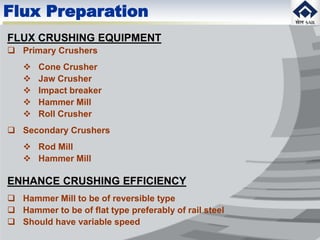
FLUX CRUSHING EQUIPMENT
 Primary Crushers
 Cone Crusher
 Jaw Crusher
 Impact breaker
 Hammer Mill
 Roll Crusher
 Secondary Crushers
 Rod Mill
 Hammer Mill
ENHANCE CRUSHING EFFICIENCY
 Hammer Mill to be of reversible type
 Hammer to be of flat type preferably of rail steel
 Should have variable speed
Flux Preparation
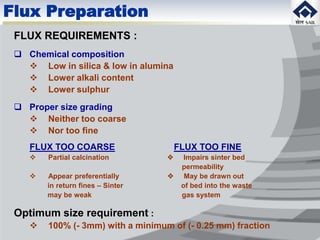
FLUX REQUIREMENTS :
 Chemical composition
 Low in silica & low in alumina
 Lower alkali content
 Lower sulphur
 Proper size grading
 Neither too coarse
 Nor too fine
FLUX TOO COARSE FLUX TOO FINE
 Partial calcination  Impairs sinter bed
permeability
 Appear preferentially  May be drawn out
in return fines – Sinter of bed into the waste
may be weak gas system
Optimum size requirement :
 100% (- 3mm) with a minimum of (- 0.25 mm) fraction
Flux Preparation
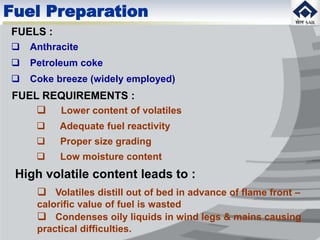
FUELS :
 Anthracite
 Petroleum coke
 Coke breeze (widely employed)
Fuel Preparation
FUEL REQUIREMENTS :
 Lower content of volatiles
 Adequate fuel reactivity
 Proper size grading
 Low moisture content
High volatile content leads to :
 Volatiles distill out of bed in advance of flame front –
calorific value of fuel is wasted
 Condenses oily liquids in wind legs & mains causing
practical difficulties.
Fuel Preparation
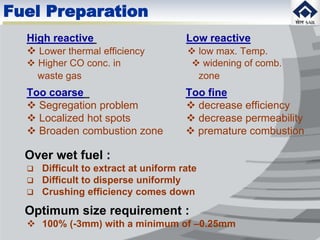
High reactive Low reactive
 Lower thermal efficiency  low max. Temp.
 Higher CO conc. in  widening of comb.
waste gas zone
Too coarse Too fine
 Segregation problem  decrease efficiency
 Localized hot spots  decrease permeability
 Broaden combustion zone  premature combustion
Over wet fuel :
 Difficult to extract at uniform rate
 Difficult to disperse uniformly
 Crushing efficiency comes down
Optimum size requirement :
 100% (-3mm) with a minimum of –0.25mm
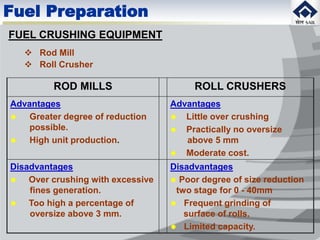
ROD MILLS ROLL CRUSHERS
Advantages
 Greater degree of reduction
possible.
 High unit production.
Advantages
 Little over crushing
 Practically no oversize
above 5 mm
 Moderate cost.
Disadvantages
 Over crushing with excessive
fines generation.
 Too high a percentage of
oversize above 3 mm.
Disadvantages
 Poor degree of size reduction
two stage for 0 - 40mm
 Frequent grinding of
surface of rolls.
 Limited capacity.
FUEL CRUSHING EQUIPMENT
 Rod Mill
 Roll Crusher
Fuel Preparation
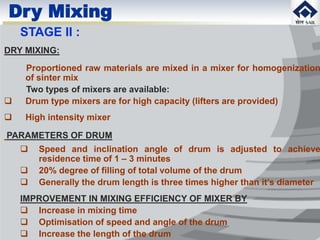
Dry Mixing
STAGE II :
DRY MIXING:
Proportioned raw materials are mixed in a mixer for homogenization
of sinter mix
Two types of mixers are available:
 Drum type mixers are for high capacity (lifters are provided)
 High intensity mixer
PARAMETERS OF DRUM
 Speed and inclination angle of drum is adjusted to achieve
residence time of 1 – 3 minutes
 20% degree of filling of total volume of the drum
 Generally the drum length is three times higher than it’s diameter
IMPROVEMENT IN MIXING EFFICIENCY OF MIXER BY
 Increase in mixing time
 Optimisation of speed and angle of the drum
 Increase the length of the drum
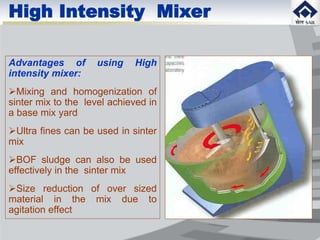
Advantages of using High
intensity mixer:
Mixing and homogenization of
sinter mix to the level achieved in
a base mix yard
Ultra fines can be used in sinter
mix
BOF sludge can also be used
effectively in the sinter mix
Size reduction of over sized
material in the mix due to
agitation effect
High Intensity Mixer
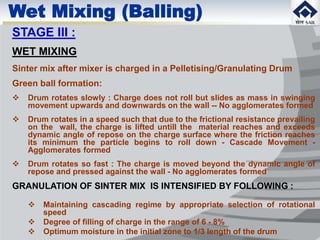
Wet Mixing (Balling)
STAGE III :
WET MIXING
Sinter mix after mixer is charged in a Pelletising/Granulating Drum
Green ball formation:
 Drum rotates slowly : Charge does not roll but slides as mass in swinging
movement upwards and downwards on the wall -- No agglomerates formed
 Drum rotates in a speed such that due to the frictional resistance prevailing
on the wall, the charge is lifted untill the material reaches and exceeds
dynamic angle of repose on the charge surface where the friction reaches
its minimum the particle begins to roll down - Cascade Movement -
Agglomerates formed
 Drum rotates so fast : The charge is moved beyond the dynamic angle of
repose and pressed against the wall - No agglomerates formed
GRANULATION OF SINTER MIX IS INTENSIFIED BY FOLLOWING :
 Maintaining cascading regime by appropriate selection of rotational
speed
 Degree of filling of charge in the range of 6 - 8%
 Optimum moisture in the initial zone to 1/3 length of the drum
During sintering preheating of sinter mix, combustion of fuel,
decomposition of carbonates, oxidation and reduction of oxides
and formation of sinter takes place in small portion of the height
of bed.
The reaction zone is shifted continuously towards the grate by
method of suction. The heating of sinter mix at each elementary
layer takes place both due to heat transfer from layers lying
above (mainly by convection) and due to the heat generated
during combustion of fuel. The heat accumulated in this layer is
spent in preheating and melting of particles of sinter mix and
also in occurrence of endothermic reaction (decomposition of
hydrates and carbonates).
After completion of combustion of coke and formation of sinter,
cooling of sinter starts. The heat is transferred to air passing
through and also partly (by radiation and thermal conduction) to
sinter layer below.
Sintering Process
 After ignition, hot products of combustion of gases are
sucked through bed and transfer their heat to a very narrow
layer of sinter mix at the top removing moisture from this layer
and creating conditions for the beginning of combustion of
coke particles in the mix
 Important feature of sintering is, each moment coke particles
present in a narrow layer 30 to 40 mm burns out
 All coke particles located below are not heated to a
temperature (700oC) or don’t get sufficient 02 from above.
combustion zone moves down wards through whole bed only
after the carbon is burn out in each layer
 At any given moment, zone of ready sinter is there above the
zone of combustion and air passes through this zone. Sinter
gets cooled by the air which gets pre heated and this heat is
utilised in the combustion zone
 Combustion product coming out of combustion zone give up
their heat to small layer of cold mix which gets heated quickly.
Temperature of waste gas at exhauster is 600C for long time
and for few minutes of the process raises to 3000C. The
temperature at combustion zone reaches 14000C
Sintering Process
 Raw mix adjacent to combustion zone is pre heated quickly
and loses hygroscopic moisture and then hydrate moisture.
Water vapours condense on layers of cold mix and create
zone of re-condensation of moisture and exceeds more than
initial moisture
 In pre heating zone chemical reaction between solid phases
takes place, carbonates & hydrates decompose
 Sintering of iron ore fines by suction is defined by the heat
transfer between gas and solids. The evaluation, movement
and assimilation of heat occurring due to passage of air
thro. Bed determines the temp. level of heating of solids and
cooling of sinter and also the rate of sintering
 The temperature level to a considerable extent determines
the strength of sinter
Sintering Process
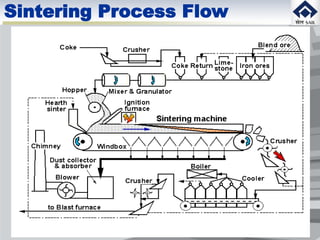
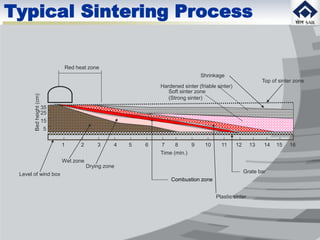
Sintering Process Flow
1 2 3 4 5 6 7 8 9 10 11 12 13 14 15 16
Red heat zone
Top of sinter zone
Shrinkage
Soft sinter zone
(Strong sinter)
Hardened sinter (friable sinter)
Bedheight(cm)
5
15
25
35
Level of wind box
Grate bar
Combustion zone
Drying zone
Wet zone
Time (min.)
Plastic sinter
Typical Sintering Process
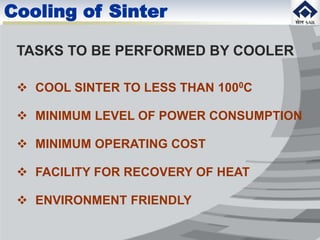
Cooling of Sinter
TASKS TO BE PERFORMED BY COOLER
 COOL SINTER TO LESS THAN 1000C
 MINIMUM LEVEL OF POWER CONSUMPTION
 MINIMUM OPERATING COST
 FACILITY FOR RECOVERY OF HEAT
 ENVIRONMENT FRIENDLY
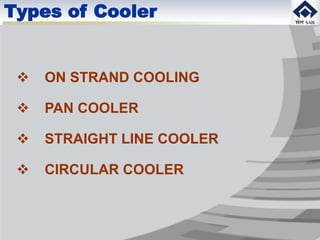
 ON STRAND COOLING
 PAN COOLER
 STRAIGHT LINE COOLER
 CIRCULAR COOLER
Types of Cooler
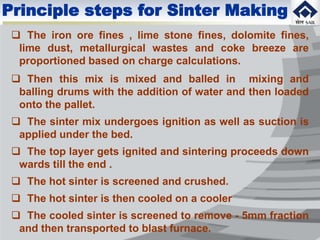
Principle steps for Sinter Making
 The iron ore fines , lime stone fines, dolomite fines,
lime dust, metallurgical wastes and coke breeze are
proportioned based on charge calculations.
 Then this mix is mixed and balled in mixing and
balling drums with the addition of water and then loaded
onto the pallet.
 The sinter mix undergoes ignition as well as suction is
applied under the bed.
 The top layer gets ignited and sintering proceeds down
wards till the end .
 The hot sinter is screened and crushed.
 The hot sinter is then cooled on a cooler
 The cooled sinter is screened to remove - 5mm fraction
and then transported to blast furnace.
Sinter Quality Improvement
Return Sinter Management
RETURN SINTER MANAGEMENT
1) RETURN SINTER BALANCE
2) REDUCTION IN RETURN SINTER
GENERATION
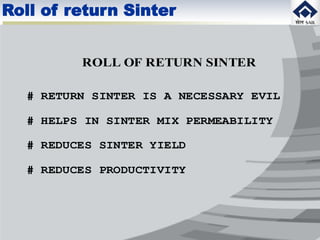
ROLL OF RETURN SINTER
# RETURN SINTER IS A NECESSARY EVIL
# HELPS IN SINTER MIX PERMEABILITY
# REDUCES SINTER YIELD
# REDUCES PRODUCTIVITY
Roll of return Sinter
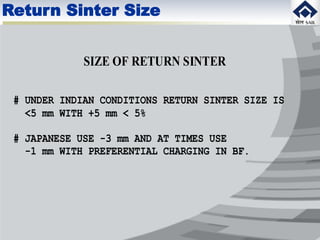
SIZE OF RETURN SINTER
# UNDER INDIAN CONDITIONS RETURN SINTER SIZE IS
<5 mm WITH +5 mm < 5%
# JAPANESE USE -3 mm AND AT TIMES USE
-1 mm WITH PREFERENTIAL CHARGING IN BF.
Return Sinter Size
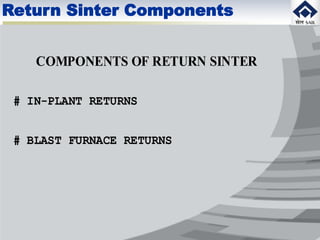
COMPONENTS OF RETURN SINTER
# IN-PLANT RETURNS
# BLAST FURNACE RETURNS
Return Sinter Components
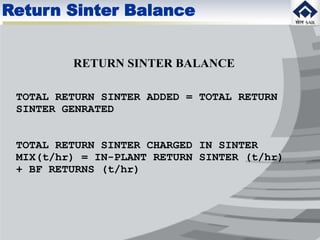
RETURN SINTER BALANCE
TOTAL RETURN SINTER ADDED = TOTAL RETURN
SINTER GENRATED
TOTAL RETURN SINTER CHARGED IN SINTER
MIX(t/hr) = IN-PLANT RETURN SINTER (t/hr)
+ BF RETURNS (t/hr)
Return Sinter Balance
RETURN SINTER BALANCE
RETURN SINTER BALANCE CAN BE ACHIEVED BY:
1) CONSISTANCY IN RAW MATERIAL GRANULOMETRY AND
CHEMISTRY
2) CONSISTANCY IN OPERATION
3) CONTINUOUS RUNNING OF MACHINE
Return Sinter Balance
RETURN SINTER BALANCE
CONSISTANCY IN RAW MATERIAL GRANULOMETRY AND
CHEMISTRY
Return Sinter Balance
RETURN SINTER BALANCE
CONSISTANCY IN OPERATION
Return Sinter Balance
RETURN SINTER BALANCE
CONTINUOUS RUNNING OF MACHINE
Return Sinter Balance
REDUCTION IN RETURN SINTER
GENERATION
1) RAW MATERIALS
2) PROCESS
3) TRANSPORTATION
Reduction in Return Sinter
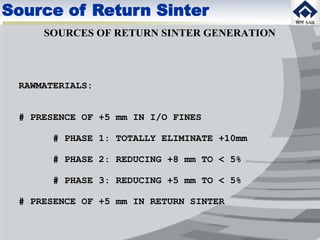
SOURCES OF RETURN SINTER GENERATION
RAWMATERIALS:
# PRESENCE OF +5 mm IN I/O FINES
# PHASE 1: TOTALLY ELIMINATE +10mm
# PHASE 2: REDUCING +8 mm TO < 5%
# PHASE 3: REDUCING +5 mm TO < 5%
# PRESENCE OF +5 mm IN RETURN SINTER
Source of Return Sinter
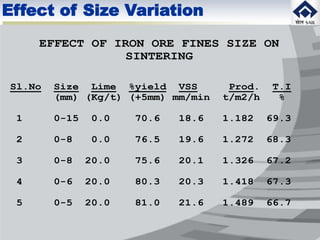
EFFECT OF IRON ORE FINES SIZE ON
SINTERING
Sl.No Size Lime %yield VSS Prod. T.I
(mm) (Kg/t) (+5mm) mm/min t/m2/h %
1 0-15 0.0 70.6 18.6 1.182 69.3
2 0-8 0.0 76.5 19.6 1.272 68.3
3 0-8 20.0 75.6 20.1 1.326 67.2
4 0-6 20.0 80.3 20.3 1.418 67.3
5 0-5 20.0 81.0 21.6 1.489 66.7
Effect of Size Variation
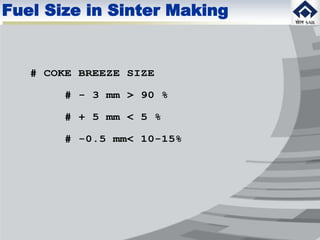
# COKE BREEZE SIZE
# - 3 mm > 90 %
# + 5 mm < 5 %
# -0.5 mm< 10-15%
Fuel Size in Sinter Making
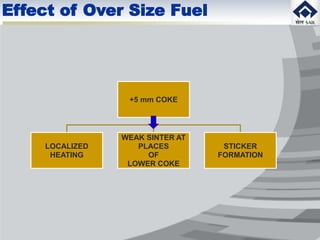
+5 mm COKE
LOCALIZED
HEATING
WEAK SINTER AT
PLACES
OF
LOWER COKE
STICKER
FORMATION
Effect of Over Size Fuel
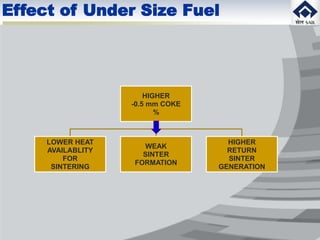
HIGHER
-0.5 mm COKE
%
LOWER HEAT
AVAILABLITY
FOR
SINTERING
WEAK
SINTER
FORMATION
HIGHER
RETURN
SINTER
GENERATION
Effect of Under Size Fuel
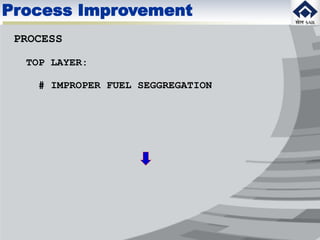
PROCESS
TOP LAYER:
# IMPROPER FUEL SEGGREGATION
Process Improvement
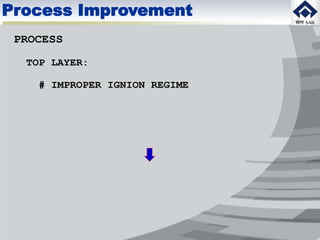
PROCESS
TOP LAYER:
# IMPROPER IGNION REGIME
Process Improvement
PROCESS:
RIM-ZONE EFFECT
Process Improvement
PROCESS:
LOWER MIXING EFFICIENCY
Process Improvement
PROCESS:
IMPROPER MOISTURE CONTROL
Process Improvement
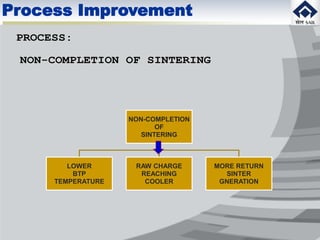
PROCESS:
NON-COMPLETION OF SINTERING
NON-COMPLETION
OF
SINTERING
LOWER
BTP
TEMPERATURE
RAW CHARGE
REACHING
COOLER
MORE RETURN
SINTER
GNERATION
Process Improvement
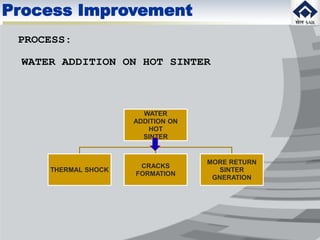
PROCESS:
WATER ADDITION ON HOT SINTER
WATER
ADDITION ON
HOT
SINTER
THERMAL SHOCK
CRACKS
FORMATION
MORE RETURN
SINTER
GNERATION
Process Improvement
BF RETURNS
# BF RETURN SINTER SIZE
#SIZE SHOULD BE -5mm WITH +5mm<5%
Transportation
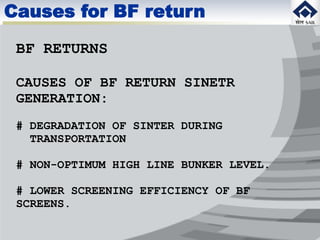
BF RETURNS
CAUSES OF BF RETURN SINETR
GENERATION:
# DEGRADATION OF SINTER DURING
TRANSPORTATION
# NON-OPTIMUM HIGH LINE BUNKER LEVEL.
# LOWER SCREENING EFFICIENCY OF BF
SCREENS.
Causes for BF return
BF RETURN SINTER GENERATION COULD BE
REDUCED
BY:
# REDUCING DEGRADATION AT TRANSFER POINTS BY
INSTALLING STONE BOXES OR LADDER TYPE
CHUTES.
# MAINTAINING THE HIGH LINE BUNKER LEVEL AT
40-50%
# IMPROVING THE SCREENING EFFICIENCY OF BF
SINTER SCREENS
# RE-SCREENING OF BF RETURN SINTER
Measures to be taken
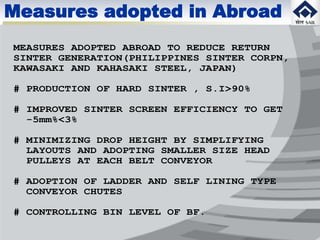
MEASURES ADOPTED ABROAD TO REDUCE RETURN
SINTER GENERATION(PHILIPPINES SINTER CORPN,
KAWASAKI AND KAHASAKI STEEL, JAPAN)
# PRODUCTION OF HARD SINTER , S.I>90%
# IMPROVED SINTER SCREEN EFFICIENCY TO GET
-5mm%<3%
# MINIMIZING DROP HEIGHT BY SIMPLIFYING
LAYOUTS AND ADOPTING SMALLER SIZE HEAD
PULLEYS AT EACH BELT CONVEYOR
# ADOPTION OF LADDER AND SELF LINING TYPE
CONVEYOR CHUTES
# CONTROLLING BIN LEVEL OF BF.
Measures adopted in Abroad
Effect of different factor
on sintering
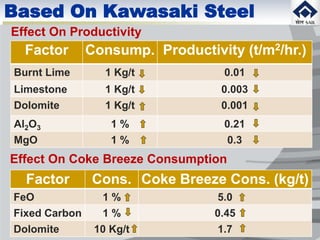
Factor Consump. Productivity (t/m2/hr.)
Burnt Lime 1 Kg/t 0.01
Limestone 1 Kg/t 0.003
Dolomite 1 Kg/t 0.001
Al2O3 1 % 0.21
MgO 1 % 0.3
Effect On Productivity
Factor Cons. Coke Breeze Cons. (kg/t)
FeO 1 % 5.0
Fixed Carbon 1 % 0.45
Dolomite 10 Kg/t 1.7
Effect On Coke Breeze Consumption
Based On Kawasaki Steel
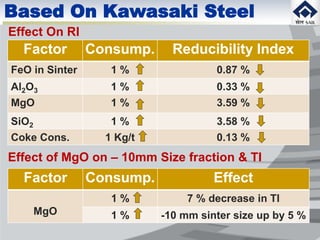
Factor Consump. Reducibility Index
FeO in Sinter 1 % 0.87 %
Al2O3 1 % 0.33 %
MgO 1 % 3.59 %
SiO2 1 % 3.58 %
Coke Cons. 1 Kg/t 0.13 %
Effect On RI
Effect of MgO on – 10mm Size fraction & TI
Factor Consump. Effect
MgO
1 % 7 % decrease in TI
1 % -10 mm sinter size up by 5 %
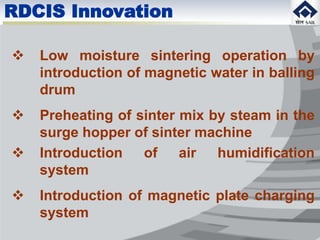
RDCIS Innovation
RDCIS Innovation
 Low moisture sintering operation by
introduction of magnetic water in balling
drum
 Preheating of sinter mix by steam in the
surge hopper of sinter machine
 Introduction of air humidification
system
 Introduction of magnetic plate charging
system
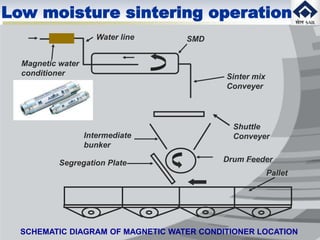
Low moisture sintering operation
SCHEMATIC DIAGRAM OF MAGNETIC WATER CONDITIONER LOCATION
Magnetic water
conditioner
SMDWater line
Shuttle
Conveyer
Sinter mix
Conveyer
Intermediate
bunker
Segregation Plate Drum Feeder
Pallet
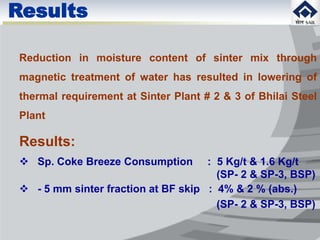
Results
Reduction in moisture content of sinter mix through
magnetic treatment of water has resulted in lowering of
thermal requirement at Sinter Plant # 2 & 3 of Bhilai Steel
Plant
Results:
 Sp. Coke Breeze Consumption : 5 Kg/t & 1.6 Kg/t
(SP- 2 & SP-3, BSP)
 - 5 mm sinter fraction at BF skip : 4% & 2 % (abs.)
(SP- 2 & SP-3, BSP)
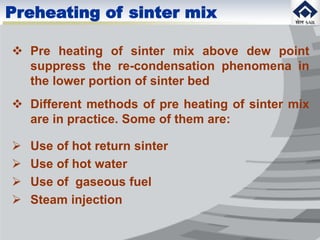
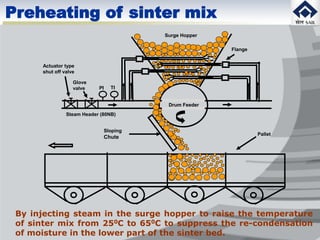
 Pre heating of sinter mix above dew point
suppress the re-condensation phenomena in
the lower portion of sinter bed
 Different methods of pre heating of sinter mix
are in practice. Some of them are:
 Use of hot return sinter
 Use of hot water
 Use of gaseous fuel
 Steam injection
Preheating of sinter mix
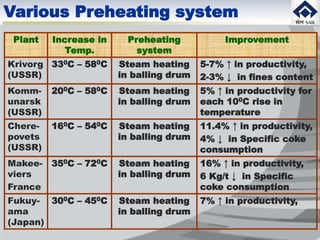
Various Preheating system
Plant Increase in
Temp.
Preheating
system
Improvement
Krivorg
(USSR)
330C – 580C Steam heating
in balling drum
5-7% ↑ in productivity,
2-3% ↓ in fines content
Komm-
unarsk
(USSR)
200C – 580C Steam heating
in balling drum
5% ↑ in productivity for
each 100C rise in
temperature
Chere-
povets
(USSR)
160C – 540C Steam heating
in balling drum
11.4% ↑ in productivity,
4% ↓ in Specific coke
consumption
Makee-
viers
France
350C – 720C Steam heating
in balling drum
16% ↑ in productivity,
6 Kg/t ↓ in Specific
coke consumption
Fukuy-
ama
(Japan)
300C – 450C Steam heating
in balling drum
7% ↑ in productivity,
Actuator type
shut off valve
Glove
valve PI TI
Surge Hopper
Flange
Drum Feeder
Steam Header (80NB)
Sloping
Chute
Pallet
By injecting steam in the surge hopper to raise the temperature
of sinter mix from 250C to 650C to suppress the re-condensation
of moisture in the lower part of the sinter bed.
Preheating of sinter mix
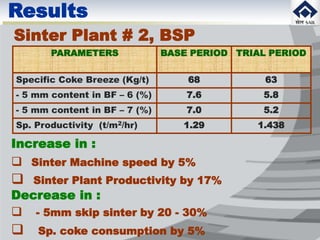
Results
Increase in :
 Sinter Machine speed by 5%
 Sinter Plant Productivity by 17%
Decrease in :
 - 5mm skip sinter by 20 - 30%
 Sp. coke consumption by 5%
PARAMETERS BASE PERIOD TRIAL PERIOD
Specific Coke Breeze (Kg/t) 68 63
- 5 mm content in BF – 6 (%) 7.6 5.8
- 5 mm content in BF – 7 (%) 7.0 5.2
Sp. Productivity (t/m2/hr) 1.29 1.438
Sinter Plant # 2, BSP
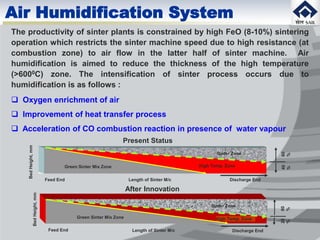
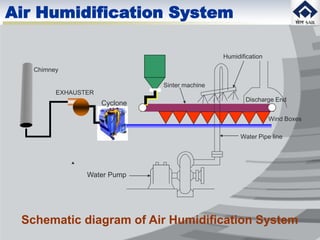
Air Humidification System
The productivity of sinter plants is constrained by high FeO (8-10%) sintering
operation which restricts the sinter machine speed due to high resistance (at
combustion zone) to air flow in the latter half of sinter machine. Air
humidification is aimed to reduce the thickness of the high temperature
(>6000C) zone. The intensification of sinter process occurs due to
humidification is as follows :
 Oxygen enrichment of air
 Improvement of heat transfer process
 Acceleration of CO combustion reaction in presence of water vapour
BedHeight,mm
Feed End Length of Sinter M/c Discharge End
20
%
80
%
Sinter Zone
High Temp. ZoneGreen Sinter Mix Zone
Sinter Zone
High Temp. ZoneGreen Sinter Mix Zone
60
%
40
%
Feed End Length of Sinter M/c Discharge End
BedHeight,mm
Present Status
After Innovation
Air Humidification System
EXHAUSTER
Cyclone
Sinter machine
Wind Boxes
Chimney
Discharge End
Humidification
Water Pipe line
Water Pump
Schematic diagram of Air Humidification System
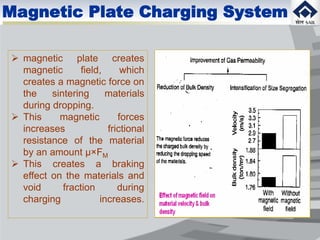
 magnetic plate creates
magnetic field, which
creates a magnetic force on
the sintering materials
during dropping.
 This magnetic forces
increases frictional
resistance of the material
by an amount µ×FM
 This creates a braking
effect on the materials and
void fraction during
charging increases.
Magnetic Plate Charging System
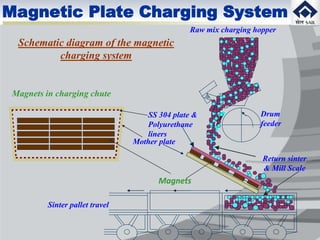
Schematic diagram of the magnetic
charging system
Raw mix charging hopper
Drum
feeder
Sinter pallet travel
SS 304 plate &
Polyurethane
liners
Mother plate
Magnets in charging chute
v
v
Magnets
Return sinter
& Mill Scale
Magnetic Plate Charging System
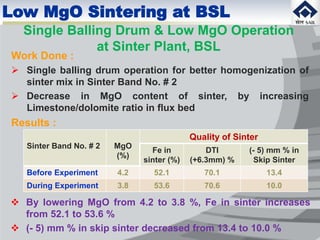
Low MgO Sintering at BSL
Single Balling Drum & Low MgO Operation
at Sinter Plant, BSL
Work Done :
 Single balling drum operation for better homogenization of
sinter mix in Sinter Band No. # 2
 Decrease in MgO content of sinter, by increasing
Limestone/dolomite ratio in flux bed
Results :
Sinter Band No. # 2 MgO
(%)
Quality of Sinter
Fe in
sinter (%)
DTI
(+6.3mm) %
(- 5) mm % in
Skip Sinter
Before Experiment 4.2 52.1 70.1 13.4
During Experiment 3.8 53.6 70.6 10.0
 By lowering MgO from 4.2 to 3.8 %, Fe in sinter increases
from 52.1 to 53.6 %
 (- 5) mm % in skip sinter decreased from 13.4 to 10.0 %
New Sinter Plants at SAIL
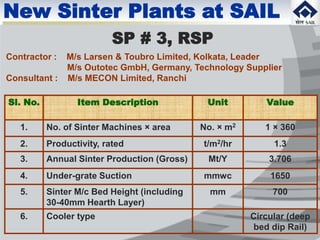
Sl. No. Item Description Unit Value
1. No. of Sinter Machines × area No. × m2 1 × 360
2. Productivity, rated t/m2/hr 1.3
3. Annual Sinter Production (Gross) Mt/Y 3.706
4. Under-grate Suction mmwc 1650
5. Sinter M/c Bed Height (including
30-40mm Hearth Layer)
mm 700
6. Cooler type Circular (deep
bed dip Rail)
SP # 3, RSP
Contractor : M/s Larsen & Toubro Limited, Kolkata, Leader
M/s Outotec GmbH, Germany, Technology Supplier
Consultant : M/s MECON Limited, Ranchi
New Sinter Plants at SAIL
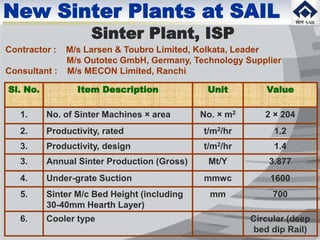
Sinter Plant, ISP
Sl. No. Item Description Unit Value
1. No. of Sinter Machines × area No. × m2 2 × 204
2. Productivity, rated t/m2/hr 1.2
3. Productivity, design t/m2/hr 1.4
3. Annual Sinter Production (Gross) Mt/Y 3.877
4. Under-grate Suction mmwc 1600
5. Sinter M/c Bed Height (including
30-40mm Hearth Layer)
mm 700
6. Cooler type Circular (deep
bed dip Rail)
Contractor : M/s Larsen & Toubro Limited, Kolkata, Leader
M/s Outotec GmbH, Germany, Technology Supplier
Consultant : M/s MECON Limited, Ranchi
New Sinter Plants at SAIL
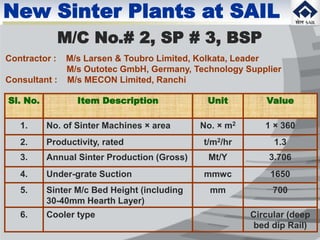
M/C No.# 2, SP # 3, BSP
Sl. No. Item Description Unit Value
1. No. of Sinter Machines × area No. × m2 1 × 360
2. Productivity, rated t/m2/hr 1.3
3. Annual Sinter Production (Gross) Mt/Y 3.706
4. Under-grate Suction mmwc 1650
5. Sinter M/c Bed Height (including
30-40mm Hearth Layer)
mm 700
6. Cooler type Circular (deep
bed dip Rail)
Contractor : M/s Larsen & Toubro Limited, Kolkata, Leader
M/s Outotec GmbH, Germany, Technology Supplier
Consultant : M/s MECON Limited, Ranchi
Sintering   Technology

Sintering Technology

  • 1.
    Sinter Making Technology AritraMallick AGM (Agglomeration) RDCIS, Ranchi
  • 2.
    Introduction  During miningoperation of Iron ore, big boulders are crushed to smaller size suitable for blast furnace charging. During this operation fines are generated and the same can not be discarded as it contains Fe to the tune of 60% and also the same can not be charged in the blast furnace due to the size restriction. During mining fines are generated to the tune of 70%.  Blast furnace production is based on counter- current principle basis i.e. charge descends from top and air is supplied from bottom. Permeability plays a vital role in the blast furnace for production of hot metal. Blast furnace is charged with lumps, size of 8 - 40mm.
  • 3.
    Introduction  To conservethe fines it has become essential to agglomerate the fines to a desired size which can be charged in the blast furnace.  Many types of agglomerating processes are available where sintering is techno - economically viable. Resulted in installation of sinter plants.  Sintering can be defined as agglomeration of fines into a porous mass by incipient fusion.  Use of sinter has many fold advantages in the blast furnace like :  Conservation of fines (ecological)  Pre-reduced material  High softening temperature  Use of flux through sinter  Higher reducibility of sinter
  • 4.
    Raw Material Preparation Preparation of raw materials and production of consistent quality sinter is utmost important.  To produce consistent quality sinter maximum attention is required for preparation of raw materials, and sintering process. Why preparation?  To minimize the fluctuation in the quality of final product What is preparation?  Raw material preparation for sinter making can be explained as crushing, mixing & granulation of raw materials with different physico-chemical properties and proportion of the same (iron ore fines, flux fines, fuel fines, metallurgical wastes) to provide a homogeneous mixture, so as to produce sinter which has a good and consistent metallurgical properties.
  • 5.
    Raw Material Preparation Preparationof sinter mix exerts considerable influence on productivity, quality (RDI,RI), consistency of sinter chemistry as well as machine operation. Quality and productivity are determined by coke combustion behavior during sintering process Following raw materials are used for sintering: I/o fines 0 - 10mm (generated ) flux fines 0 - 3mm (crushed) fuel fines 0 - 3mm ( crushed) met. wastes 0 - 3mm (generated in plant) mill scale 0 - 10mm (generated in plant)
  • 6.
    Raw material preparationfor sinter making consists of :  Crushing, Proportioning  Dry mixing  Wet mixing (Balling) STAGE I:  Crushing of bigger size material to smaller size fraction by hammer crusher/roll crusher/rod mill for easy and proper mixing.  Fuels and fluxes received in bigger size and can’t be used as such  Combustion behaviour of coke is the controlling factor for sintering IMPROVEMENT IN COMBUSTION BEHAVIOUR RESULTS IN  Energy saving  Increased productivity  Improved quality of sinter Raw Material Preparation
  • 7.
    Flux Preparation FLUXES : Limestone  Dolomite  Serpentine (replacement for dolomite)  Calcined lime (absorbs moisture & helps in balling and preheating of sinter mix) ADVANTAGES OF ADDING FLUX IN SINTER MIX :  Calcination of flux takes place during sintering process  Intimately mixed with ore and get pre slagged  Sinter produced likely to be more reducible  Increases average permeability which increases rate of sintering
  • 8.
    FLUX CRUSHING EQUIPMENT Primary Crushers  Cone Crusher  Jaw Crusher  Impact breaker  Hammer Mill  Roll Crusher  Secondary Crushers  Rod Mill  Hammer Mill ENHANCE CRUSHING EFFICIENCY  Hammer Mill to be of reversible type  Hammer to be of flat type preferably of rail steel  Should have variable speed Flux Preparation
  • 9.
    FLUX REQUIREMENTS : Chemical composition  Low in silica & low in alumina  Lower alkali content  Lower sulphur  Proper size grading  Neither too coarse  Nor too fine FLUX TOO COARSE FLUX TOO FINE  Partial calcination  Impairs sinter bed permeability  Appear preferentially  May be drawn out in return fines – Sinter of bed into the waste may be weak gas system Optimum size requirement :  100% (- 3mm) with a minimum of (- 0.25 mm) fraction Flux Preparation
  • 10.
    FUELS :  Anthracite Petroleum coke  Coke breeze (widely employed) Fuel Preparation FUEL REQUIREMENTS :  Lower content of volatiles  Adequate fuel reactivity  Proper size grading  Low moisture content High volatile content leads to :  Volatiles distill out of bed in advance of flame front – calorific value of fuel is wasted  Condenses oily liquids in wind legs & mains causing practical difficulties.
  • 11.
    Fuel Preparation High reactiveLow reactive  Lower thermal efficiency  low max. Temp.  Higher CO conc. in  widening of comb. waste gas zone Too coarse Too fine  Segregation problem  decrease efficiency  Localized hot spots  decrease permeability  Broaden combustion zone  premature combustion Over wet fuel :  Difficult to extract at uniform rate  Difficult to disperse uniformly  Crushing efficiency comes down Optimum size requirement :  100% (-3mm) with a minimum of –0.25mm
  • 12.
    ROD MILLS ROLLCRUSHERS Advantages  Greater degree of reduction possible.  High unit production. Advantages  Little over crushing  Practically no oversize above 5 mm  Moderate cost. Disadvantages  Over crushing with excessive fines generation.  Too high a percentage of oversize above 3 mm. Disadvantages  Poor degree of size reduction two stage for 0 - 40mm  Frequent grinding of surface of rolls.  Limited capacity. FUEL CRUSHING EQUIPMENT  Rod Mill  Roll Crusher Fuel Preparation
  • 13.
    Dry Mixing STAGE II: DRY MIXING: Proportioned raw materials are mixed in a mixer for homogenization of sinter mix Two types of mixers are available:  Drum type mixers are for high capacity (lifters are provided)  High intensity mixer PARAMETERS OF DRUM  Speed and inclination angle of drum is adjusted to achieve residence time of 1 – 3 minutes  20% degree of filling of total volume of the drum  Generally the drum length is three times higher than it’s diameter IMPROVEMENT IN MIXING EFFICIENCY OF MIXER BY  Increase in mixing time  Optimisation of speed and angle of the drum  Increase the length of the drum
  • 14.
    Advantages of usingHigh intensity mixer: Mixing and homogenization of sinter mix to the level achieved in a base mix yard Ultra fines can be used in sinter mix BOF sludge can also be used effectively in the sinter mix Size reduction of over sized material in the mix due to agitation effect High Intensity Mixer
  • 15.
    Wet Mixing (Balling) STAGEIII : WET MIXING Sinter mix after mixer is charged in a Pelletising/Granulating Drum Green ball formation:  Drum rotates slowly : Charge does not roll but slides as mass in swinging movement upwards and downwards on the wall -- No agglomerates formed  Drum rotates in a speed such that due to the frictional resistance prevailing on the wall, the charge is lifted untill the material reaches and exceeds dynamic angle of repose on the charge surface where the friction reaches its minimum the particle begins to roll down - Cascade Movement - Agglomerates formed  Drum rotates so fast : The charge is moved beyond the dynamic angle of repose and pressed against the wall - No agglomerates formed GRANULATION OF SINTER MIX IS INTENSIFIED BY FOLLOWING :  Maintaining cascading regime by appropriate selection of rotational speed  Degree of filling of charge in the range of 6 - 8%  Optimum moisture in the initial zone to 1/3 length of the drum
  • 16.
    During sintering preheatingof sinter mix, combustion of fuel, decomposition of carbonates, oxidation and reduction of oxides and formation of sinter takes place in small portion of the height of bed. The reaction zone is shifted continuously towards the grate by method of suction. The heating of sinter mix at each elementary layer takes place both due to heat transfer from layers lying above (mainly by convection) and due to the heat generated during combustion of fuel. The heat accumulated in this layer is spent in preheating and melting of particles of sinter mix and also in occurrence of endothermic reaction (decomposition of hydrates and carbonates). After completion of combustion of coke and formation of sinter, cooling of sinter starts. The heat is transferred to air passing through and also partly (by radiation and thermal conduction) to sinter layer below. Sintering Process
  • 17.
     After ignition,hot products of combustion of gases are sucked through bed and transfer their heat to a very narrow layer of sinter mix at the top removing moisture from this layer and creating conditions for the beginning of combustion of coke particles in the mix  Important feature of sintering is, each moment coke particles present in a narrow layer 30 to 40 mm burns out  All coke particles located below are not heated to a temperature (700oC) or don’t get sufficient 02 from above. combustion zone moves down wards through whole bed only after the carbon is burn out in each layer  At any given moment, zone of ready sinter is there above the zone of combustion and air passes through this zone. Sinter gets cooled by the air which gets pre heated and this heat is utilised in the combustion zone  Combustion product coming out of combustion zone give up their heat to small layer of cold mix which gets heated quickly. Temperature of waste gas at exhauster is 600C for long time and for few minutes of the process raises to 3000C. The temperature at combustion zone reaches 14000C Sintering Process
  • 18.
     Raw mixadjacent to combustion zone is pre heated quickly and loses hygroscopic moisture and then hydrate moisture. Water vapours condense on layers of cold mix and create zone of re-condensation of moisture and exceeds more than initial moisture  In pre heating zone chemical reaction between solid phases takes place, carbonates & hydrates decompose  Sintering of iron ore fines by suction is defined by the heat transfer between gas and solids. The evaluation, movement and assimilation of heat occurring due to passage of air thro. Bed determines the temp. level of heating of solids and cooling of sinter and also the rate of sintering  The temperature level to a considerable extent determines the strength of sinter Sintering Process
  • 19.
  • 20.
    1 2 34 5 6 7 8 9 10 11 12 13 14 15 16 Red heat zone Top of sinter zone Shrinkage Soft sinter zone (Strong sinter) Hardened sinter (friable sinter) Bedheight(cm) 5 15 25 35 Level of wind box Grate bar Combustion zone Drying zone Wet zone Time (min.) Plastic sinter Typical Sintering Process
  • 21.
    Cooling of Sinter TASKSTO BE PERFORMED BY COOLER  COOL SINTER TO LESS THAN 1000C  MINIMUM LEVEL OF POWER CONSUMPTION  MINIMUM OPERATING COST  FACILITY FOR RECOVERY OF HEAT  ENVIRONMENT FRIENDLY
  • 22.
     ON STRANDCOOLING  PAN COOLER  STRAIGHT LINE COOLER  CIRCULAR COOLER Types of Cooler
  • 23.
    Principle steps forSinter Making  The iron ore fines , lime stone fines, dolomite fines, lime dust, metallurgical wastes and coke breeze are proportioned based on charge calculations.  Then this mix is mixed and balled in mixing and balling drums with the addition of water and then loaded onto the pallet.  The sinter mix undergoes ignition as well as suction is applied under the bed.  The top layer gets ignited and sintering proceeds down wards till the end .  The hot sinter is screened and crushed.  The hot sinter is then cooled on a cooler  The cooled sinter is screened to remove - 5mm fraction and then transported to blast furnace.
  • 24.
  • 25.
    Return Sinter Management RETURNSINTER MANAGEMENT 1) RETURN SINTER BALANCE 2) REDUCTION IN RETURN SINTER GENERATION
  • 26.
    ROLL OF RETURNSINTER # RETURN SINTER IS A NECESSARY EVIL # HELPS IN SINTER MIX PERMEABILITY # REDUCES SINTER YIELD # REDUCES PRODUCTIVITY Roll of return Sinter
  • 27.
    SIZE OF RETURNSINTER # UNDER INDIAN CONDITIONS RETURN SINTER SIZE IS <5 mm WITH +5 mm < 5% # JAPANESE USE -3 mm AND AT TIMES USE -1 mm WITH PREFERENTIAL CHARGING IN BF. Return Sinter Size
  • 28.
    COMPONENTS OF RETURNSINTER # IN-PLANT RETURNS # BLAST FURNACE RETURNS Return Sinter Components
  • 29.
    RETURN SINTER BALANCE TOTALRETURN SINTER ADDED = TOTAL RETURN SINTER GENRATED TOTAL RETURN SINTER CHARGED IN SINTER MIX(t/hr) = IN-PLANT RETURN SINTER (t/hr) + BF RETURNS (t/hr) Return Sinter Balance
  • 30.
    RETURN SINTER BALANCE RETURNSINTER BALANCE CAN BE ACHIEVED BY: 1) CONSISTANCY IN RAW MATERIAL GRANULOMETRY AND CHEMISTRY 2) CONSISTANCY IN OPERATION 3) CONTINUOUS RUNNING OF MACHINE Return Sinter Balance
  • 31.
    RETURN SINTER BALANCE CONSISTANCYIN RAW MATERIAL GRANULOMETRY AND CHEMISTRY Return Sinter Balance
  • 32.
    RETURN SINTER BALANCE CONSISTANCYIN OPERATION Return Sinter Balance
  • 33.
    RETURN SINTER BALANCE CONTINUOUSRUNNING OF MACHINE Return Sinter Balance
  • 34.
    REDUCTION IN RETURNSINTER GENERATION 1) RAW MATERIALS 2) PROCESS 3) TRANSPORTATION Reduction in Return Sinter
  • 35.
    SOURCES OF RETURNSINTER GENERATION RAWMATERIALS: # PRESENCE OF +5 mm IN I/O FINES # PHASE 1: TOTALLY ELIMINATE +10mm # PHASE 2: REDUCING +8 mm TO < 5% # PHASE 3: REDUCING +5 mm TO < 5% # PRESENCE OF +5 mm IN RETURN SINTER Source of Return Sinter
  • 36.
    EFFECT OF IRONORE FINES SIZE ON SINTERING Sl.No Size Lime %yield VSS Prod. T.I (mm) (Kg/t) (+5mm) mm/min t/m2/h % 1 0-15 0.0 70.6 18.6 1.182 69.3 2 0-8 0.0 76.5 19.6 1.272 68.3 3 0-8 20.0 75.6 20.1 1.326 67.2 4 0-6 20.0 80.3 20.3 1.418 67.3 5 0-5 20.0 81.0 21.6 1.489 66.7 Effect of Size Variation
  • 37.
    # COKE BREEZESIZE # - 3 mm > 90 % # + 5 mm < 5 % # -0.5 mm< 10-15% Fuel Size in Sinter Making
  • 38.
    +5 mm COKE LOCALIZED HEATING WEAKSINTER AT PLACES OF LOWER COKE STICKER FORMATION Effect of Over Size Fuel
  • 39.
    HIGHER -0.5 mm COKE % LOWERHEAT AVAILABLITY FOR SINTERING WEAK SINTER FORMATION HIGHER RETURN SINTER GENERATION Effect of Under Size Fuel
  • 40.
    PROCESS TOP LAYER: # IMPROPERFUEL SEGGREGATION Process Improvement
  • 41.
    PROCESS TOP LAYER: # IMPROPERIGNION REGIME Process Improvement
  • 42.
  • 43.
  • 44.
  • 45.
    PROCESS: NON-COMPLETION OF SINTERING NON-COMPLETION OF SINTERING LOWER BTP TEMPERATURE RAWCHARGE REACHING COOLER MORE RETURN SINTER GNERATION Process Improvement
  • 46.
    PROCESS: WATER ADDITION ONHOT SINTER WATER ADDITION ON HOT SINTER THERMAL SHOCK CRACKS FORMATION MORE RETURN SINTER GNERATION Process Improvement
  • 47.
    BF RETURNS # BFRETURN SINTER SIZE #SIZE SHOULD BE -5mm WITH +5mm<5% Transportation
  • 48.
    BF RETURNS CAUSES OFBF RETURN SINETR GENERATION: # DEGRADATION OF SINTER DURING TRANSPORTATION # NON-OPTIMUM HIGH LINE BUNKER LEVEL. # LOWER SCREENING EFFICIENCY OF BF SCREENS. Causes for BF return
  • 49.
    BF RETURN SINTERGENERATION COULD BE REDUCED BY: # REDUCING DEGRADATION AT TRANSFER POINTS BY INSTALLING STONE BOXES OR LADDER TYPE CHUTES. # MAINTAINING THE HIGH LINE BUNKER LEVEL AT 40-50% # IMPROVING THE SCREENING EFFICIENCY OF BF SINTER SCREENS # RE-SCREENING OF BF RETURN SINTER Measures to be taken
  • 50.
    MEASURES ADOPTED ABROADTO REDUCE RETURN SINTER GENERATION(PHILIPPINES SINTER CORPN, KAWASAKI AND KAHASAKI STEEL, JAPAN) # PRODUCTION OF HARD SINTER , S.I>90% # IMPROVED SINTER SCREEN EFFICIENCY TO GET -5mm%<3% # MINIMIZING DROP HEIGHT BY SIMPLIFYING LAYOUTS AND ADOPTING SMALLER SIZE HEAD PULLEYS AT EACH BELT CONVEYOR # ADOPTION OF LADDER AND SELF LINING TYPE CONVEYOR CHUTES # CONTROLLING BIN LEVEL OF BF. Measures adopted in Abroad
  • 51.
    Effect of differentfactor on sintering
  • 52.
    Factor Consump. Productivity(t/m2/hr.) Burnt Lime 1 Kg/t 0.01 Limestone 1 Kg/t 0.003 Dolomite 1 Kg/t 0.001 Al2O3 1 % 0.21 MgO 1 % 0.3 Effect On Productivity Factor Cons. Coke Breeze Cons. (kg/t) FeO 1 % 5.0 Fixed Carbon 1 % 0.45 Dolomite 10 Kg/t 1.7 Effect On Coke Breeze Consumption Based On Kawasaki Steel
  • 53.
    Based On KawasakiSteel Factor Consump. Reducibility Index FeO in Sinter 1 % 0.87 % Al2O3 1 % 0.33 % MgO 1 % 3.59 % SiO2 1 % 3.58 % Coke Cons. 1 Kg/t 0.13 % Effect On RI Effect of MgO on – 10mm Size fraction & TI Factor Consump. Effect MgO 1 % 7 % decrease in TI 1 % -10 mm sinter size up by 5 %
  • 54.
  • 55.
    RDCIS Innovation  Lowmoisture sintering operation by introduction of magnetic water in balling drum  Preheating of sinter mix by steam in the surge hopper of sinter machine  Introduction of air humidification system  Introduction of magnetic plate charging system
  • 56.
    Low moisture sinteringoperation SCHEMATIC DIAGRAM OF MAGNETIC WATER CONDITIONER LOCATION Magnetic water conditioner SMDWater line Shuttle Conveyer Sinter mix Conveyer Intermediate bunker Segregation Plate Drum Feeder Pallet
  • 57.
    Results Reduction in moisturecontent of sinter mix through magnetic treatment of water has resulted in lowering of thermal requirement at Sinter Plant # 2 & 3 of Bhilai Steel Plant Results:  Sp. Coke Breeze Consumption : 5 Kg/t & 1.6 Kg/t (SP- 2 & SP-3, BSP)  - 5 mm sinter fraction at BF skip : 4% & 2 % (abs.) (SP- 2 & SP-3, BSP)
  • 58.
     Pre heatingof sinter mix above dew point suppress the re-condensation phenomena in the lower portion of sinter bed  Different methods of pre heating of sinter mix are in practice. Some of them are:  Use of hot return sinter  Use of hot water  Use of gaseous fuel  Steam injection Preheating of sinter mix
  • 59.
    Various Preheating system PlantIncrease in Temp. Preheating system Improvement Krivorg (USSR) 330C – 580C Steam heating in balling drum 5-7% ↑ in productivity, 2-3% ↓ in fines content Komm- unarsk (USSR) 200C – 580C Steam heating in balling drum 5% ↑ in productivity for each 100C rise in temperature Chere- povets (USSR) 160C – 540C Steam heating in balling drum 11.4% ↑ in productivity, 4% ↓ in Specific coke consumption Makee- viers France 350C – 720C Steam heating in balling drum 16% ↑ in productivity, 6 Kg/t ↓ in Specific coke consumption Fukuy- ama (Japan) 300C – 450C Steam heating in balling drum 7% ↑ in productivity,
  • 60.
    Actuator type shut offvalve Glove valve PI TI Surge Hopper Flange Drum Feeder Steam Header (80NB) Sloping Chute Pallet By injecting steam in the surge hopper to raise the temperature of sinter mix from 250C to 650C to suppress the re-condensation of moisture in the lower part of the sinter bed. Preheating of sinter mix
  • 61.
    Results Increase in : Sinter Machine speed by 5%  Sinter Plant Productivity by 17% Decrease in :  - 5mm skip sinter by 20 - 30%  Sp. coke consumption by 5% PARAMETERS BASE PERIOD TRIAL PERIOD Specific Coke Breeze (Kg/t) 68 63 - 5 mm content in BF – 6 (%) 7.6 5.8 - 5 mm content in BF – 7 (%) 7.0 5.2 Sp. Productivity (t/m2/hr) 1.29 1.438 Sinter Plant # 2, BSP
  • 62.
    Air Humidification System Theproductivity of sinter plants is constrained by high FeO (8-10%) sintering operation which restricts the sinter machine speed due to high resistance (at combustion zone) to air flow in the latter half of sinter machine. Air humidification is aimed to reduce the thickness of the high temperature (>6000C) zone. The intensification of sinter process occurs due to humidification is as follows :  Oxygen enrichment of air  Improvement of heat transfer process  Acceleration of CO combustion reaction in presence of water vapour BedHeight,mm Feed End Length of Sinter M/c Discharge End 20 % 80 % Sinter Zone High Temp. ZoneGreen Sinter Mix Zone Sinter Zone High Temp. ZoneGreen Sinter Mix Zone 60 % 40 % Feed End Length of Sinter M/c Discharge End BedHeight,mm Present Status After Innovation
  • 63.
    Air Humidification System EXHAUSTER Cyclone Sintermachine Wind Boxes Chimney Discharge End Humidification Water Pipe line Water Pump Schematic diagram of Air Humidification System
  • 64.
     magnetic platecreates magnetic field, which creates a magnetic force on the sintering materials during dropping.  This magnetic forces increases frictional resistance of the material by an amount µ×FM  This creates a braking effect on the materials and void fraction during charging increases. Magnetic Plate Charging System
  • 65.
    Schematic diagram ofthe magnetic charging system Raw mix charging hopper Drum feeder Sinter pallet travel SS 304 plate & Polyurethane liners Mother plate Magnets in charging chute v v Magnets Return sinter & Mill Scale Magnetic Plate Charging System
  • 66.
    Low MgO Sinteringat BSL Single Balling Drum & Low MgO Operation at Sinter Plant, BSL Work Done :  Single balling drum operation for better homogenization of sinter mix in Sinter Band No. # 2  Decrease in MgO content of sinter, by increasing Limestone/dolomite ratio in flux bed Results : Sinter Band No. # 2 MgO (%) Quality of Sinter Fe in sinter (%) DTI (+6.3mm) % (- 5) mm % in Skip Sinter Before Experiment 4.2 52.1 70.1 13.4 During Experiment 3.8 53.6 70.6 10.0  By lowering MgO from 4.2 to 3.8 %, Fe in sinter increases from 52.1 to 53.6 %  (- 5) mm % in skip sinter decreased from 13.4 to 10.0 %
  • 67.
  • 68.
    New Sinter Plantsat SAIL Sl. No. Item Description Unit Value 1. No. of Sinter Machines × area No. × m2 1 × 360 2. Productivity, rated t/m2/hr 1.3 3. Annual Sinter Production (Gross) Mt/Y 3.706 4. Under-grate Suction mmwc 1650 5. Sinter M/c Bed Height (including 30-40mm Hearth Layer) mm 700 6. Cooler type Circular (deep bed dip Rail) SP # 3, RSP Contractor : M/s Larsen & Toubro Limited, Kolkata, Leader M/s Outotec GmbH, Germany, Technology Supplier Consultant : M/s MECON Limited, Ranchi
  • 69.
    New Sinter Plantsat SAIL Sinter Plant, ISP Sl. No. Item Description Unit Value 1. No. of Sinter Machines × area No. × m2 2 × 204 2. Productivity, rated t/m2/hr 1.2 3. Productivity, design t/m2/hr 1.4 3. Annual Sinter Production (Gross) Mt/Y 3.877 4. Under-grate Suction mmwc 1600 5. Sinter M/c Bed Height (including 30-40mm Hearth Layer) mm 700 6. Cooler type Circular (deep bed dip Rail) Contractor : M/s Larsen & Toubro Limited, Kolkata, Leader M/s Outotec GmbH, Germany, Technology Supplier Consultant : M/s MECON Limited, Ranchi
  • 70.
    New Sinter Plantsat SAIL M/C No.# 2, SP # 3, BSP Sl. No. Item Description Unit Value 1. No. of Sinter Machines × area No. × m2 1 × 360 2. Productivity, rated t/m2/hr 1.3 3. Annual Sinter Production (Gross) Mt/Y 3.706 4. Under-grate Suction mmwc 1650 5. Sinter M/c Bed Height (including 30-40mm Hearth Layer) mm 700 6. Cooler type Circular (deep bed dip Rail) Contractor : M/s Larsen & Toubro Limited, Kolkata, Leader M/s Outotec GmbH, Germany, Technology Supplier Consultant : M/s MECON Limited, Ranchi