Gandhinagar Institute of
Technology(012)
Active Learning Assignment
Subject : Elements of Mechanical Engineering (2110006)
Topic Name :- Steel Material
Branch : Computer
Div. : A
How steel is made
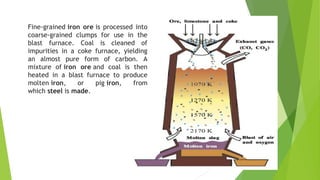
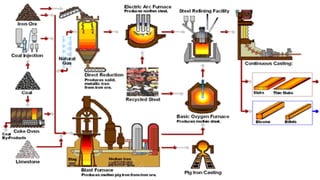
Fine-grained iron ore is processed into
coarse-grained clumps for use in the
blast furnace. Coal is cleaned of
impurities in a coke furnace, yielding
an almost pure form of carbon. A
mixture of iron ore and coal is then
heated in a blast furnace to produce
molten iron, or pig iron, from
which steel is made.
Wrought iron:
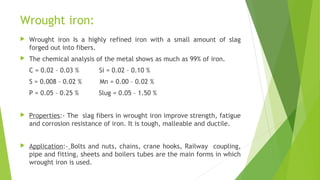
 Wrought iron Is a highly refined iron with a small amount of slag
forged out into fibers.
 The chemical analysis of the metal shows as much as 99% of iron.
C = 0.02 – 0.03 % Si = 0.02 – 0.10 %
S = 0.008 – 0.02 % Mn = 0.00 – 0.02 %
P = 0.05 – 0.25 % Slug = 0.05 – 1.50 %
 Properties:- The slag fibers in wrought iron improve strength, fatigue
and corrosion resistance of iron. It is tough, malleable and ductile.
 Application:- Bolts and nuts, chains, crane hooks, Railway coupling,
pipe and fitting, sheets and boilers tubes are the main forms in which
wrought iron is used.
Steel:
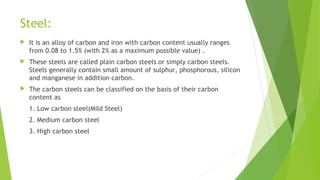
 It is an alloy of carbon and iron with carbon content usually ranges
from 0.08 to 1.5% (with 2% as a maximum possible value) .
 These steels are called plain carbon steels or simply carbon steels.
Steels generally contain small amount of sulphur, phosphorous, silicon
and manganese in addition carbon.
 The carbon steels can be classified on the basis of their carbon
content as
1. Low carbon steel(Mild Steel)
2. Medium carbon steel
3. High carbon steel
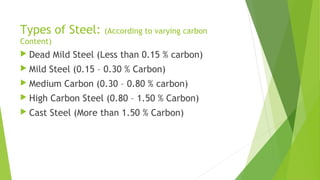
Types of Steel: (According to varying carbon
Content)
 Dead Mild Steel (Less than 0.15 % carbon)
 Mild Steel (0.15 – 0.30 % Carbon)
 Medium Carbon (0.30 – 0.80 % carbon)
 High Carbon Steel (0.80 – 1.50 % Carbon)
 Cast Steel (More than 1.50 % Carbon)
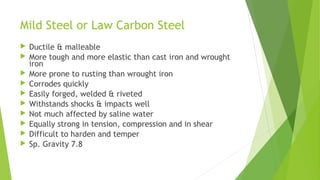
Mild Steel or Law Carbon Steel
 Ductile & malleable
 More tough and more elastic than cast iron and wrought
iron
 More prone to rusting than wrought iron
 Corrodes quickly
 Easily forged, welded & riveted
 Withstands shocks & impacts well
 Not much affected by saline water
 Equally strong in tension, compression and in shear
 Difficult to harden and temper
 Sp. Gravity 7.8
Mild Steel : Application
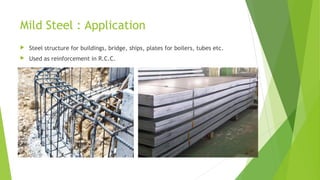
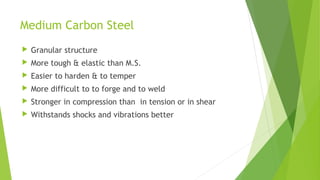
 Steel structure for buildings, bridge, ships, plates for boilers, tubes etc.
 Used as reinforcement in R.C.C.
Medium Carbon Steel
 Granular structure
 More tough & elastic than M.S.
 Easier to harden & to temper
 More difficult to to forge and to weld
 Stronger in compression than in tension or in shear
 Withstands shocks and vibrations better
Medium Carbon Steel : Application
 For making tools such as dills, files, chisels
 Used for making those parts that ae hard , tough and durable and capable of
withstanding shocks and vibrations
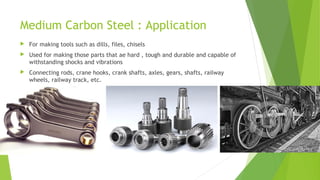
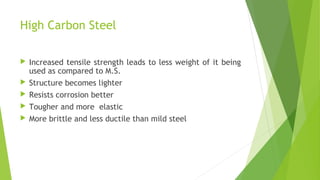
 Connecting rods, crane hooks, crank shafts, axles, gears, shafts, railway
wheels, railway track, etc.
High Carbon Steel
 Increased tensile strength leads to less weight of it being
used as compared to M.S.
 Structure becomes lighter
 Resists corrosion better
 Tougher and more elastic
 More brittle and less ductile than mild steel
High Carbon Steel : Application
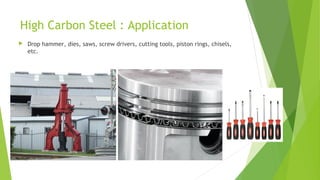
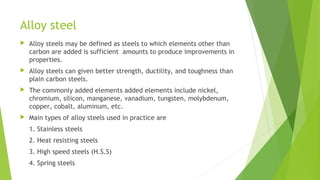
 Drop hammer, dies, saws, screw drivers, cutting tools, piston rings, chisels,
etc.
Alloy steel
 Alloy steels may be defined as steels to which elements other than
carbon are added is sufficient amounts to produce improvements in
properties.
 Alloy steels can given better strength, ductility, and toughness than
plain carbon steels.
 The commonly added elements added elements include nickel,
chromium, silicon, manganese, vanadium, tungsten, molybdenum,
copper, cobalt, aluminum, etc.
 Main types of alloy steels used in practice are
1. Stainless steels
2. Heat resisting steels
3. High speed steels (H.S.S)
4. Spring steels
1. Stainless steels
 This steels are alloyed with chromium( 4 to 20%), nickel,
molybdenum, and manganese for obtaining the desired properties for
particular application.
 This steels are classified into three broad categories :
 a. Austenitic stainless steel
 b. Ferritic stainless steel
 c. Martensitic stainless steel
 Application :- These steels find wide application in dairy and chemical
industries, household utensils, cutlery, and all types of surgical and
dental instruments.
2. Heat resisting steels
 These steels retain their properties at high temperatures for long,
periods. They possess good creep resistance, resistance to scaling
and oxidation etc.
 Alloying elements, such as tungsten, chromium, and nickel are added
in order to meet these requirements.
 Application :- These steels are used for gas turbines, steam, power
plants, furnace parts, etc.
3. High speed steels (H.S.S)
 High speed steels were so named because they may be operated as
cutting tools at much higher cutting speeds than is possible with plain
carbon tool steels.
 They have excellent hardenability and can retain hardness upto 650
degree C.
 The most common variety of high speed steels is 18-4-1. It contains
18%tungsten, 4% chromium, 1% vanadium and about 0.5 to 0.75%
carbon.
 Application :- These steels are used for high speed cutting tools, tools
for lathe and shaping machine, drills, and milling cutters.
4. Spring steels
 The most suitable material for springs are those which can store up
the maximum amount of work or energy in a given weight or volume
of spring material, without permanent deformation. These steels
should have a high elastic limit as well as high deflection value.
 The steels most commonly usedfor making springs are as follows :
 a. Medium and high carbon steels with higher amount of manganese.
 b. Medium carbon alloy steels with manganese and silicon as the main
alloying elements.
 Application :- These steels are used for leaf and helical springs,
automatic and air craft valve springs etc.
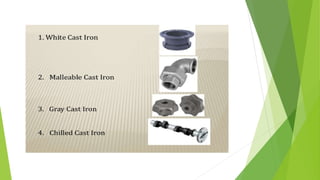
Cast iron
 Cast iron is primarily an alloy of iron and carbon. The carbon in cast
iron varies from 2% to 4.3%.
 In addition to carbon, cast iron contains small amounts of silicon,
manganese, phosphorous, and sulphur.
 Cast iron is the most important and widely used metal. It is very
brittle, less ductile material.
 The various types of cast iron in use are as follows :
1. Grey cast iron
2. White cast iron
3. Malleable cast iron
1. Grey cast iron
 When carbon is presents in the form of graphite flakes, the cast iron
is called grey, because it shows grey surface on fracture.
 Ordinary commercial iron having the following compositions :
Carbon = 3 to 3.5% Silicon = 1 to 2.75%
Manganese = 0.40 to 1% Phosphorus = 0.15 to 1%
 Sulphur = 0.02 to 0.15%, and remaining is iron.
 Properties :-
• It has a low tensile strength, high compressive strength and no
ductility.
• It can be easily machined.
• It is harder and brittle and may easily be broken if a heavy harmer is
used.
 Application :- This iron castings are widely used for machine tool
bodies, automotive cylinder blocks, fly-wheels, pipes, and pipe
fittings, etc.
2. White cast iron
 White cast iron contains carbon in the form of cementite.
 It shows white fractured surface due to face that it has no graphite.
 It’s composition is :
 Carbon = 1.75 to 2.3% Silicon = 0.85 to 1.2%
 Manganese = less than 0.4% Phosphorus = less than 0.2%
 Sulphur = less than 0.12%, and the remaining is iron.
 Properties :-
• It is extremely hard and brittle.
• Its fractured surface has a silvery metallic appearance.
• It has excellent resistance to wear but has poor machinability.
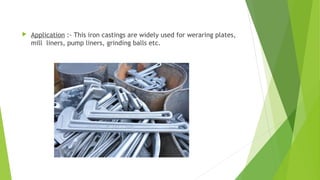
 Application :- This iron castings are widely used for weraring plates,
mill liners, pump liners, grinding balls etc.
3. Malleable cast iron
 Malleable cast iron is produced by giving long heat treatment to white
cast iron at sufficiently high temperature(900 to 950 degree C) and
then allowed to cool slowly.
 Properties :-
• It is ductile and may be bent without breaking or fracturing the
section.
• The tensile strength is usually higher than that of grey cast iron and
has excellent machining qualities.
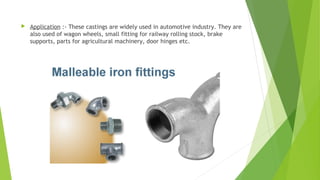
 Application :- These castings are widely used in automotive industry. They are
also used of wagon wheels, small fitting for railway rolling stock, brake
supports, parts for agricultural machinery, door hinges etc.
Steel Material
Steel Material