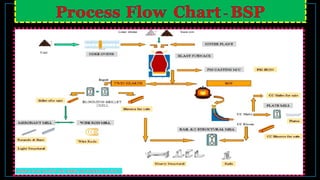
I. Blast furnace is a counter current heat and mass
exchanger in which reduction and smelting of
metallic mineral takes place.
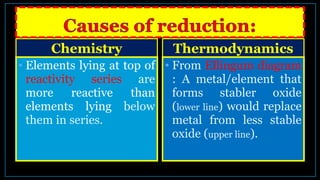
Chemistry
• Elements lying at top of
reactivity series are
more reactive than
elements lying below
them in series.
Thermodynamics
• From Ellingum diagram
: A metal/element that
forms stabler oxide
(lower line) would replace
metal from less stable
oxide (upper line).
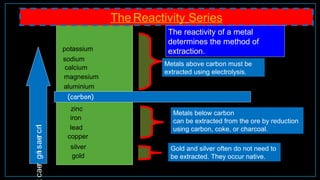
The Reactivity Series
potassium
sodium
calcium
magnesium
aluminium
zinc
iron
copper
gold
(carbon)
Increasingreac
Metals above carbon must be
extracted using electrolysis.
Metals below carbon
can be extracted from the ore by reduction
using carbon, coke, or charcoal.
Gold and silver often do not need to
be extracted. They occur native.
The reactivity of a metal
determines the method of
extraction.
lead
silver
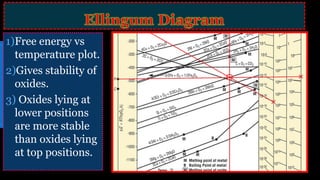
1)Free energy vs
temperature plot.
2)Gives stability of
oxides.
3) Oxides lying at
lower positions
are more stable
than oxides lying
at top positions.
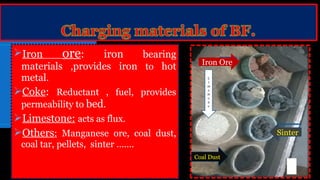
Iron ore: iron bearing
materials ,provides iron to hot
metal.
Coke: Reductant , fuel, provides
permeability to bed.
Limestone: acts as flux.
Others: Manganese ore, coal dust,
coal tar, pellets, sinter …….
Iron Ore
Sinter
L
i
m
e
st
o
n
e
Coal Dust
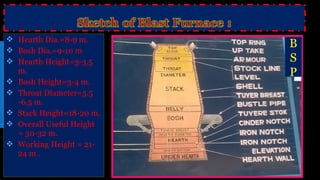
 Hearth Dia.=8-9 m.
 Bosh Dia.=9-10 m
 Hearth Height=3-3.5
m.
 Bosh Height=3-4 m.
 Throat Diameter=5.5
-6.5 m.
 Stack Height=18-20 m.
 Overall Useful Height
= 30-32 m.
 Working Height = 21-
24 m .
B
S
P
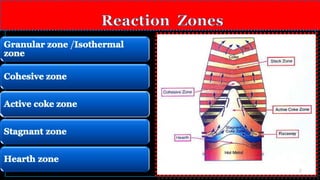
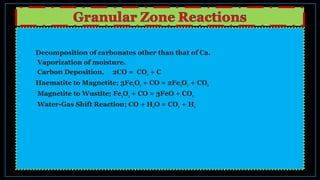
• Decomposition of carbonates other than that of Ca.
• Vaporization of moisture.
• Carbon Deposition, 2CO = CO2 + C
• Haematite to Magnetite; 3Fe2O3 + CO = 2Fe3O4 + CO2
• Magnetite to Wustite; Fe3O4 + CO = 3FeO + CO2
• Water-Gas Shift Reaction; CO + H2O = CO2 + H2
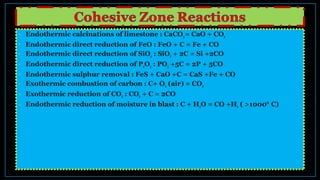
• Endothermic calcinations of limestone : CaCO3= CaO + CO2
• Endothermic direct reduction of FeO : FeO + C = Fe + CO
• Endothermic direct reduction of SiO2 : SiO2 + 2C = Si +2CO
• Endothermic direct reduction of P2O3 : PO3 +5C = 2P + 5CO
• Endothermic sulphur removal : FeS + CaO +C = CaS +Fe + CO
• Exothermic combustion of carbon : C+ O2 (air) = CO2
• Exothermic reduction of CO2 : CO2 + C = 2CO
• Endothermic reduction of moisture in blast : C + H2O = CO +H2 ( >1000 C)⁰
• Temperature of hearth zone is about 1500 – 1550 C.⁰
• The reactions occuring in this zone are electrochemical in nature :
1. [Mn ] = (Mn2+
) + 2 e-
[ anodic reaction ]
2.( Fe 2+
) + 2e-
= [ Fe] [cathodic reaction ]
Hence,
[Mn ] +( FeO ) = ( MnO) + [Fe ]
[Mn] +( Fe 2+
) = ( Mn2+
) + [ Fe ] .
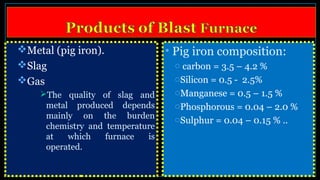
Metal (pig iron).
Slag
Gas
The quality of slag and
metal produced depends
mainly on the burden
chemistry and temperature
at which furnace is
operated.
• Pig iron composition:
o carbon = 3.5 – 4.2 %
oSilicon = 0.5 - 2.5%
oManganese = 0.5 – 1.5 %
oPhosphorous = 0.04 – 2.0 %
oSulphur = 0.04 – 0.15 % ..
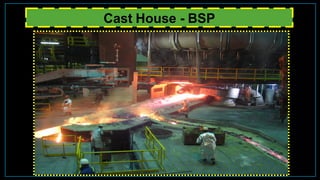
Cast House - BSP
Blast furnace presentation

Blast furnace presentation

  • 2.
    I. Blast furnaceis a counter current heat and mass exchanger in which reduction and smelting of metallic mineral takes place.
  • 3.
    Chemistry • Elements lyingat top of reactivity series are more reactive than elements lying below them in series. Thermodynamics • From Ellingum diagram : A metal/element that forms stabler oxide (lower line) would replace metal from less stable oxide (upper line).
  • 4.
    The Reactivity Series potassium sodium calcium magnesium aluminium zinc iron copper gold (carbon) Increasingreac Metalsabove carbon must be extracted using electrolysis. Metals below carbon can be extracted from the ore by reduction using carbon, coke, or charcoal. Gold and silver often do not need to be extracted. They occur native. The reactivity of a metal determines the method of extraction. lead silver
  • 5.
    1)Free energy vs temperatureplot. 2)Gives stability of oxides. 3) Oxides lying at lower positions are more stable than oxides lying at top positions.
  • 6.
    Iron ore: ironbearing materials ,provides iron to hot metal. Coke: Reductant , fuel, provides permeability to bed. Limestone: acts as flux. Others: Manganese ore, coal dust, coal tar, pellets, sinter ……. Iron Ore Sinter L i m e st o n e Coal Dust
  • 7.
     Hearth Dia.=8-9m.  Bosh Dia.=9-10 m  Hearth Height=3-3.5 m.  Bosh Height=3-4 m.  Throat Diameter=5.5 -6.5 m.  Stack Height=18-20 m.  Overall Useful Height = 30-32 m.  Working Height = 21- 24 m . B S P
  • 9.
    • Decomposition ofcarbonates other than that of Ca. • Vaporization of moisture. • Carbon Deposition, 2CO = CO2 + C • Haematite to Magnetite; 3Fe2O3 + CO = 2Fe3O4 + CO2 • Magnetite to Wustite; Fe3O4 + CO = 3FeO + CO2 • Water-Gas Shift Reaction; CO + H2O = CO2 + H2
  • 10.
    • Endothermic calcinationsof limestone : CaCO3= CaO + CO2 • Endothermic direct reduction of FeO : FeO + C = Fe + CO • Endothermic direct reduction of SiO2 : SiO2 + 2C = Si +2CO • Endothermic direct reduction of P2O3 : PO3 +5C = 2P + 5CO • Endothermic sulphur removal : FeS + CaO +C = CaS +Fe + CO • Exothermic combustion of carbon : C+ O2 (air) = CO2 • Exothermic reduction of CO2 : CO2 + C = 2CO • Endothermic reduction of moisture in blast : C + H2O = CO +H2 ( >1000 C)⁰
  • 12.
    • Temperature ofhearth zone is about 1500 – 1550 C.⁰ • The reactions occuring in this zone are electrochemical in nature : 1. [Mn ] = (Mn2+ ) + 2 e- [ anodic reaction ] 2.( Fe 2+ ) + 2e- = [ Fe] [cathodic reaction ] Hence, [Mn ] +( FeO ) = ( MnO) + [Fe ] [Mn] +( Fe 2+ ) = ( Mn2+ ) + [ Fe ] .
  • 13.
    Metal (pig iron). Slag Gas Thequality of slag and metal produced depends mainly on the burden chemistry and temperature at which furnace is operated. • Pig iron composition: o carbon = 3.5 – 4.2 % oSilicon = 0.5 - 2.5% oManganese = 0.5 – 1.5 % oPhosphorous = 0.04 – 2.0 % oSulphur = 0.04 – 0.15 % ..
  • 14.

Editor's Notes

  • #15 Cast house and runner system: refractory lined runners to separate liquid iron and slag