PIT FURNACE
Pit Furnace: 
What is pit furnace? 
 A furnace made in pit for melting metal for taking casting process is called 
a pit furnace 
 It is a furnace for which first a pit had to be made first according to the 
height of furnace. 
 After this, the furnace is fitted in pit so that blower should b fitted properly 
below the furnace.
Construction of Pit Furnace: 
 The furnace body is made of heavy steel plate reinforced with steel profiles and profile 
bent steel sheet. The heavy-duty upper flange is reinforced with internal braces. 
 The furnace lining is mainly ceramic fiber. 
 The furnace hot face is made up of vacuum-formed fiber into which metallic supports for 
the elements are fixed . 
 The lid is formed as a concave end cover. Between the end cover and the upper part the 
lid is insulated with ceramic fiber of the same thickness as the rest of the furnace .
Construction (cont.): 
 The circulation fan is mounted centrally in the lid. The fan is a water-cooled 
high temperature fan with a cast fan wheel mounted on a cone 
 In the lid there are also connection points for oxygen measuring cell, 
thermocouple, process gas supply and exhaust pipe. There is also an extra 
connection point. 
 The retort is formed as a cylinder with a heavy-duty flange on top. On the 
flange there is a circular cooling tube housing two seals to tighten against 
the furnace lid.
Construction (cont.): 
 The furnace bottom functions as a support for the furnace charge as well as 
a seal for the atmosphere, which is built up in the furnace during the 
process. 
 The retort is provided with an inner corrugated guide cylinder for the 
circulation of gas. 
 The furnace is equipped with a safety waste gas burner system for 
combustible gases. 
 The gases making up the atmosphere in the furnace can be chosen for the 
desired process, we want. Such as LPG for melting metal.
Construction Involves : 
 3/16" thick steel plate furnace shell 
 1/2" thick steel top plate 
 Energy-saving lightweight ceramic fiber insulation reduces operating costs 
 Insulating refractory floor to support heavy loads 
 Excellent temperature uniformity throughout work space 
 Fast heat-up and cool-down
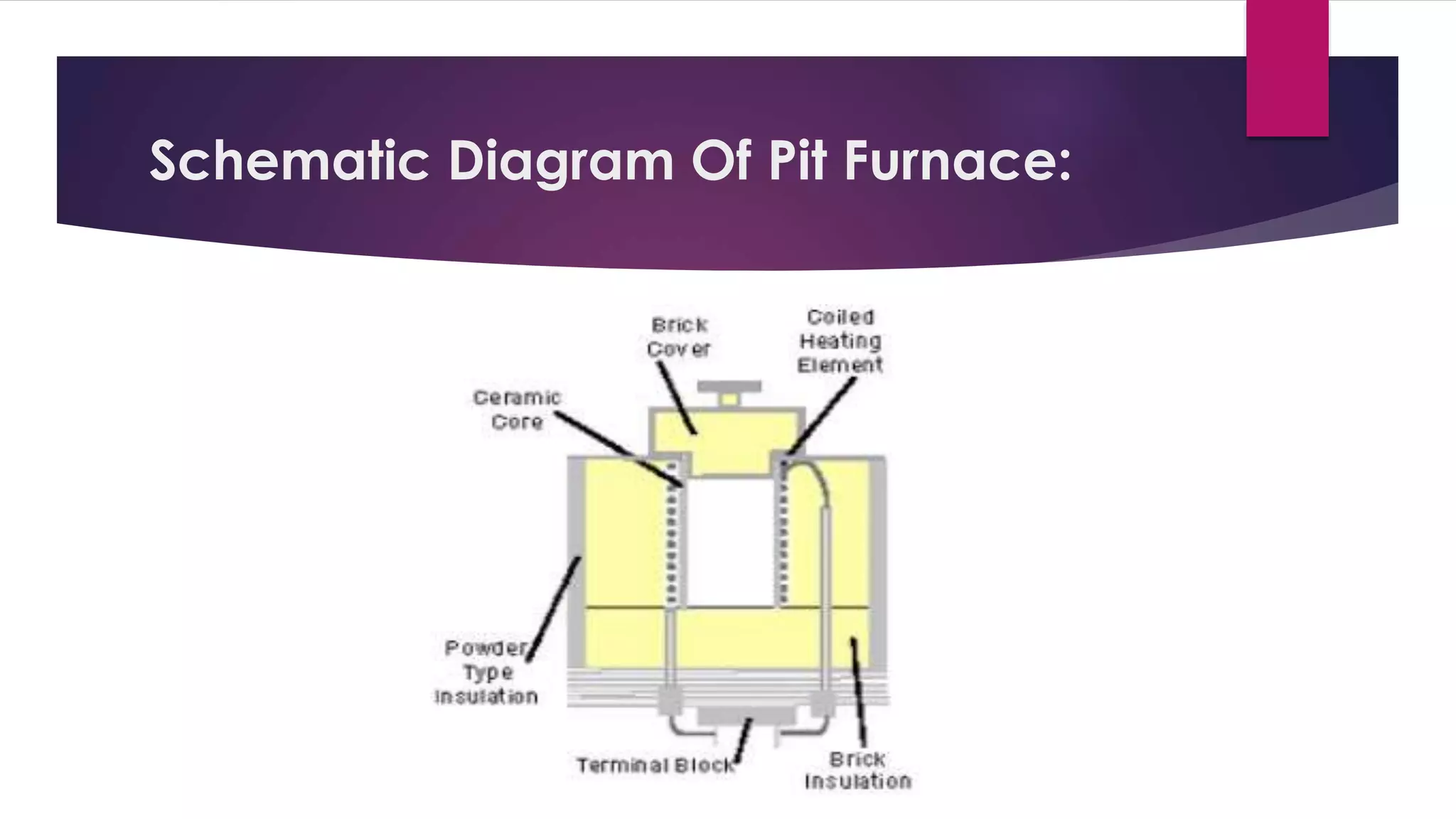
Schematic Diagram Of Pit Furnace:
Working Of Pit Furnace: 
 To prepare the furnace for melting, a deep bed of coke is kindled and 
allowed to burn until a state of good combustion is attained. 
 Some of the coke is removed to make place for the crucible .The crucible 
is then lowered into furnace . 
 The coke is replaced and additional coke is put to surround the crucible 
on all sides. 
 Metal is then charged in the crucible and the furnace lid is replaced to 
give natural draft.
Working (cont.): 
 The draft of the air through the furnace may be a natural draft for low 
melting temperature metals but a force draft with the help of a blower to 
accelerate the melting process in case of higher melting temperature 
metals and alloys. 
 .When the metal melts and reaches the desired temperature the crucible is 
removed from the furnace with special long handle tongs. 
 The molten metal is then put into casting molds for the casting of metal.
Key Features That Must Be Observed: 
 Maximum temperature: up to 1000 °C 
 High temperature uniformity 
 Highly efficient atmosphere circulation system 
 Highly efficient system for load cooling 
 Use of the most precise and modern instrumentation currently available
Types: 
Type of pit furnace design: 
 pit furnaces with closed bottom 
 pit furnaces- with opened bottom and fixed hearth 
Type of pit furnace heating system: 
 Electrically heated furnaces 
 Gas fired furnaces
Technological Application of Pit 
Furnace: 
 Gas carburizing 
 Hardening 
 Bright Annealing 
 Normalizing 
 Carbon Nitriding
Gas Carburizing: 
 Gas Carburizing Process is a surface chemistry process, which improves 
the hardness of a component by diffusing carbon into the surface layer to 
improve wear and fatigue resistance. The work pieces are pre-heated and 
then held for a period of time at an elevated temperature, typically 
between 820 and 940°C. 
 During the thermal cycle the components are subject to an enriched 
carbon atmosphere such that nascent species of carbon can diffuse into 
the surface layers of the component.
Hardening: 
 Hardening is a metallurgical and metal working process used to increase 
the hardness of a metal. 
 A harder metal will have a higher resistance to plastic deformation than a 
less hard metal
Bright Annealing: 
 What is Annealing? 
Heat (metal or glass) and allow it to cool slowly, in order to remove 
internal stresses and toughen it. 
 An annealing process that is carried out in a controlled atmosphere 
furnace or vacuum in order that oxidation is reduced to a minimum and 
the surface remains relatively bright.
Normalizing: 
 Normalization is a type of annealing process used to relieve stress in 
harden able steels after cold work and to improve ductility and 
toughness properties 
 Normalizing Heat Treatment process is heating a steel above the critical 
temperature, holding for a period of time long enough for transformation to 
occur, and air cooling.
Carbon-nitriding: 
 Carbonitriding is a metallurgical surface modification technique that is 
used to increase the surface hardness of a metal, thereby reducing wear. 
During the process, atoms of carbon and nitrogen diffuse interstitially into 
the metal, increasing the hardness and modulus near the surface. 
 Carbonitriding is often applied to inexpensive, easily machined low 
carbon steel to impart the surface properties of more expensive and 
difficult to work grades of steel.
Main advantages of pit furnace: 
 Working flexibility. 
 Economic effectiveness, due to the relatively small requirements for media 
needed for furnace operation. 
 Easy service and maintenance. 
 Very high repeatability of processes and very precise heat treatment of 
various parts. 
 High accuracy of process control (temperature and carbon potential). 
 Safe operation. 
 Ability to treat large parts.
Query… ???? 
Thanks !!!

Pit furnace

  • 1.
  • 2.
    Pit Furnace: Whatis pit furnace?  A furnace made in pit for melting metal for taking casting process is called a pit furnace  It is a furnace for which first a pit had to be made first according to the height of furnace.  After this, the furnace is fitted in pit so that blower should b fitted properly below the furnace.
  • 3.
    Construction of PitFurnace:  The furnace body is made of heavy steel plate reinforced with steel profiles and profile bent steel sheet. The heavy-duty upper flange is reinforced with internal braces.  The furnace lining is mainly ceramic fiber.  The furnace hot face is made up of vacuum-formed fiber into which metallic supports for the elements are fixed .  The lid is formed as a concave end cover. Between the end cover and the upper part the lid is insulated with ceramic fiber of the same thickness as the rest of the furnace .
  • 4.
    Construction (cont.): The circulation fan is mounted centrally in the lid. The fan is a water-cooled high temperature fan with a cast fan wheel mounted on a cone  In the lid there are also connection points for oxygen measuring cell, thermocouple, process gas supply and exhaust pipe. There is also an extra connection point.  The retort is formed as a cylinder with a heavy-duty flange on top. On the flange there is a circular cooling tube housing two seals to tighten against the furnace lid.
  • 5.
    Construction (cont.): The furnace bottom functions as a support for the furnace charge as well as a seal for the atmosphere, which is built up in the furnace during the process.  The retort is provided with an inner corrugated guide cylinder for the circulation of gas.  The furnace is equipped with a safety waste gas burner system for combustible gases.  The gases making up the atmosphere in the furnace can be chosen for the desired process, we want. Such as LPG for melting metal.
  • 6.
    Construction Involves :  3/16" thick steel plate furnace shell  1/2" thick steel top plate  Energy-saving lightweight ceramic fiber insulation reduces operating costs  Insulating refractory floor to support heavy loads  Excellent temperature uniformity throughout work space  Fast heat-up and cool-down
  • 7.
  • 8.
    Working Of PitFurnace:  To prepare the furnace for melting, a deep bed of coke is kindled and allowed to burn until a state of good combustion is attained.  Some of the coke is removed to make place for the crucible .The crucible is then lowered into furnace .  The coke is replaced and additional coke is put to surround the crucible on all sides.  Metal is then charged in the crucible and the furnace lid is replaced to give natural draft.
  • 9.
    Working (cont.): The draft of the air through the furnace may be a natural draft for low melting temperature metals but a force draft with the help of a blower to accelerate the melting process in case of higher melting temperature metals and alloys.  .When the metal melts and reaches the desired temperature the crucible is removed from the furnace with special long handle tongs.  The molten metal is then put into casting molds for the casting of metal.
  • 10.
    Key Features ThatMust Be Observed:  Maximum temperature: up to 1000 °C  High temperature uniformity  Highly efficient atmosphere circulation system  Highly efficient system for load cooling  Use of the most precise and modern instrumentation currently available
  • 11.
    Types: Type ofpit furnace design:  pit furnaces with closed bottom  pit furnaces- with opened bottom and fixed hearth Type of pit furnace heating system:  Electrically heated furnaces  Gas fired furnaces
  • 12.
    Technological Application ofPit Furnace:  Gas carburizing  Hardening  Bright Annealing  Normalizing  Carbon Nitriding
  • 13.
    Gas Carburizing: Gas Carburizing Process is a surface chemistry process, which improves the hardness of a component by diffusing carbon into the surface layer to improve wear and fatigue resistance. The work pieces are pre-heated and then held for a period of time at an elevated temperature, typically between 820 and 940°C.  During the thermal cycle the components are subject to an enriched carbon atmosphere such that nascent species of carbon can diffuse into the surface layers of the component.
  • 14.
    Hardening:  Hardeningis a metallurgical and metal working process used to increase the hardness of a metal.  A harder metal will have a higher resistance to plastic deformation than a less hard metal
  • 15.
    Bright Annealing: What is Annealing? Heat (metal or glass) and allow it to cool slowly, in order to remove internal stresses and toughen it.  An annealing process that is carried out in a controlled atmosphere furnace or vacuum in order that oxidation is reduced to a minimum and the surface remains relatively bright.
  • 16.
    Normalizing:  Normalizationis a type of annealing process used to relieve stress in harden able steels after cold work and to improve ductility and toughness properties  Normalizing Heat Treatment process is heating a steel above the critical temperature, holding for a period of time long enough for transformation to occur, and air cooling.
  • 17.
    Carbon-nitriding:  Carbonitridingis a metallurgical surface modification technique that is used to increase the surface hardness of a metal, thereby reducing wear. During the process, atoms of carbon and nitrogen diffuse interstitially into the metal, increasing the hardness and modulus near the surface.  Carbonitriding is often applied to inexpensive, easily machined low carbon steel to impart the surface properties of more expensive and difficult to work grades of steel.
  • 18.
    Main advantages ofpit furnace:  Working flexibility.  Economic effectiveness, due to the relatively small requirements for media needed for furnace operation.  Easy service and maintenance.  Very high repeatability of processes and very precise heat treatment of various parts.  High accuracy of process control (temperature and carbon potential).  Safe operation.  Ability to treat large parts.
  • 19.