Ferrous Metals andFerrous Metals and
AlloysAlloys
By-By-
Abhishek SinghAbhishek Singh
ME-2ME-2
14014400041401440004
ContentsContents
 ferrous metalsferrous metals
 pig ironpig iron
 cast ironcast iron
 types of cast irontypes of cast iron
 wrought ironwrought iron
 steelssteels
 Effects of elements in steelsEffects of elements in steels
 carbon steelcarbon steel
 alloy steelalloy steel
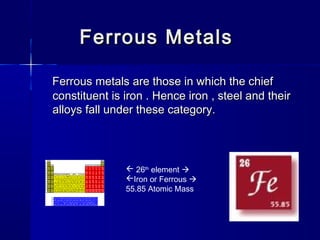
Ferrous MetalsFerrous Metals
Ferrous metals are those in which the chiefFerrous metals are those in which the chief
constituent is iron . Hence iron , steel and theirconstituent is iron . Hence iron , steel and their
alloys fall under these category.alloys fall under these category.
 26th
element 
Iron or Ferrous 
55.85 Atomic Mass
Pig IronPig Iron
 it is crude form of iron and used as ait is crude form of iron and used as a
raw material for production of variousraw material for production of various
other metals such as cast iron, steelother metals such as cast iron, steel
etc.etc.
 The main raw materials required are –The main raw materials required are –
– iron oreiron ore
– CoalCoal
– fluxflux
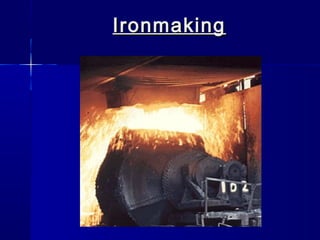
IronmakingIronmaking
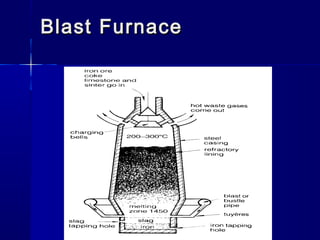
Blast FurnaceBlast Furnace
WorkingWorking
 The three raw materials are dumped into a blastThe three raw materials are dumped into a blast
furnace.furnace.
 Hot air (2000*F) is blasted into the furnace, which helpsHot air (2000*F) is blasted into the furnace, which helps
drive the chemical reaction. The coke forms CO and thedrive the chemical reaction. The coke forms CO and the
CO reduces the iron oxide to iron.CO reduces the iron oxide to iron.
 The slag floats to the top and the metal is transferred toThe slag floats to the top and the metal is transferred to
molds and cools. It is now pig iron, ready for more ironmolds and cools. It is now pig iron, ready for more iron
work or steelmaking.work or steelmaking.
Cast IronCast Iron
 Contains 2%-4% of carbonContains 2%-4% of carbon
 Very hard and brittleVery hard and brittle
 Strong under compressionStrong under compression
 Suitable for casting [can be pour at aSuitable for casting [can be pour at a
relatively low temperature]relatively low temperature]
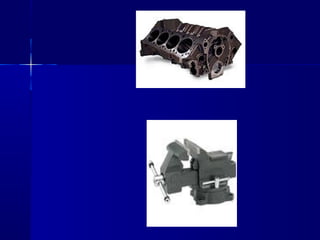
 Engine block, engineer vices, machineEngine block, engineer vices, machine
partsparts
Types of cast ironTypes of cast iron
 Gray cast ironGray cast iron
 White cast ironWhite cast iron
 Malleable cast ironMalleable cast iron
 Nodular cast ironNodular cast iron
 Alloy cast ironAlloy cast iron
Gray Cast IronGray Cast Iron
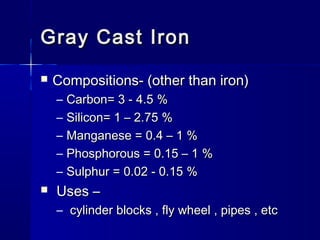
 Compositions- (other than iron)Compositions- (other than iron)
– Carbon= 3 - 4.5 %Carbon= 3 - 4.5 %
– Silicon= 1 – 2.75 %Silicon= 1 – 2.75 %
– Manganese = 0.4 – 1 %Manganese = 0.4 – 1 %
– Phosphorous = 0.15 – 1 %Phosphorous = 0.15 – 1 %
– Sulphur = 0.02 - 0.15 %Sulphur = 0.02 - 0.15 %
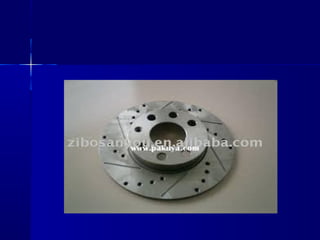
 Uses –Uses –
– cylinder blocks , fly wheel , pipes , etccylinder blocks , fly wheel , pipes , etc
White Cast IronWhite Cast Iron
 Compositions –
– carbon = 1.75 – 2.5 %
– silicon = 0.85 – 1.2 %
– manganese = 0.1 - 0.4 %
– phosphorous = 0.05 - 0.2 %
– sulphur = 0.12 – 0.35 %
 Uses-
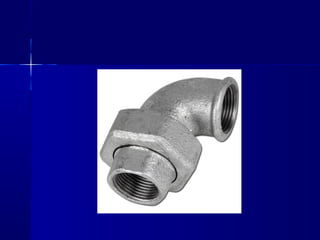
– Use as raw materials , break shoes ,
pumps
Malleable Cast Iron
 Obtain from white cast iron by
annealing process
 It separate free graphite into nodular
form
 Uses-
– hubs of wagon wheel , pipes fittings , etc
Nodular Cast IronNodular Cast Iron
 Also known as ductile cast ironAlso known as ductile cast iron
 Can be produced in thicker part thanCan be produced in thicker part than
malleable cast ironmalleable cast iron
 uses –uses –
– in cast parts where density and pressurein cast parts where density and pressure
tightness is highly desired quality . Ex –tightness is highly desired quality . Ex –
valves , hydraulic cylindersvalves , hydraulic cylinders
Alloy Cast Iron
 Produced by adding alloying elementsProduced by adding alloying elements
such as Ni , Cr , Mo , Cu , Si etcsuch as Ni , Cr , Mo , Cu , Si etc
 These elements provide moreThese elements provide more
strength, corrosion resistance etcstrength, corrosion resistance etc
 Uses-Uses-
– piston , piston rings , parts of crushingpiston , piston rings , parts of crushing
and grinding etcand grinding etc
Wrought IronWrought Iron
 Purest form of iron contain atleast 99.5Purest form of iron contain atleast 99.5
% iron% iron
 It is tough , malleable ,ductile butIt is tough , malleable ,ductile but
cannot withstand sudden andcannot withstand sudden and
excessive shocksexcessive shocks
 Uses –Uses –
– crane hooks , railway cuppling , etccrane hooks , railway cuppling , etc
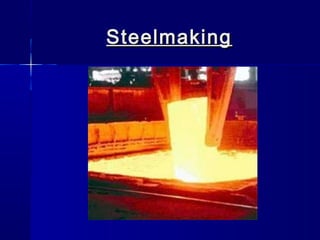
SteelmakingSteelmaking
SteelSteel
 It is classified into two types –It is classified into two types –
– carbon steelscarbon steels
– Alloy steelsAlloy steels
Effects of Elements inEffects of Elements in
SteelsSteels
 CarbonCarbon: improves hardenability, strength,: improves hardenability, strength,
hardness, and wear resistance; it reduces ductility,hardness, and wear resistance; it reduces ductility,
weldability, and toughness.weldability, and toughness.
 ChromiumChromium: improves toughness, hardenability,: improves toughness, hardenability,
wear and corrosion resistance, and high-wear and corrosion resistance, and high-
temperature strength; it increases the depth of thetemperature strength; it increases the depth of the
hardness penetration resulting from heat treatmenthardness penetration resulting from heat treatment
by promoting carburizationby promoting carburization
 CobaltCobalt: improves strength and hardness at: improves strength and hardness at
elevated temperatures.elevated temperatures. CalciumCalcium: Deoxidizes: Deoxidizes
steels, improves toughness, and may improvesteels, improves toughness, and may improve
formability and machinability.formability and machinability.
 CopperCopper: improves resistance to atmospheric: improves resistance to atmospheric
corrosion and, to a lesser extent, increases strengthcorrosion and, to a lesser extent, increases strength
with little loss in ductility; it adversely affects thewith little loss in ductility; it adversely affects the
hot-working characteristics and surface quality.hot-working characteristics and surface quality.
 LeadLead: improves machinability; it causes liquid-: improves machinability; it causes liquid-
metal embrittlement.metal embrittlement.
 MagnesiumMagnesium: has the same effects as cerium.: has the same effects as cerium.
 ManganeseManganese: improves hardenability, strength,: improves hardenability, strength,
abrasion resistance, and machinability; it deoxidizesabrasion resistance, and machinability; it deoxidizes
the molten steel, reduce shot shortness, andthe molten steel, reduce shot shortness, and
decreases weldability.decreases weldability.
 MolybdenumMolybdenum: improves hardenability, wear: improves hardenability, wear
resistance, toughness, elevated-temperatureresistance, toughness, elevated-temperature
strength, creep resistance, and hardness; itstrength, creep resistance, and hardness; it
minimizes temper embrittlement.minimizes temper embrittlement.
 NickelNickel: improves strength, toughness, and: improves strength, toughness, and
corrosion resistance; it improves hardenability.corrosion resistance; it improves hardenability.
 PhosphorusPhosphorus: improves strength, hardenability,: improves strength, hardenability,
corrosion resistance, and machinability; it severelycorrosion resistance, and machinability; it severely
reduces ductility and toughness.reduces ductility and toughness.
 SiliconSilicon: improves strength, hardness, corrosion: improves strength, hardness, corrosion
resistance, and electrical conductivity; it decreasesresistance, and electrical conductivity; it decreases
magnetic-hysteresis loss, machinability, and coldmagnetic-hysteresis loss, machinability, and cold
formability.formability.
Carbon SteelsCarbon Steels
 Carbon steels are groupCarbon steels are group
by their percentage ofby their percentage of
carbon content per weight.carbon content per weight.
The higher the carbonThe higher the carbon
content the greater thecontent the greater the
hardness, strength andhardness, strength and
wear resistance after heatwear resistance after heat
treatment.treatment.
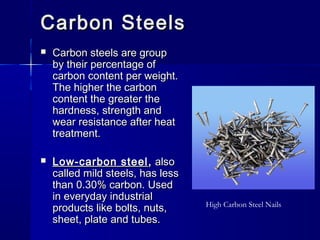
 Low-carbon steelLow-carbon steel ,, alsoalso
called mild steels, has lesscalled mild steels, has less
than 0.30% carbon. Usedthan 0.30% carbon. Used
in everyday industrialin everyday industrial
products like bolts, nuts,products like bolts, nuts,
sheet, plate and tubes.sheet, plate and tubes.
High Carbon Steel Nails
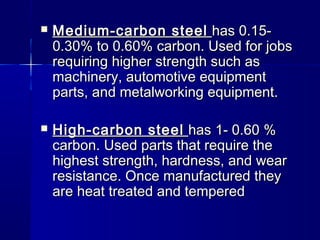
 Medium-carbon steelMedium-carbon steel has 0.15-has 0.15-
0.30% to 0.60% carbon. Used for jobs0.30% to 0.60% carbon. Used for jobs
requiring higher strength such asrequiring higher strength such as
machinery, automotive equipmentmachinery, automotive equipment
parts, and metalworking equipment.parts, and metalworking equipment.
 High-carbon steelHigh-carbon steel has 1- 0.60 %has 1- 0.60 %
carbon. Used parts that require thecarbon. Used parts that require the
highest strength, hardness, and wearhighest strength, hardness, and wear
resistance. Once manufactured theyresistance. Once manufactured they
are heat treated and temperedare heat treated and tempered
Alloy SteelsAlloy Steels
 Alloy steelsAlloy steels are steels that containare steels that contain
significant amounts of alloyingsignificant amounts of alloying
elements.elements.
– Nickel alloy steel
– Chromium alloy steel
– Stainless steel
– high speed steel
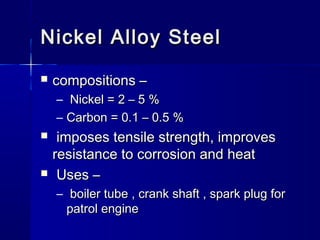
Nickel Alloy SteelNickel Alloy Steel
 compositions –compositions –
– Nickel = 2 – 5 %Nickel = 2 – 5 %
– Carbon = 0.1 – 0.5 %Carbon = 0.1 – 0.5 %
 imposes tensile strength, improvesimposes tensile strength, improves
resistance to corrosion and heatresistance to corrosion and heat
 Uses –Uses –
– boiler tube , crank shaft , spark plug forboiler tube , crank shaft , spark plug for
patrol enginepatrol engine
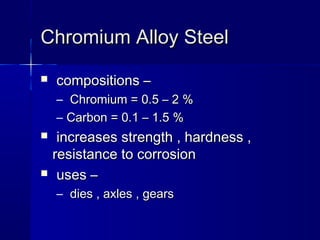
Chromium Alloy SteelChromium Alloy Steel
 compositions –compositions –
– Chromium = 0.5 – 2 %Chromium = 0.5 – 2 %
– Carbon = 0.1 – 1.5 %Carbon = 0.1 – 1.5 %
 increases strength , hardness ,increases strength , hardness ,
resistance to corrosionresistance to corrosion
 uses –uses –
– dies , axles , gearsdies , axles , gears
Stainless SteelsStainless Steels
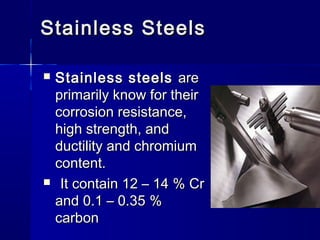
 Stainless steelsStainless steels areare
primarily know for theirprimarily know for their
corrosion resistance,corrosion resistance,
high strength, andhigh strength, and
ductility and chromiumductility and chromium
content.content.
 It contain 12 – 14 % CrIt contain 12 – 14 % Cr
and 0.1 – 0.35 %and 0.1 – 0.35 %
carboncarbon
Stainless SteelsStainless Steels
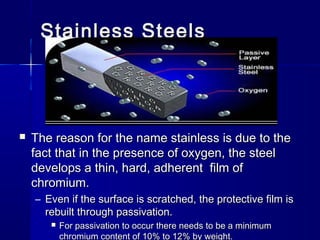
 The reason for the name stainless is due to theThe reason for the name stainless is due to the
fact that in the presence of oxygen, the steelfact that in the presence of oxygen, the steel
develops a thin, hard, adherent film ofdevelops a thin, hard, adherent film of
chromium.chromium.
– Even if the surface is scratched, the protective film isEven if the surface is scratched, the protective film is
rebuilt through passivation.rebuilt through passivation.
 For passivation to occur there needs to be a minimumFor passivation to occur there needs to be a minimum
chromium content of 10% to 12% by weight.chromium content of 10% to 12% by weight.
Stainless SteelsStainless Steels
 Stainless steels tend to have lowerStainless steels tend to have lower
carbon content since increased carboncarbon content since increased carbon
content lowers the corrosioncontent lowers the corrosion
resistance of stainless steels.resistance of stainless steels.
– Since the carbon reacts with chromium itSince the carbon reacts with chromium it
decreases the available chromiumdecreases the available chromium
content which is needed for developingcontent which is needed for developing
the protective film.the protective film.
Stainless SteelsStainless Steels
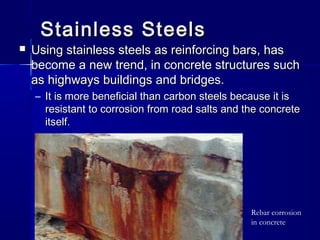
 Using stainless steels as reinforcing bars, hasUsing stainless steels as reinforcing bars, has
become a new trend, in concrete structures suchbecome a new trend, in concrete structures such
as highways buildings and bridges.as highways buildings and bridges.
– It is more beneficial than carbon steels because it isIt is more beneficial than carbon steels because it is
resistant to corrosion from road salts and the concreteresistant to corrosion from road salts and the concrete
itself.itself.
Rebar corrosion
in concrete
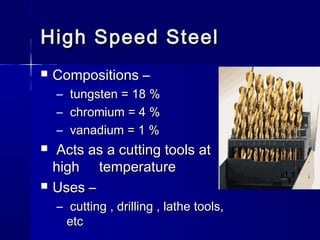
High Speed SteelHigh Speed Steel
 Compositions –Compositions –
– tungsten = 18 %tungsten = 18 %
– chromium = 4 %chromium = 4 %
– vanadium = 1 %vanadium = 1 %
 Acts as a cutting tools atActs as a cutting tools at
high temperaturehigh temperature
 Uses –Uses –
– cutting , drilling , lathe tools,cutting , drilling , lathe tools,
etcetc
ferrous metals and alloys

ferrous metals and alloys

  • 1.
    Ferrous Metals andFerrousMetals and AlloysAlloys By-By- Abhishek SinghAbhishek Singh ME-2ME-2 14014400041401440004
  • 2.
    ContentsContents  ferrous metalsferrousmetals  pig ironpig iron  cast ironcast iron  types of cast irontypes of cast iron  wrought ironwrought iron  steelssteels  Effects of elements in steelsEffects of elements in steels  carbon steelcarbon steel  alloy steelalloy steel
  • 3.
    Ferrous MetalsFerrous Metals Ferrousmetals are those in which the chiefFerrous metals are those in which the chief constituent is iron . Hence iron , steel and theirconstituent is iron . Hence iron , steel and their alloys fall under these category.alloys fall under these category.  26th element  Iron or Ferrous  55.85 Atomic Mass
  • 4.
    Pig IronPig Iron it is crude form of iron and used as ait is crude form of iron and used as a raw material for production of variousraw material for production of various other metals such as cast iron, steelother metals such as cast iron, steel etc.etc.  The main raw materials required are –The main raw materials required are – – iron oreiron ore – CoalCoal – fluxflux
  • 5.
  • 6.
  • 7.
    WorkingWorking  The threeraw materials are dumped into a blastThe three raw materials are dumped into a blast furnace.furnace.  Hot air (2000*F) is blasted into the furnace, which helpsHot air (2000*F) is blasted into the furnace, which helps drive the chemical reaction. The coke forms CO and thedrive the chemical reaction. The coke forms CO and the CO reduces the iron oxide to iron.CO reduces the iron oxide to iron.  The slag floats to the top and the metal is transferred toThe slag floats to the top and the metal is transferred to molds and cools. It is now pig iron, ready for more ironmolds and cools. It is now pig iron, ready for more iron work or steelmaking.work or steelmaking.
  • 8.
    Cast IronCast Iron Contains 2%-4% of carbonContains 2%-4% of carbon  Very hard and brittleVery hard and brittle  Strong under compressionStrong under compression  Suitable for casting [can be pour at aSuitable for casting [can be pour at a relatively low temperature]relatively low temperature]  Engine block, engineer vices, machineEngine block, engineer vices, machine partsparts
  • 10.
    Types of castironTypes of cast iron  Gray cast ironGray cast iron  White cast ironWhite cast iron  Malleable cast ironMalleable cast iron  Nodular cast ironNodular cast iron  Alloy cast ironAlloy cast iron
  • 11.
    Gray Cast IronGrayCast Iron  Compositions- (other than iron)Compositions- (other than iron) – Carbon= 3 - 4.5 %Carbon= 3 - 4.5 % – Silicon= 1 – 2.75 %Silicon= 1 – 2.75 % – Manganese = 0.4 – 1 %Manganese = 0.4 – 1 % – Phosphorous = 0.15 – 1 %Phosphorous = 0.15 – 1 % – Sulphur = 0.02 - 0.15 %Sulphur = 0.02 - 0.15 %  Uses –Uses – – cylinder blocks , fly wheel , pipes , etccylinder blocks , fly wheel , pipes , etc
  • 13.
    White Cast IronWhiteCast Iron  Compositions – – carbon = 1.75 – 2.5 % – silicon = 0.85 – 1.2 % – manganese = 0.1 - 0.4 % – phosphorous = 0.05 - 0.2 % – sulphur = 0.12 – 0.35 %  Uses- – Use as raw materials , break shoes , pumps
  • 15.
    Malleable Cast Iron Obtain from white cast iron by annealing process  It separate free graphite into nodular form  Uses- – hubs of wagon wheel , pipes fittings , etc
  • 16.
    Nodular Cast IronNodularCast Iron  Also known as ductile cast ironAlso known as ductile cast iron  Can be produced in thicker part thanCan be produced in thicker part than malleable cast ironmalleable cast iron  uses –uses – – in cast parts where density and pressurein cast parts where density and pressure tightness is highly desired quality . Ex –tightness is highly desired quality . Ex – valves , hydraulic cylindersvalves , hydraulic cylinders
  • 17.
    Alloy Cast Iron Produced by adding alloying elementsProduced by adding alloying elements such as Ni , Cr , Mo , Cu , Si etcsuch as Ni , Cr , Mo , Cu , Si etc  These elements provide moreThese elements provide more strength, corrosion resistance etcstrength, corrosion resistance etc  Uses-Uses- – piston , piston rings , parts of crushingpiston , piston rings , parts of crushing and grinding etcand grinding etc
  • 18.
    Wrought IronWrought Iron Purest form of iron contain atleast 99.5Purest form of iron contain atleast 99.5 % iron% iron  It is tough , malleable ,ductile butIt is tough , malleable ,ductile but cannot withstand sudden andcannot withstand sudden and excessive shocksexcessive shocks  Uses –Uses – – crane hooks , railway cuppling , etccrane hooks , railway cuppling , etc
  • 19.
  • 20.
    SteelSteel  It isclassified into two types –It is classified into two types – – carbon steelscarbon steels – Alloy steelsAlloy steels
  • 21.
    Effects of ElementsinEffects of Elements in SteelsSteels  CarbonCarbon: improves hardenability, strength,: improves hardenability, strength, hardness, and wear resistance; it reduces ductility,hardness, and wear resistance; it reduces ductility, weldability, and toughness.weldability, and toughness.  ChromiumChromium: improves toughness, hardenability,: improves toughness, hardenability, wear and corrosion resistance, and high-wear and corrosion resistance, and high- temperature strength; it increases the depth of thetemperature strength; it increases the depth of the hardness penetration resulting from heat treatmenthardness penetration resulting from heat treatment by promoting carburizationby promoting carburization  CobaltCobalt: improves strength and hardness at: improves strength and hardness at elevated temperatures.elevated temperatures. CalciumCalcium: Deoxidizes: Deoxidizes steels, improves toughness, and may improvesteels, improves toughness, and may improve formability and machinability.formability and machinability.
  • 22.
     CopperCopper: improvesresistance to atmospheric: improves resistance to atmospheric corrosion and, to a lesser extent, increases strengthcorrosion and, to a lesser extent, increases strength with little loss in ductility; it adversely affects thewith little loss in ductility; it adversely affects the hot-working characteristics and surface quality.hot-working characteristics and surface quality.  LeadLead: improves machinability; it causes liquid-: improves machinability; it causes liquid- metal embrittlement.metal embrittlement.  MagnesiumMagnesium: has the same effects as cerium.: has the same effects as cerium.  ManganeseManganese: improves hardenability, strength,: improves hardenability, strength, abrasion resistance, and machinability; it deoxidizesabrasion resistance, and machinability; it deoxidizes the molten steel, reduce shot shortness, andthe molten steel, reduce shot shortness, and decreases weldability.decreases weldability.  MolybdenumMolybdenum: improves hardenability, wear: improves hardenability, wear resistance, toughness, elevated-temperatureresistance, toughness, elevated-temperature strength, creep resistance, and hardness; itstrength, creep resistance, and hardness; it minimizes temper embrittlement.minimizes temper embrittlement.
  • 23.
     NickelNickel: improvesstrength, toughness, and: improves strength, toughness, and corrosion resistance; it improves hardenability.corrosion resistance; it improves hardenability.  PhosphorusPhosphorus: improves strength, hardenability,: improves strength, hardenability, corrosion resistance, and machinability; it severelycorrosion resistance, and machinability; it severely reduces ductility and toughness.reduces ductility and toughness.  SiliconSilicon: improves strength, hardness, corrosion: improves strength, hardness, corrosion resistance, and electrical conductivity; it decreasesresistance, and electrical conductivity; it decreases magnetic-hysteresis loss, machinability, and coldmagnetic-hysteresis loss, machinability, and cold formability.formability.
  • 24.
    Carbon SteelsCarbon Steels Carbon steels are groupCarbon steels are group by their percentage ofby their percentage of carbon content per weight.carbon content per weight. The higher the carbonThe higher the carbon content the greater thecontent the greater the hardness, strength andhardness, strength and wear resistance after heatwear resistance after heat treatment.treatment.  Low-carbon steelLow-carbon steel ,, alsoalso called mild steels, has lesscalled mild steels, has less than 0.30% carbon. Usedthan 0.30% carbon. Used in everyday industrialin everyday industrial products like bolts, nuts,products like bolts, nuts, sheet, plate and tubes.sheet, plate and tubes. High Carbon Steel Nails
  • 25.
     Medium-carbon steelMedium-carbonsteel has 0.15-has 0.15- 0.30% to 0.60% carbon. Used for jobs0.30% to 0.60% carbon. Used for jobs requiring higher strength such asrequiring higher strength such as machinery, automotive equipmentmachinery, automotive equipment parts, and metalworking equipment.parts, and metalworking equipment.  High-carbon steelHigh-carbon steel has 1- 0.60 %has 1- 0.60 % carbon. Used parts that require thecarbon. Used parts that require the highest strength, hardness, and wearhighest strength, hardness, and wear resistance. Once manufactured theyresistance. Once manufactured they are heat treated and temperedare heat treated and tempered
  • 26.
    Alloy SteelsAlloy Steels Alloy steelsAlloy steels are steels that containare steels that contain significant amounts of alloyingsignificant amounts of alloying elements.elements. – Nickel alloy steel – Chromium alloy steel – Stainless steel – high speed steel
  • 27.
    Nickel Alloy SteelNickelAlloy Steel  compositions –compositions – – Nickel = 2 – 5 %Nickel = 2 – 5 % – Carbon = 0.1 – 0.5 %Carbon = 0.1 – 0.5 %  imposes tensile strength, improvesimposes tensile strength, improves resistance to corrosion and heatresistance to corrosion and heat  Uses –Uses – – boiler tube , crank shaft , spark plug forboiler tube , crank shaft , spark plug for patrol enginepatrol engine
  • 28.
    Chromium Alloy SteelChromiumAlloy Steel  compositions –compositions – – Chromium = 0.5 – 2 %Chromium = 0.5 – 2 % – Carbon = 0.1 – 1.5 %Carbon = 0.1 – 1.5 %  increases strength , hardness ,increases strength , hardness , resistance to corrosionresistance to corrosion  uses –uses – – dies , axles , gearsdies , axles , gears
  • 29.
    Stainless SteelsStainless Steels Stainless steelsStainless steels areare primarily know for theirprimarily know for their corrosion resistance,corrosion resistance, high strength, andhigh strength, and ductility and chromiumductility and chromium content.content.  It contain 12 – 14 % CrIt contain 12 – 14 % Cr and 0.1 – 0.35 %and 0.1 – 0.35 % carboncarbon
  • 30.
    Stainless SteelsStainless Steels The reason for the name stainless is due to theThe reason for the name stainless is due to the fact that in the presence of oxygen, the steelfact that in the presence of oxygen, the steel develops a thin, hard, adherent film ofdevelops a thin, hard, adherent film of chromium.chromium. – Even if the surface is scratched, the protective film isEven if the surface is scratched, the protective film is rebuilt through passivation.rebuilt through passivation.  For passivation to occur there needs to be a minimumFor passivation to occur there needs to be a minimum chromium content of 10% to 12% by weight.chromium content of 10% to 12% by weight.
  • 31.
    Stainless SteelsStainless Steels Stainless steels tend to have lowerStainless steels tend to have lower carbon content since increased carboncarbon content since increased carbon content lowers the corrosioncontent lowers the corrosion resistance of stainless steels.resistance of stainless steels. – Since the carbon reacts with chromium itSince the carbon reacts with chromium it decreases the available chromiumdecreases the available chromium content which is needed for developingcontent which is needed for developing the protective film.the protective film.
  • 32.
    Stainless SteelsStainless Steels Using stainless steels as reinforcing bars, hasUsing stainless steels as reinforcing bars, has become a new trend, in concrete structures suchbecome a new trend, in concrete structures such as highways buildings and bridges.as highways buildings and bridges. – It is more beneficial than carbon steels because it isIt is more beneficial than carbon steels because it is resistant to corrosion from road salts and the concreteresistant to corrosion from road salts and the concrete itself.itself. Rebar corrosion in concrete
  • 33.
    High Speed SteelHighSpeed Steel  Compositions –Compositions – – tungsten = 18 %tungsten = 18 % – chromium = 4 %chromium = 4 % – vanadium = 1 %vanadium = 1 %  Acts as a cutting tools atActs as a cutting tools at high temperaturehigh temperature  Uses –Uses – – cutting , drilling , lathe tools,cutting , drilling , lathe tools, etcetc