Bone Biomechanics: Relating Mechanics Concepts to Bone Presented by: Jeff Leismer, PhD
Introduction Definitions Statics, dynamics, mechanics of materials, failure Concepts to be learned What are stresses and strains? How can knowledge of loads and deformations be used to obtain stresses and strains? How does bone fail? Audience background/interests?
Agenda Ed & Jeff_________________________________________(25 minutes) Bone mechanics overview Mechanical influences on the skeleton Statics Mechanics of materials Stress-strain relationship Mechanical testing Failure modes in bone Jeff_______________________________________________(5 minutes) Application: Manatee bone fracture study
Overview   Mechanics (effects of forces on a body) BONE MECHANICS To Prof. Walsh BONE MECHANICS Mechanical Testing (response to loading) Statics (equilibrium of forces and moments) Dynamics (bodies in motion) Kinematics (displacements, velocities, and accelerations) Kinetics (forces responsible for motion) Failure (result of loading)
Bone Mechanics Overview To Jeff
Mechanical Influences on the Skeleton Internal/external loading factors Loading site, direction, magnitude, speed, repetition, duration Physiological loading concepts Muscle forces Tendon and ligament attachment points Moment arms (*bicep curl example)
Mechanical Lever System Mechanical Lever System d F b=fulcrum d=moment arm F~1/d To Prof. Walsh W a b c L q f
Vocabulary Load (N; lbf) Deformation (mm; in) Stress (N/m 2 =Pa; psi) Strain (mm/mm; in/in) Moment/Torque (N*m=J; in-lb) Moment of Inertia (mm 4 ; in 4 )
Overview   Statics (equilibrium of forces and moments) Dynamics (bodies in motion) Statics (equilibrium of forces and moments) Mechanics (effects of forces on a body) Mechanical Testing (response to loading) Kinematics (displacements, velocities, and accelerations) Kinetics (forces responsible for motion) Failure (result of loading)
Statics Overview
Statics Equilibrium of forces ∑ F=0 Equilibrium of moments ∑ M=0 *Bicep curl example To Jeff
Static Analysis F Static Analysis -To solve for the muscle force, remove rigid body ‘bc’ and replace the section with reaction forces at ‘b’ W c L d q f Rx Ry a b
F Static Analysis Resolve muscle force vector into x and y components useful angles Sum the forces and moments and set them equal to zero Use the figure to find the forces and moments in each direction Now let’s plug in some realistic values and solve for the forces What happens to F if we increase the moment arm, d? To Prof. Walsh W L d q f Rx Ry a b If W=20 lbf, L=14 in, d=0.5 in,   =70°, and   =50°:  =70° F=687 lbf Rx=-235 lbf Ry=626 lbf If d=1 in F=343 lbf Rx=-117 lbf Ry=303 lbf =Rx+F*cos(  )  Rx=-F*cos(  ) =F*sin(  )-W+Ry  Ry=W-F*sin(  ) =W*L*sin(  )-d*F*sin(  )  F=W*L*sin(  )/[d*sin(  )] +  ∑Fx=0 +  ∑Fy=0 +  ∑M b =0     =90 ° -  +  y x
Overview   Mechanics (effects of forces on a body) Mechanical Testing (response to loading) Statics (equilibrium of forces and moments) Dynamics (bodies in motion) Mechanics (effects of forces on a body) Kinematics (displacements, velocities, and accelerations) Kinetics (forces responsible for motion) Failure (result of loading)
Mechanics of Materials Overview
Mechanics of Materials Types of stresses and their equations state of stress (can be used to show the state of stress at a point) To Jeff  xx  yy  zz  xy  xy  yz  yz  xz  xz  xz  zz  xx  yy  yz  yz  xz  xz  xy  xy F F F rigid body stress cube Normal Stresses: Bending  b =M*c/I Axial  =F/A Shear Stresses: Torsion  =T*r/J Transverse Shear  =V/A
Mechanics of Materials Mechanics of Materials a M -To find the stresses at point ‘e’: -Make a cut at ‘e’ -Replace the removed section with reaction forces and a moment at point ‘e’ -Remove all components to the right of the cut W q Rx Ry d L F c f b e
Mechanics of Materials q a M L-d Simplify analysis by rotating the coordinate system and force vectors Solve for the reaction forces and moment W Rx Ry e Wy Wx x y Wy=W*cos(  ) ; Wx=W*sin(  ) +  ∑Fx=0=Rx +  ∑Fy=0=-Wy+Ry  Ry=Wy +  ∑M=0=Wy*(L-d)-M  M=Wy*(L-d) If W=20 lbf, L=14 in, d=1 in, and   =70°: M=89 in-lb
Mechanics of Materials q M L-d Cross-section of bone at ‘e’ Bending stress at ‘e’ due to moment ‘M’  b =M*c/I Normal stress at ‘e’ due to Rx  N =Rx/A   N =4.4 psi  A=  *(ro 2 -ri 2 )=1.57 in 2 Rx=Wx=W*cos(  )=6.8 lbf Shear stress at point ‘e’ due to Ry  N =Ry/A   N =12 psi Ry=Wy=W*sin(  )=18.8 lbf c=ro I=  *(ro 4 -ri 4 )/4 For M=89 in-lb, ro=0.75 in, ri=0.25 in I=0.245 in 4  b =272 lb/in 2  = 272 psi failure strength (bending) <<   f =30,250 psi To Prof. Walsh The stresses found above were calculated for a point at the top of the cross-section. The stresses will be lower at any other point about the cross-section.  W Rx Ry Wy Wx x y e a ro ri
Stress-Strain Relationship: Constitutive Law Hooke’s Law {  }=[C]{ ε }   where [C] is the stiffness matrix { ε }=[S]{  },  where [S] is the compliance matrix Inverse relationship [S]=[C] -1 Material properties Elastic modulus = E Poisson’s ratio =   Shear modulus = G To Jeff Anisotropy (21 elastic constants) Orthotropy (9 elastic constants) Transverse Isotropy (5 elastic constants) Isotropy (2 elastic constants)
Overview   Mechanics (effects of forces on a body) Mechanical Testing (response to loading) Statics (equilibrium of forces and moments) Dynamics (bodies in motion) Mechanics (effects of forces on a body) Kinematics (displacements, velocities, and accelerations) Kinetics (forces responsible for motion) Failure (result of loading)
Mechanical Testing of Bone Handling considerations Hydration, temperature, strain rate Types of tests Tension/compression, bending, torsion, shear, indentation, fracture, fatigue, acoustic Equipment Mechanical testing machine, deformation measurement system, recording instrumentation (load-deflection) Other considerations Specimen size & orientation, species, sampling location
Mechanical Testing Outcome measures (uniaxial test) Ultimate load: reflects integrity of bone structure Stiffness: related to mineralization Work to failure: energy required to break bone Ultimate displacement: inversely related to brittleness Etc. X Load Displacement Fracture Ultimate Load Ultimate Displacement S U
Overview   Mechanics (effects of forces on a body) Mechanical Testing (response to loading) Statics (equilibrium of forces and moments) Dynamics (bodies in motion) Mechanics (effects of forces on a body) Kinematics (displacements, velocities, and accelerations) Kinetics (forces responsible for motion) Failure (result of loading)
Failure of Bone Failure modes Ductile Overload Fracture  Failure results from loading bone in excess of its failure strength Brittle Fracture Stress is intensified at sharp corners (micro-cracks or voids) and results in fracture without exceeding the failure strength of bone Creep Slow, permanent deformation resulting from application of a sustained, sub-failure magnitude load (*Silly Putty™) Fatigue Failure due to repetitive loading below the failure strength of bone (a.k.a. stress fractures)
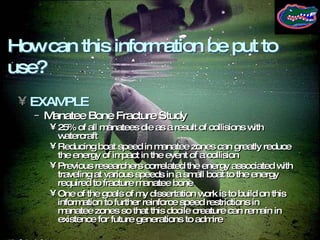
How can this information be put to use? EXAMPLE Manatee Bone Fracture Study 25% of all manatees die as a result of collisions with watercraft Reducing boat speed in manatee zones can greatly reduce the energy of impact in the event of a collision Previous researchers correlated the energy associated with traveling at various speeds in a small boat to the energy required to fracture manatee bone One of the goals of my dissertation work is to build on this information to further reinforce speed restrictions in manatee zones so that this docile creature can remain in existence for future generations to admire EXAMPLE Manatee Bone Fracture Study 25% of all manatees die as a result of collisions with watercraft Reducing boat speed in manatee zones can greatly reduce the energy of impact in the event of a collision Previous researchers correlated the energy associated with traveling at various speeds in a small boat to the energy required to fracture manatee bone One of the goals of my dissertation work is to build on this information to further reinforce speed restrictions in manatee zones so that this docile creature can remain in existence for future generations to admire How can this information be put to use?
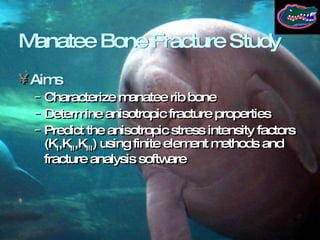
Manatee Bone Fracture Study Aims Characterize manatee rib bone Determine anisotropic fracture properties Predict the anisotropic stress intensity factors (K I ,K II ,K III ) using finite element methods and fracture analysis software Aims Characterize manatee rib bone Determine anisotropic fracture properties Predict the anisotropic stress intensity factors (K I ,K II ,K III ) using finite element methods and fracture analysis software Manatee Bone Fracture Study
Tension Torsion Compact Tension Manatee Bone Fracture Study Specimens Measured Properties Tests Rib bone Elastic Moduli and Poisson’s Ratios E 1 , E 2 , E 3 ,   23 ,   13 ,   12   Shear Moduli G 23 , G 13 , G 12 Stress Intensity Factors, Fracture Toughness 1) K I , K II , K III , K IC 2) K I , K II , K III , K IC 3) K I , K II , K III , K IC crack tip proximal 3   2 distal 1
Manatee Bone Fracture Study Visual Image Correlation (VIC) Manatee Bone Fracture Study Correlation software maps the specimen surfaces from the images to digitized 3D space 2 cameras take simultaneous pictures of the specimen as it is loaded Images of the loaded specimen are used to digitally measure deformations relative to the reference photo of the undeformed specimen
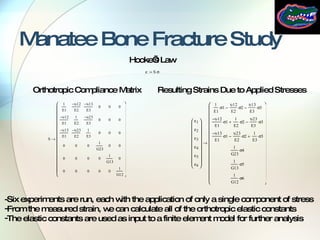
Manatee Bone Fracture Study -Six experiments are run, each with the application of only a single component of stress From the measured strain, we can calculate all of the orthotropic elastic constants The elastic constants are used as input to a finite element model for further analysis Orthotropic Compliance Matrix Resulting Strains Due to Applied Stresses Hooke’s Law
Manatee Bone Fracture Study Finite Element Analysis (FEA) Computational Fracture Analysis Crack opening displacements (COD’s) from FEA are used to determine the 3D anisotropic stress intensity factors in a specimen Numerical results are compared with those from experiment to determine the predictive capacity of the model for fracture analyses
Resources Contact Info: Email:  [email_address] Phone: 920-287-1930 Web Profile: http://profile.jeffleismer.googlepages.com/    Books: Bone Mechanics Handbook (Cowin, 2001) Mechanical Testing of Bone (An & Draughn, 2000) WE HOPE YOU ENJOYED THE PRESENTATION PROFESSOR WALSH AND I WILL NOW TAKE THE REMAINING TIME TO ANSWER YOUR QUESTIONS

Bone Mechanics - Leismer and Walsh 2006

  • 1.
    Bone Biomechanics: RelatingMechanics Concepts to Bone Presented by: Jeff Leismer, PhD
  • 2.
    Introduction Definitions Statics,dynamics, mechanics of materials, failure Concepts to be learned What are stresses and strains? How can knowledge of loads and deformations be used to obtain stresses and strains? How does bone fail? Audience background/interests?
  • 3.
    Agenda Ed &Jeff_________________________________________(25 minutes) Bone mechanics overview Mechanical influences on the skeleton Statics Mechanics of materials Stress-strain relationship Mechanical testing Failure modes in bone Jeff_______________________________________________(5 minutes) Application: Manatee bone fracture study
  • 4.
    Overview Mechanics (effects of forces on a body) BONE MECHANICS To Prof. Walsh BONE MECHANICS Mechanical Testing (response to loading) Statics (equilibrium of forces and moments) Dynamics (bodies in motion) Kinematics (displacements, velocities, and accelerations) Kinetics (forces responsible for motion) Failure (result of loading)
  • 5.
  • 6.
    Mechanical Influences onthe Skeleton Internal/external loading factors Loading site, direction, magnitude, speed, repetition, duration Physiological loading concepts Muscle forces Tendon and ligament attachment points Moment arms (*bicep curl example)
  • 7.
    Mechanical Lever SystemMechanical Lever System d F b=fulcrum d=moment arm F~1/d To Prof. Walsh W a b c L q f
  • 8.
    Vocabulary Load (N;lbf) Deformation (mm; in) Stress (N/m 2 =Pa; psi) Strain (mm/mm; in/in) Moment/Torque (N*m=J; in-lb) Moment of Inertia (mm 4 ; in 4 )
  • 9.
    Overview Statics (equilibrium of forces and moments) Dynamics (bodies in motion) Statics (equilibrium of forces and moments) Mechanics (effects of forces on a body) Mechanical Testing (response to loading) Kinematics (displacements, velocities, and accelerations) Kinetics (forces responsible for motion) Failure (result of loading)
  • 10.
  • 11.
    Statics Equilibrium offorces ∑ F=0 Equilibrium of moments ∑ M=0 *Bicep curl example To Jeff
  • 12.
    Static Analysis FStatic Analysis -To solve for the muscle force, remove rigid body ‘bc’ and replace the section with reaction forces at ‘b’ W c L d q f Rx Ry a b
  • 13.
    F Static AnalysisResolve muscle force vector into x and y components useful angles Sum the forces and moments and set them equal to zero Use the figure to find the forces and moments in each direction Now let’s plug in some realistic values and solve for the forces What happens to F if we increase the moment arm, d? To Prof. Walsh W L d q f Rx Ry a b If W=20 lbf, L=14 in, d=0.5 in,  =70°, and  =50°:  =70° F=687 lbf Rx=-235 lbf Ry=626 lbf If d=1 in F=343 lbf Rx=-117 lbf Ry=303 lbf =Rx+F*cos(  ) Rx=-F*cos(  ) =F*sin(  )-W+Ry Ry=W-F*sin(  ) =W*L*sin(  )-d*F*sin(  ) F=W*L*sin(  )/[d*sin(  )] + ∑Fx=0 + ∑Fy=0 + ∑M b =0     =90 ° -  +  y x
  • 14.
    Overview Mechanics (effects of forces on a body) Mechanical Testing (response to loading) Statics (equilibrium of forces and moments) Dynamics (bodies in motion) Mechanics (effects of forces on a body) Kinematics (displacements, velocities, and accelerations) Kinetics (forces responsible for motion) Failure (result of loading)
  • 15.
  • 16.
    Mechanics of MaterialsTypes of stresses and their equations state of stress (can be used to show the state of stress at a point) To Jeff  xx  yy  zz  xy  xy  yz  yz  xz  xz  xz  zz  xx  yy  yz  yz  xz  xz  xy  xy F F F rigid body stress cube Normal Stresses: Bending  b =M*c/I Axial  =F/A Shear Stresses: Torsion  =T*r/J Transverse Shear  =V/A
  • 17.
    Mechanics of MaterialsMechanics of Materials a M -To find the stresses at point ‘e’: -Make a cut at ‘e’ -Replace the removed section with reaction forces and a moment at point ‘e’ -Remove all components to the right of the cut W q Rx Ry d L F c f b e
  • 18.
    Mechanics of Materialsq a M L-d Simplify analysis by rotating the coordinate system and force vectors Solve for the reaction forces and moment W Rx Ry e Wy Wx x y Wy=W*cos(  ) ; Wx=W*sin(  ) + ∑Fx=0=Rx + ∑Fy=0=-Wy+Ry Ry=Wy + ∑M=0=Wy*(L-d)-M M=Wy*(L-d) If W=20 lbf, L=14 in, d=1 in, and  =70°: M=89 in-lb
  • 19.
    Mechanics of Materialsq M L-d Cross-section of bone at ‘e’ Bending stress at ‘e’ due to moment ‘M’  b =M*c/I Normal stress at ‘e’ due to Rx  N =Rx/A  N =4.4 psi A=  *(ro 2 -ri 2 )=1.57 in 2 Rx=Wx=W*cos(  )=6.8 lbf Shear stress at point ‘e’ due to Ry  N =Ry/A  N =12 psi Ry=Wy=W*sin(  )=18.8 lbf c=ro I=  *(ro 4 -ri 4 )/4 For M=89 in-lb, ro=0.75 in, ri=0.25 in I=0.245 in 4  b =272 lb/in 2 = 272 psi failure strength (bending) <<  f =30,250 psi To Prof. Walsh The stresses found above were calculated for a point at the top of the cross-section. The stresses will be lower at any other point about the cross-section. W Rx Ry Wy Wx x y e a ro ri
  • 20.
    Stress-Strain Relationship: ConstitutiveLaw Hooke’s Law {  }=[C]{ ε } where [C] is the stiffness matrix { ε }=[S]{  }, where [S] is the compliance matrix Inverse relationship [S]=[C] -1 Material properties Elastic modulus = E Poisson’s ratio =  Shear modulus = G To Jeff Anisotropy (21 elastic constants) Orthotropy (9 elastic constants) Transverse Isotropy (5 elastic constants) Isotropy (2 elastic constants)
  • 21.
    Overview Mechanics (effects of forces on a body) Mechanical Testing (response to loading) Statics (equilibrium of forces and moments) Dynamics (bodies in motion) Mechanics (effects of forces on a body) Kinematics (displacements, velocities, and accelerations) Kinetics (forces responsible for motion) Failure (result of loading)
  • 22.
    Mechanical Testing ofBone Handling considerations Hydration, temperature, strain rate Types of tests Tension/compression, bending, torsion, shear, indentation, fracture, fatigue, acoustic Equipment Mechanical testing machine, deformation measurement system, recording instrumentation (load-deflection) Other considerations Specimen size & orientation, species, sampling location
  • 23.
    Mechanical Testing Outcomemeasures (uniaxial test) Ultimate load: reflects integrity of bone structure Stiffness: related to mineralization Work to failure: energy required to break bone Ultimate displacement: inversely related to brittleness Etc. X Load Displacement Fracture Ultimate Load Ultimate Displacement S U
  • 24.
    Overview Mechanics (effects of forces on a body) Mechanical Testing (response to loading) Statics (equilibrium of forces and moments) Dynamics (bodies in motion) Mechanics (effects of forces on a body) Kinematics (displacements, velocities, and accelerations) Kinetics (forces responsible for motion) Failure (result of loading)
  • 25.
    Failure of BoneFailure modes Ductile Overload Fracture Failure results from loading bone in excess of its failure strength Brittle Fracture Stress is intensified at sharp corners (micro-cracks or voids) and results in fracture without exceeding the failure strength of bone Creep Slow, permanent deformation resulting from application of a sustained, sub-failure magnitude load (*Silly Putty™) Fatigue Failure due to repetitive loading below the failure strength of bone (a.k.a. stress fractures)
  • 26.
    How can thisinformation be put to use? EXAMPLE Manatee Bone Fracture Study 25% of all manatees die as a result of collisions with watercraft Reducing boat speed in manatee zones can greatly reduce the energy of impact in the event of a collision Previous researchers correlated the energy associated with traveling at various speeds in a small boat to the energy required to fracture manatee bone One of the goals of my dissertation work is to build on this information to further reinforce speed restrictions in manatee zones so that this docile creature can remain in existence for future generations to admire EXAMPLE Manatee Bone Fracture Study 25% of all manatees die as a result of collisions with watercraft Reducing boat speed in manatee zones can greatly reduce the energy of impact in the event of a collision Previous researchers correlated the energy associated with traveling at various speeds in a small boat to the energy required to fracture manatee bone One of the goals of my dissertation work is to build on this information to further reinforce speed restrictions in manatee zones so that this docile creature can remain in existence for future generations to admire How can this information be put to use?
  • 27.
    Manatee Bone FractureStudy Aims Characterize manatee rib bone Determine anisotropic fracture properties Predict the anisotropic stress intensity factors (K I ,K II ,K III ) using finite element methods and fracture analysis software Aims Characterize manatee rib bone Determine anisotropic fracture properties Predict the anisotropic stress intensity factors (K I ,K II ,K III ) using finite element methods and fracture analysis software Manatee Bone Fracture Study
  • 28.
    Tension Torsion CompactTension Manatee Bone Fracture Study Specimens Measured Properties Tests Rib bone Elastic Moduli and Poisson’s Ratios E 1 , E 2 , E 3 ,  23 ,  13 ,  12 Shear Moduli G 23 , G 13 , G 12 Stress Intensity Factors, Fracture Toughness 1) K I , K II , K III , K IC 2) K I , K II , K III , K IC 3) K I , K II , K III , K IC crack tip proximal 3 2 distal 1
  • 29.
    Manatee Bone FractureStudy Visual Image Correlation (VIC) Manatee Bone Fracture Study Correlation software maps the specimen surfaces from the images to digitized 3D space 2 cameras take simultaneous pictures of the specimen as it is loaded Images of the loaded specimen are used to digitally measure deformations relative to the reference photo of the undeformed specimen
  • 30.
    Manatee Bone FractureStudy -Six experiments are run, each with the application of only a single component of stress From the measured strain, we can calculate all of the orthotropic elastic constants The elastic constants are used as input to a finite element model for further analysis Orthotropic Compliance Matrix Resulting Strains Due to Applied Stresses Hooke’s Law
  • 31.
    Manatee Bone FractureStudy Finite Element Analysis (FEA) Computational Fracture Analysis Crack opening displacements (COD’s) from FEA are used to determine the 3D anisotropic stress intensity factors in a specimen Numerical results are compared with those from experiment to determine the predictive capacity of the model for fracture analyses
  • 32.
    Resources Contact Info:Email: [email_address] Phone: 920-287-1930 Web Profile: http://profile.jeffleismer.googlepages.com/ Books: Bone Mechanics Handbook (Cowin, 2001) Mechanical Testing of Bone (An & Draughn, 2000) WE HOPE YOU ENJOYED THE PRESENTATION PROFESSOR WALSH AND I WILL NOW TAKE THE REMAINING TIME TO ANSWER YOUR QUESTIONS