1
MEM 160: WORKSHOPPRACTICE
CHAPTER 4
INDUSTRIAL MATERIALS USED IN
WORKSHOP AND IDENTIFICATION
2.
2
OBJECTIVES & LEARNINGOUTCOMES
1. Acquire knowledge on basic
engineering materials in real world
industry.
2. Differentiate types of engineering
materials, basic characteristics and
its application.
3. Application of engineering materials
especially in workshop practice.
3.
3
4. INTRODUCTION
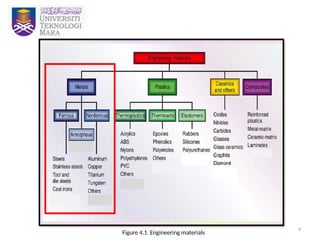
1. Engineeringmaterial can be divided into Metal & Non-Metal.
3. Metal major characteristic: a. Crystallinity.
b. Conductivity to heat and electricity
c. Relatively high strength and
toughness.
2. Metal can be categorized into ferrous (iron) and non ferrous.
5
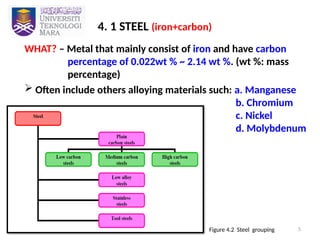
4. 1 STEEL(iron+carbon)
WHAT? – Metal that mainly consist of iron and have carbon
percentage of 0.022wt % ~ 2.14 wt %. (wt %: mass
percentage)
Often include others alloying materials such: a. Manganese
b. Chromium
c. Nickel
d. Molybdenum
Figure 4.2 Steel grouping
6.
6
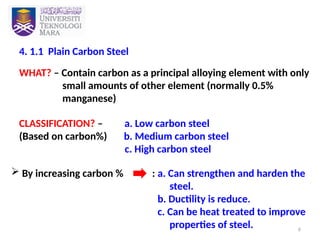
4. 1.1 PlainCarbon Steel
WHAT? – Contain carbon as a principal alloying element with only
small amounts of other element (normally 0.5%
manganese)
CLASSIFICATION? – a. Low carbon steel
(Based on carbon%) b. Medium carbon steel
c. High carbon steel
By increasing carbon % : a. Can strengthen and harden the
steel.
b. Ductility is reduce.
c. Can be heat treated to improve
properties of steel.
7.
7
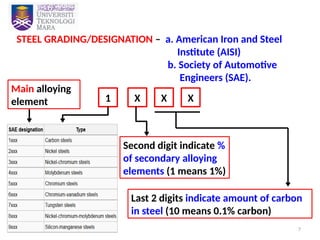
STEEL GRADING/DESIGNATION –a. American Iron and Steel
Institute (AISI)
b. Society of Automotive
Engineers (SAE).
X
1 X
X
Second digit indicate %
of secondary alloying
elements (1 means 1%)
Last 2 digits indicate amount of carbon
in steel (10 means 0.1% carbon)
Main alloying
element
8.
8
4. 2 ALLOYSTEEL (iron+carbon+other
element)
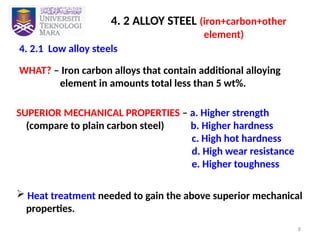
WHAT? – Iron carbon alloys that contain additional alloying
element in amounts total less than 5 wt%.
SUPERIOR MECHANICAL PROPERTIES – a. Higher strength
(compare to plain carbon steel) b. Higher hardness
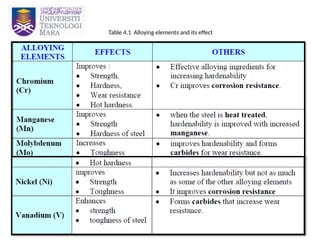
c. High hot hardness
d. High wear resistance
e. Higher toughness
Heat treatment needed to gain the above superior mechanical
properties.
4. 2.1 Low alloy steels
10
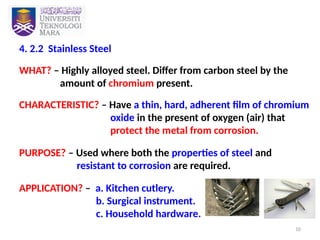
4. 2.2 StainlessSteel
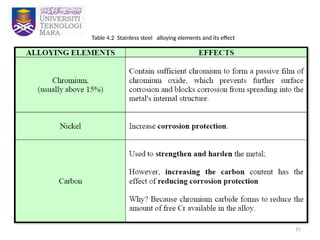
WHAT? – Highly alloyed steel. Differ from carbon steel by the
amount of chromium present.
CHARACTERISTIC? – Have a thin, hard, adherent film of chromium
oxide in the present of oxygen (air) that
protect the metal from corrosion.
PURPOSE? – Used where both the properties of steel and
resistant to corrosion are required.
APPLICATION? – a. Kitchen cutlery.
b. Surgical instrument.
c. Household hardware.
12
4. 2.3 ToolSteel
WHAT? – A variety of carbon and alloy steels that are particularly
well-suited to be made into tools.
CHARACTERISTIC? – High strength, impact toughness and wear
resistance. Has an excess carbides (carbon
alloy that makes them hard and wear
resistance.
PURPOSE? – Used to forming, machining or cutting others
materials.
13.
13
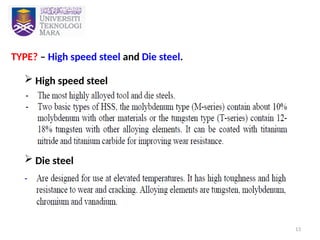
TYPE? – Highspeed steel and Die steel.
High speed steel
Die steel
14.
14
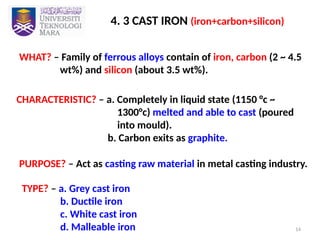
4. 3 CASTIRON (iron+carbon+silicon)
WHAT? – Family of ferrous alloys contain of iron, carbon (2 ~ 4.5
wt%) and silicon (about 3.5 wt%).
CHARACTERISTIC? – a. Completely in liquid state (1150 °c ~
1300°c) melted and able to cast (poured
into mould).
b. Carbon exits as graphite.
PURPOSE? – Act as casting raw material in metal casting industry.
TYPE? – a. Grey cast iron
b. Ductile iron
c. White cast iron
d. Malleable iron
15.
15
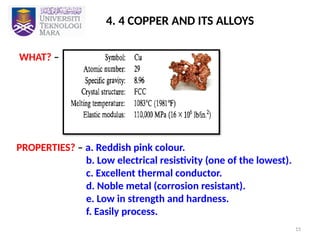
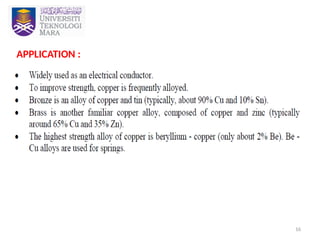
4. 4 COPPERAND ITS ALLOYS
WHAT? –
PROPERTIES? – a. Reddish pink colour.
b. Low electrical resistivity (one of the lowest).
c. Excellent thermal conductor.
d. Noble metal (corrosion resistant).
e. Low in strength and hardness.
f. Easily process.
17
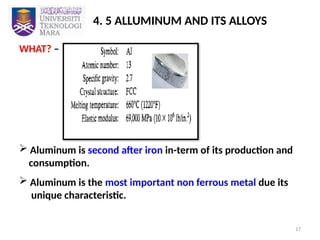
4. 5 ALLUMINUMAND ITS ALLOYS
WHAT? –
Aluminum is second after iron in-term of its production and
consumption.
Aluminum is the most important non ferrous metal due its
unique characteristic.
18.
18
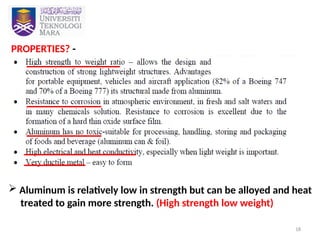
PROPERTIES? -
Aluminumis relatively low in strength but can be alloyed and heat
treated to gain more strength. (High strength low weight)
19.
19
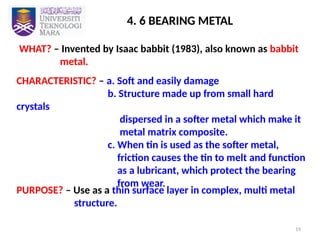
4. 6 BEARINGMETAL
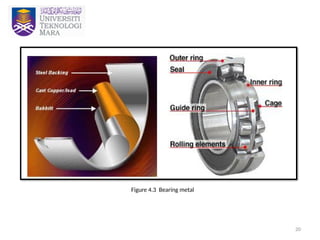
WHAT? – Invented by Isaac babbit (1983), also known as babbit
metal.
CHARACTERISTIC? – a. Soft and easily damage
b. Structure made up from small hard
crystals
dispersed in a softer metal which make it
metal matrix composite.
c. When tin is used as the softer metal,
friction causes the tin to melt and function
as a lubricant, which protect the bearing
from wear.
PURPOSE? – Use as a thin surface layer in complex, multi metal
structure.
21
1. Based onthe classification of plain carbon steel, give and list
the characteristic & application of each type of plain carbon
steel.
2. Based on the given types of cast iron steel, give and list
the descriptions, properties & application/product of each type
of cast iron steel.
ASSIGNMENT!
3. Determine below steel grade base on its SAE steel grade no. or
steel characteristic:
1. SAE 1060
2. SAE 1020
3. Chromium steel of 0.3 wt% carbon
4. Tungsten steel of 0.5 wt% carbon
22.
22
REFERENCES
1. Bawa, H.S. (1995). Workshop Technology. New Delhi, Tata McGraw-Hill.
2. Kalpakjian, S & Schmid, S. R. (2010). Manufacturing Processes
for Engineering Materials, 6th
edition, Prentice Hall.
3. Farrah, N. (2013). Introduction to Bench Fitting [PDF document].
Retrieved from http://i-learn.uitm.edu.my/v2/
4. Rao, P.N. (2001), Manufacturing Technology : Foundry, Forming and
Welding. New Delhi, Tata McGraw-Hill.