The Formation of Iron and
Steel
The Blast Furnace
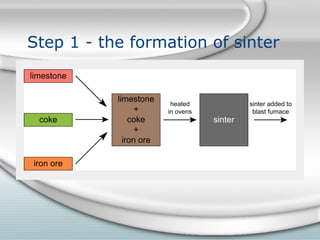
Step 1 - the formation of sinter
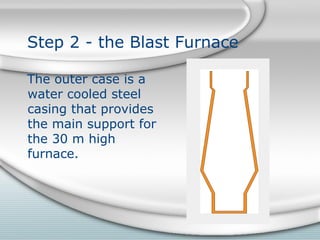
Step 2 - the Blast Furnace
The outer case is a
water cooled steel
casing that provides
the main support for
the 30 m high
furnace.
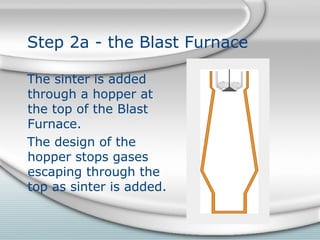
Step 2a - the Blast Furnace
The sinter is added
through a hopper at
the top of the Blast
Furnace.
The design of the
hopper stops gases
escaping through the
top as sinter is added.
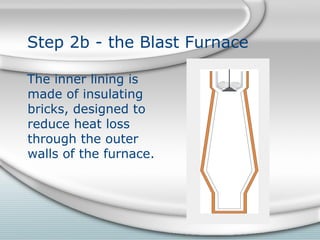
Step 2b - the Blast Furnace
The inner lining is
made of insulating
bricks, designed to
reduce heat loss
through the outer
walls of the furnace.
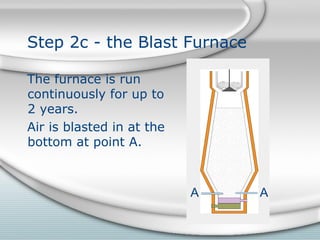
Step 2c - the Blast Furnace
The furnace is run
continuously for up to
2 years.
Air is blasted in at the
bottom at point A.
AA
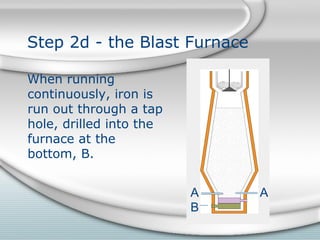
Step 2d - the Blast Furnace
When running
continuously, iron is
run out through a tap
hole, drilled into the
furnace at the
bottom, B.
AA
B
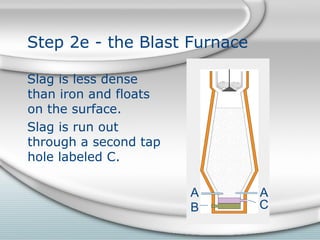
Step 2e - the Blast Furnace
Slag is less dense
than iron and floats
on the surface.
Slag is run out
through a second tap
hole labeled C.
AA
B C
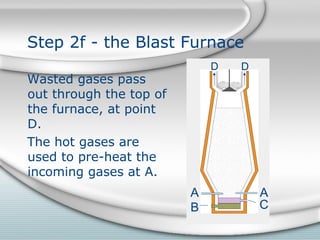
Step 2f - the Blast Furnace
Wasted gases pass
out through the top of
the furnace, at point
D.
The hot gases are
used to pre-heat the
incoming gases at A.
AA
B C
D D
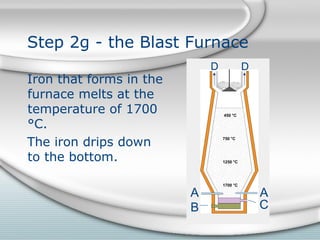
Step 2g - the Blast Furnace
Iron that forms in the
furnace melts at the
temperature of 1700
°C.
The iron drips down
to the bottom.
AA
B C
D D
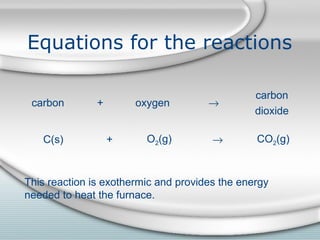
Equations for the reactions
carbon oxygen
carbon
dioxide
+ →
C(s) O2(g) CO2(g)+ →
This reaction is exothermic and provides the energy
needed to heat the furnace.
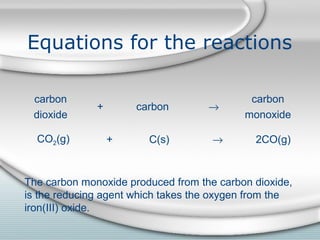
Equations for the reactions
carbon
dioxide
carbon
carbon
monoxide
+ →
CO2(g) C(s) 2CO(g)+ →
The carbon monoxide produced from the carbon dioxide,
is the reducing agent which takes the oxygen from the
iron(III) oxide.
Equations for the reactions
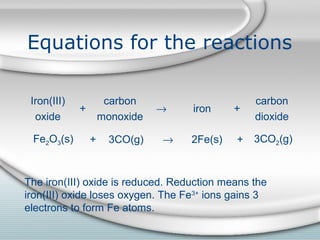
Iron(III)
oxide
carbon
monoxide
iron
carbon
dioxide
+ +→
Fe2O3(s) 3CO(g) 2Fe(s) 3CO2(g)+ +→
The iron(III) oxide is reduced. Reduction means the
iron(III) oxide loses oxygen. The Fe3+
ions gains 3
electrons to form Fe atoms.
Cast Iron
The iron from the furnace contains
up to 5 % carbon along with other
impurities.
Cast iron is brittle and has only
limited uses such as engine blocks.
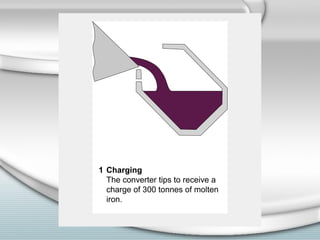
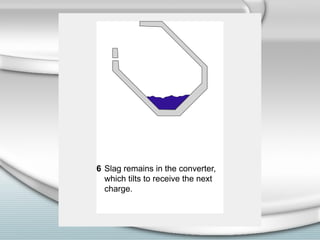
Cast iron into steel
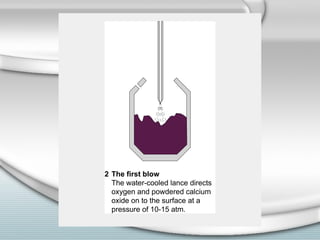
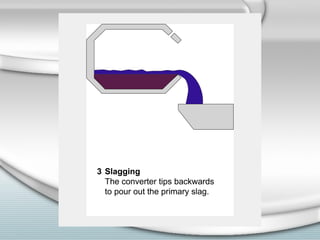
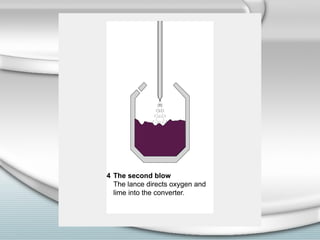
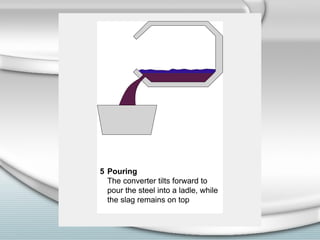
Steel is made from cast iron. The
carbon is removed by passing
oxygen through the molten cast
iron.
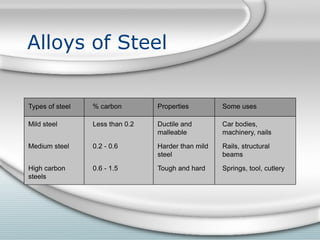
When the carbon content has fallen
to the required level, other metals
are added to form a number of
alloys.
Alloys of Steel
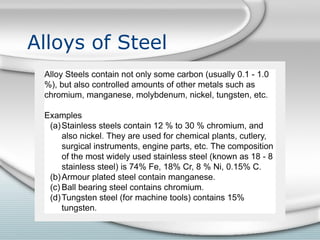
Alloys of Steel

Blast furnace

  • 1.
    The Formation ofIron and Steel The Blast Furnace
  • 2.
    Step 1 -the formation of sinter
  • 3.
    Step 2 -the Blast Furnace The outer case is a water cooled steel casing that provides the main support for the 30 m high furnace.
  • 4.
    Step 2a -the Blast Furnace The sinter is added through a hopper at the top of the Blast Furnace. The design of the hopper stops gases escaping through the top as sinter is added.
  • 5.
    Step 2b -the Blast Furnace The inner lining is made of insulating bricks, designed to reduce heat loss through the outer walls of the furnace.
  • 6.
    Step 2c -the Blast Furnace The furnace is run continuously for up to 2 years. Air is blasted in at the bottom at point A. AA
  • 7.
    Step 2d -the Blast Furnace When running continuously, iron is run out through a tap hole, drilled into the furnace at the bottom, B. AA B
  • 8.
    Step 2e -the Blast Furnace Slag is less dense than iron and floats on the surface. Slag is run out through a second tap hole labeled C. AA B C
  • 9.
    Step 2f -the Blast Furnace Wasted gases pass out through the top of the furnace, at point D. The hot gases are used to pre-heat the incoming gases at A. AA B C D D
  • 10.
    Step 2g -the Blast Furnace Iron that forms in the furnace melts at the temperature of 1700 °C. The iron drips down to the bottom. AA B C D D
  • 11.
    Equations for thereactions carbon oxygen carbon dioxide + → C(s) O2(g) CO2(g)+ → This reaction is exothermic and provides the energy needed to heat the furnace.
  • 12.
    Equations for thereactions carbon dioxide carbon carbon monoxide + → CO2(g) C(s) 2CO(g)+ → The carbon monoxide produced from the carbon dioxide, is the reducing agent which takes the oxygen from the iron(III) oxide.
  • 13.
    Equations for thereactions Iron(III) oxide carbon monoxide iron carbon dioxide + +→ Fe2O3(s) 3CO(g) 2Fe(s) 3CO2(g)+ +→ The iron(III) oxide is reduced. Reduction means the iron(III) oxide loses oxygen. The Fe3+ ions gains 3 electrons to form Fe atoms.
  • 14.
    Cast Iron The ironfrom the furnace contains up to 5 % carbon along with other impurities. Cast iron is brittle and has only limited uses such as engine blocks.
  • 15.
    Cast iron intosteel Steel is made from cast iron. The carbon is removed by passing oxygen through the molten cast iron. When the carbon content has fallen to the required level, other metals are added to form a number of alloys.
  • 22.
  • 23.