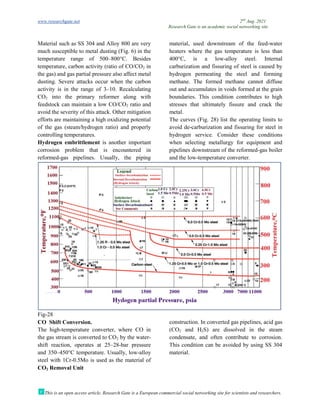
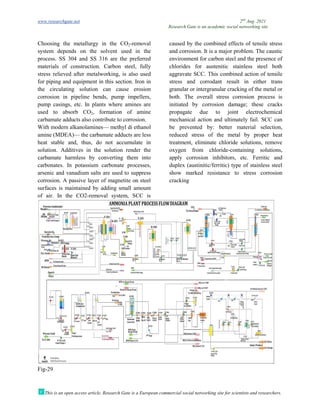
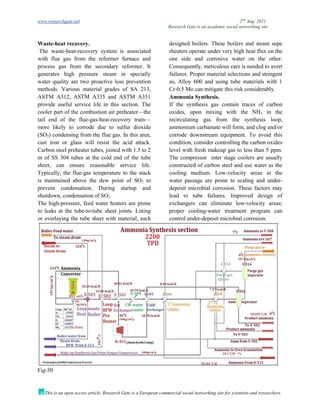
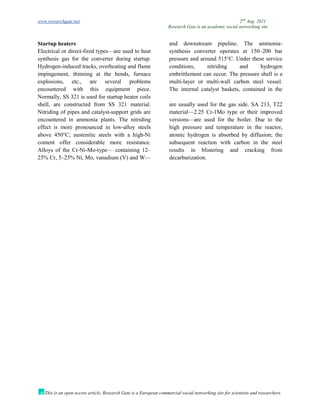
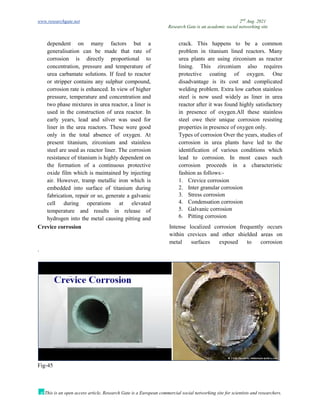
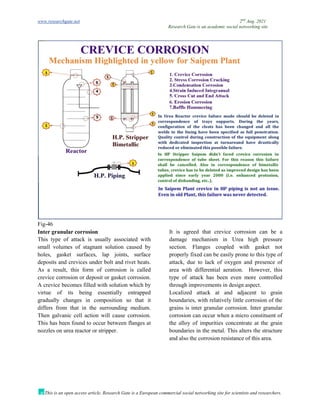
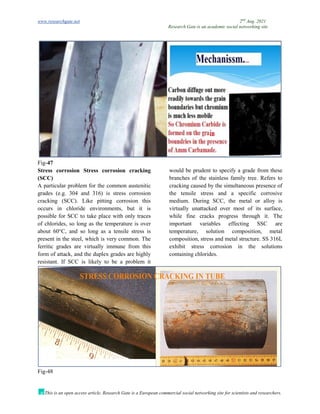
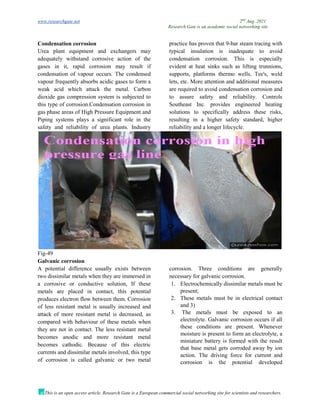
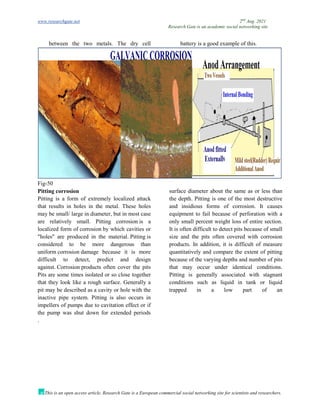
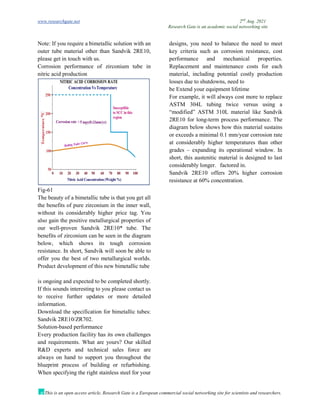
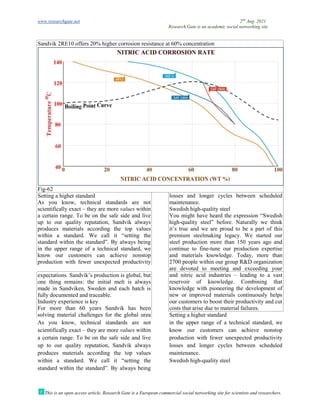
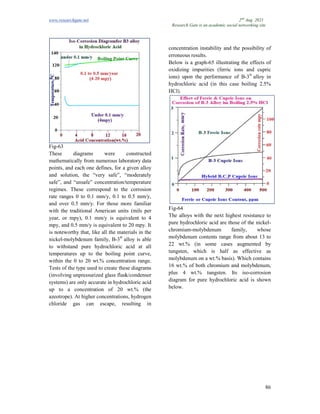
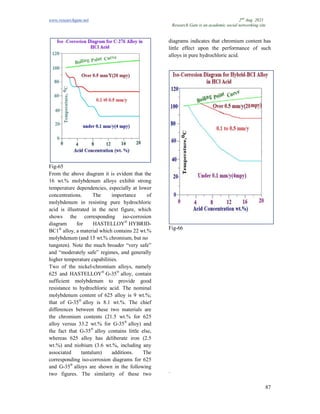
See discussions, stats, and author profiles for this publication at: https://www.researchgate.net/publication/353638068
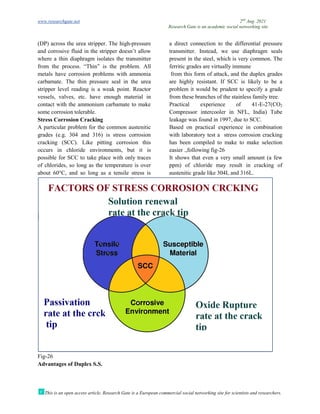
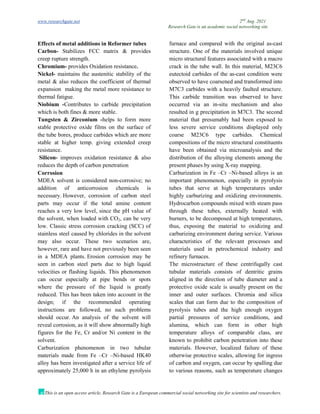
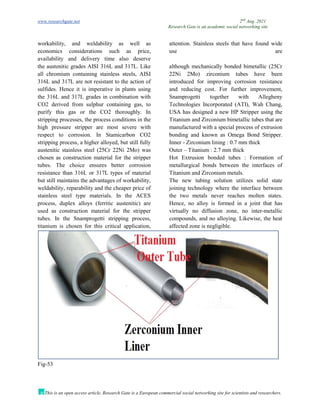
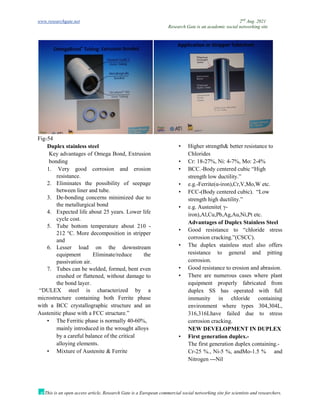
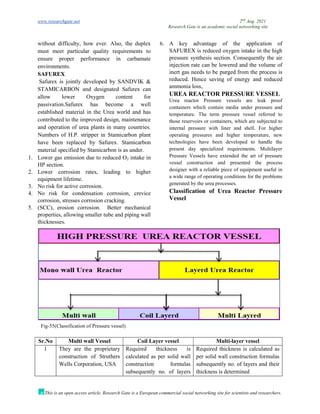
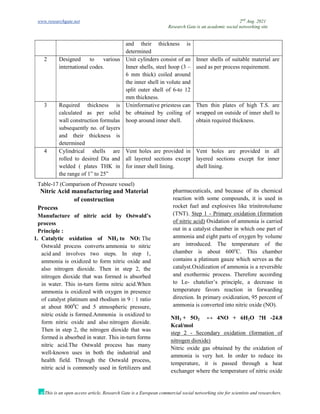
MATERIAL TECHNOLOGY FOR FERTILIZERS INDUSTRIES
Presentation · August 2021
DOI: 10.13140/RG.2.2.20549.99044
CITATIONS
0
1 author:
Some of the authors of this publication are also working on these related projects:
Comparison Stamicarbon Saipem View project
Silo (UREA) level measurement View project
Prem Baboo
Dangote Fertilizer Ltd
77 PUBLICATIONS   13 CITATIONS   
SEE PROFILE
All content following this page was uploaded by Prem Baboo on 02 August 2021.
The user has requested enhancement of the downloaded file.
www.researchgate.net 2nd
Aug. 2021
Research Gate is an academic social networking site
This is an open access article, Research Gate is a European commercial social networking site for scientists and researchers.
MATERIAL TECHNOLOGY FOR FERTILIZERS
INDUSTRIES
By
Prem Baboo
Former Sr. Manager, National Fertilizers Ltd., India
Abstract
Over the past two decades, the ammonia and
urea industry have witnessed spectacular
metallurgical developments for process
equipment. For example, stainless steels,
modified with special materials, can improve
high temperature creep rupture resistance. Using
duplex stainless steels and modern corrosion
abatement techniques are other methods that
improve plant-operating performance.
Materials plays very important role in any
industry. Selection of material is vital at design
stage itself ,Wrong selection of material may
lead to catastrophic failures and outage of plants
& even loss of Human lives, Right selection of
material leads to long life of plant. Over the past
two decades, the ammonia and urea industry
have witnessed spectacular metallurgical
developments for process equipment. For
example, stainless steels, modified with special
materials, can improve high temperature creep
rupture resistance. Using duplex stainless steels
and modern corrosion abatement techniques are
other methods that improve plant-operating
performance. The actual reactor has been
constructed using a variety of materials over the
years that can resist ammonium carbamate
corrosion. In the latest plants specialty duplex
steels, such as Sandvik’s Safurex, have greatly
improved the resistance to ammonium
carbamate corrosion. Fertilizer Plants employ
various corrosive, hazardous and abrasive fluids
and chemicals. The temperatures involved range
from cryogenic (-330C) in ammonia storage to
10000C in reformer. The pressure is as high as
175- 350kg/cm2 in ammonia converter and in
urea plant reactor pressure 150-250
kg/cm2.Once equipment has been selected, the
materials for its construction must be
established. Although a process Engineer is not
expected to be knowledgeable as a metallurgist,
the engineer should have a general idea of what
materials are compatible with the process.
Therefore, this topic presents some general
guidelines in the selection of material for
process equipment. In all ammonia, Urea Plants
worldwide the problem of severe erosion and
corrosion of high pressure vessel has been a
common phenomenon. Duplex steels have also
been adopted for piping, valves, etc. Since the
advent of industrial urea processes based on the
direct reaction between ammonia and carbon
dioxide, designers and urea plant owners have
had to deal with the problems of corrosion.
Although pure urea solutions are not very
corrosive, ammonium Carbamate (an
intermediate in urea synthesis) is a highly
corrosive liquid. For example, carbon steel in
contact with Carbamate solutions will corrode at
a rate of more than 900 mm/year. A corrosion-
resistant layer made of a special type of stainless
steel is therefore required to protect carbon steel
pressure vessel walls in the urea synthesis
section. In this book description of all material
used in ammonia and urea fertilizers.
Mani Topics
Classification of materials
Types of materials used in Fertilizers Industries
www.researchgate.net 2nd
Aug. 2021
Research Gate is an academic social networking site
This is an open access article, Research Gate is a European commercial social networking site for scientists and researchers.
Types of Steel
Special material used in new developments
Material for ammonia plants
Materials for Urea Plants
Material for Nitric acid and Ammonium Nitrate
Plants.
Classification of Materials
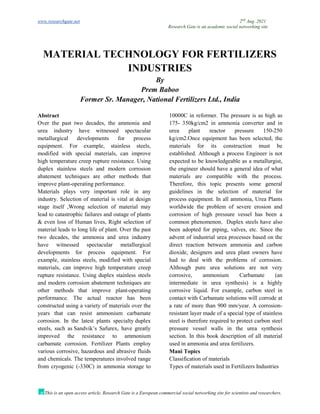
There is a wide variety of materials use to
construct process equipment. The type of
material selected depends on its compatibility
with process conditions and cost. The materials
of choice can be divided into the following
general categories
Fig-1
Metal
The metals used in the process industries can be
generally divided into two groups, ferrous and
nonferrous. Ferrous metals are arbitrarily
defined as those containing at least 50% iron.As
a group they far exceed any other group of metal
alloys used in the process industry.
Ferrous Alloy
The reason for popularity of ferrous alloys is
their relatively low cost, ready availability and
good workability. Ferrous alloys are subdivided
into cast irons, carbon steels , low alloy steels,
and stainless steels. There are also tool steels,
but these will not be discussed as they are of
limited used in the process industry.
Cast Iron
Cast iron are iron alloys that have greater than
1.5% Carbon content. These are four types.
Grey Cast iron.-This type is used in
applications such as construction equipment
requiring vibration damping and wear resistance.
Its gray appearance is caused by the graphite
particles spread throughout its mass. Gray cast
iron has a low tensile strength and is brittle, and
it should not be used in high pressure process
vessels.
White Cast Iron.-White cast iron has a much
lower silicon content than gray cast iron. No
graphite particles exist in its microstructure, and
any carbon in the cast iron is combined with iron
in the form of iron carbide (Fe3C). The metal is
hard, extremely abrasive, brittle .
Ductile Cast Iron-When ductile cast iron is
manufactured, small spherical nodules of
graphite are produced in its micro Structure.
This causes it to be ductile rather than brittle.
Ductile cast iron is used for high strength pipes,
valve bodies, pump casing, compressor casings,
crankshaft and machine tools.
Wrought Cast Iron-Prior to the nineteenth
century, wrought iron was the only form of iron
used. It is basically pure iron low in the carbon
but with a few percent of slag remaining in the
form of an iron silicate. The slag forms a fibrous
www.researchgate.net 2nd
Aug. 2021
Research Gate is an academic social networking site
This is an open access article, Research Gate is a European commercial social networking site for scientists and researchers.
structure within the wrought iron that gives it
excellent shock, vibration, and corrosion
resistance. wrought iron can be used for water
pipe, air brake pipes, and engine bolts.
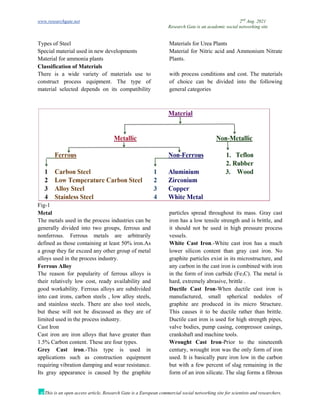
Fig-2
Properties of Material
Strength –“The resistance offered by a material
on application of external force is called
strength.”
Hardness-“hardness is the resistance offered by a
material to indentation.”
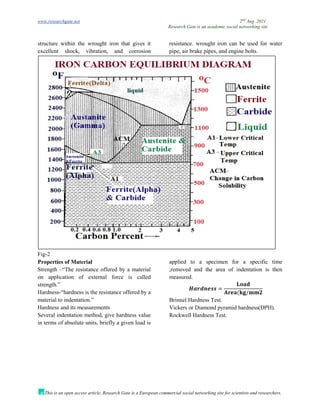
Hardness and its measurements
Several indentation method, give hardness value
in terms of absolute units, briefly a given load is
applied to a specimen for a specific time
,removed and the area of indentation is then
measured.
𝑯𝒂𝒓𝒅𝒏𝒆𝒔𝒔 =
𝐋𝐨𝐚𝐝
𝐀𝐫𝐞𝐚(𝐤𝐠/𝐦𝐦𝟐
Brinnel Hardness Test.
Vickers or Diamond pyramid hardness(DPH).
Rockwell Hardness Test.
www.researchgate.net 2nd
Aug. 2021
Research Gate is an academic social networking site
This is an open access article, Research Gate is a European commercial social networking site for scientists and researchers.
Indenter
Specimen
surface
h1 h2
Pre load
Pre load
Main Load
+
d
D
I
Brinnel
Vickers Or
DPH
Knop
Indentation shapes for various indentation hardness test method
Measuring sequence in Rockwell Hardness Test
HV=1.8544F/D2.
BH= F
( ΠD)(D-√D2-d2)
F=Load
Fig-3
Tensile Strength
Tensile strength is the maximum amount of
stretching or pulling a metal can withstand
before it fails or is permanently damaged.
Essentially, tensile strength is the measure of
how much tension the metal can resist. It serves
as a good point of reference for how a metal part
will perform in an application.
There are three types of tensile strength:
Yield strength- is the stress point at which
metal begins to deform plastically.
Ultimate strength- describes the maximum
amount of stress a metal can endure.
Breakable strength- is the stress coordinate on
the stress-strain curve at the point of failure.
A metal’s plasticity refers to the deformation of
the material while it undergoes
A metal’s plasticity refers to the deformation of
the material while it undergoes permanent
changes as a result of applied forces. In the case
of metal, ‘applied forces’ can include bending or
pounding actions. Once the yield point is passed,
some of the resulting deformation is permanent
and non-reversible. Prior to yield, there is
elasticity deformation where a material is
deformed under stress but returns to its original
state once the stress is removed. Among
commonly used metal alloys, stainless steel and
tempered structural aluminum have relatively
high tensile strengths: 6327.6 kg/cm2
and 3163.6
kg/cm2
, respectively.
Impact Strength
Impact strength is a measure of how much
impact or suddenly applied force a metal can
take before it fails. The impact load and the limit
that the metal can withstand are both expressed
in terms of energy. So, essentially, impact
Strength measures the amount of energy that a
metal can absorb before it fractures.
Compressive Strength
As its name implies, compressive strength is the
maximum amount of pressure or compression a
metal can withstand. This is typically measured
with a universal testing machine that applies an
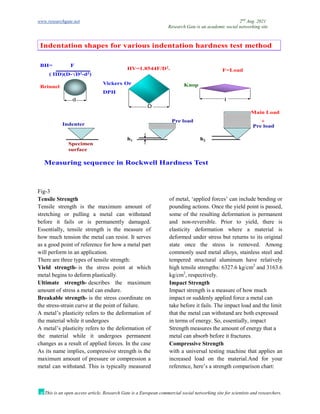
increased load on the material.And for your
reference, here’s a strength comparison chart:
www.researchgate.net
This is an open access article, Research Gate is a European commercial social networking site for scientists and researchers.
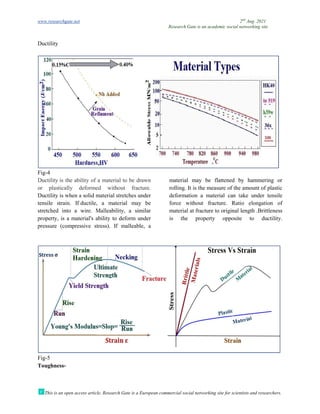
Ductility
Fig-4
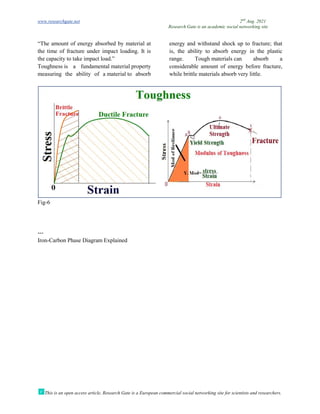
Ductility is the ability of a material to be drawn
or plastically deformed without fracture.
Ductility is when a solid material stretches under
tensile strain. If ductile, a material may be
stretched into a wire. Malleability, a similar
property, is a material's ability to deform under
pressure (compressive stress). If malleable, a
Fig-5
Toughness-
Research Gate is an academic social networking site
This is an open access article, Research Gate is a European commercial social networking site for scientists and researchers.
is the ability of a material to be drawn
plastically deformed without fracture.
is when a solid material stretches under
ductile, a material may be
stretched into a wire. Malleability, a similar
property, is a material's ability to deform under
tress). If malleable, a
material may be flattened by hammering or
rolling. It is the measure of the amount of plastic
deformation a material can take under tensile
force without fracture. Ratio elongation of
material at fracture to original length .Brittle
is the property opposite to ductility.
2nd
Aug. 2021
Research Gate is an academic social networking site
This is an open access article, Research Gate is a European commercial social networking site for scientists and researchers.
material may be flattened by hammering or
. It is the measure of the amount of plastic
deformation a material can take under tensile
force without fracture. Ratio elongation of
material at fracture to original length .Brittleness
is the property opposite to ductility.
www.researchgate.net
This is an open access article, Research Gate is a European commercial social networking site for scientists and researchers.
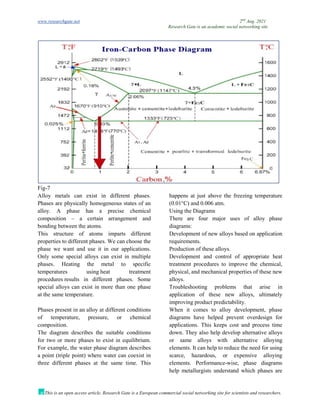
“The amount of energy absorbed by material at
the time of fracture under impact loading. It is
the capacity to take impact load.”
Toughness is a fundamental material
measuring the ability of a material
Fig-6
---
Iron-Carbon Phase Diagram Explained
Research Gate is an academic social networking site
This is an open access article, Research Gate is a European commercial social networking site for scientists and researchers.
The amount of energy absorbed by material at
the time of fracture under impact loading. It is
material property
material to absorb
energy and withstand shock up to fracture; that
is, the ability to absorb energy in the plastic
range. Tough materials can absorb a
considerable amount of energy before fracture,
while brittle materials absorb very little
Carbon Phase Diagram Explained
2nd
Aug. 2021
Research Gate is an academic social networking site
This is an open access article, Research Gate is a European commercial social networking site for scientists and researchers.
energy and withstand shock up to fracture; that
nergy in the plastic
can absorb a
considerable amount of energy before fracture,
very little.
www.researchgate.net 2nd
Aug. 2021
Research Gate is an academic social networking site
This is an open access article, Research Gate is a European commercial social networking site for scientists and researchers.
Fig-7
Alloy metals can exist in different phases.
Phases are physically homogeneous states of an
alloy. A phase has a precise chemical
composition – a certain arrangement and
bonding between the atoms.
This structure of atoms imparts different
properties to different phases. We can choose the
phase we want and use it in our applications.
Only some special alloys can exist in multiple
phases. Heating the metal to specific
temperatures using heat treatment
procedures results in different phases. Some
special alloys can exist in more than one phase
at the same temperature.
Phases present in an alloy at different conditions
of temperature, pressure, or chemical
composition.
The diagram describes the suitable conditions
for two or more phases to exist in equilibrium.
For example, the water phase diagram describes
a point (triple point) where water can coexist in
three different phases at the same time. This
happens at just above the freezing temperature
(0.01°C) and 0.006 atm.
Using the Diagrams
There are four major uses of alloy phase
diagrams:
Development of new alloys based on application
requirements.
Production of these alloys.
Development and control of appropriate heat
treatment procedures to improve the chemical,
physical, and mechanical properties of these new
alloys.
Troubleshooting problems that arise in
application of these new alloys, ultimately
improving product predictability.
When it comes to alloy development, phase
diagrams have helped prevent overdesign for
applications. This keeps cost and process time
down. They also help develop alternative alloys
or same alloys with alternative alloying
elements. It can help to reduce the need for using
scarce, hazardous, or expensive alloying
elements. Performance-wise, phase diagrams
help metallurgists understand which phases are
www.researchgate.net
This is an open access article, Research Gate is a European commercial social networking site for scientists and researchers.
thermodynamically stable, metastable, or
run. Appropriate elements can then be chosen
for alloying to prevent machinery breakdown.
Material for exhaust piping, for example, if not
chosen properly, may lead to breakdown at
higher temperatures.
.
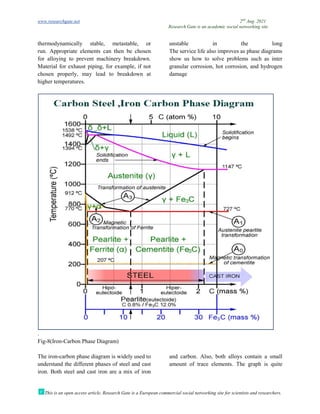
Fig-8(Iron-Carbon Phase Diagram)
The iron-carbon phase diagram is widely used to
understand the different phases of steel and cast
iron. Both steel and cast iron are a mix of iron
Research Gate is an academic social networking site
This is an open access article, Research Gate is a European commercial social networking site for scientists and researchers.
thermodynamically stable, metastable, or unstable in the long
an then be chosen
for alloying to prevent machinery breakdown.
Material for exhaust piping, for example, if not
chosen properly, may lead to breakdown at
The service life also improves as phase diagrams
show us how to solve problems such as inter
granular corrosion, hot corrosion, and hydrogen
damage
carbon phase diagram is widely used to
understand the different phases of steel and cast
oth steel and cast iron are a mix of iron
and carbon. Also, both alloys contain a small
amount of trace elements. The graph is quite
2nd
Aug. 2021
Research Gate is an academic social networking site
This is an open access article, Research Gate is a European commercial social networking site for scientists and researchers.
unstable in the long
The service life also improves as phase diagrams
olve problems such as inter
granular corrosion, hot corrosion, and hydrogen
and carbon. Also, both alloys contain a small
The graph is quite
www.researchgate.net 2nd
Aug. 2021
Research Gate is an academic social networking site
This is an open access article, Research Gate is a European commercial social networking site for scientists and researchers.
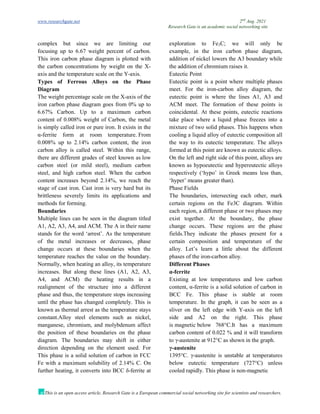
complex but since we are limiting our exploration to Fe3C; we will only be
focusing up to 6.67 weight percent of carbon.
This iron carbon phase diagram is plotted with
the carbon concentrations by weight on the X-
axis and the temperature scale on the Y-axis.
Types of Ferrous Alloys on the Phase
Diagram
The weight percentage scale on the X-axis of the
iron carbon phase diagram goes from 0% up to
6.67% Carbon. Up to a maximum carbon
content of 0.008% weight of Carbon, the metal
is simply called iron or pure iron. It exists in the
α-ferrite form at room temperature. From
0.008% up to 2.14% carbon content, the iron
carbon alloy is called steel. Within this range,
there are different grades of steel known as low
carbon steel (or mild steel), medium carbon
steel, and high carbon steel. When the carbon
content increases beyond 2.14%, we reach the
stage of cast iron. Cast iron is very hard but its
brittleness severely limits its applications and
methods for forming.
Boundaries
Multiple lines can be seen in the diagram titled
A1, A2, A3, A4, and ACM. The A in their name
stands for the word ‘arrest’. As the temperature
of the metal increases or decreases, phase
change occurs at these boundaries when the
temperature reaches the value on the boundary.
Normally, when heating an alloy, its temperature
increases. But along these lines (A1, A2, A3,
A4, and ACM) the heating results in a
realignment of the structure into a different
phase and thus, the temperature stops increasing
until the phase has changed completely. This is
known as thermal arrest as the temperature stays
constant.Alloy steel elements such as nickel,
manganese, chromium, and molybdenum affect
the position of these boundaries on the phase
diagram. The boundaries may shift in either
direction depending on the element used. For
example, in the iron carbon phase diagram,
addition of nickel lowers the A3 boundary while
the addition of chromium raises it.
Eutectic Point
Eutectic point is a point where multiple phases
meet. For the iron-carbon alloy diagram, the
eutectic point is where the lines A1, A3 and
ACM meet. The formation of these points is
coincidental. At these points, eutectic reactions
take place where a liquid phase freezes into a
mixture of two solid phases. This happens when
cooling a liquid alloy of eutectic composition all
the way to its eutectic temperature. The alloys
formed at this point are known as eutectic alloys.
On the left and right side of this point, alloys are
known as hypoeutectic and hypereutectic alloys
respectively (‘hypo’ in Greek means less than,
‘hyper’ means greater than).
Phase Fields
The boundaries, intersecting each other, mark
certain regions on the Fe3C diagram. Within
each region, a different phase or two phases may
exist together. At the boundary, the phase
change occurs. These regions are the phase
fields.They indicate the phases present for a
certain composition and temperature of the
alloy. Let’s learn a little about the different
phases of the iron-carbon alloy.
Different Phases
α-ferrite
Existing at low temperatures and low carbon
content, α-ferrite is a solid solution of carbon in
BCC Fe. This phase is stable at room
temperature. In the graph, it can be seen as a
sliver on the left edge with Y-axis on the left
side and A2 on the right. This phase
is magnetic below 768°C.It has a maximum
carbon content of 0.022 % and it will transform
to γ-austenite at 912°C as shown in the graph.
γ-austenite
This phase is a solid solution of carbon in FCC
Fe with a maximum solubility of 2.14% C. On
further heating, it converts into BCC δ-ferrite at
1395°C. γ-austenite is unstable at temperatures
below eutectic temperature (727°C) unless
cooled rapidly. This phase is non-magnetic
www.researchgate.net 2nd
Aug. 2021
Research Gate is an academic social networking site
This is an open access article, Research Gate is a European commercial social networking site for scientists and researchers.
δ-ferrite
This phase has a similar structure as that of α-
ferrite but exists only at high temperatures. The
phase can be spotted at the top left corner in the
graph. It has a melting point of 1538°C.
Fe-3 C or Cementite
Cementite is a metastable phase of this alloy
with a fixed composition of Fe3C. It decomposes
extremely slowly at room temperature into Iron
and carbon (graphite).This decomposition time
is long and it will take much longer than the
service life of the application at room
temperature. Some other factors (high
temperatures and addition of certain alloying
elements for instance) can affect this
decomposition as they promote graphite
formation .Cementite is hard and brittle which
makes it suitable for strengthening steels. Its
mechanical properties are a function of its
microstructure, which depends upon how it is
mixed with ferrite.
Fe-C liquid solution
Marked on the diagram as ‘L’, it can be seen in
the upper region in the diagram. As the name
suggests, it is a liquid solution of carbon in iron.
As we know that δ-ferrite melts at 1538°C, it is
evident that melting temperature of iron
decreases with increasing carbon content.
Role of Different Element Used in Steel Alloy
You may only know different steel grade has
many different chemical composition and
elements in different amount. Here in this post,
we sort out and list 21 chemical elements
and effects on steel properties.Steel in general is
an alloy of carbon and iron, it does contain many
other elements, some of which are retained from
the steel making process, other elements are
added to produce specific properties. We can see
some most common chemical elements with
important effects on steel properties.
Carbon
Carbon is the most important element in steel, it
is essential in steels which have to be hardened
by quenching and the degree of carbon controls
the hardness and strength of the material, as well
as response to heat treatment (harden ability)
Types of Steel
According to the American Iron & Steel Institute
(AISI), Steel can be categorized into four basic
groups based on the chemical compositions:
Carbon Steel
Alloy Steel
Stainless Steel
Tool Steel
Classifications
Types of Steel can also be classified by a variety
of different factors:
Composition: Carbon range, Alloy, Stainless.
The production method: Continuous cast,
Electric furnace, Etc. Finishing method
used: Cold Rolled, Hot Rolled ,Cold Drawn
(Cold Finished), Etc.
Form or shape: Bar, Rod, Tube, Pipe, Plate,
Sheet, Structural, Etc. De-oxidation process
(oxygen removed from steelmaking process):
Killed & Semi-Killed Steel, Etc. Microstructure:
Ferritic, Pearlitic, Martensitic, Etc. Physical
Strength (Per ASTM Standards).Heat Treatment:
Annealed, Quenched & Tempered, Etc. Quality
Nomenclature: Commercial Quality, Drawing
Quality, Pressure Vessel Quality, Etc
Steel Numbering Systems
There are two major numbering systems used by
the steel industry, the first developed by
the American Iron & Steel Institute (AISI), and
the second by the Society of Automotive
Engineers (SAE). Both of
these systems are based on four digit code
numbers when identifying the base carbon and
alloy steels. There are selections of alloys that
have five digit codes instead.
If the first digit is a one (1) in this designation it
indicates a carbon steel. All carbon steels are in
this group (1xxx) in both the SAE & AISI
system. They are also subdivided into four
www.researchgate.net 2nd
Aug. 2021
Research Gate is an academic social networking site
This is an open access article, Research Gate is a European commercial social networking site for scientists and researchers.
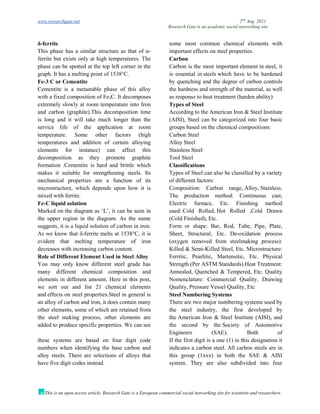
categories due to particular underlying properties among them. See below:
Plain Carbon Steel is encompassed within the
10xx series (containing 1.00% Mn maximum)
Re-Sulfurized Carbon steel is encompassed
within the 11xx series
Re -Sulfurized and Re-Phosphorized Carbon
Steel is encompassed within the 12xx series
Non-Re-Sulfurized High-Manganese (up-to
1.65%) carbon steel is encompassed within the
15xx series.
The first digit on all other alloy steels (under the
SAE-AISI system), are then classified as
follows:
2 = Nickel steels.
3 = Nickel-chromium steels.
4 = Molybdenum steels.
5 = Chromium steels.
6 = Chromium-vanadium steels.
7 = Tungsten-chromium steels.
8 = Nickel-chromium-molybdenum steels
9 = Silicon-manganese steels and various other
SAE grades
The second digit of the series (sometimes but not
always) indicates the concentration of the major
element in percentiles (1 equals 1%).The last
two digits of the series indicate the carbon
concentration to 0.01%.For example: SAE 5130
is a chromium alloy steel containing about 1% of
chromium and approximately 0.30% of carbon.
Carbon Steel
Carbon Steel can be segregated into three main
categories: Low carbon steel (sometimes known
as mild steel); Medium carbon steel; and High
carbon steel.
Low Carbon Steel (Mild Steel): Typically
contain 0.04
There are many different grades of steel that
encompass varied properties. These properties
can be physical, chemical and environmental.
All steel is composed of iron and carbon. It is
the amount of carbon, and the additional alloys
that determine the properties of each grade.
The characteristic difference between cast iron
and carbon steel is the carbon content. Carbon
steel has less than 1.5 % carbon. It is easy to
fabricate and has better strength than cast iron. It
is easier to weld than cast iron. The main
disadvantage in using carbon steel is its
susceptibility to corrosion.
Types of Carbon steel
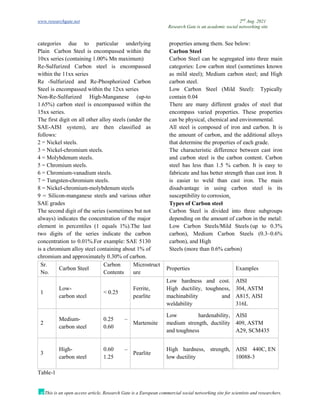
Carbon Steel is divided into three subgroups
depending on the amount of carbon in the metal:
Low Carbon Steels/Mild Steels (up to 0.3%
carbon), Medium Carbon Steels (0.3–0.6%
carbon), and High
Steels (more than 0.6% carbon)
Sr.
No.
Carbon Steel
Carbon
Contents
Microstruct
ure
Properties Examples
1
Low-
carbon steel
< 0.25
Ferrite,
pearlite
Low hardness and cost.
High ductility, toughness,
machinability and
weldability
AISI
304, ASTM
A815, AISI
316L
2
Medium-
carbon steel
0.25 –
0.60
Martensite
Low hardenability,
medium strength, ductility
and toughness
AISI
409, ASTM
A29, SCM435
3
High-
carbon steel
0.60 –
1.25
Pearlite
High hardness, strength,
low ductility
AISI 440C, EN
10088-3
Table-1
www.researchgate.net 2nd
Aug. 2021
Research Gate is an academic social networking site
This is an open access article, Research Gate is a European commercial social networking site for scientists and researchers.
Low-carbon steel
Low-carbon steel is the most widely used form
of carbon steel. These steels usually have a
carbon content of less than 0.25 wt. %. They
cannot be hardened by heat treatment (to form
martensite) so this is usually achieved by cold
work. Carbon steels are usually relatively soft
and have low strength. They do, however, have
high ductility, making them excellent for
machining, welding and low cost. High-strength,
low-alloy steels (HSLA) are also often classified
as low-carbon steels, however, also contain other
elements such as copper, nickel, vanadium
and molybdenum. Combined, these comprise up
to 10 wt.% of the steel content. High-strength,
low-alloy steels, as the name suggests, have
higher strengths, which is achieved by heat
treatment. They also retain ductility, making
them easily formable and machinable. HSLA are
more resistant to corrosion than plain low-
carbon steels.
Medium-carbon steel
Medium-carbon steel has a carbon content of
0.25 – 0.60 wt.% and a manganese content of
0.60 – 1.65 wt.%. The mechanical properties of
this steel are improved via heat treatment
involving autenitising followed by quenching
and tempering, giving them a martensitic
microstructure.
Heat treatment can only be performed on very
thin sections, however, additional alloying
elements, such as chromium, molybdenum and
nickel, can be added to improve the steels ability
to be heat treated and, thus, hardened. Hardened
medium-carbon steels have greater strength than
low-carbon steels, however, this comes at the
expense of ductility and toughness.
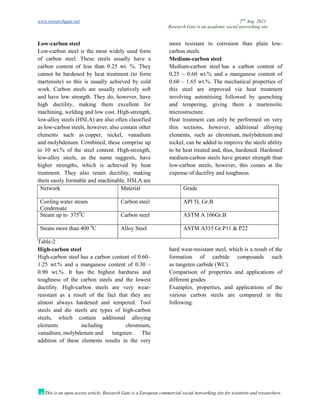
Network Material Grade
Cooling water steam
Condensate
Carbon steel API 5L Gr.B
Steam up to 3750
C Carbon steel ASTM A 106Gr.B
Steam more than 400 0
C Alloy Steel ASTM A335 Gr.P11 & P22
Table-2
High-carbon steel
High-carbon steel has a carbon content of 0.60–
1.25 wt.% and a manganese content of 0.30 –
0.90 wt.%. It has the highest hardness and
toughness of the carbon steels and the lowest
ductility. High-carbon steels are very wear-
resistant as a result of the fact that they are
almost always hardened and tempered. Tool
steels and die steels are types of high-carbon
steels, which contain additional alloying
elements including chromium,
vanadium, molybdenum and tungsten. The
addition of these elements results in the very
hard wear-resistant steel, which is a result of the
formation of carbide compounds such
as tungsten carbide (WC).
Comparison of properties and applications of
different grades
Examples, properties, and applications of the
various carbon steels are compared in the
following.
www.researchgate.net 2nd
Aug. 2021
Research Gate is an academic social networking site
This is an open access article, Research Gate is a European commercial social networking site for scientists and researchers.
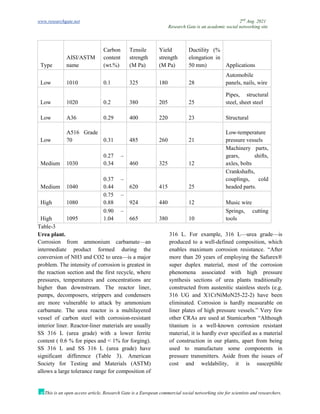
Type
AISI/ASTM
name
Carbon
content
(wt.%)
Tensile
strength
(M Pa)
Yield
strength
(M Pa)
Ductility (%
elongation in
50 mm) Applications
Low 1010 0.1 325 180 28
Automobile
panels, nails, wire
Low 1020 0.2 380 205 25
Pipes, structural
steel, sheet steel
Low A36 0.29 400 220 23 Structural
Low
A516 Grade
70 0.31 485 260 21
Low-temperature
pressure vessels
Medium 1030
0.27 –
0.34 460 325 12
Machinery parts,
gears, shifts,
axles, bolts
Medium 1040
0.37 –
0.44 620 415 25
Crankshafts,
couplings, cold
headed parts.
High 1080
0.75 –
0.88 924 440 12 Music wire
High 1095
0.90 –
1.04 665 380 10
Springs, cutting
tools
Table-3
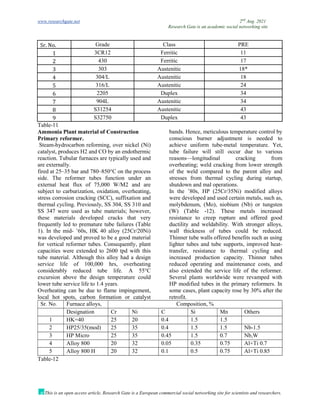
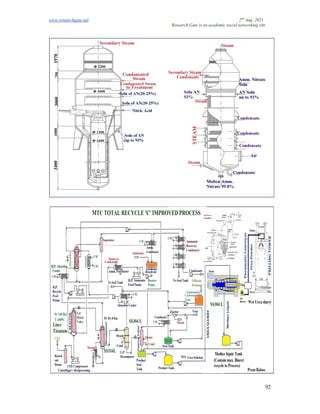
Urea plant.
Corrosion from ammonium carbamate—an
intermediate product formed during the
conversion of NH3 and CO2 to urea—is a major
problem. The intensity of corrosion is greatest in
the reaction section and the first recycle, where
pressures, temperatures and concentrations are
higher than downstream. The reactor liner,
pumps, decomposers, strippers and condensers
are more vulnerable to attack by ammonium
carbamate. The urea reactor is a multilayered
vessel of carbon steel with corrosion-resistant
interior liner. Reactor-liner materials are usually
SS 316 L (urea grade) with a lower ferrite
content ( 0.6 % for pipes and < 1% for forging).
SS 316 L and SS 316 L (urea grade) have
significant difference (Table 3). American
Society for Testing and Materials (ASTM)
allows a large tolerance range for composition of
316 L. For example, 316 L—urea grade—is
produced to a well-defined composition, which
enables maximum corrosion resistance. “After
more than 20 years of employing the Safurex®
super duplex material, most of the corrosion
phenomena associated with high pressure
synthesis sections of urea plants traditionally
constructed from austenitic stainless steels (e.g.
316 UG and X1CrNiMoN25-22-2) have been
eliminated. Corrosion is hardly measurable on
liner plates of high pressure vessels.” Very few
other CRAs are used at Stamicarbon “Although
titanium is a well-known corrosion resistant
material, it is hardly ever specified as a material
of construction in our plants, apart from being
used to manufacture some components in
pressure transmitters. Aside from the issues of
cost and weldability, it is susceptible
www.researchgate.net 2nd
Aug. 2021
Research Gate is an academic social networking site
This is an open access article, Research Gate is a European commercial social networking site for scientists and researchers.
to hydrogen embrittlement in oxygen free
ammonium carbamate and erosion corrosion.
Nickel alloys are not suitable for use in urea
plants due to the likely formation of nickel-
ammonia complexes which reduce their
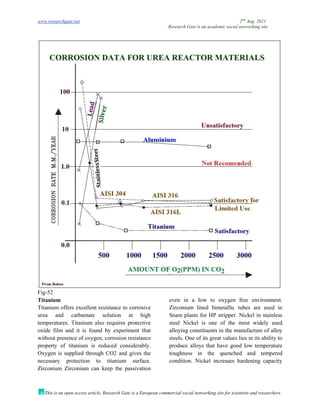
corrosion resistance.”Titanium and zirconium
are used to line urea reactors. The liner is
continuously passivated with oxygen to resist
corrosive action by adding air (0.5–0.8%vol
oxygen) in the CO2 feed. In urea plants,
corrosion failures include erosion, pitting, weld
embrittlement and cracking, crevice corrosion
and SCC. In the reactor, the liquid/vapor
interface is a corrosion-prone area. Attaching a
sacrificial plate to the liner can strengthen this
section. The multi-layer vessel may also undergo
severe corrosion damage from the reactor
contents when the liner becomes defective and
leaks. Zirconium-lined reactors have good
corrosion resistance and do not require
passivation.Reactor-outlet piping and let-down
valve are subjected to erosion corrosion from the
pressure reduction across the valve and high
fluid velocities in pipelines. For the low pressure
downstream equipment, SS 316L and SS 304 are
good construction materials. Aluminum alloys
and piping are quite resistant to the corrosive
attack by urea due to the protective oxide film.
These alloys are used in low-pressure piping,
floor gratings, hand rails, etc. Dead spots and
crevices—where equipment parts are not
continuously wetted by oxygen-containing
liquids—are prone to severe corrosion.
Accordingly, fabrication of this equipment
should be done to avoid such vulnerable spots.
The probability of process contamination with
corrosive agents, such as, sulfur (through oil in
liquid NH3), H2S (along with CO2) and chloride
(from cooling water) should be minimized.
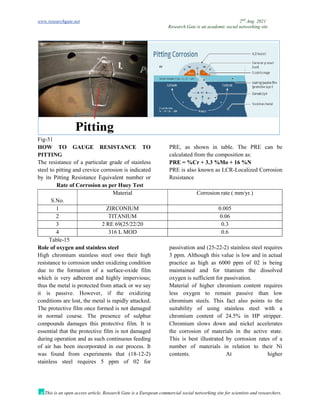
Pitting and crevice corrosion occur by the local-
cell action on exposed surfaces and weak points
on the surface. In threaded or flanged
connections where the passivating effect of
oxygen is low, this phenomenon can occur and
is aggravated by chlorides and higher
temperatures. Pitting resistance index (PREN)—
a means of comparing corrosion resistance of
stainless steel—may provide a useful guideline
for material selection in such environments.
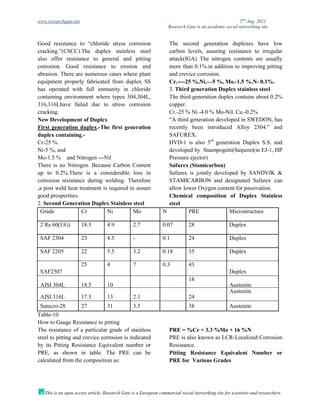
Pitting resistance equivalent number (PREN) or
Pitting resistance index = %Cr + 3.3X%Mo +
l6X%N Duplex stainless steel alloys are a
mixture of ferritic (400 series) and austenitic
(300 series) microstructure of approximately
equal volume fraction after final water-
quenchingheat treatment during metalworking.
Using this material has become popular because
of its resistance to stress corrosion and fatigue,
pitting resistance, suitability for a wide
temperature range of industrial applications (–
50°C to 280°C) and cost effectiveness. In the
urea plants, duplex stainless steel is used to
construct strippers, decomposers, condensers
and pipe lines.
Cavitations corrosion occur in pumps where the
flow conditions form bubbles on surface of
impellers. These bubbles, upon formation break
with enough force to rupture the protective film
of the stainless steel. The above situation can be
corrected through design that prevents bubble
formation,
www.researchgate.net
This is an open access article, Research Gate is a European commercial social networking site for scientists and researchers.
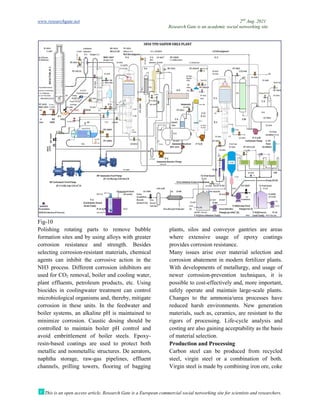
Fig-10
Polishing rotating parts to remove bubble
formation sites and by using alloys with greater
corrosion resistance and strength. Besides
selecting corrosion-resistant materials, chemical
agents can inhibit the corrosive action in the
NH3 process. Different corrosion i
used for CO2 removal, boiler and cooling water,
plant effluents, petroleum products, etc. Using
biocides in coolingwater treatment can control
microbiological organisms and, thereby, mitigate
corrosion in these units. In the feedwater and
boiler systems, an alkaline pH is maintained to
minimize corrosion. Caustic dosing should be
controlled to maintain boiler pH control and
avoid embrittlement of boiler steels. Epoxy
resin-based coatings are used to protect both
metallic and nonmetallic structures. De aerators,
naphtha storage, raw-gas pipelines, effluent
channels, prilling towers, flooring of bagging
Research Gate is an academic social networking site
This is an open access article, Research Gate is a European commercial social networking site for scientists and researchers.
rotating parts to remove bubble
formation sites and by using alloys with greater
corrosion resistance and strength. Besides
resistant materials, chemical
agents can inhibit the corrosive action in the
NH3 process. Different corrosion inhibitors are
removal, boiler and cooling water,
plant effluents, petroleum products, etc. Using
biocides in coolingwater treatment can control
microbiological organisms and, thereby, mitigate
corrosion in these units. In the feedwater and
ler systems, an alkaline pH is maintained to
minimize corrosion. Caustic dosing should be
controlled to maintain boiler pH control and
avoid embrittlement of boiler steels. Epoxy-
based coatings are used to protect both
ures. De aerators,
gas pipelines, effluent
channels, prilling towers, flooring of bagging
plants, silos and conveyor gantries are areas
where extensive usage of epoxy coatings
provides corrosion resistance.
Many issues arise over mater
corrosion abatement in modern fertilizer plants.
With developments of metallurgy, and usage of
newer corrosion-prevention techniques, it is
possible to cost-effectively and, more important,
safely operate and maintain large
Changes to the ammonia/urea processes have
reduced harsh environments. New generation
materials, such as, ceramics, are resistant to the
rigors of processing. Life-cycle analysis and
costing are also gaining acceptability as the basis
of material selection.
Production and Processing
Carbon steel can be produced from recycled
steel, virgin steel or a combination of both.
Virgin steel is made by combining iron ore, coke
2nd
Aug. 2021
Research Gate is an academic social networking site
This is an open access article, Research Gate is a European commercial social networking site for scientists and researchers.
plants, silos and conveyor gantries are areas
where extensive usage of epoxy coatings
Many issues arise over material selection and
corrosion abatement in modern fertilizer plants.
With developments of metallurgy, and usage of
prevention techniques, it is
effectively and, more important,
safely operate and maintain large-scale plants.
Changes to the ammonia/urea processes have
reduced harsh environments. New generation
materials, such as, ceramics, are resistant to the
cycle analysis and
costing are also gaining acceptability as the basis
Carbon steel can be produced from recycled
steel, virgin steel or a combination of both.
Virgin steel is made by combining iron ore, coke
www.researchgate.net 2nd
Aug. 2021
Research Gate is an academic social networking site
This is an open access article, Research Gate is a European commercial social networking site for scientists and researchers.
(produced by heating coal in the absence of air)
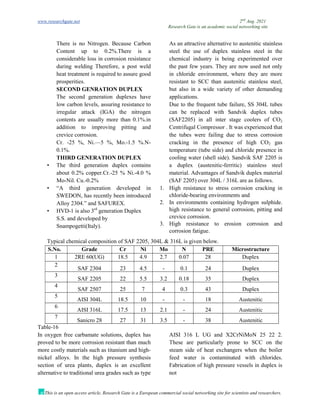
and lime in a blast furnace at around 1650 °C.
The molten iron extracted from the iron ore is
enriched with carbon from the burning coke. The
remaining impurities combine with the lime to
form slag, which floats on top of the molten
metal where it can be extracted. The resulting
molten steel contains roughly 4 wt.% carbon.
This
carbon content is then reduced to the desired
amount in a process called decarburisation. This
is achieved by passing oxygen through the melt,
which oxidises the carbon in the steel, producing
carbon monoxide and carbon dioxide
Carbon Steel Advantages
There are several advantages to choosing carbon
steel over traditional steel, one of which is
increased strength. The use of carbon makes iron
or steel stronger by shuffling around its crystal
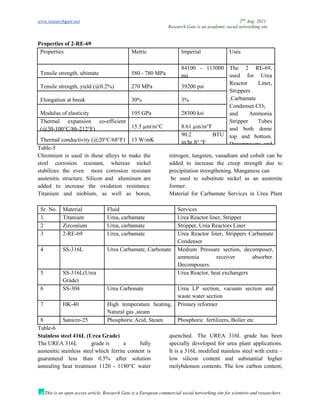
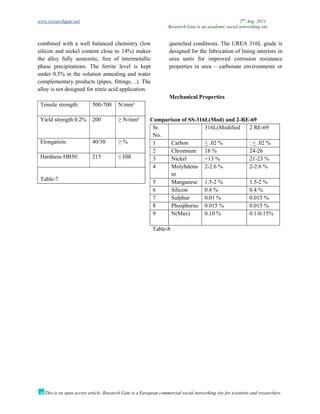
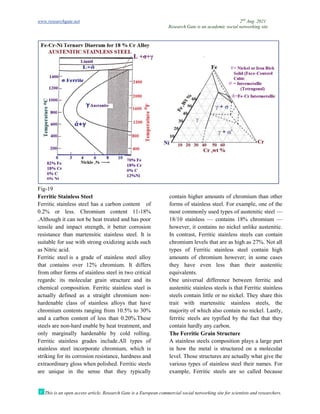
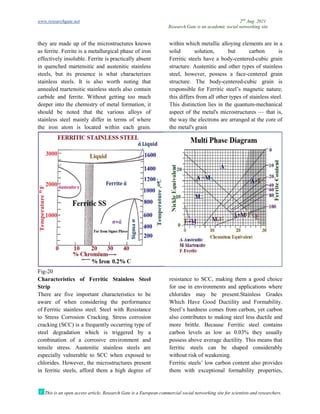
lattice. While carbon steel can still stress and
break under pressure, it’s less likely to occur
than with other types of steel. This makes carbon
steel particularly effective in applications where
strength is needed. Japanese blade smiths, for
example, produced swords out of high-carbon
steel known as tamahagane steel many centuries
ago. Today, carbon steel is used to make
everything from construction materials to tools,
automotive components and more.
Carbon Steel Disadvantages
But there are also some disadvantages to
choosing carbon steel over traditional steel.
Because it’s so strong, carbon steel is difficult to
work with. It can’t be easily bent and molded
into different shapes, thus limiting its utility in
certain applications. Carbon steel is also more
susceptible to rust and corrosion than other types
to steel. To make steel “stainless,”
manufacturers add chromium usually about 10%
to 12%. Chromium acts as a barrier of protection
over the steel itself, thereby protecting it from
moisture that could otherwise cause rusting.
Carbon steel doesn’t contain chromium,
however, so it may rust when exposed to
moisture for long periods of time. To recap,
carbon steel is an alloy metal consisting of iron
and carbon. Unlike stainless steel and other
types of steel, though, it’s characterized by high
carbon content.
Steel, a term that actually describes an entire
family of metal alloys, is a versatile and
common type of metal with a wide variety of
applications and uses. There are many grades but
most types of steel fall into two broad
categories, carbon steels and stainless steels.
Though they have the same basic composition of
iron and carbon, steel types tend to have a
variety of alloying elements. Carbon steel tends
to have under 10.5% chromium content, but
steel must be at least 10.5% chromium to be
considered stainless. These differences give each
type of steel its respective properties.
Stainless Steel
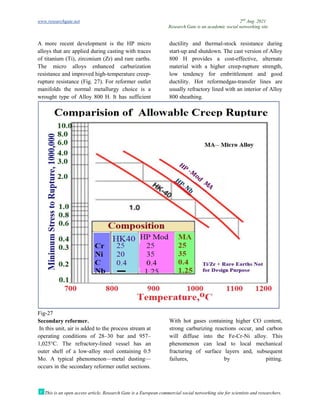
“A steel that has 12% or more chromium is
considered a stainless steel.”“Another
criterion defining a stainless steel is its
Passivity.”
PASSIVITY.- “Passivity is the ability of a metal
to form an impervious surface coating which
inhibits corrosion resulting from the
electrochemical reaction of the metal with the
surrounding environment.”
“Stainless Steels exhibit passivity in oxidizing
environment.”
Stainless steel refers to a type of steel which is
defined by the addition of chromium, and some
other alloying elements such as nickel. It is
sometimes called inox steel as it is designed to
protect against oxidisation and so is
‘inexorable.’ When exposed to oxygen, iron
oxidizes, making it rust, however chromium can
be exposed to oxygen without undergoing this
process. Stainless steel is therefore given a
protective layer of chromium to create a barrier
between environmental oxygen and the metal’s
www.researchgate.net 2nd
Aug. 2021
Research Gate is an academic social networking site
This is an open access article, Research Gate is a European commercial social networking site for scientists and researchers.
iron content. This allows it to resist corrosion or
rust and makes it ‘stainless.’
Types of Stainless Steel
Different chromium levels of stainless steel will
give it different properties, with a lower
chromium content generally producing a cheaper
but less durable steel. There are various types of
stainless steel, which include:
Austenitic, the most widely used type of
stainless steel, with low yield strength but strong
corrosion and heat resistance, commonly used in
housewares, industrial piping and vessels,
construction, and architectural facades – this is
the largest family of stainless steel and makes up
about two thirds of all stainless steel production
Ferritic, a form of steel generally with no
nickel, often possessing better corrosion, heat,
and cracking resistance than more common
types, and frequently used in washing machines,
boilers and indoor architecture
Martensitic, which tends to be magnetic and
less corrosion-resistant than other stainless steels
due to its low chromium content – these metals
are very hard and strong and are used to make
knives and turbine blades
Duplex, a composite of austenitic and ferritic
steels, making it both strong and flexible, with
twice the yield strength of austenitic stainless
steel, used in the paper, pulp, shipbuilding, and
petrochemical industries
Precipitation, with the corrosion resistance of
austenitic metals, but can be hardened to higher
strengths, and so can be made to be extremely
strong when other elements like aluminium,
copper and niobium are added
Carbon steel vs Stainless steel
Steel is an alloy made out of iron and carbon.
The carbon percentage can vary depending on
the grade, and mostly it is between 0.2% and
2.1% by weight. Though carbon is the main
alloying material for iron some other elements
like Tungsten, chromium, manganese can also
be used for the purpose. Different types and
amounts of alloying element used determine the
hardness, ductility and tensile strength of steel.
While in Carbon Steel, Carbon as the main
alloying element. In carbon steel, the properties
are mainly defined by the amount of carbon it
has. For this alloy, the amounts of other alloying
elements like chromium, manganese, cobalt,
tungsten are not defined.
Stainless steel has a high chromium content that
forms an invisible layer on the steel to prevent
corrosion and staining. Carbon steel has a higher
carbon content, which gives the steel a lower
melting point, more malleability and durability,
and better heat distribution.
How to Distinguish Carbon and Stainless Steel?
Stainless steel is lustrous and comes in various
grades that can increase the chromium in the
alloy until the steel finish is as reflective as a
mirror. To the casual observer, carbon steel and
stainless steel are easy to distinguish. Carbon
steel is dull, with a matte finish that is
comparable to a cast iron pot or wrought iron
fencing.
In a nutshell, main differences between Carbon
Steel & Stainless Steel
There is an in built chromium oxide layer in
stainless steel, which is not present in carbon
steel. Carbon steel can corrode whereas stainless
steel is protected from corrosion. Stainless steel
is preferred for many consumer products and can
be used decoratively in construction, while
carbon steel is often preferred in manufacturing,
production and in projects where the steel is
mostly hidden from view. Stainless Steel has
lower thermal conductivity than Carbon steel
Alloying Element & Materials, Role of
Alloying Element in Steel
Different alloying elements have particular
effects on the properties of stainless steel. It is
the combined effect of all the alloying elements,
heat treatment, and, to some extent, impurities
that determine the
www.researchgate.net 2nd
Aug. 2021
Research Gate is an academic social networking site
This is an open access article, Research Gate is a European commercial social networking site for scientists and researchers.
property profile of a specific steel grade. It
should be noted that the effect of the alloying
elements differs to some extent between the
different types of stainless steel.
Chromium (Cr)
Chromium is the most important alloying
element since it gives stainless steel its general
corrosion resistance. All stainless steels have a
Cr content of at least 10.5%. Additionally, the
corrosion resistance increases the higher
chromium content. Chromium also increases the
resistance to oxidation at high temperatures and
promotes a Ferritic microstructure.
“It is strong Carbide former and form complex
series of carbides compound of chromium and
iron.”
It is essential for formation of passive film to
resist corrosion.It helps to raise the critical
Temperature of steel. It improves hardness and
wear resistance.
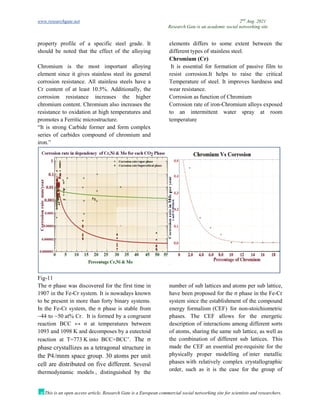
Corrosion as function of Chromium
Corrosion rate of iron-Chromium alloys exposed
to an intermittent water spray at room
temperature
Fig-11
The σ phase was discovered for the first time in
1907 in the Fe-Cr system. It is nowadays known
to be present in more than forty binary systems.
In the Fe-Cr system, the σ phase is stable from
~44 to ~50 at% Cr. It is formed by a congruent
reaction BCC ↔ σ at temperatures between
1093 and 1098 K and decomposes by a eutectoid
reaction at T=773 K into BCC+BCC’. The σ
phase crystallizes as a tetragonal structure in
the P42/mnm space group. 30 atoms per unit
cell are distributed on five different. Several
thermodynamic models , distinguished by the
number of sub lattices and atoms per sub lattice,
have been proposed for the σ phase in the Fe-Cr
system since the establishment of the compound
energy formalism (CEF) for non-stoichiometric
phases. The CEF allows for the energetic
description of interactions among different sorts
of atoms, sharing the same sub lattice, as well as
the combination of different sub lattices. This
made the CEF an essential pre-requisite for the
physically proper modelling of inter metallic
phases with relatively complex crystallographic
order, such as it is the case for the group of
www.researchgate.net 2nd
Aug. 2021
Research Gate is an academic social networking site
This is an open access article, Research Gate is a European commercial social networking site for scientists and researchers.
topologically close-packed phases including σ
phase. In the CEF, the mathematical model
divides the phase into different sub lattices.
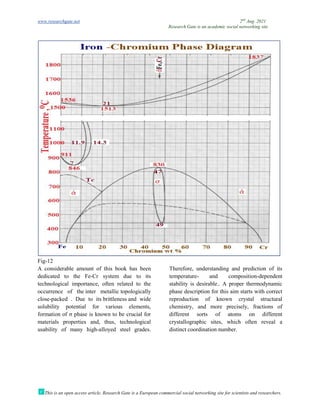
Iron Chromium Phase Diagram
With chromium contents between 20 and 70%
,the “sigma” microstructure is formed.
Following figure No-shows the phase diagram
for iron chromium in all proportions.
Sigma Microstructure.- “This microstructure
is hard, brittle and poor corrosion resistance.”
The sigma phase is the prominent feature of the
important system iron-chromium. which forms
only slowly, after lengthy annealing found a new
structure denoted o. X-ray and microscopic
investigations on samples annealed up to 60
days at 600°C confirmed 0, which is formed
below a temperature of 832°C: Because of the
slow equilibration rate and the small driving
force (i.e. the small difference ) this system is a
typical example where the phase boundaries can
only be assessed by thermo chemical
calculation. The then surprising result was the
observation that the 0 phase closes at the lower
temperature of 440°C (Fig.-12) below which the
solid solutions in iron and chromium are in
equilibrium, thus forming a miscibility gap
which metastable closes at about 575°C (shown
as a dotted curve in Fig.-12)
www.researchgate.net
This is an open access article, Research Gate is a European commercial social networking site for scientists and researchers.
Fig-12
A considerable amount of this book
dedicated to the Fe-Cr system due to its
technological importance, often related to the
occurrence of the inter metallic
close-packed . Due to its brittlene
solubility potential for various elements,
formation of σ phase is known to be crucial for
materials properties and, thus, technological
usability of many high-alloyed steel grades.
Research Gate is an academic social networking site
This is an open access article, Research Gate is a European commercial social networking site for scientists and researchers.
A considerable amount of this book has been
Cr system due to its
technological importance, often related to the
topologically
brittleness and wide
solubility potential for various elements,
formation of σ phase is known to be crucial for
materials properties and, thus, technological
alloyed steel grades.
Therefore, understanding and prediction of its
temperature- and composition
stability is desirable.. A proper thermodynamic
phase description for this aim starts with correct
reproduction of known crystal structural
chemistry, and more precisely, fractions of
different sorts of atoms on different
crystallographic sites, which often reveal a
distinct coordination number.
2nd
Aug. 2021
Research Gate is an academic social networking site
This is an open access article, Research Gate is a European commercial social networking site for scientists and researchers.
Therefore, understanding and prediction of its
d composition-dependent
stability is desirable.. A proper thermodynamic
phase description for this aim starts with correct
reproduction of known crystal structural
chemistry, and more precisely, fractions of
different sorts of atoms on different
raphic sites, which often reveal a
www.researchgate.net
This is an open access article, Research Gate is a European commercial social networking site for scientists and researchers.
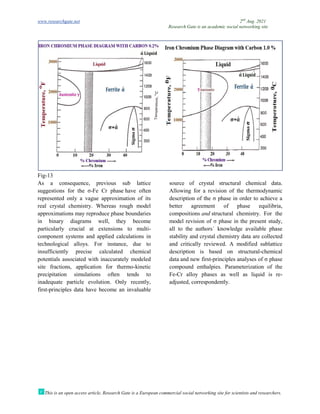
Fig-13
As a consequence, previous sub lattice
suggestions for the σ-Fe Cr phase
represented only a vague approximation of its
real crystal chemistry. Whereas rough model
approximations may reproduce phase boundaries
in binary diagrams well, they become
particularly crucial at extensions to multi
component systems and applied calculations in
technological alloys. For instance, due to
insufficiently precise calculated chemical
potentials associated with inaccurately modeled
site fractions, application for thermo
precipitation simulations often tends to
inadequate particle evolution. Only recently,
first-principles data have become an invaluable
Research Gate is an academic social networking site
This is an open access article, Research Gate is a European commercial social networking site for scientists and researchers.
As a consequence, previous sub lattice
Cr phase have often
represented only a vague approximation of its
real crystal chemistry. Whereas rough model
approximations may reproduce phase boundaries
in binary diagrams well, they become
particularly crucial at extensions to multi-
nd applied calculations in
technological alloys. For instance, due to
insufficiently precise calculated chemical
potentials associated with inaccurately modeled
site fractions, application for thermo-kinetic
precipitation simulations often tends to
ate particle evolution. Only recently,
principles data have become an invaluable
source of crystal structural chemical data.
Allowing for a revision of the thermodynamic
description of the σ phase in order to achieve a
better agreement of phase equil
compositions and structural chemistry. For the
model revision of σ phase in the present study,
all to the authors´ knowledge available phase
stability and crystal chemistry data are collected
and critically reviewed. A modified sublattice
description is based on structural
data and new first-principles analyses of σ phase
compound enthalpies. Parameterization of the
Fe-Cr alloy phases as well as liquid is re
adjusted, correspondently.
2nd
Aug. 2021
Research Gate is an academic social networking site
This is an open access article, Research Gate is a European commercial social networking site for scientists and researchers.
rystal structural chemical data.
Allowing for a revision of the thermodynamic
description of the σ phase in order to achieve a
better agreement of phase equilibria,
structural chemistry. For the
model revision of σ phase in the present study,
all to the authors´ knowledge available phase
stability and crystal chemistry data are collected
and critically reviewed. A modified sublattice
n is based on structural-chemical
principles analyses of σ phase
compound enthalpies. Parameterization of the
Cr alloy phases as well as liquid is re-
www.researchgate.net
This is an open access article, Research Gate is a European commercial social networking site for scientists and researchers.
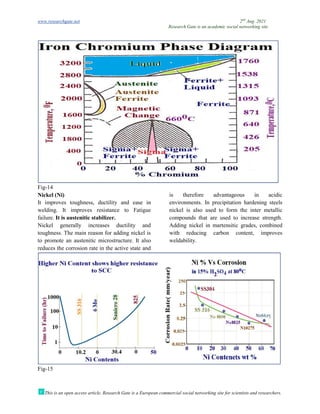
Fig-14
Nickel (Ni)
It improves toughness, ductility and ease
welding. It improves resistance to Fatigue
failure. It is austenitic stabilizer.
Nickel generally increases ductility and
toughness. The main reason for adding nickel is
to promote an austenitic microstructure. It also
reduces the corrosion rate in the active state and
Fig-15
Research Gate is an academic social networking site
This is an open access article, Research Gate is a European commercial social networking site for scientists and researchers.
ductility and ease in
improves resistance to Fatigue
Nickel generally increases ductility and
toughness. The main reason for adding nickel is
to promote an austenitic microstructure. It also
reduces the corrosion rate in the active state and
is therefore advantageous in acidic
environments. In precipitation
nickel is also used to form the inter
compounds that are used to increase strength.
Adding nickel in martensitic grades, combined
with reducing carbon content, improves
weldability.
2nd
Aug. 2021
Research Gate is an academic social networking site
This is an open access article, Research Gate is a European commercial social networking site for scientists and researchers.
is therefore advantageous in acidic
environments. In precipitation hardening steels
nickel is also used to form the inter metallic
compounds that are used to increase strength.
Adding nickel in martensitic grades, combined
with reducing carbon content, improves
www.researchgate.net
This is an open access article, Research Gate is a European commercial social networking site for scientists and researchers.
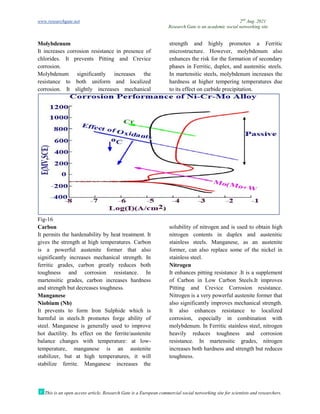
Molybdenum
It increases corrosion resistance in presence of
chlorides. It prevents Pitting and Crevice
corrosion.
Molybdenum significantly increases the
resistance to both uniform and localized
corrosion. It slightly increases mechanical
Fig-16
Carbon
It permits the hardenability by heat treatment.
gives the strength at high temperatures.
is a powerful austenite former that also
significantly increases mechanical strength. In
ferritic grades, carbon greatly reduces both
toughness and corrosion resistance. In
martensitic grades, carbon increases hardness
and strength but decreases toughness.
Manganese
Niobium (Nb)
It prevents to form Iron Sulphide which is
harmful in steels.It promotes forge ability of
steel. Manganese is generally used to improve
hot ductility. Its effect on the ferrite/austenite
balance changes with temperature: at low
temperature, manganese is an austenite
stabilizer, but at high temperatures,
stabilize ferrite. Manganese increases the
Research Gate is an academic social networking site
This is an open access article, Research Gate is a European commercial social networking site for scientists and researchers.
It increases corrosion resistance in presence of
It prevents Pitting and Crevice
Molybdenum significantly increases the
resistance to both uniform and localized
corrosion. It slightly increases mechanical
strength and highly promotes a Ferritic
microstructure. However, molybdenum also
enhances the risk for the formation of secondary
phases in Ferritic, duplex, and austenitic steels.
In martensitic steels, molybdenum increases the
hardness at higher tempering temperatures due
to its effect on carbide precipitation.
hardenability by heat treatment. It
gives the strength at high temperatures. Carbon
is a powerful austenite former that also
al strength. In
ferritic grades, carbon greatly reduces both
toughness and corrosion resistance. In
martensitic grades, carbon increases hardness
and strength but decreases toughness.
It prevents to form Iron Sulphide which is
in steels.It promotes forge ability of
Manganese is generally used to improve
hot ductility. Its effect on the ferrite/austenite
balance changes with temperature: at low-
temperature, manganese is an austenite
stabilizer, but at high temperatures, it will
stabilize ferrite. Manganese increases the
solubility of nitrogen and is used to obtain high
nitrogen contents in duplex and austenitic
stainless steels. Manganese, as an austenite
former, can also replace some of the nickel in
stainless steel.
Nitrogen
It enhances pitting resistance .
of Carbon in Low Carbon Steels.It improves
Pitting and Crevice Corrosion resistance.
Nitrogen is a very powerful austenite former that
also significantly improves mechanical strength.
It also enhances resistance to localized
corrosion, especially in combination with
molybdenum. In Ferritic stainless steel, nitrogen
heavily reduces toughness and corrosion
resistance. In martensitic grades, nitrogen
increases both hardness and strength but reduces
toughness.
2nd
Aug. 2021
Research Gate is an academic social networking site
This is an open access article, Research Gate is a European commercial social networking site for scientists and researchers.
motes a Ferritic
microstructure. However, molybdenum also
enhances the risk for the formation of secondary
phases in Ferritic, duplex, and austenitic steels.
In martensitic steels, molybdenum increases the
hardness at higher tempering temperatures due
ts effect on carbide precipitation.
solubility of nitrogen and is used to obtain high
nitrogen contents in duplex and austenitic
stainless steels. Manganese, as an austenite
former, can also replace some of the nickel in
.It is a supplement
of Carbon in Low Carbon Steels.It improves
Pitting and Crevice Corrosion resistance.
Nitrogen is a very powerful austenite former that
also significantly improves mechanical strength.
It also enhances resistance to localized
corrosion, especially in combination with
molybdenum. In Ferritic stainless steel, nitrogen
ss and corrosion
resistance. In martensitic grades, nitrogen
increases both hardness and strength but reduces
www.researchgate.net 2nd
Aug. 2021
Research Gate is an academic social networking site
This is an open access article, Research Gate is a European commercial social networking site for scientists and researchers.
Niobium is a strong ferrite and carbide former
and promotes a Ferritic structure, just like
titanium. In austenitic steels, niobium is added to
improve the resistance to inter granular
corrosion (stabilized grades). Additionally, it
enhances mechanical properties at high
temperatures. In ferritic grades, niobium and/or
titanium is/are sometimes added to improve
toughness and to minimize the risk for inter
granular corrosion. In martensitic steels,
niobium lowers hardness and increases
tempering resistance.
Copper (Cu)
Increases strength up to about 12 %. Higher
concentration cause brittleness. Copper improve
the elevated temperature properties and
machinability. Used in concentration of about
0.5% or less, produces a tenacious self sealing
oxide film on a metal surface.Copper improves
corrosion resistance to certain acids and supports
an austenitic microstructure. It can also be added
to decrease work hardening in grades designed
for improved machinability. Additionally, it can
also be added to improve formability.
Cobalt (Co)
Cobalt is used in martensitic steels, where it
increases hardness and tempering resistance,
especially at higher temperatures.
Silicon (Si)
Silicon increases resistance to oxidation during
casting of ingots, both at high temperatures and
in strongly oxidizing solutions at lower
temperatures. It promotes a Ferritic
microstructure and increases strength. It dissolve
in Ferrite increase strength and hardness without
lowering the ductility.
Sulfur (S)
Sulfur is added to certain stainless steels to
increase their machinability. At the levels
present in these grades, sulfur slightly reduces
corrosion resistance, ductility, weldability, and
formability. Lower levels of sulfur can be added
to decrease work hardening for improved
formability. Slightly increased sulfur content
also improves the weldability of steel.
Titanium (Ti)
Titanium is a strong ferrite and carbide former
that lowers the effective carbon content and
promotes a ferritic structure in two ways. By
adding Titanium, the resistance to intergranular
corrosion (stabilized grades) increases in
austenitic steels, as well as carbon content and
mechanical properties at high temperatures are
improved. In ferritic grades, titanium is added to
improve toughness, formability, and corrosion
resistance. In martensitic steels, titanium lowers
the martensite hardness in combination with
carbon and increases temper resistance. In
precipitation hardening steels, titanium is used to
form the inter metallic compounds that are used
to increase strength.
Tungsten (W)
Tungsten is present as an impurity in most
stainless steels, although it is added to some
special grades, for example the super duplex
grade 4501, to improve pitting corrosion
resistance
Vanadium (V)
Vanadium forms carbides and nitrides at lower
temperatures, promotes ferrite in the
microstructure, and increases toughness. It
increases the hardness of martensitic steels due
to its effect on the type of carbide present. It also
increases tempering resistance. It is only used in
stainless steels that can be hardened.
Types of Stainless Steel
There are four general types of stainless steel of
interest to the process engineerThere are three
general types of stainless steel of interest to the
process engineer
Austenitic Stainless Steels. These are the most
frequently used types of stainless steels.
Ferritic Stainless Steels. The second most
common form of stainless steel
after austenitic alloys. ...
Martensitic Stainless Steels. The least common
category of stainless steel alloy.
www.researchgate.net
This is an open access article, Research Gate is a European commercial social networking site for scientists and researchers.
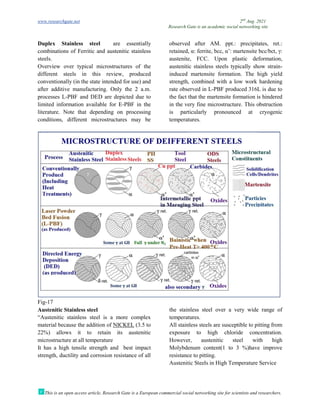
Duplex Stainless steel are essentially
combinations of Ferritic and austenitic stainless
steels.
Overview over typical microstructures of the
different steels in this review, produced
conventionally (in the state intended for use) and
after additive manufacturing. Only the 2 a.m.
processes L-PBF and DED are depicted due to
limited information available for E
literature. Note that depending on processing
conditions, different microstructures may be
Fig-17
Austenitic Stainless steel
“Austenitic stainless steel is a more complex
material because the addition of NICKEL
22%) allows it to retain its austenitic
microstructure at all temperature
It has a high tensile strength and best impact
strength, ductility and corrosion resistance of all
Research Gate is an academic social networking site
This is an open access article, Research Gate is a European commercial social networking site for scientists and researchers.
are essentially
combinations of Ferritic and austenitic stainless
typical microstructures of the
different steels in this review, produced
conventionally (in the state intended for use) and
after additive manufacturing. Only the 2 a.m.
PBF and DED are depicted due to
limited information available for E-PBF in the
literature. Note that depending on processing
conditions, different microstructures may be
observed after AM. ppt.: precipitates, ret.:
retained, α: ferrite, bcc, α’: marte
austenite, FCC. Upon plastic deformation,
austenitic stainless steels typically show strain
induced martensite formation. The high yield
strength, combined with a low work hardening
rate observed in L-PBF produced 316L is due to
the fact that the martensite formation is hindered
in the very fine microstructure
is particularly pronounced at cryo
temperatures.
“Austenitic stainless steel is a more complex
NICKEL (3.5 to
22%) allows it to retain its austenitic
It has a high tensile strength and best impact
strength, ductility and corrosion resistance of all
the stainless steel over a very wide range of
temperatures.
All stainless steels are susceptible to pitting from
exposure to high chloride concentration.
However, austenitic steel with high
Molybdenum content(1 to 3 %)have improve
resistance to pitting.
Austenitic Steels in High Temperature Service
2nd
Aug. 2021
Research Gate is an academic social networking site
This is an open access article, Research Gate is a European commercial social networking site for scientists and researchers.
observed after AM. ppt.: precipitates, ret.:
retained, α: ferrite, bcc, α’: martensite bcc/bct, γ:
Upon plastic deformation,
s steels typically show strain-
induced martensite formation. The high yield
strength, combined with a low work hardening
PBF produced 316L is due to
the fact that the martensite formation is hindered
microstructure. This obstruction
is particularly pronounced at cryogenic
the stainless steel over a very wide range of
steels are susceptible to pitting from
exposure to high chloride concentration.
austenitic steel with high
Molybdenum content(1 to 3 %)have improve
Austenitic Steels in High Temperature Service
www.researchgate.net
This is an open access article, Research Gate is a European commercial social networking site for scientists and researchers.
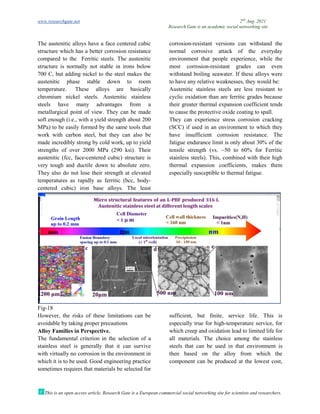
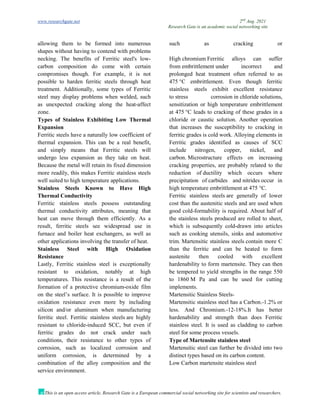
The austenitic alloys have a face centered cubic
structure which has a better corrosion resistance
compared to the Ferritic steels. The austenitic
structure is normally not stable in irons below
700 C, but adding nickel to the steel
austenitic phase stable down to room
temperature. These alloys are basically
chromium nickel steels. Austenitic stainless
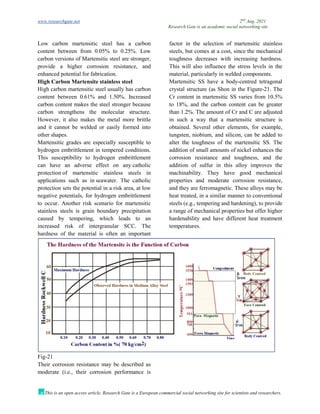
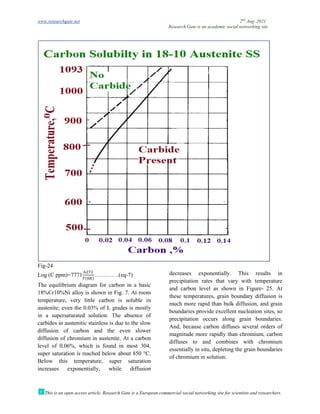
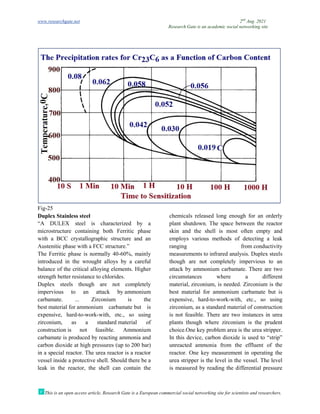
steels have many advantages from a
metallurgical point of view. They can be made
soft enough (i.e., with a yield strength about 200
MPa) to be easily formed by the same tools that
work with carbon steel, but they can also be
made incredibly strong by cold wor
strengths of over 2000 MPa (290 ksi). Their
austenitic (fcc, face-centered cubic) structure is
very tough and ductile down to absolute zero.
They also do not lose their strength at elevated
temperatures as rapidly as ferritic (bcc, body
centered cubic) iron base alloys. The least
Fig-18
However, the risks of these limitations can be
avoidable by taking proper precautions
Alloy Families in Perspective.
The fundamental criterion in the selection of a
stainless steel is generally that it can survive
with virtually no corrosion in the environment in
which it is to be used. Good engineering practice
sometimes requires that materials be selected for
Research Gate is an academic social networking site
This is an open access article, Research Gate is a European commercial social networking site for scientists and researchers.
tic alloys have a face centered cubic
better corrosion resistance
compared to the Ferritic steels. The austenitic
in irons below
to the steel makes the
austenitic phase stable down to room
These alloys are basically
Austenitic stainless
els have many advantages from a
metallurgical point of view. They can be made
soft enough (i.e., with a yield strength about 200
MPa) to be easily formed by the same tools that
work with carbon steel, but they can also be
made incredibly strong by cold work, up to yield
strengths of over 2000 MPa (290 ksi). Their
centered cubic) structure is
very tough and ductile down to absolute zero.
They also do not lose their strength at elevated
temperatures as rapidly as ferritic (bcc, body-
ered cubic) iron base alloys. The least
corrosion-resistant versions can withstand the
normal corrosive attack of the everyday
environment that people experience, while the
most corrosion-resistant grades can even
withstand boiling seawater. If these alloy
to have any relative weaknesses, they would be:
Austenitic stainless steels are less resistant to
cyclic oxidation than are ferritic grades because
their greater thermal expansion coefficient tends
to cause the protective oxide coating to spall.
They can experience stress corrosion cracking
(SCC) if used in an environment to which they
have insufficient corrosion resistance.
fatigue endurance limit is only about 30% of the
tensile strength (vs. ~50 to 60% for Ferritic
stainless steels). This, combined with their high
thermal expansion coefficients, makes them
especially susceptible to thermal fatigue
However, the risks of these limitations can be
avoidable by taking proper precautions
The fundamental criterion in the selection of a
stainless steel is generally that it can survive
with virtually no corrosion in the environment in
which it is to be used. Good engineering practice
s be selected for
sufficient, but finite, service life. This is
especially true for high-temperature service, for
which creep and oxidation lead to limited life for
all materials. The choice among the stainless
steels that can be used in that environment i
then based on the alloy from which the
component can be produced at the lowest cost,
2nd
Aug. 2021
Research Gate is an academic social networking site
This is an open access article, Research Gate is a European commercial social networking site for scientists and researchers.
resistant versions can withstand the
normal corrosive attack of the everyday
environment that people experience, while the
resistant grades can even
withstand boiling seawater. If these alloys were
to have any relative weaknesses, they would be:
Austenitic stainless steels are less resistant to
cyclic oxidation than are ferritic grades because
their greater thermal expansion coefficient tends
to cause the protective oxide coating to spall.
y can experience stress corrosion cracking
(SCC) if used in an environment to which they
have insufficient corrosion resistance. The
fatigue endurance limit is only about 30% of the
tensile strength (vs. ~50 to 60% for Ferritic
bined with their high
thermal expansion coefficients, makes them
especially susceptible to thermal fatigue.
sufficient, but finite, service life. This is
temperature service, for
which creep and oxidation lead to limited life for
all materials. The choice among the stainless
steels that can be used in that environment is
then based on the alloy from which the
component can be produced at the lowest cost,
www.researchgate.net 2nd
Aug. 2021
Research Gate is an academic social networking site
This is an open access article, Research Gate is a European commercial social networking site for scientists and researchers.
including maintenance, over the intended service life. The ferritic stainless
steels are less expensive for the same corrosion
resistance but sometimes are found lacking
because of Lack of toughness, as is the case at
subambient temperatures or in thicknesses
greater than about 1.5 mm. Lack of great
ductility, specifically if more than about 30%
elongation is needed. Susceptibility to high-
temperature embrittling phases when moderately
alloyed.The less-expensive martensitic grades
are used instead of austenitic when high strength
and hardness are better achieved by heat treating
rather than by cold work, and mechanical
properties are more important than corrosion
resistance. This is also the case for the more
expensive PH grades, which can achieve
corrosion resistance only matching the least
corrosion resistant of the austenitic alloys.
Duplex grades match austenitic grades in
corrosion resistance and have higher strength in
the annealed condition but present the designer
with challenges with regard to embrittling
phases that can form with prolonged exposure to
elevated temperatures and only moderate
ductility like the ferritic alloys.So, the austenitic
grades are the most commonly used grades of
stainless mainly because, in many instances,
they provide very predictable levels of corrosion
resistance with excellent mechanical properties.
Using them wisely can save the design engineer
significant costs in his or her product. They are a
user-friendly metal alloy with life-cycle cost of
fully manufactured products lower than many
other materials.
AUSTENETIC STAINLESS STTEEL
(Chemical Requirements)
AISI % C % Mn % Si % Cr % Ni % Mo Others
304 0.08 2 1 18 to 20 8 to 10.5 -
304L 0.03 2 1 18 to 20 8 to 10.5 -
309 0.2 2 1 22 to 24 12 to 15 -
310 0.2 2 1 24 to 26 19 to 22 -
316 0.08 2 1 16 to 18 10 to 14 2 to 3
316L 0.03 2 1 16 to 18 10 to 14 2 to 3
321 0.08 2 1 17 to 19 9 to 12 Ti >5xC
347 0.08 2 1 17 to 19 9 to 12 Nb >5xC
2-RE-69 0.02 1.7 25 22 2.1
0.4 N-0.12
SS-316
(Urea
Grade)
Sanicro-
25
0.1 0.2 22.5 25 Co-1.5,Cu-
3.0,N0.23,Nb-
0.5
Table-4
www.researchgate.net 2nd
Aug. 2021
Research Gate is an academic social networking site
This is an open access article, Research Gate is a European commercial social networking site for scientists and researchers.
Properties of 2-RE-69
Properties Metric Imperial Uses
Tensile strength, ultimate 580 - 780 MPa
84100 - 113000
psi
The 2 RE-69,
used for Urea
Reactor Liner,
Strippers
,Carbamate
Condenser.CO2
and Ammonia
Stripper Tubes
and both dome
top and bottom.
Decomposers and
Tensile strength, yield (@0.2%) 270 MPa 39200 psi
Elongation at break 30% 3%
Modulus of elasticity 195 GPa 28300 ksi
Thermal expansion co-efficient
(@30-100°C/86-212°F) 15.5 µm/m°C 8.61 µin/in°F
Thermal conductivity (@20°C/68°F) 13 W/mK
90.2 BTU
in/hr.ft².°F
Table-5
Chromium is used in these alloys to make the
steel corrosion resistant, whereas nickel
stabilizes the even more corrosion resistant
austenitic structure. Silicon and aluminum are
added to increase the oxidation resistance.
Titanium and niobium, as well as boron,
nitrogen, tungsten, vanadium and cobalt can be
added to increase the creep strength due to
precipitation strengthening. Manganese can
be used to substitute nickel as an austenite
former.
Material for Carbamate Services in Urea Plant
Sr. No. Material Fluid Services
1. Titanium Urea, carbamate Urea Reactor liner, Stripper
2 Zirconium Urea, carbamate Stripper, Urea Reactors Liner
3 2-RE-69 Urea, carbamate Urea Reactor liner, Strippers Carbamate
Condenser
4 SS-316L Urea Carbamate, Carbonate Medium Pressure section, decomposer,
ammonia receiver absorber.
Decomposers.
5 SS-316L(Urea
Grade)
Urea Reactor, heat exchangers
6 SS-304 Urea Carbonate Urea LP section, vacuum section and
waste water section
7 HK-40 High temperature heating,
Natural gas ,steam
Primary reformer
8 Sanicro-25 Phosphoric Acid, Steam Phosphoric fertilizers, Bolier etc
Table-6
Stainless steel 416L (Urea Grade)
The UREA 316L grade is a fully
austenitic stainless steel which ferrite content is
guaranteed less than 0.5% after solution
annealing heat treatment 1120 - 1180°C water
quenched. The UREA 316L grade has been
specially developed for urea plant applications.
It is a 316L modified stainless steel with extra –
low silicon content and substantial higher
molybdenum contents. The low carbon content,
www.researchgate.net 2nd
Aug. 2021
Research Gate is an academic social networking site
This is an open access article, Research Gate is a European commercial social networking site for scientists and researchers.
combined with a well balanced chemistry (low
silicon and nickel content close to 14%) makes
the alloy fully austenitic, free of intermetallic
phase precipitations. The ferrite level is kept
under 0.5% in the solution annealing and water
quenched conditions. The UREA 316L grade is
designed for the fabrication of lining interiors in
urea units for improved corrosion resistance
properties in urea – carbonate environments or
complementary products (pipes, fittings…). The
alloy is not designed for nitric acid application.
Mechanical Properties
Comparison of SS-316L(Mod) and 2-RE-69
Sr.
No.
316L(Modified 2 RE-69
1 Carbon < .02 % : < .02 %
2 Chromium 18 % 24-26
3 Nickel >13 % 21-23 %
4 Molybdenu
m
2-2.6 % 2-2.6 %
5 Manganese 1.5-2 % 1.5-2 %
6 Silicon 0.4 % 0.4 %
7 Sulphur 0.01 % 0.015 %
8 Phosphorus 0.015 % 0.015 %
9 N(Max) 0.10 % 0.1-0.15%
Table-8
Tensile strength: 500-700 N/mm²
Yield strength 0.2% 200 ≥ N/mm²
Elongation: 40/30 ≥ %
Hardness HB30: 215 ≤ HB
Table-7
www.researchgate.net
This is an open access article, Research Gate is a European commercial social networking site for scientists and researchers.
Fig-19
Ferritic Stainless Steel
Ferritic stainless steel has a carbon
0.2% or less. Chromium content 11
.Although it can not be heat treated and has poor
tensile and impact strength, it better corrosion
resistance than martensitic stainless steel.
suitable for use with strong oxidizing acids such
as Nitric acid.
Ferritic steel is a grade of stainless steel alloy
that contains over 12% chromium. It differs
from other forms of stainless steel in two critical
regards: its molecular grain structure and its
chemical composition. Ferritic stainless steel is
actually defined as a straight chromium non
hardenable class of stainless alloys that have
chromium contents ranging from 10.5% to 30%
and a carbon content of less than 0.20%.These
steels are non-hard enable by heat treatment,
only marginally hardenable by cold rolling.
Ferritic stainless grades include.All
stainless steel incorporate chromium, which is
striking for its corrosion resistance, hardness and
extraordinary gloss when polished. Ferritic
are unique in the sense that they typically
Research Gate is an academic social networking site
This is an open access article, Research Gate is a European commercial social networking site for scientists and researchers.
a carbon content of
Chromium content 11-18%
.Although it can not be heat treated and has poor
tensile and impact strength, it better corrosion
resistance than martensitic stainless steel. It is
ong oxidizing acids such
is a grade of stainless steel alloy
that contains over 12% chromium. It differs
from other forms of stainless steel in two critical
regards: its molecular grain structure and its
Ferritic stainless steel is
actually defined as a straight chromium non-
hardenable class of stainless alloys that have
chromium contents ranging from 10.5% to 30%
and a carbon content of less than 0.20%.These
hard enable by heat treatment, and
only marginally hardenable by cold rolling.
All types of
stainless steel incorporate chromium, which is
striking for its corrosion resistance, hardness and
extraordinary gloss when polished. Ferritic steels
are unique in the sense that they typically
contain higher amounts of chromium than other
forms of stainless steel. For example, one of the
most commonly used types of austenitic steel
18/10 stainless — contains 18% chromium
however, it contains no nickel unlike
In contrast, Ferritic stainless steels can contain
chromium levels that are as high as 27%. Not all
types of Ferritic stainless steel contain high
amounts of chromium however; in some cases
they have even less than their auste
equivalents.
One universal difference between ferritic and
austenitic stainless steels is that
steels contain little or no nickel. They share this
trait with martensitic stainless steels, the
majority of which also contain no nicke
ferritic steels are typified by the fact that they
contain hardly any carbon.
The Ferritic Grain Structure
A stainless steels composition plays a large part
in how the metal is structured on a molecular
level. Those structures are actually what give the
various types of stainless steel their names. For
example, Ferritic steels are so called because
2nd
Aug. 2021
Research Gate is an academic social networking site
This is an open access article, Research Gate is a European commercial social networking site for scientists and researchers.
contain higher amounts of chromium than other
For example, one of the
most commonly used types of austenitic steel —
contains 18% chromium —
no nickel unlike austenitic.
stainless steels can contain
chromium levels that are as high as 27%. Not all
stainless steel contain high
amounts of chromium however; in some cases
they have even less than their austenitic
One universal difference between ferritic and
austenitic stainless steels is that Ferritic stainless
steels contain little or no nickel. They share this
trait with martensitic stainless steels, the
majority of which also contain no nickel. Lastly,
ferritic steels are typified by the fact that they
The Ferritic Grain Structure
composition plays a large part
in how the metal is structured on a molecular
re actually what give the
various types of stainless steel their names. For
steels are so called because
www.researchgate.net
This is an open access article, Research Gate is a European commercial social networking site for scientists and researchers.
they are made up of the microstructures known
as ferrite. Ferrite is a metallurgical phase of iron
effectively insoluble. Ferrite is practically absent
in quenched martensitic and austenitic stainless
steels, but its presence is what characterizes
stainless steels. It is also worth noting that
annealed martensitic stainless steels also contain
carbide and ferrite. Without getting too much
deeper into the chemistry of metal formation, it
should be noted that the various alloys of
stainless steel mainly differ in terms of where
the iron atom is located within e
Fig-20
Characteristics of Ferritic Stainless Steel
Strip
There are five important characteristics to be
aware of when considering the performance
of Ferritic stainless steel. Steel with Resistance
to Stress Corrosion Cracking. Stress corrosion
cracking (SCC) is a frequently occurring type of
steel degradation which is triggered by a
combination of a corrosive environment and
tensile stress. Austenitic stainless steels are
especially vulnerable to SCC when exposed to
chlorides. However, the microstructures present
in ferritic steels, afford them a high degree of
Research Gate is an academic social networking site
This is an open access article, Research Gate is a European commercial social networking site for scientists and researchers.
they are made up of the microstructures known
Ferrite is a metallurgical phase of iron
within which metallic alloying ele
solid solution, but carbon is
effectively insoluble. Ferrite is practically absent
in quenched martensitic and austenitic stainless
steels, but its presence is what characterizes
stainless steels. It is also worth noting that
nsitic stainless steels also contain
Without getting too much
deeper into the chemistry of metal formation, it
should be noted that the various alloys of
stainless steel mainly differ in terms of where
the iron atom is located within each grain.
Ferritic steels have a body-centered
structure. Austenitic and other types of stainless
steel, however, possess a face
structure. The body-centered
responsible for Ferritic steel’s magnetic nature;
this differs from all other types of stainless steel.
This distinction lies in the quantum
aspect of the metal's microstructures
the way the electrons are arranged at the core of
the metal's grain
Characteristics of Ferritic Stainless Steel
There are five important characteristics to be
aware of when considering the performance
Steel with Resistance
Stress corrosion
frequently occurring type of
steel degradation which is triggered by a
combination of a corrosive environment and
tensile stress. Austenitic stainless steels are
especially vulnerable to SCC when exposed to
chlorides. However, the microstructures present
in ferritic steels, afford them a high degree of
resistance to SCC, making them a good choice
for use in environments and applications where
chlorides may be present.Stainless Grades
Which Have Good Ductility and
Steel’s hardness comes from ca
also contributes to making steel less ductile and
more brittle. Because Ferritic
carbon levels as low as 0.03% they usually
possess above average ductility. This means that
ferritic steels can be shaped considerably
without risk of weakening.
Ferritic steels’ low carbon content also provides
them with exceptional formability properties,
2nd
Aug. 2021
Research Gate is an academic social networking site
This is an open access article, Research Gate is a European commercial social networking site for scientists and researchers.
within which metallic alloying elements are in a
solid solution, but carbon is
centered-cubic grain
structure. Austenitic and other types of stainless
steel, however, possess a face-centered grain
centered-cubic grain is
steel’s magnetic nature;
differs from all other types of stainless steel.
This distinction lies in the quantum-mechanical
aspect of the metal's microstructures — that is,
the way the electrons are arranged at the core of
resistance to SCC, making them a good choice
for use in environments and applications where
chlorides may be present.Stainless Grades
Which Have Good Ductility and Formability.
hardness comes from carbon, yet carbon
also contributes to making steel less ductile and
Ferritic steel contains
carbon levels as low as 0.03% they usually
possess above average ductility. This means that
ferritic steels can be shaped considerably
Ferritic steels’ low carbon content also provides
them with exceptional formability properties,
www.researchgate.net 2nd
Aug. 2021
Research Gate is an academic social networking site
This is an open access article, Research Gate is a European commercial social networking site for scientists and researchers.
allowing them to be formed into numerous
shapes without having to contend with problems
such as cracking or
necking. The benefits of Ferritic steel's low-
carbon composition do come with certain
compromises though. For example, it is not
possible to harden ferritic steels through heat
treatment. Additionally, some types of Ferritic
steel may display problems when welded, such
as unexpected cracking along the heat-affect
zone.
Types of Stainless Exhibiting Low Thermal
Expansion
Ferritic steels have a naturally low coefficient of
thermal expansion. This can be a real benefit,
and simply means that Ferritic steels will
undergo less expansion as they take on heat.
Because the metal will retain its fixed dimension
more readily, this makes Ferritic stainless steels
well suited to high temperature applications.
Stainless Steels Known to Have High
Thermal Conductivity
Ferritic stainless steels possess outstanding
thermal conductivity attributes, meaning that
heat can move through them efficiently. As a
result, ferritic steels see widespread use in
furnace and boiler heat exchangers, as well as
other applications involving the transfer of heat.
Stainless Steel with High Oxidation
Resistance
Lastly, Ferritic stainless steel is exceptionally
resistant to oxidation, notably at high
temperatures. This resistance is a result of the
formation of a protective chromium-oxide film
on the steel’s surface. It is possible to improve
oxidation resistance even more by including
silicon and/or aluminum when manufacturing
ferritic steel. Ferritic stainless steels are highly
resistant to chloride-induced SCC, but even if
ferritic grades do not crack under such
conditions, their resistance to other types of
corrosion, such as localized corrosion and
uniform corrosion, is determined by a
combination of the alloy composition and the
service environment.
High chromium Ferritic alloys can suffer
from embrittlement under incorrect and
prolonged heat treatment often referred to as
475 °C embrittlement. Even though ferritic
stainless steels exhibit excellent resistance
to stress corrosion in chloride solutions,
sensitization or high temperature embrittlement
at 475 °C leads to cracking of these grades in a
chloride or caustic solution. Another operation
that increases the susceptibility to cracking in
ferritic grades is cold work. Alloying elements in
Ferritic grades identified as causes of SCC
include nitrogen, copper, nickel, and
carbon. Microstructure effects on increasing
cracking properties, are probably related to the
reduction of ductility which occurs where
precipitation of carbides and nitrides occur in
high temperature embrittlement at 475 °C.
Ferritic stainless steels are generally of lower
cost than the austenitic steels and are used when
good cold-formability is required. About half of
the stainless steels produced are rolled to sheet,
which is subsequently cold-drawn into articles
such as cooking utensils, sinks and automotive
trim. Martensitic stainless steels contain more C
than the ferritic and can be heated to form
austenite then cooled with excellent
hardenability to form martensite. They can then
be tempered to yield strengths in the range 550
to 1860 M Pa and can be used for cutting
implements.
Martensitic Stainless Steels-
Martensitic stainless steel has a Carbon.-1.2% or
less. And Chromium.-12-18%.It has better
hardenability and strength than does Ferritic
stainless steel. It is used as cladding to carbon
steel for some process vessels.
Type of Martensite stainless steel
Martensitic steel can further be divided into two
distinct types based on its carbon content.
Low Carbon martensite stainless steel
www.researchgate.net 2nd
Aug. 2021
Research Gate is an academic social networking site
This is an open access article, Research Gate is a European commercial social networking site for scientists and researchers.
Low carbon martensitic steel has a carbon
content between from 0.05% to 0.25%. Low
carbon versions of Martensitic steel are stronger,
provide a higher corrosion resistance, and
enhanced potential for fabrication.
High Carbon Martensite stainless steel
High carbon martensitic steel usually has carbon
content between 0.61% and 1.50%. Increased
carbon content makes the steel stronger because
carbon strengthens the molecular structure.
However, it also makes the metal more brittle
and it cannot be welded or easily formed into
other shapes.
Martensitic grades are especially susceptible to
hydrogen embrittlement in tempered conditions.
This susceptibility to hydrogen embrittlement
can have an adverse effect on any catholic
protection of martensitic stainless steels in
applications such as in seawater. The catholic
protection sets the potential in a risk area, at low
negative potentials, for hydrogen embrittlement
to occur. Another risk scenario for martensitic
stainless steels is grain boundary precipitation
caused by tempering, which leads to an
increased risk of intergranular SCC. The
hardness of the material is often an important
factor in the selection of martensitic stainless
steels, but comes at a cost, since the mechanical
toughness decreases with increasing hardness.
This will also influence the stress levels in the
material, particularly in welded components.
Martensitic SS have a body-centred tetragonal
crystal structure (as Shon in the Figure-21. The
Cr content in martensitic SS varies from 10.5%
to 18%, and the carbon content can be greater
than 1.2%. The amount of Cr and C are adjusted
in such a way that a martensitic structure is
obtained. Several other elements, for example,
tungsten, niobium, and silicon, can be added to
alter the toughness of the martensitic SS. The
addition of small amounts of nickel enhances the
corrosion resistance and toughness, and the
addition of sulfur in this alloy improves the
machinability. They have good mechanical
properties and moderate corrosion resistance,
and they are ferromagnetic. These alloys may be
heat treated, in a similar manner to conventional
steels (e.g., tempering and hardening), to provide
a range of mechanical properties but offer higher
hardenability and have different heat treatment
temperatures.
Fig-21
Their corrosion resistance may be described as
moderate (i.e., their corrosion performance is
www.researchgate.net 2nd
Aug. 2021
Research Gate is an academic social networking site
This is an open access article, Research Gate is a European commercial social networking site for scientists and researchers.
poorer than other stainless steels of the same
chromium and alloy content). These stainless
steels can be hardened and
tempered by heat treatment. Thus they are
capable of developing a wide range of
mechanical properties (i.e., high hardness for
cutting instruments and lower hardness with
increased toughness for load-bearing
applications). Martensitic stainless steels used in
medical devices usually contain up to 1% nickel.
Although there are some martensitic grades with
higher nickel contents, these grades are not
generally used for medical device applications.
For example, applications of martensitic SS
(Fig.22) include bone curettes, chisels and
gouges, dental burs, dental chisels, curettes,
explorers, root elevators, forceps, haemostats,
retractors, orthodontic pliers, and scalpels.
Fig-22
What Is The Difference Between Ferritic,
Austenitic And Martensitic Stainless Steels?
Crystalline Structure Of Stainless Steels. The
vast majority of metals have a crystalline
structure in their solid state, meaning that they
are made up of crystallized lattice structures of
atoms. By definition, all steels, including
stainless steels, are primarily made up of
crystallized iron atoms with the addition of
carbon. The iron in steel can exist in several
different crystalline structures, dependent on the
conditions of its creation. Ferrite, austenite, and
martensite are all examples of iron’s crystal
structures, and all are found within different
types of steel. One of the defining differences
between these crystal structures is the amount of
carbon they can absorb - a greater carbon
content generally, though not always, makes a
steel harder, but more brittle.
www.researchgate.net 2nd
Aug. 2021
Research Gate is an academic social networking site
This is an open access article, Research Gate is a European commercial social networking site for scientists and researchers.
As a liquid, molten iron is not crystalline, and
crystals are only formed when the material
cools. When the material cools, steel solidifies
as individual crystals forming gradually, which
can mean that any one type of steel is actually
made up of several crystal types as the metal
slowly forms crystals through multiple
temperature stages. This means that regardless
of their defining crystal structure, it is not
uncommon for steels to contain small mixed
amounts of ferrite, austenite, and Cementite.
While the information below covers Ferritic,
austenitic, and martensitic steels, almost all of
Accu's stainless steel components have an
austenitic crystalline structure. For more specific
information on exact austenitic steel grades,
please see our article on the many different
grades of austenitic stainless steel.
Ferritic Stainless Steel Austenitic stainless steels
Ferritic steels are made up of ferrite crystals, a form of
iron which contains only a very small amount (up to
0.025%) of carbon. Ferrite absorbs such a small amount
of carbon because of its body centered cubic crystal
structure - one iron atom at each corner, and one in the
middle. This central iron atom is what gives Ferritic
stainless steels their magnetic properties.
Ferritic stainless steels are less widely-used due to their
limited corrosion resistance and average strength and
hardness.
Ferritic stainless steels are classified in the 400 series,
usually with 10% to 30% chromium content, and are
often chosen for their excellent corrosion resistance and
elevated temperature oxidation resistance. With greater
strength than carbon steels, ferritics provide an
advantage in many applications where thinner materials
and reduced weight are necessary, such as automotive
emission control systems. They are non-hardenable by
heat treating and are always magnetic. Typical
applications for ferritic stainless steels include
petrochemical, automotive exhaust systems and trim,
heat exchangers, furnaces, appliances and food
equipment to name a few.
Austenitic stainless steels contain austenite,
a form of iron which can absorb more
carbon than ferrite. Austenite is created by
heating ferrite to 912 degrees C, at which
point it transitions from a body centred
cubic crystal structure to a face centred
cubic crystal structure. Face centred cubic
structures can absorb up to 2% carbon.
When austenite cools, it generally reverts
back to its ferrite form, which makes
austenite difficult to utilize at anything
below the extreme temperatures of a
smelting furnace. Austenite can be forced to
retain its crystal structure at low
temperatures with the inclusion of chemical
additives, such as the nickel and manganese
found in many austenitic stainless steels.
Austenitic stainless steels cannot be
significantly hardened by heat treatment,
but can be hardened by cold working.
Austenitic stainless steels are widely used,
particularly in stainless steel screws, due to
their excellent resistance to corrosion.
www.researchgate.net 2nd
Aug. 2021
Research Gate is an academic social networking site
This is an open access article, Research Gate is a European commercial social networking site for scientists and researchers.
Fig-23
Composition of some Ferritic stainless steels (in wt %)
Type C Mn Si Cr Ni P S Other
405 0.08 1 1 11.5–14.5 – 0.04 0.03 0.01–0.03
Al
430 0.12 1 1 10.5–11.75 – 0.04 0.03
434 0.12 1 1 16 – 0.04 0.03
444 0.12 1 1 17.5–19.5 – 0.04 0.03
1.75–1.25
Mo;
446 0.12 1 1 23–27 – 0.04 0.03
Table-9
Martensite and Austenite. Stability.
The formation of martensite at room
temperature may be thermodynamically
possible, but the driving force for its formation
may be insufficient for it to form spontaneously.
However, since martensite forms from unstable
austenite by a diffusion less shear mechanism, it
can occur if that shear is provided mechanically
by external forces. This happens during
deformation, and the degree to which it occurs
varies with composition.
Md30(0
C)=551-462(%C+%N)
-9.2(%Si)-8.1(%Mn)-13.6(%Cr)
-29(%Ni+Cu)-18.5(%Mo)
-68(%Nb)-1.42(GS-8)----------(Eq-1)
This is the temperature at which 50% of the
austenite transforms to martensite with 30% true
strain . It should be noted that even elements that
are chromium equivalents in promoting ferrite
are austenite stabilizers in that they impede
martensite formation. This temperature is the
common index of austenite stability. This
regression analysis was generated for
homogeneous alloys. If alloys are
inhomogeneous,
Such as occurs when they are sensitized or when
solute segregation occurs, as from welding, then
the equation applies on a microscopic scale.
Sensitized zones (i.e., the regions near grain
boundaries where chromium carbides have
precipitated) will have a much higher tendency
to transform to martensite. Figures 3(a) and (b)
show the changes in phase structure as a
function of composition over ranges that
encompass these alloys. Martensite can be
present in two different forms. The α′-form is the
bcc magnetic form, while ε is a nonmagnetic,
hcp (hexagonal close packed) version. The
formation of ε versus α′ is related to the stacking
fault energy of the alloy.
www.researchgate.net 2nd
Aug. 2021
Research Gate is an academic social networking site
This is an open access article, Research Gate is a European commercial social networking site for scientists and researchers.
Y300
SF(mJM-2
)=Y0
SF+1.59Ni-1.34Mn
+0.06Mn2
-1.75Cr+0.01Cr2
+15.21Mo-5.59Si
-60.69(C+1.2N)1
/2
+26.27(C+1.2N)
(Cr+Mn+Mo)1/2
+0.61[Ni(Cr+Mn)]1/2
……….(eq-2)
Stainless Steels for Design Engineers
Mechanical Properties.
The tensile properties in the annealed state not
surprisingly relate well to composition. The
0.2% yield strength and tensile strength,
respectively, are reported (Ref 10) to follow the
equations:
Yield strength (M.Pa) =15.4[4.4+23(%C) +
32(%N)
+0.24(%Cr)+0.94(%Mo)
+1.3(%Si)+1.2(%V)
+0.29(%W)+0.26(%Nb)
+ 1.7(%Ti)+0.82(%Al)
+0.16(%Ferrite)
+0.46(%d-1/1/2
)…………….(eq-3)
Tensile Strength (M.Pa)= 15.4[29+35(%C) +
55(%N)
+2.4(%Si)+0.11(%Ni)+1.2(Mo)
+5.0(%Nb)+3.0(%Ti)+1.2(%Al)
+0.14(%Ferrite)+0.82(d-
1/2
)……….(eq-4)
In each case, d is the grain diameter in
millimetres. Another research gave the
relationships as:
Yield strength (M.Pa)=120+210√(N+.02)
+2Mn+2Cr
+14Mo+10Cu+(6.15-0.054δ)δ
+7+35(N+0.2)
+14Mo+1.5δ)+δd-1/2
……………..(eq-5)
TS=470+600(N+0.2)+14Mo+1,5δ+8d-
1/2
…………………………………… .(eq-6)
Again, d is grain diameter in millimetres, and δ
is percent ferrite. The claimed accuracy for the
latter set of equations is 20 MPa and is said to
apply to both austenitic and duplex stainless
steels, but clearly the tensile strength
relationship must break down for leaner alloys,
such as 301, in which tensile strength increases
with decreasing alloy content because of the
effect of increasing alloying causing less
transformation to martensite, which inarguably
produces higher tensile strengths in austenitic
stainless steels. Equation 3 must also be favored
over Eq- 5 in that it accounts for carbon
explicitly. One other hardening mechanism is
possible in austenitic stainless steels, and that is
precipitation hardening. Most precipitation-
hardening stainless steels are unstable austenite,
which is transformed to martensite before the
precipitation hardening takes place. One
commercial alloy, A-286, is entirely austenitic
and employs the precipitation within the
austenite matrix of Ni3 (titanium, aluminium)
for strengthening. This is dealt with in a separate
section. Austenitic stainless steels do not have a
clear yield point but can begin to deform at as
little as 40% of the yield strength. As a rule of
thumb, behaviour at less than half the yield
strength is considered fully elastic and stresses
below two thirds of the yield strength produce
negligible plastic deformation. This quasi-elastic
behavior is a consequence of the many active
slip systems in the fcc structure. Even highly
cold worked material exhibits this phenomenon,
although stress-relieving cold-worked material
will cause dislocations to “lock in place” and
form more stable dislocation arrays that break
loose at a higher and distinct yield point. The
tensile properties of austenitic stainless steels
with unstable austenite, that is, those with Md30
temperatures (Eq- 1) near room temperature, are
very strain
www.researchgate.net 2nd
Aug. 2021
Research Gate is an academic social networking site
This is an open access article, Research Gate is a European commercial social networking site for scientists and researchers.
rate dependent. This is simply due to the
influence of adiabatic heating during testing
increasing the stability of the austenite. Tests run
under constant temperature conditions, either by
slow strain rates or use of heat sinks produce
lower tensile strengths. Thus, reported tensile
strengths should not be taken as an absolute
value but a result that can be significantly
changed by changes in testing procedure, even
with accepted norms and standards. Highly cold-
worked austenitic stainless steels are often used
for their robust mechanical properties. Few
metallic materials can match the very high
strengths they can achieve. Very lean 301 can be
cold worked to yield strengths on the order of
2000 MPa because of its unstable austenite
transforming to martensite. When cold worked
to lower degrees, it can provide very high
strength while keeping impressive ductility.
Precipitation of Carbides and Nitrides.
Carbon is normally considered as an undesirable
impurity in austenitic stainless steel. While it
stabilizes the austenite structure, it has a great
thermodynamic affinity for chromium. Because
of this affinity, chromium carbides, M23C6 ,
form whenever carbon reaches levels of
supersatura tion in austenite, and diffusion rates
are sufficient for carbon and chromium to
segregate into precipitates. The solubility of
carbon in austenite is over 0.4% at solidification
but decreases greatly with decreasing
temperature.
www.researchgate.net
This is an open access article, Research Gate is a European commercial social networking site for scientists and researchers.
Fig-24
Log (C ppm)=7771
( )
………….(eq
The equilibrium diagram for carbon in a basic
18%Cr10%Ni alloy is shown in Fig. 7. At room
temperature, very little carbon is soluble in
austenite; even the 0.03% of L grades is mostly
in a supersaturated solution. The absence of
carbides in austenitic stainless is due to the slow
diffusion of carbon and the even slower
diffusion of chromium in austenite. At a carbon
level of 0.06%, which is found in most 304,
super saturation is reached below about 850 °C.
Below this temperature, super
increases exponentially, while diffusion
Research Gate is an academic social networking site
This is an open access article, Research Gate is a European commercial social networking site for scientists and researchers.
………….(eq-7)
The equilibrium diagram for carbon in a basic
18%Cr10%Ni alloy is shown in Fig. 7. At room
temperature, very little carbon is soluble in
austenite; even the 0.03% of L grades is mostly
supersaturated solution. The absence of
carbides in austenitic stainless is due to the slow
diffusion of carbon and the even slower
diffusion of chromium in austenite. At a carbon
level of 0.06%, which is found in most 304,
w about 850 °C.
Below this temperature, super saturation
increases exponentially, while diffusion
decreases exponentially. This results in
precipitation rates that vary with temperature
and carbon level as shown in Figure
these temperatures, grain boundary diffusion is
much more rapid than bulk diffusion, and grain
boundaries provide excellent nucleation sites, so
precipitation occurs along grain boundaries.
And, because carbon diffuses several orders of
magnitude more rapidly than chromium, carbon
diffuses to and combines with chromium
essentially in situ, depleting the grain boundaries
of chromium in solution.
2nd
Aug. 2021
Research Gate is an academic social networking site
This is an open access article, Research Gate is a European commercial social networking site for scientists and researchers.
decreases exponentially. This results in
precipitation rates that vary with temperature
nd carbon level as shown in Figure- 25. At
boundary diffusion is
much more rapid than bulk diffusion, and grain
boundaries provide excellent nucleation sites, so
precipitation occurs along grain boundaries.
And, because carbon diffuses several orders of
magnitude more rapidly than chromium, carbon
diffuses to and combines with chromium
essentially in situ, depleting the grain boundaries
www.researchgate.net
This is an open access article, Research Gate is a European commercial social networking site for scientists and researchers.
Fig-25
Duplex Stainless steel
“A DULEX steel is characterized by a
microstructure containing both Ferrit
with a BCC crystallographic structure and an
Austenitic phase with a FCC structure.”
The Ferritic phase is normally 40-
introduced in the wrought alloys by a careful
balance of the critical alloying elements.
strength better resistance to chlorides
Duplex steels though are not completely
impervious to an attack by
carbamate. ... Zirconium is the
best material for ammonium carbamate
expensive, hard-to-work-with, etc., so using
zirconium, as a standard material of
construction is not feasible.
carbamate is produced by reacting ammonia and
carbon dioxide at high pressures (up to
in a special reactor. The urea reactor is a reactor
vessel inside a protective shell. Should there be a
leak in the reactor, the shell can contain the
Research Gate is an academic social networking site
This is an open access article, Research Gate is a European commercial social networking site for scientists and researchers.
“A DULEX steel is characterized by a
microstructure containing both Ferritic phase
with a BCC crystallographic structure and an
Austenitic phase with a FCC structure.”
-60%, mainly
introduced in the wrought alloys by a careful
balance of the critical alloying elements. Higher
chlorides.
Duplex steels though are not completely
impervious to an attack by ammonium
. ... Zirconium is the
ammonium carbamate but is
with, etc., so using
material of
Ammonium
carbamate is produced by reacting ammonia and
carbon dioxide at high pressures (up to 200 bar)
in a special reactor. The urea reactor is a reactor
vessel inside a protective shell. Should there be a
leak in the reactor, the shell can contain the
chemicals released long enough for an orderly
plant shutdown. The space between the reactor
skin and the shell is most often empty
employs various methods of detecting a leak
ranging
measurements to infrared analysis.
though are not completely impervious to an
attack by ammonium carbamate. There are two
circumstances where a different
material, zirconium, is needed. Zirconium is the
best material for ammonium carbamate but is
expensive, hard-to-work-with, etc., so using
zirconium, as a standard material of construction
is not feasible. There are two instances in urea
plants though where zirconium is the prudent
choice.One key problem area is the urea stripper.
In this device, carbon dioxide is used to “strip”
unreacted ammonia from the effluent of the
reactor. One key measurement in operating the
urea stripper is the level in the vessel. The level
is measured by reading the differential pressure
2nd
Aug. 2021
Research Gate is an academic social networking site
This is an open access article, Research Gate is a European commercial social networking site for scientists and researchers.
chemicals released long enough for an orderly
plant shutdown. The space between the reactor
e shell is most often empty and
employs various methods of detecting a leak
from conductivity
infrared analysis. Duplex steels
though are not completely impervious to an
attack by ammonium carbamate. There are two
e a different
zirconium, is needed. Zirconium is the
best material for ammonium carbamate but is
with, etc., so using
zirconium, as a standard material of construction
is not feasible. There are two instances in urea
s though where zirconium is the prudent
choice.One key problem area is the urea stripper.
In this device, carbon dioxide is used to “strip”
unreacted ammonia from the effluent of the
reactor. One key measurement in operating the
in the vessel. The level
is measured by reading the differential pressure
www.researchgate.net
This is an open access article, Research Gate is a European commercial social networking site for scientists and researchers.
(DP) across the urea stripper. The high
and corrosive fluid in the stripper doesn’t allow
where a thin diaphragm isolates the transmitter
from the process. “Thin” is the problem.
metals have corrosion problems with ammonia
carbamate. The thin pressure seal in the urea
stripper level reading is a weak point. Reactor
vessels, valves, etc. have enough material in
contact with the ammonium carbamate to make
some corrosion tolerable.
Stress Corrosion Cracking
A particular problem for the common austenitic
grades (e.g. 304 and 316) is stress corrosion
cracking (SCC). Like pitting corro
occurs in chloride environments, but
possible for SCC to take place with only traces
of chlorides, so long as the temperature is over
about 60°C, and so long as a tensile stress is
Fig-26
Advantages of Duplex S.S.
Research Gate is an academic social networking site
This is an open access article, Research Gate is a European commercial social networking site for scientists and researchers.
The high-pressure
and corrosive fluid in the stripper doesn’t allow
a direct connection to the differential pressure
transmitter. Instead, we use diaph
where a thin diaphragm isolates the transmitter
from the process. “Thin” is the problem. All
metals have corrosion problems with ammonia
carbamate. The thin pressure seal in the urea
stripper level reading is a weak point. Reactor
es, etc. have enough material in
contact with the ammonium carbamate to make
A particular problem for the common austenitic
grades (e.g. 304 and 316) is stress corrosion
cracking (SCC). Like pitting corrosion this
occurs in chloride environments, but it is
possible for SCC to take place with only traces
of chlorides, so long as the temperature is over
about 60°C, and so long as a tensile stress is
present in the steel, which is very common. The
ferritic grades are virtually immune
from this form of attack, and the duplex grades
are highly resistant. If SCC is likely to be a
problem it would be prudent to specify a grade
from these branches of the stainless family tree.
Practical experience of 41
Compressor intercooler in NFL, India) Tube
leakage was found in 1997, due
Based on practical experience in combination
with laboratory test a stress corrosion cracking
has been compiled to make to make selection
easier .,following fig-26
It shows that even a very small amount (a few
ppm) of chloride may result in cracking of
austenitic grade like 304L and 316L.
2nd
Aug. 2021
Research Gate is an academic social networking site
This is an open access article, Research Gate is a European commercial social networking site for scientists and researchers.
a direct connection to the differential pressure
transmitter. Instead, we use diaphragm seals
is very common. The
ades are virtually immune
from this form of attack, and the duplex grades
are highly resistant. If SCC is likely to be a
prudent to specify a grade
from these branches of the stainless family tree.
Practical experience of 41-E-27(CO2
ompressor intercooler in NFL, India) Tube
, due to SCC.
Based on practical experience in combination
with laboratory test a stress corrosion cracking
has been compiled to make to make selection
hat even a very small amount (a few
ppm) of chloride may result in cracking of
austenitic grade like 304L and 316L.
www.researchgate.net 2nd
Aug. 2021
Research Gate is an academic social networking site
This is an open access article, Research Gate is a European commercial social networking site for scientists and researchers.
Good resistance to “chloride stress corrosion
cracking.”(CSCC).The duplex stainless steel
also offer resistance to general and pitting
corrosion. Good resistance to erosion and
abrasion. There are numerous cases where plant
equipment properly fabricated from duplex SS
has operated with full immunity in chloride
containing environment where types 304,304L,
316,316Lhave failed due to stress corrosion
cracking.
New Development of Duplex
First generation duplex.-The first generation
duplex containing.-
Cr-25 %.
Ni-5 %, and
Mo-1.5 % and Nitrogen ---Nil
There is no Nitrogen. Because Carbon Content
up to 0.2%.There is a considerable loss in
corrosion resistance during welding. Therefore
,a post weld heat treatment is required to assure
good prosperities.
2. Second Generation Duplex Stainless steel
The second generation duplexes have low
carbon levels, assuring resistance to irregular
attack(IGA) The nitrogen contents are usually
more than 0.1%.in addition to improving pitting
and crevice corrosion.
Cr.----25 %,Ni.—5 %, Mo.-1.5 %.N- 0.1%.
3. Third generation Duplex stainless steel
The third generation duplex contains about 0.2%
copper.
Cr.-25 % Ni.-4.0 % Mo-Nil. Cu.-0.2%
“A third generation developed in SWEDON, has
recently been introduced Alloy 2304.” and
SAFUREX.
HVD-1 is also 3rd
generation Duplex S.S. and
developed by Snampogetti(Saipem)(in EJ-1, HP
Pressure ejector)
Safurex (Stamicarbon)
Safurex is jointly developed by SANDVIK &
STAMICARBON and designated Safurex.
can
allow lower Oxygen content for passivation.
Chemical composition of Duplex Stainless
steel
Grade Cr Ni Mo N PRE Microstructure
2 Re 60(UG) 18.5 4.9 2.7 0.07 28 Duplex
SAF 2304 23 4.5 - 0.1 24 Duplex
SAF 2205 22 5.5 3.2 0.18 35 Duplex
25 4 7 0.3 43
SAF2507 Duplex
18
AISI 304L 18.5 10 Austenite
Austenite
AISI 316L 17.5 13 2.1 24
Sanicro-28 27 31 3.5 38 Austenite
Table-10
How to Gauge Resistance to pitting
The resistance of a particular grade of stainless
steel to pitting and crevice corrosion is indicated
by its Pitting Resistance Equivalent number or
PRE, as shown in table. The PRE can be
calculated from the composition as:
PRE = %Cr + 3.3 %Mo + 16 %N
PRE is also known as LCR-Localized Corrosion
Resistance.
Pitting Resistance Equivalent Number or
PRE for Various Grades
www.researchgate.net 2nd
Aug. 2021
Research Gate is an academic social networking site
This is an open access article, Research Gate is a European commercial social networking site for scientists and researchers.
Sr. No. Grade Class PRE
1 3CR12 Ferritic 11
2 430 Ferritic 17
3 303 Austenitic 18*
4 304/L Austenitic 18
5 316/L Austenitic 24
6 2205 Duplex 34
7 904L Austenitic 34
8 S31254 Austenitic 43
9 S32750 Duplex 43
Table-11
Ammonia Plant material of Construction
Primary reformer.
Steam-hydrocarbon reforming, over nickel (Ni)
catalyst, produces H2 and CO by an endothermic
reaction. Tubular furnaces are typically used and
are externally.
fired at 25–35 bar and 780–850°C on the process
side. The reformer tubes function under an
external heat flux of 75,000 W/M2 and are
subject to carburization, oxidation, overheating,
stress corrosion cracking (SCC), suffixation and
thermal cycling. Previously, SS 304, SS 310 and
SS 347 were used as tube materials; however,
these materials developed cracks that very
frequently led to premature tube failures (Table
1). In the mid- ’60s, HK 40 alloy (25Cr/20Ni)
was developed and proved to be a good material
for vertical reformer tubes. Consequently, plant
capacities were extended to 2600 tpd with this
tube material. Although this alloy had a design
service life of 100,000 hrs, overheating
considerably reduced tube life. A 55°C
excursion above the design temperature could
lower tube service life to 1.4 years.
Overheating can be due to flame impingement,
local hot spots, carbon formation or catalyst
bands. Hence, meticulous temperature control by
conscious burner adjustment is needed to
achieve uniform tube-metal temperature. Yet,
tube failure will still occur due to various
reasons—longitudinal cracking from
overheating; weld cracking from lower strength
of the weld compared to the parent alloy and
stresses from thermal cycling during startup,
shutdown and mal operations.
In the ’80s, HP (25Cr/35Ni) modified alloys
were developed and used certain metals, such as,
molybdenum, (Mo), niobium (Nb) or tungsten
(W) (Table -12). These metals increased
resistance to creep rupture and offered good
ductility and weldability. With stronger alloys,
wall thickness of tubes could be reduced.
Thinner tube walls offered benefits such as using
lighter tubes and tube supports, improved heat-
transfer, resistance to thermal cycling and
increased production capacity. Thinner tubes
reduced operating and maintenance costs, and
also extended the service life of the reformer.
Several plants worldwide were revamped with
HP modified tubes in the primary reformers. In
some cases, plant capacity rose by 30% after the
retrofit.
Sr. No. Furnace alloys, Composition, %
Designation Cr Ni C Si Mn Others
1 HK=40 25 20 0.4 1.5 1.5
2 HP25/35(mod) 25 35 0.4 1.5 1.5 Nb-1.5
3 HP Micro 25 35 0.45 1.5 0.7 Nb,W
4 Alloy 800 20 32 0.05 0.35 0.75 Al+Ti 0.7
5 Alloy 800 H 20 32 0.1 0.5 0.75 Al+Ti 0.85
Table-12
www.researchgate.net
This is an open access article, Research Gate is a European commercial social networking site for scientists and researchers.
A more recent development is the HP micro
alloys that are applied during casting with traces
of titanium (Ti), zirconium (Zr) and rare earths.
The micro alloys enhanced carburization
resistance and improved high-temperature creep
rupture resistance (Fig. 27). For reformer outlet
manifolds the normal metallurgy choice is a
wrought type of Alloy 800 H. It has sufficient
Fig-27
Secondary reformer.
In this unit, air is added to the process stream at
operating conditions of 28–30 bar and 957
1,025°C. The refractory-lined vessel has an
outer shell of a low-alloy steel containing 0.5
Mo. A typical phenomenon—metal dusti
occurs in the secondary reformer outlet sections.
Research Gate is an academic social networking site
This is an open access article, Research Gate is a European commercial social networking site for scientists and researchers.
A more recent development is the HP micro
alloys that are applied during casting with traces
of titanium (Ti), zirconium (Zr) and rare earths.
The micro alloys enhanced carburization
temperature creep-
reformer outlet
manifolds the normal metallurgy choice is a
wrought type of Alloy 800 H. It has sufficient
ductility and thermal-stock resistance during
start-up and shutdown. The cast version of Alloy
800 H provides a cost-effectiv
material with a higher creep
low tendency for embrittlement and good
ductility. Hot reformedgas-transfer lines are
usually refractory lined with an interior of Alloy
800 sheathing.
In this unit, air is added to the process stream at
30 bar and 957–
lined vessel has an
alloy steel containing 0.5
metal dusting—
occurs in the secondary reformer outlet sections.
With hot gases containing higher CO content,
strong carburizing reactions occur, and carbon
will diffuse into the Fe-Cr
phenomenon can lead to local mechanical
fracturing of surface layers
failures, by pitting.
2nd
Aug. 2021
Research Gate is an academic social networking site
This is an open access article, Research Gate is a European commercial social networking site for scientists and researchers.
stock resistance during
up and shutdown. The cast version of Alloy
effective, alternate
material with a higher creep-rupture strength,
low tendency for embrittlement and good
transfer lines are
usually refractory lined with an interior of Alloy
With hot gases containing higher CO content,
strong carburizing reactions occur, and carbon
Cr-Ni alloy. This
phenomenon can lead to local mechanical
and, subsequent
failures, by pitting.
www.researchgate.net
This is an open access article, Research Gate is a European commercial social networking site for scientists and researchers.
Material such as SS 304 and Alloy 800 are very
much susceptible to metal dusting (Fig. 6) in the
temperature range of 500–800°C. Besides
temperature, carbon activity (ratio of CO/CO
the gas) and gas partial pressure also affect metal
dusting. Severe attacks occur when the carbon
activity is in the range of 3–10. Recalculating
CO2 into the primary reformer along with
feedstock can maintain a low CO/CO
avoid the severity of this attack. Other mitigation
efforts are maintaining a high oxidizing potential
of the gas (steam/hydrogen ratio) and properly
controlling temperatures.
Hydrogen embrittlement is another important
corrosion problem that is encountered in
reformed-gas pipelines. Usually, the piping
Fig-28
CO Shift Conversion.
The high-temperature converter, where CO in
the gas stream is converted to CO2
shift reaction, operates at 25–28-
and 350–450°C temperature. Usually, low
steel with 1Cr-0.5Mo is used as the material of
CO2 Removal Unit
Research Gate is an academic social networking site
This is an open access article, Research Gate is a European commercial social networking site for scientists and researchers.
Material such as SS 304 and Alloy 800 are very
much susceptible to metal dusting (Fig. 6) in the
800°C. Besides
temperature, carbon activity (ratio of CO/CO2 in
ure also affect metal
dusting. Severe attacks occur when the carbon
10. Recalculating
into the primary reformer along with
feedstock can maintain a low CO/CO2 ratio and
avoid the severity of this attack. Other mitigation
fforts are maintaining a high oxidizing potential
of the gas (steam/hydrogen ratio) and properly
is another important
corrosion problem that is encountered in
gas pipelines. Usually, the piping
material, used downstream of the feed
heaters where the gas temperature is less than
400°C, is a low-alloy steel. Internal
carburization and fissuring of steel is caused by
hydrogen permeating the steel and forming
methane. The formed methane cannot diff
out and accumulates in voids formed at the grain
boundaries. This condition contributes to high
stresses that ultimately fissure and crack the
metal.
The curves (Fig. 28) list the operating limits to
avoid de-carburization and fissuring for steel in
hydrogen service. Consider these conditions
when selecting metallurgy for equipment and
pipelines downstream of the reformed
and the low-temperature converter.
temperature converter, where CO in
by the water-
-bar pressure
450°C temperature. Usually, low-alloy
0.5Mo is used as the material of
construction. In converted gas pipelines, acid gas
(CO2 and H2S) are dissolved in the steam
condensate, and often contribute to corrosion.
This condition can be avoided by using SS 304
material.
2nd
Aug. 2021
Research Gate is an academic social networking site
This is an open access article, Research Gate is a European commercial social networking site for scientists and researchers.
rial, used downstream of the feed-water
heaters where the gas temperature is less than
alloy steel. Internal
carburization and fissuring of steel is caused by
hydrogen permeating the steel and forming
methane. The formed methane cannot diffuse
out and accumulates in voids formed at the grain
boundaries. This condition contributes to high
stresses that ultimately fissure and crack the
the operating limits to
carburization and fissuring for steel in
hydrogen service. Consider these conditions
when selecting metallurgy for equipment and
pipelines downstream of the reformed-gas boiler
temperature converter.
construction. In converted gas pipelines, acid gas
S) are dissolved in the steam
condensate, and often contribute to corrosion.
This condition can be avoided by using SS 304
www.researchgate.net
This is an open access article, Research Gate is a European commercial social networking site for scientists and researchers.
Choosing the metallurgy in the CO
system depends on the solvent used in the
process. SS 304 and SS 316 are the preferred
materials of construction. Carbon steel, fully
stress relieved after metalworking, is also used
for piping and equipment in this section. Iron in
the circulating solution can cause erosion
corrosion in pipeline bends, pump impellers,
pump casings, etc. In plants where amines are
used to absorb CO2, formation of amine
carbamate adducts also contribute to corrosion.
With modern alkanolamines— methyl di
amine (MDEA)— the carbamate adducts are less
heat stable and, thus, do not accumulate in
solution. Additives in the solution render the
carbamate harmless by converting them into
carbonates. In potassium carbonate processes,
arsenic and vanadium salts are used to suppress
corrosion. A passive layer of magnetite on steel
surfaces is maintained by adding small amount
of air. In the CO2-removal system, SCC is
Fig-29
Research Gate is an academic social networking site
This is an open access article, Research Gate is a European commercial social networking site for scientists and researchers.
Choosing the metallurgy in the CO2-removal
system depends on the solvent used in the
process. SS 304 and SS 316 are the preferred
materials of construction. Carbon steel, fully
stress relieved after metalworking, is also used
equipment in this section. Iron in
the circulating solution can cause erosion
corrosion in pipeline bends, pump impellers,
pump casings, etc. In plants where amines are
, formation of amine
carbamate adducts also contribute to corrosion.
methyl di ethanol
the carbamate adducts are less
heat stable and, thus, do not accumulate in
solution. Additives in the solution render the
carbamate harmless by converting them into
ate processes,
arsenic and vanadium salts are used to suppress
corrosion. A passive layer of magnetite on steel
surfaces is maintained by adding small amount
removal system, SCC is
caused by the combined effects of tensile stress
and corrosion. It is a major problem. The caustic
environment for carbon steel and the presence of
chlorides for austenitic stainless steel both
aggravate SCC. This combined action of tensile
stress and corrodant result in either trans
granular or intergranular cracking of the metal or
both. The overall stress corrosion process is
initiated by corrosion damage; these cracks
propagate due to joint electrochemical
mechanical action and ultimately fail. SCC can
be prevented by: better material selection,
reduced stress of the metal by proper heat
treatment, eliminate chloride solutions, remove
oxygen from chloride-containing solutions,
apply corrosion inhibitors, etc. Ferritic and
duplex (austinitic/ferritic) type of stainless steel
show marked resistance to stress co
cracking
2nd
Aug. 2021
Research Gate is an academic social networking site
This is an open access article, Research Gate is a European commercial social networking site for scientists and researchers.
caused by the combined effects of tensile stress
rosion. It is a major problem. The caustic
environment for carbon steel and the presence of
chlorides for austenitic stainless steel both
aggravate SCC. This combined action of tensile
stress and corrodant result in either trans
racking of the metal or
both. The overall stress corrosion process is
initiated by corrosion damage; these cracks
propagate due to joint electrochemical
mechanical action and ultimately fail. SCC can
be prevented by: better material selection,
ss of the metal by proper heat
treatment, eliminate chloride solutions, remove
containing solutions,
apply corrosion inhibitors, etc. Ferritic and
duplex (austinitic/ferritic) type of stainless steel
show marked resistance to stress corrosion
www.researchgate.net 2nd
Aug. 2021
Research Gate is an academic social networking site
This is an open access article, Research Gate is a European commercial social networking site for scientists and researchers.
Waste-heat recovery.
The waste-heat-recovery system is associated
with flue gas from the reformer furnace and
process gas from the secondary reformer. It
generates high pressure steam in specially
designed boilers. These boilers and steam supe
rheaters operate under very high heat flux on the
one side and corrosive water on the other.
Consequently, meticulous care is needed to avert
failures. Proper material selections and stringent
water quality are two proactive loss prevention
methods. Various material grades of SA 213,
ASTM A312, ASTM A335 and ASTM A351
provide useful service life in this section. The
cooler part of the combustion air preheater—the
tail end of the flue-gas-heat-recovery train—
more likely to corrode due to sulfur dioxide
(SO2) condensing from the flue gas. In this area,
cast iron or glass will resist the acid attack.
Carbon steel preheater tubes, joined with 1.5 to 2
m of SS 304 tubes at the cold end of the tube
sheet, can ensure reasonable service life.
Typically, the flue-gas temperature to the stack
is maintained above the dew point of SO2 to
prevent condensation. During startup and
shutdown, condensation of SO2
The high-pressure, feed water heaters are prone
to leaks at the tube-to-tube sheet joints. Lining
or overlaying the tube sheet with material, such
as, Alloy 600 and using tube materials with 1
Cr-0.5 Mo can mitigate this risk considerably.
Ammonia Synthesis.
If the synthesis gas contain traces of carbon
oxides, upon mixing with the NH3 in the
recirculating gas from the synthesis loop,
ammonium carbamate will form, and clog and/or
corrode downstream equipment. To avoid this
condition, consider controlling the carbon oxides
level with fresh makeup gas to less than 5 ppm.
The compressor inter stage coolers are usually
constructed of carbon steel and use water as the
cooling medium. Low-velocity areas in the
water passage are prone to scaling and under-
deposit microbial corrosion. These factors may
lead to tube failures. Improved design of
exchangers can eliminate low-velocity areas;
proper cooling-water treatment program can
control under-deposit microbial corrosion.
Fig-30
www.researchgate.net 2nd
Aug. 2021
Research Gate is an academic social networking site
This is an open access article, Research Gate is a European commercial social networking site for scientists and researchers.
Startup heaters
Electrical or direct-fired types—are used to heat
synthesis gas for the converter during startup.
Hydrogen-induced tracks, overheating and flame
impingement, thinning at the bends, furnace
explosions, etc., are several problems
encountered with this equipment piece.
Normally, SS 321 is used for startup heater coils
and downstream pipeline. The ammonia-
synthesis converter operates at 150–200 bar
pressure and around 515°C. Under these service
conditions, nitriding and hydrogen
embrittlement can occur. The pressure shell is a
multi-layer or multi-wall carbon steel vessel.
The internal catalyst baskets, contained in the
shell, are constructed from SS 321 material.
Nitriding of pipes and catalyst-support grids are
encountered in ammonia plants. The nitriding
effect is more pronounced in low-alloy steels
above 450°C; austenitic steels with a high-Ni
content offer considerable more resistance.
Alloys of the Cr-Ni-Mo-type— containing 12–
25% Cr, 5–25% Ni, Mo, vanadium (V) and W—
are usually used for the gas side. SA 213, T22
material—2.25 Cr-1Mo type or their improved
versions—are used for the boiler. Due to the
high pressure and temperature in the reactor,
atomic hydrogen is absorbed by diffusion; the
subsequent reaction with carbon in the steel
results in blistering and cracking from
decarburization.
www.researchgate.net 2nd
Aug. 2021
Research Gate is an academic social networking site
This is an open access article, Research Gate is a European commercial social networking site for scientists and researchers.
Fig-31
Ammonia storage.
Carbon steel, such as, BS1515, BS1511-213,
ASTM A516, etc., are the conventional
construction materials for ammonia storage—
bullet, Hortonsphere or atmospheric storage. For
refrigerated (atmospheric) storage, low-
temperature carbon steel is used. A major
problem encountered in the storage and transport
of anhydrous liquid ammonia is SCC of carbon
steel equipment. Cracks occur mostly at weld
joints where the left over stress is the greatest.
The hardness of the material and presence of
www.researchgate.net
This is an open access article, Research Gate is a European commercial social networking site for scientists and researchers.
impurities and oxygenates in NH3 aggravate
SCC. Complete stresses relief, operating without
and adding small quantities of water (0.2%) as
an inhibitor can effectively mitigate SCC.
Fig-32
carbon steels; it is the preferred construction
material for large atmospheric liquid NH
storage tanks, operating at –33°C.
Primary Reformer Tubes
The reformer contains about 200
made off chromium nickel steel, 10
long, with an inner diameter of 75-140
wall thickness of 11-18 mm . Under the severe
conditions taking place in the reformer the tubes
start to creep and rupture. Determining factors
for such deformation are the internal pressure
and the tube-wall temperature. Figure shows the
stress to rupture of different materials. To avoid
tube rupture, lower pressures are employed,
leading to higher power use for compression in
ammonia synthesis. The reaction in the reformer
is endothermic and proceeds with an increase in
volume. To compensate for the lower conversion
Research Gate is an academic social networking site
This is an open access article, Research Gate is a European commercial social networking site for scientists and researchers.
impurities and oxygenates in NH3 aggravate
SCC. Complete stresses relief, operating without
air contact
and adding small quantities of water (0.2%) as
an inhibitor can effectively mitigate SCC. Low-
temperature carbon steels have considerable
more resistance to SCC than normal.
carbon steels; it is the preferred construction
material for large atmospheric liquid NH3
The reformer contains about 200-400 tubes
made off chromium nickel steel, 10-13 meters
140 mm and a
18 mm . Under the severe
conditions taking place in the reformer the tubes
art to creep and rupture. Determining factors
for such deformation are the internal pressure
wall temperature. Figure shows the
stress to rupture of different materials. To avoid
tube rupture, lower pressures are employed,
wer use for compression in
ammonia synthesis. The reaction in the reformer
is endothermic and proceeds with an increase in
volume. To compensate for the lower conversion
rate due to the increased pressure the reaction
temperature needs to increase.
material for many years was the HK 40. The HP
modified (1.5% Nb) material, due to its
improved temperature properties (40 bar
reforming pressure at a tube wall temperature of
900o
C), has been used in many tube
replacements and tubes in new plants . T
of micro alloys containing Ti and
improvement (see Figure). Their use permits the
reduction of tube-wall thickness while
maintaining the same tube lifetime (100,000
hours). By installing tubes with smaller wall
thickness and/or wider diameter the capacity of
the front end of an ammonia plant can be
increased. The use of micro alloyed tubes with
minimum wall thickness can increase the
catalyst volume, increase firing and lower the
pressures drop. According to Fertilizer
2nd
Aug. 2021
Research Gate is an academic social networking site
This is an open access article, Research Gate is a European commercial social networking site for scientists and researchers.
air contact
temperature carbon steels have considerable
more resistance to SCC than normal.
rate due to the increased pressure the reaction
temperature needs to increase. The standard
material for many years was the HK 40. The HP
modified (1.5% Nb) material, due to its
improved temperature properties (40 bar
reforming pressure at a tube wall temperature of
C), has been used in many tube
replacements and tubes in new plants . The use
of micro alloys containing Ti and Zr are another
improvement (see Figure). Their use permits the
wall thickness while
maintaining the same tube lifetime (100,000
hours). By installing tubes with smaller wall
diameter the capacity of
the front end of an ammonia plant can be
increased. The use of micro alloyed tubes with
minimum wall thickness can increase the
catalyst volume, increase firing and lower the
pressures drop. According to Fertilizer
www.researchgate.net 2nd
Aug. 2021
Research Gate is an academic social networking site
This is an open access article, Research Gate is a European commercial social networking site for scientists and researchers.
Association of India, with the new
improvements in materials it is possible to
increase the life time of the reformer tubes (by
up to 20 000 hours) and have higher tube-wall
temperatures (up to 906 o
C).
Fig-33
Huey Test
“Metal sample is boiled in 65% HNO3 for 48 Hrs (5 times) to estimate corrosion rate”
Corrosion Rate
Sr. No. Material Corrosion Rate(mm/year)
1 Zirconium(Zr) 0.005
2 Titanium 0.06
3 2-RE-69(25/22/2) 0.3
4 316 L(mod) 0.6
Table-13
Using Improved Materials for Reformer
Tubes
The reformer contains about 250-450 tubes
made off chromium nickel steel, 10-13 meters
long, with an inner diameter of 75-140 mm and a
wall thickness of 11-18mm . Under the severe
conditions taking place in the reformer the tubes
start to creep and rupture. Determining factors
for such deformation are the internal pressure
and the tube-wall temperature. Figure-34 shows
the stress to rupture of different materials. To
avoid tube rupture, lower pressures are
employed, leading to higher power use for
compression in ammonia synthesis. The reaction
in the reformer is endothermic and proceeds
with an increase in volume. To compensate for
the lower conversion rate due to the increased
pressure the reaction temperature needs to
increase. However, tube materials limit the
allowable increase in temperature.
The standard material for many years was the
HK 40. The HP modified (1.5% Nb) material,
due to its improved temperature properties (40
bar reforming pressure at a tube wall
www.researchgate.net 2nd
Aug. 2021
Research Gate is an academic social networking site
This is an open access article, Research Gate is a European commercial social networking site for scientists and researchers.
temperature of 900o
C), has been used in many
tube replacements and tubes in new plants . The
use of micro alloys containing Ti and Zr are
another improvement (see Figure-34 ). Their use
permits the reduction of tube-wall thickness
while
maintaining the same tube lifetime (100,000
hours). By installing tubes with smaller wall
thickness and/or wider diameter the capacity of
the front end of an ammonia plant can be
increased
.
Fig-34
The use of micro alloyed tubes with minimum
wall thickness can increase the catalyst volume,
increase firing and lower the pressures drop.
According to Fertilizer Association of India,
with the new improvements in materials it is
possible to increase the life time of the reformer
tubes (by up to 20 000 hours) and have higher
tube-wall temperatures (up to 906 o
C)
www.researchgate.net
This is an open access article, Research Gate is a European commercial social networking site for scientists and researchers.
Fig-35
Creep in Reformer Tubes
 If a load below metal’s tensile strength
is applied at room temperature, it will
cause some initial elongation
 But if the load is constant, there will be
no further measurable elongation
 If the same load is applied to a metal at a
high temperature, the situation changes
 Although the load is at a constant level,
the metal will gradually continue to
elongate
This characteristic is called CREEP
Tube failure mechanism due to creep.
illustrates the stages of creep damage
Research Gate is an academic social networking site
This is an open access article, Research Gate is a European commercial social networking site for scientists and researchers.
If a load below metal’s tensile strength
is applied at room temperature, it will
cause some initial elongation
But if the load is constant, there will be
no further measurable elongation
If the same load is applied to a metal at a
high temperature, the situation changes
Although the load is at a constant level,
lly continue to
CREEP.
Tube failure mechanism due to creep. Fig – 36
illustrates the stages of creep damage
mechanism, which can be divided into three
stages
Stage (I) : primary creep stage, No significant
cavity nor voids
Stage (II) : secondary creep stage, where
isolated cavities occurs at the grain boundary,
and at the end of this stage these cavities start to
settle in the oriented boundaries.
Stage (III): Tertiary creep stage, the oriented
cavities combine and form micro cracks. These
micro cracks form macro cracks at the end of the
stage.
2nd
Aug. 2021
Research Gate is an academic social networking site
This is an open access article, Research Gate is a European commercial social networking site for scientists and researchers.
mechanism, which can be divided into three
primary creep stage, No significant
: secondary creep stage, where
isolated cavities occurs at the grain boundary,
and at the end of this stage these cavities start to
settle in the oriented boundaries.
creep stage, the oriented
cavities combine and form micro cracks. These
micro cracks form macro cracks at the end of the
www.researchgate.net
This is an open access article, Research Gate is a European commercial social networking site for scientists and researchers.
Fig-36
Post service examination of Alloy HV 48%Ni,
28% Cr
Creep rupture testing represents th
method to determine the remaining tube life. The
Test had conducted this test to develop a specific
criteria for tube replacement, regardless the
general criteria that has been developed by
others. Results of the conducted test is illustrated
on fig-38
The resulted curve of the accelerated creep test
matches with the standard creep curve. The three
distinct stages of the creep are characterised with
the following:
1. Primary creep includes elastic and
plastic deformation continues up a strain
of 0.02.
2. Secondary creep, includes only the
plastic deformation continues up to a
strain of 0.0675
Research Gate is an academic social networking site
This is an open access article, Research Gate is a European commercial social networking site for scientists and researchers.
Post service examination of Alloy HV 48%Ni,
Creep rupture testing represents the popular
e the remaining tube life. The
had conducted this test to develop a specific
criteria for tube replacement, regardless the
general criteria that has been developed by
others. Results of the conducted test is illustrated
The resulted curve of the accelerated creep test
matches with the standard creep curve. The three
distinct stages of the creep are characterised with
Primary creep includes elastic and
plastic deformation continues up a strain
Secondary creep, includes only the
plastic deformation continues up to a
Based on the remaining life of reformer tubes at
the end of creep secondary stage
1 ~3 years test has set strain criteria of 0.0675 as
the maximum limit to start procurement of a new
set of reformer tubes. Based on that remaining
lifetime of the tube is calculated using the
following equation.
𝑅𝑒𝑚𝑎𝑖𝑛𝑖𝑛𝑔 𝑇𝑖𝑚𝑒(𝑡)
=
0.0675 − 𝑃𝑟𝑒𝑠𝑒𝑛𝑡 𝑆𝑡𝑟𝑎𝑖𝑛
Actual Creep
Using the creep elongation measurement the
question can be expressed as follows
𝑅𝑒𝑚𝑎𝑖𝑛𝑖𝑛𝑔 𝑇𝑖𝑚𝑒(𝑡)
=
550 𝑚𝑚 − 𝑃𝑟𝑒𝑠𝑒𝑛𝑡 𝑒𝑙𝑜𝑛𝑔𝑎𝑡𝑖𝑜𝑛
Actual Creep alongation
Creep elongation measurement
Figure-37 illustrates the cr
measurements since start up of reformer tube,
alloy Hv. upper part- HP-Nb for the lower part.
2nd
Aug. 2021
Research Gate is an academic social networking site
This is an open access article, Research Gate is a European commercial social networking site for scientists and researchers.
Based on the remaining life of reformer tubes at
the end of creep secondary stage is ranging from
n criteria of 0.0675 as
limit to start procurement of a new
set of reformer tubes. Based on that remaining
lifetime of the tube is calculated using the
𝑆𝑡𝑟𝑎𝑖𝑛 𝑉𝑎𝑙𝑢𝑒
Rate
creep elongation measurement the
question can be expressed as follows
𝑒𝑙𝑜𝑛𝑔𝑎𝑡𝑖𝑜𝑛 𝑚𝑒𝑎𝑠𝑢𝑟𝑚𝑒𝑛𝑡
alongation Rate
Creep elongation measurement
the creep elongation
measurements since start up of reformer tube,
Nb for the lower part.
www.researchgate.net
This is an open access article, Research Gate is a European commercial social networking site for scientists and researchers.
Fig-37(Creep alongation Measurment)
Fig- 38 (Pattern of Creep Behavior actual
From Experiment –It is clear that tubes are
about to reach the end of the secondary creep
stage. Creep elongation rate is about 40
mm/year. Which simply means by the end of
2004 the tertiary creep stage starts.
Research Gate is an academic social networking site
This is an open access article, Research Gate is a European commercial social networking site for scientists and researchers.
(Creep alongation Measurment)
Behavior actual test temperature 10000
C)
that tubes are
about to reach the end of the secondary creep
stage. Creep elongation rate is about 40
mm/year. Which simply means by the end of
However six
tubes developed cracks starting f
after elongation limit. Tubes may work with
higher elongation but the as per experts another
problems with feed gas hoses that ID directly
2nd
Aug. 2021
Research Gate is an academic social networking site
This is an open access article, Research Gate is a European commercial social networking site for scientists and researchers.
tubes developed cracks starting from year 2002,
after elongation limit. Tubes may work with
higher elongation but the as per experts another
problems with feed gas hoses that ID directly
www.researchgate.net
This is an open access article, Research Gate is a European commercial social networking site for scientists and researchers.
elongation of the tubes.The matter that led to
earlier replacement of the reformer tubes.
Measurement of creep elongation is the most
practical way to monitor the board tube life. A
criteria of 550 mm can be used a limit to start
15% circumferential growth of the upper part
can be used as a limit for tube replacement. Post
service examination, if possible, will give more
accurate estimation about the remaining
the tubes. .Controlling the operation of reformer
in a good manner, especially reducing the
upsetting conditions helps in extending the tube
life.
Fig-39
Research Gate is an academic social networking site
This is an open access article, Research Gate is a European commercial social networking site for scientists and researchers.
elongation of the tubes.The matter that led to
earlier replacement of the reformer tubes.
t of creep elongation is the most
practical way to monitor the board tube life. A
criteria of 550 mm can be used a limit to start
procurement of new set of reformer tubes for the
alloy of HV on the upper part of tube.
Measurement of circumferential growth
important to have accurate estimation of tube
life.
15% circumferential growth of the upper part
can be used as a limit for tube replacement. Post
service examination, if possible, will give more
accurate estimation about the remaining life to
the tubes. .Controlling the operation of reformer
in a good manner, especially reducing the
upsetting conditions helps in extending the tube
A more recent development is the HP micro
alloys that are applied during casting with traces
of titanium (Ti), zirconium (Zr) and rare earths.
The micro alloys enhanced carburization
resistance and improved high-temperature creep
rupture resistance (Fig. 39).
2nd
Aug. 2021
Research Gate is an academic social networking site
This is an open access article, Research Gate is a European commercial social networking site for scientists and researchers.
procurement of new set of reformer tubes for the
alloy of HV on the upper part of tube.
Measurement of circumferential growth is
important to have accurate estimation of tube
A more recent development is the HP micro
alloys that are applied during casting with traces
nium (Ti), zirconium (Zr) and rare earths.
The micro alloys enhanced carburization
temperature creep-
www.researchgate.net 2nd
Aug. 2021
Research Gate is an academic social networking site
This is an open access article, Research Gate is a European commercial social networking site for scientists and researchers.
Effects of metal additions in Reformer tubes
Carbon- Stabilizes FCC matrix & provides
creep rupture strength.
Chromium- provides Oxidation resistance.
Nickel- maintains the austenitic stability of the
metal & also reduces the coefficient of thermal
expansion making the metal more resistance to
thermal fatigue.
Niobium -Contributes to carbide precipitation
which is both fines & more stable.
Tungsten & Zirconium -helps to form more
stable protective oxide films on the surface of
the tube bores, produce carbides which are more
stable at higher temp. giving extended creep
resistance.
Silicon- improves oxidation resistance & also
reduces the depth of carbon penetration
Corrosion
MDEA solvent is considered non-corrosive; no
addition of anticorrosion chemicals is
necessary. However, corrosion of carbon steel
parts may occur if the total amine content
reaches a very low level, since the pH value of
the solvent, when loaded with CO2, can be very
low. Classic stress corrosion cracking (SCC) of
stainless steel caused by chlorides in the solvent
may also occur. These two scenarios are,
however, rare and have not previously been seen
in a MDEA plants. Erosion corrosion may be
seen in carbon steel parts due to high liquid
velocities or flashing liquids. This phenomenon
can occur especially at pipe bends or spots
where the pressure of the liquid is greatly
reduced. This has been taken into account in the
design; if the recommended operating
instructions are followed, no such problems
should occur. An analysis of the solvent will
reveal corrosion, as it will show abnormally high
figures for the Fe, Cr and/or Ni content in the
solvent.
Carburization phenomenon in two tubular
materials made from Fe –Cr –Ni-based HK40
alloy has been investigated after a service life of
approximately 25,000 h in an ethylene pyrolysis
furnace and compared with the original as-cast
structure. One of the materials involved unique
micro structural features associated with a macro
crack in the tube wall. In this material, M23C6
eutectoid carbides of the as-cast condition were
observed to have coarsened and transformed into
M7C3 carbides with a heavily faulted structure.
This carbide transition was observed to have
occurred via an in-situ mechanism and also
resulted in g precipitation in M7C3. The second
material that presumably had been exposed to
less severe service conditions displayed only
coarse M23C6 type carbides. Chemical
compositions of the micro structural constituents
have been obtained via microanalysis and the
distribution of the alloying elements among the
present phases by using X-ray mapping.
Carburization in Fe –Cr –Ni-based alloys is an
important phenomenon, especially in pyrolysis
tubes that serve at high temperatures under
highly carburizing and oxidizing environments.
Hydrocarbon compounds mixed with steam pass
through these tubes, externally heated with
burners, to be decomposed at high temperatures,
thus, exposing the material to oxidizing and
carburizing environment during service. Various
characteristics of the relevant processes and
materials used in petrochemical industry and
refinery furnaces.
The microstructure of these centrifugally cast
tubular materials consists of dentritic grains
aligned in the direction of tube diameter and a
protective oxide scale is usually present on the
inner and outer surfaces. Chromia and silica
scales that can form due to the composition of
pyrolysis tubes and the high enough oxygen
partial pressures of service conditions, and
alumina, which can form in other high
temperature alloys of comparable class, are
known to prohibit carbon penetration into these
materials. However, localized failure of these
otherwise protective scales, allowing for ingress
of carbon and oxygen, can occur by spalling due
to various reasons, such as temperature changes
www.researchgate.net
This is an open access article, Research Gate is a European commercial social networking site for scientists and researchers.
and creep. Analysis of microstructure using
optical and scanning electron
showed that the alloys contained relatively large
amount of Cr-carbide, Nb-compound, and MnS
at the austenite grain boundary. The addition of
W promoted the formation of Cr
affected the high-temperature mechanical
properties.
trips, based on process gas temperatures within
the catalyst tubes, preventing potential injury to
plant personnel and costly reformer damage.
Tube temperature profile measurement leading
to more accurate prediction of the operating
Fig-40
Improved understanding of catalyst parameters
for an enhanced understanding of catalyst
performance and change out scheduling.
Monitoring real reformer tube outlet tempe
to determine actual pigtail temperatures leading
Research Gate is an academic social networking site
This is an open access article, Research Gate is a European commercial social networking site for scientists and researchers.
Analysis of microstructure using
nning electron microscopes
showed that the alloys contained relatively large
compound, and MnS
at the austenite grain boundary. The addition of
W promoted the formation of Cr-carbide and
temperature mechanical
In-line monitoring (as shown in Fig.
shown that the Cat Tracker temperature probe
can be used as the leading indicator to the
temperature in the reformer tubes. This provides
continuous monitoring of the in
temperature profile, with the profile available in
real time through the plant DCS.
trips, based on process gas temperatures within
the catalyst tubes, preventing potential injury to
el and costly reformer damage.
Tube temperature profile measurement leading
to more accurate prediction of the operating
proximity of the catalyst to the carbon formation
zone, thus allowing operation whi
carbon formation. Operation of the reformer at
lower steam to carbon ratios without the risk of
carbon formation.
Improved understanding of catalyst parameters
for an enhanced understanding of catalyst
nce and change out scheduling.
Monitoring real reformer tube outlet temperature
to determine actual pigtail temperatures leading
to a reduction in pigtail failures.
of catalyst poisoning.
Cat Tracker
The catalyst temperature tracking system
patented by daily. The metrics was first
2nd
Aug. 2021
Research Gate is an academic social networking site
This is an open access article, Research Gate is a European commercial social networking site for scientists and researchers.
as shown in Fig.-40 ) has
Tracker temperature probe
can be used as the leading indicator to the
temperature in the reformer tubes. This provides
continuous monitoring of the in-tube
ure profile, with the profile available in
al time through the plant DCS. Interlocks or
proximity of the catalyst to the carbon formation
zone, thus allowing operation whilst avoiding
Operation of the reformer at
ratios without the risk of
eduction in pigtail failures. Early detection
The catalyst temperature tracking system
The metrics was first
www.researchgate.net 2nd
Aug. 2021
Research Gate is an academic social networking site
This is an open access article, Research Gate is a European commercial social networking site for scientists and researchers.
introduced commercially in 2001. It is now a
proven technology with over 500 installations
across five continents profiling hundreds of
vessels. With 25 000 sensing points it has shown
superior operational service. At present there are
33 systems installed in a range of synthesis gas
plants, which will increase to 81 installations
this year(2021).The Cat Tracker employing
patented aerospace thermocouple technology,
offers the Syngas industry the most rugged yet
flexible temperature probes designed to be in
direct
contact with the process. Its temperature sensors
are engineered to withstand the harshest
environments and the most strenuous
temperature demands making them highly
suitable for installation in a reformer.
Failure of Reformer Tubes at Ammonia Plant
The ammonia plant restart after a trip without
incident until process gas was introduced.
Burners were lit as per standard sequence
procedure to match 750
C/hr rate, process gas
temperature outlet the reformer tubes. During
this period there was adequate process steam
flow through the reformer tubes as indicated by
the flow meter @ 20 TPH. Approximately 40
minutes into the startup process, with 50% of the
burners lit, process gas was introduced to the
reformer. After process gas flow was started, it
was impossible to properly control furnace draft
and reformer temperatures continued to increase
rapidly. For next 30 minutes operators struggled
to maintain the furnace parameters. Process gas
and reformer fuel gas flows were stopped at
18:46. The reformer outlet (process gas side)
temperature went to a high of 927 C and the
mixed feed temperature to the reformer
exceeded the 737 C temperature scale. The
tunnel temperatures (flue gas side) exceeded
10000
C temperature scale. The reformer was
observed to be very hot, and some of the tubes
were fractured. Most of these temperature
risings took place very rapidly in the time scale
of 5-10 minutes. The plant was secured and
cooled down overnight. There were no injuries
and no environmental releases.
Plant Shut Down
The root cause for the initial tube failure(s) is
not fully understood. The number of tubes that
initially failed is not known. We can certainly
explain why many tubes failed subsequently
following process gas introduction. However,
the only explanation that can be theorised for the
initial failure(s) is ‘thermal shock’ of the tubes in
the tunnel area during reintroduction of steam,
following the trip out. As evidenced by the rapid
drop in temperature, 25 minutes after steam
reintroduction. Another possible factor is the
large amount of residual radiant heat in the brick
tunnel sections can keep the tube walls locally
hot in those sections, and a sudden
reintroduction of steam flow might give a shock
in those areas, causing them to develop cracks.
New Trip Initiators Installed
Following the above incident investigation, two
additional trip initiators were added to the
primary reformer trip logic – Extra High
Temperature (process gas exit primary reformer
– 2 out of 4 voting), Extra High Temperature
(Mixed Feed Coil outlet, feed to primary
reformer, 1 out of 2 voting).
Some operator actions could have prevented a
large scale destruction of the tubes, and
minimized the extent of damage. A
companywide detailed review of reformer
operating practices was undertaken following
this incident. A ‘Best Operating Practices’
document was developed and a series of
changes/modifications were implemented to
prevent such incidents in the future. Only a
visual check by field operators can tell what is
going on inside the box. Furnace box should be
protected from water incursions. Tubes reheat
from walls especially from tunnel bricks. Check
full length of tube just before adding steam.
Overheated tubes have either failed suddenly or
have lost life from local overheating. As a
www.researchgate.net 2nd
Aug. 2021
Research Gate is an academic social networking site
This is an open access article, Research Gate is a European commercial social networking site for scientists and researchers.
preventive action, on loss of steam flow, visually
check that tubes are black before steam is
reintroduced. Tubes can overheat quickly on lost
flow. Black tubes indicate temperatures are low
enough to reintroduce steam without shattering
or snapping. One can use a pyrometer or infrared
gun to check tube skin temperatures.
Fig-41
www.researchgate.net 2nd
Aug. 2021
Research Gate is an academic social networking site
This is an open access article, Research Gate is a European commercial social networking site for scientists and researchers.
Fig-42
Fig-43
www.researchgate.net 2nd
Aug. 2021
Research Gate is an academic social networking site
This is an open access article, Research Gate is a European commercial social networking site for scientists and researchers.
Fig-44
CORROSION IN FERTILIZERS PLANTS
Corrosion is defined as deterioration of metals
by direct chemical or electro-chemical action.
The extent of corrosion is accelerated by other
environmental factors such as pressure,
temperature, heat and time,
electrochemical reaction, velocity of circulation
etc. Hence corrosion can be said to be a
physicochemical phenomena. Certain metals like
gold, silver and platinum have very good
corrosion resistant properties and are called
“Noble” metals. Most types of corrosion have an
electrochemical basis. The metal which is
corroded loses electrons and oxidised while the
corrosion causing material gains electrons and
reduced. This can be better understood by taking
example of iron. When it comes in contact with
hydrochloric acid, iron is invariably dissolved
and forms a compound. The mechanism of the
reaction is given in the form of equation.
Fe → Fe++ + 2 e-
2 H2 + 2e-
→H2 (Gas)
The iron is oxidised by loosing two electrons
while two hydrogen ions attract two electrons
forming molecular hydrogen. Ferrous ions react
immediately with two chloride ions forming
ferrous chloride. Thus iron is corroded by
oxidation and corrodent is subjected to
reduction. All corrosion phenomena are the
combination of two reactions. Oxidation and
reduction takes place on the metal surface
whenever it is exposed to corroding
environment. The area on the metal surface
where oxidation takes place, is called anode and
the area where corrodent is reduced known as
cathode. A complete electrical circuit comes into
existence between the cathode and anode and
current flows between them. The rate of
corrosion is proportional to the current flowing
between the electrons. The potential different
between the cathode and anode is called “Redox
potential
The total potential difference between the two
electrodes can be considered as the combination
www.researchgate.net 2nd
Aug. 2021
Research Gate is an academic social networking site
This is an open access article, Research Gate is a European commercial social networking site for scientists and researchers.
of two half potentials. The half cell potential
depends upon the concentration of the
electrolytes. The standard half cell potential
defined as the potential existing when the
concentration of the ions is one gm per litre. The
half cell potential of various system can be
estimated by coupling with standard electrodes
like hydrogen electrode or calomel electrode.
The action between different metals is called
galvanic because they form a galvanic couple (
two metals ). Corrosion current flowing between
two points on the same metal surface are “Local
“. But whether the current is due to local or
galvanic action, it will need to understand how it
originated before the correct preventive measure
is decided. The galvanic series is given below :-
Sr. No. Anodic corroded end Muntz metal
1 Magnesium Brasses
2 Magnesium alloys Copper
3 Zinc Bronzes
4 Aluminium Copper - Nickel alloys
5 Cadmium Nickel
6 Alloy steels Inconel
7 Wrought iron Stainless steel ( Pass. )
8 Cast iron Titanium
9 Stainless steel ( Active ) Silver
10 Ni - Resist Graphite
11 Soft solders Gold
12 Lead Platinum
13 Tin Cathodic protected end
Table-14
Metals near the top of this series act as anodes,
suffer corrosion when coupled with one nearer
the bottom. Galvanic couples of metals close
together in this series usually corrode more
slowly than couples composed of metals from
the extremes. Note that certain metals are
grouped together. Couples of metals within these
groups have the least tendency to corrode.
As corrosion products build up at anodes and
cathodes, the voltage differences tend to dip.
Anode and cathode voltages drift towards each
other showing down corrosion rate. This voltage
change is called polarization. Polarizing at the
cathode is usually greater than at the anode, so it
is more likely to be concerned with it’s cathodic
effect. Hydrogen gas, for example can blanket
the cathode surface cutting corrosion at the
anode. But hydrogen may soon be removed by
combining with the oxygen to form water. Urea
manufacture poses very complex metallurgical
problems. Corrosion has been the biggest
problem plaguing most of the urea plants in
many installation. The onstream efficiency of
urea plant has been poor due to frequent
breakdowns caused by corrosion. This is one
reason why till recently urea plants have been
laid out in more streams instead of large capacity
single stream. With developments in metallurgy
and with acquisition of more knowledge of the
mechanism of urea plant corrosion, as a result of
years of operating experience, urea plants of
large capacity were established in single stream.
The corrosion in urea plant is mainly due to
corrosive nature of
1. wet CO2 gas
2. Urea carbamate solution mixture at high
temperature and pressure
3. Urea solution
Corrosion in CO2 system In CO2 compression,
corrosion of carbon steel is mainly due to the
moisture condensation on the compressor valve
www.researchgate.net 2nd
Aug. 2021
Research Gate is an academic social networking site
This is an open access article, Research Gate is a European commercial social networking site for scientists and researchers.
plates, piping and separators etc. This moisture
condensation takes place when compressed CO2
gas, saturated with water vapour, is cooled
down. This condensed water is acidic and cause
of all corrosion in CO2 compression system.
This corrosion is overcome now a days by
increasing corrosion allowances of equipment,
using stainless steel in critical location like
moisture separators, pipelines carrying wet CO2
etc. Moisture separators in compressed CO2 gas
system, immediately after the cooler are very
efficient.
A greater understanding of the corrosion
phenomena caused by ammonium carbamate in
the HP synthesis section of urea plants means
that plant owners can now expect typical
lifetimes of more than 20 years for critical items
of process equipment, provided that they have
been manufactured according to the strict
material specifications and recommended
fabrication procedures of the urea process
licensors.In the early days corrosion problems
were so serious that for many years they
compromised not only the good performance of
urea plants (safety, on-stream factor, product
quality), but even further improvement of the
process itself. Corrosion of a major item of high-
pressure equipment can result in leaks, rupture
or even explosion.In the past, urea processes
operating under the most severe operating
conditions required exotic and expensive
materials for the urea reactor lining and other
critical services. Today the situation has greatly
improved, but the process conditions
(temperature, pressure, fluid composition) still
require careful selection of construction
materials and skillful design. Unsuitable
selection of materials can result in increased
maintenance due to corrosion of equipment, loss
of production due to frequent plant shutdowns
for maintenance and excessive investment costs
if higher grade materials than required are
selected. The fabrication of equipment, or
equipment parts, must also be carded out with
particular care and in compliance with the
specific procedures issued by the process
licensor.
The most common causes of corrosion are
summarized below:
1. Quality of material, stainless steel or
other, not according to best quality
standards;
2. High temperature;
3. Quantity of passivating oxygen not
according to the design standards;
4. Composition of process fluids not
according to design *
5. Dead spots where parts of equipment
are not continuously wetted by oxygen-
containing process liquids (e.g. in falling
film exchangers, reactor tray supporting
rings with insufficient gap between the
reactor wall, etc.);
6. Presence of corrosive agents such as
sulphur compounds in feed reactants
Although corrosion resistant stainless steels
developed in recent years have been
successfully used in the urea industry,
corrosion phenomena are still a significant
concern for the urea plant designers and
plant owners. Despite the fact that corrosion
events have been studied for a long time and
considerable data are available from
laboratory tests and plants, these phenomena
are still not completely understood.
Corrosion in high pressure synthesis section
The most severe corrosion in the entire plant
occurs in locations where urea and
carbamate solutions are handled at higher
temperature and pressure. These equipment
are HP stripper, autoclave, HP condenser
and HP scrubber. This corrosion, however,
can be controlled through careful selection
of materials of construction and initiation of
proper corrosion control procedures. The
corrosion due to urea carbamate mixtures in
synthesis and recirculation sections is
www.researchgate.net 2nd
Aug. 2021
Research Gate is an academic social networking site
This is an open access article, Research Gate is a European commercial social networking site for scientists and researchers.
dependent on many factors but a
generalisation can be made that rate of
corrosion is directly proportional to
concentration, pressure and temperature of
urea carbamate solutions. If feed to reactor
or stripper contains any sulphur compound,
corrosion rate is enhanced. In view of higher
pressure, temperature and concentration and
two phase mixtures in urea reactor, a liner is
used in the construction of urea reactor. In
early years, lead and silver was used for
liner in the urea reactors. These were good
only in the total absence of oxygen. At
present titanium, zirconium and stainless
steel are used as reactor liner. The corrosion
resistance of titanium is highly dependent on
the formation of a continuous protective
oxide film which is maintained by injecting
air. However, tramp metallic iron which is
embedded into surface of titanium during
fabrication, repair or so, generate a galvanic
cell during operations at elevated
temperature and results in release of
hydrogen into the metal causing pitting and
crack. This happens to be a common
problem in titanium lined reactors. Many
urea plants are using zirconium as reactor
lining. This zirconium also requires
protective coating of oxygen. One
disadvantage is its cost and complicated
welding problem. Extra low carbon stainless
steel is now used widely as liner in urea
reactor after it was found highly satisfactory
in presence of oxygen.All these stainless
steel owe their unique corrosion resisting
properties in presence of oxygen only.
Types of corrosion Over the years, studies of
corrosion in urea plants have led to the
identification of various conditions which
lead to corrosion. In most cases such
corrosion proceeds in a characteristic
fashion as follows:-
1. Crevice corrosion
2. Inter granular corrosion
3. Stress corrosion
4. Condensation corrosion
5. Galvanic corrosion
6. Pitting corrosion
Crevice corrosion Intense localized corrosion frequently occurs
within crevices and other shielded areas on
metal surfaces exposed to corrosion
.
Fig-45
www.researchgate.net 2nd
Aug. 2021
Research Gate is an academic social networking site
This is an open access article, Research Gate is a European commercial social networking site for scientists and researchers.
Fig-46
Inter granular corrosion
This type of attack is usually associated with
small volumes of stagnant solution caused by
holes, gasket surfaces, lap joints, surface
deposits and crevices under bolt and rivet heats.
As a result, this form of corrosion is called
crevice corrosion or deposit or gasket corrosion.
A crevice becomes filled with solution which by
virtue of its being essentially entrapped
gradually changes in composition so that it
differs from that in the surrounding medium.
Then galvanic cell action will cause corrosion.
This has been found to occur between flanges at
nozzles on urea reactor or stripper.
It is agreed that crevice corrosion can be a
damage mechanism in Urea high pressure
section. Flanges coupled with gasket not
properly fixed can be easily prone to this type of
attack, due to lack of oxygen and presence of
area with differential aeration. However, this
type of attack has been even more controlled
through improvements in design aspect.
Localized attack at and adjacent to grain
boundaries, with relatively little corrosion of the
grains is inter granular corrosion. Inter granular
corrosion can occur when a micro constituent of
the alloy of impurities concentrate at the grain
boundaries in the metal. This alters the structure
and also the corrosion resistance of this area.
www.researchgate.net 2nd
Aug. 2021
Research Gate is an academic social networking site
This is an open access article, Research Gate is a European commercial social networking site for scientists and researchers.
Fig-47
Stress corrosion Stress corrosion cracking
(SCC)
A particular problem for the common austenitic
grades (e.g. 304 and 316) is stress corrosion
cracking (SCC). Like pitting corrosion this
occurs in chloride environments, but it is
possible for SCC to take place with only traces
of chlorides, so long as the temperature is over
about 60°C, and so long as a tensile stress is
present in the steel, which is very common. The
ferritic grades are virtually immune from this
form of attack, and the duplex grades are highly
resistant. If SCC is likely to be a problem it
would be prudent to specify a grade from these
branches of the stainless family tree. Refers to
cracking caused by the simultaneous presence of
the tensile stress and a specific corrosive
medium. During SCC, the metal or alloy is
virtually unattacked over most of its surface,
while fine cracks progress through it. The
important variables effecting SSC are
temperature, solution composition, metal
composition, stress and metal structure. SS 316L
exhibit stress corrosion in the solutions
containing chlorides.
Fig-48
www.researchgate.net 2nd
Aug. 2021
Research Gate is an academic social networking site
This is an open access article, Research Gate is a European commercial social networking site for scientists and researchers.
Condensation corrosion
Urea plant equipment and exchangers may
adequately withstand corrosive action of the
gases in it, rapid corrosion may result if
condensation of vapour occurs. The condensed
vapour frequently absorbs acidic gases to form a
weak acid which attack the metal. Carbon
dioxide gas compression system is subjected to
this type of corrosion.Condensation corrosion in
gas phase areas of High Pressure Equipment and
Piping systems plays a significant role in the
safety and reliability of urea plants. Industry
practice has proven that 9-bar steam tracing with
typical insulation is inadequate to avoid
condensation corrosion. This is especially
evident at heat sinks such as lifting trunnions,
supports, platforms thermo wells, Tee's, weld
lets, etc. More attention and additional measures
are required to avoid condensation corrosion and
to assure safety and reliability. Controls
Southeast Inc. provides engineered heating
solutions to specifically address these risks,
resulting in a higher safety standard, higher
reliability and a longer lifecycle.
Fig-49
Galvanic corrosion
A potential difference usually exists between
two dissimilar metals when they are immersed in
a corrosive or conductive solution, If these
metals are placed in contact, this potential
produces electron flow between them. Corrosion
of less resistant metal is usually increased and
attack of more resistant metal is decreased, as
compared with behaviour of these metals when
they are not in contact. The less resistant metal
becomes anodic and more resistant metal
becomes cathodic. Because of this electric
currents and dissimilar metals involved, this type
of corrosion is called galvanic or two metal
corrosion. Three conditions are generally
necessary for galvanic corrosion.
1. Electrochemically dissimilar metals must be
present;
2. These metals must be in electrical contact
and 3)
3. The metals must be exposed to an
electrolyte. Galvanic corrosion occurs if all
these conditions are present. Whenever
moisture is present to form an electrolyte, a
miniature battery is formed with the result
that base metal gets corroded away by ion
action. The driving force for current and
corrosion is the potential developed
www.researchgate.net 2nd
Aug. 2021
Research Gate is an academic social networking site
This is an open access article, Research Gate is a European commercial social networking site for scientists and researchers.
between the two metals. The dry cell battery is a good example of this.
Fig-50
Pitting corrosion
Pitting is a form of extremely localized attack
that results in holes in the metal. These holes
may be small/ large in diameter, but in most case
are relatively small. Pitting corrosion is a
localized form of corrosion by which cavities or
"holes" are produced in the material. Pitting is
considered to be more dangerous than
uniform corrosion damage because it is more
difficult to detect, predict and design
against. Corrosion products often cover the pits
Pits are some times isolated or so close together
that they look like a rough surface. Generally a
pit may be described as a cavity or hole with the
surface diameter about the same as or less than
the depth. Pitting is one of the most destructive
and insidious forms of corrosion. It causes
equipment to fail because of perforation with a
only small percent weight loss of entire section.
It is often difficult to detect pits because of small
size and the pits often covered with corrosion
products. In addition, it is difficult of measure
quantitatively and compare the extent of pitting
because of the varying depths and number of pits
that may occur under identical conditions.
Pitting is generally associated with stagnant
conditions such as liquid in tank or liquid
trapped in a low part of an
inactive pipe system. Pitting is also occurs in
impellers of pumps due to cavitation effect or if
the pump was shut down for extended periods
.
www.researchgate.net 2nd
Aug. 2021
Research Gate is an academic social networking site
This is an open access article, Research Gate is a European commercial social networking site for scientists and researchers.
Fig-51
HOW TO GAUGE RESISTANCE TO
PITTING
The resistance of a particular grade of stainless
steel to pitting and crevice corrosion is indicated
by its Pitting Resistance Equivalent number or
PRE, as shown in table. The PRE can be
calculated from the composition as:
PRE = %Cr + 3.3 %Mo + 16 %N
PRE is also known as LCR-Localized Corrosion
Resistance
Rate of Corrosion as per Huey Test
S.No.
Material Corrosion rate ( mm/yr.)
1 ZIRCONIUM 0.005
2 TITANIUM 0.06
3 2 RE 69(25/22/20 0.3
4 316 L MOD 0.6
Table-15
Role of oxygen and stainless steel
High chromium stainless steel owe their high
resistance to corrosion under oxidizing condition
due to the formation of a surface-oxide film
which is very adherent and highly impervious;
thus the metal is protected from attack or we say
it is passive. However, if the oxidizing
conditions are lost, the metal is rapidly attacked.
The protective film once formed is not damaged
in normal course. The presence of sulphur
compounds damages this protective film. It is
essential that the protective film is not damaged
during operation and as such continuous feeding
of air has been incorporated in our process. It
was found from experiments that (18-12-2)
stainless steel requires 5 ppm of 02 for
passivation and (25-22-2) stainless steel requires
3 ppm. Although this value is low and in actual
practice as high as 6000 ppm of 02 is being
maintained and for titanium the dissolved
oxygen is sufficient for passivation.
Material of higher chromium content requires
less oxygen to remain passive than low
chromium steels. This fact also points to the
suitability of using stainless steel with a
chromium content of 24.5% in HP stripper.
Chromium slows down and nickel accelerates
the corrosion of materials in the active state.
This is best illustrated by corrosion rates of a
number of materials in relation to their Ni
contents. At higher
www.researchgate.net 2nd
Aug. 2021
Research Gate is an academic social networking site
This is an open access article, Research Gate is a European commercial social networking site for scientists and researchers.
temperature and pressure and where aggressive
condition of urea carbamate mixture exists,
stainless steel of higher chromium and nickel
contents are found to be more effective against
corrosion. At this condition, the influence of Ni
is also apparent. However, the corrosion rate of
(25-22-2) stainless steel is about 5 times as low
as that of 18-12-2 which indicates that the
favourable influence of Cr is much larger than
the unfavourable influence of Ni. Since the
liquid phase in urea synthesis behaves as an
electrolyte, the corrosion is of an
electrochemical nature. Stainless steel in a
corrosive medium owes its corrosion resistance
to the presence of a protective oxide layer on the
metal. As long as this layer is intact, the metal
corrodes at a very low rate. Passive corrosion
rates of austenitic urea grade stainless steels are
generally between When the condensation
constitutes an essential process step - for
example, in high pressure and low pressure
carbamate condensers-special technological
measures must be taken. These measures can
involve ensuring that an oxygen rich liquid
phase is introduced into the condenser, while
appropriate liquid gas distribution devices
ensure that no dry spots exist on condensing
surfaces. Not only condensing but also stagnant
conditions are dangerous, especially where
narrow crevices are present, into which hardly
any oxygen can penetrate and oxygen depletion
may occur.
www.researchgate.net 2nd
Aug. 2021
Research Gate is an academic social networking site
This is an open access article, Research Gate is a European commercial social networking site for scientists and researchers.
Fig-52
Titanium
Titanium offers excellent resistance to corrosive
urea and carbamate solution at high
temperatures. Titanium also requires protective
oxide film and it is found by experiment that
without presence of oxygen, corrosion resistance
property of titanium is reduced considerably.
Oxygen is supplied through CO2 and gives the
necessary protection to titanium surface.
Zirconium Zirconium can keep the passivation
even in a low to oxygen free environment.
Zirconium lined bimetallic tubes are used in
Snam plants for HP stripper. Nickel in stainless
steel Nickel is one of the most widely used
alloying constituents in the manufacture of alloy
steels. One of its great values lies in its ability to
produce alloys that have good low temperature
toughness in the quenched and tempered
condition. Nickel increases hardening capacity
www.researchgate.net 2nd
Aug. 2021
Research Gate is an academic social networking site
This is an open access article, Research Gate is a European commercial social networking site for scientists and researchers.
of steel. The thermal expansion is also low due to the effect of nickel in stainless steel. Nickel
does not prohibit corrosion and increases
corrosion rate of stainless steel in active state at
higher temperatures.
Zirconium
Zirconium can keep the passivation even in a
low to oxygen free environment. Zirconium
lined bimetallic tubes are used in Snam plants
for HP stripper. Nickel in stainless steel Nickel
is one of the most widely used alloying
constituents in the manufacture of alloy steels.
One of its great values lies in its ability to
produce alloys that have good low temperature
toughness in the quenched and tempered
condition. Nickel increases hardening capacity
of steel. The thermal expansion is also low due
to the effect of nickel in stainless steel. Nickel
does not prohibit corrosion and increases
corrosion rate of stainless steel in active state at
higher temperatures.
Role of temperature and other process
parameters in corrosion
Temperature is the most important technological
factor in the behaviour of the steels employed in
urea synthesis. An increase in temperature
increases active corrosion, above a critical
temperature it causes spontaneous activation of
passive steel. The higher alloyed austenitic
stainless steels (e.g., containing 25 wt %
chromium, 22 wt % nickel and 2 wt %
molybdenum) appear to be much less sensitive
to this critical temperature than 316 L types of
steel. U-55 Sometimes the NH3:CO2 ratio in
synthesis solutions is claimed to have an
influence on the corrosion rate of steels under
urea synthesis conditions. Experiments have
showed that under practical conditions this
influence is not measurable because the steel
retains passivity. Spontaneous activation did not
occur. Only with electrochemical activation
could 316L types of stainless steel be activated
at intermediate NH3:CO2 ratios. At low and
high ratios, 316L stainless steel could not be
activated. The higher alloyed steel type 25Cr
22Ni 2Mo showed stable passivity, irrespective
of the NH3:CO2 ratio, even when activated
electrochemically. These results depend on the
specific temperature and oxygen content during
the experiments.
Corrosion due to urea dust
Urea prills and dust being hygroscopic absorb
moisture and corrode concrete and steel
structures badly. It is commonly seen that
structures of urea plant are found badly eaten
away where it is not properly protected. As for
steel structures, they have to be painted with
anticorrosive paints, as otherwise, they will be
subjected to corrosion by moisture. All
structures and open electrical installation that
may come in contact with urea dust must be
protected either by anticorrosive painting or by
providing suitable cover.
Concrete Corrosion
The Induced draft fans on the top of prill tower
are exhausting air with urea dust which settle
down on the walls of prill tower or on
equipment, piping, floors etc. mostly in urea
plant. This urea dust settles down, goes into
solution due to atmospheric humidity, will seep
through the concrete and over exposure may
reach even upto reinforcing rods. Once urea has
seeped through, it is difficult to get rid of that, as
any amount of washing cannot remove this. The
urea solution will crystallise and nice mushroom
like flowering of urea crystals on the surface will
take place. The urea reacts with concrete
resulting in lime precipitation. This applies to all
the concrete surfaces in the urea plant where
urea dust can penetrate. To avoid spalling of the
concrete and to protect reinforcements,
prevention in the form of good paint is the best
solution rather than the care of doing the same,
once the attack has commenced.
Corrosion prevention and material selection
Corrosion resistance is not the only factor
determining the choice of construction materials.
Other factors such as mechanical properties,
www.researchgate.net 2nd
Aug. 2021
Research Gate is an academic social networking site
This is an open access article, Research Gate is a European commercial social networking site for scientists and researchers.
workability, and weldability as well as
economics considerations such as price,
availability and delivery time also deserve
attention. Stainless steels that have found wide
use are
the austenitic grades AISI 316L and 317L. Like
all chromium containing stainless steels, AISI
316L and 317L are not resistant to the action of
sulfides. Hence it is imperative in plants using
the 316L and 317L grades in combination with
CO2 derived from sulphur containing gas, to
purify this gas or the CO2 thoroughly. In
stripping processes, the process conditions in the
high pressure stripper are most severe with
respect to corrosion. In Stamicarbon CO2
stripping process, a higher alloyed, but still fully
austenitic stainless steel (25Cr 22Ni 2Mo) was
chosen as construction material for the stripper
tubes. The choice ensures better corrosion
resistance than 316L or 317L types of material
but still maintains the advantages of workability,
weldability, reparability and the cheaper price of
stainless steel type materials. In the ACES
process, duplex alloys (ferritic austenitic) are
used as construction material for the stripper
tubes. In the Snamprogetti stripping process,
titanium is chosen for this critical application,
although mechanically bonded bimetallic (25Cr
22Ni 2Mo) zirconium tubes have been
introduced for improving corrosion resistance
and reducing cost. For further improvement,
Snamprogetti together with Allegheny
Technologies Incorporated (ATI), Wah Chang,
USA has designed a new HP Stripper using the
Titanium and Zirconium bimetallic tubes that are
manufactured with a special process of extrusion
bonding and known as Omega Bond Stripper.
Inner - Zirconium lining : 0.7 mm thick
Outer – Titanium : 2.7 mm thick
Hot Extrusion bonded tubes : Formation of
metallurgical bonds between the interfaces of
Titanium and Zirconium metals.
The new tubing solution utilizes solid state
joining technology where the interface between
the two metals never reaches molten states.
Hence, no alloy is formed in a joint that has
virtually no diffusion zone, no inter-metallic
compounds, and no alloying. Likewise, the heat
affected zone is negligible.
Fig-53
www.researchgate.net 2nd
Aug. 2021
Research Gate is an academic social networking site
This is an open access article, Research Gate is a European commercial social networking site for scientists and researchers.
Fig-54
Duplex stainless steel
Key advantages of Omega Bond, Extrusion
bonding
1. Very good corrosion and erosion
resistance.
2. Eliminates the possibility of seepage
between liner and tube.
3. De-bonding concerns minimized due to
the metallurgical bond
4. Expected life about 25 years. Lower life
cycle cost.
5. Tube bottom temperature about 210 -
212 °C. More decomposition in stripper
and
6. Lesser load on the downstream
equipment Eliminate/reduce the
passivation air.
7. Tubes can be welded, formed, bent even
crushed or flattened, without damage to
the bond layer.
“DULEX steel is characterized by a
microstructure containing both Ferrite phase
with a BCC crystallographic structure and an
Austenitic phase with a FCC structure.”
• The Ferritic phase is normally 40-60%,
mainly introduced in the wrought alloys
by a careful balance of the critical
alloying elements.
• Mixture of Austenite & Ferrite
• Higher strength& better resistance to
Chlorides
• Cr: 18-27%, Ni: 4-7%, Mo: 2-4%
• BCC.-Body centered cubic “High
strength low ductility.”
• e.g.-Ferrite(α-iron),Cr,V,Mo,W etc.
• FCC-(Body centered cubic). “Low
strength high ductility.”
• e.g. Austenite( γ-
iron),Al,Cu,Pb,Ag,Au,Ni,Pt etc.
Advantages of Duplex Stainless Steel
• Good resistance to “chloride stress
corrosion cracking.”(CSCC).
• The duplex stainless steel also offers
resistance to general and pitting
corrosion.
• Good resistance to erosion and abrasion.
• There are numerous cases where plant
equipment properly fabricated from
duplex SS has operated with full
immunity in chloride containing
environment where types 304,304L,
316,316Lhave failed due to stress
corrosion cracking.
NEW DEVELOPMENT IN DUPLEX
• First generation duplex.-
The first generation duplex containing.-
Cr-25 %., Ni-5 %, andMo-1.5 % and
Nitrogen ---Nil
www.researchgate.net 2nd
Aug. 2021
Research Gate is an academic social networking site
This is an open access article, Research Gate is a European commercial social networking site for scientists and researchers.
There is no Nitrogen. Because Carbon
Content up to 0.2%.There is a
considerable loss in corrosion resistance
during welding Therefore, a post weld
heat treatment is required to assure good
prosperities.
SECOND GENRATION DUPLEX
The second generation duplexes have
low carbon levels, assuring resistance to
irregular attack (IGA) the nitrogen
contents are usually more than 0.1%.in
addition to improving pitting and
crevice corrosion.
Cr. -25 %, Ni.—5 %, Mo.-1.5 %.N-
0.1%.
THIRD GENERATION DUPLEX
• The third generation duplex contains
about 0.2% copper.Cr.-25 % Ni.-4.0 %
Mo-Nil. Cu.-0.2%
• “A third generation developed in
SWEDON, has recently been introduced
Alloy 2304.” and SAFUREX.
• HVD-1 is also 3rd
generation Duplex
S.S. and developed by
Snampogetti(Italy).
As an attractive alternative to austenitic stainless
steel the use of duplex stainless steel in the
chemical industry is being experimented over
the past few years. They are now used not only
in chloride environment, where they are more
resistant to SCC than austenitic stainless steel,
but also in a wide variety of other demanding
applications.
Due to the frequent tube failure, SS 304L tubes
can be replaced with Sandvik duplex tubes
(SAF2205) in all inter stage coolers of CO2
Centrifugal Compressor . It was experienced that
the tubes were failing due to stress corrosion
cracking in the presence of high CO2 gas
temperature (tube side) and chloride presence in
cooling water (shell side). Sandvik SAF 2205 is
a duplex (austenitic-ferritic) stainless steel
material. Advantages of Sandvik duplex material
(SAF 2205) over 304L / 316L are as follows.
1. High resistance to stress corrosion cracking in
chloride-bearing environments and
2. In environments containing hydrogen sulphide.
high resistance to general corrosion, pitting and
crevice corrosion.
3. High resistance to erosion corrosion and
corrosion fatigue.
Typical chemical composition of SAF 2205, 304L & 316L is given below.
S.No. Grade Cr Ni Mo N PRE Microstructure
1 2RE 60(UG) 18.5 4.9 2.7 0.07 28 Duplex
2
SAF 2304 23 4.5 - 0.1 24 Duplex
3
SAF 2205 22 5.5 3.2 0.18 35 Duplex
4
SAF 2507 25 7 4 0.3 43 Duplex
5
AISI 304L 18.5 10 - - 18 Austenitic
6
AISI 316L 17.5 13 2.1 - 24 Austenitic
7
Sanicro 28 27 31 3.5 - 38 Austenitic
Table-16
In oxygen free carbamate solutions, duplex has
proved to be more corrosion resistant than much
more costly materials such as titanium and high-
nickel alloys. In the high pressure synthesis
section of urea plants, duplex is an excellent
alternative to traditional urea grades such as type
AISI 316 L UG and X2CrNiMoN 25 22 2.
These are particularly prone to SCC on the
steam side of heat exchangers when the boiler
feed water is contaminated with chlorides.
Fabrication of high pressure vessels in duplex is
not
www.researchgate.net 2nd
Aug. 2021
Research Gate is an academic social networking site
This is an open access article, Research Gate is a European commercial social networking site for scientists and researchers.
without difficulty, how ever. Also, the duplex
must meet particular quality requirements to
ensure proper performance in carbamate
environments.
SAFUREX
Safurex is jointly developed by SANDVIK &
STAMICARBON and designated Safurex can
allow lower Oxygen content for
passivation.Safurex has become a well
established material in the Urea world and has
contributed to the improved design, maintenance
and operation of urea plants in many countries.
Numbers of H.P. stripper in Stamicarbon plant
have been replaced by Safurex. Stamicarbon
material specified by Stamicarbon is as under.
1. Lower gas emission due to reduced O2 intake in
HP section.
2. Lower corrosion rates, leading to higher
equipment lifetime.
3. No risk for active corrosion.
4. No risk for condensation corrosion, crevice
corrosion, stresses corrosion cracking.
5. (SCC), erosion corrosion. Better mechanical
properties, allowing smaller tube and piping wall
thicknesses.
6. A key advantage of the application of
SAFUREX is reduced oxygen intake in the high
pressure synthesis section. Consequently the air
injection rate can be lowered and the volume of
inert gas needs to be purged from the process is
reduced. Hence saving of energy and reduced
ammonia loss,
UREA REACTOR PRESSURE VESSEL
Urea reactor Pressure vessels are leak proof
containers which contain media under pressure and
temperature. The term pressure vessel referred to
those reservoirs or containers, which are subjected to
internal pressure with liner and shell. For higher
operating pressures and higher temperature, new
technologies have been developed to handle the
present day specialized requirements. Multilayer
Pressure Vessels have extended the art of pressure
vessel construction and presented the process
designer with a reliable piece of equipment useful in
a wide range of operating conditions for the problems
generated by the urea processes.
Classification of Urea Reactor Pressure
Vessel
Fig-55(Classification of Pressure vessel)
Sr.No Multi wall Vessel Coil Layer vessel Multi-layer vessel
1 They are the proprietary
construction of Struthers
Wells Corporation, USA
Required thickness is
calculated as per solid wall
construction formulas
subsequently no. of layers
Required thickness is calculated as
per solid wall construction formulas
subsequently no. of layers and their
thickness is determined
www.researchgate.net 2nd
Aug. 2021
Research Gate is an academic social networking site
This is an open access article, Research Gate is a European commercial social networking site for scientists and researchers.
and their thickness is
determined
2 Designed to various
international codes.
Unit cylinders consist of an
Inner shells, steel hoop (3 –
6 mm thick) coiled around
the inner shell in volute and
split outer shell of 6-to 12
mm thickness.
Inner shells of suitable material are
used as per process requirement.
3 Required thickness is
calculated as per solid
wall construction formulas
subsequently no. of layers
and their thickness is
determined
Uninformative priestess can
be obtained by coiling of
hoop around inner shell.
Then thin plates of high T.S. are
wrapped on outside of inner shell to
obtain required thickness.
4 Cylindrical shells are
rolled to desired Dia and
welded ( plates THK in
the range of 1” to 25”
Vent holes are provided in
all layered sections except
for inner shell lining.
Vent holes are provided in all
layered sections except for inner
shell lining.
Table-17 (Comparison of Pressure vessel)
Nitric Acid manufacturing and Material
of construction
Process
Manufacture of nitric acid by Ostwald’s
process
Principle :
1. Catalytic oxidation of NH3 to NO: The
Ostwald process converts ammonia to nitric
acid and involves two steps. In step 1,
ammonia is oxidized to form nitric oxide and
also nitrogen dioxide. Then in step 2, the
nitrogen dioxide that was formed is absorbed
in water. This in-turn forms nitric acid.When
ammonia is oxidized with oxygen in presence
of catalyst platinum and rhodium in 9 : 1 ratio
at about 8000
C and 5 atmospheric pressure,
nitric oxide is formed.Ammonia is oxidized to
form nitric oxide and also nitrogen dioxide.
Then in step 2, the nitrogen dioxide that was
formed is absorbed in water. This in-turn forms
nitric acid.The Ostwald process has many
well-known uses in both the industrial and
health field. Through the Ostwald process,
nitric acid is commonly used in fertilizers and
pharmaceuticals, and because of its chemical
reaction with some compounds, it is used in
rocket fuel and explosives like trinitrotoluene
(TNT). Step 1 - Primary oxidation (formation
of nitric acid) Oxidation of ammonia is carried
out in a catalyst chamber in which one part of
ammonia and eight parts of oxygen by volume
are introduced. The temperature of the
chamber is about 600o
C. This chamber
contains a platinum gauze which serves as the
catalyst.Oxidization of ammonia is a reversible
and exothermic process. Therefore according
to Le- chatelier’s principle, a decrease in
temperature favors reaction in forwarding
direction. In primary oxidization, 95 percent of
ammonia is converted into nitric oxide (NO).
NH3 + 5O2 ↔ 4NO + 6H2O ?H -24.8
Kcal/mol
step 2 - Secondary oxidation (formation of
nitrogen dioxide)
Nitric oxide gas obtained by the oxidation of
ammonia is very hot. In order to reduce its
temperature, it is passed through a heat
exchanger where the temperature of nitric oxide
www.researchgate.net
This is an open access article, Research Gate is a European commercial social networking site for scientists and researchers.
is reduced to 150o
C. Nitric oxide
is transferred to another oxidizing tower where
at about 50o
C it is oxidized to nitrogen dioxide
(NO2).
2NO + O2 ↔2 NO2
Step 3 - Absorption of NO2 (formation of
HNO3)
Nitrogen dioxide from secondary oxidation
chamber is introduced into a special absorption
tower. NO2 gas passed through the tower and
water is showered over it. By the absorption,
nitric acid is obtained.
Fig-56
Research Gate is an academic social networking site
This is an open access article, Research Gate is a European commercial social networking site for scientists and researchers.
after cooling
another oxidizing tower where
C it is oxidized to nitrogen dioxide
(formation of
Nitrogen dioxide from secondary oxidation
chamber is introduced into a special absorption
s passed through the tower and
water is showered over it. By the absorption,
3NO2 + H2O -> 2HNO3 + NO
Nitric acid so obtained is very dilute. It is
recycled in absorption tower so that more and
more NO2 get absorbed. HNO
becomes about 68 percent concentrated.
Step 4 - Concentration
In order to increase the concentration of HNO
vapors of HNO3 are passed over concentrated
H2SO4. Being a dehydrating agent,
H2SO4 absorbs water from HNO
concentrated HNO3 is obtained.
2nd
Aug. 2021
Research Gate is an academic social networking site
This is an open access article, Research Gate is a European commercial social networking site for scientists and researchers.
+ NO
Nitric acid so obtained is very dilute. It is
recycled in absorption tower so that more and
get absorbed. HNO3, after recycle,
becomes about 68 percent concentrated.
In order to increase the concentration of HNO3,
are passed over concentrated
. Being a dehydrating agent,
absorbs water from HNO3 and
ned.
www.researchgate.net 2nd
Aug. 2021
Research Gate is an academic social networking site
This is an open access article, Research Gate is a European commercial social networking site for scientists and researchers.
Fig-57
Fig-58
www.researchgate.net 2nd
Aug. 2021
Research Gate is an academic social networking site
This is an open access article, Research Gate is a European commercial social networking site for scientists and researchers.
Fig-59
Meeting corrosion challenges
Nitric acid is an oxidizing acid at all
concentrations. It attacks most metals. However,
nitric acid has the power to push for the
formation of passive films on passive metals,
such as aluminum, chromium, and reactive
metals. Nevertheless, nitric acid is a strong acid
having the capability to dissolve the film and to
disrupt the film formation process. The
corrosion resistance of passive metals alloys in
nitric acid depends on acid concentration and
temperature. For example, dilute nitric acid is
not oxidizing enough for aluminum but is ideal
for stainless steels, and concentrated nitric acid
is compatible with aluminum but is too
oxidizing for stainless steels.The majority of the
world's nitric acid is produced by the oxidation
of ammonium in air. Ammonia is mixed with air
over a platinum-based catalyst and converted to
nitric oxide at 800 ° C to 950 ° C. The resulting
nitric oxide is further oxidized into nitrogen
dioxide. Nitric acid of up to 65% concentration
is formed by the adsorption of nitrogen dioxide
in water. During the high-temperature oxidation,
corrosion of the plant materials is of secondary
concern to the more important strength
requirement. During and after condensation,
corrosion consider ions become essential.Nitric
acid of concentrations up to 99% requires
additional processing to remove water. This
involves the use of a dehydrating agent such as
sulfuric acid or magnesium nitrate. Then, the
mixed acid is separated by distillation and
condensation processes.
Corrosion occurs in virtually all engineering
materials’ applications but more severe in some
environments. Therefore, this study is focused
on corrosion in nitric acid. It is used due to its
high acidic concentration which results in high
corrosive effect on contacting mediums. In this
study, consideration is given to various
corrosion mechanisms of passive metals in nitric
acid. Corrosion processes in nitric acid is
affected by a number of factors, some of which
include welding, cold work, NO x gases,
dissolved species, radiation, solution boiling,
and heat transfer. Meanwhile, stainless steels,
www.researchgate.net 2nd
Aug. 2021
Research Gate is an academic social networking site
This is an open access article, Research Gate is a European commercial social networking site for scientists and researchers.
titanium, and zirconium have been proved to
withstand the corrosive effect of nitric acid.
When these materials are subjected to testing in
boiling with 65% nitric acid, the corrosive rate
ranges between 0.001 and 5 mm year −1 . In
addition, zirconium, niobium, hafnium, and
tantalum are generally highly resistant to nitric
acid corrosion. The ranking test and prediction
of in-service corrosion rates are presented. It is
believed that these findings are very useful in
reducing corrosive attack by nitric acid on
materials.
The second largest commodity mineral acid,
nitric acid (HNO3) is widely used in the
manufacture of fertilizers and explosives. It is
also a major constituent for pickling solutions
used in stainless steels and nickel alloys
production.
. As a strong oxidising agent, nitric acid can be
very corrosive depending on its concentration
and temperature. Therefore, materials selected
for the manufacture of its storage and handling
equipment have to be readily available, easy to
fabricate and most importantly corrosion
resistant to HNO3 at a specific range of
concentrations and temperatures.
The following table shows suggested alloys for
storage and handling equipment of HNO3 in
various conditions.
Molybdenum bearing grades such as 316/316L
or duplex 2205 offer no additional advantage
over 304L in pure acid. This is because the
sigma formation and other molybdenum
transitional phases, commonly associated to the
alloys, are prone to HNO3 attack. However,
subject to coupon testing, duplex and super
duplex may become more suitable when it
comes to mixed acid (HNO3+HF and
HNO3+HCl) or acid containing metallic ions
(pickling solution).
The selection of materials of construction is an
Important part of the development of a new
chemical process. In many cases the selection
depends mainly on the corrosion resistance of
the material. A chemical process developed at
the Savannah River Laboratory required a
material that could resist corrosion by a mixture
of nitric and hydrofluoric acids that contained
several strong reducing agents
When dealing with higher temperatures and
concentrations of nitric acid, you may notice
some corrosion problems in the hot inlet of the
cooler/condenser or tailgas preheater. As shown
in the diagram below, when nitrogen oxide
(NOx) gases condense at temperatures of 120-
130°C and the hot droplets reboil, corrosion can
be initiated. Re-tubing from 304 or 304L to a
higher alloy material such as Sandvik 2RE10
can prevent this and safeguard operations at
about 20% higher temperature. This is due to the
material’s low impurity levels and higher
chromium content, which increases corrosion
resistance. Corrosion challenges may occur in
the inlet of shell and tube heat exchangers
Zirconium-level performance at an affordable
price
As described, corrosion in the re-boiling zone
can easily decrease the efficiency and
productivity of any shell and tube heat
exchanger. The good news is that we will soon
be able to offer you a truly superior solution to
combat this: Sandvik bimetallic tube – with an
inner tube made of zirconium, one of the most
corrosion-resistant metals available. The inner
tube is mechanically bonded to the outer tube,
which is made of Sandvik 2RE10*. The inner
liner prevents corrosion while the outer tube
ensures structural integrity and positive welding
properties. The bimetallic tube will also enable
the use of a stainless steel tube plate or even re-
tubing of an entire stainless steel heat exchanger.
And since welding is purely stainless-to-
stainless, no post weld heat treatment will be
necessary.
www.researchgate.net 2nd
Aug. 2021
Research Gate is an academic social networking site
This is an open access article, Research Gate is a European commercial social networking site for scientists and researchers.
Note: If you require a bimetallic solution with an
outer tube material other than Sandvik 2RE10,
please get in touch with us.
Corrosion performance of zirconium tube in
nitric acid production
Fig-61
The beauty of a bimetallic tube is that you get all
the benefits of pure zirconium in the inner wall,
without its considerably higher price tag. You
also gain the positive metallurgical properties of
our well-proven Sandvik 2RE10* tube. The
benefits of zirconium can be seen in the diagram
below, which shows its tough corrosion
resistance. In short, Sandvik will soon be able to
offer you the best of two metallurgical worlds.
Product development of this new bimetallic tube
is ongoing and expected to be completed shortly.
If this sounds interesting to you please contact us
to receive further updates or more detailed
information.
Download the specification for bimetallic tubes:
Sandvik 2RE10/ZR702.
Solution-based performance
Every production facility has its own challenges
and requirements. What are yours? Our skilled
R&D experts and technical sales force are
always on hand to support you throughout the
blueprint process of building or refurbishing.
When specifying the right stainless steel for your
designs, you need to balance the need to meet
key criteria such as corrosion resistance, cost
performance and mechanical properties.
Replacement and maintenance costs for each
material, including potential costly production
losses due to shutdowns, need to
be Extend your equipment lifetime
For example, it will always cost more to replace
ASTM 304L tubing twice versus using a
“modified” ASTM 310L material like Sandvik
2RE10 for long-term process performance. The
diagram below shows how this material sustains
or exceeds a minimal 0.1 mm/year corrosion rate
at considerably higher temperatures than other
grades – expanding its operational window. In
short, this austenitic material is designed to last
considerably longer. factored in.
Sandvik 2RE10 offers 20% higher corrosion
resistance at 60% concentration.
www.researchgate.net
This is an open access article, Research Gate is a European commercial social networking site for scientists and researchers.
Sandvik 2RE10 offers 20% higher corrosion resistance at 60% concentration
Fig-62
Setting a higher standard
As you know, technical standards are not
scientifically exact – they are more
a certain range. To be on the safe side and live
up to our quality reputation, Sandvik always
produces materials according the top values
within a standard. We call it “setting the
standard within the standard”. By always being
in the upper range of a technical standard, we
know our customers can achieve nonstop
production with fewer unexpected productivity
expectations. Sandvik’s production is global, but
one thing remains: the initial melt is always
made in Sandviken, Sweden and each batch is
fully documented and traceable.
Industry experience is key
For more than 60 years Sandvik has been
solving material challenges for the global urea
As you know, technical standards are not
scientifically exact – they are more
a certain range. To be on the safe side and live
up to our quality reputation, Sandvik always
produces materials according the top values
within a standard. We call it “setting the
standard within the standard”. By always being
Research Gate is an academic social networking site
This is an open access article, Research Gate is a European commercial social networking site for scientists and researchers.
Sandvik 2RE10 offers 20% higher corrosion resistance at 60% concentration
As you know, technical standards are not
values within
a certain range. To be on the safe side and live
up to our quality reputation, Sandvik always
produces materials according the top values
within a standard. We call it “setting the
standard within the standard”. By always being
ange of a technical standard, we
know our customers can achieve nonstop
production with fewer unexpected productivity
losses and longer cycles between scheduled
maintenance.
Swedish high-quality steel
You might have heard the expression “Sw
high-quality steel” before. Naturally we think
it’s true and we are proud to be a part of this
premium steelmaking legacy. We started our
steel production more than 150 years ago and
continue to fine-tune our production expertise
and materials knowledge. Today, more than
2700 people within our group R&D organization
are devoted to meeting and exceeding your
expectations. Sandvik’s production is global, but
one thing remains: the initial melt is always
made in Sandviken, Sweden and each batch is
For more than 60 years Sandvik has been
solving material challenges for the global urea
and nitric acid industries –
reservoir of knowledge. Combining that
knowledge with pioneering th
new or improved materials continuously helps
our customers to boost their productivity and cut
costs that arise due to material failures.
Setting a higher standard
As you know, technical standards are not
values within
a certain range. To be on the safe side and live
up to our quality reputation, Sandvik always
produces materials according the top values
within a standard. We call it “setting the
standard within the standard”. By always being
in the upper range of a technical standard, we
know our customers can achieve nonstop
production with fewer unexpected productivity
losses and longer cycles between scheduled
maintenance.
Swedish high-quality steel
2nd
Aug. 2021
Research Gate is an academic social networking site
This is an open access article, Research Gate is a European commercial social networking site for scientists and researchers.
losses and longer cycles between scheduled
You might have heard the expression “Swedish
quality steel” before. Naturally we think
it’s true and we are proud to be a part of this
premium steelmaking legacy. We started our
steel production more than 150 years ago and
tune our production expertise
dge. Today, more than
2700 people within our group R&D organization
are devoted to meeting and exceeding your
leading to a vast
reservoir of knowledge. Combining that
knowledge with pioneering the development of
new or improved materials continuously helps
our customers to boost their productivity and cut
costs that arise due to material failures.
a technical standard, we
know our customers can achieve nonstop
production with fewer unexpected productivity
losses and longer cycles between scheduled
www.researchgate.net 2nd
Aug. 2021
Research Gate is an academic social networking site
This is an open access article, Research Gate is a European commercial social networking site for scientists and researchers.
You might have heard the expression “Swedish
high-quality steel” before. Naturally we think
it’s true and we are proud to be a part of this
premium steelmaking legacy. We started our
steel production more than 150 years ago and
continue to fine-tune our production expertise
and materials knowledge. Today, more than
2700 people within our group R&D organization
are devoted to meeting and exceeding your
expectations. Sandvik’s production is global, but
one thing remains: the initial melt is always
made in Sandviken, Sweden and each batch is
fully documented and traceable. Industry
experience is key.For more than 60 years
Sandvik has been solving material challenges for
the global urea and nitric acid industries –
leading to a vast reservoir of knowledge.
Combining that knowledge with pioneering the
development of new or improved materials
continuously helps our customers to boost their
productivity and cut costs that arise due to
material failures.
Corrosive Environments
Aqueous Corrosion Background
Corrosion in aqueous solutions is an
electrochemical process, involving ions
(electrically charged atoms) and the transfer of
electrical charges at the metallic surfaces.
Anodes and cathodes occur locally on the
surfaces; metal is removed at the anodes (in the
form of positively charged ions, i.e. M > M+
).
Electrons flow within the metallic material from
anodic sites to cathodic sites, and vice versa in
the aqueous solution. The principle cathodic
reaction during corrosion by acids is the
reduction of positively charged hydrogen ions to
regular hydrogen atoms (i.e. H+
> H), and
subsequently hydrogen molecules (gas). Hence
the term reducing acid solution. An oxidizing
acid solution is one that induces a cathodic
reaction of higher potential; oxidizing acids tend
to induce passivation (passivity), whereby
protective films form on the metallic surfaces.
These films can be multi-layered and can be
oxides, hydroxides, or oxy-hydroxides. The
corrosion performance of even one metallic
material is a very complex issue, given that there
are many forms of corrosion, each dependent
upon temperature, concentration, and the
chemical purity of the solution. To simplify
matters, therefore, this section deals with each
form of corrosion in turn, with particular
emphasis on the key industrial, inorganic
chemicals, and upon the characteristics of each
of the major alloy families (within the realm of
corrosion- resistant, nickel- and cobalt-based
alloys). The emphasis on inorganic chemicals is
a reflection of their ionic nature, hence ability to
induce an electrochemical (corrosive) process.
Uniform Corrosion in Hydrochloric Acid
Hydrochloric is a reducing acid. It is extremely
corrosive to most metals and alloys. As will be
discussed, many nickel-based corrosion alloys
(particularly those with high molybdenum
contents) are able to withstand pure hydrochloric
acid, within specific concentration and
temperature ranges. Be aware, however, that the
concentration and temperature dependencies can
be strong with certain alloys, and that upset
conditions in industry can result in significantly
higher corrosion rates when these alloys are
pushed close to their limits. Furthermore, some
nickel alloys, notably those in the nickel-
molybdenum family, are negatively affected by
the presence of oxidizing impurities (which can
occur in “real world” solutions of hydrochloric
acid). Industrial field trials are therefore
important, prior to use.
The alloys with the highest resistance to pure
hydrochloric acid are those of the nickel-
molybdenum family, whose molybdenum
contents are close to 30 wt. The corrosion rates
of alloy in pure, reagent-grade hydrochloric acid
are shown in the figure below, as a function of
concentration and temperature. Such charts
(known as “Iso-Corrosion Diagrams”) will be
used frequently in this manual, so some
explanation is in order.
www.researchgate.net
Fig-63
These diagrams were constructed
mathematically from numerous laboratory data
points, and each one defines, for a given alloy
and solution, the “very safe”, “moderately
safe”, and “unsafe” concentration/temperature
regimes. These correspond to the corrosion
rate ranges 0 to 0.1 mm/y, 0.1 to 0.5 mm/y,
and over 0.5 mm/y. For those more familiar
with the traditional American units (mils per
year, or mpy), 0.1 mm/y is equivalent to 4
mpy, and 0.5 mm/y is equivalent to 20 mpy. It
is noteworthy that, like all the materials in the
nickel-molybdenum family, B-3®
alloy is able
to withstand pure hydrochloric acid at al
temperatures up to the boiling point curve,
within the 0 to 20 wt.% concentration range.
Tests of the type used to create these diagrams
(involving unpressurized glass flask/condenser
systems) are only accurate in hydrochloric acid
up to a concentration of 20 wt.% (the
azeotrope). At higher concentrations, hydrogen
chloride gas can escape, resulting in
Research Gate is an academic social networking site
These diagrams were constructed
mathematically from numerous laboratory data
es, for a given alloy
and solution, the “very safe”, “moderately
safe”, and “unsafe” concentration/temperature
regimes. These correspond to the corrosion
rate ranges 0 to 0.1 mm/y, 0.1 to 0.5 mm/y,
and over 0.5 mm/y. For those more familiar
ional American units (mils per
year, or mpy), 0.1 mm/y is equivalent to 4
mpy, and 0.5 mm/y is equivalent to 20 mpy. It
is noteworthy that, like all the materials in the
alloy is able
to withstand pure hydrochloric acid at all
temperatures up to the boiling point curve,
within the 0 to 20 wt.% concentration range.
Tests of the type used to create these diagrams
(involving unpressurized glass flask/condenser
systems) are only accurate in hydrochloric acid
of 20 wt.% (the
azeotrope). At higher concentrations, hydrogen
chloride gas can escape, resulting in
concentration instability and the possibility of
erroneous results.
Below is a graph-65 illustrating
oxidizing impurities (ferric ions and c
ions) upon the performance of B
hydrochloric acid (in this case boiling 2.5%
HCl).
Fig-64
The alloys with the next highest resistance to
pure hydrochloric acid are those of the nickel
chromium-molybdenum family, whose
molybdenum contents range from about 13 to
22 wt.% (in some cases augmented by
tungsten, which is half as effective as
molybdenum on a wt.% basis). Which contains
16 wt.% of both chromium and molybdenum,
plus 4 wt.% tungsten. Its iso
diagram for pure hydrochloric acid is shown
below.
2nd
Aug. 2021
Research Gate is an academic social networking site
86
concentration instability and the possibility of
illustrating the effects of
oxidizing impurities (ferric ions and cupric
ions) upon the performance of B-3®
alloy in
hydrochloric acid (in this case boiling 2.5%
The alloys with the next highest resistance to
pure hydrochloric acid are those of the nickel-
molybdenum family, whose
contents range from about 13 to
22 wt.% (in some cases augmented by
tungsten, which is half as effective as
molybdenum on a wt.% basis). Which contains
16 wt.% of both chromium and molybdenum,
plus 4 wt.% tungsten. Its iso-corrosion
hloric acid is shown
www.researchgate.net
Fig-65
From the above diagram it is evident that the
16 wt.% molybdenum alloys exhibit strong
temperature dependencies, especially at lower
concentrations. The importance of
molybdenum in resisting pure hy
acid is illustrated in the next figure, which
shows the corresponding iso
diagram for HASTELLOY®
BC1®
alloy, a material which contains 22 wt.%
molybdenum (and 15 wt.% chromium, but no
tungsten). Note the much broader “very safe
and “moderately safe” regimes, and generally
higher temperature capabilities.
Two of the nickel-chromium alloys, namely
625 and HASTELLOY®
G-35®
alloy, contain
sufficient molybdenum to provide good
resistance to hydrochloric acid. The nominal
molybdenum content of 625 alloy is 9 wt.%;
that of G-35®
alloy is 8.1 wt.%. The chief
differences between these two materials are
the chromium contents (21.5 wt.% for 625
alloy versus 33.2 wt.% for G-35®
the fact that G-35®
alloy contains little else,
whereas 625 alloy has deliberate iron (2.5
wt.%) and niobium (3.6 wt.%, including any
associated tantalum) additions. The
corresponding iso-corrosion diagrams for 625
and G-35®
alloys are shown in the following
two figures. The similarity of these two
Research Gate is an academic social networking site
From the above diagram it is evident that the
16 wt.% molybdenum alloys exhibit strong
temperature dependencies, especially at lower
concentrations. The importance of
molybdenum in resisting pure hydrochloric
acid is illustrated in the next figure, which
shows the corresponding iso-corrosion
®
HYBRID-
alloy, a material which contains 22 wt.%
molybdenum (and 15 wt.% chromium, but no
tungsten). Note the much broader “very safe”
and “moderately safe” regimes, and generally
chromium alloys, namely
alloy, contain
sufficient molybdenum to provide good
resistance to hydrochloric acid. The nominal
content of 625 alloy is 9 wt.%;
alloy is 8.1 wt.%. The chief
differences between these two materials are
the chromium contents (21.5 wt.% for 625
®
alloy) and
alloy contains little else,
eas 625 alloy has deliberate iron (2.5
wt.%) and niobium (3.6 wt.%, including any
associated tantalum) additions. The
corrosion diagrams for 625
alloys are shown in the following
two figures. The similarity of these two
diagrams indicates that chromium content has
little effect upon the performance of such
alloys in pure hydrochloric acid.
Fig-66
.
2nd
Aug. 2021
Research Gate is an academic social networking site
87
indicates that chromium content has
little effect upon the performance of such
alloys in pure hydrochloric acid.
www.researchgate.net 2nd
Aug. 2021
Research Gate is an academic social networking site
88
ALLOY CONCENTRATION TEMPERATURE NOTE
304/304L ≤ 60% Acid Boiling Point
“L” grades refer to stabilised grades.
They are used to prevent intergranular
attack from HNO3 at weld joints
(chromium depleted area due to carbide
formation).
17-4PH ≤ 25% Acid Boiling Point Low corrosion rate
2205 ≤ 65% Acid Boiling Point Similar performance to 304/304L
316 10% 90°C
Can be used with 60%HNO3 + 2%HCl
at 50°C - 122°C
316L 65.30% Acid Boiling Point
304/304L performs better due to an
absence of Molybdenum
C276 10% 90°C
Can be used with 60%HNO3 + 2%HCl
at 50°C - 122°C (performs better than
316 under the same conditions)
625 10% Acid Boiling Point
High corrosion rate for mixed acid i.e.
3%HF
690 ≥ 70% ≤ 80°C
Excellent for use with 10%-15%HNO3
+ 3%HF and 20%HNO3 + 2%HF at
60°C
310 ≥ 70% Subject to Testing Low carbon grade (S31002)
G30 10% Acid Boiling Point
High corrosion rate for 60%-65%
concentration and for mixed acid i.e. 1-
3%HF
Titanium Gr
2 & 7
≤ 10% & 65%-90% Subject to Testing
Aluminium
Alloys e.g.
A91100 &
A95052
≥ 80% Room Temperature
www.researchgate.net 2nd
Aug. 2021
Research Gate is an academic social networking site
89
Aluminium
Alloys e.g.
A91100 &
A95052
≥ 93% ≤ 43°C
Table-18
Alloy Notes
Concentr
ation, %
Temperature Time
Corrosion
Rate
Ref
C F mm/yr
mils/
yr
17-4PH
condition H
1075 25 boiling 5x48hr 0.18 7 13
17-4PH
condition H
1075 50 boiling 5x48hr 1.2 47 13
17-4PH
condition H
1075 65 boiling 5x48hr 2.72 107 13
17-4PH
H 1075 + 1%
HF 10 35 95 5x48hr 38 1500 13
2250 — 65 boiling 240hr 0.2 7.9 8
2205 — 65.3 boiling — 0.13 5.3 9
304 — 65 116 241 — 0.23 9 1
304L plus 3% HF 10 70 158 4fr 157 6410 1
316 plus 3% HF 5 68 155 — 4.18 165 1
316 — 10 90 194 — 0.22 9 1
316 plus 2% HCI 60 50 122 — 0.28 11 1
316 A 262 C 65 boiling 24hr 0.872 34 1
316L — 65.3 boiling — 0.25 9.8 9
316L plus 3% HF 10 70
15
8 4hr 64.6 2450 1
317L — 65.3 boiling — 0.21 8.3 9
310S plus 3% HF 10 70
15
8 4hr 9.36 369 1
AL-6XN plus 3% HF 5 68
15
5 — 1.55 61 1
AL-6XN plus 3% HF 10 70
15
8 4hr 2.56 101 1
www.researchgate.net 2nd
Aug. 2021
Research Gate is an academic social networking site
90
AL-6XN A 262 C 65 boiling 24hr 0.738 29 1
800 plus 3% HF 10 70
15
8 4hr 18.6 732 1
20Cb-3 plus 3% HF 10 70
15
8 4hr 7.65 301 1
825 plus 3% HF 10 70
15
8 4hr 3.02 119 1
825 plus 1% HF 53 80
17
6 336hr 5.1 200 12
RA333 mill annealed 65 boiling 5x48hr 1.07 42 3
RA333
anneal + 1250
1hr 65 boiling 5x48hr 3.96 156 3
RA333
anneal +
1700F 1hr 65 boiling 5x48hr 0.292 11.5 3
RA333
anneal +
1700F 1hr
+1250 1hr 65 boiling 5x48hr 0.292 11.5 3
G-30 plus 1% HF 20 80 176 — 0.85 34 6
G-30 plus 6% HF 20 80 176 — 3.6 140 6
G-30 plus 1% HF 50 80 176 — 4.9 192 6
G-30 plus 3% HF 10 70 158 4hr 1.04 41 1
G-30 plus 3% HF 5 68 155 — 0.741 29 1
G-30 — 10 boiling — 0.02 0.7 6
G-30 — 60 boiling — 0.13 5.3 6
C-276 — 10 90 194 — <0.01 0.2 2
C-276 plus 3% HF 10 70 158 4hr 6.71 264 1
C-276 — 65 116 241 — 0.74 29 2
C-276 plus 2% HCI 60 50 122 — 0.21 8.2 2
C-22 plus 3% HF 10 70 158 4hr 1.71 67 1
625 plus 3% HF 10 70 158 4hr 3.96 156 1
625 — 65 boiling — 0.76 30 16
Table-19
www.researchgate.net
Research Gate is an academic social networking site
2nd
Aug. 2021
Research Gate is an academic social networking site
91
www.researchgate.net 2nd
Aug. 2021
Research Gate is an academic social networking site
92
www.researchgate.net
Conclusion
Over the past two decades, the ammonia and
urea industry have witnessed spectacular
metallurgical developments for process
equipment. For example, stainless steels,
modified with special materials, can improve
high-temperature creep rupture resistance.
Using duplex stainless steels and modern
corrosion abatement techniques are other
methods that improve plant
performance.
Large-scale fertilizer plants continue to be
built worldwide to meet the growing fertilizer
demand. A major factor contributin
achievement is the industry's success in
combating corrosion. Adopting modern
corrosion-abatement techniques and applying
new generation/improved materials of
construction effectively mitigate process
corrosion factors. Materials science is
an interdisciplinary field involving the
properties of matter and its applications
Research Gate is an academic social networking site
Over the past two decades, the ammonia and
urea industry have witnessed spectacular
metallurgical developments for process
equipment. For example, stainless steels,
modified with special materials, can improve
temperature creep rupture resistance.
ng duplex stainless steels and modern
corrosion abatement techniques are other
methods that improve plant-operating
scale fertilizer plants continue to be
built worldwide to meet the growing fertilizer
demand. A major factor contributing to this
achievement is the industry's success in
combating corrosion. Adopting modern
abatement techniques and applying
new generation/improved materials of
construction effectively mitigate process
Materials science is
terdisciplinary field involving the
properties of matter and its applications to
various areas of science and engineering. It
includes elements of applied physics and
chemistry, as well as chemical, mechanical,
civil and electrical engineering.
science is also an important part of
engineering and failure analysis
investigating materials, products, structures or
components, which fail or do not function as
intended, causing personal injury or damage to
property. Such investigations are key to
understanding, for example, the causes of
various aviation accidents and incidents.
issues arise over material selection and
corrosion abatement in modern fertilizer
plants. With developments of metallurgy, and
usage of newer corrosio
techniques, it is possible to cost
and, more important, safely operate and
maintain large-scale plants. Changes to the
ammonia/urea processes have reduced harsh
environments. New generation materials, such
as, ceramics, are resistant to the rigors of
2nd
Aug. 2021
Research Gate is an academic social networking site
93
various areas of science and engineering. It
includes elements of applied physics and
chemistry, as well as chemical, mechanical,
civil and electrical engineering. Materials
science is also an important part of forensic
failure analysis –
investigating materials, products, structures or
components, which fail or do not function as
intended, causing personal injury or damage to
tions are key to
understanding, for example, the causes of
aviation accidents and incidents. Many
issues arise over material selection and
corrosion abatement in modern fertilizer
plants. With developments of metallurgy, and
usage of newer corrosion-prevention
techniques, it is possible to cost-effectively
and, more important, safely operate and
scale plants. Changes to the
ammonia/urea processes have reduced harsh
environments. New generation materials, such
nt to the rigors of
www.researchgate.net 2nd
Aug. 2021
Research Gate is an academic social networking site
94
processing. Life-cycle analysis and costing are
also gaining acceptability as the basis of
material selection.
References
1. Control corrosion factors in ammonia
and urea plants By MP Sukumaran
Nair.Published on ResearchGate.net.
2. Stainless Steels for Design Engineers,
www.asminternational.org.
3. Book the fertilizers Technology by
Prem Baboo.
View publication stats

Materialtechnologyforfertilizersindustries

  • 1.
    See discussions, stats,and author profiles for this publication at: https://www.researchgate.net/publication/353638068 MATERIAL TECHNOLOGY FOR FERTILIZERS INDUSTRIES Presentation · August 2021 DOI: 10.13140/RG.2.2.20549.99044 CITATIONS 0 1 author: Some of the authors of this publication are also working on these related projects: Comparison Stamicarbon Saipem View project Silo (UREA) level measurement View project Prem Baboo Dangote Fertilizer Ltd 77 PUBLICATIONS   13 CITATIONS    SEE PROFILE All content following this page was uploaded by Prem Baboo on 02 August 2021. The user has requested enhancement of the downloaded file.
  • 2.
    www.researchgate.net 2nd Aug. 2021 ResearchGate is an academic social networking site This is an open access article, Research Gate is a European commercial social networking site for scientists and researchers. MATERIAL TECHNOLOGY FOR FERTILIZERS INDUSTRIES By Prem Baboo Former Sr. Manager, National Fertilizers Ltd., India Abstract Over the past two decades, the ammonia and urea industry have witnessed spectacular metallurgical developments for process equipment. For example, stainless steels, modified with special materials, can improve high temperature creep rupture resistance. Using duplex stainless steels and modern corrosion abatement techniques are other methods that improve plant-operating performance. Materials plays very important role in any industry. Selection of material is vital at design stage itself ,Wrong selection of material may lead to catastrophic failures and outage of plants & even loss of Human lives, Right selection of material leads to long life of plant. Over the past two decades, the ammonia and urea industry have witnessed spectacular metallurgical developments for process equipment. For example, stainless steels, modified with special materials, can improve high temperature creep rupture resistance. Using duplex stainless steels and modern corrosion abatement techniques are other methods that improve plant-operating performance. The actual reactor has been constructed using a variety of materials over the years that can resist ammonium carbamate corrosion. In the latest plants specialty duplex steels, such as Sandvik’s Safurex, have greatly improved the resistance to ammonium carbamate corrosion. Fertilizer Plants employ various corrosive, hazardous and abrasive fluids and chemicals. The temperatures involved range from cryogenic (-330C) in ammonia storage to 10000C in reformer. The pressure is as high as 175- 350kg/cm2 in ammonia converter and in urea plant reactor pressure 150-250 kg/cm2.Once equipment has been selected, the materials for its construction must be established. Although a process Engineer is not expected to be knowledgeable as a metallurgist, the engineer should have a general idea of what materials are compatible with the process. Therefore, this topic presents some general guidelines in the selection of material for process equipment. In all ammonia, Urea Plants worldwide the problem of severe erosion and corrosion of high pressure vessel has been a common phenomenon. Duplex steels have also been adopted for piping, valves, etc. Since the advent of industrial urea processes based on the direct reaction between ammonia and carbon dioxide, designers and urea plant owners have had to deal with the problems of corrosion. Although pure urea solutions are not very corrosive, ammonium Carbamate (an intermediate in urea synthesis) is a highly corrosive liquid. For example, carbon steel in contact with Carbamate solutions will corrode at a rate of more than 900 mm/year. A corrosion- resistant layer made of a special type of stainless steel is therefore required to protect carbon steel pressure vessel walls in the urea synthesis section. In this book description of all material used in ammonia and urea fertilizers. Mani Topics Classification of materials Types of materials used in Fertilizers Industries
  • 3.
    www.researchgate.net 2nd Aug. 2021 ResearchGate is an academic social networking site This is an open access article, Research Gate is a European commercial social networking site for scientists and researchers. Types of Steel Special material used in new developments Material for ammonia plants Materials for Urea Plants Material for Nitric acid and Ammonium Nitrate Plants. Classification of Materials There is a wide variety of materials use to construct process equipment. The type of material selected depends on its compatibility with process conditions and cost. The materials of choice can be divided into the following general categories Fig-1 Metal The metals used in the process industries can be generally divided into two groups, ferrous and nonferrous. Ferrous metals are arbitrarily defined as those containing at least 50% iron.As a group they far exceed any other group of metal alloys used in the process industry. Ferrous Alloy The reason for popularity of ferrous alloys is their relatively low cost, ready availability and good workability. Ferrous alloys are subdivided into cast irons, carbon steels , low alloy steels, and stainless steels. There are also tool steels, but these will not be discussed as they are of limited used in the process industry. Cast Iron Cast iron are iron alloys that have greater than 1.5% Carbon content. These are four types. Grey Cast iron.-This type is used in applications such as construction equipment requiring vibration damping and wear resistance. Its gray appearance is caused by the graphite particles spread throughout its mass. Gray cast iron has a low tensile strength and is brittle, and it should not be used in high pressure process vessels. White Cast Iron.-White cast iron has a much lower silicon content than gray cast iron. No graphite particles exist in its microstructure, and any carbon in the cast iron is combined with iron in the form of iron carbide (Fe3C). The metal is hard, extremely abrasive, brittle . Ductile Cast Iron-When ductile cast iron is manufactured, small spherical nodules of graphite are produced in its micro Structure. This causes it to be ductile rather than brittle. Ductile cast iron is used for high strength pipes, valve bodies, pump casing, compressor casings, crankshaft and machine tools. Wrought Cast Iron-Prior to the nineteenth century, wrought iron was the only form of iron used. It is basically pure iron low in the carbon but with a few percent of slag remaining in the form of an iron silicate. The slag forms a fibrous
  • 4.
    www.researchgate.net 2nd Aug. 2021 ResearchGate is an academic social networking site This is an open access article, Research Gate is a European commercial social networking site for scientists and researchers. structure within the wrought iron that gives it excellent shock, vibration, and corrosion resistance. wrought iron can be used for water pipe, air brake pipes, and engine bolts. Fig-2 Properties of Material Strength –“The resistance offered by a material on application of external force is called strength.” Hardness-“hardness is the resistance offered by a material to indentation.” Hardness and its measurements Several indentation method, give hardness value in terms of absolute units, briefly a given load is applied to a specimen for a specific time ,removed and the area of indentation is then measured. 𝑯𝒂𝒓𝒅𝒏𝒆𝒔𝒔 = 𝐋𝐨𝐚𝐝 𝐀𝐫𝐞𝐚(𝐤𝐠/𝐦𝐦𝟐 Brinnel Hardness Test. Vickers or Diamond pyramid hardness(DPH). Rockwell Hardness Test.
  • 5.
    www.researchgate.net 2nd Aug. 2021 ResearchGate is an academic social networking site This is an open access article, Research Gate is a European commercial social networking site for scientists and researchers. Indenter Specimen surface h1 h2 Pre load Pre load Main Load + d D I Brinnel Vickers Or DPH Knop Indentation shapes for various indentation hardness test method Measuring sequence in Rockwell Hardness Test HV=1.8544F/D2. BH= F ( ΠD)(D-√D2-d2) F=Load Fig-3 Tensile Strength Tensile strength is the maximum amount of stretching or pulling a metal can withstand before it fails or is permanently damaged. Essentially, tensile strength is the measure of how much tension the metal can resist. It serves as a good point of reference for how a metal part will perform in an application. There are three types of tensile strength: Yield strength- is the stress point at which metal begins to deform plastically. Ultimate strength- describes the maximum amount of stress a metal can endure. Breakable strength- is the stress coordinate on the stress-strain curve at the point of failure. A metal’s plasticity refers to the deformation of the material while it undergoes A metal’s plasticity refers to the deformation of the material while it undergoes permanent changes as a result of applied forces. In the case of metal, ‘applied forces’ can include bending or pounding actions. Once the yield point is passed, some of the resulting deformation is permanent and non-reversible. Prior to yield, there is elasticity deformation where a material is deformed under stress but returns to its original state once the stress is removed. Among commonly used metal alloys, stainless steel and tempered structural aluminum have relatively high tensile strengths: 6327.6 kg/cm2 and 3163.6 kg/cm2 , respectively. Impact Strength Impact strength is a measure of how much impact or suddenly applied force a metal can take before it fails. The impact load and the limit that the metal can withstand are both expressed in terms of energy. So, essentially, impact Strength measures the amount of energy that a metal can absorb before it fractures. Compressive Strength As its name implies, compressive strength is the maximum amount of pressure or compression a metal can withstand. This is typically measured with a universal testing machine that applies an increased load on the material.And for your reference, here’s a strength comparison chart:
  • 6.
    www.researchgate.net This is anopen access article, Research Gate is a European commercial social networking site for scientists and researchers. Ductility Fig-4 Ductility is the ability of a material to be drawn or plastically deformed without fracture. Ductility is when a solid material stretches under tensile strain. If ductile, a material may be stretched into a wire. Malleability, a similar property, is a material's ability to deform under pressure (compressive stress). If malleable, a Fig-5 Toughness- Research Gate is an academic social networking site This is an open access article, Research Gate is a European commercial social networking site for scientists and researchers. is the ability of a material to be drawn plastically deformed without fracture. is when a solid material stretches under ductile, a material may be stretched into a wire. Malleability, a similar property, is a material's ability to deform under tress). If malleable, a material may be flattened by hammering or rolling. It is the measure of the amount of plastic deformation a material can take under tensile force without fracture. Ratio elongation of material at fracture to original length .Brittle is the property opposite to ductility. 2nd Aug. 2021 Research Gate is an academic social networking site This is an open access article, Research Gate is a European commercial social networking site for scientists and researchers. material may be flattened by hammering or . It is the measure of the amount of plastic deformation a material can take under tensile force without fracture. Ratio elongation of material at fracture to original length .Brittleness is the property opposite to ductility.
  • 7.
    www.researchgate.net This is anopen access article, Research Gate is a European commercial social networking site for scientists and researchers. “The amount of energy absorbed by material at the time of fracture under impact loading. It is the capacity to take impact load.” Toughness is a fundamental material measuring the ability of a material Fig-6 --- Iron-Carbon Phase Diagram Explained Research Gate is an academic social networking site This is an open access article, Research Gate is a European commercial social networking site for scientists and researchers. The amount of energy absorbed by material at the time of fracture under impact loading. It is material property material to absorb energy and withstand shock up to fracture; that is, the ability to absorb energy in the plastic range. Tough materials can absorb a considerable amount of energy before fracture, while brittle materials absorb very little Carbon Phase Diagram Explained 2nd Aug. 2021 Research Gate is an academic social networking site This is an open access article, Research Gate is a European commercial social networking site for scientists and researchers. energy and withstand shock up to fracture; that nergy in the plastic can absorb a considerable amount of energy before fracture, very little.
  • 8.
    www.researchgate.net 2nd Aug. 2021 ResearchGate is an academic social networking site This is an open access article, Research Gate is a European commercial social networking site for scientists and researchers. Fig-7 Alloy metals can exist in different phases. Phases are physically homogeneous states of an alloy. A phase has a precise chemical composition – a certain arrangement and bonding between the atoms. This structure of atoms imparts different properties to different phases. We can choose the phase we want and use it in our applications. Only some special alloys can exist in multiple phases. Heating the metal to specific temperatures using heat treatment procedures results in different phases. Some special alloys can exist in more than one phase at the same temperature. Phases present in an alloy at different conditions of temperature, pressure, or chemical composition. The diagram describes the suitable conditions for two or more phases to exist in equilibrium. For example, the water phase diagram describes a point (triple point) where water can coexist in three different phases at the same time. This happens at just above the freezing temperature (0.01°C) and 0.006 atm. Using the Diagrams There are four major uses of alloy phase diagrams: Development of new alloys based on application requirements. Production of these alloys. Development and control of appropriate heat treatment procedures to improve the chemical, physical, and mechanical properties of these new alloys. Troubleshooting problems that arise in application of these new alloys, ultimately improving product predictability. When it comes to alloy development, phase diagrams have helped prevent overdesign for applications. This keeps cost and process time down. They also help develop alternative alloys or same alloys with alternative alloying elements. It can help to reduce the need for using scarce, hazardous, or expensive alloying elements. Performance-wise, phase diagrams help metallurgists understand which phases are
  • 9.
    www.researchgate.net This is anopen access article, Research Gate is a European commercial social networking site for scientists and researchers. thermodynamically stable, metastable, or run. Appropriate elements can then be chosen for alloying to prevent machinery breakdown. Material for exhaust piping, for example, if not chosen properly, may lead to breakdown at higher temperatures. . Fig-8(Iron-Carbon Phase Diagram) The iron-carbon phase diagram is widely used to understand the different phases of steel and cast iron. Both steel and cast iron are a mix of iron Research Gate is an academic social networking site This is an open access article, Research Gate is a European commercial social networking site for scientists and researchers. thermodynamically stable, metastable, or unstable in the long an then be chosen for alloying to prevent machinery breakdown. Material for exhaust piping, for example, if not chosen properly, may lead to breakdown at The service life also improves as phase diagrams show us how to solve problems such as inter granular corrosion, hot corrosion, and hydrogen damage carbon phase diagram is widely used to understand the different phases of steel and cast oth steel and cast iron are a mix of iron and carbon. Also, both alloys contain a small amount of trace elements. The graph is quite 2nd Aug. 2021 Research Gate is an academic social networking site This is an open access article, Research Gate is a European commercial social networking site for scientists and researchers. unstable in the long The service life also improves as phase diagrams olve problems such as inter granular corrosion, hot corrosion, and hydrogen and carbon. Also, both alloys contain a small The graph is quite
  • 10.
    www.researchgate.net 2nd Aug. 2021 ResearchGate is an academic social networking site This is an open access article, Research Gate is a European commercial social networking site for scientists and researchers. complex but since we are limiting our exploration to Fe3C; we will only be focusing up to 6.67 weight percent of carbon. This iron carbon phase diagram is plotted with the carbon concentrations by weight on the X- axis and the temperature scale on the Y-axis. Types of Ferrous Alloys on the Phase Diagram The weight percentage scale on the X-axis of the iron carbon phase diagram goes from 0% up to 6.67% Carbon. Up to a maximum carbon content of 0.008% weight of Carbon, the metal is simply called iron or pure iron. It exists in the α-ferrite form at room temperature. From 0.008% up to 2.14% carbon content, the iron carbon alloy is called steel. Within this range, there are different grades of steel known as low carbon steel (or mild steel), medium carbon steel, and high carbon steel. When the carbon content increases beyond 2.14%, we reach the stage of cast iron. Cast iron is very hard but its brittleness severely limits its applications and methods for forming. Boundaries Multiple lines can be seen in the diagram titled A1, A2, A3, A4, and ACM. The A in their name stands for the word ‘arrest’. As the temperature of the metal increases or decreases, phase change occurs at these boundaries when the temperature reaches the value on the boundary. Normally, when heating an alloy, its temperature increases. But along these lines (A1, A2, A3, A4, and ACM) the heating results in a realignment of the structure into a different phase and thus, the temperature stops increasing until the phase has changed completely. This is known as thermal arrest as the temperature stays constant.Alloy steel elements such as nickel, manganese, chromium, and molybdenum affect the position of these boundaries on the phase diagram. The boundaries may shift in either direction depending on the element used. For example, in the iron carbon phase diagram, addition of nickel lowers the A3 boundary while the addition of chromium raises it. Eutectic Point Eutectic point is a point where multiple phases meet. For the iron-carbon alloy diagram, the eutectic point is where the lines A1, A3 and ACM meet. The formation of these points is coincidental. At these points, eutectic reactions take place where a liquid phase freezes into a mixture of two solid phases. This happens when cooling a liquid alloy of eutectic composition all the way to its eutectic temperature. The alloys formed at this point are known as eutectic alloys. On the left and right side of this point, alloys are known as hypoeutectic and hypereutectic alloys respectively (‘hypo’ in Greek means less than, ‘hyper’ means greater than). Phase Fields The boundaries, intersecting each other, mark certain regions on the Fe3C diagram. Within each region, a different phase or two phases may exist together. At the boundary, the phase change occurs. These regions are the phase fields.They indicate the phases present for a certain composition and temperature of the alloy. Let’s learn a little about the different phases of the iron-carbon alloy. Different Phases α-ferrite Existing at low temperatures and low carbon content, α-ferrite is a solid solution of carbon in BCC Fe. This phase is stable at room temperature. In the graph, it can be seen as a sliver on the left edge with Y-axis on the left side and A2 on the right. This phase is magnetic below 768°C.It has a maximum carbon content of 0.022 % and it will transform to γ-austenite at 912°C as shown in the graph. γ-austenite This phase is a solid solution of carbon in FCC Fe with a maximum solubility of 2.14% C. On further heating, it converts into BCC δ-ferrite at 1395°C. γ-austenite is unstable at temperatures below eutectic temperature (727°C) unless cooled rapidly. This phase is non-magnetic
  • 11.
    www.researchgate.net 2nd Aug. 2021 ResearchGate is an academic social networking site This is an open access article, Research Gate is a European commercial social networking site for scientists and researchers. δ-ferrite This phase has a similar structure as that of α- ferrite but exists only at high temperatures. The phase can be spotted at the top left corner in the graph. It has a melting point of 1538°C. Fe-3 C or Cementite Cementite is a metastable phase of this alloy with a fixed composition of Fe3C. It decomposes extremely slowly at room temperature into Iron and carbon (graphite).This decomposition time is long and it will take much longer than the service life of the application at room temperature. Some other factors (high temperatures and addition of certain alloying elements for instance) can affect this decomposition as they promote graphite formation .Cementite is hard and brittle which makes it suitable for strengthening steels. Its mechanical properties are a function of its microstructure, which depends upon how it is mixed with ferrite. Fe-C liquid solution Marked on the diagram as ‘L’, it can be seen in the upper region in the diagram. As the name suggests, it is a liquid solution of carbon in iron. As we know that δ-ferrite melts at 1538°C, it is evident that melting temperature of iron decreases with increasing carbon content. Role of Different Element Used in Steel Alloy You may only know different steel grade has many different chemical composition and elements in different amount. Here in this post, we sort out and list 21 chemical elements and effects on steel properties.Steel in general is an alloy of carbon and iron, it does contain many other elements, some of which are retained from the steel making process, other elements are added to produce specific properties. We can see some most common chemical elements with important effects on steel properties. Carbon Carbon is the most important element in steel, it is essential in steels which have to be hardened by quenching and the degree of carbon controls the hardness and strength of the material, as well as response to heat treatment (harden ability) Types of Steel According to the American Iron & Steel Institute (AISI), Steel can be categorized into four basic groups based on the chemical compositions: Carbon Steel Alloy Steel Stainless Steel Tool Steel Classifications Types of Steel can also be classified by a variety of different factors: Composition: Carbon range, Alloy, Stainless. The production method: Continuous cast, Electric furnace, Etc. Finishing method used: Cold Rolled, Hot Rolled ,Cold Drawn (Cold Finished), Etc. Form or shape: Bar, Rod, Tube, Pipe, Plate, Sheet, Structural, Etc. De-oxidation process (oxygen removed from steelmaking process): Killed & Semi-Killed Steel, Etc. Microstructure: Ferritic, Pearlitic, Martensitic, Etc. Physical Strength (Per ASTM Standards).Heat Treatment: Annealed, Quenched & Tempered, Etc. Quality Nomenclature: Commercial Quality, Drawing Quality, Pressure Vessel Quality, Etc Steel Numbering Systems There are two major numbering systems used by the steel industry, the first developed by the American Iron & Steel Institute (AISI), and the second by the Society of Automotive Engineers (SAE). Both of these systems are based on four digit code numbers when identifying the base carbon and alloy steels. There are selections of alloys that have five digit codes instead. If the first digit is a one (1) in this designation it indicates a carbon steel. All carbon steels are in this group (1xxx) in both the SAE & AISI system. They are also subdivided into four
  • 12.
    www.researchgate.net 2nd Aug. 2021 ResearchGate is an academic social networking site This is an open access article, Research Gate is a European commercial social networking site for scientists and researchers. categories due to particular underlying properties among them. See below: Plain Carbon Steel is encompassed within the 10xx series (containing 1.00% Mn maximum) Re-Sulfurized Carbon steel is encompassed within the 11xx series Re -Sulfurized and Re-Phosphorized Carbon Steel is encompassed within the 12xx series Non-Re-Sulfurized High-Manganese (up-to 1.65%) carbon steel is encompassed within the 15xx series. The first digit on all other alloy steels (under the SAE-AISI system), are then classified as follows: 2 = Nickel steels. 3 = Nickel-chromium steels. 4 = Molybdenum steels. 5 = Chromium steels. 6 = Chromium-vanadium steels. 7 = Tungsten-chromium steels. 8 = Nickel-chromium-molybdenum steels 9 = Silicon-manganese steels and various other SAE grades The second digit of the series (sometimes but not always) indicates the concentration of the major element in percentiles (1 equals 1%).The last two digits of the series indicate the carbon concentration to 0.01%.For example: SAE 5130 is a chromium alloy steel containing about 1% of chromium and approximately 0.30% of carbon. Carbon Steel Carbon Steel can be segregated into three main categories: Low carbon steel (sometimes known as mild steel); Medium carbon steel; and High carbon steel. Low Carbon Steel (Mild Steel): Typically contain 0.04 There are many different grades of steel that encompass varied properties. These properties can be physical, chemical and environmental. All steel is composed of iron and carbon. It is the amount of carbon, and the additional alloys that determine the properties of each grade. The characteristic difference between cast iron and carbon steel is the carbon content. Carbon steel has less than 1.5 % carbon. It is easy to fabricate and has better strength than cast iron. It is easier to weld than cast iron. The main disadvantage in using carbon steel is its susceptibility to corrosion. Types of Carbon steel Carbon Steel is divided into three subgroups depending on the amount of carbon in the metal: Low Carbon Steels/Mild Steels (up to 0.3% carbon), Medium Carbon Steels (0.3–0.6% carbon), and High Steels (more than 0.6% carbon) Sr. No. Carbon Steel Carbon Contents Microstruct ure Properties Examples 1 Low- carbon steel < 0.25 Ferrite, pearlite Low hardness and cost. High ductility, toughness, machinability and weldability AISI 304, ASTM A815, AISI 316L 2 Medium- carbon steel 0.25 – 0.60 Martensite Low hardenability, medium strength, ductility and toughness AISI 409, ASTM A29, SCM435 3 High- carbon steel 0.60 – 1.25 Pearlite High hardness, strength, low ductility AISI 440C, EN 10088-3 Table-1
  • 13.
    www.researchgate.net 2nd Aug. 2021 ResearchGate is an academic social networking site This is an open access article, Research Gate is a European commercial social networking site for scientists and researchers. Low-carbon steel Low-carbon steel is the most widely used form of carbon steel. These steels usually have a carbon content of less than 0.25 wt. %. They cannot be hardened by heat treatment (to form martensite) so this is usually achieved by cold work. Carbon steels are usually relatively soft and have low strength. They do, however, have high ductility, making them excellent for machining, welding and low cost. High-strength, low-alloy steels (HSLA) are also often classified as low-carbon steels, however, also contain other elements such as copper, nickel, vanadium and molybdenum. Combined, these comprise up to 10 wt.% of the steel content. High-strength, low-alloy steels, as the name suggests, have higher strengths, which is achieved by heat treatment. They also retain ductility, making them easily formable and machinable. HSLA are more resistant to corrosion than plain low- carbon steels. Medium-carbon steel Medium-carbon steel has a carbon content of 0.25 – 0.60 wt.% and a manganese content of 0.60 – 1.65 wt.%. The mechanical properties of this steel are improved via heat treatment involving autenitising followed by quenching and tempering, giving them a martensitic microstructure. Heat treatment can only be performed on very thin sections, however, additional alloying elements, such as chromium, molybdenum and nickel, can be added to improve the steels ability to be heat treated and, thus, hardened. Hardened medium-carbon steels have greater strength than low-carbon steels, however, this comes at the expense of ductility and toughness. Network Material Grade Cooling water steam Condensate Carbon steel API 5L Gr.B Steam up to 3750 C Carbon steel ASTM A 106Gr.B Steam more than 400 0 C Alloy Steel ASTM A335 Gr.P11 & P22 Table-2 High-carbon steel High-carbon steel has a carbon content of 0.60– 1.25 wt.% and a manganese content of 0.30 – 0.90 wt.%. It has the highest hardness and toughness of the carbon steels and the lowest ductility. High-carbon steels are very wear- resistant as a result of the fact that they are almost always hardened and tempered. Tool steels and die steels are types of high-carbon steels, which contain additional alloying elements including chromium, vanadium, molybdenum and tungsten. The addition of these elements results in the very hard wear-resistant steel, which is a result of the formation of carbide compounds such as tungsten carbide (WC). Comparison of properties and applications of different grades Examples, properties, and applications of the various carbon steels are compared in the following.
  • 14.
    www.researchgate.net 2nd Aug. 2021 ResearchGate is an academic social networking site This is an open access article, Research Gate is a European commercial social networking site for scientists and researchers. Type AISI/ASTM name Carbon content (wt.%) Tensile strength (M Pa) Yield strength (M Pa) Ductility (% elongation in 50 mm) Applications Low 1010 0.1 325 180 28 Automobile panels, nails, wire Low 1020 0.2 380 205 25 Pipes, structural steel, sheet steel Low A36 0.29 400 220 23 Structural Low A516 Grade 70 0.31 485 260 21 Low-temperature pressure vessels Medium 1030 0.27 – 0.34 460 325 12 Machinery parts, gears, shifts, axles, bolts Medium 1040 0.37 – 0.44 620 415 25 Crankshafts, couplings, cold headed parts. High 1080 0.75 – 0.88 924 440 12 Music wire High 1095 0.90 – 1.04 665 380 10 Springs, cutting tools Table-3 Urea plant. Corrosion from ammonium carbamate—an intermediate product formed during the conversion of NH3 and CO2 to urea—is a major problem. The intensity of corrosion is greatest in the reaction section and the first recycle, where pressures, temperatures and concentrations are higher than downstream. The reactor liner, pumps, decomposers, strippers and condensers are more vulnerable to attack by ammonium carbamate. The urea reactor is a multilayered vessel of carbon steel with corrosion-resistant interior liner. Reactor-liner materials are usually SS 316 L (urea grade) with a lower ferrite content ( 0.6 % for pipes and < 1% for forging). SS 316 L and SS 316 L (urea grade) have significant difference (Table 3). American Society for Testing and Materials (ASTM) allows a large tolerance range for composition of 316 L. For example, 316 L—urea grade—is produced to a well-defined composition, which enables maximum corrosion resistance. “After more than 20 years of employing the Safurex® super duplex material, most of the corrosion phenomena associated with high pressure synthesis sections of urea plants traditionally constructed from austenitic stainless steels (e.g. 316 UG and X1CrNiMoN25-22-2) have been eliminated. Corrosion is hardly measurable on liner plates of high pressure vessels.” Very few other CRAs are used at Stamicarbon “Although titanium is a well-known corrosion resistant material, it is hardly ever specified as a material of construction in our plants, apart from being used to manufacture some components in pressure transmitters. Aside from the issues of cost and weldability, it is susceptible
  • 15.
    www.researchgate.net 2nd Aug. 2021 ResearchGate is an academic social networking site This is an open access article, Research Gate is a European commercial social networking site for scientists and researchers. to hydrogen embrittlement in oxygen free ammonium carbamate and erosion corrosion. Nickel alloys are not suitable for use in urea plants due to the likely formation of nickel- ammonia complexes which reduce their corrosion resistance.”Titanium and zirconium are used to line urea reactors. The liner is continuously passivated with oxygen to resist corrosive action by adding air (0.5–0.8%vol oxygen) in the CO2 feed. In urea plants, corrosion failures include erosion, pitting, weld embrittlement and cracking, crevice corrosion and SCC. In the reactor, the liquid/vapor interface is a corrosion-prone area. Attaching a sacrificial plate to the liner can strengthen this section. The multi-layer vessel may also undergo severe corrosion damage from the reactor contents when the liner becomes defective and leaks. Zirconium-lined reactors have good corrosion resistance and do not require passivation.Reactor-outlet piping and let-down valve are subjected to erosion corrosion from the pressure reduction across the valve and high fluid velocities in pipelines. For the low pressure downstream equipment, SS 316L and SS 304 are good construction materials. Aluminum alloys and piping are quite resistant to the corrosive attack by urea due to the protective oxide film. These alloys are used in low-pressure piping, floor gratings, hand rails, etc. Dead spots and crevices—where equipment parts are not continuously wetted by oxygen-containing liquids—are prone to severe corrosion. Accordingly, fabrication of this equipment should be done to avoid such vulnerable spots. The probability of process contamination with corrosive agents, such as, sulfur (through oil in liquid NH3), H2S (along with CO2) and chloride (from cooling water) should be minimized. Pitting and crevice corrosion occur by the local- cell action on exposed surfaces and weak points on the surface. In threaded or flanged connections where the passivating effect of oxygen is low, this phenomenon can occur and is aggravated by chlorides and higher temperatures. Pitting resistance index (PREN)— a means of comparing corrosion resistance of stainless steel—may provide a useful guideline for material selection in such environments. Pitting resistance equivalent number (PREN) or Pitting resistance index = %Cr + 3.3X%Mo + l6X%N Duplex stainless steel alloys are a mixture of ferritic (400 series) and austenitic (300 series) microstructure of approximately equal volume fraction after final water- quenchingheat treatment during metalworking. Using this material has become popular because of its resistance to stress corrosion and fatigue, pitting resistance, suitability for a wide temperature range of industrial applications (– 50°C to 280°C) and cost effectiveness. In the urea plants, duplex stainless steel is used to construct strippers, decomposers, condensers and pipe lines. Cavitations corrosion occur in pumps where the flow conditions form bubbles on surface of impellers. These bubbles, upon formation break with enough force to rupture the protective film of the stainless steel. The above situation can be corrected through design that prevents bubble formation,
  • 16.
    www.researchgate.net This is anopen access article, Research Gate is a European commercial social networking site for scientists and researchers. Fig-10 Polishing rotating parts to remove bubble formation sites and by using alloys with greater corrosion resistance and strength. Besides selecting corrosion-resistant materials, chemical agents can inhibit the corrosive action in the NH3 process. Different corrosion i used for CO2 removal, boiler and cooling water, plant effluents, petroleum products, etc. Using biocides in coolingwater treatment can control microbiological organisms and, thereby, mitigate corrosion in these units. In the feedwater and boiler systems, an alkaline pH is maintained to minimize corrosion. Caustic dosing should be controlled to maintain boiler pH control and avoid embrittlement of boiler steels. Epoxy resin-based coatings are used to protect both metallic and nonmetallic structures. De aerators, naphtha storage, raw-gas pipelines, effluent channels, prilling towers, flooring of bagging Research Gate is an academic social networking site This is an open access article, Research Gate is a European commercial social networking site for scientists and researchers. rotating parts to remove bubble formation sites and by using alloys with greater corrosion resistance and strength. Besides resistant materials, chemical agents can inhibit the corrosive action in the NH3 process. Different corrosion inhibitors are removal, boiler and cooling water, plant effluents, petroleum products, etc. Using biocides in coolingwater treatment can control microbiological organisms and, thereby, mitigate corrosion in these units. In the feedwater and ler systems, an alkaline pH is maintained to minimize corrosion. Caustic dosing should be controlled to maintain boiler pH control and avoid embrittlement of boiler steels. Epoxy- based coatings are used to protect both ures. De aerators, gas pipelines, effluent channels, prilling towers, flooring of bagging plants, silos and conveyor gantries are areas where extensive usage of epoxy coatings provides corrosion resistance. Many issues arise over mater corrosion abatement in modern fertilizer plants. With developments of metallurgy, and usage of newer corrosion-prevention techniques, it is possible to cost-effectively and, more important, safely operate and maintain large Changes to the ammonia/urea processes have reduced harsh environments. New generation materials, such as, ceramics, are resistant to the rigors of processing. Life-cycle analysis and costing are also gaining acceptability as the basis of material selection. Production and Processing Carbon steel can be produced from recycled steel, virgin steel or a combination of both. Virgin steel is made by combining iron ore, coke 2nd Aug. 2021 Research Gate is an academic social networking site This is an open access article, Research Gate is a European commercial social networking site for scientists and researchers. plants, silos and conveyor gantries are areas where extensive usage of epoxy coatings Many issues arise over material selection and corrosion abatement in modern fertilizer plants. With developments of metallurgy, and usage of prevention techniques, it is effectively and, more important, safely operate and maintain large-scale plants. Changes to the ammonia/urea processes have reduced harsh environments. New generation materials, such as, ceramics, are resistant to the cycle analysis and costing are also gaining acceptability as the basis Carbon steel can be produced from recycled steel, virgin steel or a combination of both. Virgin steel is made by combining iron ore, coke
  • 17.
    www.researchgate.net 2nd Aug. 2021 ResearchGate is an academic social networking site This is an open access article, Research Gate is a European commercial social networking site for scientists and researchers. (produced by heating coal in the absence of air) and lime in a blast furnace at around 1650 °C. The molten iron extracted from the iron ore is enriched with carbon from the burning coke. The remaining impurities combine with the lime to form slag, which floats on top of the molten metal where it can be extracted. The resulting molten steel contains roughly 4 wt.% carbon. This carbon content is then reduced to the desired amount in a process called decarburisation. This is achieved by passing oxygen through the melt, which oxidises the carbon in the steel, producing carbon monoxide and carbon dioxide Carbon Steel Advantages There are several advantages to choosing carbon steel over traditional steel, one of which is increased strength. The use of carbon makes iron or steel stronger by shuffling around its crystal lattice. While carbon steel can still stress and break under pressure, it’s less likely to occur than with other types of steel. This makes carbon steel particularly effective in applications where strength is needed. Japanese blade smiths, for example, produced swords out of high-carbon steel known as tamahagane steel many centuries ago. Today, carbon steel is used to make everything from construction materials to tools, automotive components and more. Carbon Steel Disadvantages But there are also some disadvantages to choosing carbon steel over traditional steel. Because it’s so strong, carbon steel is difficult to work with. It can’t be easily bent and molded into different shapes, thus limiting its utility in certain applications. Carbon steel is also more susceptible to rust and corrosion than other types to steel. To make steel “stainless,” manufacturers add chromium usually about 10% to 12%. Chromium acts as a barrier of protection over the steel itself, thereby protecting it from moisture that could otherwise cause rusting. Carbon steel doesn’t contain chromium, however, so it may rust when exposed to moisture for long periods of time. To recap, carbon steel is an alloy metal consisting of iron and carbon. Unlike stainless steel and other types of steel, though, it’s characterized by high carbon content. Steel, a term that actually describes an entire family of metal alloys, is a versatile and common type of metal with a wide variety of applications and uses. There are many grades but most types of steel fall into two broad categories, carbon steels and stainless steels. Though they have the same basic composition of iron and carbon, steel types tend to have a variety of alloying elements. Carbon steel tends to have under 10.5% chromium content, but steel must be at least 10.5% chromium to be considered stainless. These differences give each type of steel its respective properties. Stainless Steel “A steel that has 12% or more chromium is considered a stainless steel.”“Another criterion defining a stainless steel is its Passivity.” PASSIVITY.- “Passivity is the ability of a metal to form an impervious surface coating which inhibits corrosion resulting from the electrochemical reaction of the metal with the surrounding environment.” “Stainless Steels exhibit passivity in oxidizing environment.” Stainless steel refers to a type of steel which is defined by the addition of chromium, and some other alloying elements such as nickel. It is sometimes called inox steel as it is designed to protect against oxidisation and so is ‘inexorable.’ When exposed to oxygen, iron oxidizes, making it rust, however chromium can be exposed to oxygen without undergoing this process. Stainless steel is therefore given a protective layer of chromium to create a barrier between environmental oxygen and the metal’s
  • 18.
    www.researchgate.net 2nd Aug. 2021 ResearchGate is an academic social networking site This is an open access article, Research Gate is a European commercial social networking site for scientists and researchers. iron content. This allows it to resist corrosion or rust and makes it ‘stainless.’ Types of Stainless Steel Different chromium levels of stainless steel will give it different properties, with a lower chromium content generally producing a cheaper but less durable steel. There are various types of stainless steel, which include: Austenitic, the most widely used type of stainless steel, with low yield strength but strong corrosion and heat resistance, commonly used in housewares, industrial piping and vessels, construction, and architectural facades – this is the largest family of stainless steel and makes up about two thirds of all stainless steel production Ferritic, a form of steel generally with no nickel, often possessing better corrosion, heat, and cracking resistance than more common types, and frequently used in washing machines, boilers and indoor architecture Martensitic, which tends to be magnetic and less corrosion-resistant than other stainless steels due to its low chromium content – these metals are very hard and strong and are used to make knives and turbine blades Duplex, a composite of austenitic and ferritic steels, making it both strong and flexible, with twice the yield strength of austenitic stainless steel, used in the paper, pulp, shipbuilding, and petrochemical industries Precipitation, with the corrosion resistance of austenitic metals, but can be hardened to higher strengths, and so can be made to be extremely strong when other elements like aluminium, copper and niobium are added Carbon steel vs Stainless steel Steel is an alloy made out of iron and carbon. The carbon percentage can vary depending on the grade, and mostly it is between 0.2% and 2.1% by weight. Though carbon is the main alloying material for iron some other elements like Tungsten, chromium, manganese can also be used for the purpose. Different types and amounts of alloying element used determine the hardness, ductility and tensile strength of steel. While in Carbon Steel, Carbon as the main alloying element. In carbon steel, the properties are mainly defined by the amount of carbon it has. For this alloy, the amounts of other alloying elements like chromium, manganese, cobalt, tungsten are not defined. Stainless steel has a high chromium content that forms an invisible layer on the steel to prevent corrosion and staining. Carbon steel has a higher carbon content, which gives the steel a lower melting point, more malleability and durability, and better heat distribution. How to Distinguish Carbon and Stainless Steel? Stainless steel is lustrous and comes in various grades that can increase the chromium in the alloy until the steel finish is as reflective as a mirror. To the casual observer, carbon steel and stainless steel are easy to distinguish. Carbon steel is dull, with a matte finish that is comparable to a cast iron pot or wrought iron fencing. In a nutshell, main differences between Carbon Steel & Stainless Steel There is an in built chromium oxide layer in stainless steel, which is not present in carbon steel. Carbon steel can corrode whereas stainless steel is protected from corrosion. Stainless steel is preferred for many consumer products and can be used decoratively in construction, while carbon steel is often preferred in manufacturing, production and in projects where the steel is mostly hidden from view. Stainless Steel has lower thermal conductivity than Carbon steel Alloying Element & Materials, Role of Alloying Element in Steel Different alloying elements have particular effects on the properties of stainless steel. It is the combined effect of all the alloying elements, heat treatment, and, to some extent, impurities that determine the
  • 19.
    www.researchgate.net 2nd Aug. 2021 ResearchGate is an academic social networking site This is an open access article, Research Gate is a European commercial social networking site for scientists and researchers. property profile of a specific steel grade. It should be noted that the effect of the alloying elements differs to some extent between the different types of stainless steel. Chromium (Cr) Chromium is the most important alloying element since it gives stainless steel its general corrosion resistance. All stainless steels have a Cr content of at least 10.5%. Additionally, the corrosion resistance increases the higher chromium content. Chromium also increases the resistance to oxidation at high temperatures and promotes a Ferritic microstructure. “It is strong Carbide former and form complex series of carbides compound of chromium and iron.” It is essential for formation of passive film to resist corrosion.It helps to raise the critical Temperature of steel. It improves hardness and wear resistance. Corrosion as function of Chromium Corrosion rate of iron-Chromium alloys exposed to an intermittent water spray at room temperature Fig-11 The σ phase was discovered for the first time in 1907 in the Fe-Cr system. It is nowadays known to be present in more than forty binary systems. In the Fe-Cr system, the σ phase is stable from ~44 to ~50 at% Cr. It is formed by a congruent reaction BCC ↔ σ at temperatures between 1093 and 1098 K and decomposes by a eutectoid reaction at T=773 K into BCC+BCC’. The σ phase crystallizes as a tetragonal structure in the P42/mnm space group. 30 atoms per unit cell are distributed on five different. Several thermodynamic models , distinguished by the number of sub lattices and atoms per sub lattice, have been proposed for the σ phase in the Fe-Cr system since the establishment of the compound energy formalism (CEF) for non-stoichiometric phases. The CEF allows for the energetic description of interactions among different sorts of atoms, sharing the same sub lattice, as well as the combination of different sub lattices. This made the CEF an essential pre-requisite for the physically proper modelling of inter metallic phases with relatively complex crystallographic order, such as it is the case for the group of
  • 20.
    www.researchgate.net 2nd Aug. 2021 ResearchGate is an academic social networking site This is an open access article, Research Gate is a European commercial social networking site for scientists and researchers. topologically close-packed phases including σ phase. In the CEF, the mathematical model divides the phase into different sub lattices. Iron Chromium Phase Diagram With chromium contents between 20 and 70% ,the “sigma” microstructure is formed. Following figure No-shows the phase diagram for iron chromium in all proportions. Sigma Microstructure.- “This microstructure is hard, brittle and poor corrosion resistance.” The sigma phase is the prominent feature of the important system iron-chromium. which forms only slowly, after lengthy annealing found a new structure denoted o. X-ray and microscopic investigations on samples annealed up to 60 days at 600°C confirmed 0, which is formed below a temperature of 832°C: Because of the slow equilibration rate and the small driving force (i.e. the small difference ) this system is a typical example where the phase boundaries can only be assessed by thermo chemical calculation. The then surprising result was the observation that the 0 phase closes at the lower temperature of 440°C (Fig.-12) below which the solid solutions in iron and chromium are in equilibrium, thus forming a miscibility gap which metastable closes at about 575°C (shown as a dotted curve in Fig.-12)
  • 21.
    www.researchgate.net This is anopen access article, Research Gate is a European commercial social networking site for scientists and researchers. Fig-12 A considerable amount of this book dedicated to the Fe-Cr system due to its technological importance, often related to the occurrence of the inter metallic close-packed . Due to its brittlene solubility potential for various elements, formation of σ phase is known to be crucial for materials properties and, thus, technological usability of many high-alloyed steel grades. Research Gate is an academic social networking site This is an open access article, Research Gate is a European commercial social networking site for scientists and researchers. A considerable amount of this book has been Cr system due to its technological importance, often related to the topologically brittleness and wide solubility potential for various elements, formation of σ phase is known to be crucial for materials properties and, thus, technological alloyed steel grades. Therefore, understanding and prediction of its temperature- and composition stability is desirable.. A proper thermodynamic phase description for this aim starts with correct reproduction of known crystal structural chemistry, and more precisely, fractions of different sorts of atoms on different crystallographic sites, which often reveal a distinct coordination number. 2nd Aug. 2021 Research Gate is an academic social networking site This is an open access article, Research Gate is a European commercial social networking site for scientists and researchers. Therefore, understanding and prediction of its d composition-dependent stability is desirable.. A proper thermodynamic phase description for this aim starts with correct reproduction of known crystal structural chemistry, and more precisely, fractions of different sorts of atoms on different raphic sites, which often reveal a
  • 22.
    www.researchgate.net This is anopen access article, Research Gate is a European commercial social networking site for scientists and researchers. Fig-13 As a consequence, previous sub lattice suggestions for the σ-Fe Cr phase represented only a vague approximation of its real crystal chemistry. Whereas rough model approximations may reproduce phase boundaries in binary diagrams well, they become particularly crucial at extensions to multi component systems and applied calculations in technological alloys. For instance, due to insufficiently precise calculated chemical potentials associated with inaccurately modeled site fractions, application for thermo precipitation simulations often tends to inadequate particle evolution. Only recently, first-principles data have become an invaluable Research Gate is an academic social networking site This is an open access article, Research Gate is a European commercial social networking site for scientists and researchers. As a consequence, previous sub lattice Cr phase have often represented only a vague approximation of its real crystal chemistry. Whereas rough model approximations may reproduce phase boundaries in binary diagrams well, they become particularly crucial at extensions to multi- nd applied calculations in technological alloys. For instance, due to insufficiently precise calculated chemical potentials associated with inaccurately modeled site fractions, application for thermo-kinetic precipitation simulations often tends to ate particle evolution. Only recently, principles data have become an invaluable source of crystal structural chemical data. Allowing for a revision of the thermodynamic description of the σ phase in order to achieve a better agreement of phase equil compositions and structural chemistry. For the model revision of σ phase in the present study, all to the authors´ knowledge available phase stability and crystal chemistry data are collected and critically reviewed. A modified sublattice description is based on structural data and new first-principles analyses of σ phase compound enthalpies. Parameterization of the Fe-Cr alloy phases as well as liquid is re adjusted, correspondently. 2nd Aug. 2021 Research Gate is an academic social networking site This is an open access article, Research Gate is a European commercial social networking site for scientists and researchers. rystal structural chemical data. Allowing for a revision of the thermodynamic description of the σ phase in order to achieve a better agreement of phase equilibria, structural chemistry. For the model revision of σ phase in the present study, all to the authors´ knowledge available phase stability and crystal chemistry data are collected and critically reviewed. A modified sublattice n is based on structural-chemical principles analyses of σ phase compound enthalpies. Parameterization of the Cr alloy phases as well as liquid is re-
  • 23.
    www.researchgate.net This is anopen access article, Research Gate is a European commercial social networking site for scientists and researchers. Fig-14 Nickel (Ni) It improves toughness, ductility and ease welding. It improves resistance to Fatigue failure. It is austenitic stabilizer. Nickel generally increases ductility and toughness. The main reason for adding nickel is to promote an austenitic microstructure. It also reduces the corrosion rate in the active state and Fig-15 Research Gate is an academic social networking site This is an open access article, Research Gate is a European commercial social networking site for scientists and researchers. ductility and ease in improves resistance to Fatigue Nickel generally increases ductility and toughness. The main reason for adding nickel is to promote an austenitic microstructure. It also reduces the corrosion rate in the active state and is therefore advantageous in acidic environments. In precipitation nickel is also used to form the inter compounds that are used to increase strength. Adding nickel in martensitic grades, combined with reducing carbon content, improves weldability. 2nd Aug. 2021 Research Gate is an academic social networking site This is an open access article, Research Gate is a European commercial social networking site for scientists and researchers. is therefore advantageous in acidic environments. In precipitation hardening steels nickel is also used to form the inter metallic compounds that are used to increase strength. Adding nickel in martensitic grades, combined with reducing carbon content, improves
  • 24.
    www.researchgate.net This is anopen access article, Research Gate is a European commercial social networking site for scientists and researchers. Molybdenum It increases corrosion resistance in presence of chlorides. It prevents Pitting and Crevice corrosion. Molybdenum significantly increases the resistance to both uniform and localized corrosion. It slightly increases mechanical Fig-16 Carbon It permits the hardenability by heat treatment. gives the strength at high temperatures. is a powerful austenite former that also significantly increases mechanical strength. In ferritic grades, carbon greatly reduces both toughness and corrosion resistance. In martensitic grades, carbon increases hardness and strength but decreases toughness. Manganese Niobium (Nb) It prevents to form Iron Sulphide which is harmful in steels.It promotes forge ability of steel. Manganese is generally used to improve hot ductility. Its effect on the ferrite/austenite balance changes with temperature: at low temperature, manganese is an austenite stabilizer, but at high temperatures, stabilize ferrite. Manganese increases the Research Gate is an academic social networking site This is an open access article, Research Gate is a European commercial social networking site for scientists and researchers. It increases corrosion resistance in presence of It prevents Pitting and Crevice Molybdenum significantly increases the resistance to both uniform and localized corrosion. It slightly increases mechanical strength and highly promotes a Ferritic microstructure. However, molybdenum also enhances the risk for the formation of secondary phases in Ferritic, duplex, and austenitic steels. In martensitic steels, molybdenum increases the hardness at higher tempering temperatures due to its effect on carbide precipitation. hardenability by heat treatment. It gives the strength at high temperatures. Carbon is a powerful austenite former that also al strength. In ferritic grades, carbon greatly reduces both toughness and corrosion resistance. In martensitic grades, carbon increases hardness and strength but decreases toughness. It prevents to form Iron Sulphide which is in steels.It promotes forge ability of Manganese is generally used to improve hot ductility. Its effect on the ferrite/austenite balance changes with temperature: at low- temperature, manganese is an austenite stabilizer, but at high temperatures, it will stabilize ferrite. Manganese increases the solubility of nitrogen and is used to obtain high nitrogen contents in duplex and austenitic stainless steels. Manganese, as an austenite former, can also replace some of the nickel in stainless steel. Nitrogen It enhances pitting resistance . of Carbon in Low Carbon Steels.It improves Pitting and Crevice Corrosion resistance. Nitrogen is a very powerful austenite former that also significantly improves mechanical strength. It also enhances resistance to localized corrosion, especially in combination with molybdenum. In Ferritic stainless steel, nitrogen heavily reduces toughness and corrosion resistance. In martensitic grades, nitrogen increases both hardness and strength but reduces toughness. 2nd Aug. 2021 Research Gate is an academic social networking site This is an open access article, Research Gate is a European commercial social networking site for scientists and researchers. motes a Ferritic microstructure. However, molybdenum also enhances the risk for the formation of secondary phases in Ferritic, duplex, and austenitic steels. In martensitic steels, molybdenum increases the hardness at higher tempering temperatures due ts effect on carbide precipitation. solubility of nitrogen and is used to obtain high nitrogen contents in duplex and austenitic stainless steels. Manganese, as an austenite former, can also replace some of the nickel in .It is a supplement of Carbon in Low Carbon Steels.It improves Pitting and Crevice Corrosion resistance. Nitrogen is a very powerful austenite former that also significantly improves mechanical strength. It also enhances resistance to localized corrosion, especially in combination with molybdenum. In Ferritic stainless steel, nitrogen ss and corrosion resistance. In martensitic grades, nitrogen increases both hardness and strength but reduces
  • 25.
    www.researchgate.net 2nd Aug. 2021 ResearchGate is an academic social networking site This is an open access article, Research Gate is a European commercial social networking site for scientists and researchers. Niobium is a strong ferrite and carbide former and promotes a Ferritic structure, just like titanium. In austenitic steels, niobium is added to improve the resistance to inter granular corrosion (stabilized grades). Additionally, it enhances mechanical properties at high temperatures. In ferritic grades, niobium and/or titanium is/are sometimes added to improve toughness and to minimize the risk for inter granular corrosion. In martensitic steels, niobium lowers hardness and increases tempering resistance. Copper (Cu) Increases strength up to about 12 %. Higher concentration cause brittleness. Copper improve the elevated temperature properties and machinability. Used in concentration of about 0.5% or less, produces a tenacious self sealing oxide film on a metal surface.Copper improves corrosion resistance to certain acids and supports an austenitic microstructure. It can also be added to decrease work hardening in grades designed for improved machinability. Additionally, it can also be added to improve formability. Cobalt (Co) Cobalt is used in martensitic steels, where it increases hardness and tempering resistance, especially at higher temperatures. Silicon (Si) Silicon increases resistance to oxidation during casting of ingots, both at high temperatures and in strongly oxidizing solutions at lower temperatures. It promotes a Ferritic microstructure and increases strength. It dissolve in Ferrite increase strength and hardness without lowering the ductility. Sulfur (S) Sulfur is added to certain stainless steels to increase their machinability. At the levels present in these grades, sulfur slightly reduces corrosion resistance, ductility, weldability, and formability. Lower levels of sulfur can be added to decrease work hardening for improved formability. Slightly increased sulfur content also improves the weldability of steel. Titanium (Ti) Titanium is a strong ferrite and carbide former that lowers the effective carbon content and promotes a ferritic structure in two ways. By adding Titanium, the resistance to intergranular corrosion (stabilized grades) increases in austenitic steels, as well as carbon content and mechanical properties at high temperatures are improved. In ferritic grades, titanium is added to improve toughness, formability, and corrosion resistance. In martensitic steels, titanium lowers the martensite hardness in combination with carbon and increases temper resistance. In precipitation hardening steels, titanium is used to form the inter metallic compounds that are used to increase strength. Tungsten (W) Tungsten is present as an impurity in most stainless steels, although it is added to some special grades, for example the super duplex grade 4501, to improve pitting corrosion resistance Vanadium (V) Vanadium forms carbides and nitrides at lower temperatures, promotes ferrite in the microstructure, and increases toughness. It increases the hardness of martensitic steels due to its effect on the type of carbide present. It also increases tempering resistance. It is only used in stainless steels that can be hardened. Types of Stainless Steel There are four general types of stainless steel of interest to the process engineerThere are three general types of stainless steel of interest to the process engineer Austenitic Stainless Steels. These are the most frequently used types of stainless steels. Ferritic Stainless Steels. The second most common form of stainless steel after austenitic alloys. ... Martensitic Stainless Steels. The least common category of stainless steel alloy.
  • 26.
    www.researchgate.net This is anopen access article, Research Gate is a European commercial social networking site for scientists and researchers. Duplex Stainless steel are essentially combinations of Ferritic and austenitic stainless steels. Overview over typical microstructures of the different steels in this review, produced conventionally (in the state intended for use) and after additive manufacturing. Only the 2 a.m. processes L-PBF and DED are depicted due to limited information available for E literature. Note that depending on processing conditions, different microstructures may be Fig-17 Austenitic Stainless steel “Austenitic stainless steel is a more complex material because the addition of NICKEL 22%) allows it to retain its austenitic microstructure at all temperature It has a high tensile strength and best impact strength, ductility and corrosion resistance of all Research Gate is an academic social networking site This is an open access article, Research Gate is a European commercial social networking site for scientists and researchers. are essentially combinations of Ferritic and austenitic stainless typical microstructures of the different steels in this review, produced conventionally (in the state intended for use) and after additive manufacturing. Only the 2 a.m. PBF and DED are depicted due to limited information available for E-PBF in the literature. Note that depending on processing conditions, different microstructures may be observed after AM. ppt.: precipitates, ret.: retained, α: ferrite, bcc, α’: marte austenite, FCC. Upon plastic deformation, austenitic stainless steels typically show strain induced martensite formation. The high yield strength, combined with a low work hardening rate observed in L-PBF produced 316L is due to the fact that the martensite formation is hindered in the very fine microstructure is particularly pronounced at cryo temperatures. “Austenitic stainless steel is a more complex NICKEL (3.5 to 22%) allows it to retain its austenitic It has a high tensile strength and best impact strength, ductility and corrosion resistance of all the stainless steel over a very wide range of temperatures. All stainless steels are susceptible to pitting from exposure to high chloride concentration. However, austenitic steel with high Molybdenum content(1 to 3 %)have improve resistance to pitting. Austenitic Steels in High Temperature Service 2nd Aug. 2021 Research Gate is an academic social networking site This is an open access article, Research Gate is a European commercial social networking site for scientists and researchers. observed after AM. ppt.: precipitates, ret.: retained, α: ferrite, bcc, α’: martensite bcc/bct, γ: Upon plastic deformation, s steels typically show strain- induced martensite formation. The high yield strength, combined with a low work hardening PBF produced 316L is due to the fact that the martensite formation is hindered microstructure. This obstruction is particularly pronounced at cryogenic the stainless steel over a very wide range of steels are susceptible to pitting from exposure to high chloride concentration. austenitic steel with high Molybdenum content(1 to 3 %)have improve Austenitic Steels in High Temperature Service
  • 27.
    www.researchgate.net This is anopen access article, Research Gate is a European commercial social networking site for scientists and researchers. The austenitic alloys have a face centered cubic structure which has a better corrosion resistance compared to the Ferritic steels. The austenitic structure is normally not stable in irons below 700 C, but adding nickel to the steel austenitic phase stable down to room temperature. These alloys are basically chromium nickel steels. Austenitic stainless steels have many advantages from a metallurgical point of view. They can be made soft enough (i.e., with a yield strength about 200 MPa) to be easily formed by the same tools that work with carbon steel, but they can also be made incredibly strong by cold wor strengths of over 2000 MPa (290 ksi). Their austenitic (fcc, face-centered cubic) structure is very tough and ductile down to absolute zero. They also do not lose their strength at elevated temperatures as rapidly as ferritic (bcc, body centered cubic) iron base alloys. The least Fig-18 However, the risks of these limitations can be avoidable by taking proper precautions Alloy Families in Perspective. The fundamental criterion in the selection of a stainless steel is generally that it can survive with virtually no corrosion in the environment in which it is to be used. Good engineering practice sometimes requires that materials be selected for Research Gate is an academic social networking site This is an open access article, Research Gate is a European commercial social networking site for scientists and researchers. tic alloys have a face centered cubic better corrosion resistance compared to the Ferritic steels. The austenitic in irons below to the steel makes the austenitic phase stable down to room These alloys are basically Austenitic stainless els have many advantages from a metallurgical point of view. They can be made soft enough (i.e., with a yield strength about 200 MPa) to be easily formed by the same tools that work with carbon steel, but they can also be made incredibly strong by cold work, up to yield strengths of over 2000 MPa (290 ksi). Their centered cubic) structure is very tough and ductile down to absolute zero. They also do not lose their strength at elevated temperatures as rapidly as ferritic (bcc, body- ered cubic) iron base alloys. The least corrosion-resistant versions can withstand the normal corrosive attack of the everyday environment that people experience, while the most corrosion-resistant grades can even withstand boiling seawater. If these alloy to have any relative weaknesses, they would be: Austenitic stainless steels are less resistant to cyclic oxidation than are ferritic grades because their greater thermal expansion coefficient tends to cause the protective oxide coating to spall. They can experience stress corrosion cracking (SCC) if used in an environment to which they have insufficient corrosion resistance. fatigue endurance limit is only about 30% of the tensile strength (vs. ~50 to 60% for Ferritic stainless steels). This, combined with their high thermal expansion coefficients, makes them especially susceptible to thermal fatigue However, the risks of these limitations can be avoidable by taking proper precautions The fundamental criterion in the selection of a stainless steel is generally that it can survive with virtually no corrosion in the environment in which it is to be used. Good engineering practice s be selected for sufficient, but finite, service life. This is especially true for high-temperature service, for which creep and oxidation lead to limited life for all materials. The choice among the stainless steels that can be used in that environment i then based on the alloy from which the component can be produced at the lowest cost, 2nd Aug. 2021 Research Gate is an academic social networking site This is an open access article, Research Gate is a European commercial social networking site for scientists and researchers. resistant versions can withstand the normal corrosive attack of the everyday environment that people experience, while the resistant grades can even withstand boiling seawater. If these alloys were to have any relative weaknesses, they would be: Austenitic stainless steels are less resistant to cyclic oxidation than are ferritic grades because their greater thermal expansion coefficient tends to cause the protective oxide coating to spall. y can experience stress corrosion cracking (SCC) if used in an environment to which they have insufficient corrosion resistance. The fatigue endurance limit is only about 30% of the tensile strength (vs. ~50 to 60% for Ferritic bined with their high thermal expansion coefficients, makes them especially susceptible to thermal fatigue. sufficient, but finite, service life. This is temperature service, for which creep and oxidation lead to limited life for all materials. The choice among the stainless steels that can be used in that environment is then based on the alloy from which the component can be produced at the lowest cost,
  • 28.
    www.researchgate.net 2nd Aug. 2021 ResearchGate is an academic social networking site This is an open access article, Research Gate is a European commercial social networking site for scientists and researchers. including maintenance, over the intended service life. The ferritic stainless steels are less expensive for the same corrosion resistance but sometimes are found lacking because of Lack of toughness, as is the case at subambient temperatures or in thicknesses greater than about 1.5 mm. Lack of great ductility, specifically if more than about 30% elongation is needed. Susceptibility to high- temperature embrittling phases when moderately alloyed.The less-expensive martensitic grades are used instead of austenitic when high strength and hardness are better achieved by heat treating rather than by cold work, and mechanical properties are more important than corrosion resistance. This is also the case for the more expensive PH grades, which can achieve corrosion resistance only matching the least corrosion resistant of the austenitic alloys. Duplex grades match austenitic grades in corrosion resistance and have higher strength in the annealed condition but present the designer with challenges with regard to embrittling phases that can form with prolonged exposure to elevated temperatures and only moderate ductility like the ferritic alloys.So, the austenitic grades are the most commonly used grades of stainless mainly because, in many instances, they provide very predictable levels of corrosion resistance with excellent mechanical properties. Using them wisely can save the design engineer significant costs in his or her product. They are a user-friendly metal alloy with life-cycle cost of fully manufactured products lower than many other materials. AUSTENETIC STAINLESS STTEEL (Chemical Requirements) AISI % C % Mn % Si % Cr % Ni % Mo Others 304 0.08 2 1 18 to 20 8 to 10.5 - 304L 0.03 2 1 18 to 20 8 to 10.5 - 309 0.2 2 1 22 to 24 12 to 15 - 310 0.2 2 1 24 to 26 19 to 22 - 316 0.08 2 1 16 to 18 10 to 14 2 to 3 316L 0.03 2 1 16 to 18 10 to 14 2 to 3 321 0.08 2 1 17 to 19 9 to 12 Ti >5xC 347 0.08 2 1 17 to 19 9 to 12 Nb >5xC 2-RE-69 0.02 1.7 25 22 2.1 0.4 N-0.12 SS-316 (Urea Grade) Sanicro- 25 0.1 0.2 22.5 25 Co-1.5,Cu- 3.0,N0.23,Nb- 0.5 Table-4
  • 29.
    www.researchgate.net 2nd Aug. 2021 ResearchGate is an academic social networking site This is an open access article, Research Gate is a European commercial social networking site for scientists and researchers. Properties of 2-RE-69 Properties Metric Imperial Uses Tensile strength, ultimate 580 - 780 MPa 84100 - 113000 psi The 2 RE-69, used for Urea Reactor Liner, Strippers ,Carbamate Condenser.CO2 and Ammonia Stripper Tubes and both dome top and bottom. Decomposers and Tensile strength, yield (@0.2%) 270 MPa 39200 psi Elongation at break 30% 3% Modulus of elasticity 195 GPa 28300 ksi Thermal expansion co-efficient (@30-100°C/86-212°F) 15.5 µm/m°C 8.61 µin/in°F Thermal conductivity (@20°C/68°F) 13 W/mK 90.2 BTU in/hr.ft².°F Table-5 Chromium is used in these alloys to make the steel corrosion resistant, whereas nickel stabilizes the even more corrosion resistant austenitic structure. Silicon and aluminum are added to increase the oxidation resistance. Titanium and niobium, as well as boron, nitrogen, tungsten, vanadium and cobalt can be added to increase the creep strength due to precipitation strengthening. Manganese can be used to substitute nickel as an austenite former. Material for Carbamate Services in Urea Plant Sr. No. Material Fluid Services 1. Titanium Urea, carbamate Urea Reactor liner, Stripper 2 Zirconium Urea, carbamate Stripper, Urea Reactors Liner 3 2-RE-69 Urea, carbamate Urea Reactor liner, Strippers Carbamate Condenser 4 SS-316L Urea Carbamate, Carbonate Medium Pressure section, decomposer, ammonia receiver absorber. Decomposers. 5 SS-316L(Urea Grade) Urea Reactor, heat exchangers 6 SS-304 Urea Carbonate Urea LP section, vacuum section and waste water section 7 HK-40 High temperature heating, Natural gas ,steam Primary reformer 8 Sanicro-25 Phosphoric Acid, Steam Phosphoric fertilizers, Bolier etc Table-6 Stainless steel 416L (Urea Grade) The UREA 316L grade is a fully austenitic stainless steel which ferrite content is guaranteed less than 0.5% after solution annealing heat treatment 1120 - 1180°C water quenched. The UREA 316L grade has been specially developed for urea plant applications. It is a 316L modified stainless steel with extra – low silicon content and substantial higher molybdenum contents. The low carbon content,
  • 30.
    www.researchgate.net 2nd Aug. 2021 ResearchGate is an academic social networking site This is an open access article, Research Gate is a European commercial social networking site for scientists and researchers. combined with a well balanced chemistry (low silicon and nickel content close to 14%) makes the alloy fully austenitic, free of intermetallic phase precipitations. The ferrite level is kept under 0.5% in the solution annealing and water quenched conditions. The UREA 316L grade is designed for the fabrication of lining interiors in urea units for improved corrosion resistance properties in urea – carbonate environments or complementary products (pipes, fittings…). The alloy is not designed for nitric acid application. Mechanical Properties Comparison of SS-316L(Mod) and 2-RE-69 Sr. No. 316L(Modified 2 RE-69 1 Carbon < .02 % : < .02 % 2 Chromium 18 % 24-26 3 Nickel >13 % 21-23 % 4 Molybdenu m 2-2.6 % 2-2.6 % 5 Manganese 1.5-2 % 1.5-2 % 6 Silicon 0.4 % 0.4 % 7 Sulphur 0.01 % 0.015 % 8 Phosphorus 0.015 % 0.015 % 9 N(Max) 0.10 % 0.1-0.15% Table-8 Tensile strength: 500-700 N/mm² Yield strength 0.2% 200 ≥ N/mm² Elongation: 40/30 ≥ % Hardness HB30: 215 ≤ HB Table-7
  • 31.
    www.researchgate.net This is anopen access article, Research Gate is a European commercial social networking site for scientists and researchers. Fig-19 Ferritic Stainless Steel Ferritic stainless steel has a carbon 0.2% or less. Chromium content 11 .Although it can not be heat treated and has poor tensile and impact strength, it better corrosion resistance than martensitic stainless steel. suitable for use with strong oxidizing acids such as Nitric acid. Ferritic steel is a grade of stainless steel alloy that contains over 12% chromium. It differs from other forms of stainless steel in two critical regards: its molecular grain structure and its chemical composition. Ferritic stainless steel is actually defined as a straight chromium non hardenable class of stainless alloys that have chromium contents ranging from 10.5% to 30% and a carbon content of less than 0.20%.These steels are non-hard enable by heat treatment, only marginally hardenable by cold rolling. Ferritic stainless grades include.All stainless steel incorporate chromium, which is striking for its corrosion resistance, hardness and extraordinary gloss when polished. Ferritic are unique in the sense that they typically Research Gate is an academic social networking site This is an open access article, Research Gate is a European commercial social networking site for scientists and researchers. a carbon content of Chromium content 11-18% .Although it can not be heat treated and has poor tensile and impact strength, it better corrosion resistance than martensitic stainless steel. It is ong oxidizing acids such is a grade of stainless steel alloy that contains over 12% chromium. It differs from other forms of stainless steel in two critical regards: its molecular grain structure and its Ferritic stainless steel is actually defined as a straight chromium non- hardenable class of stainless alloys that have chromium contents ranging from 10.5% to 30% and a carbon content of less than 0.20%.These hard enable by heat treatment, and only marginally hardenable by cold rolling. All types of stainless steel incorporate chromium, which is striking for its corrosion resistance, hardness and extraordinary gloss when polished. Ferritic steels are unique in the sense that they typically contain higher amounts of chromium than other forms of stainless steel. For example, one of the most commonly used types of austenitic steel 18/10 stainless — contains 18% chromium however, it contains no nickel unlike In contrast, Ferritic stainless steels can contain chromium levels that are as high as 27%. Not all types of Ferritic stainless steel contain high amounts of chromium however; in some cases they have even less than their auste equivalents. One universal difference between ferritic and austenitic stainless steels is that steels contain little or no nickel. They share this trait with martensitic stainless steels, the majority of which also contain no nicke ferritic steels are typified by the fact that they contain hardly any carbon. The Ferritic Grain Structure A stainless steels composition plays a large part in how the metal is structured on a molecular level. Those structures are actually what give the various types of stainless steel their names. For example, Ferritic steels are so called because 2nd Aug. 2021 Research Gate is an academic social networking site This is an open access article, Research Gate is a European commercial social networking site for scientists and researchers. contain higher amounts of chromium than other For example, one of the most commonly used types of austenitic steel — contains 18% chromium — no nickel unlike austenitic. stainless steels can contain chromium levels that are as high as 27%. Not all stainless steel contain high amounts of chromium however; in some cases they have even less than their austenitic One universal difference between ferritic and austenitic stainless steels is that Ferritic stainless steels contain little or no nickel. They share this trait with martensitic stainless steels, the majority of which also contain no nickel. Lastly, ferritic steels are typified by the fact that they The Ferritic Grain Structure composition plays a large part in how the metal is structured on a molecular re actually what give the various types of stainless steel their names. For steels are so called because
  • 32.
    www.researchgate.net This is anopen access article, Research Gate is a European commercial social networking site for scientists and researchers. they are made up of the microstructures known as ferrite. Ferrite is a metallurgical phase of iron effectively insoluble. Ferrite is practically absent in quenched martensitic and austenitic stainless steels, but its presence is what characterizes stainless steels. It is also worth noting that annealed martensitic stainless steels also contain carbide and ferrite. Without getting too much deeper into the chemistry of metal formation, it should be noted that the various alloys of stainless steel mainly differ in terms of where the iron atom is located within e Fig-20 Characteristics of Ferritic Stainless Steel Strip There are five important characteristics to be aware of when considering the performance of Ferritic stainless steel. Steel with Resistance to Stress Corrosion Cracking. Stress corrosion cracking (SCC) is a frequently occurring type of steel degradation which is triggered by a combination of a corrosive environment and tensile stress. Austenitic stainless steels are especially vulnerable to SCC when exposed to chlorides. However, the microstructures present in ferritic steels, afford them a high degree of Research Gate is an academic social networking site This is an open access article, Research Gate is a European commercial social networking site for scientists and researchers. they are made up of the microstructures known Ferrite is a metallurgical phase of iron within which metallic alloying ele solid solution, but carbon is effectively insoluble. Ferrite is practically absent in quenched martensitic and austenitic stainless steels, but its presence is what characterizes stainless steels. It is also worth noting that nsitic stainless steels also contain Without getting too much deeper into the chemistry of metal formation, it should be noted that the various alloys of stainless steel mainly differ in terms of where the iron atom is located within each grain. Ferritic steels have a body-centered structure. Austenitic and other types of stainless steel, however, possess a face structure. The body-centered responsible for Ferritic steel’s magnetic nature; this differs from all other types of stainless steel. This distinction lies in the quantum aspect of the metal's microstructures the way the electrons are arranged at the core of the metal's grain Characteristics of Ferritic Stainless Steel There are five important characteristics to be aware of when considering the performance Steel with Resistance Stress corrosion frequently occurring type of steel degradation which is triggered by a combination of a corrosive environment and tensile stress. Austenitic stainless steels are especially vulnerable to SCC when exposed to chlorides. However, the microstructures present in ferritic steels, afford them a high degree of resistance to SCC, making them a good choice for use in environments and applications where chlorides may be present.Stainless Grades Which Have Good Ductility and Steel’s hardness comes from ca also contributes to making steel less ductile and more brittle. Because Ferritic carbon levels as low as 0.03% they usually possess above average ductility. This means that ferritic steels can be shaped considerably without risk of weakening. Ferritic steels’ low carbon content also provides them with exceptional formability properties, 2nd Aug. 2021 Research Gate is an academic social networking site This is an open access article, Research Gate is a European commercial social networking site for scientists and researchers. within which metallic alloying elements are in a solid solution, but carbon is centered-cubic grain structure. Austenitic and other types of stainless steel, however, possess a face-centered grain centered-cubic grain is steel’s magnetic nature; differs from all other types of stainless steel. This distinction lies in the quantum-mechanical aspect of the metal's microstructures — that is, the way the electrons are arranged at the core of resistance to SCC, making them a good choice for use in environments and applications where chlorides may be present.Stainless Grades Which Have Good Ductility and Formability. hardness comes from carbon, yet carbon also contributes to making steel less ductile and Ferritic steel contains carbon levels as low as 0.03% they usually possess above average ductility. This means that ferritic steels can be shaped considerably Ferritic steels’ low carbon content also provides them with exceptional formability properties,
  • 33.
    www.researchgate.net 2nd Aug. 2021 ResearchGate is an academic social networking site This is an open access article, Research Gate is a European commercial social networking site for scientists and researchers. allowing them to be formed into numerous shapes without having to contend with problems such as cracking or necking. The benefits of Ferritic steel's low- carbon composition do come with certain compromises though. For example, it is not possible to harden ferritic steels through heat treatment. Additionally, some types of Ferritic steel may display problems when welded, such as unexpected cracking along the heat-affect zone. Types of Stainless Exhibiting Low Thermal Expansion Ferritic steels have a naturally low coefficient of thermal expansion. This can be a real benefit, and simply means that Ferritic steels will undergo less expansion as they take on heat. Because the metal will retain its fixed dimension more readily, this makes Ferritic stainless steels well suited to high temperature applications. Stainless Steels Known to Have High Thermal Conductivity Ferritic stainless steels possess outstanding thermal conductivity attributes, meaning that heat can move through them efficiently. As a result, ferritic steels see widespread use in furnace and boiler heat exchangers, as well as other applications involving the transfer of heat. Stainless Steel with High Oxidation Resistance Lastly, Ferritic stainless steel is exceptionally resistant to oxidation, notably at high temperatures. This resistance is a result of the formation of a protective chromium-oxide film on the steel’s surface. It is possible to improve oxidation resistance even more by including silicon and/or aluminum when manufacturing ferritic steel. Ferritic stainless steels are highly resistant to chloride-induced SCC, but even if ferritic grades do not crack under such conditions, their resistance to other types of corrosion, such as localized corrosion and uniform corrosion, is determined by a combination of the alloy composition and the service environment. High chromium Ferritic alloys can suffer from embrittlement under incorrect and prolonged heat treatment often referred to as 475 °C embrittlement. Even though ferritic stainless steels exhibit excellent resistance to stress corrosion in chloride solutions, sensitization or high temperature embrittlement at 475 °C leads to cracking of these grades in a chloride or caustic solution. Another operation that increases the susceptibility to cracking in ferritic grades is cold work. Alloying elements in Ferritic grades identified as causes of SCC include nitrogen, copper, nickel, and carbon. Microstructure effects on increasing cracking properties, are probably related to the reduction of ductility which occurs where precipitation of carbides and nitrides occur in high temperature embrittlement at 475 °C. Ferritic stainless steels are generally of lower cost than the austenitic steels and are used when good cold-formability is required. About half of the stainless steels produced are rolled to sheet, which is subsequently cold-drawn into articles such as cooking utensils, sinks and automotive trim. Martensitic stainless steels contain more C than the ferritic and can be heated to form austenite then cooled with excellent hardenability to form martensite. They can then be tempered to yield strengths in the range 550 to 1860 M Pa and can be used for cutting implements. Martensitic Stainless Steels- Martensitic stainless steel has a Carbon.-1.2% or less. And Chromium.-12-18%.It has better hardenability and strength than does Ferritic stainless steel. It is used as cladding to carbon steel for some process vessels. Type of Martensite stainless steel Martensitic steel can further be divided into two distinct types based on its carbon content. Low Carbon martensite stainless steel
  • 34.
    www.researchgate.net 2nd Aug. 2021 ResearchGate is an academic social networking site This is an open access article, Research Gate is a European commercial social networking site for scientists and researchers. Low carbon martensitic steel has a carbon content between from 0.05% to 0.25%. Low carbon versions of Martensitic steel are stronger, provide a higher corrosion resistance, and enhanced potential for fabrication. High Carbon Martensite stainless steel High carbon martensitic steel usually has carbon content between 0.61% and 1.50%. Increased carbon content makes the steel stronger because carbon strengthens the molecular structure. However, it also makes the metal more brittle and it cannot be welded or easily formed into other shapes. Martensitic grades are especially susceptible to hydrogen embrittlement in tempered conditions. This susceptibility to hydrogen embrittlement can have an adverse effect on any catholic protection of martensitic stainless steels in applications such as in seawater. The catholic protection sets the potential in a risk area, at low negative potentials, for hydrogen embrittlement to occur. Another risk scenario for martensitic stainless steels is grain boundary precipitation caused by tempering, which leads to an increased risk of intergranular SCC. The hardness of the material is often an important factor in the selection of martensitic stainless steels, but comes at a cost, since the mechanical toughness decreases with increasing hardness. This will also influence the stress levels in the material, particularly in welded components. Martensitic SS have a body-centred tetragonal crystal structure (as Shon in the Figure-21. The Cr content in martensitic SS varies from 10.5% to 18%, and the carbon content can be greater than 1.2%. The amount of Cr and C are adjusted in such a way that a martensitic structure is obtained. Several other elements, for example, tungsten, niobium, and silicon, can be added to alter the toughness of the martensitic SS. The addition of small amounts of nickel enhances the corrosion resistance and toughness, and the addition of sulfur in this alloy improves the machinability. They have good mechanical properties and moderate corrosion resistance, and they are ferromagnetic. These alloys may be heat treated, in a similar manner to conventional steels (e.g., tempering and hardening), to provide a range of mechanical properties but offer higher hardenability and have different heat treatment temperatures. Fig-21 Their corrosion resistance may be described as moderate (i.e., their corrosion performance is
  • 35.
    www.researchgate.net 2nd Aug. 2021 ResearchGate is an academic social networking site This is an open access article, Research Gate is a European commercial social networking site for scientists and researchers. poorer than other stainless steels of the same chromium and alloy content). These stainless steels can be hardened and tempered by heat treatment. Thus they are capable of developing a wide range of mechanical properties (i.e., high hardness for cutting instruments and lower hardness with increased toughness for load-bearing applications). Martensitic stainless steels used in medical devices usually contain up to 1% nickel. Although there are some martensitic grades with higher nickel contents, these grades are not generally used for medical device applications. For example, applications of martensitic SS (Fig.22) include bone curettes, chisels and gouges, dental burs, dental chisels, curettes, explorers, root elevators, forceps, haemostats, retractors, orthodontic pliers, and scalpels. Fig-22 What Is The Difference Between Ferritic, Austenitic And Martensitic Stainless Steels? Crystalline Structure Of Stainless Steels. The vast majority of metals have a crystalline structure in their solid state, meaning that they are made up of crystallized lattice structures of atoms. By definition, all steels, including stainless steels, are primarily made up of crystallized iron atoms with the addition of carbon. The iron in steel can exist in several different crystalline structures, dependent on the conditions of its creation. Ferrite, austenite, and martensite are all examples of iron’s crystal structures, and all are found within different types of steel. One of the defining differences between these crystal structures is the amount of carbon they can absorb - a greater carbon content generally, though not always, makes a steel harder, but more brittle.
  • 36.
    www.researchgate.net 2nd Aug. 2021 ResearchGate is an academic social networking site This is an open access article, Research Gate is a European commercial social networking site for scientists and researchers. As a liquid, molten iron is not crystalline, and crystals are only formed when the material cools. When the material cools, steel solidifies as individual crystals forming gradually, which can mean that any one type of steel is actually made up of several crystal types as the metal slowly forms crystals through multiple temperature stages. This means that regardless of their defining crystal structure, it is not uncommon for steels to contain small mixed amounts of ferrite, austenite, and Cementite. While the information below covers Ferritic, austenitic, and martensitic steels, almost all of Accu's stainless steel components have an austenitic crystalline structure. For more specific information on exact austenitic steel grades, please see our article on the many different grades of austenitic stainless steel. Ferritic Stainless Steel Austenitic stainless steels Ferritic steels are made up of ferrite crystals, a form of iron which contains only a very small amount (up to 0.025%) of carbon. Ferrite absorbs such a small amount of carbon because of its body centered cubic crystal structure - one iron atom at each corner, and one in the middle. This central iron atom is what gives Ferritic stainless steels their magnetic properties. Ferritic stainless steels are less widely-used due to their limited corrosion resistance and average strength and hardness. Ferritic stainless steels are classified in the 400 series, usually with 10% to 30% chromium content, and are often chosen for their excellent corrosion resistance and elevated temperature oxidation resistance. With greater strength than carbon steels, ferritics provide an advantage in many applications where thinner materials and reduced weight are necessary, such as automotive emission control systems. They are non-hardenable by heat treating and are always magnetic. Typical applications for ferritic stainless steels include petrochemical, automotive exhaust systems and trim, heat exchangers, furnaces, appliances and food equipment to name a few. Austenitic stainless steels contain austenite, a form of iron which can absorb more carbon than ferrite. Austenite is created by heating ferrite to 912 degrees C, at which point it transitions from a body centred cubic crystal structure to a face centred cubic crystal structure. Face centred cubic structures can absorb up to 2% carbon. When austenite cools, it generally reverts back to its ferrite form, which makes austenite difficult to utilize at anything below the extreme temperatures of a smelting furnace. Austenite can be forced to retain its crystal structure at low temperatures with the inclusion of chemical additives, such as the nickel and manganese found in many austenitic stainless steels. Austenitic stainless steels cannot be significantly hardened by heat treatment, but can be hardened by cold working. Austenitic stainless steels are widely used, particularly in stainless steel screws, due to their excellent resistance to corrosion.
  • 37.
    www.researchgate.net 2nd Aug. 2021 ResearchGate is an academic social networking site This is an open access article, Research Gate is a European commercial social networking site for scientists and researchers. Fig-23 Composition of some Ferritic stainless steels (in wt %) Type C Mn Si Cr Ni P S Other 405 0.08 1 1 11.5–14.5 – 0.04 0.03 0.01–0.03 Al 430 0.12 1 1 10.5–11.75 – 0.04 0.03 434 0.12 1 1 16 – 0.04 0.03 444 0.12 1 1 17.5–19.5 – 0.04 0.03 1.75–1.25 Mo; 446 0.12 1 1 23–27 – 0.04 0.03 Table-9 Martensite and Austenite. Stability. The formation of martensite at room temperature may be thermodynamically possible, but the driving force for its formation may be insufficient for it to form spontaneously. However, since martensite forms from unstable austenite by a diffusion less shear mechanism, it can occur if that shear is provided mechanically by external forces. This happens during deformation, and the degree to which it occurs varies with composition. Md30(0 C)=551-462(%C+%N) -9.2(%Si)-8.1(%Mn)-13.6(%Cr) -29(%Ni+Cu)-18.5(%Mo) -68(%Nb)-1.42(GS-8)----------(Eq-1) This is the temperature at which 50% of the austenite transforms to martensite with 30% true strain . It should be noted that even elements that are chromium equivalents in promoting ferrite are austenite stabilizers in that they impede martensite formation. This temperature is the common index of austenite stability. This regression analysis was generated for homogeneous alloys. If alloys are inhomogeneous, Such as occurs when they are sensitized or when solute segregation occurs, as from welding, then the equation applies on a microscopic scale. Sensitized zones (i.e., the regions near grain boundaries where chromium carbides have precipitated) will have a much higher tendency to transform to martensite. Figures 3(a) and (b) show the changes in phase structure as a function of composition over ranges that encompass these alloys. Martensite can be present in two different forms. The α′-form is the bcc magnetic form, while ε is a nonmagnetic, hcp (hexagonal close packed) version. The formation of ε versus α′ is related to the stacking fault energy of the alloy.
  • 38.
    www.researchgate.net 2nd Aug. 2021 ResearchGate is an academic social networking site This is an open access article, Research Gate is a European commercial social networking site for scientists and researchers. Y300 SF(mJM-2 )=Y0 SF+1.59Ni-1.34Mn +0.06Mn2 -1.75Cr+0.01Cr2 +15.21Mo-5.59Si -60.69(C+1.2N)1 /2 +26.27(C+1.2N) (Cr+Mn+Mo)1/2 +0.61[Ni(Cr+Mn)]1/2 ……….(eq-2) Stainless Steels for Design Engineers Mechanical Properties. The tensile properties in the annealed state not surprisingly relate well to composition. The 0.2% yield strength and tensile strength, respectively, are reported (Ref 10) to follow the equations: Yield strength (M.Pa) =15.4[4.4+23(%C) + 32(%N) +0.24(%Cr)+0.94(%Mo) +1.3(%Si)+1.2(%V) +0.29(%W)+0.26(%Nb) + 1.7(%Ti)+0.82(%Al) +0.16(%Ferrite) +0.46(%d-1/1/2 )…………….(eq-3) Tensile Strength (M.Pa)= 15.4[29+35(%C) + 55(%N) +2.4(%Si)+0.11(%Ni)+1.2(Mo) +5.0(%Nb)+3.0(%Ti)+1.2(%Al) +0.14(%Ferrite)+0.82(d- 1/2 )……….(eq-4) In each case, d is the grain diameter in millimetres. Another research gave the relationships as: Yield strength (M.Pa)=120+210√(N+.02) +2Mn+2Cr +14Mo+10Cu+(6.15-0.054δ)δ +7+35(N+0.2) +14Mo+1.5δ)+δd-1/2 ……………..(eq-5) TS=470+600(N+0.2)+14Mo+1,5δ+8d- 1/2 …………………………………… .(eq-6) Again, d is grain diameter in millimetres, and δ is percent ferrite. The claimed accuracy for the latter set of equations is 20 MPa and is said to apply to both austenitic and duplex stainless steels, but clearly the tensile strength relationship must break down for leaner alloys, such as 301, in which tensile strength increases with decreasing alloy content because of the effect of increasing alloying causing less transformation to martensite, which inarguably produces higher tensile strengths in austenitic stainless steels. Equation 3 must also be favored over Eq- 5 in that it accounts for carbon explicitly. One other hardening mechanism is possible in austenitic stainless steels, and that is precipitation hardening. Most precipitation- hardening stainless steels are unstable austenite, which is transformed to martensite before the precipitation hardening takes place. One commercial alloy, A-286, is entirely austenitic and employs the precipitation within the austenite matrix of Ni3 (titanium, aluminium) for strengthening. This is dealt with in a separate section. Austenitic stainless steels do not have a clear yield point but can begin to deform at as little as 40% of the yield strength. As a rule of thumb, behaviour at less than half the yield strength is considered fully elastic and stresses below two thirds of the yield strength produce negligible plastic deformation. This quasi-elastic behavior is a consequence of the many active slip systems in the fcc structure. Even highly cold worked material exhibits this phenomenon, although stress-relieving cold-worked material will cause dislocations to “lock in place” and form more stable dislocation arrays that break loose at a higher and distinct yield point. The tensile properties of austenitic stainless steels with unstable austenite, that is, those with Md30 temperatures (Eq- 1) near room temperature, are very strain
  • 39.
    www.researchgate.net 2nd Aug. 2021 ResearchGate is an academic social networking site This is an open access article, Research Gate is a European commercial social networking site for scientists and researchers. rate dependent. This is simply due to the influence of adiabatic heating during testing increasing the stability of the austenite. Tests run under constant temperature conditions, either by slow strain rates or use of heat sinks produce lower tensile strengths. Thus, reported tensile strengths should not be taken as an absolute value but a result that can be significantly changed by changes in testing procedure, even with accepted norms and standards. Highly cold- worked austenitic stainless steels are often used for their robust mechanical properties. Few metallic materials can match the very high strengths they can achieve. Very lean 301 can be cold worked to yield strengths on the order of 2000 MPa because of its unstable austenite transforming to martensite. When cold worked to lower degrees, it can provide very high strength while keeping impressive ductility. Precipitation of Carbides and Nitrides. Carbon is normally considered as an undesirable impurity in austenitic stainless steel. While it stabilizes the austenite structure, it has a great thermodynamic affinity for chromium. Because of this affinity, chromium carbides, M23C6 , form whenever carbon reaches levels of supersatura tion in austenite, and diffusion rates are sufficient for carbon and chromium to segregate into precipitates. The solubility of carbon in austenite is over 0.4% at solidification but decreases greatly with decreasing temperature.
  • 40.
    www.researchgate.net This is anopen access article, Research Gate is a European commercial social networking site for scientists and researchers. Fig-24 Log (C ppm)=7771 ( ) ………….(eq The equilibrium diagram for carbon in a basic 18%Cr10%Ni alloy is shown in Fig. 7. At room temperature, very little carbon is soluble in austenite; even the 0.03% of L grades is mostly in a supersaturated solution. The absence of carbides in austenitic stainless is due to the slow diffusion of carbon and the even slower diffusion of chromium in austenite. At a carbon level of 0.06%, which is found in most 304, super saturation is reached below about 850 °C. Below this temperature, super increases exponentially, while diffusion Research Gate is an academic social networking site This is an open access article, Research Gate is a European commercial social networking site for scientists and researchers. ………….(eq-7) The equilibrium diagram for carbon in a basic 18%Cr10%Ni alloy is shown in Fig. 7. At room temperature, very little carbon is soluble in austenite; even the 0.03% of L grades is mostly supersaturated solution. The absence of carbides in austenitic stainless is due to the slow diffusion of carbon and the even slower diffusion of chromium in austenite. At a carbon level of 0.06%, which is found in most 304, w about 850 °C. Below this temperature, super saturation increases exponentially, while diffusion decreases exponentially. This results in precipitation rates that vary with temperature and carbon level as shown in Figure these temperatures, grain boundary diffusion is much more rapid than bulk diffusion, and grain boundaries provide excellent nucleation sites, so precipitation occurs along grain boundaries. And, because carbon diffuses several orders of magnitude more rapidly than chromium, carbon diffuses to and combines with chromium essentially in situ, depleting the grain boundaries of chromium in solution. 2nd Aug. 2021 Research Gate is an academic social networking site This is an open access article, Research Gate is a European commercial social networking site for scientists and researchers. decreases exponentially. This results in precipitation rates that vary with temperature nd carbon level as shown in Figure- 25. At boundary diffusion is much more rapid than bulk diffusion, and grain boundaries provide excellent nucleation sites, so precipitation occurs along grain boundaries. And, because carbon diffuses several orders of magnitude more rapidly than chromium, carbon diffuses to and combines with chromium essentially in situ, depleting the grain boundaries
  • 41.
    www.researchgate.net This is anopen access article, Research Gate is a European commercial social networking site for scientists and researchers. Fig-25 Duplex Stainless steel “A DULEX steel is characterized by a microstructure containing both Ferrit with a BCC crystallographic structure and an Austenitic phase with a FCC structure.” The Ferritic phase is normally 40- introduced in the wrought alloys by a careful balance of the critical alloying elements. strength better resistance to chlorides Duplex steels though are not completely impervious to an attack by carbamate. ... Zirconium is the best material for ammonium carbamate expensive, hard-to-work-with, etc., so using zirconium, as a standard material of construction is not feasible. carbamate is produced by reacting ammonia and carbon dioxide at high pressures (up to in a special reactor. The urea reactor is a reactor vessel inside a protective shell. Should there be a leak in the reactor, the shell can contain the Research Gate is an academic social networking site This is an open access article, Research Gate is a European commercial social networking site for scientists and researchers. “A DULEX steel is characterized by a microstructure containing both Ferritic phase with a BCC crystallographic structure and an Austenitic phase with a FCC structure.” -60%, mainly introduced in the wrought alloys by a careful balance of the critical alloying elements. Higher chlorides. Duplex steels though are not completely impervious to an attack by ammonium . ... Zirconium is the ammonium carbamate but is with, etc., so using material of Ammonium carbamate is produced by reacting ammonia and carbon dioxide at high pressures (up to 200 bar) in a special reactor. The urea reactor is a reactor vessel inside a protective shell. Should there be a leak in the reactor, the shell can contain the chemicals released long enough for an orderly plant shutdown. The space between the reactor skin and the shell is most often empty employs various methods of detecting a leak ranging measurements to infrared analysis. though are not completely impervious to an attack by ammonium carbamate. There are two circumstances where a different material, zirconium, is needed. Zirconium is the best material for ammonium carbamate but is expensive, hard-to-work-with, etc., so using zirconium, as a standard material of construction is not feasible. There are two instances in urea plants though where zirconium is the prudent choice.One key problem area is the urea stripper. In this device, carbon dioxide is used to “strip” unreacted ammonia from the effluent of the reactor. One key measurement in operating the urea stripper is the level in the vessel. The level is measured by reading the differential pressure 2nd Aug. 2021 Research Gate is an academic social networking site This is an open access article, Research Gate is a European commercial social networking site for scientists and researchers. chemicals released long enough for an orderly plant shutdown. The space between the reactor e shell is most often empty and employs various methods of detecting a leak from conductivity infrared analysis. Duplex steels though are not completely impervious to an attack by ammonium carbamate. There are two e a different zirconium, is needed. Zirconium is the best material for ammonium carbamate but is with, etc., so using zirconium, as a standard material of construction is not feasible. There are two instances in urea s though where zirconium is the prudent choice.One key problem area is the urea stripper. In this device, carbon dioxide is used to “strip” unreacted ammonia from the effluent of the reactor. One key measurement in operating the in the vessel. The level is measured by reading the differential pressure
  • 42.
    www.researchgate.net This is anopen access article, Research Gate is a European commercial social networking site for scientists and researchers. (DP) across the urea stripper. The high and corrosive fluid in the stripper doesn’t allow where a thin diaphragm isolates the transmitter from the process. “Thin” is the problem. metals have corrosion problems with ammonia carbamate. The thin pressure seal in the urea stripper level reading is a weak point. Reactor vessels, valves, etc. have enough material in contact with the ammonium carbamate to make some corrosion tolerable. Stress Corrosion Cracking A particular problem for the common austenitic grades (e.g. 304 and 316) is stress corrosion cracking (SCC). Like pitting corro occurs in chloride environments, but possible for SCC to take place with only traces of chlorides, so long as the temperature is over about 60°C, and so long as a tensile stress is Fig-26 Advantages of Duplex S.S. Research Gate is an academic social networking site This is an open access article, Research Gate is a European commercial social networking site for scientists and researchers. The high-pressure and corrosive fluid in the stripper doesn’t allow a direct connection to the differential pressure transmitter. Instead, we use diaph where a thin diaphragm isolates the transmitter from the process. “Thin” is the problem. All metals have corrosion problems with ammonia carbamate. The thin pressure seal in the urea stripper level reading is a weak point. Reactor es, etc. have enough material in contact with the ammonium carbamate to make A particular problem for the common austenitic grades (e.g. 304 and 316) is stress corrosion cracking (SCC). Like pitting corrosion this occurs in chloride environments, but it is possible for SCC to take place with only traces of chlorides, so long as the temperature is over about 60°C, and so long as a tensile stress is present in the steel, which is very common. The ferritic grades are virtually immune from this form of attack, and the duplex grades are highly resistant. If SCC is likely to be a problem it would be prudent to specify a grade from these branches of the stainless family tree. Practical experience of 41 Compressor intercooler in NFL, India) Tube leakage was found in 1997, due Based on practical experience in combination with laboratory test a stress corrosion cracking has been compiled to make to make selection easier .,following fig-26 It shows that even a very small amount (a few ppm) of chloride may result in cracking of austenitic grade like 304L and 316L. 2nd Aug. 2021 Research Gate is an academic social networking site This is an open access article, Research Gate is a European commercial social networking site for scientists and researchers. a direct connection to the differential pressure transmitter. Instead, we use diaphragm seals is very common. The ades are virtually immune from this form of attack, and the duplex grades are highly resistant. If SCC is likely to be a prudent to specify a grade from these branches of the stainless family tree. Practical experience of 41-E-27(CO2 ompressor intercooler in NFL, India) Tube , due to SCC. Based on practical experience in combination with laboratory test a stress corrosion cracking has been compiled to make to make selection hat even a very small amount (a few ppm) of chloride may result in cracking of austenitic grade like 304L and 316L.
  • 43.
    www.researchgate.net 2nd Aug. 2021 ResearchGate is an academic social networking site This is an open access article, Research Gate is a European commercial social networking site for scientists and researchers. Good resistance to “chloride stress corrosion cracking.”(CSCC).The duplex stainless steel also offer resistance to general and pitting corrosion. Good resistance to erosion and abrasion. There are numerous cases where plant equipment properly fabricated from duplex SS has operated with full immunity in chloride containing environment where types 304,304L, 316,316Lhave failed due to stress corrosion cracking. New Development of Duplex First generation duplex.-The first generation duplex containing.- Cr-25 %. Ni-5 %, and Mo-1.5 % and Nitrogen ---Nil There is no Nitrogen. Because Carbon Content up to 0.2%.There is a considerable loss in corrosion resistance during welding. Therefore ,a post weld heat treatment is required to assure good prosperities. 2. Second Generation Duplex Stainless steel The second generation duplexes have low carbon levels, assuring resistance to irregular attack(IGA) The nitrogen contents are usually more than 0.1%.in addition to improving pitting and crevice corrosion. Cr.----25 %,Ni.—5 %, Mo.-1.5 %.N- 0.1%. 3. Third generation Duplex stainless steel The third generation duplex contains about 0.2% copper. Cr.-25 % Ni.-4.0 % Mo-Nil. Cu.-0.2% “A third generation developed in SWEDON, has recently been introduced Alloy 2304.” and SAFUREX. HVD-1 is also 3rd generation Duplex S.S. and developed by Snampogetti(Saipem)(in EJ-1, HP Pressure ejector) Safurex (Stamicarbon) Safurex is jointly developed by SANDVIK & STAMICARBON and designated Safurex. can allow lower Oxygen content for passivation. Chemical composition of Duplex Stainless steel Grade Cr Ni Mo N PRE Microstructure 2 Re 60(UG) 18.5 4.9 2.7 0.07 28 Duplex SAF 2304 23 4.5 - 0.1 24 Duplex SAF 2205 22 5.5 3.2 0.18 35 Duplex 25 4 7 0.3 43 SAF2507 Duplex 18 AISI 304L 18.5 10 Austenite Austenite AISI 316L 17.5 13 2.1 24 Sanicro-28 27 31 3.5 38 Austenite Table-10 How to Gauge Resistance to pitting The resistance of a particular grade of stainless steel to pitting and crevice corrosion is indicated by its Pitting Resistance Equivalent number or PRE, as shown in table. The PRE can be calculated from the composition as: PRE = %Cr + 3.3 %Mo + 16 %N PRE is also known as LCR-Localized Corrosion Resistance. Pitting Resistance Equivalent Number or PRE for Various Grades
  • 44.
    www.researchgate.net 2nd Aug. 2021 ResearchGate is an academic social networking site This is an open access article, Research Gate is a European commercial social networking site for scientists and researchers. Sr. No. Grade Class PRE 1 3CR12 Ferritic 11 2 430 Ferritic 17 3 303 Austenitic 18* 4 304/L Austenitic 18 5 316/L Austenitic 24 6 2205 Duplex 34 7 904L Austenitic 34 8 S31254 Austenitic 43 9 S32750 Duplex 43 Table-11 Ammonia Plant material of Construction Primary reformer. Steam-hydrocarbon reforming, over nickel (Ni) catalyst, produces H2 and CO by an endothermic reaction. Tubular furnaces are typically used and are externally. fired at 25–35 bar and 780–850°C on the process side. The reformer tubes function under an external heat flux of 75,000 W/M2 and are subject to carburization, oxidation, overheating, stress corrosion cracking (SCC), suffixation and thermal cycling. Previously, SS 304, SS 310 and SS 347 were used as tube materials; however, these materials developed cracks that very frequently led to premature tube failures (Table 1). In the mid- ’60s, HK 40 alloy (25Cr/20Ni) was developed and proved to be a good material for vertical reformer tubes. Consequently, plant capacities were extended to 2600 tpd with this tube material. Although this alloy had a design service life of 100,000 hrs, overheating considerably reduced tube life. A 55°C excursion above the design temperature could lower tube service life to 1.4 years. Overheating can be due to flame impingement, local hot spots, carbon formation or catalyst bands. Hence, meticulous temperature control by conscious burner adjustment is needed to achieve uniform tube-metal temperature. Yet, tube failure will still occur due to various reasons—longitudinal cracking from overheating; weld cracking from lower strength of the weld compared to the parent alloy and stresses from thermal cycling during startup, shutdown and mal operations. In the ’80s, HP (25Cr/35Ni) modified alloys were developed and used certain metals, such as, molybdenum, (Mo), niobium (Nb) or tungsten (W) (Table -12). These metals increased resistance to creep rupture and offered good ductility and weldability. With stronger alloys, wall thickness of tubes could be reduced. Thinner tube walls offered benefits such as using lighter tubes and tube supports, improved heat- transfer, resistance to thermal cycling and increased production capacity. Thinner tubes reduced operating and maintenance costs, and also extended the service life of the reformer. Several plants worldwide were revamped with HP modified tubes in the primary reformers. In some cases, plant capacity rose by 30% after the retrofit. Sr. No. Furnace alloys, Composition, % Designation Cr Ni C Si Mn Others 1 HK=40 25 20 0.4 1.5 1.5 2 HP25/35(mod) 25 35 0.4 1.5 1.5 Nb-1.5 3 HP Micro 25 35 0.45 1.5 0.7 Nb,W 4 Alloy 800 20 32 0.05 0.35 0.75 Al+Ti 0.7 5 Alloy 800 H 20 32 0.1 0.5 0.75 Al+Ti 0.85 Table-12
  • 45.
    www.researchgate.net This is anopen access article, Research Gate is a European commercial social networking site for scientists and researchers. A more recent development is the HP micro alloys that are applied during casting with traces of titanium (Ti), zirconium (Zr) and rare earths. The micro alloys enhanced carburization resistance and improved high-temperature creep rupture resistance (Fig. 27). For reformer outlet manifolds the normal metallurgy choice is a wrought type of Alloy 800 H. It has sufficient Fig-27 Secondary reformer. In this unit, air is added to the process stream at operating conditions of 28–30 bar and 957 1,025°C. The refractory-lined vessel has an outer shell of a low-alloy steel containing 0.5 Mo. A typical phenomenon—metal dusti occurs in the secondary reformer outlet sections. Research Gate is an academic social networking site This is an open access article, Research Gate is a European commercial social networking site for scientists and researchers. A more recent development is the HP micro alloys that are applied during casting with traces of titanium (Ti), zirconium (Zr) and rare earths. The micro alloys enhanced carburization temperature creep- reformer outlet manifolds the normal metallurgy choice is a wrought type of Alloy 800 H. It has sufficient ductility and thermal-stock resistance during start-up and shutdown. The cast version of Alloy 800 H provides a cost-effectiv material with a higher creep low tendency for embrittlement and good ductility. Hot reformedgas-transfer lines are usually refractory lined with an interior of Alloy 800 sheathing. In this unit, air is added to the process stream at 30 bar and 957– lined vessel has an alloy steel containing 0.5 metal dusting— occurs in the secondary reformer outlet sections. With hot gases containing higher CO content, strong carburizing reactions occur, and carbon will diffuse into the Fe-Cr phenomenon can lead to local mechanical fracturing of surface layers failures, by pitting. 2nd Aug. 2021 Research Gate is an academic social networking site This is an open access article, Research Gate is a European commercial social networking site for scientists and researchers. stock resistance during up and shutdown. The cast version of Alloy effective, alternate material with a higher creep-rupture strength, low tendency for embrittlement and good transfer lines are usually refractory lined with an interior of Alloy With hot gases containing higher CO content, strong carburizing reactions occur, and carbon Cr-Ni alloy. This phenomenon can lead to local mechanical and, subsequent failures, by pitting.
  • 46.
    www.researchgate.net This is anopen access article, Research Gate is a European commercial social networking site for scientists and researchers. Material such as SS 304 and Alloy 800 are very much susceptible to metal dusting (Fig. 6) in the temperature range of 500–800°C. Besides temperature, carbon activity (ratio of CO/CO the gas) and gas partial pressure also affect metal dusting. Severe attacks occur when the carbon activity is in the range of 3–10. Recalculating CO2 into the primary reformer along with feedstock can maintain a low CO/CO avoid the severity of this attack. Other mitigation efforts are maintaining a high oxidizing potential of the gas (steam/hydrogen ratio) and properly controlling temperatures. Hydrogen embrittlement is another important corrosion problem that is encountered in reformed-gas pipelines. Usually, the piping Fig-28 CO Shift Conversion. The high-temperature converter, where CO in the gas stream is converted to CO2 shift reaction, operates at 25–28- and 350–450°C temperature. Usually, low steel with 1Cr-0.5Mo is used as the material of CO2 Removal Unit Research Gate is an academic social networking site This is an open access article, Research Gate is a European commercial social networking site for scientists and researchers. Material such as SS 304 and Alloy 800 are very much susceptible to metal dusting (Fig. 6) in the 800°C. Besides temperature, carbon activity (ratio of CO/CO2 in ure also affect metal dusting. Severe attacks occur when the carbon 10. Recalculating into the primary reformer along with feedstock can maintain a low CO/CO2 ratio and avoid the severity of this attack. Other mitigation fforts are maintaining a high oxidizing potential of the gas (steam/hydrogen ratio) and properly is another important corrosion problem that is encountered in gas pipelines. Usually, the piping material, used downstream of the feed heaters where the gas temperature is less than 400°C, is a low-alloy steel. Internal carburization and fissuring of steel is caused by hydrogen permeating the steel and forming methane. The formed methane cannot diff out and accumulates in voids formed at the grain boundaries. This condition contributes to high stresses that ultimately fissure and crack the metal. The curves (Fig. 28) list the operating limits to avoid de-carburization and fissuring for steel in hydrogen service. Consider these conditions when selecting metallurgy for equipment and pipelines downstream of the reformed and the low-temperature converter. temperature converter, where CO in by the water- -bar pressure 450°C temperature. Usually, low-alloy 0.5Mo is used as the material of construction. In converted gas pipelines, acid gas (CO2 and H2S) are dissolved in the steam condensate, and often contribute to corrosion. This condition can be avoided by using SS 304 material. 2nd Aug. 2021 Research Gate is an academic social networking site This is an open access article, Research Gate is a European commercial social networking site for scientists and researchers. rial, used downstream of the feed-water heaters where the gas temperature is less than alloy steel. Internal carburization and fissuring of steel is caused by hydrogen permeating the steel and forming methane. The formed methane cannot diffuse out and accumulates in voids formed at the grain boundaries. This condition contributes to high stresses that ultimately fissure and crack the the operating limits to carburization and fissuring for steel in hydrogen service. Consider these conditions when selecting metallurgy for equipment and pipelines downstream of the reformed-gas boiler temperature converter. construction. In converted gas pipelines, acid gas S) are dissolved in the steam condensate, and often contribute to corrosion. This condition can be avoided by using SS 304
  • 47.
    www.researchgate.net This is anopen access article, Research Gate is a European commercial social networking site for scientists and researchers. Choosing the metallurgy in the CO system depends on the solvent used in the process. SS 304 and SS 316 are the preferred materials of construction. Carbon steel, fully stress relieved after metalworking, is also used for piping and equipment in this section. Iron in the circulating solution can cause erosion corrosion in pipeline bends, pump impellers, pump casings, etc. In plants where amines are used to absorb CO2, formation of amine carbamate adducts also contribute to corrosion. With modern alkanolamines— methyl di amine (MDEA)— the carbamate adducts are less heat stable and, thus, do not accumulate in solution. Additives in the solution render the carbamate harmless by converting them into carbonates. In potassium carbonate processes, arsenic and vanadium salts are used to suppress corrosion. A passive layer of magnetite on steel surfaces is maintained by adding small amount of air. In the CO2-removal system, SCC is Fig-29 Research Gate is an academic social networking site This is an open access article, Research Gate is a European commercial social networking site for scientists and researchers. Choosing the metallurgy in the CO2-removal system depends on the solvent used in the process. SS 304 and SS 316 are the preferred materials of construction. Carbon steel, fully stress relieved after metalworking, is also used equipment in this section. Iron in the circulating solution can cause erosion corrosion in pipeline bends, pump impellers, pump casings, etc. In plants where amines are , formation of amine carbamate adducts also contribute to corrosion. methyl di ethanol the carbamate adducts are less heat stable and, thus, do not accumulate in solution. Additives in the solution render the carbamate harmless by converting them into ate processes, arsenic and vanadium salts are used to suppress corrosion. A passive layer of magnetite on steel surfaces is maintained by adding small amount removal system, SCC is caused by the combined effects of tensile stress and corrosion. It is a major problem. The caustic environment for carbon steel and the presence of chlorides for austenitic stainless steel both aggravate SCC. This combined action of tensile stress and corrodant result in either trans granular or intergranular cracking of the metal or both. The overall stress corrosion process is initiated by corrosion damage; these cracks propagate due to joint electrochemical mechanical action and ultimately fail. SCC can be prevented by: better material selection, reduced stress of the metal by proper heat treatment, eliminate chloride solutions, remove oxygen from chloride-containing solutions, apply corrosion inhibitors, etc. Ferritic and duplex (austinitic/ferritic) type of stainless steel show marked resistance to stress co cracking 2nd Aug. 2021 Research Gate is an academic social networking site This is an open access article, Research Gate is a European commercial social networking site for scientists and researchers. caused by the combined effects of tensile stress rosion. It is a major problem. The caustic environment for carbon steel and the presence of chlorides for austenitic stainless steel both aggravate SCC. This combined action of tensile stress and corrodant result in either trans racking of the metal or both. The overall stress corrosion process is initiated by corrosion damage; these cracks propagate due to joint electrochemical mechanical action and ultimately fail. SCC can be prevented by: better material selection, ss of the metal by proper heat treatment, eliminate chloride solutions, remove containing solutions, apply corrosion inhibitors, etc. Ferritic and duplex (austinitic/ferritic) type of stainless steel show marked resistance to stress corrosion
  • 48.
    www.researchgate.net 2nd Aug. 2021 ResearchGate is an academic social networking site This is an open access article, Research Gate is a European commercial social networking site for scientists and researchers. Waste-heat recovery. The waste-heat-recovery system is associated with flue gas from the reformer furnace and process gas from the secondary reformer. It generates high pressure steam in specially designed boilers. These boilers and steam supe rheaters operate under very high heat flux on the one side and corrosive water on the other. Consequently, meticulous care is needed to avert failures. Proper material selections and stringent water quality are two proactive loss prevention methods. Various material grades of SA 213, ASTM A312, ASTM A335 and ASTM A351 provide useful service life in this section. The cooler part of the combustion air preheater—the tail end of the flue-gas-heat-recovery train— more likely to corrode due to sulfur dioxide (SO2) condensing from the flue gas. In this area, cast iron or glass will resist the acid attack. Carbon steel preheater tubes, joined with 1.5 to 2 m of SS 304 tubes at the cold end of the tube sheet, can ensure reasonable service life. Typically, the flue-gas temperature to the stack is maintained above the dew point of SO2 to prevent condensation. During startup and shutdown, condensation of SO2 The high-pressure, feed water heaters are prone to leaks at the tube-to-tube sheet joints. Lining or overlaying the tube sheet with material, such as, Alloy 600 and using tube materials with 1 Cr-0.5 Mo can mitigate this risk considerably. Ammonia Synthesis. If the synthesis gas contain traces of carbon oxides, upon mixing with the NH3 in the recirculating gas from the synthesis loop, ammonium carbamate will form, and clog and/or corrode downstream equipment. To avoid this condition, consider controlling the carbon oxides level with fresh makeup gas to less than 5 ppm. The compressor inter stage coolers are usually constructed of carbon steel and use water as the cooling medium. Low-velocity areas in the water passage are prone to scaling and under- deposit microbial corrosion. These factors may lead to tube failures. Improved design of exchangers can eliminate low-velocity areas; proper cooling-water treatment program can control under-deposit microbial corrosion. Fig-30
  • 49.
    www.researchgate.net 2nd Aug. 2021 ResearchGate is an academic social networking site This is an open access article, Research Gate is a European commercial social networking site for scientists and researchers. Startup heaters Electrical or direct-fired types—are used to heat synthesis gas for the converter during startup. Hydrogen-induced tracks, overheating and flame impingement, thinning at the bends, furnace explosions, etc., are several problems encountered with this equipment piece. Normally, SS 321 is used for startup heater coils and downstream pipeline. The ammonia- synthesis converter operates at 150–200 bar pressure and around 515°C. Under these service conditions, nitriding and hydrogen embrittlement can occur. The pressure shell is a multi-layer or multi-wall carbon steel vessel. The internal catalyst baskets, contained in the shell, are constructed from SS 321 material. Nitriding of pipes and catalyst-support grids are encountered in ammonia plants. The nitriding effect is more pronounced in low-alloy steels above 450°C; austenitic steels with a high-Ni content offer considerable more resistance. Alloys of the Cr-Ni-Mo-type— containing 12– 25% Cr, 5–25% Ni, Mo, vanadium (V) and W— are usually used for the gas side. SA 213, T22 material—2.25 Cr-1Mo type or their improved versions—are used for the boiler. Due to the high pressure and temperature in the reactor, atomic hydrogen is absorbed by diffusion; the subsequent reaction with carbon in the steel results in blistering and cracking from decarburization.
  • 50.
    www.researchgate.net 2nd Aug. 2021 ResearchGate is an academic social networking site This is an open access article, Research Gate is a European commercial social networking site for scientists and researchers. Fig-31 Ammonia storage. Carbon steel, such as, BS1515, BS1511-213, ASTM A516, etc., are the conventional construction materials for ammonia storage— bullet, Hortonsphere or atmospheric storage. For refrigerated (atmospheric) storage, low- temperature carbon steel is used. A major problem encountered in the storage and transport of anhydrous liquid ammonia is SCC of carbon steel equipment. Cracks occur mostly at weld joints where the left over stress is the greatest. The hardness of the material and presence of
  • 51.
    www.researchgate.net This is anopen access article, Research Gate is a European commercial social networking site for scientists and researchers. impurities and oxygenates in NH3 aggravate SCC. Complete stresses relief, operating without and adding small quantities of water (0.2%) as an inhibitor can effectively mitigate SCC. Fig-32 carbon steels; it is the preferred construction material for large atmospheric liquid NH storage tanks, operating at –33°C. Primary Reformer Tubes The reformer contains about 200 made off chromium nickel steel, 10 long, with an inner diameter of 75-140 wall thickness of 11-18 mm . Under the severe conditions taking place in the reformer the tubes start to creep and rupture. Determining factors for such deformation are the internal pressure and the tube-wall temperature. Figure shows the stress to rupture of different materials. To avoid tube rupture, lower pressures are employed, leading to higher power use for compression in ammonia synthesis. The reaction in the reformer is endothermic and proceeds with an increase in volume. To compensate for the lower conversion Research Gate is an academic social networking site This is an open access article, Research Gate is a European commercial social networking site for scientists and researchers. impurities and oxygenates in NH3 aggravate SCC. Complete stresses relief, operating without air contact and adding small quantities of water (0.2%) as an inhibitor can effectively mitigate SCC. Low- temperature carbon steels have considerable more resistance to SCC than normal. carbon steels; it is the preferred construction material for large atmospheric liquid NH3 The reformer contains about 200-400 tubes made off chromium nickel steel, 10-13 meters 140 mm and a 18 mm . Under the severe conditions taking place in the reformer the tubes art to creep and rupture. Determining factors for such deformation are the internal pressure wall temperature. Figure shows the stress to rupture of different materials. To avoid tube rupture, lower pressures are employed, wer use for compression in ammonia synthesis. The reaction in the reformer is endothermic and proceeds with an increase in volume. To compensate for the lower conversion rate due to the increased pressure the reaction temperature needs to increase. material for many years was the HK 40. The HP modified (1.5% Nb) material, due to its improved temperature properties (40 bar reforming pressure at a tube wall temperature of 900o C), has been used in many tube replacements and tubes in new plants . T of micro alloys containing Ti and improvement (see Figure). Their use permits the reduction of tube-wall thickness while maintaining the same tube lifetime (100,000 hours). By installing tubes with smaller wall thickness and/or wider diameter the capacity of the front end of an ammonia plant can be increased. The use of micro alloyed tubes with minimum wall thickness can increase the catalyst volume, increase firing and lower the pressures drop. According to Fertilizer 2nd Aug. 2021 Research Gate is an academic social networking site This is an open access article, Research Gate is a European commercial social networking site for scientists and researchers. air contact temperature carbon steels have considerable more resistance to SCC than normal. rate due to the increased pressure the reaction temperature needs to increase. The standard material for many years was the HK 40. The HP modified (1.5% Nb) material, due to its improved temperature properties (40 bar reforming pressure at a tube wall temperature of C), has been used in many tube replacements and tubes in new plants . The use of micro alloys containing Ti and Zr are another improvement (see Figure). Their use permits the wall thickness while maintaining the same tube lifetime (100,000 hours). By installing tubes with smaller wall diameter the capacity of the front end of an ammonia plant can be increased. The use of micro alloyed tubes with minimum wall thickness can increase the catalyst volume, increase firing and lower the pressures drop. According to Fertilizer
  • 52.
    www.researchgate.net 2nd Aug. 2021 ResearchGate is an academic social networking site This is an open access article, Research Gate is a European commercial social networking site for scientists and researchers. Association of India, with the new improvements in materials it is possible to increase the life time of the reformer tubes (by up to 20 000 hours) and have higher tube-wall temperatures (up to 906 o C). Fig-33 Huey Test “Metal sample is boiled in 65% HNO3 for 48 Hrs (5 times) to estimate corrosion rate” Corrosion Rate Sr. No. Material Corrosion Rate(mm/year) 1 Zirconium(Zr) 0.005 2 Titanium 0.06 3 2-RE-69(25/22/2) 0.3 4 316 L(mod) 0.6 Table-13 Using Improved Materials for Reformer Tubes The reformer contains about 250-450 tubes made off chromium nickel steel, 10-13 meters long, with an inner diameter of 75-140 mm and a wall thickness of 11-18mm . Under the severe conditions taking place in the reformer the tubes start to creep and rupture. Determining factors for such deformation are the internal pressure and the tube-wall temperature. Figure-34 shows the stress to rupture of different materials. To avoid tube rupture, lower pressures are employed, leading to higher power use for compression in ammonia synthesis. The reaction in the reformer is endothermic and proceeds with an increase in volume. To compensate for the lower conversion rate due to the increased pressure the reaction temperature needs to increase. However, tube materials limit the allowable increase in temperature. The standard material for many years was the HK 40. The HP modified (1.5% Nb) material, due to its improved temperature properties (40 bar reforming pressure at a tube wall
  • 53.
    www.researchgate.net 2nd Aug. 2021 ResearchGate is an academic social networking site This is an open access article, Research Gate is a European commercial social networking site for scientists and researchers. temperature of 900o C), has been used in many tube replacements and tubes in new plants . The use of micro alloys containing Ti and Zr are another improvement (see Figure-34 ). Their use permits the reduction of tube-wall thickness while maintaining the same tube lifetime (100,000 hours). By installing tubes with smaller wall thickness and/or wider diameter the capacity of the front end of an ammonia plant can be increased . Fig-34 The use of micro alloyed tubes with minimum wall thickness can increase the catalyst volume, increase firing and lower the pressures drop. According to Fertilizer Association of India, with the new improvements in materials it is possible to increase the life time of the reformer tubes (by up to 20 000 hours) and have higher tube-wall temperatures (up to 906 o C)
  • 54.
    www.researchgate.net This is anopen access article, Research Gate is a European commercial social networking site for scientists and researchers. Fig-35 Creep in Reformer Tubes  If a load below metal’s tensile strength is applied at room temperature, it will cause some initial elongation  But if the load is constant, there will be no further measurable elongation  If the same load is applied to a metal at a high temperature, the situation changes  Although the load is at a constant level, the metal will gradually continue to elongate This characteristic is called CREEP Tube failure mechanism due to creep. illustrates the stages of creep damage Research Gate is an academic social networking site This is an open access article, Research Gate is a European commercial social networking site for scientists and researchers. If a load below metal’s tensile strength is applied at room temperature, it will cause some initial elongation But if the load is constant, there will be no further measurable elongation If the same load is applied to a metal at a high temperature, the situation changes Although the load is at a constant level, lly continue to CREEP. Tube failure mechanism due to creep. Fig – 36 illustrates the stages of creep damage mechanism, which can be divided into three stages Stage (I) : primary creep stage, No significant cavity nor voids Stage (II) : secondary creep stage, where isolated cavities occurs at the grain boundary, and at the end of this stage these cavities start to settle in the oriented boundaries. Stage (III): Tertiary creep stage, the oriented cavities combine and form micro cracks. These micro cracks form macro cracks at the end of the stage. 2nd Aug. 2021 Research Gate is an academic social networking site This is an open access article, Research Gate is a European commercial social networking site for scientists and researchers. mechanism, which can be divided into three primary creep stage, No significant : secondary creep stage, where isolated cavities occurs at the grain boundary, and at the end of this stage these cavities start to settle in the oriented boundaries. creep stage, the oriented cavities combine and form micro cracks. These micro cracks form macro cracks at the end of the
  • 55.
    www.researchgate.net This is anopen access article, Research Gate is a European commercial social networking site for scientists and researchers. Fig-36 Post service examination of Alloy HV 48%Ni, 28% Cr Creep rupture testing represents th method to determine the remaining tube life. The Test had conducted this test to develop a specific criteria for tube replacement, regardless the general criteria that has been developed by others. Results of the conducted test is illustrated on fig-38 The resulted curve of the accelerated creep test matches with the standard creep curve. The three distinct stages of the creep are characterised with the following: 1. Primary creep includes elastic and plastic deformation continues up a strain of 0.02. 2. Secondary creep, includes only the plastic deformation continues up to a strain of 0.0675 Research Gate is an academic social networking site This is an open access article, Research Gate is a European commercial social networking site for scientists and researchers. Post service examination of Alloy HV 48%Ni, Creep rupture testing represents the popular e the remaining tube life. The had conducted this test to develop a specific criteria for tube replacement, regardless the general criteria that has been developed by others. Results of the conducted test is illustrated The resulted curve of the accelerated creep test matches with the standard creep curve. The three distinct stages of the creep are characterised with Primary creep includes elastic and plastic deformation continues up a strain Secondary creep, includes only the plastic deformation continues up to a Based on the remaining life of reformer tubes at the end of creep secondary stage 1 ~3 years test has set strain criteria of 0.0675 as the maximum limit to start procurement of a new set of reformer tubes. Based on that remaining lifetime of the tube is calculated using the following equation. 𝑅𝑒𝑚𝑎𝑖𝑛𝑖𝑛𝑔 𝑇𝑖𝑚𝑒(𝑡) = 0.0675 − 𝑃𝑟𝑒𝑠𝑒𝑛𝑡 𝑆𝑡𝑟𝑎𝑖𝑛 Actual Creep Using the creep elongation measurement the question can be expressed as follows 𝑅𝑒𝑚𝑎𝑖𝑛𝑖𝑛𝑔 𝑇𝑖𝑚𝑒(𝑡) = 550 𝑚𝑚 − 𝑃𝑟𝑒𝑠𝑒𝑛𝑡 𝑒𝑙𝑜𝑛𝑔𝑎𝑡𝑖𝑜𝑛 Actual Creep alongation Creep elongation measurement Figure-37 illustrates the cr measurements since start up of reformer tube, alloy Hv. upper part- HP-Nb for the lower part. 2nd Aug. 2021 Research Gate is an academic social networking site This is an open access article, Research Gate is a European commercial social networking site for scientists and researchers. Based on the remaining life of reformer tubes at the end of creep secondary stage is ranging from n criteria of 0.0675 as limit to start procurement of a new set of reformer tubes. Based on that remaining lifetime of the tube is calculated using the 𝑆𝑡𝑟𝑎𝑖𝑛 𝑉𝑎𝑙𝑢𝑒 Rate creep elongation measurement the question can be expressed as follows 𝑒𝑙𝑜𝑛𝑔𝑎𝑡𝑖𝑜𝑛 𝑚𝑒𝑎𝑠𝑢𝑟𝑚𝑒𝑛𝑡 alongation Rate Creep elongation measurement the creep elongation measurements since start up of reformer tube, Nb for the lower part.
  • 56.
    www.researchgate.net This is anopen access article, Research Gate is a European commercial social networking site for scientists and researchers. Fig-37(Creep alongation Measurment) Fig- 38 (Pattern of Creep Behavior actual From Experiment –It is clear that tubes are about to reach the end of the secondary creep stage. Creep elongation rate is about 40 mm/year. Which simply means by the end of 2004 the tertiary creep stage starts. Research Gate is an academic social networking site This is an open access article, Research Gate is a European commercial social networking site for scientists and researchers. (Creep alongation Measurment) Behavior actual test temperature 10000 C) that tubes are about to reach the end of the secondary creep stage. Creep elongation rate is about 40 mm/year. Which simply means by the end of However six tubes developed cracks starting f after elongation limit. Tubes may work with higher elongation but the as per experts another problems with feed gas hoses that ID directly 2nd Aug. 2021 Research Gate is an academic social networking site This is an open access article, Research Gate is a European commercial social networking site for scientists and researchers. tubes developed cracks starting from year 2002, after elongation limit. Tubes may work with higher elongation but the as per experts another problems with feed gas hoses that ID directly
  • 57.
    www.researchgate.net This is anopen access article, Research Gate is a European commercial social networking site for scientists and researchers. elongation of the tubes.The matter that led to earlier replacement of the reformer tubes. Measurement of creep elongation is the most practical way to monitor the board tube life. A criteria of 550 mm can be used a limit to start 15% circumferential growth of the upper part can be used as a limit for tube replacement. Post service examination, if possible, will give more accurate estimation about the remaining the tubes. .Controlling the operation of reformer in a good manner, especially reducing the upsetting conditions helps in extending the tube life. Fig-39 Research Gate is an academic social networking site This is an open access article, Research Gate is a European commercial social networking site for scientists and researchers. elongation of the tubes.The matter that led to earlier replacement of the reformer tubes. t of creep elongation is the most practical way to monitor the board tube life. A criteria of 550 mm can be used a limit to start procurement of new set of reformer tubes for the alloy of HV on the upper part of tube. Measurement of circumferential growth important to have accurate estimation of tube life. 15% circumferential growth of the upper part can be used as a limit for tube replacement. Post service examination, if possible, will give more accurate estimation about the remaining life to the tubes. .Controlling the operation of reformer in a good manner, especially reducing the upsetting conditions helps in extending the tube A more recent development is the HP micro alloys that are applied during casting with traces of titanium (Ti), zirconium (Zr) and rare earths. The micro alloys enhanced carburization resistance and improved high-temperature creep rupture resistance (Fig. 39). 2nd Aug. 2021 Research Gate is an academic social networking site This is an open access article, Research Gate is a European commercial social networking site for scientists and researchers. procurement of new set of reformer tubes for the alloy of HV on the upper part of tube. Measurement of circumferential growth is important to have accurate estimation of tube A more recent development is the HP micro alloys that are applied during casting with traces nium (Ti), zirconium (Zr) and rare earths. The micro alloys enhanced carburization temperature creep-
  • 58.
    www.researchgate.net 2nd Aug. 2021 ResearchGate is an academic social networking site This is an open access article, Research Gate is a European commercial social networking site for scientists and researchers. Effects of metal additions in Reformer tubes Carbon- Stabilizes FCC matrix & provides creep rupture strength. Chromium- provides Oxidation resistance. Nickel- maintains the austenitic stability of the metal & also reduces the coefficient of thermal expansion making the metal more resistance to thermal fatigue. Niobium -Contributes to carbide precipitation which is both fines & more stable. Tungsten & Zirconium -helps to form more stable protective oxide films on the surface of the tube bores, produce carbides which are more stable at higher temp. giving extended creep resistance. Silicon- improves oxidation resistance & also reduces the depth of carbon penetration Corrosion MDEA solvent is considered non-corrosive; no addition of anticorrosion chemicals is necessary. However, corrosion of carbon steel parts may occur if the total amine content reaches a very low level, since the pH value of the solvent, when loaded with CO2, can be very low. Classic stress corrosion cracking (SCC) of stainless steel caused by chlorides in the solvent may also occur. These two scenarios are, however, rare and have not previously been seen in a MDEA plants. Erosion corrosion may be seen in carbon steel parts due to high liquid velocities or flashing liquids. This phenomenon can occur especially at pipe bends or spots where the pressure of the liquid is greatly reduced. This has been taken into account in the design; if the recommended operating instructions are followed, no such problems should occur. An analysis of the solvent will reveal corrosion, as it will show abnormally high figures for the Fe, Cr and/or Ni content in the solvent. Carburization phenomenon in two tubular materials made from Fe –Cr –Ni-based HK40 alloy has been investigated after a service life of approximately 25,000 h in an ethylene pyrolysis furnace and compared with the original as-cast structure. One of the materials involved unique micro structural features associated with a macro crack in the tube wall. In this material, M23C6 eutectoid carbides of the as-cast condition were observed to have coarsened and transformed into M7C3 carbides with a heavily faulted structure. This carbide transition was observed to have occurred via an in-situ mechanism and also resulted in g precipitation in M7C3. The second material that presumably had been exposed to less severe service conditions displayed only coarse M23C6 type carbides. Chemical compositions of the micro structural constituents have been obtained via microanalysis and the distribution of the alloying elements among the present phases by using X-ray mapping. Carburization in Fe –Cr –Ni-based alloys is an important phenomenon, especially in pyrolysis tubes that serve at high temperatures under highly carburizing and oxidizing environments. Hydrocarbon compounds mixed with steam pass through these tubes, externally heated with burners, to be decomposed at high temperatures, thus, exposing the material to oxidizing and carburizing environment during service. Various characteristics of the relevant processes and materials used in petrochemical industry and refinery furnaces. The microstructure of these centrifugally cast tubular materials consists of dentritic grains aligned in the direction of tube diameter and a protective oxide scale is usually present on the inner and outer surfaces. Chromia and silica scales that can form due to the composition of pyrolysis tubes and the high enough oxygen partial pressures of service conditions, and alumina, which can form in other high temperature alloys of comparable class, are known to prohibit carbon penetration into these materials. However, localized failure of these otherwise protective scales, allowing for ingress of carbon and oxygen, can occur by spalling due to various reasons, such as temperature changes
  • 59.
    www.researchgate.net This is anopen access article, Research Gate is a European commercial social networking site for scientists and researchers. and creep. Analysis of microstructure using optical and scanning electron showed that the alloys contained relatively large amount of Cr-carbide, Nb-compound, and MnS at the austenite grain boundary. The addition of W promoted the formation of Cr affected the high-temperature mechanical properties. trips, based on process gas temperatures within the catalyst tubes, preventing potential injury to plant personnel and costly reformer damage. Tube temperature profile measurement leading to more accurate prediction of the operating Fig-40 Improved understanding of catalyst parameters for an enhanced understanding of catalyst performance and change out scheduling. Monitoring real reformer tube outlet tempe to determine actual pigtail temperatures leading Research Gate is an academic social networking site This is an open access article, Research Gate is a European commercial social networking site for scientists and researchers. Analysis of microstructure using nning electron microscopes showed that the alloys contained relatively large compound, and MnS at the austenite grain boundary. The addition of W promoted the formation of Cr-carbide and temperature mechanical In-line monitoring (as shown in Fig. shown that the Cat Tracker temperature probe can be used as the leading indicator to the temperature in the reformer tubes. This provides continuous monitoring of the in temperature profile, with the profile available in real time through the plant DCS. trips, based on process gas temperatures within the catalyst tubes, preventing potential injury to el and costly reformer damage. Tube temperature profile measurement leading to more accurate prediction of the operating proximity of the catalyst to the carbon formation zone, thus allowing operation whi carbon formation. Operation of the reformer at lower steam to carbon ratios without the risk of carbon formation. Improved understanding of catalyst parameters for an enhanced understanding of catalyst nce and change out scheduling. Monitoring real reformer tube outlet temperature to determine actual pigtail temperatures leading to a reduction in pigtail failures. of catalyst poisoning. Cat Tracker The catalyst temperature tracking system patented by daily. The metrics was first 2nd Aug. 2021 Research Gate is an academic social networking site This is an open access article, Research Gate is a European commercial social networking site for scientists and researchers. as shown in Fig.-40 ) has Tracker temperature probe can be used as the leading indicator to the temperature in the reformer tubes. This provides continuous monitoring of the in-tube ure profile, with the profile available in al time through the plant DCS. Interlocks or proximity of the catalyst to the carbon formation zone, thus allowing operation whilst avoiding Operation of the reformer at ratios without the risk of eduction in pigtail failures. Early detection The catalyst temperature tracking system The metrics was first
  • 60.
    www.researchgate.net 2nd Aug. 2021 ResearchGate is an academic social networking site This is an open access article, Research Gate is a European commercial social networking site for scientists and researchers. introduced commercially in 2001. It is now a proven technology with over 500 installations across five continents profiling hundreds of vessels. With 25 000 sensing points it has shown superior operational service. At present there are 33 systems installed in a range of synthesis gas plants, which will increase to 81 installations this year(2021).The Cat Tracker employing patented aerospace thermocouple technology, offers the Syngas industry the most rugged yet flexible temperature probes designed to be in direct contact with the process. Its temperature sensors are engineered to withstand the harshest environments and the most strenuous temperature demands making them highly suitable for installation in a reformer. Failure of Reformer Tubes at Ammonia Plant The ammonia plant restart after a trip without incident until process gas was introduced. Burners were lit as per standard sequence procedure to match 750 C/hr rate, process gas temperature outlet the reformer tubes. During this period there was adequate process steam flow through the reformer tubes as indicated by the flow meter @ 20 TPH. Approximately 40 minutes into the startup process, with 50% of the burners lit, process gas was introduced to the reformer. After process gas flow was started, it was impossible to properly control furnace draft and reformer temperatures continued to increase rapidly. For next 30 minutes operators struggled to maintain the furnace parameters. Process gas and reformer fuel gas flows were stopped at 18:46. The reformer outlet (process gas side) temperature went to a high of 927 C and the mixed feed temperature to the reformer exceeded the 737 C temperature scale. The tunnel temperatures (flue gas side) exceeded 10000 C temperature scale. The reformer was observed to be very hot, and some of the tubes were fractured. Most of these temperature risings took place very rapidly in the time scale of 5-10 minutes. The plant was secured and cooled down overnight. There were no injuries and no environmental releases. Plant Shut Down The root cause for the initial tube failure(s) is not fully understood. The number of tubes that initially failed is not known. We can certainly explain why many tubes failed subsequently following process gas introduction. However, the only explanation that can be theorised for the initial failure(s) is ‘thermal shock’ of the tubes in the tunnel area during reintroduction of steam, following the trip out. As evidenced by the rapid drop in temperature, 25 minutes after steam reintroduction. Another possible factor is the large amount of residual radiant heat in the brick tunnel sections can keep the tube walls locally hot in those sections, and a sudden reintroduction of steam flow might give a shock in those areas, causing them to develop cracks. New Trip Initiators Installed Following the above incident investigation, two additional trip initiators were added to the primary reformer trip logic – Extra High Temperature (process gas exit primary reformer – 2 out of 4 voting), Extra High Temperature (Mixed Feed Coil outlet, feed to primary reformer, 1 out of 2 voting). Some operator actions could have prevented a large scale destruction of the tubes, and minimized the extent of damage. A companywide detailed review of reformer operating practices was undertaken following this incident. A ‘Best Operating Practices’ document was developed and a series of changes/modifications were implemented to prevent such incidents in the future. Only a visual check by field operators can tell what is going on inside the box. Furnace box should be protected from water incursions. Tubes reheat from walls especially from tunnel bricks. Check full length of tube just before adding steam. Overheated tubes have either failed suddenly or have lost life from local overheating. As a
  • 61.
    www.researchgate.net 2nd Aug. 2021 ResearchGate is an academic social networking site This is an open access article, Research Gate is a European commercial social networking site for scientists and researchers. preventive action, on loss of steam flow, visually check that tubes are black before steam is reintroduced. Tubes can overheat quickly on lost flow. Black tubes indicate temperatures are low enough to reintroduce steam without shattering or snapping. One can use a pyrometer or infrared gun to check tube skin temperatures. Fig-41
  • 62.
    www.researchgate.net 2nd Aug. 2021 ResearchGate is an academic social networking site This is an open access article, Research Gate is a European commercial social networking site for scientists and researchers. Fig-42 Fig-43
  • 63.
    www.researchgate.net 2nd Aug. 2021 ResearchGate is an academic social networking site This is an open access article, Research Gate is a European commercial social networking site for scientists and researchers. Fig-44 CORROSION IN FERTILIZERS PLANTS Corrosion is defined as deterioration of metals by direct chemical or electro-chemical action. The extent of corrosion is accelerated by other environmental factors such as pressure, temperature, heat and time, electrochemical reaction, velocity of circulation etc. Hence corrosion can be said to be a physicochemical phenomena. Certain metals like gold, silver and platinum have very good corrosion resistant properties and are called “Noble” metals. Most types of corrosion have an electrochemical basis. The metal which is corroded loses electrons and oxidised while the corrosion causing material gains electrons and reduced. This can be better understood by taking example of iron. When it comes in contact with hydrochloric acid, iron is invariably dissolved and forms a compound. The mechanism of the reaction is given in the form of equation. Fe → Fe++ + 2 e- 2 H2 + 2e- →H2 (Gas) The iron is oxidised by loosing two electrons while two hydrogen ions attract two electrons forming molecular hydrogen. Ferrous ions react immediately with two chloride ions forming ferrous chloride. Thus iron is corroded by oxidation and corrodent is subjected to reduction. All corrosion phenomena are the combination of two reactions. Oxidation and reduction takes place on the metal surface whenever it is exposed to corroding environment. The area on the metal surface where oxidation takes place, is called anode and the area where corrodent is reduced known as cathode. A complete electrical circuit comes into existence between the cathode and anode and current flows between them. The rate of corrosion is proportional to the current flowing between the electrons. The potential different between the cathode and anode is called “Redox potential The total potential difference between the two electrodes can be considered as the combination
  • 64.
    www.researchgate.net 2nd Aug. 2021 ResearchGate is an academic social networking site This is an open access article, Research Gate is a European commercial social networking site for scientists and researchers. of two half potentials. The half cell potential depends upon the concentration of the electrolytes. The standard half cell potential defined as the potential existing when the concentration of the ions is one gm per litre. The half cell potential of various system can be estimated by coupling with standard electrodes like hydrogen electrode or calomel electrode. The action between different metals is called galvanic because they form a galvanic couple ( two metals ). Corrosion current flowing between two points on the same metal surface are “Local “. But whether the current is due to local or galvanic action, it will need to understand how it originated before the correct preventive measure is decided. The galvanic series is given below :- Sr. No. Anodic corroded end Muntz metal 1 Magnesium Brasses 2 Magnesium alloys Copper 3 Zinc Bronzes 4 Aluminium Copper - Nickel alloys 5 Cadmium Nickel 6 Alloy steels Inconel 7 Wrought iron Stainless steel ( Pass. ) 8 Cast iron Titanium 9 Stainless steel ( Active ) Silver 10 Ni - Resist Graphite 11 Soft solders Gold 12 Lead Platinum 13 Tin Cathodic protected end Table-14 Metals near the top of this series act as anodes, suffer corrosion when coupled with one nearer the bottom. Galvanic couples of metals close together in this series usually corrode more slowly than couples composed of metals from the extremes. Note that certain metals are grouped together. Couples of metals within these groups have the least tendency to corrode. As corrosion products build up at anodes and cathodes, the voltage differences tend to dip. Anode and cathode voltages drift towards each other showing down corrosion rate. This voltage change is called polarization. Polarizing at the cathode is usually greater than at the anode, so it is more likely to be concerned with it’s cathodic effect. Hydrogen gas, for example can blanket the cathode surface cutting corrosion at the anode. But hydrogen may soon be removed by combining with the oxygen to form water. Urea manufacture poses very complex metallurgical problems. Corrosion has been the biggest problem plaguing most of the urea plants in many installation. The onstream efficiency of urea plant has been poor due to frequent breakdowns caused by corrosion. This is one reason why till recently urea plants have been laid out in more streams instead of large capacity single stream. With developments in metallurgy and with acquisition of more knowledge of the mechanism of urea plant corrosion, as a result of years of operating experience, urea plants of large capacity were established in single stream. The corrosion in urea plant is mainly due to corrosive nature of 1. wet CO2 gas 2. Urea carbamate solution mixture at high temperature and pressure 3. Urea solution Corrosion in CO2 system In CO2 compression, corrosion of carbon steel is mainly due to the moisture condensation on the compressor valve
  • 65.
    www.researchgate.net 2nd Aug. 2021 ResearchGate is an academic social networking site This is an open access article, Research Gate is a European commercial social networking site for scientists and researchers. plates, piping and separators etc. This moisture condensation takes place when compressed CO2 gas, saturated with water vapour, is cooled down. This condensed water is acidic and cause of all corrosion in CO2 compression system. This corrosion is overcome now a days by increasing corrosion allowances of equipment, using stainless steel in critical location like moisture separators, pipelines carrying wet CO2 etc. Moisture separators in compressed CO2 gas system, immediately after the cooler are very efficient. A greater understanding of the corrosion phenomena caused by ammonium carbamate in the HP synthesis section of urea plants means that plant owners can now expect typical lifetimes of more than 20 years for critical items of process equipment, provided that they have been manufactured according to the strict material specifications and recommended fabrication procedures of the urea process licensors.In the early days corrosion problems were so serious that for many years they compromised not only the good performance of urea plants (safety, on-stream factor, product quality), but even further improvement of the process itself. Corrosion of a major item of high- pressure equipment can result in leaks, rupture or even explosion.In the past, urea processes operating under the most severe operating conditions required exotic and expensive materials for the urea reactor lining and other critical services. Today the situation has greatly improved, but the process conditions (temperature, pressure, fluid composition) still require careful selection of construction materials and skillful design. Unsuitable selection of materials can result in increased maintenance due to corrosion of equipment, loss of production due to frequent plant shutdowns for maintenance and excessive investment costs if higher grade materials than required are selected. The fabrication of equipment, or equipment parts, must also be carded out with particular care and in compliance with the specific procedures issued by the process licensor. The most common causes of corrosion are summarized below: 1. Quality of material, stainless steel or other, not according to best quality standards; 2. High temperature; 3. Quantity of passivating oxygen not according to the design standards; 4. Composition of process fluids not according to design * 5. Dead spots where parts of equipment are not continuously wetted by oxygen- containing process liquids (e.g. in falling film exchangers, reactor tray supporting rings with insufficient gap between the reactor wall, etc.); 6. Presence of corrosive agents such as sulphur compounds in feed reactants Although corrosion resistant stainless steels developed in recent years have been successfully used in the urea industry, corrosion phenomena are still a significant concern for the urea plant designers and plant owners. Despite the fact that corrosion events have been studied for a long time and considerable data are available from laboratory tests and plants, these phenomena are still not completely understood. Corrosion in high pressure synthesis section The most severe corrosion in the entire plant occurs in locations where urea and carbamate solutions are handled at higher temperature and pressure. These equipment are HP stripper, autoclave, HP condenser and HP scrubber. This corrosion, however, can be controlled through careful selection of materials of construction and initiation of proper corrosion control procedures. The corrosion due to urea carbamate mixtures in synthesis and recirculation sections is
  • 66.
    www.researchgate.net 2nd Aug. 2021 ResearchGate is an academic social networking site This is an open access article, Research Gate is a European commercial social networking site for scientists and researchers. dependent on many factors but a generalisation can be made that rate of corrosion is directly proportional to concentration, pressure and temperature of urea carbamate solutions. If feed to reactor or stripper contains any sulphur compound, corrosion rate is enhanced. In view of higher pressure, temperature and concentration and two phase mixtures in urea reactor, a liner is used in the construction of urea reactor. In early years, lead and silver was used for liner in the urea reactors. These were good only in the total absence of oxygen. At present titanium, zirconium and stainless steel are used as reactor liner. The corrosion resistance of titanium is highly dependent on the formation of a continuous protective oxide film which is maintained by injecting air. However, tramp metallic iron which is embedded into surface of titanium during fabrication, repair or so, generate a galvanic cell during operations at elevated temperature and results in release of hydrogen into the metal causing pitting and crack. This happens to be a common problem in titanium lined reactors. Many urea plants are using zirconium as reactor lining. This zirconium also requires protective coating of oxygen. One disadvantage is its cost and complicated welding problem. Extra low carbon stainless steel is now used widely as liner in urea reactor after it was found highly satisfactory in presence of oxygen.All these stainless steel owe their unique corrosion resisting properties in presence of oxygen only. Types of corrosion Over the years, studies of corrosion in urea plants have led to the identification of various conditions which lead to corrosion. In most cases such corrosion proceeds in a characteristic fashion as follows:- 1. Crevice corrosion 2. Inter granular corrosion 3. Stress corrosion 4. Condensation corrosion 5. Galvanic corrosion 6. Pitting corrosion Crevice corrosion Intense localized corrosion frequently occurs within crevices and other shielded areas on metal surfaces exposed to corrosion . Fig-45
  • 67.
    www.researchgate.net 2nd Aug. 2021 ResearchGate is an academic social networking site This is an open access article, Research Gate is a European commercial social networking site for scientists and researchers. Fig-46 Inter granular corrosion This type of attack is usually associated with small volumes of stagnant solution caused by holes, gasket surfaces, lap joints, surface deposits and crevices under bolt and rivet heats. As a result, this form of corrosion is called crevice corrosion or deposit or gasket corrosion. A crevice becomes filled with solution which by virtue of its being essentially entrapped gradually changes in composition so that it differs from that in the surrounding medium. Then galvanic cell action will cause corrosion. This has been found to occur between flanges at nozzles on urea reactor or stripper. It is agreed that crevice corrosion can be a damage mechanism in Urea high pressure section. Flanges coupled with gasket not properly fixed can be easily prone to this type of attack, due to lack of oxygen and presence of area with differential aeration. However, this type of attack has been even more controlled through improvements in design aspect. Localized attack at and adjacent to grain boundaries, with relatively little corrosion of the grains is inter granular corrosion. Inter granular corrosion can occur when a micro constituent of the alloy of impurities concentrate at the grain boundaries in the metal. This alters the structure and also the corrosion resistance of this area.
  • 68.
    www.researchgate.net 2nd Aug. 2021 ResearchGate is an academic social networking site This is an open access article, Research Gate is a European commercial social networking site for scientists and researchers. Fig-47 Stress corrosion Stress corrosion cracking (SCC) A particular problem for the common austenitic grades (e.g. 304 and 316) is stress corrosion cracking (SCC). Like pitting corrosion this occurs in chloride environments, but it is possible for SCC to take place with only traces of chlorides, so long as the temperature is over about 60°C, and so long as a tensile stress is present in the steel, which is very common. The ferritic grades are virtually immune from this form of attack, and the duplex grades are highly resistant. If SCC is likely to be a problem it would be prudent to specify a grade from these branches of the stainless family tree. Refers to cracking caused by the simultaneous presence of the tensile stress and a specific corrosive medium. During SCC, the metal or alloy is virtually unattacked over most of its surface, while fine cracks progress through it. The important variables effecting SSC are temperature, solution composition, metal composition, stress and metal structure. SS 316L exhibit stress corrosion in the solutions containing chlorides. Fig-48
  • 69.
    www.researchgate.net 2nd Aug. 2021 ResearchGate is an academic social networking site This is an open access article, Research Gate is a European commercial social networking site for scientists and researchers. Condensation corrosion Urea plant equipment and exchangers may adequately withstand corrosive action of the gases in it, rapid corrosion may result if condensation of vapour occurs. The condensed vapour frequently absorbs acidic gases to form a weak acid which attack the metal. Carbon dioxide gas compression system is subjected to this type of corrosion.Condensation corrosion in gas phase areas of High Pressure Equipment and Piping systems plays a significant role in the safety and reliability of urea plants. Industry practice has proven that 9-bar steam tracing with typical insulation is inadequate to avoid condensation corrosion. This is especially evident at heat sinks such as lifting trunnions, supports, platforms thermo wells, Tee's, weld lets, etc. More attention and additional measures are required to avoid condensation corrosion and to assure safety and reliability. Controls Southeast Inc. provides engineered heating solutions to specifically address these risks, resulting in a higher safety standard, higher reliability and a longer lifecycle. Fig-49 Galvanic corrosion A potential difference usually exists between two dissimilar metals when they are immersed in a corrosive or conductive solution, If these metals are placed in contact, this potential produces electron flow between them. Corrosion of less resistant metal is usually increased and attack of more resistant metal is decreased, as compared with behaviour of these metals when they are not in contact. The less resistant metal becomes anodic and more resistant metal becomes cathodic. Because of this electric currents and dissimilar metals involved, this type of corrosion is called galvanic or two metal corrosion. Three conditions are generally necessary for galvanic corrosion. 1. Electrochemically dissimilar metals must be present; 2. These metals must be in electrical contact and 3) 3. The metals must be exposed to an electrolyte. Galvanic corrosion occurs if all these conditions are present. Whenever moisture is present to form an electrolyte, a miniature battery is formed with the result that base metal gets corroded away by ion action. The driving force for current and corrosion is the potential developed
  • 70.
    www.researchgate.net 2nd Aug. 2021 ResearchGate is an academic social networking site This is an open access article, Research Gate is a European commercial social networking site for scientists and researchers. between the two metals. The dry cell battery is a good example of this. Fig-50 Pitting corrosion Pitting is a form of extremely localized attack that results in holes in the metal. These holes may be small/ large in diameter, but in most case are relatively small. Pitting corrosion is a localized form of corrosion by which cavities or "holes" are produced in the material. Pitting is considered to be more dangerous than uniform corrosion damage because it is more difficult to detect, predict and design against. Corrosion products often cover the pits Pits are some times isolated or so close together that they look like a rough surface. Generally a pit may be described as a cavity or hole with the surface diameter about the same as or less than the depth. Pitting is one of the most destructive and insidious forms of corrosion. It causes equipment to fail because of perforation with a only small percent weight loss of entire section. It is often difficult to detect pits because of small size and the pits often covered with corrosion products. In addition, it is difficult of measure quantitatively and compare the extent of pitting because of the varying depths and number of pits that may occur under identical conditions. Pitting is generally associated with stagnant conditions such as liquid in tank or liquid trapped in a low part of an inactive pipe system. Pitting is also occurs in impellers of pumps due to cavitation effect or if the pump was shut down for extended periods .
  • 71.
    www.researchgate.net 2nd Aug. 2021 ResearchGate is an academic social networking site This is an open access article, Research Gate is a European commercial social networking site for scientists and researchers. Fig-51 HOW TO GAUGE RESISTANCE TO PITTING The resistance of a particular grade of stainless steel to pitting and crevice corrosion is indicated by its Pitting Resistance Equivalent number or PRE, as shown in table. The PRE can be calculated from the composition as: PRE = %Cr + 3.3 %Mo + 16 %N PRE is also known as LCR-Localized Corrosion Resistance Rate of Corrosion as per Huey Test S.No. Material Corrosion rate ( mm/yr.) 1 ZIRCONIUM 0.005 2 TITANIUM 0.06 3 2 RE 69(25/22/20 0.3 4 316 L MOD 0.6 Table-15 Role of oxygen and stainless steel High chromium stainless steel owe their high resistance to corrosion under oxidizing condition due to the formation of a surface-oxide film which is very adherent and highly impervious; thus the metal is protected from attack or we say it is passive. However, if the oxidizing conditions are lost, the metal is rapidly attacked. The protective film once formed is not damaged in normal course. The presence of sulphur compounds damages this protective film. It is essential that the protective film is not damaged during operation and as such continuous feeding of air has been incorporated in our process. It was found from experiments that (18-12-2) stainless steel requires 5 ppm of 02 for passivation and (25-22-2) stainless steel requires 3 ppm. Although this value is low and in actual practice as high as 6000 ppm of 02 is being maintained and for titanium the dissolved oxygen is sufficient for passivation. Material of higher chromium content requires less oxygen to remain passive than low chromium steels. This fact also points to the suitability of using stainless steel with a chromium content of 24.5% in HP stripper. Chromium slows down and nickel accelerates the corrosion of materials in the active state. This is best illustrated by corrosion rates of a number of materials in relation to their Ni contents. At higher
  • 72.
    www.researchgate.net 2nd Aug. 2021 ResearchGate is an academic social networking site This is an open access article, Research Gate is a European commercial social networking site for scientists and researchers. temperature and pressure and where aggressive condition of urea carbamate mixture exists, stainless steel of higher chromium and nickel contents are found to be more effective against corrosion. At this condition, the influence of Ni is also apparent. However, the corrosion rate of (25-22-2) stainless steel is about 5 times as low as that of 18-12-2 which indicates that the favourable influence of Cr is much larger than the unfavourable influence of Ni. Since the liquid phase in urea synthesis behaves as an electrolyte, the corrosion is of an electrochemical nature. Stainless steel in a corrosive medium owes its corrosion resistance to the presence of a protective oxide layer on the metal. As long as this layer is intact, the metal corrodes at a very low rate. Passive corrosion rates of austenitic urea grade stainless steels are generally between When the condensation constitutes an essential process step - for example, in high pressure and low pressure carbamate condensers-special technological measures must be taken. These measures can involve ensuring that an oxygen rich liquid phase is introduced into the condenser, while appropriate liquid gas distribution devices ensure that no dry spots exist on condensing surfaces. Not only condensing but also stagnant conditions are dangerous, especially where narrow crevices are present, into which hardly any oxygen can penetrate and oxygen depletion may occur.
  • 73.
    www.researchgate.net 2nd Aug. 2021 ResearchGate is an academic social networking site This is an open access article, Research Gate is a European commercial social networking site for scientists and researchers. Fig-52 Titanium Titanium offers excellent resistance to corrosive urea and carbamate solution at high temperatures. Titanium also requires protective oxide film and it is found by experiment that without presence of oxygen, corrosion resistance property of titanium is reduced considerably. Oxygen is supplied through CO2 and gives the necessary protection to titanium surface. Zirconium Zirconium can keep the passivation even in a low to oxygen free environment. Zirconium lined bimetallic tubes are used in Snam plants for HP stripper. Nickel in stainless steel Nickel is one of the most widely used alloying constituents in the manufacture of alloy steels. One of its great values lies in its ability to produce alloys that have good low temperature toughness in the quenched and tempered condition. Nickel increases hardening capacity
  • 74.
    www.researchgate.net 2nd Aug. 2021 ResearchGate is an academic social networking site This is an open access article, Research Gate is a European commercial social networking site for scientists and researchers. of steel. The thermal expansion is also low due to the effect of nickel in stainless steel. Nickel does not prohibit corrosion and increases corrosion rate of stainless steel in active state at higher temperatures. Zirconium Zirconium can keep the passivation even in a low to oxygen free environment. Zirconium lined bimetallic tubes are used in Snam plants for HP stripper. Nickel in stainless steel Nickel is one of the most widely used alloying constituents in the manufacture of alloy steels. One of its great values lies in its ability to produce alloys that have good low temperature toughness in the quenched and tempered condition. Nickel increases hardening capacity of steel. The thermal expansion is also low due to the effect of nickel in stainless steel. Nickel does not prohibit corrosion and increases corrosion rate of stainless steel in active state at higher temperatures. Role of temperature and other process parameters in corrosion Temperature is the most important technological factor in the behaviour of the steels employed in urea synthesis. An increase in temperature increases active corrosion, above a critical temperature it causes spontaneous activation of passive steel. The higher alloyed austenitic stainless steels (e.g., containing 25 wt % chromium, 22 wt % nickel and 2 wt % molybdenum) appear to be much less sensitive to this critical temperature than 316 L types of steel. U-55 Sometimes the NH3:CO2 ratio in synthesis solutions is claimed to have an influence on the corrosion rate of steels under urea synthesis conditions. Experiments have showed that under practical conditions this influence is not measurable because the steel retains passivity. Spontaneous activation did not occur. Only with electrochemical activation could 316L types of stainless steel be activated at intermediate NH3:CO2 ratios. At low and high ratios, 316L stainless steel could not be activated. The higher alloyed steel type 25Cr 22Ni 2Mo showed stable passivity, irrespective of the NH3:CO2 ratio, even when activated electrochemically. These results depend on the specific temperature and oxygen content during the experiments. Corrosion due to urea dust Urea prills and dust being hygroscopic absorb moisture and corrode concrete and steel structures badly. It is commonly seen that structures of urea plant are found badly eaten away where it is not properly protected. As for steel structures, they have to be painted with anticorrosive paints, as otherwise, they will be subjected to corrosion by moisture. All structures and open electrical installation that may come in contact with urea dust must be protected either by anticorrosive painting or by providing suitable cover. Concrete Corrosion The Induced draft fans on the top of prill tower are exhausting air with urea dust which settle down on the walls of prill tower or on equipment, piping, floors etc. mostly in urea plant. This urea dust settles down, goes into solution due to atmospheric humidity, will seep through the concrete and over exposure may reach even upto reinforcing rods. Once urea has seeped through, it is difficult to get rid of that, as any amount of washing cannot remove this. The urea solution will crystallise and nice mushroom like flowering of urea crystals on the surface will take place. The urea reacts with concrete resulting in lime precipitation. This applies to all the concrete surfaces in the urea plant where urea dust can penetrate. To avoid spalling of the concrete and to protect reinforcements, prevention in the form of good paint is the best solution rather than the care of doing the same, once the attack has commenced. Corrosion prevention and material selection Corrosion resistance is not the only factor determining the choice of construction materials. Other factors such as mechanical properties,
  • 75.
    www.researchgate.net 2nd Aug. 2021 ResearchGate is an academic social networking site This is an open access article, Research Gate is a European commercial social networking site for scientists and researchers. workability, and weldability as well as economics considerations such as price, availability and delivery time also deserve attention. Stainless steels that have found wide use are the austenitic grades AISI 316L and 317L. Like all chromium containing stainless steels, AISI 316L and 317L are not resistant to the action of sulfides. Hence it is imperative in plants using the 316L and 317L grades in combination with CO2 derived from sulphur containing gas, to purify this gas or the CO2 thoroughly. In stripping processes, the process conditions in the high pressure stripper are most severe with respect to corrosion. In Stamicarbon CO2 stripping process, a higher alloyed, but still fully austenitic stainless steel (25Cr 22Ni 2Mo) was chosen as construction material for the stripper tubes. The choice ensures better corrosion resistance than 316L or 317L types of material but still maintains the advantages of workability, weldability, reparability and the cheaper price of stainless steel type materials. In the ACES process, duplex alloys (ferritic austenitic) are used as construction material for the stripper tubes. In the Snamprogetti stripping process, titanium is chosen for this critical application, although mechanically bonded bimetallic (25Cr 22Ni 2Mo) zirconium tubes have been introduced for improving corrosion resistance and reducing cost. For further improvement, Snamprogetti together with Allegheny Technologies Incorporated (ATI), Wah Chang, USA has designed a new HP Stripper using the Titanium and Zirconium bimetallic tubes that are manufactured with a special process of extrusion bonding and known as Omega Bond Stripper. Inner - Zirconium lining : 0.7 mm thick Outer – Titanium : 2.7 mm thick Hot Extrusion bonded tubes : Formation of metallurgical bonds between the interfaces of Titanium and Zirconium metals. The new tubing solution utilizes solid state joining technology where the interface between the two metals never reaches molten states. Hence, no alloy is formed in a joint that has virtually no diffusion zone, no inter-metallic compounds, and no alloying. Likewise, the heat affected zone is negligible. Fig-53
  • 76.
    www.researchgate.net 2nd Aug. 2021 ResearchGate is an academic social networking site This is an open access article, Research Gate is a European commercial social networking site for scientists and researchers. Fig-54 Duplex stainless steel Key advantages of Omega Bond, Extrusion bonding 1. Very good corrosion and erosion resistance. 2. Eliminates the possibility of seepage between liner and tube. 3. De-bonding concerns minimized due to the metallurgical bond 4. Expected life about 25 years. Lower life cycle cost. 5. Tube bottom temperature about 210 - 212 °C. More decomposition in stripper and 6. Lesser load on the downstream equipment Eliminate/reduce the passivation air. 7. Tubes can be welded, formed, bent even crushed or flattened, without damage to the bond layer. “DULEX steel is characterized by a microstructure containing both Ferrite phase with a BCC crystallographic structure and an Austenitic phase with a FCC structure.” • The Ferritic phase is normally 40-60%, mainly introduced in the wrought alloys by a careful balance of the critical alloying elements. • Mixture of Austenite & Ferrite • Higher strength& better resistance to Chlorides • Cr: 18-27%, Ni: 4-7%, Mo: 2-4% • BCC.-Body centered cubic “High strength low ductility.” • e.g.-Ferrite(α-iron),Cr,V,Mo,W etc. • FCC-(Body centered cubic). “Low strength high ductility.” • e.g. Austenite( γ- iron),Al,Cu,Pb,Ag,Au,Ni,Pt etc. Advantages of Duplex Stainless Steel • Good resistance to “chloride stress corrosion cracking.”(CSCC). • The duplex stainless steel also offers resistance to general and pitting corrosion. • Good resistance to erosion and abrasion. • There are numerous cases where plant equipment properly fabricated from duplex SS has operated with full immunity in chloride containing environment where types 304,304L, 316,316Lhave failed due to stress corrosion cracking. NEW DEVELOPMENT IN DUPLEX • First generation duplex.- The first generation duplex containing.- Cr-25 %., Ni-5 %, andMo-1.5 % and Nitrogen ---Nil
  • 77.
    www.researchgate.net 2nd Aug. 2021 ResearchGate is an academic social networking site This is an open access article, Research Gate is a European commercial social networking site for scientists and researchers. There is no Nitrogen. Because Carbon Content up to 0.2%.There is a considerable loss in corrosion resistance during welding Therefore, a post weld heat treatment is required to assure good prosperities. SECOND GENRATION DUPLEX The second generation duplexes have low carbon levels, assuring resistance to irregular attack (IGA) the nitrogen contents are usually more than 0.1%.in addition to improving pitting and crevice corrosion. Cr. -25 %, Ni.—5 %, Mo.-1.5 %.N- 0.1%. THIRD GENERATION DUPLEX • The third generation duplex contains about 0.2% copper.Cr.-25 % Ni.-4.0 % Mo-Nil. Cu.-0.2% • “A third generation developed in SWEDON, has recently been introduced Alloy 2304.” and SAFUREX. • HVD-1 is also 3rd generation Duplex S.S. and developed by Snampogetti(Italy). As an attractive alternative to austenitic stainless steel the use of duplex stainless steel in the chemical industry is being experimented over the past few years. They are now used not only in chloride environment, where they are more resistant to SCC than austenitic stainless steel, but also in a wide variety of other demanding applications. Due to the frequent tube failure, SS 304L tubes can be replaced with Sandvik duplex tubes (SAF2205) in all inter stage coolers of CO2 Centrifugal Compressor . It was experienced that the tubes were failing due to stress corrosion cracking in the presence of high CO2 gas temperature (tube side) and chloride presence in cooling water (shell side). Sandvik SAF 2205 is a duplex (austenitic-ferritic) stainless steel material. Advantages of Sandvik duplex material (SAF 2205) over 304L / 316L are as follows. 1. High resistance to stress corrosion cracking in chloride-bearing environments and 2. In environments containing hydrogen sulphide. high resistance to general corrosion, pitting and crevice corrosion. 3. High resistance to erosion corrosion and corrosion fatigue. Typical chemical composition of SAF 2205, 304L & 316L is given below. S.No. Grade Cr Ni Mo N PRE Microstructure 1 2RE 60(UG) 18.5 4.9 2.7 0.07 28 Duplex 2 SAF 2304 23 4.5 - 0.1 24 Duplex 3 SAF 2205 22 5.5 3.2 0.18 35 Duplex 4 SAF 2507 25 7 4 0.3 43 Duplex 5 AISI 304L 18.5 10 - - 18 Austenitic 6 AISI 316L 17.5 13 2.1 - 24 Austenitic 7 Sanicro 28 27 31 3.5 - 38 Austenitic Table-16 In oxygen free carbamate solutions, duplex has proved to be more corrosion resistant than much more costly materials such as titanium and high- nickel alloys. In the high pressure synthesis section of urea plants, duplex is an excellent alternative to traditional urea grades such as type AISI 316 L UG and X2CrNiMoN 25 22 2. These are particularly prone to SCC on the steam side of heat exchangers when the boiler feed water is contaminated with chlorides. Fabrication of high pressure vessels in duplex is not
  • 78.
    www.researchgate.net 2nd Aug. 2021 ResearchGate is an academic social networking site This is an open access article, Research Gate is a European commercial social networking site for scientists and researchers. without difficulty, how ever. Also, the duplex must meet particular quality requirements to ensure proper performance in carbamate environments. SAFUREX Safurex is jointly developed by SANDVIK & STAMICARBON and designated Safurex can allow lower Oxygen content for passivation.Safurex has become a well established material in the Urea world and has contributed to the improved design, maintenance and operation of urea plants in many countries. Numbers of H.P. stripper in Stamicarbon plant have been replaced by Safurex. Stamicarbon material specified by Stamicarbon is as under. 1. Lower gas emission due to reduced O2 intake in HP section. 2. Lower corrosion rates, leading to higher equipment lifetime. 3. No risk for active corrosion. 4. No risk for condensation corrosion, crevice corrosion, stresses corrosion cracking. 5. (SCC), erosion corrosion. Better mechanical properties, allowing smaller tube and piping wall thicknesses. 6. A key advantage of the application of SAFUREX is reduced oxygen intake in the high pressure synthesis section. Consequently the air injection rate can be lowered and the volume of inert gas needs to be purged from the process is reduced. Hence saving of energy and reduced ammonia loss, UREA REACTOR PRESSURE VESSEL Urea reactor Pressure vessels are leak proof containers which contain media under pressure and temperature. The term pressure vessel referred to those reservoirs or containers, which are subjected to internal pressure with liner and shell. For higher operating pressures and higher temperature, new technologies have been developed to handle the present day specialized requirements. Multilayer Pressure Vessels have extended the art of pressure vessel construction and presented the process designer with a reliable piece of equipment useful in a wide range of operating conditions for the problems generated by the urea processes. Classification of Urea Reactor Pressure Vessel Fig-55(Classification of Pressure vessel) Sr.No Multi wall Vessel Coil Layer vessel Multi-layer vessel 1 They are the proprietary construction of Struthers Wells Corporation, USA Required thickness is calculated as per solid wall construction formulas subsequently no. of layers Required thickness is calculated as per solid wall construction formulas subsequently no. of layers and their thickness is determined
  • 79.
    www.researchgate.net 2nd Aug. 2021 ResearchGate is an academic social networking site This is an open access article, Research Gate is a European commercial social networking site for scientists and researchers. and their thickness is determined 2 Designed to various international codes. Unit cylinders consist of an Inner shells, steel hoop (3 – 6 mm thick) coiled around the inner shell in volute and split outer shell of 6-to 12 mm thickness. Inner shells of suitable material are used as per process requirement. 3 Required thickness is calculated as per solid wall construction formulas subsequently no. of layers and their thickness is determined Uninformative priestess can be obtained by coiling of hoop around inner shell. Then thin plates of high T.S. are wrapped on outside of inner shell to obtain required thickness. 4 Cylindrical shells are rolled to desired Dia and welded ( plates THK in the range of 1” to 25” Vent holes are provided in all layered sections except for inner shell lining. Vent holes are provided in all layered sections except for inner shell lining. Table-17 (Comparison of Pressure vessel) Nitric Acid manufacturing and Material of construction Process Manufacture of nitric acid by Ostwald’s process Principle : 1. Catalytic oxidation of NH3 to NO: The Ostwald process converts ammonia to nitric acid and involves two steps. In step 1, ammonia is oxidized to form nitric oxide and also nitrogen dioxide. Then in step 2, the nitrogen dioxide that was formed is absorbed in water. This in-turn forms nitric acid.When ammonia is oxidized with oxygen in presence of catalyst platinum and rhodium in 9 : 1 ratio at about 8000 C and 5 atmospheric pressure, nitric oxide is formed.Ammonia is oxidized to form nitric oxide and also nitrogen dioxide. Then in step 2, the nitrogen dioxide that was formed is absorbed in water. This in-turn forms nitric acid.The Ostwald process has many well-known uses in both the industrial and health field. Through the Ostwald process, nitric acid is commonly used in fertilizers and pharmaceuticals, and because of its chemical reaction with some compounds, it is used in rocket fuel and explosives like trinitrotoluene (TNT). Step 1 - Primary oxidation (formation of nitric acid) Oxidation of ammonia is carried out in a catalyst chamber in which one part of ammonia and eight parts of oxygen by volume are introduced. The temperature of the chamber is about 600o C. This chamber contains a platinum gauze which serves as the catalyst.Oxidization of ammonia is a reversible and exothermic process. Therefore according to Le- chatelier’s principle, a decrease in temperature favors reaction in forwarding direction. In primary oxidization, 95 percent of ammonia is converted into nitric oxide (NO). NH3 + 5O2 ↔ 4NO + 6H2O ?H -24.8 Kcal/mol step 2 - Secondary oxidation (formation of nitrogen dioxide) Nitric oxide gas obtained by the oxidation of ammonia is very hot. In order to reduce its temperature, it is passed through a heat exchanger where the temperature of nitric oxide
  • 80.
    www.researchgate.net This is anopen access article, Research Gate is a European commercial social networking site for scientists and researchers. is reduced to 150o C. Nitric oxide is transferred to another oxidizing tower where at about 50o C it is oxidized to nitrogen dioxide (NO2). 2NO + O2 ↔2 NO2 Step 3 - Absorption of NO2 (formation of HNO3) Nitrogen dioxide from secondary oxidation chamber is introduced into a special absorption tower. NO2 gas passed through the tower and water is showered over it. By the absorption, nitric acid is obtained. Fig-56 Research Gate is an academic social networking site This is an open access article, Research Gate is a European commercial social networking site for scientists and researchers. after cooling another oxidizing tower where C it is oxidized to nitrogen dioxide (formation of Nitrogen dioxide from secondary oxidation chamber is introduced into a special absorption s passed through the tower and water is showered over it. By the absorption, 3NO2 + H2O -> 2HNO3 + NO Nitric acid so obtained is very dilute. It is recycled in absorption tower so that more and more NO2 get absorbed. HNO becomes about 68 percent concentrated. Step 4 - Concentration In order to increase the concentration of HNO vapors of HNO3 are passed over concentrated H2SO4. Being a dehydrating agent, H2SO4 absorbs water from HNO concentrated HNO3 is obtained. 2nd Aug. 2021 Research Gate is an academic social networking site This is an open access article, Research Gate is a European commercial social networking site for scientists and researchers. + NO Nitric acid so obtained is very dilute. It is recycled in absorption tower so that more and get absorbed. HNO3, after recycle, becomes about 68 percent concentrated. In order to increase the concentration of HNO3, are passed over concentrated . Being a dehydrating agent, absorbs water from HNO3 and ned.
  • 81.
    www.researchgate.net 2nd Aug. 2021 ResearchGate is an academic social networking site This is an open access article, Research Gate is a European commercial social networking site for scientists and researchers. Fig-57 Fig-58
  • 82.
    www.researchgate.net 2nd Aug. 2021 ResearchGate is an academic social networking site This is an open access article, Research Gate is a European commercial social networking site for scientists and researchers. Fig-59 Meeting corrosion challenges Nitric acid is an oxidizing acid at all concentrations. It attacks most metals. However, nitric acid has the power to push for the formation of passive films on passive metals, such as aluminum, chromium, and reactive metals. Nevertheless, nitric acid is a strong acid having the capability to dissolve the film and to disrupt the film formation process. The corrosion resistance of passive metals alloys in nitric acid depends on acid concentration and temperature. For example, dilute nitric acid is not oxidizing enough for aluminum but is ideal for stainless steels, and concentrated nitric acid is compatible with aluminum but is too oxidizing for stainless steels.The majority of the world's nitric acid is produced by the oxidation of ammonium in air. Ammonia is mixed with air over a platinum-based catalyst and converted to nitric oxide at 800 ° C to 950 ° C. The resulting nitric oxide is further oxidized into nitrogen dioxide. Nitric acid of up to 65% concentration is formed by the adsorption of nitrogen dioxide in water. During the high-temperature oxidation, corrosion of the plant materials is of secondary concern to the more important strength requirement. During and after condensation, corrosion consider ions become essential.Nitric acid of concentrations up to 99% requires additional processing to remove water. This involves the use of a dehydrating agent such as sulfuric acid or magnesium nitrate. Then, the mixed acid is separated by distillation and condensation processes. Corrosion occurs in virtually all engineering materials’ applications but more severe in some environments. Therefore, this study is focused on corrosion in nitric acid. It is used due to its high acidic concentration which results in high corrosive effect on contacting mediums. In this study, consideration is given to various corrosion mechanisms of passive metals in nitric acid. Corrosion processes in nitric acid is affected by a number of factors, some of which include welding, cold work, NO x gases, dissolved species, radiation, solution boiling, and heat transfer. Meanwhile, stainless steels,
  • 83.
    www.researchgate.net 2nd Aug. 2021 ResearchGate is an academic social networking site This is an open access article, Research Gate is a European commercial social networking site for scientists and researchers. titanium, and zirconium have been proved to withstand the corrosive effect of nitric acid. When these materials are subjected to testing in boiling with 65% nitric acid, the corrosive rate ranges between 0.001 and 5 mm year −1 . In addition, zirconium, niobium, hafnium, and tantalum are generally highly resistant to nitric acid corrosion. The ranking test and prediction of in-service corrosion rates are presented. It is believed that these findings are very useful in reducing corrosive attack by nitric acid on materials. The second largest commodity mineral acid, nitric acid (HNO3) is widely used in the manufacture of fertilizers and explosives. It is also a major constituent for pickling solutions used in stainless steels and nickel alloys production. . As a strong oxidising agent, nitric acid can be very corrosive depending on its concentration and temperature. Therefore, materials selected for the manufacture of its storage and handling equipment have to be readily available, easy to fabricate and most importantly corrosion resistant to HNO3 at a specific range of concentrations and temperatures. The following table shows suggested alloys for storage and handling equipment of HNO3 in various conditions. Molybdenum bearing grades such as 316/316L or duplex 2205 offer no additional advantage over 304L in pure acid. This is because the sigma formation and other molybdenum transitional phases, commonly associated to the alloys, are prone to HNO3 attack. However, subject to coupon testing, duplex and super duplex may become more suitable when it comes to mixed acid (HNO3+HF and HNO3+HCl) or acid containing metallic ions (pickling solution). The selection of materials of construction is an Important part of the development of a new chemical process. In many cases the selection depends mainly on the corrosion resistance of the material. A chemical process developed at the Savannah River Laboratory required a material that could resist corrosion by a mixture of nitric and hydrofluoric acids that contained several strong reducing agents When dealing with higher temperatures and concentrations of nitric acid, you may notice some corrosion problems in the hot inlet of the cooler/condenser or tailgas preheater. As shown in the diagram below, when nitrogen oxide (NOx) gases condense at temperatures of 120- 130°C and the hot droplets reboil, corrosion can be initiated. Re-tubing from 304 or 304L to a higher alloy material such as Sandvik 2RE10 can prevent this and safeguard operations at about 20% higher temperature. This is due to the material’s low impurity levels and higher chromium content, which increases corrosion resistance. Corrosion challenges may occur in the inlet of shell and tube heat exchangers Zirconium-level performance at an affordable price As described, corrosion in the re-boiling zone can easily decrease the efficiency and productivity of any shell and tube heat exchanger. The good news is that we will soon be able to offer you a truly superior solution to combat this: Sandvik bimetallic tube – with an inner tube made of zirconium, one of the most corrosion-resistant metals available. The inner tube is mechanically bonded to the outer tube, which is made of Sandvik 2RE10*. The inner liner prevents corrosion while the outer tube ensures structural integrity and positive welding properties. The bimetallic tube will also enable the use of a stainless steel tube plate or even re- tubing of an entire stainless steel heat exchanger. And since welding is purely stainless-to- stainless, no post weld heat treatment will be necessary.
  • 84.
    www.researchgate.net 2nd Aug. 2021 ResearchGate is an academic social networking site This is an open access article, Research Gate is a European commercial social networking site for scientists and researchers. Note: If you require a bimetallic solution with an outer tube material other than Sandvik 2RE10, please get in touch with us. Corrosion performance of zirconium tube in nitric acid production Fig-61 The beauty of a bimetallic tube is that you get all the benefits of pure zirconium in the inner wall, without its considerably higher price tag. You also gain the positive metallurgical properties of our well-proven Sandvik 2RE10* tube. The benefits of zirconium can be seen in the diagram below, which shows its tough corrosion resistance. In short, Sandvik will soon be able to offer you the best of two metallurgical worlds. Product development of this new bimetallic tube is ongoing and expected to be completed shortly. If this sounds interesting to you please contact us to receive further updates or more detailed information. Download the specification for bimetallic tubes: Sandvik 2RE10/ZR702. Solution-based performance Every production facility has its own challenges and requirements. What are yours? Our skilled R&D experts and technical sales force are always on hand to support you throughout the blueprint process of building or refurbishing. When specifying the right stainless steel for your designs, you need to balance the need to meet key criteria such as corrosion resistance, cost performance and mechanical properties. Replacement and maintenance costs for each material, including potential costly production losses due to shutdowns, need to be Extend your equipment lifetime For example, it will always cost more to replace ASTM 304L tubing twice versus using a “modified” ASTM 310L material like Sandvik 2RE10 for long-term process performance. The diagram below shows how this material sustains or exceeds a minimal 0.1 mm/year corrosion rate at considerably higher temperatures than other grades – expanding its operational window. In short, this austenitic material is designed to last considerably longer. factored in. Sandvik 2RE10 offers 20% higher corrosion resistance at 60% concentration.
  • 85.
    www.researchgate.net This is anopen access article, Research Gate is a European commercial social networking site for scientists and researchers. Sandvik 2RE10 offers 20% higher corrosion resistance at 60% concentration Fig-62 Setting a higher standard As you know, technical standards are not scientifically exact – they are more a certain range. To be on the safe side and live up to our quality reputation, Sandvik always produces materials according the top values within a standard. We call it “setting the standard within the standard”. By always being in the upper range of a technical standard, we know our customers can achieve nonstop production with fewer unexpected productivity expectations. Sandvik’s production is global, but one thing remains: the initial melt is always made in Sandviken, Sweden and each batch is fully documented and traceable. Industry experience is key For more than 60 years Sandvik has been solving material challenges for the global urea As you know, technical standards are not scientifically exact – they are more a certain range. To be on the safe side and live up to our quality reputation, Sandvik always produces materials according the top values within a standard. We call it “setting the standard within the standard”. By always being Research Gate is an academic social networking site This is an open access article, Research Gate is a European commercial social networking site for scientists and researchers. Sandvik 2RE10 offers 20% higher corrosion resistance at 60% concentration As you know, technical standards are not values within a certain range. To be on the safe side and live up to our quality reputation, Sandvik always produces materials according the top values within a standard. We call it “setting the standard within the standard”. By always being ange of a technical standard, we know our customers can achieve nonstop production with fewer unexpected productivity losses and longer cycles between scheduled maintenance. Swedish high-quality steel You might have heard the expression “Sw high-quality steel” before. Naturally we think it’s true and we are proud to be a part of this premium steelmaking legacy. We started our steel production more than 150 years ago and continue to fine-tune our production expertise and materials knowledge. Today, more than 2700 people within our group R&D organization are devoted to meeting and exceeding your expectations. Sandvik’s production is global, but one thing remains: the initial melt is always made in Sandviken, Sweden and each batch is For more than 60 years Sandvik has been solving material challenges for the global urea and nitric acid industries – reservoir of knowledge. Combining that knowledge with pioneering th new or improved materials continuously helps our customers to boost their productivity and cut costs that arise due to material failures. Setting a higher standard As you know, technical standards are not values within a certain range. To be on the safe side and live up to our quality reputation, Sandvik always produces materials according the top values within a standard. We call it “setting the standard within the standard”. By always being in the upper range of a technical standard, we know our customers can achieve nonstop production with fewer unexpected productivity losses and longer cycles between scheduled maintenance. Swedish high-quality steel 2nd Aug. 2021 Research Gate is an academic social networking site This is an open access article, Research Gate is a European commercial social networking site for scientists and researchers. losses and longer cycles between scheduled You might have heard the expression “Swedish quality steel” before. Naturally we think it’s true and we are proud to be a part of this premium steelmaking legacy. We started our steel production more than 150 years ago and tune our production expertise dge. Today, more than 2700 people within our group R&D organization are devoted to meeting and exceeding your leading to a vast reservoir of knowledge. Combining that knowledge with pioneering the development of new or improved materials continuously helps our customers to boost their productivity and cut costs that arise due to material failures. a technical standard, we know our customers can achieve nonstop production with fewer unexpected productivity losses and longer cycles between scheduled
  • 86.
    www.researchgate.net 2nd Aug. 2021 ResearchGate is an academic social networking site This is an open access article, Research Gate is a European commercial social networking site for scientists and researchers. You might have heard the expression “Swedish high-quality steel” before. Naturally we think it’s true and we are proud to be a part of this premium steelmaking legacy. We started our steel production more than 150 years ago and continue to fine-tune our production expertise and materials knowledge. Today, more than 2700 people within our group R&D organization are devoted to meeting and exceeding your expectations. Sandvik’s production is global, but one thing remains: the initial melt is always made in Sandviken, Sweden and each batch is fully documented and traceable. Industry experience is key.For more than 60 years Sandvik has been solving material challenges for the global urea and nitric acid industries – leading to a vast reservoir of knowledge. Combining that knowledge with pioneering the development of new or improved materials continuously helps our customers to boost their productivity and cut costs that arise due to material failures. Corrosive Environments Aqueous Corrosion Background Corrosion in aqueous solutions is an electrochemical process, involving ions (electrically charged atoms) and the transfer of electrical charges at the metallic surfaces. Anodes and cathodes occur locally on the surfaces; metal is removed at the anodes (in the form of positively charged ions, i.e. M > M+ ). Electrons flow within the metallic material from anodic sites to cathodic sites, and vice versa in the aqueous solution. The principle cathodic reaction during corrosion by acids is the reduction of positively charged hydrogen ions to regular hydrogen atoms (i.e. H+ > H), and subsequently hydrogen molecules (gas). Hence the term reducing acid solution. An oxidizing acid solution is one that induces a cathodic reaction of higher potential; oxidizing acids tend to induce passivation (passivity), whereby protective films form on the metallic surfaces. These films can be multi-layered and can be oxides, hydroxides, or oxy-hydroxides. The corrosion performance of even one metallic material is a very complex issue, given that there are many forms of corrosion, each dependent upon temperature, concentration, and the chemical purity of the solution. To simplify matters, therefore, this section deals with each form of corrosion in turn, with particular emphasis on the key industrial, inorganic chemicals, and upon the characteristics of each of the major alloy families (within the realm of corrosion- resistant, nickel- and cobalt-based alloys). The emphasis on inorganic chemicals is a reflection of their ionic nature, hence ability to induce an electrochemical (corrosive) process. Uniform Corrosion in Hydrochloric Acid Hydrochloric is a reducing acid. It is extremely corrosive to most metals and alloys. As will be discussed, many nickel-based corrosion alloys (particularly those with high molybdenum contents) are able to withstand pure hydrochloric acid, within specific concentration and temperature ranges. Be aware, however, that the concentration and temperature dependencies can be strong with certain alloys, and that upset conditions in industry can result in significantly higher corrosion rates when these alloys are pushed close to their limits. Furthermore, some nickel alloys, notably those in the nickel- molybdenum family, are negatively affected by the presence of oxidizing impurities (which can occur in “real world” solutions of hydrochloric acid). Industrial field trials are therefore important, prior to use. The alloys with the highest resistance to pure hydrochloric acid are those of the nickel- molybdenum family, whose molybdenum contents are close to 30 wt. The corrosion rates of alloy in pure, reagent-grade hydrochloric acid are shown in the figure below, as a function of concentration and temperature. Such charts (known as “Iso-Corrosion Diagrams”) will be used frequently in this manual, so some explanation is in order.
  • 87.
    www.researchgate.net Fig-63 These diagrams wereconstructed mathematically from numerous laboratory data points, and each one defines, for a given alloy and solution, the “very safe”, “moderately safe”, and “unsafe” concentration/temperature regimes. These correspond to the corrosion rate ranges 0 to 0.1 mm/y, 0.1 to 0.5 mm/y, and over 0.5 mm/y. For those more familiar with the traditional American units (mils per year, or mpy), 0.1 mm/y is equivalent to 4 mpy, and 0.5 mm/y is equivalent to 20 mpy. It is noteworthy that, like all the materials in the nickel-molybdenum family, B-3® alloy is able to withstand pure hydrochloric acid at al temperatures up to the boiling point curve, within the 0 to 20 wt.% concentration range. Tests of the type used to create these diagrams (involving unpressurized glass flask/condenser systems) are only accurate in hydrochloric acid up to a concentration of 20 wt.% (the azeotrope). At higher concentrations, hydrogen chloride gas can escape, resulting in Research Gate is an academic social networking site These diagrams were constructed mathematically from numerous laboratory data es, for a given alloy and solution, the “very safe”, “moderately safe”, and “unsafe” concentration/temperature regimes. These correspond to the corrosion rate ranges 0 to 0.1 mm/y, 0.1 to 0.5 mm/y, and over 0.5 mm/y. For those more familiar ional American units (mils per year, or mpy), 0.1 mm/y is equivalent to 4 mpy, and 0.5 mm/y is equivalent to 20 mpy. It is noteworthy that, like all the materials in the alloy is able to withstand pure hydrochloric acid at all temperatures up to the boiling point curve, within the 0 to 20 wt.% concentration range. Tests of the type used to create these diagrams (involving unpressurized glass flask/condenser systems) are only accurate in hydrochloric acid of 20 wt.% (the azeotrope). At higher concentrations, hydrogen chloride gas can escape, resulting in concentration instability and the possibility of erroneous results. Below is a graph-65 illustrating oxidizing impurities (ferric ions and c ions) upon the performance of B hydrochloric acid (in this case boiling 2.5% HCl). Fig-64 The alloys with the next highest resistance to pure hydrochloric acid are those of the nickel chromium-molybdenum family, whose molybdenum contents range from about 13 to 22 wt.% (in some cases augmented by tungsten, which is half as effective as molybdenum on a wt.% basis). Which contains 16 wt.% of both chromium and molybdenum, plus 4 wt.% tungsten. Its iso diagram for pure hydrochloric acid is shown below. 2nd Aug. 2021 Research Gate is an academic social networking site 86 concentration instability and the possibility of illustrating the effects of oxidizing impurities (ferric ions and cupric ions) upon the performance of B-3® alloy in hydrochloric acid (in this case boiling 2.5% The alloys with the next highest resistance to pure hydrochloric acid are those of the nickel- molybdenum family, whose contents range from about 13 to 22 wt.% (in some cases augmented by tungsten, which is half as effective as molybdenum on a wt.% basis). Which contains 16 wt.% of both chromium and molybdenum, plus 4 wt.% tungsten. Its iso-corrosion hloric acid is shown
  • 88.
    www.researchgate.net Fig-65 From the abovediagram it is evident that the 16 wt.% molybdenum alloys exhibit strong temperature dependencies, especially at lower concentrations. The importance of molybdenum in resisting pure hy acid is illustrated in the next figure, which shows the corresponding iso diagram for HASTELLOY® BC1® alloy, a material which contains 22 wt.% molybdenum (and 15 wt.% chromium, but no tungsten). Note the much broader “very safe and “moderately safe” regimes, and generally higher temperature capabilities. Two of the nickel-chromium alloys, namely 625 and HASTELLOY® G-35® alloy, contain sufficient molybdenum to provide good resistance to hydrochloric acid. The nominal molybdenum content of 625 alloy is 9 wt.%; that of G-35® alloy is 8.1 wt.%. The chief differences between these two materials are the chromium contents (21.5 wt.% for 625 alloy versus 33.2 wt.% for G-35® the fact that G-35® alloy contains little else, whereas 625 alloy has deliberate iron (2.5 wt.%) and niobium (3.6 wt.%, including any associated tantalum) additions. The corresponding iso-corrosion diagrams for 625 and G-35® alloys are shown in the following two figures. The similarity of these two Research Gate is an academic social networking site From the above diagram it is evident that the 16 wt.% molybdenum alloys exhibit strong temperature dependencies, especially at lower concentrations. The importance of molybdenum in resisting pure hydrochloric acid is illustrated in the next figure, which shows the corresponding iso-corrosion ® HYBRID- alloy, a material which contains 22 wt.% molybdenum (and 15 wt.% chromium, but no tungsten). Note the much broader “very safe” and “moderately safe” regimes, and generally chromium alloys, namely alloy, contain sufficient molybdenum to provide good resistance to hydrochloric acid. The nominal content of 625 alloy is 9 wt.%; alloy is 8.1 wt.%. The chief differences between these two materials are the chromium contents (21.5 wt.% for 625 ® alloy) and alloy contains little else, eas 625 alloy has deliberate iron (2.5 wt.%) and niobium (3.6 wt.%, including any associated tantalum) additions. The corrosion diagrams for 625 alloys are shown in the following two figures. The similarity of these two diagrams indicates that chromium content has little effect upon the performance of such alloys in pure hydrochloric acid. Fig-66 . 2nd Aug. 2021 Research Gate is an academic social networking site 87 indicates that chromium content has little effect upon the performance of such alloys in pure hydrochloric acid.
  • 89.
    www.researchgate.net 2nd Aug. 2021 ResearchGate is an academic social networking site 88 ALLOY CONCENTRATION TEMPERATURE NOTE 304/304L ≤ 60% Acid Boiling Point “L” grades refer to stabilised grades. They are used to prevent intergranular attack from HNO3 at weld joints (chromium depleted area due to carbide formation). 17-4PH ≤ 25% Acid Boiling Point Low corrosion rate 2205 ≤ 65% Acid Boiling Point Similar performance to 304/304L 316 10% 90°C Can be used with 60%HNO3 + 2%HCl at 50°C - 122°C 316L 65.30% Acid Boiling Point 304/304L performs better due to an absence of Molybdenum C276 10% 90°C Can be used with 60%HNO3 + 2%HCl at 50°C - 122°C (performs better than 316 under the same conditions) 625 10% Acid Boiling Point High corrosion rate for mixed acid i.e. 3%HF 690 ≥ 70% ≤ 80°C Excellent for use with 10%-15%HNO3 + 3%HF and 20%HNO3 + 2%HF at 60°C 310 ≥ 70% Subject to Testing Low carbon grade (S31002) G30 10% Acid Boiling Point High corrosion rate for 60%-65% concentration and for mixed acid i.e. 1- 3%HF Titanium Gr 2 & 7 ≤ 10% & 65%-90% Subject to Testing Aluminium Alloys e.g. A91100 & A95052 ≥ 80% Room Temperature
  • 90.
    www.researchgate.net 2nd Aug. 2021 ResearchGate is an academic social networking site 89 Aluminium Alloys e.g. A91100 & A95052 ≥ 93% ≤ 43°C Table-18 Alloy Notes Concentr ation, % Temperature Time Corrosion Rate Ref C F mm/yr mils/ yr 17-4PH condition H 1075 25 boiling 5x48hr 0.18 7 13 17-4PH condition H 1075 50 boiling 5x48hr 1.2 47 13 17-4PH condition H 1075 65 boiling 5x48hr 2.72 107 13 17-4PH H 1075 + 1% HF 10 35 95 5x48hr 38 1500 13 2250 — 65 boiling 240hr 0.2 7.9 8 2205 — 65.3 boiling — 0.13 5.3 9 304 — 65 116 241 — 0.23 9 1 304L plus 3% HF 10 70 158 4fr 157 6410 1 316 plus 3% HF 5 68 155 — 4.18 165 1 316 — 10 90 194 — 0.22 9 1 316 plus 2% HCI 60 50 122 — 0.28 11 1 316 A 262 C 65 boiling 24hr 0.872 34 1 316L — 65.3 boiling — 0.25 9.8 9 316L plus 3% HF 10 70 15 8 4hr 64.6 2450 1 317L — 65.3 boiling — 0.21 8.3 9 310S plus 3% HF 10 70 15 8 4hr 9.36 369 1 AL-6XN plus 3% HF 5 68 15 5 — 1.55 61 1 AL-6XN plus 3% HF 10 70 15 8 4hr 2.56 101 1
  • 91.
    www.researchgate.net 2nd Aug. 2021 ResearchGate is an academic social networking site 90 AL-6XN A 262 C 65 boiling 24hr 0.738 29 1 800 plus 3% HF 10 70 15 8 4hr 18.6 732 1 20Cb-3 plus 3% HF 10 70 15 8 4hr 7.65 301 1 825 plus 3% HF 10 70 15 8 4hr 3.02 119 1 825 plus 1% HF 53 80 17 6 336hr 5.1 200 12 RA333 mill annealed 65 boiling 5x48hr 1.07 42 3 RA333 anneal + 1250 1hr 65 boiling 5x48hr 3.96 156 3 RA333 anneal + 1700F 1hr 65 boiling 5x48hr 0.292 11.5 3 RA333 anneal + 1700F 1hr +1250 1hr 65 boiling 5x48hr 0.292 11.5 3 G-30 plus 1% HF 20 80 176 — 0.85 34 6 G-30 plus 6% HF 20 80 176 — 3.6 140 6 G-30 plus 1% HF 50 80 176 — 4.9 192 6 G-30 plus 3% HF 10 70 158 4hr 1.04 41 1 G-30 plus 3% HF 5 68 155 — 0.741 29 1 G-30 — 10 boiling — 0.02 0.7 6 G-30 — 60 boiling — 0.13 5.3 6 C-276 — 10 90 194 — <0.01 0.2 2 C-276 plus 3% HF 10 70 158 4hr 6.71 264 1 C-276 — 65 116 241 — 0.74 29 2 C-276 plus 2% HCI 60 50 122 — 0.21 8.2 2 C-22 plus 3% HF 10 70 158 4hr 1.71 67 1 625 plus 3% HF 10 70 158 4hr 3.96 156 1 625 — 65 boiling — 0.76 30 16 Table-19
  • 92.
    www.researchgate.net Research Gate isan academic social networking site 2nd Aug. 2021 Research Gate is an academic social networking site 91
  • 93.
    www.researchgate.net 2nd Aug. 2021 ResearchGate is an academic social networking site 92
  • 94.
    www.researchgate.net Conclusion Over the pasttwo decades, the ammonia and urea industry have witnessed spectacular metallurgical developments for process equipment. For example, stainless steels, modified with special materials, can improve high-temperature creep rupture resistance. Using duplex stainless steels and modern corrosion abatement techniques are other methods that improve plant performance. Large-scale fertilizer plants continue to be built worldwide to meet the growing fertilizer demand. A major factor contributin achievement is the industry's success in combating corrosion. Adopting modern corrosion-abatement techniques and applying new generation/improved materials of construction effectively mitigate process corrosion factors. Materials science is an interdisciplinary field involving the properties of matter and its applications Research Gate is an academic social networking site Over the past two decades, the ammonia and urea industry have witnessed spectacular metallurgical developments for process equipment. For example, stainless steels, modified with special materials, can improve temperature creep rupture resistance. ng duplex stainless steels and modern corrosion abatement techniques are other methods that improve plant-operating scale fertilizer plants continue to be built worldwide to meet the growing fertilizer demand. A major factor contributing to this achievement is the industry's success in combating corrosion. Adopting modern abatement techniques and applying new generation/improved materials of construction effectively mitigate process Materials science is terdisciplinary field involving the properties of matter and its applications to various areas of science and engineering. It includes elements of applied physics and chemistry, as well as chemical, mechanical, civil and electrical engineering. science is also an important part of engineering and failure analysis investigating materials, products, structures or components, which fail or do not function as intended, causing personal injury or damage to property. Such investigations are key to understanding, for example, the causes of various aviation accidents and incidents. issues arise over material selection and corrosion abatement in modern fertilizer plants. With developments of metallurgy, and usage of newer corrosio techniques, it is possible to cost and, more important, safely operate and maintain large-scale plants. Changes to the ammonia/urea processes have reduced harsh environments. New generation materials, such as, ceramics, are resistant to the rigors of 2nd Aug. 2021 Research Gate is an academic social networking site 93 various areas of science and engineering. It includes elements of applied physics and chemistry, as well as chemical, mechanical, civil and electrical engineering. Materials science is also an important part of forensic failure analysis – investigating materials, products, structures or components, which fail or do not function as intended, causing personal injury or damage to tions are key to understanding, for example, the causes of aviation accidents and incidents. Many issues arise over material selection and corrosion abatement in modern fertilizer plants. With developments of metallurgy, and usage of newer corrosion-prevention techniques, it is possible to cost-effectively and, more important, safely operate and scale plants. Changes to the ammonia/urea processes have reduced harsh environments. New generation materials, such nt to the rigors of
  • 95.
    www.researchgate.net 2nd Aug. 2021 ResearchGate is an academic social networking site 94 processing. Life-cycle analysis and costing are also gaining acceptability as the basis of material selection. References 1. Control corrosion factors in ammonia and urea plants By MP Sukumaran Nair.Published on ResearchGate.net. 2. Stainless Steels for Design Engineers, www.asminternational.org. 3. Book the fertilizers Technology by Prem Baboo. View publication stats View publication stats