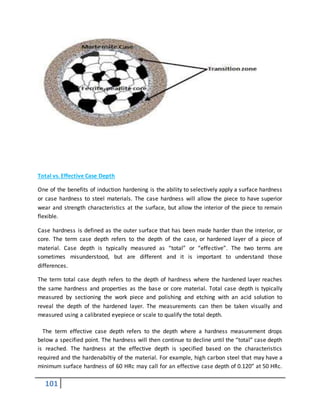
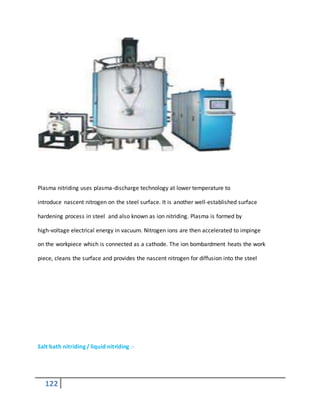
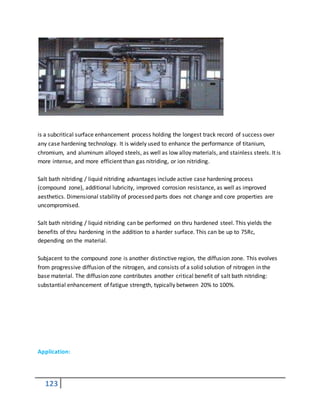
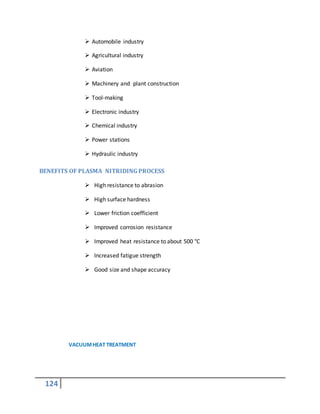
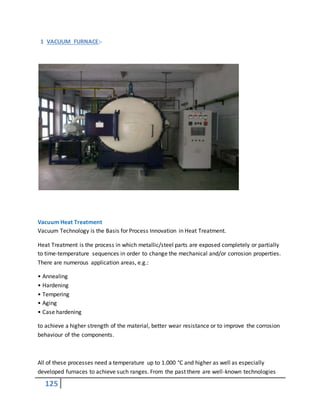
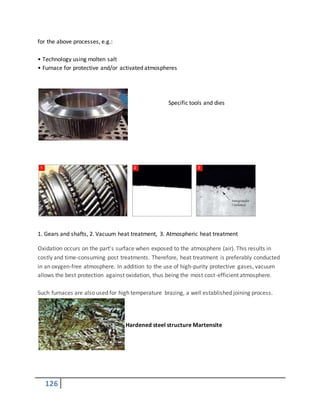
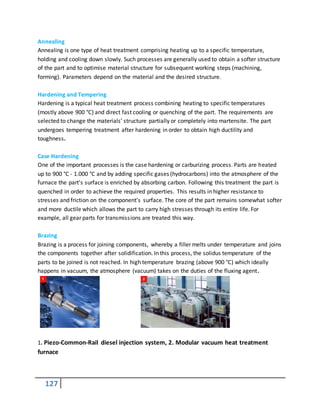
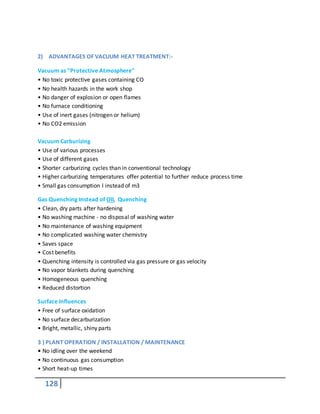
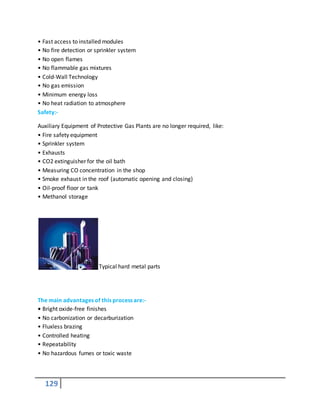
1
1). ENGG. MATERIALS:-
INTRODUCTIONMETAL / METALLIC MATERIALS
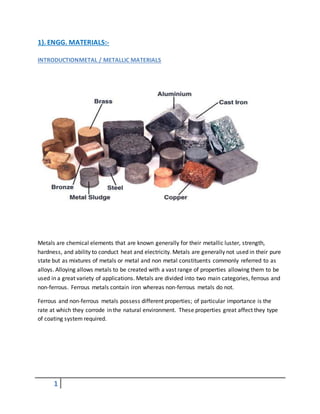
Metals are chemical elements that are known generally for their metallic luster, strength,
hardness, and ability to conduct heat and electricity. Metals are generally not used in their pure
state but as mixtures of metals or metal and non metal constituents commonly referred to as
alloys. Alloying allows metals to be created with a vast range of properties allowing them to be
used in a great variety of applications. Metals are divided into two main categories, ferrous and
non-ferrous. Ferrous metals contain iron whereas non-ferrous metals do not.
Ferrous and non-ferrous metals possess different properties; of particular importance is the
rate at which they corrode in the natural environment. These properties great affect they type
of coating system required.
2
FERROUS METALS:-
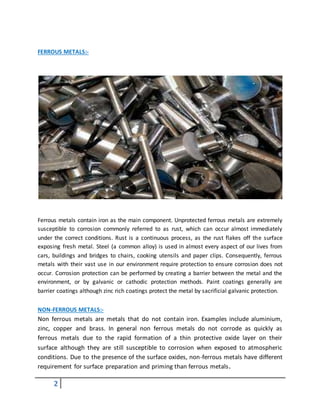
Ferrous metals contain iron as the main component. Unprotected ferrous metals are extremely
susceptible to corrosion commonly referred to as rust, which can occur almost immediately
under the correct conditions. Rust is a continuous process, as the rust flakes off the surface
exposing fresh metal. Steel (a common alloy) is used in almost every aspect of our lives from
cars, buildings and bridges to chairs, cooking utensils and paper clips. Consequently, ferrous
metals with their vast use in our environment require protection to ensure corrosion does not
occur. Corrosion protection can be performed by creating a barrier between the metal and the
environment, or by galvanic or cathodic protection methods. Paint coatings generally are
barrier coatings although zinc rich coatings protect the metal by sacrificial galvanic protection.
NON-FERROUS METALS:-
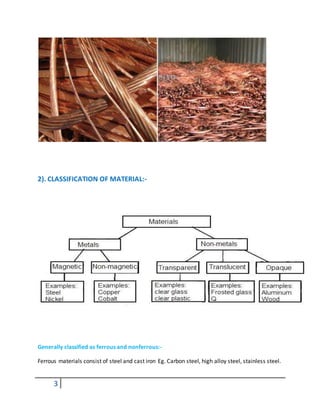
Non ferrous metals are metals that do not contain iron. Examples include aluminium,
zinc, copper and brass. In general non ferrous metals do not corrode as quickly as
ferrous metals due to the rapid formation of a thin protective oxide layer on their
surface although they are still susceptible to corrosion when exposed to atmospheric
conditions. Due to the presence of the surface oxides, non-ferrous metals have different
requirement for surface preparation and priming than ferrous metals.
3
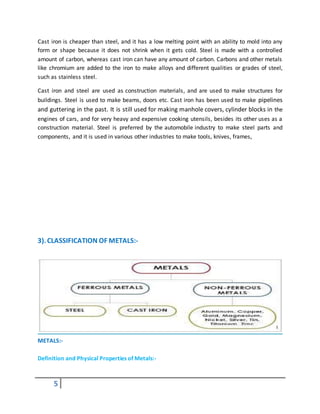
2). CLASSIFICATION OF MATERIAL:-
Generally classified as ferrous and nonferrous:-
Ferrous materials consist of steel and cast iron Eg. Carbon steel, high alloy steel, stainless steel.
4
Nonferrous materials consist of the rest of the metals and alloys Eg. Aluminum, magnesium,
titanium & their alloys
Materials from each group are further classified and given certain designation according to the
ASTM standard.
Each has their own unique number/code that represent main alloying elements, cast or
wrought and in case of plain carbon – amount of carbon.
Steel can be classified or grouped according to some common characteristic.
The most common classification is by their
Composition
Example : EN-31, EN-24 ,
CAST IRON VS CAST STEEL:-
Iron is a hard grey metal, and heavier than any of the other elements found on Earth. During a
process, impurities or slag is removed from iron, and it is turned into a steel alloy. This confirms
that steel is an alloy, whereas iron is an element. Iron exists in natural forms, and scientists
have found it in meteorite rocks as well. The main difference between the two elements is that
steel is produced from iron ore and scrap metals, and is called an alloy of iron, with controlled
carbon . Whereas, around 4% of carbon in iron makes it cast iron, and less than 2% of carbon
makes it steel.
5
Cast iron is cheaper than steel, and it has a low melting point with an ability to mold into any
form or shape because it does not shrink when it gets cold. Steel is made with a controlled
amount of carbon, whereas cast iron can have any amount of carbon. Carbons and other metals
like chromium are added to the iron to make alloys and different qualities or grades of steel,
such as stainless steel.
Cast iron and steel are used as construction materials, and are used to make structures for
buildings. Steel is used to make beams, doors etc. Cast iron has been used to make pipelines
and guttering in the past. It is still used for making manhole covers, cylinder blocks in the
engines of cars, and for very heavy and expensive cooking utensils, besides its other uses as a
construction material. Steel is preferred by the automobile industry to make steel parts and
components, and it is used in various other industries to make tools, knives, frames,
3). CLASSIFICATION OF METALS:-
METALS:-
Definition and Physical Properties of Metals:-
6
In general, a metal is typically described as a chemical element, or
mixture of elements, with the following properties:
• Metals are typically hard when they are in their solid state (although
there are exceptions, such as lead).
• They are usually shiny or lustrous.
• Metals are typically heavy; that is, they have relatively high density.
• They are malleable (able to be formed and shaped) and ductile (easily
drawn or bent).
• They are good conductors of both heat and electricity.
How can we compare metals?
 Performance Physical & Chemical Properties
 Composition & Structure Processing & Synthesis
 These four categories are useful ways to sort different materials. Metals, polymers and
 ceramics tend to have great differences in these categories. Each category will be
briefly
 discussed here, then used in later chapters to highlight the special qualities of each
material
1) CLASSIFICATIONS OF STEEL :-
STEEL:-
Steel classification is important in understanding what types are used in certain applications
and which are used for others. For example, most commercial steels are classified into one of
three groups: plain carbon, low-alloy, and high-alloy. Steel classification systems are set up and
updated frequently for this type of information.
7
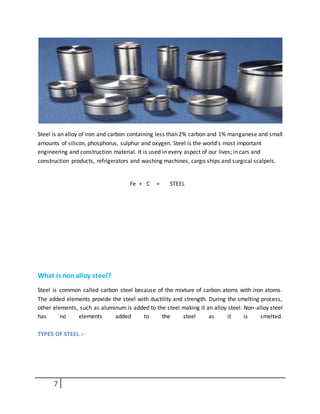
Steel is an alloy of iron and carbon containing less than 2% carbon and 1% manganese and small
amounts of silicon, phosphorus, sulphur and oxygen. Steel is the world's most important
engineering and construction material. It is used in every aspect of our lives; in cars and
construction products, refrigerators and washing machines, cargo ships and surgical scalpels.
Fe + C = STEEL
What is non alloy steel?
Steel is common called carbon steel because of the mixture of carbon atoms with iron atoms.
The added elements provide the steel with ductility and strength. During the smelting process,
other elements, such as aluminum is added to the steel making it an alloy steel. Non-alloy steel
has no elements added to the steel as it is smelted.
TYPES OF STEEL :-
8
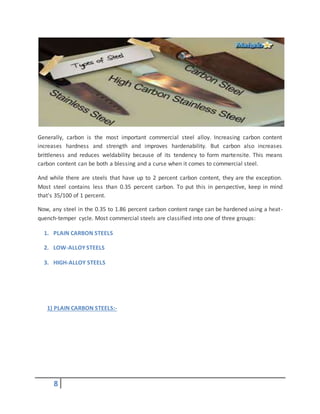
Generally, carbon is the most important commercial steel alloy. Increasing carbon content
increases hardness and strength and improves hardenability. But carbon also increases
brittleness and reduces weldability because of its tendency to form martensite. This means
carbon content can be both a blessing and a curse when it comes to commercial steel.
And while there are steels that have up to 2 percent carbon content, they are the exception.
Most steel contains less than 0.35 percent carbon. To put this in perspective, keep in mind
that's 35/100 of 1 percent.
Now, any steel in the 0.35 to 1.86 percent carbon content range can be hardened using a heat-
quench-temper cycle. Most commercial steels are classified into one of three groups:
1. PLAIN CARBON STEELS
2. LOW-ALLOY STEELS
3. HIGH-ALLOY STEELS
1) PLAIN CARBON STEELS:-
9
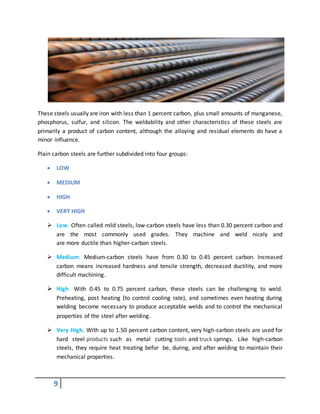
These steels usually are iron with less than 1 percent carbon, plus small amounts of manganese,
phosphorus, sulfur, and silicon. The weldability and other characteristics of these steels are
primarily a product of carbon content, although the alloying and residual elements do have a
minor influence.
Plain carbon steels are further subdivided into four groups:
 LOW
 MEDIUM
 HIGH
 VERY HIGH
 Low. Often called mild steels, low-carbon steels have less than 0.30 percent carbon and
are the most commonly used grades. They machine and weld nicely and
are more ductile than higher-carbon steels.
 Medium. Medium-carbon steels have from 0.30 to 0.45 percent carbon. Increased
carbon means increased hardness and tensile strength, decreased ductility, and more
difficult machining.
 High. With 0.45 to 0.75 percent carbon, these steels can be challenging to weld.
Preheating, post heating (to control cooling rate), and sometimes even heating during
welding become necessary to produce acceptable welds and to control the mechanical
properties of the steel after welding.
 Very High. With up to 1.50 percent carbon content, very high-carbon steels are used for
hard steel products such as metal cutting tools and truck springs. Like high-carbon
steels, they require heat treating befor be, during, and after welding to maintain their
mechanical properties.
10
3) CLASSIFICATIONS OF ALLOY STEEL:-
1) LOW-ALLOY STEELS:-
When these steels are designed for welded applications, their carbon content is usually below
0.25 percent and often below 0.15 percent. Typical alloys include nickel, chromium,
molybdenum, manganese, and silicon, which add strength at room temperatures and increase
low-temperature notch toughness.
These alloys can, in the right combination, improve corrosion resistance and influence the
steel's response to heat treatment. But the alloys added can also negatively influence crack
susceptibility, so it's a good idea to use low-hydrogen welding processes with them. Preheating
might also prove necessary. This can be determined by using the carbon equivalent formula,
which we'll cover in a later issue.
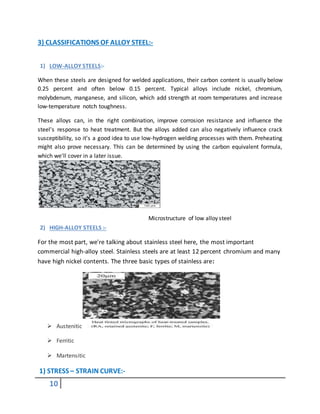
Microstructure of low alloy steel
2) HIGH-ALLOY STEELS :-
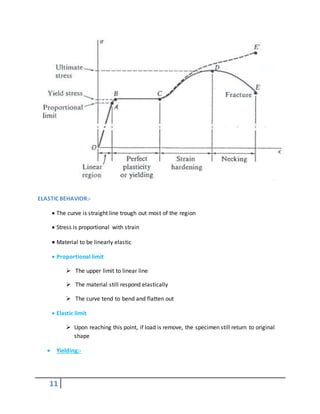
For the most part, we're talking about stainless steel here, the most important
commercial high-alloy steel. Stainless steels are at least 12 percent chromium and many
have high nickel contents. The three basic types of stainless are:
 Austenitic
 Ferritic
 Martensitic
1) STRESS – STRAIN CURVE:-
11
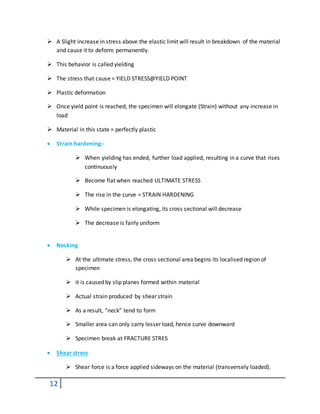
ELASTIC BEHAVIOR:-
 The curve is straight line trough out most of the region
 Stress is proportional with strain
 Material to be linearly elastic
 Proportional limit
 The upper limit to linear line
 The material still respond elastically
 The curve tend to bend and flatten out
 Elastic limit
 Upon reaching this point, if load is remove, the specimen still return to original
shape
 Yielding:-
12
 A Slight increase in stress above the elastic limit will result in breakdown of the material
and cause it to deform permanently.
 This behavior is called yielding
 The stress that cause = YIELD STRESS@YIELD POINT
 Plastic deformation
 Once yield point is reached, the specimen will elongate (Strain) without any increase in
load
 Material in this state = perfectly plastic
 Strain hardening:-
 When yielding has ended, further load applied, resulting in a curve that rises
continuously
 Become flat when reached ULTIMATE STRESS
 The rise in the curve = STRAIN HARDENING
 While specimen is elongating, its cross sectional will decrease
 The decrease is fairly uniform
 Necking
 At the ultimate stress, the cross sectional area begins its localised region of
specimen
 it is caused by slip planes formed within material
 Actual strain produced by shear strain
 As a result, “neck” tend to form
 Smaller area can only carry lesser load, hence curve downward
 Specimen break at FRACTURE STRES
 Shear stress
 Shear force is a force applied sideways on the material (transversely loaded).
13
 Shear stress is the force per unit area carrying the load. This means the cross
sectional area of the material being cut, the beam and pin.
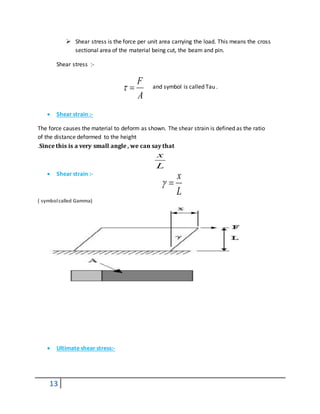
Shear stress :-
and symbol is called Tau .
 Shear strain :-
The force causes the material to deform as shown. The shear strain is defined as the ratio
of the distance deformed to the height
.Since this is a very small angle , we can say that
 Shear strain :-
( symbolcalled Gamma)
 Ultimate shear stress:-
A
F

L
x
L
x

14
 If a material is sheared beyond a certain limit and it becomes permanently distorted and
does not spring all the way back to its original shape, the elastic limit has been
exceeded.
 If the material stressed to the limit so that it parts into two, the ultimate limit has been
reached.
 The ultimate shear stress has symbol and this value is used to calculate the force
needed by shears and punches.
2) MECHANICAL PROPERTIES OF STEEL:-
The alloys and the heat treatment used in the production of steel result in it having different
values and strengths. Testing must be accurate to determine the properties of the steel and to
ensure adherence to standards.
Different steels have different values of strength and toughness depending on the alloys made
and the heat treatments used. Testing methods are important to determine values and to
ensure that standards are adhered to. Methods of testing determine the yield strength,
ductility and stiffness through tensile testing, toughness through impact testing, and hardness
through resistance to penetration of the surface by a hard object.
15
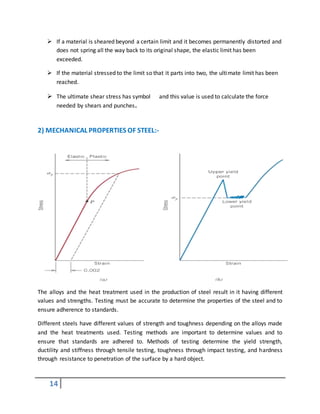
Tensile testing is a method of evaluating the structural response of steel to applied loads, with
the results expressed as a relationship between stress and strain fig:- (a) & (b) is a good
example .
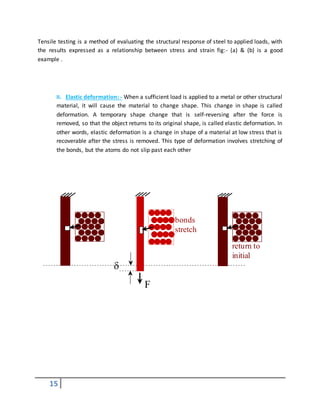
II. Elastic deformation: - When a sufficient load is applied to a metal or other structural
material, it will cause the material to change shape. This change in shape is called
deformation. A temporary shape change that is self-reversing after the force is
removed, so that the object returns to its original shape, is called elastic deformation. In
other words, elastic deformation is a change in shape of a material at low stress that is
recoverable after the stress is removed. This type of deformation involves stretching of
the bonds, but the atoms do not slip past each other
F

bonds
stretch
return to
initial
16
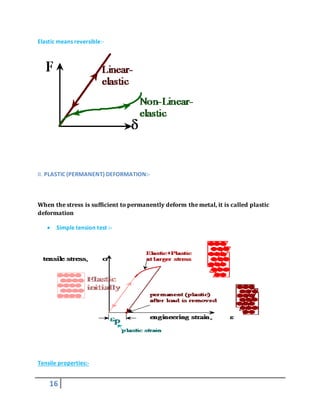
Elastic means reversible:-
II. PLASTIC (PERMANENT) DEFORMATION:-
When the stress is sufficient to permanently deform the metal, it is called plastic
deformation
 Simple tension test :-
Tensile properties:-
17
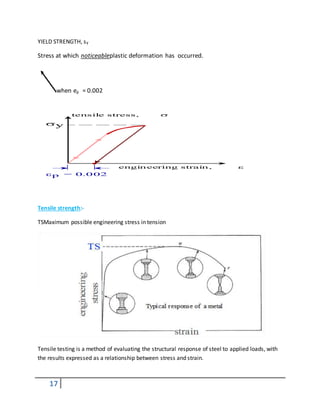
YIELD STRENGTH, sy
Stress at which noticeableplastic deformation has occurred.
when ep = 0.002
Tensile strength:-
TSMaximum possible engineering stress in tension
Tensile testing is a method of evaluating the structural response of steel to applied loads, with
the results expressed as a relationship between stress and strain.
tensile stress, 
engineering strain, 
y
p = 0.002
18
 Specially shaped specimens of steel are subjected to a tensile force which gradually
elongates the steel. The force is increased and the extension of the steel carefully
measured.
 The stress on the metal is evaluated by dividing the value of the force applied by the
cross-sectional area of the specimen.
 Stress = LOAD in Newtons / CROSS-SECTIONAL AREA of specimen in mm2
 Strain is measured by calculating the increase in length of the specimen as a proportion
of the original length.
 Strain = INCREASE IN LENGTH in mm / ORIGINAL LENGTH in mm
• Metals: occurs when noticeable necking starts.
• Ceramics: occurs when crack propagation starts.
• Polymers: occurs when polymer backbones are
aligned and about to break.
3) UNIVERSAL TESTING MACHINE:-
19
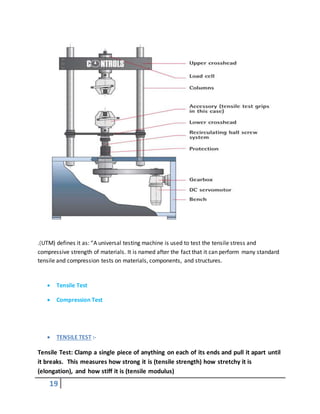
.(UTM) defines it as: “A universal testing machine is used to test the tensile stress and
compressive strength of materials. It is named after the fact that it can perform many standard
tensile and compression tests on materials, components, and structures.
 Tensile Test
 Compression Test
 TENSILE TEST :-
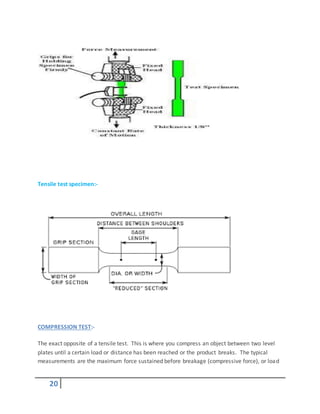
Tensile Test: Clamp a single piece of anything on each of its ends and pull it apart until
it breaks. This measures how strong it is (tensile strength) how stretchy it is
(elongation), and how stiff it is (tensile modulus)
20
Tensile test specimen:-
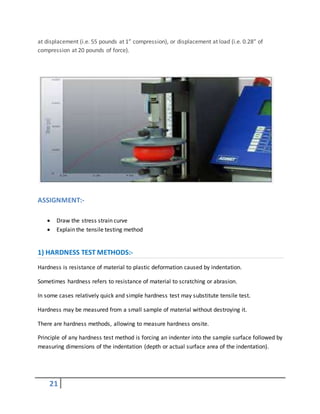
COMPRESSION TEST:-
The exact opposite of a tensile test. This is where you compress an object between two level
plates until a certain load or distance has been reached or the product breaks. The typical
measurements are the maximum force sustained before breakage (compressive force), or load
21
at displacement (i.e. 55 pounds at 1” compression), or displacement at load (i.e. 0.28” of
compression at 20 pounds of force).
ASSIGNMENT:-
 Draw the stress strain curve
 Explain the tensile testing method
1) HARDNESS TEST METHODS:-
Hardness is resistance of material to plastic deformation caused by indentation.
Sometimes hardness refers to resistance of material to scratching or abrasion.
In some cases relatively quick and simple hardness test may substitute tensile test.
Hardness may be measured from a small sample of material without destroying it.
There are hardness methods, allowing to measure hardness onsite.
Principle of any hardness test method is forcing an indenter into the sample surface followed by
measuring dimensions of the indentation (depth or actual surface area of the indentation).
22
Benefits of hardness test:
 Easy
 Inexpensive
 Quick
 Non-destructive
 May be applied to the samples of various dimensions and shapes
 May be performed in-situ
Depending on the loading force value and the indentation dimensions, hardness is defined as a
macro- , micro- or nano-hardness.
Macro-hardness tests (Rockwell, Brinell, Vickers) are the most widely used methods for rapid
routine hardness measurements. The indenting forces in macro-hardness tests are in the range
of 50N to 30000N.
 Brinell Hardness Test
 Rockwell Hardness Test
 Rockwell Superficial Hardness Test
 Vickers Hardness Test
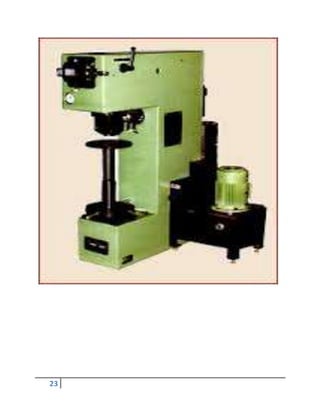
 BRINELLHARDNESS TEST:-
23
24
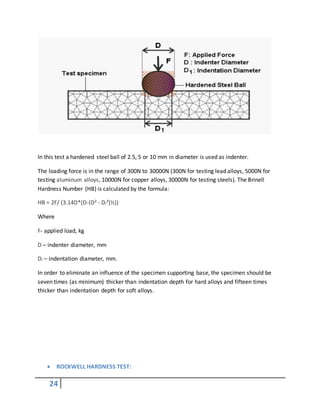
In this test a hardened steel ball of 2.5, 5 or 10 mm in diameter is used as indenter.
The loading force is in the range of 300N to 30000N (300N for testing lead alloys, 5000N for
testing aluminum alloys, 10000N for copper alloys, 30000N for testing steels). The Brinell
Hardness Number (HB) is calculated by the formula:
HB = 2F/ (3.14D*(D-(D² - Di²)½))
Where
F- applied load, kg
D – indenter diameter, mm
Di – indentation diameter, mm.
In order to eliminate an influence of the specimen supporting base, the specimen should be
seven times (as minimum) thicker than indentation depth for hard alloys and fifteen times
thicker than indentation depth for soft alloys.
 ROCKWELL HARDNESS TEST:
25
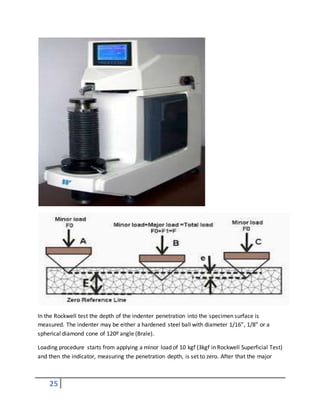
In the Rockwell test the depth of the indenter penetration into the specimen surface is
measured. The indenter may be either a hardened steel ball with diameter 1/16”, 1/8” or a
spherical diamond cone of 120º angle (Brale).
Loading procedure starts from applying a minor load of 10 kgf (3kgf in Rockwell Superficial Test)
and then the indicator, measuring the penetration depth, is set to zero. After that the major
26
load (60, 100 or 150 kgf)is applied. The penetration depth is measured after removal of the
major load.
Hardness is measured in different scales (A, B, C, D, E, F, G, H, K) and in numbers, having no
units (in contrast to Brinell and Vickers methods).
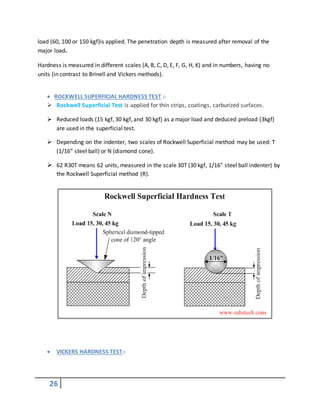
 ROCKWELL SUPERFICIAL HARDNESS TEST :-
 Rockwell Superficial Test is applied for thin strips, coatings, carburized surfaces.
 Reduced loads (15 kgf, 30 kgf, and 30 kgf) as a major load and deduced preload (3kgf)
are used in the superficial test.
 Depending on the indenter, two scales of Rockwell Superficial method may be used: T
(1/16” steel ball) or N (diamond cone).
 62 R30T means 62 units, measured in the scale 30T (30 kgf, 1/16” steel ball indenter) by
the Rockwell Superficial method (R).
 VICKERS HARDNESS TEST:-
27
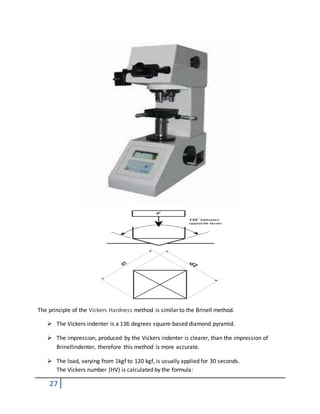
The principle of the Vickers Hardness method is similar to the Brinell method.
 The Vickers indenter is a 136 degrees square-based diamond pyramid.
 The impression, produced by the Vickers indenter is clearer, than the impression of
Brinellindenter, therefore this method is more accurate.
 The load, varying from 1kgf to 120 kgf, is usually applied for 30 seconds.
The Vickers number (HV) is calculated by the formula:
28
 HV = 1.854*F/ D²
 Where
 F-applied load, kg
 D – length of the impression diagonal, mm
 The length of the impression diagonal is measured by means of a microscope, which is
usually an integral part of the Vickers Tester.
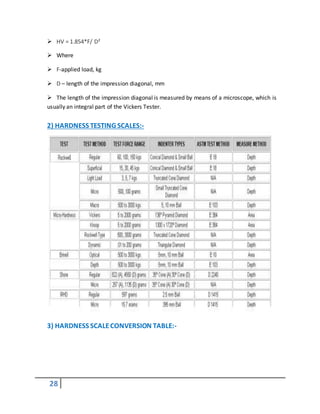
2) HARDNESS TESTING SCALES:-
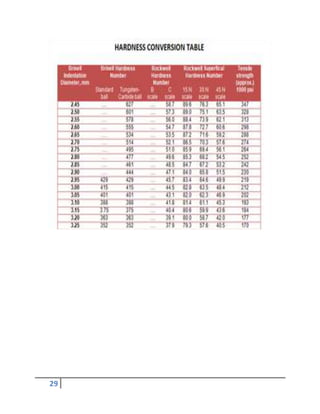
3) HARDNESS SCALECONVERSION TABLE:-
29
30
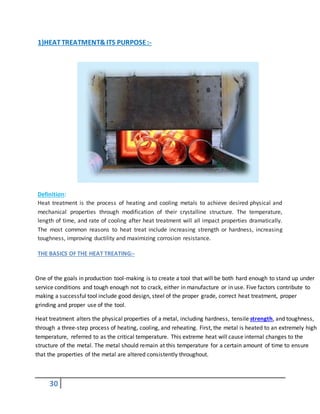
1)HEATTREATMENT&ITS PURPOSE:-
Definition:
Heat treatment is the process of heating and cooling metals to achieve desired physical and
mechanical properties through modification of their crystalline structure. The temperature,
length of time, and rate of cooling after heat treatment will all impact properties dramatically.
The most common reasons to heat treat include increasing strength or hardness, increasing
toughness, improving ductility and maximizing corrosion resistance.
THE BASICS OF THE HEAT TREATING:-
One of the goals in production tool-making is to create a tool that will be both hard enough to stand up under
service conditions and tough enough not to crack, either in manufacture or in use. Five factors contribute to
making a successful tool include good design, steel of the proper grade, correct heat treatment, proper
grinding and proper use of the tool.
Heat treatment alters the physical properties of a metal, including hardness, tensile strength, and toughness,
through a three-step process of heating, cooling, and reheating. First, the metal is heated to an extremely high
temperature, referred to as the critical temperature. This extreme heat will cause internal changes to the
structure of the metal. The metal should remain at this temperature for a certain amount of time to ensure
that the properties of the metal are altered consistently throughout.
31
Why use heat treatment?
• Soften a Part That Is Too Hard.,Harden a Part That Is Not Hard Enough,Put Hard Skin on
Parts That Are Soft,Make Good Magnets Out of Ordinary Material.
HEAT TREATMENT PROCESS:-
HEAT-TREATING THEORY:-
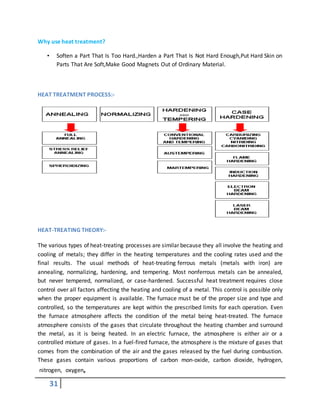
The various types of heat-treating processes are similar because they all involve the heating and
cooling of metals; they differ in the heating temperatures and the cooling rates used and the
final results. The usual methods of heat-treating ferrous metals (metals with iron) are
annealing, normalizing, hardening, and tempering. Most nonferrous metals can be annealed,
but never tempered, normalized, or case-hardened. Successful heat treatment requires close
control over all factors affecting the heating and cooling of a metal. This control is possible only
when the proper equipment is available. The furnace must be of the proper size and type and
controlled, so the temperatures are kept within the prescribed limits for each operation. Even
the furnace atmosphere affects the condition of the metal being heat-treated. The furnace
atmosphere consists of the gases that circulate throughout the heating chamber and surround
the metal, as it is being heated. In an electric furnace, the atmosphere is either air or a
controlled mixture of gases. In a fuel-fired furnace, the atmosphere is the mixture of gases that
comes from the combination of the air and the gases released by the fuel during combustion.
These gases contain various proportions of carbon mon-oxide, carbon dioxide, hydrogen,
nitrogen, oxygen,
32
2) SAGES OF HEATTREATMENT:-
Heat treating is accomplished in three major stages
 Heating the metal slowly to ensure a uniform temperature Stage
 Soaking (holding) the metal at a given temperature for a given time and cooling the
metal to room temperature stage
 Cooling the metal to room temperature
HEATING STAGE:-
The primary objective in the heating stage is to maintain uniform temperatures. If uneven
heating occurs, one section of a part can expand faster than another and result in distortion or
cracking. Uniform temperatures are attained by slow heating. The heating rate of a part
depends on several factors. One important factor is the heat conductivity of the metal. A metal
with a high-heat conductivity heats at a faster rate than one with a low conductivity. Also, the
condition of the metal determines the rate at which it may be heated. The heating rate for
hardened tools and parts should be slower than unstressed or untreated metals. Finally, size
and cross section figure into the heating rate. Parts with a large cross section requires lower
heating rates to allow the interior temperature to remain close to the surface temperature that
prevents warping or cracking. Parts with uneven cross sections experience uneven heating;
however, such parts are less apt to be cracked or excessively warped when the heating rate is
kept slow.
SOAKING STAGE:-
After the metal is heated to the proper temperature, it is held at that temperature until the
desired internal structural changes take place. This process is called SOAKING. The length of
time depends upon thickness of the job.
COOLING STAGE
Cooling is done according to material and mechanical properties required.
33
3) SAFETY MEASURES:-
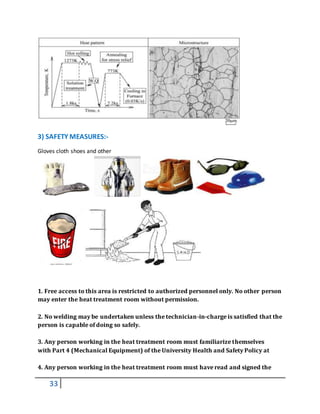
Gloves cloth shoes and other
1. Free access to this area is restricted to authorized personnel only. No other person
may enter the heat treatment room without permission.
2. No welding may be undertaken unless the technician-in-charge is satisfied that the
person is capable of doing so safely.
3. Any person working in the heat treatment room must familiarize themselves
with Part 4 (Mechanical Equipment) of the University Health and Safety Policy at
4. Any person working in the heat treatment room must have read and signed the
34
appropriate risk assessment if the work or equipment they are using has been risk
assessed.
1) THE IRON-CARBONEQUILIBRIUM DIAGRAM:-
A study of the constitution and structure of all steels and irons must first start with the iron-
carbon equilibrium diagram. Many of the basic features of this system influence the behavior of
even the most complex alloy steels.
For example, the phases found in the simple binary Fe-C systempersist in complex steels, but it
is necessary to examine the effects alloying elements have on the formation and properties of
these phases. The iron-carbon diagram provides a valuable foundation on which to build
knowledge of both plain carbon and alloy steels in their immense variety.
Iron-carbon equilibrium diagram
It should first be pointed out that the normal equilibrium diagram really represents the
metastable equilibrium between iron and iron carbide (cementite). Cementite is metastable,
and the true equilibrium should be between iron and graphite. Although graphite occurs
extensively in cast irons (2-4 wt % C), it is usually difficult to obtain this equilibrium phase in
steels (0.03-1.5 wt %C). Therefore, the metastable equilibrium between iron and iron carbide
should be considered, because it is relevant to the behavior of most steels in practice.
35
The much larger phase field of γ-iron (austenite) compared with that of α-iron (ferrite) reflects
the much greater solubility of carbon in γ-iron, with a maximum value of just over 2 wt % at
1147°C (E, Fig.1). This high solubility of carbon in γ-iron is of extreme importance in heat
treatment, when solution treatment in the γ-region followed by rapid quenching to room
temperature allows a supersaturated solid solution of carbon in iron to be formed.
The α-iron phase field is severely restricted, with a maximum carbon solubility of 0.02 wt% at
723°C (P), so over the carbon range encountered in steels from 0.05 to 1.5 wt%, α-iron is
normally associated with iron carbide in one form or another. Similarly, the δ-phase field is very
restricted between 1390 and 1534°C and disappears completely when the carbon content
reaches 0.5 wt% (B).
There are several temperatures or critical points in the diagram, which are important, both
from the basic and from the practical point of view.
Firstly, there is the A1, temperature at which the eutectoid reaction occurs (P-S-K), which is
723°C in the binary diagram.
Secondly, there is the A3, temperature when α-iron transforms to γ-iron. For pure iron this
occurs at 910°C, but the transformation temperature is progressively lowered along the line GS
by the addition of carbon.
The third point is A4 at which γ-iron transforms to δ-iron, 1390°C in pure iron, hut this is raised
as carbon is added. The A2, point is the Curie point when iron changes from the ferro- to the
paramagnetic condition. This temperature is 769°C for pure iron, but no change in crystal
structure is involved. The A1, A3 and A4 points are easily detected by thermal analysis or
dilatometry during cooling or heating cycles, and some hysteresis is observed. Consequently,
three values for each point can be obtained. Ac for heating, Ar for cooling and Ae (equilibrium},
but it should be emphasized that the Ac and Ar values will be sensitive to the rates of heating
and cooling, as well as to the presence of alloying elements.
The great difference in carbon solubility between γ- and α-iron leads normally to the rejection
of carbon as iron carbide at the boundaries of the γ phase field. The transformation of γ to α -
iron occurs via a eutectoid reaction, which plays a dominant role in heat treatment.
THE AUSTENITE- FERRITE TRANSFORMATION
36
Under equilibrium conditions, pro-eutectoid ferrite will form in iron-carbon alloys containing up
to 0.8 % carbon. The reaction occurs at 910°C in pure iron, but takes place between 910°C and
723°C in iron-carbon alloys.
However, by quenching from the austenitic state to temperatures below the eutectoid
temperature Ae1, ferrite can be formed down to temperatures as low as 600°C. There are
pronounced morphological changes as the transformation temperature is lowered, which it
should be emphasized apply in general to hypo-and hyper-eutectoid phases, although in each
case there will be variations due to the precise crystallography of the phases involved. For
example, the same principles apply to the formation of cementite from austenite, but it is not
difficult to distinguish ferrite from cementite morphologically.
THE AUSTENITE-CEMENTITE TRANSFORMATION
The classification applies equally well to the various morphologies of cementite formed at
progressively lower transformation temperatures. The initial development of grain boundary
allotriomorphs is very similar to that of ferrite, and the growth of side plates or Widmanstaten
cementite follows the same pattern. The cementite plates are more rigorously crystallographic
in form, despite the fact that the orientation relationship with austenite is a more complex one.
As in the case of ferrite, most of the side plates originate from grain boundary allotriomorphs,
but in the cementite reaction more side plates nucleate at twin boundaries in austenite.
THE AUSTENITE-PEARLITE REACTION
Pearlite is probably the most familiar micro structural feature in the whole science of
metallography. It was discovered by Sorby over 100 years ago, who correctly assumed it to be a
lamellar mixture of iron and iron carbide.
Pearlite is a very common constituent of a wide variety of steels, where it provides a substantial
contribution to strength. Lamellar eutectoid structures of this type are widespread in
metallurgy, and frequently pearlite is used as a generic term to describe them.
2) HYPO & HYPER EUTECTOID STEELS:-
Eutectoid, Hypo-eutectoid & Hyper-eutectoid Alloys
As discussed in the previous topic are those reactions accompanied by certain phase
transformation and microstructural changes. These reactions happen at a given temperature
and composition, giving them the name of a "zero degree of freedom'' reaction. Yet, with
37
varying the content of the alloying element, it is possible to undergo invariant reactions, giving
a certain amount of the "invariant" phase(s). In this report, the focus is upon the eutectoid
reaction. In this reaction, a solid solution phase transforms into a 2-phase solid solution
structure as indicated in the following equation and figure (1).
Cooling f
Figure (1)
Eutectoid Reaction
Same goes for the eutectoid reaction in terms of the production of a eutectoid phases at lower
or higher contents of the alloying element, producing hypo-eutectoid and hyper-eutectoid
alloys respectively. Definitely such microstructural changes influence the mechanical
properties. That is why one of the important phase diagrams to investigate the effect of such
changes would be the Fe-Fe3C diagram (read as iron-iron carbide diagram) due to the branched
and widespread applications of steel.
38
Fe-Fe3C phase diagram
As shown in the Fe-Fe3C diagram, the iron iron carbide systemexperiences the eutectoid
reaction when the gamma (austenite) phase transforms into alpha (ferrite) and Fe3C (cementite)
phases. In fact, such transformation happens under certain conditions regarding the cooling
rates, whether it is air or furnace cooled. This affects the microstructure of the produced
eutectoid phases. In addition, increasing and decreasing the carbon content changes the
amount of eutectoid phase
1) TTT DIAGRAM :-
39
Time Temperature Transformation
(TTT) Diagrams
a. Path 1 (Red line)
b. Path 2 (Green line)
c. Path 3 (Blue line)
d. Path 4 (Orange line
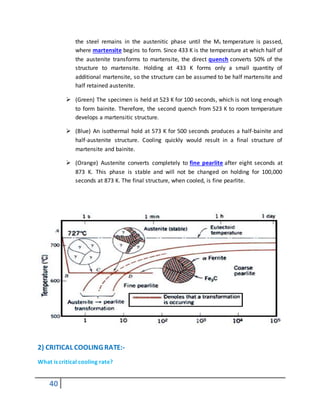
 (Red) The specimen is cooled rapidly to 433 K and left for 20 minutes. The
cooling rate is too rapid for pearlite to form at higher temperatures; therefore,
40
the steel remains in the austenitic phase until the Ms temperature is passed,
where martensite begins to form. Since 433 K is the temperature at which half of
the austenite transforms to martensite, the direct quench converts 50% of the
structure to martensite. Holding at 433 K forms only a small quantity of
additional martensite, so the structure can be assumed to be half martensite and
half retained austenite.
 (Green) The specimen is held at 523 K for 100 seconds, which is not long enough
to form bainite. Therefore, the second quench from 523 K to room temperature
develops a martensitic structure.
 (Blue) An isothermal hold at 573 K for 500 seconds produces a half-bainite and
half-austenite structure. Cooling quickly would result in a final structure of
martensite and bainite.
 (Orange) Austenite converts completely to fine pearlite after eight seconds at
873 K. This phase is stable and will not be changed on holding for 100,000
seconds at 873 K. The final structure, when cooled, is fine pearlite.
2) CRITICAL COOLING RATE:-
What is critical cooling rate?
41
The minimum rate of continuous cooling in the heat treatment of steels that is enough to
prevent undesired transformations and formation of martensite in steel.
Critical cooling rate: "The critical cooling rate is the limiting rate of cooling which ensures that a
particular type of transformation product is formed.
Carbon steel and the hardening thereof, weren't sufficiently understood until well into the last
century. Before that time, and especially centuries before, the whole process was wrapped in
secrecy, myth, ritual and magic. All knowledge was empirical and it was difficult, if not
impossible, to know which parts of a forging ritual were vital and which weren't. Did moon
phase have abearing? Were swords forged in the winter necessarily better than those in the
summer? Did the wood source for charcoal really make much difference? Does speaking the
correct words at the right moment matter? What could you do if your anvil got hexed?
Chemical composition was uncertain, if not unknown. So the best smiths could do was follow a
forging ritual which had an acceptable rate of success. That parts of forging rituals were silly,
irrelevant and possibly counter-productive shouldn't preclude the process of having a ritual in
the first place. What I'm presenting in this tutorial is a ritual of sorts. It's a way to understand,
think about, organize information and activity toward a forging outcome. I suppose what I'm
saying is that knowledge is just about updating the ritual not replacing it.
Steel is a crystalline substance and as it's temperature changes, so too does it's
crystalline structure. That's what heat treatmentdoes-it changes the crystalline
structure by way of time and temperature.
There are a lot of different structures in steel but only three needs your
attention: Austenite, Ferrite and Martensite. Austenite exists at high temperature and
to the left in the graphic below. Ferrite is to the right and Martensite at the bottom.
We will use the term, Ferrite, to include Pearlite and Cementite as Pearlite is a form of
Ferrite. Mostly, we're using Ferrite to mean any non-Austenite/Martinsite
structure. So you only need to learn three steel words.
COOLING PATH:-
42
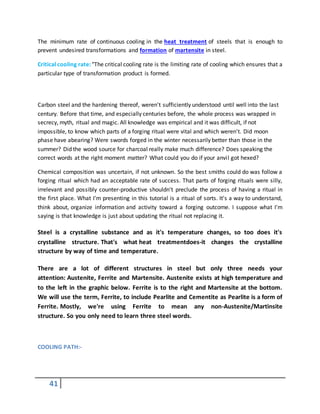
 We're now ready to grapple with the central mystery of carbon steel--the Cooling Path.
Above are five Cooling Paths--A through D. Each line signifies a different rate of cooling
and thus different resultant steel structures. Steels with less than 0.3 % carbon cannot
be hardened effectively, while the maximum effect is obtained at about 0.76 % due to
an increased tendency to retain Austenite in high carbon steels.
 But first, let's back up and first look at some other diagrams. Following is a phase
diagram of carbon and iron. Indicated is our area of interest--1/2 to 1 percent of carbon
and a temperature range of maybe 1800F down to room temperature.
EQUILIBRIUM FE-C PHASE DIAGRAM:-
43
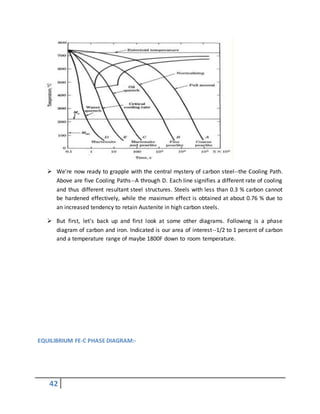
The Iron Age is based on this diagram--it's also color coded for temperature.
Cast iron and steel exist because of the strange and wonderful chemical interactions between
carbon and iron. Our area of interest, the blue line is 0.76% carbon.
The thing to take away from this graphic is that as steel cools it experiences changes in
crystalline structure.
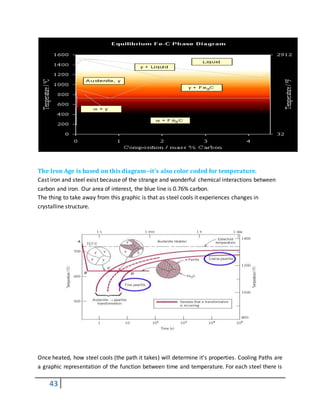
Once heated, how steel cools (the path it takes) will determine it's properties. Cooling Paths are
a graphic representation of the function between time and temperature. For each steel there is
44
a graph called a TTT (time, temperature, transformation) graph or sometimes it's called a
Isothermal Transformation Diagram. Let's call it TTT. Above is a portion of a generalized TTT
graph. The red line starting at the upper left denotes a partial cooling path.
Two things to notice here: First, the time axis at the bottom is a log (as in logarithmic) scale. TTT
graphs always use a log time scale and it may take some getting used to. Notice the time scale
at the top of the graph, it's the same, time-wise as the scale at the bottom. Now does a log
scale make more sense? And finally, second, the cooling path is demonstrating a Austenite to
Ferrite transformation--which, during final heat treating is the transformation we'll try and
avoid.
3)THEORY OF MARTENSITEFORMATION:-
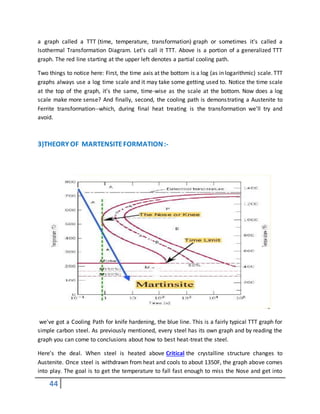
we've got a Cooling Path for knife hardening, the blue line. This is a fairly typical TTT graph for
simple carbon steel. As previously mentioned, every steel has its own graph and by reading the
graph you can come to conclusions about how to best heat-treat the steel.
Here's the deal. When steel is heated above Critical the crystalline structure changes to
Austenite. Once steel is withdrawn from heat and cools to about 1350F, the graph above comes
into play. The goal is to get the temperature to fall fast enough to miss the Nose and get into
45
the Martensite range before the Time Limit. In this case, that's less than a second (green dotted
line). If you can get from Austenite to Martensite without crossing the Nose you'll have a hard,
strong steel. The structure in the graph depicted by red lines is usually called an S Curve. We
want to avoid it except at the bottom--the Martinsite range. That's it! That's the whole thing--
creating a cooling path, with quenchants, which avoids the S Curve and doesn't cause your
blade to strain and crack. You have less than a second--one Mississippi--to get the blade's
temperature under a thousand degrees. And to do it in a way that doesn't wreck the steel
through heat shock. Do that and you've won the game! That's what the Cooling Path is, that's
what it's about.
PURPOSEOF HEATTREATMENT:-
We heat treat metals in an attempt to optimize the mechanical and physical properties for a
given application. Most people think of heat treatment as a process for hardening metal. This is
not necessarily so, as many heat treatments are applied to soften metal in order to allow metal
working operations such as deep drawing, cold forging and machining.
Where increased strength and wear resistance is required, hardening and tempering
treatments are given. Extremely hard steels find applications in cutting tools where highly
defined edges must be maintained and heat treatment of these steels is a critical operation.
Hard surfaces with ductile base material may be developed by heat treatment.
There are also the solution heat treatments and ageing processes designed to increase the
strength of some non ferrous metals and precipitation hardening steels.
Heat treatment is a significant industry and forms a basic part of the industrial infrastructure of
countries.
1) HEAT TREATMENTOF PLAIN CARBON STEELS:-
Plain carbon steels are iron alloys of carbon content less than 2.08%. Heat treatment is
changing the microstructure of steels alloys to change the strength, ductility, hardness,
machinability, grain size and wear resistance. There are general reasons for heat treatment:
1. Hardening: a heat treatment to increase the hardness of the steel alloys.
46
2. Tempering: a heat treatment that reduces the brittleness of a steel without significantly
lowering its hardness and strength. All hardened steels must be tempered before use.
3. Softening: a heat treatment to increase the machinability of steels.
4. Re-crystallization: transformation of cold-worked grains to an undistorted shape.
5. Stress relief: removing internal stress from a metal that has been subjected to cold working
or welding.
6. Hot working operations
7. Diffusion of alloying elements: remove internal stress from a metal that has been subjected
to cold working or welding.
One of the commonest heat treatment processes is the formation of Martensite. The process of
formation of Martensite can be pinpointed as follows:
1. Heating a plain carbon steel alloy (from the eutectoid region, either hypo or hyper) to the
austenite region
2. Having it held there for a while of time to fully austenize its structure.
3. Exposing it to a non-equilibrium cooling rate, the austenite will transform into Martensite.
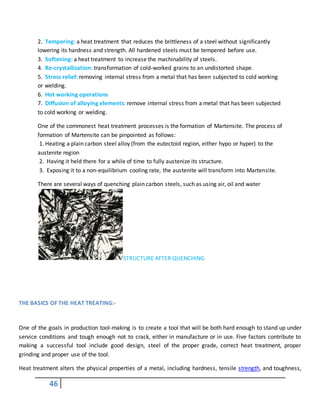
There are several ways of quenching plain carbon steels, such as using air, oil and water
STRUCTURE AFTER QUENCHING
THE BASICS OF THE HEAT TREATING:-
One of the goals in production tool-making is to create a tool that will be both hard enough to stand up under
service conditions and tough enough not to crack, either in manufacture or in use. Five factors contribute to
making a successful tool include good design, steel of the proper grade, correct heat treatment, proper
grinding and proper use of the tool.
Heat treatment alters the physical properties of a metal, including hardness, tensile strength, and toughness,
47
through a three-step process of heating, cooling, and reheating. First, the metal is heated to an extremely high
temperature, referred to as the critical temperature. This extreme heat will cause internal changes to the
structure of the metal. The metal should remain at this temperature for a certain amount of time to ensure
that the properties of the metal are altered consistently throughout.
If the metal is then left to cool naturally, the metal will return to normal. In heat treatment, however, a
process called quenching is used to control the rate at which the metal cools. Quenching involves the use of
liquids or gases to cool the metal faster than it would naturally, allowing the metal to retain some of the
changes introduced during the initial heating phase.
Finally, the metal is heated again, this time to a temperature below the critical temperature. This second
round of heat, referred to as tempering, is used to correct some of the issues that can be caused by the
previous steps. The initial heating and quenching processes result in metal that is stressed, making it brittle
and hard. Tempering relieves the stresses, increasing the toughness and ductility of the metal while retaining
sufficient hardness and strength. Reheating the metal is an important step of the heat treatment process that
should be performed soon after quenching.
HARDENING:-
The first step in heat treatment involves heating the metal to an extreme temperature to prepare it for
quenching. All metals have a threshold, called the critical temperature, above which specific changes occur that
alter the properties of the metal. During hardening, the metal should be brought to this temperature and should
remain there until the heat has thoroughly penetrated the metal. In general, the metal should be kept at this
critical temperature for a minimum of five minutes per inch of diameter or thickness. When working with metals
such as steel tools, pre-heating may be necessary if the tool is large or has both heavy and light sections.
Accuracy is very important during this stage, as both temperature and duration will affect the quality of the
results. The furnace used must be brought to the correct temperature, above the metal’s critical range, and this
temperature must be maintained for the proper length of time. Allowing the heat to thoroughly penetrate the
metal ensures that the changes in the metal are uniform throughout. This is necessary to adequately prepare the
metal for quenching, when the metal will be cooled at a controlled rate
QUENCHING:-
The second step in the heat treatment process is called quenching. During this phase, the heated metal is
cooled using either a gas or liquid medium. This allows the metal to be cooled at a faster rate than if it were
48
left to cool naturally, thus retaining some of the physical alterations introduced by the initial heating stage.
Once the metal has cooled, it should be tempered soon after quenching to relieve stresses in the metal due to
the heating and quenching process.
Quenching too quickly can cause metals to crack, so providing the proper medium for the metal, as well as an
adequate amount of the fluid, is important to obtain quality results. When quenching in liquid baths, it is
important to use sufficient amounts of fluid in order to keep the liquid cool and effective. Approximately one
gallon of oil or water per hour should be used for every pound of steel to be quenched. In general, the tool
should be cooled in the quenching medium until it reaches 150 Fahrenheit, then allowed to cool to room
temperature before placing it in the tempering oven.
1.
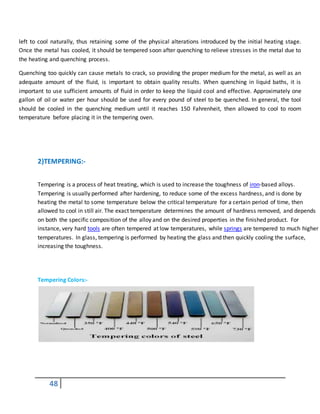
2. 2)TEMPERING:-
Tempering is a process of heat treating, which is used to increase the toughness of iron-based alloys.
Tempering is usually performed after hardening, to reduce some of the excess hardness, and is done by
heating the metal to some temperature below the critical temperature for a certain period of time, then
allowed to cool in still air. The exact temperature determines the amount of hardness removed, and depends
on both the specific composition of the alloy and on the desired properties in the finished product. For
instance, very hard tools are often tempered at low temperatures, while springs are tempered to much higher
temperatures. In glass, tempering is performed by heating the glass and then quickly cooling the surface,
increasing the toughness.
After a
Tempering Colors:-
49
3) PURPOSEOF TEMPERING:-
Tempering is a process of heat treating, which is used to increase the toughness of iron-based
alloys. Tempering is usually performed after hardening, to reduce some of the excess hardness,
and is done by heating the metal to some temperature below the critical temperature for a
certain period of time, then allowed to cool in still air. The exact temperature determines the
amount of hardness removed, and depends on both the specific composition of the alloy and
on the desired properties in the finished product. For instance, very hard tools are often
tempered at low temperatures, while springs are tempered to much higher temperatures. In
glass, tempering is performed by heating the glass and then quickly cooling the surface,
increasing the toughness.
1) DIFFERENTQUENCHING PROCESSES:-
Definition:
Quenching is an accelerated method of bringing a metal back to room temperature, preventing
the lower temperatures through which the material is cooled from having a chance to cause
significant alterations in the microstructure through diffusion. Quenching can be performed
with forced air convection, oil, fresh water, salt water and special purpose polymers.
The slower the quench rate, the longer thermodynamic forces have a chance to alter the
microstructure, which is in some cases desirable, hence the use of different media. When
quenching in a liquid medium, it is important to stir the liquid around the piece to clear away
steam from the surface; steampockets locally defeat the quench by air cooling until they are
cleared away. Most commonly performed to harden steels, water quenching from a
temperature above the austenitic temperature will cause carbon to be trapped inside the
austenitic lath, resulting in the hard and brittle martensitic phase. Typically, the steel will be
subsequently tempered to restore some of the ductility and toughness lost by conversion to
martensite.
50
EFFECT OF QUENCH MEDIA ON STEEL PARTS
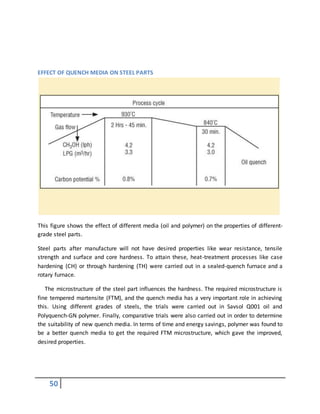
This figure shows the effect of different media (oil and polymer) on the properties of different-
grade steel parts.
Steel parts after manufacture will not have desired properties like wear resistance, tensile
strength and surface and core hardness. To attain these, heat-treatment processes like case
hardening (CH) or through hardening (TH) were carried out in a sealed-quench furnace and a
rotary furnace.
The microstructure of the steel part influences the hardness. The required microstructure is
fine tempered martensite (FTM), and the quench media has a very important role in achieving
this. Using different grades of steels, the trials were carried out in Savsol Q001 oil and
Polyquench-GN polymer. Finally, comparative trials were also carried out in order to determine
the suitability of new quench media. In terms of time and energy savings, polymer was found to
be a better quench media to get the required FTM microstructure, which gave the improved,
desired properties.
51
2) QUENCHING MEDIA DURING THEHEAT TREATMENT
Quenching media is very important to hardening because it is a very effective of hardness of
the material
quenching medias:
Water:
water is fairly good quenching medium. It is cheap, readily available, easily stored nontoxic
nonflammable smokeless and easy to filer and pump but with water quench the formation of
bubbles may cause soft spots in the metal. Agitation is recommended with use of water
quench. Still other problems with water quench include its oxidizing nature, its corrosivity and
the tendency to excessive distortion and cracking although this bad properties for plain carbon
steels.
Brine (salt water): Brine is a more severe quench medium than water. Unfortunately it tends to
accelerate corrosion problems unless completely removed. Sodium or potassium hydroxide can
be used when very severe quenching is desired and one wishes to obtain good hardness in low
carbon steels
]
Oil: When slower cooling rate is desired oil quenches can be employed. The slower cooling
through the ms to mf temperature range leads to a milder temperature gradient and a reduced
likelihood of cracking. Problems associated with quenchants include water contamination,
smoke and fire hazards. In addition quench oils tend to be somewhat expensive.
Air: Low alloy steels in light sections and high alloy steels may be successfully hardened by
means of compressed air or still air. The advantages of using air are that distortion is negligible
and that the steel can easily be straightened during cooling process. One drawback here is that
the surface may be oxidized the cooling.
52
3) SELECTION OF QUENCHING MEDIUMS
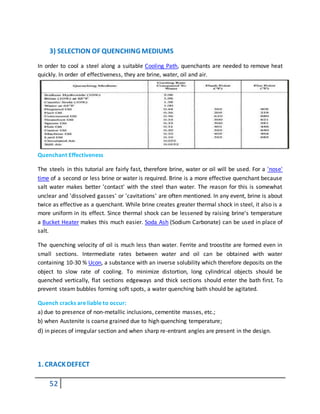
In order to cool a steel along a suitable Cooling Path, quenchants are needed to remove heat
quickly. In order of effectiveness, they are brine, water, oil and air.
Quenchant Effectiveness
The steels in this tutorial are fairly fast, therefore brine, water or oil will be used. For a 'nose'
time of a second or less brine or water is required. Brine is a more effective quenchant because
salt water makes better 'contact' with the steel than water. The reason for this is somewhat
unclear and 'dissolved gasses' or 'cavitations' are often mentioned. In any event, brine is about
twice as effective as a quenchant. While brine creates greater thermal shock in steel, it also is a
more uniform in its effect. Since thermal shock can be lessened by raising brine's temperature
a Bucket Heater makes this much easier. Soda Ash (Sodium Carbonate) can be used in place of
salt.
The quenching velocity of oil is much less than water. Ferrite and troostite are formed even in
small sections. Intermediate rates between water and oil can be obtained with water
containing 10-30 % Ucon, a substance with an inverse solubility which therefore deposits on the
object to slow rate of cooling. To minimize distortion, long cylindrical objects should be
quenched vertically, flat sections edgeways and thick sections should enter the bath first. To
prevent steam bubbles forming soft spots, a water quenching bath should be agitated.
Quench cracks are liable to occur:
a) due to presence of non-metallic inclusions, cementite masses, etc.;
b) when Austenite is coarse grained due to high quenching temperature;
d) in pieces of irregular section and when sharp re-entrant angles are present in the design.
1. CRACKDEFECT
53
Causes of Cracks during Heat Treat
The heat treating process can be an intensely stressful process for the material involved. The
material must first be heated to the point where austenitization can occur, and then cooled
rapidly enough to have the transformation into martensite take place, but avoid the possibility
cracking. It can be a delicate process at times.
Cracking during heat treat can be caused by several factors. One of the factors that may initiate
a crack may be the heating of the material itself. As the material is heated it undergoes a
volumetric change both as a result of transformation products being produced and thermal
expansion. At times “cracks” that become evident during this phase are really material
imperfections, seams and inclusions from the manufacturing process.
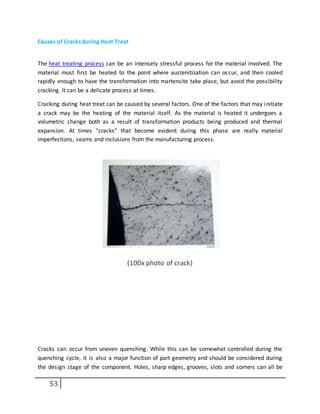
(100x photo of crack)
Cracks can occur from uneven quenching. While this can be somewhat controlled during the
quenching cycle, it is also a major function of part geometry and should be considered during
the design stage of the component. Holes, sharp edges, grooves, slots and corners can all be
54
potential crack initiation zones. At a sharp edge or edge of a hole for example, the heating and
cooling rates can be substantially higher than the surrounding areas. This puts tremendous
strain on the material in these regions during the heating and quenching cycles. While those
features may be necessary in the component, it is important to exercise good engineering
practices and properly chamfer or radius those areas to prevent sharp corners and edges.
When this is not practical, certain materials may be placed in holes and other critical areas to
help act as a heat sink and dampen the shock during the quenching operation, this can be costly
and the efficiency of the heat treat operation will suffer.
Additionally material selection and process can contribute to the possibility of cracking. High
carbon and alloy materials with high hardenability often exhibit a higher tendency to initiate
and propagate cracks. Also, as is the case often with Induction heat treating of multiple zones,
care must be taken to temper the material before subsequent heat treating, especially if the
zones are close together or part geometry or specific requirements mandate it.
We at Zion Industries look forward to working with you on specific parts that may be a problem
currently or that you may have had a problem with cracking in the past. Our team would be
happy to evaluate the project and help offer a solution.
2) PROCESS RELATED CRACK:-
Failures of steel parts in service or production occur very infrequently. However, when steel
parts fail, the consequences are dire
55
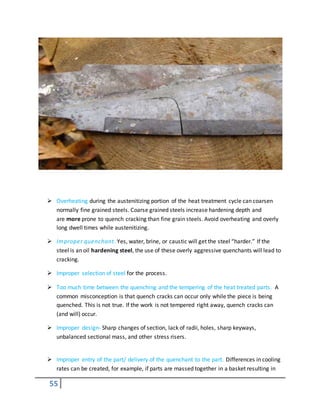
 Overheating during the austenitizing portion of the heat treatment cycle can coarsen
normally fine grained steels. Coarse grained steels increase hardening depth and
are more prone to quench cracking than fine grain steels. Avoid overheating and overly
long dwell times while austenitizing.
 Improper quenchant. Yes, water, brine, or caustic will get the steel “harder.” If the
steel is an oil hardening steel, the use of these overly aggressive quenchants will lead to
cracking.
 Improper selection of steel for the process.
 Too much time between the quenching and the tempering of the heat treated parts. A
common misconception is that quench cracks can occur only while the piece is being
quenched. This is not true. If the work is not tempered right away, quench cracks can
(and will) occur.
 Improper design- Sharp changes of section, lack of radii, holes, sharp keyways,
unbalanced sectional mass, and other stress risers.
 Improper entry of the part/ delivery of the quenchant to the part. Differences in cooling
rates can be created, for example, if parts are massed together in a basket resulting in
56
the parts along the edges cooling faster than those in the mass in the center. Part
geometry can also interfere with quenchant delivery and effectiveness, especially on
induction lines.
Failure to take sufficient stock removal from the original part during machining. This can leave
remnants of seams or other surface imperfections which can act as a nucleation site for a
quench crack.
Finally, materials that are heat treated to very high strength levels, even though they did not
quench crack, may contain localized concentrations of high residual stresses. If these stresses
are acting in the same direction as the load applied in service, an instantaneous failure can
occur. This will be virtually indistinguishable from a quench crack during an examination, due to
its brittle failure mode, lack of decarburization on surface of the fracture, or other forensic
evidence of a process failure.
When looking at quench cracking failures under the microscope, cracks and crack
tributaries that follow the prior austenitic grain boundaries are a pretty good clue that
grain coarsening and or its causes- overheating or too long time at temperature-
occurred. Temper scale on the fracture surface helps the metallurgist know that the
crack was present before tempering. Decarburization may show that the crack was
open prior to quenching.
3) PREVENTION OF CRACKS IN HEATTREATMENT:-
1. We can prevent the crack during the heat treatment:-
2. By selecting the proper quenching medium
3. By selecting the proper quenching method
4. Keeping the hardening temperature on lower side
5. Avoiding the over soaking
6. Checking the material before heat treatment
1). BENDING / DISTORTION DURING HARDENING:-
During quenching, certain material properties change. Quenching suppresses phase
transformations by only providing a narrow window of time for low-temperature processes.
Process conditions and the resulting heat transfer from workpiece surfaces to quenching
medium are crucial conditions for the description of the quenching process and possible
distortion. This distortion in industrial processes is compensated by material allowance in the
57
manufacturing and finishing rework after the final heat treatment or hardening process,
respectively.
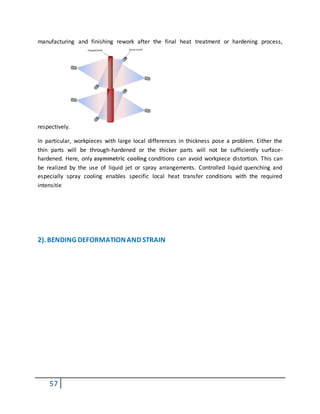
In particular, workpieces with large local differences in thickness pose a problem. Either the
thin parts will be through-hardened or the thicker parts will not be sufficiently surface-
hardened. Here, only asymmetric cooling conditions can avoid workpiece distortion. This can
be realized by the use of liquid jet or spray arrangements. Controlled liquid quenching and
especially spray cooling enables specific local heat transfer conditions with the required
intensitie
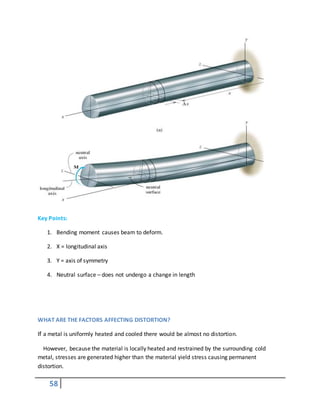
2). BENDING DEFORMATIONAND STRAIN
58
Key Points:
1. Bending moment causes beam to deform.
2. X = longitudinal axis
3. Y = axis of symmetry
4. Neutral surface – does not undergo a change in length
WHAT ARE THE FACTORS AFFECTING DISTORTION?
If a metal is uniformly heated and cooled there would be almost no distortion.
However, because the material is locally heated and restrained by the surrounding cold
metal, stresses are generated higher than the material yield stress causing permanent
distortion.
59
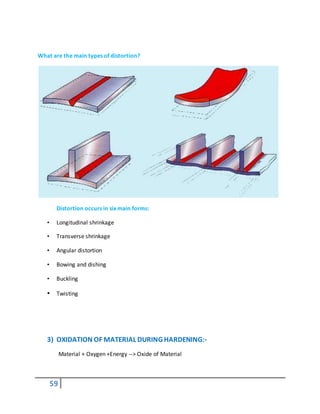
What are the main types of distortion?
Distortion occurs in six main forms:
• Longitudinal shrinkage
• Transverse shrinkage
• Angular distortion
• Bowing and dishing
• Buckling
• Twisting
3) OXIDATION OF MATERIAL DURING HARDENING:-
Material + Oxygen +Energy --> Oxide of Material
60
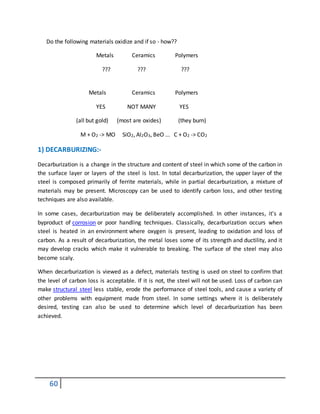
Do the following materials oxidize and if so - how??
Metals Ceramics Polymers
??? ??? ???
Metals Ceramics Polymers
YES NOT MANY YES
(all but gold) (most are oxides) (they burn)
M + O2 -> MO SiO2, Al2O3, BeO ... C + O2 -> CO2
1) DECARBURIZING:-
Decarburization is a change in the structure and content of steel in which some of the carbon in
the surface layer or layers of the steel is lost. In total decarburization, the upper layer of the
steel is composed primarily of ferrite materials, while in partial decarburization, a mixture of
materials may be present. Microscopy can be used to identify carbon loss, and other testing
techniques are also available.
In some cases, decarburization may be deliberately accomplished. In other instances, it's a
byproduct of corrosion or poor handling techniques. Classically, decarburization occurs when
steel is heated in an environment where oxygen is present, leading to oxidation and loss of
carbon. As a result of decarburization, the metal loses some of its strength and ductility, and it
may develop cracks which make it vulnerable to breaking. The surface of the steel may also
become scaly.
When decarburization is viewed as a defect, materials testing is used on steel to confirm that
the level of carbon loss is acceptable. If it is not, the steel will not be used. Loss of carbon can
make structural steel less stable, erode the performance of steel tools, and cause a variety of
other problems with equipment made from steel. In some settings where it is deliberately
desired, testing can also be used to determine which level of decarburization has been
achieved.
61
.
picture of decarb zone
2) CAUSES OF DECARBURIZATION:-
Chemical reactions
The most common reactions are:
also called the Boudouard reaction
Other reactions are[1]
62
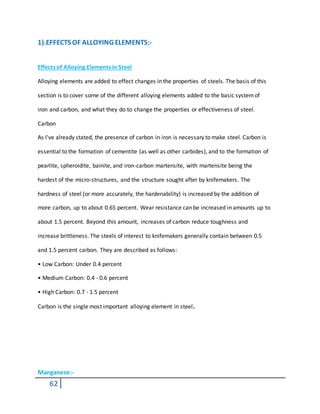
1).EFFECTS OF ALLOYING ELEMENTS:-
Effects of Alloying Elements in Steel
Alloying elements are added to effect changes in the properties of steels. The basis of this
section is to cover some of the different alloying elements added to the basic systemof
iron and carbon, and what they do to change the properties or effectiveness of steel.
Carbon
As I've already stated, the presence of carbon in iron is necessary to make steel. Carbon is
essential to the formation of cementite (as well as other carbides), and to the formation of
pearlite, spheroidite, bainite, and iron-carbon martensite, with martensite being the
hardest of the micro-structures, and the structure sought after by knifemakers. The
hardness of steel (or more accurately, the hardenability) is increased by the addition of
more carbon, up to about 0.65 percent. Wear resistance can be increased in amounts up to
about 1.5 percent. Beyond this amount, increases of carbon reduce toughness and
increase brittleness. The steels of interest to knifemakers generally contain between 0.5
and 1.5 percent carbon. They are described as follows:
• Low Carbon: Under 0.4 percent
• Medium Carbon: 0.4 - 0.6 percent
• High Carbon: 0.7 - 1.5 percent
Carbon is the single most important alloying element in steel.
Manganese:-
63
Manganese slightly increases the strength of ferrite, and also increases the hardness
penetration of steel in the quench by decreasing the critical quenching speed. This also
makes the steel more stable in the quench. Steels with manganese can be quenched in oil
rather than water, and therefore are less susceptible to cracking because of a reduction in
the shock of quenching. Manganese is present in most commercially made steels
Silicon
Silicon is used as a deoxidizer in the manufacture of steel. It slightly increases the
strength of ferrite, and when used in conjunction with other alloys can help increase the
toughness and hardness penetration of steel
Nickel
Nickel increases the strength of ferrite, therefore increasing the strength of the steel. It is
used in low alloy steels to increase toughness and hardenability. Nickel also tends to help
reduce distortion and cracking during the quenching phase of heat treatment.
Molybdenum
Molybdenum increases the hardness penetration of steel, slows the critical quenching
speed, and increases high temperature tensile strength.
Vanadium
Vanadium helps control grain growth during heat treatment. By inhibiting grain growth it
helps increase the toughness and strength of the steel.
Tungsten
Used in small amounts, tungsten combines with the free carbides in steel during heat
treatment, to produce high wear resistance with little or no loss of toughness. High
amounts combined with chromium gives steel a property known as red hardness. This
64
means that the steel will not lose its working hardness at high temperatures. An example
of this would be tools designed to cut hard materials at high speeds, where the friction
between the tool and the material would generate high temperatures.
Copper
The addition of copper in amounts of 0.2 to 0.5 percent primarily improves steels
resistance to atmospheric corrosion. It should be noted that with respect to knife steels,
copper has a detrimental effect to surface quality and to hot-working behavior due to
migration into the grain boundaries of the steel.
Niobium
In low carbon alloy steels Niobium lowers the transition temperature and aids in a fine
grain structure. Niobium retards tempering and can decrease the hardenability of steel
because it forms very stable carbides. This can mean a reduction in the amount of carbon
dissolved into the austenite during heat treating.
Boron
Boron can significantly increase the hardenability of steel without loss of ductility. Its
effectiveness is most noticeable at lower carbon levels. The addition of boron is usually
in very small amounts ranging from 0.0005 to 0.003 percent.
Titanium
This element, when used in conjunction with Boron, increases the effectiveness of the Boron in
the hardenability of steel.
2) SPECIFIC ELEMENTEFFECT ON HARDNESS:-
The effects of alloying elements vanadium and molybdenum on hardness and the
linear thermal expansion coefficient of the Invar-type austenitic cast irons were investigated. A
65
combined addition of vanadium and molybdenum was found to be the most effective for the
improvement of hardness without causing an increase in the thermal expansion coefficient.
Without heat treatment, the hardness value increased up to 180 HB, and the thermal expansion
coefficient was kept at a relatively low value of 4.6 × 10⁻⁶ K−1 with a combined addition of 4.6
wt% V and 3.8 wt% Mo. The effects on the damping capacity of graphite morphology, the
magnetic domain, and the combined addition of vanadium and molybdenum were also
investigated. The good damping capacity of Invar-type cast irons was mainly the result of stress
absorption in graphite. As the amounts of vanadium
Major classifications of steel[2]
SAE
designation
Type
1xxx Carbonsteels
2xxx Nickel steels
3xxx Nickel-chromiumsteels
4xxx Molybdenumsteels
5xxx Chromiumsteels
6xxx Chromium-vanadiumsteels
7xxx Tungstensteels
66
1) LOW ALLOY STEEL GRADE:-
Low alloy steels contain a few percent (typically between 1 and 7%) of elements such as Cr, Ni,
Mo and V. This category includes chromium steels (containing up to 5% Cr and 1% Mo) and
nickel steels (containing up to 5% Ni).
Low alloy steels are generally weldable (see What is weldability?), but it is important to know
the service, joint configuration and the subgroup of the material type.
It is important to know the composition of the material, either from a mill sheet or a dedicated
chemical analysis, as composition influences weldability significantly.
With increasing carbon or alloy content, low alloy steels generally become more difficult to
weld as the heat affected zone hardness increases. The need for postweld heat
treatment (PWHT) of these joints also increases. The composition is also important in
identifying high, but allowable, levels of residual elements such as sulphur or phosphorus,
which can lead to problems with liquation cracking or temper embrittlement during PWHT.
To avoid fabrication hydrogen cracking, it is important to use low hydrogen processes and
consumables, particularly as increasing the carbon and alloy content, and increasing the section
thickness, increases the risk of hydrogen cracking. A post-heat treatment may be required to
reduce the levels of hydrogen in the weld region.
Stainless steel
Type 102—austenitic general purpose stainless steel working for furniture
200 Series—austenitic chromium-nickel-manganese alloys
Type 201—austenitic that is hardenable through cold working
Type 202—austenitic general purpose stainless steel
300 Series—austenitic chromium-nickel alloys
Type 301—highly ductile, for formed products. Also hardens rapidly during mechanical working.
Good weldability. Better wear resistance and fatigue strength than 304.
8xxx Nickel-chromium-molybdenumsteels
9xxx Silicon-manganese steels
67
Type 302—same corrosion resistance as 304, with slightly higher strength due to additional
carbon.
Type 303—free machining version of 304 via addition of sulfur and phosphorus. Type 304—the
most common grade; the classic 18/8 (18% chromium, 8% nickel) stainless steel. Outside of the
US it is commonly known as "A2 stainless steel",
Type 304L—same as the 304 grade but lower carbon content to increase weldability. Is slightly
weaker than 304.
2)CHEMICAL COMPOSITIONOF LOWALLOY STEEL GRADES:-
The American Iron and Steel Institute (AISI) defines carbon steel as follows: Steel is considered
to be carbon steel when no minimum content is specified or required for chromium, cobalt,
columbium [niobium], molybdenum, nickel, titanium, tungsten, vanadium or zirconium, or any
other element to be added to obtain a desired alloying effect; when the specified minimum for
copper does not exceed 0.40 per cent; or when the maximum content specified for any of the
following elements does not exceed the percentages noted: manganese 1.65, silicon 0.60,
copper 0.60.
Steels can be classified by a variety of different systems depending on:
 The composition, such as carbon, low-alloy or stainless steel.
 The manufacturing methods, such as open hearth, basic oxygen process, or
electric furnace methods.
 The finishing method, such as hot rolling or cold rolling
 The product form, such as bar plate, sheet, strip, tubing or structural shape
 The deoxidation practice, such as killed, semi-killed, capped or rimmed steel
 The microstructure, such as ferritic, pearlitic and martensitic
 The required strength level, as specified in ASTM standards
 The heat treatment, such as annealing, quenching and tempering, and
thermomechanical processing
68
 Quality descriptors, such as forging quality and commercial quality
Standard Chemical Analysis Specifications: Please choose an AISI/SAE number and press
"Display Analysis" to see standard chemical analysis specification. Alternatively, click here to
view a table of all chemical composition limits for our Low Carbon steels.
AISI C Mn P S SAE
1008 .10 Max. .30 - .50 .040 .050 1008
1010 .08 - .13 .30 - .60 .040 .050 1010
1012 .10 - .15 .30 - .60 .040 .050 1012
1015 .12 - .18 .30 - .60 .040 .050 1015
1016 .12 - .18 .60 - .90 .040 .050 1016
1017 .14 - .20 .30 - .60 .040 .050 1017
1018 .14 - .20 .60 - .90 .040 .050 1018
1019 .14 - .20 .70 - 1.00 .040 .050 1019
1020 .17 - .23 .30 - .60 .040 .050 1020
1022 .17 - .23 .70 - 1.00 .040 .050 1022
1023 .19 - .25 .30 - .06 .040 .050 -
1025 .22 - .28 .30 - .60 .040 .050 1025
1030 .27 - .34 .60 - .90 .040 .050 1030
69
1035 .31 - .38 .60 - .90 .040 .050 1035
1040 .36 - .44 .60 - .90 .040 .050 1040
1) HEAT TREATMENT FURNACE:-
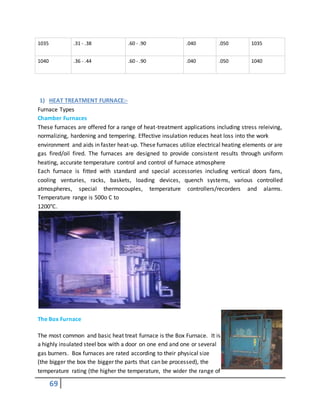
Furnace Types
Chamber Furnaces
These furnaces are offered for a range of heat-treatment applications including stress releiving,
normalizing, hardening and tempering. Effective insulation reduces heat loss into the work
environment and aids in faster heat-up. These furnaces utilize electrical heating elements or are
gas fired/oil fired. The furnaces are designed to provide consistent results through uniform
heating, accurate temperature control and control of furnace atmosphere
Each furnace is fitted with standard and special accessories including vertical doors fans,
cooling venturies, racks, baskets, loading devices, quench systems, various controlled
atmospheres, special thermocouples, temperature controllers/recorders and alarms.
Temperature range is 500o C to
1200°C.
The Box Furnace
The most common and basic heat treat furnace is the Box Furnace. It is
a highly insulated steel box with a door on one end and one or several
gas burners. Box furnaces are rated according to their physical size
(the bigger the box the bigger the parts that can be processed), the
temperature rating (the higher the temperature, the wider the range of
70
products) and the pounds per hour (productivity).
Insulation may be fibrous (like blankets or mats) or rigid (like boards, slabs or bricks).
Accuracy of temperature control is an issue in many processes, so better units will promote
tighter temperature control.
Pit-Pot Type Furnaces:-Pit-Pot type furnaces are specially designed for annealing, normalizing &
salt-bath solution treatment. The furnaces are electrically heated with high-tech ceramics
blanket insulation. These furnaces are provided with steel baffles which accommodate the
charge basket. Hence charge is not exposed to direct radiation of heat. Furnaces can be
provided with centrifugal blowers for even heat distribution.Doors are vertical lifting and
revolving type with press & lock lever mechanism. Temperature of furnaces is controlled
automatically by on/off digital temperature controllers and digital timers with alarm. Furnace
with forced air circulation for tempering also offered. The furnaces are thematically sealed with
good temperature uniformity and hence are suitable for carbo fluids, endo gas or nitriogen
methanol atmosphere. Hence they find applications in carbonitriding, bright hardening, bright
annealing, bright normalizing etc.
Pit Furnaces
Pit Furnaces may or may not actually be installed in "pits" but the load is always vertical. They
range in size from about 6 feet that stand on a floor, to over 40 feet that penetrate deep into
the ground. Note that the load must be put in and taken out from over-head equipment. So a
40 foot load must have a 40+ foot crane, etc.
71
The same kinds of processes are completed in pit furnaces as any other kind of batch furnace,
but the loads are very sensitive to flexing or bending stresses so they must be held
vertically.
Vacuum Furnaces
These Furnaces are engineered to provide the highly controlled furnace environment required
for effective heat treating of material. These furnace systems represent a clean processing
alternative with no adverse effect on environment. Advantages of vacuum heat treatment
include: No change in surface structure, composition or properties of steel, No oxidation or
decarburizing, No need to clean after treatment and No heat loss.
Vacuum furnaces are a special kind of controlled atmosphere furnace. The parts produced in
vacuum furnaces are highly critical to the atmosphere they are exposed to when heated, so the
atmosphere in the furnace is first removed - a near vacuum is created, and then in some cases
the process continues in the 'vacuum' or a small amount of very pure gas is injected.
In the past, vacuum furnaces were only available in electric. Work over several years by the gas
industry has resulted in a several gas models, but they are still restricted in temperature range,
as compared to the electric versions. Therefore, electric still dominates this sector.
HEAT TRANSFER IN FURNACES:-
72
The main ways in which heat is transferred to the steel in a reheating furnace are shown in
Figure In simple terms, heat is transferred to the stock by:
• Radiation from the flame, hot combustion products and the furnace walls and roof.
• Convection due to the movement of hot gases over the stock surface
At the high temperatures employed in reheating furnaces, the dominant mode of heat
transfer is wall radiation. Heat transfer by gas radiation is dependent on the gas composition
(mainly the carbon dioxide and water vapour concentrations), the temperature and the
geometry of the furnace.
APPLICATIONS:-
 Controlled Atmosphere Heat Treat
o Normalizing
o Annealing
o Austenitizing
o Quenching / Hardening
o Ion-Nitriding
 Tempering
o Stress Relieving
o Solution Heat Treating
o Aging (Softening)
GENERAL FUEL ECONOMY MEASURES IN FURNACES:-
Typical energy efficiency measures for an industry with furnace are:
1) Complete combustion with minimum excess air
2) Correct heat distribution
3) Operating at the desired temperature
4) Reducing heat losses from furnace openings
5) Maintaining correct amount of furnace draught
6) Optimum capacity utilization
7) Waste heat recovery from the flue gases
73
8) Minimum refractory losses
9) Use of Ceramic Coatings
2) Working of main parts:-
 an plug Assemblies, fan wheels, shafts
 Bearings
 Radiant tube assemblies
 Ceramics
 Silicon carbide hearth plates
 Furnace retorts
 Furnace curtains
 Thermocouples
 Bayonet heating elements
 Recuperative burners
 Furnace rolls
 Maintenance agreements
 Activated alumina catalyst
 Moly heating elements
 Graphite heating elements
 Burners
1) SALT BATH FURNACE :-
Design Principles
74
The salt bath furnace consists essentially of a container made of metal. This container
holds molten salt in which the work pieces are immersed. The mode of heat transfer to
the work piece is by convection through the liquid bath. The molten bath possesses high
heat capacity which results in the work piece being heated up very quickly. To fabricate
a molten salt bath furnace that will work efficiently at an affordable cost of production.
Thus the following design considerations were taken:
Power consumption (diesel) required to operate the furnace should be at a minimum;
The component parts should be easily replaceableincaseofdamageorfailure;and
The design should be simple for easy construction and ease of operation; and safety
of the operator must be guaranteed
Furnace Lining Material
Silica Brick was selected as lining material for the furnace because of its low cost, high
refractoriness, and very low thermal conductivity .Other components and parts
selected for the design where influenced by cost, availability, efficiency and reliability.
Furnace Pot
The pot is a chrome based alloy steel pot with the following composition- 0.6%C,
0.30%Si, 2.00%Mn, 0.025%S, 0.018%P, 18%Cr, 10.5%Ni, and 3.0% Mo. The steel alloy
material was selected in preference to titanium due to its low cost and availability. In
addition, the chrome based alloy steel pot has very high melting point of 1920deg.C,
which is far above the maximum operating temperature of the furnace
HIGH TEMPERATURE SALT BATH:-
Recommended for both commercial and in-house heat treating. The high temperature salt bath
provides an air/oxygen-free medium for heating steels which greatly reduces oxidation,
decarburizing, and scaling of work.
Salt baths are very uniform and accurate and can be used up to1,800 degrees F. They are
popular with tool and die shops, machine shops, commercial heat treaters, and manufacturers.
Applications:
• Neutral hardening
• Carburizing
• Carbon nitriding
• Nitriding
• Stress relieving
75
• Annealing
• Tempering
• Cleaning/stripping (caustic
2) Working of main parts:-
Assembling:-
The assembling of the salt bath furnace was carried out manually and it involved the following:
1. Positioning of the furnace.
2. Coupling of the burner parts.
3. Fixing of the suction system.
4. Coupling and standing of the extractor line.
5. Fixing of the exhaust extension.
6. Positioning of the burner.
7. Setting the alignment of the burner and the extractorsystem.
8. Tightening of bolts and nuts.
9. Fixing the thermocouple in the furnace pot
Electrical Connections:-
Well insulated wires were used in other to prevent shock sand hazards. The sparker
transformer, sparker timer, thermocouple and light indicators were connected to the
temperature controller while the suction system was connected to the main switch of the salt
bath furnace. The circuit diagram for the entire connection is shown in Figure
76
PERFORMANCE EVALUATION:-
The performance of the furnace was evaluated by using its functionality (Temperature Sensing,
fuel consumption rate, and heating rate), aesthetics, maintainability, cost analysis ,estimated
life time and carburizing efficiency as basis for assessing the efficiency of the furnace.
Functionality of the Furnace Effectiveness of Temperature Sensing
The thermocouple tip is positioned in the salt bath 1/3 one third from the base and the salt at
molten is convectional, so there is homogeneity of the temperature in the inner pot. The
temperature controller is digital which makes the reading sensed to be accurate; also there is
regular temperature check using an external probe to calibrate the temperature controller
thereby guaranteeing effective temperature reading
Maintainability of the Salt bath Furnace :-
The furnace service life and efficiency can be enhanced by simple maintenance strategy, and by
following safety measures which are outlined in section 3.3. Bailing out of the cyanide salt when
it is still in the molten state after every operation is a necessity - this is because the salt is
hygroscopic and has the potentials of corroding the inner pot if not removed. The cyanide salt
should always fill the inner pot whenever the furnace is to be used. After the removal of the
molten salt at the end of heat-treatment, a salt neutralizer should be applied into the inner pot
as the temperature of the empty inner pot reduces to below150deg c.
All metallic containers, rods and plates used that had contact with the cyanide salt should be
washed in hot water before drying I performance of the salt bath furnace. It is observed that
the case and core hardness value is higher when a carburizing temperature of 870deg C. is
utilized in comparison with the selection of a carburizing temperature of 800deg.C. Also the
case and core hardness increases with the use of longer carburizing holding time. The trend
observed is consistent with the results reported by Gupta (2007) who performed similar
77
treatments using conventional furnaces. Since the developed salt bath furnace yields similar
results under the same test conditions as the conventional furnaces, then it could be said to be
reliable for use for thermo chemical treatment of steel materials.
3. Salt Composition & Selection :-
Hardening and quenching in molten salt baths offer the following benefits over other hardening
and quenching methods:
 Requires less floor space
 Faster heating cycles
 Scale free parts
 No pitting
 Reduced part distortion
 Elimination of quench cracks
 Easily washed
How Heat Treatment Salts Work
Heat treatment salts are melted in a salt bath furnace or system to form a molten salt bath.
Parts are dipped into the molten salt to clean, descale, anneal, temper, quench, cure, nitride,
carburize, carbonitride, case harden or coat. Operating temperatures or working temperature
ranges of molten salt baths range from under 200 to over 2000° F. Some heat treatment salts
are used inside sealed pack, which are then heated in a furnace to perform a pack carburizing
process. The large mass of the molten salt provides a very uniform heat source, which assures
parts are exposed to the same thermal profile within a batch or across a large part. Molten salts
are also useful in removing oxides and scales from metal without attacking the base metal,
which allows molten descaling salt baths to replace dangerous mineral acid solutions in some
applicationS
No. Composition Approximate melting point Work temperature range
78
HEAT TREATMENTS CONDUCTED IN SALT BATHS:-
 Quenching of steels. Quenching is rapid cooling from the temperature
above A3 (upper critical temperature). Relatively slow cooling rate provided by
molten salts prevents the work part from cracking and distortion.
 Austempering. Austempering is the isothermal hardening method in which a part is
quenched in a quenching medium (molten salt) and is left in it reaching uniform
1
NaOH 75%
KOH 19%
H2O 6%
284ºF (140ºC) 320-752ºF (160-280ºC)
2
KOH 50-60%%
NaOH 50-40%
- 572-752ºF (300-400ºC)
3 KNO3 100% 639ºF (337ºC) 662-930ºF (350-500ºC)
4
KNO3 50-60%
NaNO2 50-40%
275ºF (135ºC) 320-1022ºF (160-550ºC)
5
NaNO3 50-60%
NaNO2 50-40%
293ºF (145ºC) 311-932ºF (150-500ºC)
6
KNO3 50-60%
NaNO3 50-40%
437ºF (225ºC) 500-1112ºF (260-600ºC)
7 NaNO3 100% 698ºF (370ºC) 752-1110ºF (400-600ºC)
8
NaCl 10-15%
KCl 20-30%
BaCl2 40-50%
CaCl2 15-20%
752ºF (400ºC) 932-1472ºF (500-800ºC)
9
NaCO3 45-55%
KCl 55-45%
842ºF (450ºC) 1022-1652ºF (550-900ºC)
79
temperature distribution. The part is removed from the quenching medium after the
complete bainite formation. Tha austempering temperature range is 400-750°F
(204-399°C). Nitrate salts No. 4-6 are used for austempering treatment.
 Martempering. Martempering is the isothermal hardening method in which a part is
quenched in a quenching medium (molten salt) and is left in it reaching uniform
temperature distribution. The part is removed from the quenching medium before
the bainite formation. Martempering is performed at a temperature above the the
temperature of martensite formation (austenite-martensite transformation), which
is 400-480°F (200-250°C). Nitrate salts No. 4-6 are used for martempering
treatment of most alloys. Sodium nitrate (No.7) a potassium nitrate (No.3) are used
for martempering tool steels (hot-work and high speed steel).
 Hardening. Hardening is performed at 1400-2300°F (760-1260°C) in chloride salts
(No.8-11).
 Nitriding. Liquid nitriding is the process of diffusion enrichment of the surface layer
of a part withNitrogen provided by a molten cyanide base salt (extremely toxic
substance). The process is carried out at the temperatures 950-1075°F (510-580°C)
for about 4 hour.
 Carbonitriding. Liquid carbonitriding is the process of diffusion enrichment of the
surface layer of a part with carbon and nitrogen provided by a molten salt
containing 20-25% of sodium cyanide (extremely toxic substance). The process is
carried out at the temperatures 1500-1580°F (820-860°C).
 Carburizing. Liquid carburizing is the process of diffusion enrichment of the surface
layer of a part with carbon provided by a molten salt containing 10-25% of sodium
cyanide (extremely toxic substance). The process is carried out at the temperatures
1562-1742°F (850-950°C).
 Solution treatment of Aluminum alloys. Solution treatment is the operation of
heating the work park to a temperature at which the hardening
second phase particles dissolve in the matrix. Solution treatment of heat treatable
aluminum alloys is carried out at 900-1025°F (482-551°C). Fast solution heat
treatment may be achieved by heating .
 Deep brazing. Brazing is a method of joining two metal work pieces by means of a
filler material at a temperature above its melting point but below the melting point
of either of the materials being joined. Dip brazing is a brazing method in which the
work pieces together with the filler metal are immersed into a bath with a molten
salt. The filler material melts and flows into the joint. Chloride salts with addition of
reactive agents are used for deep brazing.
 Cleaning. Polymeric contamination on metal parts surfaces may be effectively
removed by immersion of the part into a molten salt. Polymers decompose and burn
80
at the temperature of the molten salt. Mixtures of hydroxides and nitrates at a
temperature within 650-950°F (343-510°C) are used for cleaning operation.
4. Safety precautions :-
The position of the furnace is a well ventilated area which reduces the risk of inhaling cyanide
fumes and it also helps to reduce the heat radiation from the furnace to the furnace
environment. Thus other operations can comfortably be carried out near the furnace environs
without the fear of heat radiation. Also the furnace is non-flammable, has very low volatility
and it does not pollute the environment.
The most expensive part of the developed salt bath furnace is the burner (heat exchanger)
which was purchased at the rate of #65,000.00 ($433.33). The average burner life span is over
20 years if the manufacturers guide is followed and the recommended simple routine
maintenance performed regularly. The major parts of the burner are the electric motor (of
maximum ½ Horse Power) that drives the pump ,the spark transformer that occasionally ignites
the atomized diesel, the nozzle that atomizes diesel and the fan blades attached to the line of
the electric motor. Of all these major parts only the electric motor require so annual
maintenance necessitated by the nature of electricity supply in which there are instances of
high voltage power supply. The estimated life time of the developed salt bath furnace is
conservatively 20yearswhich is comparable to life spans of furnaces designed in
Safety Precautions in the Use of Heat Treatment Salt Baths
1. In the case of cyanide salts, because of their poisonous nature, extreme care must be taken
in their use and disposal. An antidote to the poison must be kept close to the operating area
ready for immediate use.
2. The bath must be fitted with efficient hoods and extractors to carry all noxious fumes away
from the working area.
3. All items to be placed into the furnace should be preheated to remove any moisture, as this
could cause an explosion when brought into contact with the molten salts.
4. All salts should be washed clear of every metallic surface as they may cause corrosion.
81
5. The requirements to wear safety clothing and a full face mask must be complied with when
either working in, or attending salt bath furnaces.
HEAT TREATMENT ROOM SAFETY REGULATIONS:-
1. Free access to this area is restricted to authorized personnel only. No other person may
enter the heat treatment room without permission.
2. No welding may be undertaken unless the technician-in-charge is satisfied that the
person is capable of doing so safely.
3. Any person working in the heat treatment room must familiarize themselves
4. Any person working in the heat treatment room must have read and signed the appropriate
risk assessment if the work or equipment they are using has been risk assessed. Risk
assessments are kept in the filing cabinet within the mechanical workshop
5. During any welding operation the fume extraction system must be used.
6. Personal protective equipment is provided and must be used where necessary. Barrier
cream, lab coats, safety glasses/goggles and safety shoes are to be used as the work dictates.
Long hair must be completely covered.
7. No person shall mount any abrasive wheel unless he/she has been trained in accordance
with Grinding machines shall only be operated by technical staff and eye protection must be
worn.
8. Do not carry loads such that the weight may be dangerous or vision obscured.
9. Report any defective equipment to the technician-in-charge.
10. Smoking, eating and drinking in workshop areas is strictly prohibited.
11. Equipment must be cleaned after use. Any materials, tools or equipment used must be
tidied away.
12. Tools and equipment must not be removed from the heat treatment room without the
permission of the technician-in-charge.
82
13. In the event of a fire, act in accordance with the FIRE ACTION NOTICES displayed
throughout the building. Leave the building immediately and proceed to the assembly point.
14. All accidents/incidents/occupational ill health must be reported by using the online
reporting systemand the person in charge of the area must be informed.
15. It is the responsibility of the technician-in-charge to enforce these rules.
IMPORTANT:- Manual loading and unloading of heat treat furnaces is a dangerous and
unpleasant business. It places employees at substantial risk of injury and adds a great deal of risk
to the employer, especially when a quench operation is involved. Automatic loading is a better
and safer method.
HEAT TREATMENT OF TOOL STEELS
1 ) DIFFERENT GRADES OF TOOL STEELS:-
Tool steel refers to a variety of carbon and alloy steels that are particularly well-suited to be
made into tools. Their suitability comes from their distinctive hardness, resistance to abrasion,
their ability to hold a cutting edge, and/or their resistance to deformation at elevated
temperatures (red-hardness). Tool steel is generally used in a heat-treated state. Many high
carbon tool steels are also more resistant to corrosion due to their higher ratios of elements
such as vanadium and niobium.
With carbon content between 0.7% and 1.5%, tool steels are manufactured under carefully
controlled conditions to produce the required quality. The manganese content is often kept low
to minimize the possibility of cracking during water quenching. However, proper heat
treating of these steels is important for adequate performance, and there are many suppliers
who provide tooling blanks intended for oil quenching.
Tool steels are made to a number of grades for different applications. Choice of grade depends
on, among other things, whether a keen cutting edge is necessary, as in stamping dies, or
whether the tool has to withstand impact loading and service conditions encountered with such
hand tools as axes, pickaxes, and quarrying implements. In general, the edge temperature
under expected use is an important determinant of both composition and required heat
83
treatment. The higher carbon grades are typically used for such applications as stamping dies,
metal cutting tools, etc.
High speed types:-
T-type and M-type tool steels are used for cutting tools where strength and hardness must be
retained at temperatures up to or exceeding 760 °C (1,400 °F). M-type tool steels were
developed to reduce the amount of tungsten and chromium required.
T1 (also known as 18-4-1) is a common T-type alloy. Its composition is 0.7% carbon, 18%
tungsten, 4% chromium, and 1% vanadium. M2 is a common M-type alloy.
Hot-working types:-
H-type tool steels were developed for strength and hardness during prolonged
exposure to elevated temperatures. All of these tool steels use a substantial amount
of carbide forming alloys. H1 to H19 are based on a chromium content of 5%; H20 to
H39 are based on a tungsten content of 9-18% and a chromium content of 3–4%; H40
to H59 are molybdenum based.
Tool Steel Grades:-
Defining
property
AISI-SAE grade Significant characteristics
Water-
hardening
W
Cold-
working
O Oil-hardening
A Air-hardening; medium alloy
84
D High carbon; high chromium
Shock
resisting
S
High
speed
T Tungsten base
M Molybdenum base
Hot-
working
H
H1–H19: chromium base
H20–H39: tungsten base
H40–H59: molybdenum base
2) HARDENING & TEMPERING OF TOOLS STEELS:-
Heat Treating Process
The process consists of:-
A) PREHEATING 600-650 C & 950-1050 C
B) AUSTENITIZING (Soaking at High Heat).
C) QUENCHING - Quench to Hard Brittle (Martensite) condition.
D) TEMPERING (Drawing to desired hardness).
Annealing:-
Tool steels are furnished in the annealed condition which is the soft, machineable and
necessary condition for proper heat treat response. The exceptions to this are the prehardened
85
steels such as P-20, Brake Die, Holder Block and Maxel Tooling Plate which are furnished at
28/32 HRC and used at that hardness.
Tool steels should always be annealed prior to re-hardening and annealed steels should be re-
annealed after welding. Unlike hardening which requires a quench after soaking at the
hardening temperature, the essence of annealing is very slow cooling from the annealing
temperature. By way of example, A2 tool steel is annealed by heating to 1550 degrees F,
soaking for two hours at temperature, furnace cooling 50 degrees F per hour to below 1200
degrees F followed by air cooling. Some shops anneal late in the day after all other heat treating
has been finished by simply soaking the part to be annealed at the proper annealing
temperature and then turning the furnace off. The next morning the part is fully annealed and
ready for handling.
Preheating:-
Preheating plays no part in the actual hardening reaction and is often considered an
unnecessary step. However, preheating performs at least one major function, it minimizes
thermal shock, thus reducing the danger of excessive distortion, warping or cracking. As a
matter of fact, intricate tools and particularly high speed steels, are often preheated in two
steps: one below the transformation temperature and the second right at the transformation
temperature. Preheating does not require "soaking" but the tool should be equalized at the
preheat temperature. Remember, always bring your tools up with the furnace to the
preheating temperature.
Austenitizing (High Heat)
Austenitizing depends upon time and temperature, thus the common term, soak at high heat.
Of the two, temperature is the most critical. Never exceed the high heat range for the grade.
Excessive temperature will cause erratic results. Classic symptoms of overheating are low as-
quenched hardnesses and, depending upon the alloy content, shrinkage and loss of magnetic
properties. Soaking time should always be after the steel has caught up with the furnace
temperature. With the exception of high speed steels, a rule of thumb for soak time is one half
hour per inch of thickness with a forty-five minute minimum and if in doubt over how long to
soak a tool, soak it longer - never less. High speed steels are essentially equalized with the
furnace temperature as opposed to soaking due to the fact that the high heat range is so close
to the melting point. Essentially, high speed steels are equalized at the austenitizing (High Heat)
temperature in minutes of furnace time, never soaked.
Quenching:-
86
Quenching must be done promptly in the medium prescribed for the grade with the exceptions
discussed further. Actually, Water Hardening steels are properly quenched in brine. A pound of
salt to a gallon of water is a good guide. Oil Hardening steels should be quenched in circulated
commercial quenching oil which has been heated to 100/125 degrees F. In either case, the
liquid quenching bath should contain sufficient volume to prevent the bath from exceeding the
proper bath temperatures. Air Hardening steels will harden in still air in small sections.
However, medium to large sections may require a light, evenly distributed fan blast. A fan blast
on only one side of a section may cause uneven quenching which will result in warpage.
Large sections in certain air hardening grades will not develop full as- quenched hardness
unless they are started in oil. This process is commonly called interrupted oil quenching.
Simply stated, the tool is quenched into oil until the section just turns black followed by air
cooling. S7, an air hardening -shock resisting tool steel, is a classic example of a steel which
will not develop full hardness in larger sections unless it is given an interrupted oil quench.
High Speed steels are basically considered oil hardening, however, to minimize distortion, high
speed steels are commonly hardened with an interrupted oil quench or quenched in hot
quenching salt at 1000 degrees F followed by air cooling.
Tempering :-
Upon quenching, tool steels are in a highly stressed condition. To avoid cracking, tools should
be tempered immediately after quenching. As with Austenitizing, tempering is dependent on
temperature and time. The temperature must be closely controlled, to develop the desired
hardness range. For tempering time, a rule of thumb is one hour per inch of thickness with a
two hour minimum. Longer tempering times are not detrimental and it is essential that the
steel is soaked at temperature after the steel catches up with the furnace temperature. While
one thorough tempering cycle is sufficient for the lower alloyed tool steels like Wl and 01, the
more highly alloyed grades such as H13, S7, A2, D2 and the High Speed steels require multiple
tempering cycles. A rule of thumb is that liquid quenched steels may be tempered once, air
hardening steel require a double temper and high speed steels should have a triple temper.
All steels must be cooled in air to about 125 degrees F prior to the next tempering cycle.
Tool Materials generally have at least 0.60% C to 1.00% C
 High hardness to resist deformation
 Resistance to wear to achieve economical tool life
 Dimensional stability
87
APPLICATIONS
 Cutting Tools
 Dies for Casting or Forming
 Gages for Dimensional Tolerance Measurement
Dimensional Changes upon Heat Treatment
88
High Carbon Tool Steel
Formation of Austenite:-
Hypoeutectoid steels heated above A3 line
Hypereuctectoid steels heated between A1 and Acm lines
Potential problems include
Too low of temperature means incomplete solution of carbides
Too high of temperature
Austenite grain size becomes too large: brittleness
Quenching strain greater
Partial melting for high alloy steels
For high carbon steels containing appreciable amount of nickel and manganese, retained
austenite can form
Depresses Ms and Mf line
Tempering of Tool Steels:-
 Most heat treat shops will perform two tempering treatments
 Tempers martensite formed in first tempering operation
89
 reduces micro- and macro stresses
Secondary Hardening
Subzero Treatments of Tool Steels
High C and alloy content causes retained austenite
 Higher than normal austenitization temperature
 failure to cool steel sufficiently
90
• Results in-
 greater secondary hardening
 greater change of dimensions upon tempering
 more chances of cracking upon cooling after tempering
 more brittle structure
 Three ways to minimize retained austenite
 under hardening (i.e. low austenitization temperature) .
 cooling to a low temperature to pass Mf line.
 double or triple temper.
CASE HARDENING OF STEELS
1. CONCEPT CASE HARDENING :-
Case hardening:-
Low carbon steels cannot be hardened by heating due to the small amounts of carbon present.
Case hardening seeks to give a hard outer skin over a softer core on the metal.
The addition of carbon to the outer skin is known as carburizing.
Pack carburizing.
91
The component is packed surrounded by a carbon-rich compound and placed in the furnace at
900 degrees.
Over a period of time carbon will diffuse into the surface of the metal.
The longer left in the furnace, the greater the depth of hard carbon skin. Grain refining is
necessary in order to prevent cracking.
Case Hardening :-
•Carburizing gas mixtures:-
– CO, CO2, H2, H2O, and N2(carrier gas)
– Reactions:
• 2CO Æ C(s) +CO2
• CO+H2 Æ C + H2O
– Control CO/CO2 + H2/H2O ratios to carburize or
decarburize
Surface Hardening
• Thermochemical treatments to harden surface of
part (carbon, nitrogen)
• Also called case hardening
• May or may not require quenching
92
• Interior remains tough and strong
Nitriding:-
• Nitrogen diffused into surface of special alloy
steels (aluminum or chromium)
• Nitride compounds precipitate out
– Gas nitriding - heat in ammonia
– Liquid nitriding - dip in molten cyanide bath
• Case thicknesses between 0.001 and 0.020 in. with
hardness up to HRC 70
Other Case Hardening:-
• Carbonotriding - use both carbon and nitrogen
• Chroming - pack or dip in chromium-rich
material - adds heat and wear resistance
• Boronizing - improves abrasion resistance,
coefficient of friction
Surface Hardening Methods:-
Reasons to Surface Harden
• Increase wear resistance
• Increase surface strenght for load carrying (crush resistance)
• Induce suitable residual and compressive stresses
• Improve fatigue life
• Impact resistance
Methods to Surface Harden:-
Induction Hardening:-
93

Induced eddy currents heat the surface of the steel very quickly and is quickly followed by
jets of water to quench the component.
 A hard outer layer is created with a soft core. The slide ways on a lathe are induction
hardened.
 Flame Hardening:-
94
Gas flames raise the temperature of the outer surface above the upper critical temp. The
core will heat by conduction.
Water jets quench the component
Age Hardening:-
 Hardening over a period of time
 Also known as precipitation hardening
 Occurs in duraluminium which is an aluminium alloy that contains 4% copper. This
makes this alloy very useful as it is light yet reasonably hard and strong; it is used in the
space industry.
The metal is heated and soaked (solution treatment) then cooled and left
COMMON MATHOD OF SURFACE HARDENING :-
• Heat Treatment
– Induction
95
– Flame
– Laser
– Light
– Electron beam
• Case Hardening
– Carburizing
– Cyaniding
– Carbonitriding
– Nitriding
Case Hardening :-
• Carburizing gas mixtures
– CO, CO2, H2, H2O, and N2(carrier gas)
– Reactions:
• 2CO Æ C(s) +CO2
• CO+H2 Æ C + H2O
– Control CO/CO2 + H2/H2O ratios to carburize or decarburize
2)Types of carburizing:-
Low-carbon steel is heated in a carbon-rich
Environment
– Pack carburizing - packing parts in charcoal or coke -
makes thick layer (0.025 - 0.150 in)
– Gas carburizing - use of propane or other gas in a
closed furnace - makes thin layer (0.005 - 0.030 in)
– Liquid carburizing - molten salt bath containing sodium
cyanide, barium chloride - thickness between other two
methods
• Followed by quenching, hardness about HRC 60
96
Pack Carburising
This process is the simplest and earliest carburising process based on placing the components
to be treated in metal containers with the caburising mixture, based on powdered charcoal and
10% barium carbonate, packed around the components. The containers are then heated to a
constant temperature (850oC to 850oC )for a time period to ensure an even temperature
throughout and sufficient to enable the carbon to diffuse into the surface of the components .
Because this process is difficult to control case depths of less than 0,6mm are not viable and the
normal case depths produced are 0,25mm to 6mm.
Advantages of pack carburizing:-
1) It is a cheap and simple method if only few parts are to be carburized.
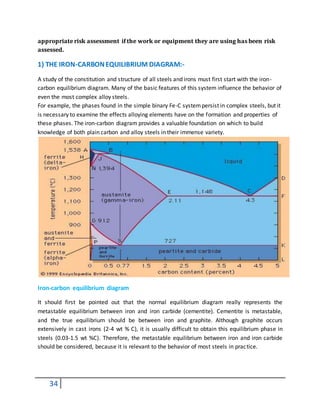
2) Very large and massive parts which are too large for gas or salt carburization
can be carburized if a furnace of that size is available. Pack carburization
can be done in large variety of furnaces if these are having uniformity of the temperature.
3) In comparison to liquid and gas carburization, this method carburization involves less capital
investment.
4) No atmosphere-controlled furnace is required.
Disadvantages of pack carburizing:-
1) Carburizing time is very long, as carburizing boxes as well as bad heat
conducting carburizing materials need to be heated.
2) It is difficult to control the surface carbon and the carbon gradient.
3) It is difficult to control the case depth exactly.
4) Handling carburizing material and packing is dirty and dusty job.
5) In pack carburization it is difficult to quench the carburized parts
Gas carburising:-
Gas caburising allos is accurate control of the process temperature and caburising atmosphere.
97
The components are brought to a uniform temperature in a neutral atmosphere. The caburising
atmosphere is introduced only for the required time to ensure the correct depth of case. The
carbon potential of the gas can be lowered to permit diffusion avoiding excess carbon in the
surface layer.
Gas carburising uses a gaseous atmosphere in a sealed furnace usually containing propane
(C3H8) or butane (C4H10). Sometimes the generted carbon dioxide, water vapour, and oxygen
are controlled at low levels by purifying using activated carbon filters at high tempertures.
An alternative carburising atmosphere is sometime generated by using a drip feed system by
feed an organic fluid based on methyl , ethyl or isopropyl achohol + benzene or equivalent is
fed into the carburising chamber at a controlled rate. In this process there are generally internal
fans working to ensure and even gas in the chamber.
After carburizing, the work is either slow cooled for later quench hardening, or quenched
directly into various liquid quenches. Quench selection is made to achieve the optimum
properties with acceptable levels of dimensional change. Hot oil quenching is preferred for
minimal distortion, but may be limited in application by the strength requirements for the
product.
Liquid carburising :-
This process is mostly used for producing shallow case depths in thin sections. The
components are heated quickly in a bath containing a suitable sodium cyanide salts and sodium
carbonate. The proportion of NaCN being maintained 20% to 30% by controlled feed strong
NaCN.
The normal case depths for this process are about 0,25mm with bath strengths of 20% to 30%
NaCN. High bath strengths 40% to 50% NaCN are required for case depths of 0,5mm. The case
resulting from this process includes carbon and nitrogen. The nitrogen does provide a hard
surface but can also encourage retained undesireable austenite in the surface layer. The bath is
sometimes convered with a graphite material to reduce the nitrogen content.
This process normall works with bath temperatures of 800oC to 950oC for immersion times from
2 to7 hours depending on the depth required.
For thicker case depths (up to 1,6mm) activated salt baths are used these are based on cyanide
and alkaline earth chlorides which act as the activators.
98
Components are normally jigged and pre-heated to about 350oC before being introduced into
the bath.
Advantages of gas carburization:
1) In gas carburization, the surface carbon content as well as the case depth can be accurately
controlled.
2) It gives more uniform case depth.
3) It is much cleaner and more efficient method than pack carburizing.
4) Total time of carburization is much less than the pack carburization as the
boxes and the solid carburizer are not to be heated.
Disadvantages of gas carburizing:-
1) Furnace and gas generator are expensive.
2) Trays are expensive.
3) Greater degree of operating skill is required.
4) Handling of fire hazards and toxic gases is difficult.
CASE HARDENING
• Reasons
– Easy to control depths
– Good for complicated parts
– Mass production compatible
– Can use with low carbon steels (cheaper and
tougher)
99
Application of case hardening
Typical applications include
Transportation: Case-hardened components are needed in any engine-driven vehicle, whether
it's a small car, a racecar, a truck or an ocean vessel.
Energy generation: Gear wheels and large components have to withstand cyclic stress and wear
in hydroelectric power stations, wind-turbine generators, propeller drives of drilling rigs and
steam-turbine gears of power stations.
General mechanical engineering: General mechanical engineering: Applications in this area
include forging presses, metal rolling equipment, machine tools; drivelines of mining equipment
and heavy-duty transmissions; earthmoving equipment and heavy-duty construction cranes.
Wear resistance and good fatigue strength are always key characteristics of the case-hardened
steels used for these applications
Everything that moves needs case-hardened gears
Quenching from the carburising temperature and subsequent tempering of the component
produces a high-carbon martensite having great hardness and wear resistance near the surface.
The uncarburised core retains its original good strength and toughness properties.
HARDENING AND TEMPERING OF LOW CARBON STEEL :-
Carbon steel:
Carbon steel (plain carbon steel) is steel which contain main alloying element is
carbon. Here we find maximum up to 1.5% carbon and other alloying elements like
copper, manganese, silicon. Most of the steel produced now-a-days is plain carbon
steel. It is divided into the following types depending upon the carbon content.
100
1. Dead or mild steel (up to 0.15% carbon)
2. Low carbon steel (0.15%-0.45% carbon)
3. Medium carbon steel(0.45%-0.8% carbon)
4. High carbon steel (0.8%-1.5% carbon)
Steel with low carbon content has properties similar to iron. As the carbon
content increases the metal becomes harder and stronger but less ductile and
more difficult to weld. Higher carbon content lowers the melting point and its
temperature resistance carbon content cannot alter yield strength of material.
Low carbon steel:-
Low carbon steel has carbon content of 1.5% to 4.5%. Low carbon steel is the
most common type of steel as its price is relatively low while its provides material
properties that are acceptable for many applications. It is neither externally brittle
nor ductile due to its low carbon content. It has lower tensile strength and
EN353 GEAR.
1) CASE DEPTH :-
Case depth is the thickness of the hardened layer on a specimen. Casehardening improves both
the wear resistance and the fatigue strength of parts under dynamic and/or thermal stresses.
Hardened steel parts are typically used in rotating applications where high wear resistance and
strength is required.
101
Total vs. Effective Case Depth
One of the benefits of induction hardening is the ability to selectively apply a surface hardness
or case hardness to steel materials. The case hardness will allow the piece to have superior
wear and strength characteristics at the surface, but allow the interior of the piece to remain
flexible.
Case hardness is defined as the outer surface that has been made harder than the interior, or
core. The term case depth refers to the depth of the case, or hardened layer of a piece of
material. Case depth is typically measured as “total” or “effective”. The two terms are
sometimes misunderstood, but are different and it is important to understand those
differences.
The term total case depth refers to the depth of hardness where the hardened layer reaches
the same hardness and properties as the base or core material. Total case depth is typically
measured by sectioning the work piece and polishing and etching with an acid solution to
reveal the depth of the hardened layer. The measurements can then be taken visually and
measured using a calibrated eyepiece or scale to qualify the total depth.
The term effective case depth refers to the depth where a hardness measurement drops
below a specified point. The hardness will then continue to decline until the “total” case depth
is reached. The hardness at the effective depth is specified based on the characteristics
required and the hardenabiltiy of the material. For example, high carbon steel that may have a
minimum surface hardness of 60 HRc may call for an effective case depth of 0.120” at 50 HRc.
102
The method of determining effective case depth involves sectioning the piece and polishing the
surface. Measurements of the hardness are then taken at regular depth intervals until the
hardness drops to the specified range. This distance from the surface is then measured to
determine the effective depth.
2) EFFECTIVE CASE DEPTH :-
Effective case depth of a hardened case is the depth up to a further point, for which a specified
level of hardness is maintained.
Total case depth
Total case depth of the hardened or unhardened case is the depth to a point where no
differences in chemical or physical properties of
the case and core can no longer be distinguished.
Case hardening methods
 Carburized cases
 Cyanided cases
 Carbonitrided cases
 Nitrided cases
 Flame or induction hardened cases
3.) CASE DEPTH DETERMINATION
Methods employed for determining the depth of the case are the following:-
 Chemical Methods
This method is generally applicable only for carburized cases, but may be used for
cyanided or carbonitrided cases.
The procedure consists of determining the carbon content at various depths below the surface
of a test sample. This method is considered as the most accurate for measuring the total case
depth
 Mechanical Methods
103
In general this method is considered to be one of the most useful and accurate of the case
depth measuring methods. It is the preferred method for determination for effective case
depth and can be used effectively on all types of hardness cases.
The following table suggests the hardness levels for various nominal carbon levels.
Carbon content % C Effective Case Depth
Carbon content % C Hardness
HRC HV
0.28 – 0.32 35 345
0.33 – 0.42 40 392
0.43 – 0.52 45 446
0.53 and over 50 513
 Visual Method
This method in general applies visual procedure with or without the aid of magnification for
reading the depth of case procedure by any of the various processes. Samples may be prepared
by combinations of fracturing, cutting, grinding and polishing methods. Etching with a suitable
reagent is normally required to produce the contrast between the case and core. Nital
(concentrated nitric acid in alcohol) of various strengths is frequently used for this purpose.
 Macroscopic Method
Magnification methods for determination of case depth measurement are recommended for
routine process control, primary because of the short time required for determinations, and the
minimum of specialised equipment and trained personnel needed. They have the added
advantage of being applicable to the measurement of all types of cases.
 Microscopic
Microscopic methods are generally for laboratory determination and require a complete
metallographic polish and an etch suitable for the material and the process. Usually the
104
magnification is 100x, in our case the used magnification is 40x which can be extra magnified by
2 or 3 times.
Microscopic method may be used for laboratory determination of total case and effective case
depths in the hardened condition. The distinction between macro and micro is based on the
test forces in relation to the indentation depth. Attention is drawn to the fact that the micro
range has an upper limit given by the force of 2N and a lower depth limit given by the
indentation of 0.2 µm.
Finally it is important to bear in mind that the method of case depth determination should be
carefully selected on the basis of specific requirements in terms of economy Vickers Micro
hardness test measurements principles The continuous monitoring of the force and the depth
of the indentation can permit the determination of hardness and materials properties. The
Diamond indenter is an orthogonal pyramid with a square base and in an inner angle α=136º
between the opposite faces at the vertex.
SPECIFIC HEAT TREATMENT PROCESSES
1) ANNEALING PROCESSES:-
 Makes a metal as soft as possible
 Hypoeutectoid steels (less than 0.83% carbon) are heated above upper critical temp.,
soaked and cooled slowly.
 Hypereutecoid (above 0.83%) are heated above lower critical temp., soaked and
allowed to cool slowly.
105
– All the structural changes obtained by hardening and tempering may be
eliminated by annealing.
• to relieve stresses
• to increase softness, ductility, and toughness
• to produce a specific microstructure
– Process consists of
• heating to the desired temperature
• holding
• cooling to room temperature
– annealing time must be long enough to allow for any necessary transformation
reactions
– Normalizing - used to refine the grains
–
• cooling in air, less expensive, some sections of a part may cool too fast
106
– Full anneal: Utilized in low and medium carbon steels that will be machined or
plastically deformed
• cooling in furnace to room temperature
• final product is coarse perlite (soft and ductile)
•
– Spheroidizing
• for medium and high carbon steels
• Fe3C will turn into the spheroids
– Some parts should be hard on the surface but soft and ductile inside
• shafts, gears, guideways of machine tools
• carious surface hardening processes
• heating on the surface only and
• quenching it
107
• flame hardening (by torch)
• induction hardening
• carburizing
2) DIFFERENT TYPES OF ANNEALING PROCESS:-
Types of Annealing
There are various types of annealing.
1. Full Annealing - The process involves heating the steel to 30 to 50 degrees Centigrade above
the critical temperature of steel and maintaining the temperature for a specified period of time,
then allowing the material to slowly cool down inside the furnace itself without any forced
means of cooling. Hot Worked sheets, forgings, and castings made from medium and high
carbon steels need full annealing.
2. Process Annealing - This process is mainly suited for low carbon steel. The material is heated
up to a temperature just below the lower critical temperature of steel. Cold worked steel
normally tends to posses increased hardness and decrease ductility making it difficult to work.
Process annealing tends to improve these characteristics. This is mainly carried out on cold
rolled steel like wire drawn steel, etc.
3. Stress Relief Annealing - Large castings or welded structures tend to possess internal stresses
caused mainly during their manufacture and uneven cooling. This internal stress cause
brittleness at isolated locations in the castings or structures, which can lead to sudden breakage
or failure of the material. This process involves heating the casting or structure to about
650 Degree centigrade. The temperature is maintained constantly for a few hours and allowed
to cool down slowly.
4. Spherodise Annealing - This is a process for high carbon and alloy steel in order to improve
their machinability. The process tends to improve the internal structure of the steel. This can be
done by two methods
a. The material is heated just below the lower critical temperature about 700 Degree
centigrade and the temperature is maintained for about 8 hours and allowed to cool down
slowly.
b. Heating and cooling the material alternatively between temperatures just above and below
the lower critical temperature.
5. Isothermal Annealing – This is a process where is steel is heated above the upper critical
temperature. This causes the structure of the steel to be converted rapidly into austenite
structure. The steel is then cooled to a temperature below the lower critical temperature about
108
600 to 700 Degree Centigrade. This cooling is done using a forced cooling means. The
temperature is then maintained constant for a specified amount of time in order to produce a
homogenous structure in the material. This is mainly applicable for low carbon and alloy steels
to improve their machinability.
Advantages of Annealing
The following are some of the advantages of annealing.
· It softens the steel.
· It enhances and improves the machinability of steel.
· It increases the ductility of steel
· It enhances the toughness of steel
· It improves the homogeneity in steel
· The grain size of the steel is refined a lot by annealing
· It prepares the steel for further heat treatment.
3) GRAIN SIZE & GRAIN GROWTH:-
Definition:
Grain size is normally quantified by a numbering system. Coarse 1-5 and fine 5-8. The
number is derived from the formula N=2n-1 where n is the number of grains per
square inch at a magnification of 100 diameters. Grain size has an important effect on
physical properties. For service at ordinary temperatures it is generally considered
that fine grained steels give a bettercombination of strength and toughness, whereas
coarse grained steels have better machinability.
GRAIN SIZE ANALYSIS
Why do grain size analysis?
Purely descriptive, quantitative measure of sediment
109
Grain size distribution may be characteristic of sediment deposited in certain environments
Size distributions may provide data about transport, deposition and diagenesis of the sediment.
Size is important in other properties like porosity and permeability
Different Measures of Size
Another complicating factor is the different measures of grain size. The planimetric method,
described below, yields the number of grains per square millimeter area, NA, from which we can
calculate the average grain area, A. It is common practice to take the square root of A and call
this the grain diameter, d, although this assumes that the cross sectional shape of the grains is a
square, which it is not. The intercept method yields a mean intercept length, L3 ; its relationship
to NA, A, ord is not exceptionally well defined. A variety of planar grain size distribution
methods have also been developed to estimate the number of grains per unit volume, Nv, from
which the average grain volume, V, can be calculated. The relationship between these spatial
measures of grain size and the above planar measures is also ill-defined.
It is now common to express grain sizes in terms of a simple exponential equation:
n = 2 G - 1
where:
n = the number of grains per square inch at 100X magnification, and
G = the ASTM grain size number.
This approach was developed and introduced in 1951 with the premiere of ASTM standard E 91,
Methods for Estimating the Average Grain Size of Non-Ferrous Metals, Other Than Copper and
Their Alloys. Although the NA, d, or L3, values had been used for many years as measures of
grain size, the G values were adopted readily due to their simplicity. As shown in Eq. 1, we can
directly relate the number of grains per unit area to G, but the relationship between L3, and G,
110
or NV and G are not as clearly defined. This problem is one of many being addressed by ASTM
Committee E4 on Metallography.
Grain growth is the increase in size of grains(crystallites) in a material at high temperature. This
occurs when recovery and recrystallisation are complete and further reduction in the internal
energy can only be achieved by reducing the total area of grain boundary.
Microstructure of different annealing materials:-
Pearlite and ferrite grain size
111
1) NORMALIZING:-
Applied to some, but not all, engineering steels, normalising can soften, harden or stress relieve
a material, depending on its initial state. The objective of the treatment is to counter the effects
of prior processes, such as casting, forging or rolling, by refining the existing non-uniform
structure into one which enhances machinability/formability or, in certain product forms,
meets final mechanical property requirements.
A primary purpose is to condition the steel so that, after subsequent shaping, a component
responds satisfactorily to a hardening operation (e.g. aiding dimensional stability).
Normalising consists of heating the suitable steel to a temperature typically in the range 830-
950°C (at or above the hardening temperature of hardening steels, or above the carburising
temperature for carburising steels) and then cooling in air. Heating is usually carried out in air,
so subsequent machining or surface finishing is required to remove scale or decarburised
layers.
Air-hardening steels (e.g. some automotive gear steels) are often "tempered" (subcritical
annealing ) after normalising to soften the structure and/or promote machinability. Many
aircraft specifications also call for this combination of treatments. Steels that are not usually
normalised are those which would harden significantly during air cooling (e.g. many tool steels),
or those which gain no structural benefit or produce inappropriate structures or mechanical
properties (e.g. the stainless steels).
Normalizing:-
112
 A heat treatment process consisting of austenitizing at temperatures of 30–80˚C above
the AC3 transformation temperature followed by slow cooling (usually in air)
 The aim of which is to obtain a fine-grained, uniformly distributed, ferrite–pearlite
structure
 Normalizing is applied mainly to unalloyed and low-alloy hypo eutectoid steels.
 For hypereutectoid steels the austenitizing temperature is 30–80˚C above the AC1 or ACm
transformation temperature
Normalizing – Heating and Cooling:-
113
After forging, hot rolling or casting a steel’s microstructure is often unhomogeneous consisting
of large grains, and unwanted structural components such as bainite and carbides. Such a
microstructure has a negative impact on the steel’s mechanical properties as well as on the
machinability. Through normalising, the steel can obtain a more fine-grained homogeneous
structure with predictable properties and machinability.
Effect of Normalizing on Grain Size:-
 Normalizing refines the grain of a steel that has become coarse-grained as a result of
heating to a high temperature, e.g., for forging or welding
steel of 0.5% C. (a) As-rolled or forged; (b) normalized. Magnification 500
114
Normalizing is normally done to achieve any one of the following purposes.
 To modify and/or refine the grain structure and to eliminate coarse grained structures
obtained in previous working operations such as rolling and forging etc.
 To modify and improve cast dendritic structures and reduce segregation by
homogenization of the microstructure.
 To produce a homogeneous micro structure and to obtain desired microstructure and
mechanical properties.
 To improve machinability of low carbon steels
 To improve dimensional stability
 To reduce banding
 To improve ductility and toughness
 To provide a more consistent response when hardening or case hardening.
 To remove macro structure created by irregular forming or by welding.
ANNEALING AND NORMALIZING:-
Annealing
In general, the main purpose of annealing heat treatment is to soften the steel, regenerate
overheated steel structures or just remove internal tensions.
It basically consists of heating to austenitizing temperature (800ºC and 950ºC depending on the
type of steel), followed by slow cooling.
Normalizing
Normalization is an annealing process. The objective of normalization is to intend to leave the
material in a normal state, in other words with the absence of internal tensions and even
distribution of carbon. For the process the high temperatures are maintained until the
complete transformation of austenite with air cooling.
It is usually used as a post-treatment to forging, and pre-treatment to quenching and
tempering.
115
Induction is used in most applications of annealing and normalizing in compared to
conventional ovens.
4) APPLICATION OF NORMALIZING PROCESS:-
Application of normalizing:-Normalizing is the most extensively used industrial process since it
is more economical to normalize the steel as against annealing. In normalizing since the cooling
takes place in air, the furnace is ready for next cycle as soon as heating and soaking is over as
compared to annealing where furnace cooling after heating and soaking needs 8 to twenty
hours depending upon the quantity of charge. Hence in many cases annealing is replaced by
normalizing to reduce the cost of heat treatment. Normalizing is adopted if the properties
requirements are not very critical.
Some typical examples of normalizing in commercial practice are as below.
Normalizing of gear blanks prior to machining so that during subsequent hardening or case
hardening dimensional changes such as growth, shrinkage or warpage can be controlled better.
Homogenization of cast and wrought structures
Cast metals and alloys are characterized by segregated, cored and dendritic structures as well
as non uniform properties. Similarly wrought metal and alloys after mechanical working such as
forging, rolling extrusion etc. have non uniform structure and properties. These structures and
properties are made homogeneous by normalizing.
In some few cases, when the steel is hot or cold worked, it is necessary to perform a
normalizing heat treatment in order to recover its original mechanical properties.
In case of normalizing heat treatment on weld metal the original as welded metal fine grained
microstructure is changed to a coarse equiaxed ferrite with ferrite-carbide aggregates and the
yield and tensile strength properties are considerably reduced.
116
ADVANCE HEAT TREATMENT PROCESSES
1 NITRIDING FURNACE :-
117
118
What is nitriding / nitrocarburising?
Gas nitriding and nitrocarburising belong to thermo chemical processes. During these
processes the surface of several work pieces or machine parts is enriched with nitrogen
(nitriding) or nitrogen with carbon (nitrocarburising). The former to improve the
mechanic properties of the surface of the workpieces or machine parts.
How does nitriding / nitrocarburising take place?During nitriding the components are exposed
to a nitrogen emitting environment at a temperature between 480-580 ⁰C,
During nitriding processes the components are exposed to a nitrogen emitting environment at
a temperature between 480-580 ⁰C, whereby this nitrogen is diffused
in the surface of the component.
Build-up and structure:-
119
Nitriding and nitrocarburising layers consist typically of two areas. The inner area, the
diffusion area, is characterized by formation of nitride needles at the edge of the component.
The normal layer thickness is between 0.2 to 1.5 mm. The outer area with a
thickness between approximately 5 to 30 μm
Process Variations:-
Nitriding and nitrocarburising processes can be performed in gas atmosphere, where the
nitrogen and carbon are available as gas, in a salt bath, where the nitrogen and carbon
are offered by molten salts, or in plasma, where the carbon and nitrogen is provided in
a vacuum atmosphere with ionized gasses. Except salt bath processes, all nitriding or
nitrocarburising processes can be performed. Also, the special processes such as Nitrotec®
or Stainihard® can be performed.
Suitable materials :-
All conventional steel, cast iron and sintering materials can be treated. Unalloyed as wel
as low and/or medium and alloyed steels are suitable for gas nitriding or nitrocarburising. High-
alloy steels with more than 13% Cr are due to their surface passivity only suitable for
treatment under certain conditions. Alloying elements such as aluminum, chromium and
titanium favor thereby increasing hardness and wear-resistance in the edge zone.
Alternatively, for these highly alloyed (austenitizing) steels the Stainihard® process
was developed. During this, stainless steel can be hardened without adversely affecting its
corrosion resistance.
Hardness Penetration Depth :-
Nitriding and nitrocarburising layers are characterized by the following layer thickness
120
and hardness penetration depth. The Nitriding Hardness Depth (NHT) according
to DIN 50 190-3- is the vertical distance from the edge, where the hardness reaches the
value of the core hardness plus 50 HV 0.5 hardness limit.The thickness of the connection zone
and the Nitriding Hardness Depth must often be agreed with the client according to the specific
material and the application.
Advantages of plasma nitriding crank shafts
Minimal distortion due to low temperature treatment.
No crack formation in consequence of tension optimized characteristics of the plasma nitrided
crank shafts.Very good emergency running properties due to lubrication oil stored in porous
zone of the white layer.Increased fatigue strength cause by raised compressive stress after
plasma nitriding.Threads and bore holes are not nitrided due to reduced gas pressure or
mechanical masking.Absolute reproducibility of heat treatment.
Disadvantages of conventional treatments
The difficulty, especially the heat treatment of crank shafts for high performance engines with
conventional treatment such as salt bath nitriding, gas nitriding and inductive hardening is well
known and constitutes, depending on the technique, the following disadvantages:
Thermal caused distortion and process-related inaccuracy of dimensions. Masking of threads
and lubrication holes combined with relatively high efforts. Crack formation.Bad or no
emergency running properties. Differences in tension in the peripheral zone. Low fatigue
strength .Ecological impacts. Lack of reproducibility
2) DIFFERENT NITRIDING PROCESS:-
Gas nitriding :-
121
In gas nitriding, nitrogen is introduced into a steel surface from a controlled
atmosphere by holding the metal at a suitable temperature in contact with a nitrogenous
gas, usually ammonia, NH3. The process represents one of the most efficient among the
various methods of improving the surface properties of engineering components,
especially the parts with complicated shapes requiring homogeneous hardening of the steel
Plasma nitriding :-
122
Plasma nitriding uses plasma-discharge technology at lower temperature to
introduce nascent nitrogen on the steel surface. It is another well-established surface
hardening process in steel and also known as ion nitriding. Plasma is formed by
high-voltage electrical energy in vacuum. Nitrogen ions are then accelerated to impinge
on the workpiece which is connected as a cathode. The ion bombardment heats the work
piece, cleans the surface and provides the nascent nitrogen for diffusion into the steel
Salt bath nitriding / liquid nitriding :-
123
is a subcritical surface enhancement process holding the longest track record of success over
any case hardening technology. It is widely used to enhance the performance of titanium,
chromium, and aluminum alloyed steels, as well as low alloy materials, and stainless steels. It is
more intense, and more efficient than gas nitriding, or ion nitriding.
Salt bath nitriding / liquid nitriding advantages include active case hardening process
(compound zone), additional lubricity, improved corrosion resistance, as well as improved
aesthetics. Dimensional stability of processed parts does not change and core properties are
uncompromised.
Salt bath nitriding / liquid nitriding can be performed on thru hardened steel. This yields the
benefits of thru hardening in the addition to a harder surface. This can be up to 75Rc,
depending on the material.
Subjacent to the compound zone is another distinctive region, the diffusion zone. This evolves
from progressive diffusion of the nitrogen, and consists of a solid solution of nitrogen in the
base material. The diffusion zone contributes another critical benefit of salt bath nitriding:
substantial enhancement of fatigue strength, typically between 20% to 100%.
Application:
124
 Automobile industry
 Agricultural industry
 Aviation
 Machinery and plant construction
 Tool-making
 Electronic industry
 Chemical industry
 Power stations
 Hydraulic industry
BENEFITS OF PLASMA NITRIDING PROCESS
 High resistance to abrasion
 High surface hardness
 Lower friction coefficient
 Improved corrosion resistance
 Improved heat resistance to about 500 °C
 Increased fatigue strength
 Good size and shape accuracy
VACUUMHEAT TREATMENT
125
1 VACUUM FURNACE:-
Vacuum Heat Treatment
Vacuum Technology is the Basis for Process Innovation in Heat Treatment.
Heat Treatment is the process in which metallic/steel parts are exposed completely or partially
to time-temperature sequences in order to change the mechanical and/or corrosion properties.
There are numerous application areas, e.g.:
• Annealing
• Hardening
• Tempering
• Aging
• Case hardening
to achieve a higher strength of the material, better wear resistance or to improve the corrosion
behaviour of the components.
All of these processes need a temperature up to 1.000 °C and higher as well as especially
developed furnaces to achieve such ranges. From the past there are well-known technologies
126
for the above processes, e.g.:
• Technology using molten salt
• Furnace for protective and/or activated atmospheres
Specific tools and dies
1. Gears and shafts, 2. Vacuum heat treatment, 3. Atmospheric heat treatment
Oxidation occurs on the part's surface when exposed to the atmosphere (air). This results in
costly and time-consuming post treatments. Therefore, heat treatment is preferably conducted
in an oxygen-free atmosphere. In addition to the use of high-purity protective gases, vacuum
allows the best protection against oxidation, thus being the most cost-efficient atmosphere.
Such furnaces are also used for high temperature brazing, a well established joining process.
Hardened steel structure Martensite
127
Annealing
Annealing is one type of heat treatment comprising heating up to a specific temperature,
holding and cooling down slowly. Such processes are generally used to obtain a softer structure
of the part and to optimise material structure for subsequent working steps (machining,
forming). Parameters depend on the material and the desired structure.
Hardening and Tempering
Hardening is a typical heat treatment process combining heating to specific temperatures
(mostly above 900 °C) and direct fast cooling or quenching of the part. The requirements are
selected to change the materials’ structure partially or completely into martensite. The part
undergoes tempering treatment after hardening in order to obtain high ductility and
toughness.
Case Hardening
One of the important processes is the case hardening or carburizing process. Parts are heated
up to 900 °C - 1.000 °C and by adding specific gases (hydrocarbons) into the atmosphere of the
furnace the part’s surface is enriched by absorbing carbon. Following this treatment the part is
quenched in order to achieve the required properties. This results in higher resistance to
stresses and friction on the component’s surface. The core of the part remains somewhat softer
and more ductile which allows the part to carry high stresses through its entire life. For
example, all gear parts for transmissions are treated this way.
Brazing
Brazing is a process for joining components, whereby a filler melts under temperature and joins
the components together after solidification. In this process, the solidus temperature of the
parts to be joined is not reached. In high temperature brazing (above 900 °C) which ideally
happens in vacuum, the atmosphere (vacuum) takes on the duties of the fluxing agent.
1. Piezo-Common-Rail diesel injection system, 2. Modular vacuum heat treatment
furnace
128
2) ADVANTAGES OF VACUUM HEAT TREATMENT:-
Vacuum as "Protective Atmosphere"
• No toxic protective gases containing CO
• No health hazards in the work shop
• No danger of explosion or open flames
• No furnace conditioning
• Use of inert gases (nitrogen or helium)
• No CO2 emission
Vacuum Carburizing
• Use of various processes
• Use of different gases
• Shorter carburizing cycles than in conventional technology
• Higher carburizing temperatures offer potential to further reduce process time
• Small gas consumption l instead of m3
Gas Quenching Instead of OIL Quenching
• Clean, dry parts after hardening
• No washing machine - no disposal of washing water
• No maintenance of washing equipment
• No complicated washing water chemistry
• Saves space
• Cost benefits
• Quenching intensity is controlled via gas pressure or gas velocity
• No vapor blankets during quenching
• Homogeneous quenching
• Reduced distortion
Surface Influences
• Free of surface oxidation
• No surface decarburization
• Bright, metallic, shiny parts
3 ) PLANT OPERATION / INSTALLATION / MAINTENANCE
• No idling over the weekend
• No continuous gas consumption
• Short heat-up times
129
• Fast access to installed modules
• No fire detection or sprinkler system
• No open flames
• No flammable gas mixtures
• Cold-Wall Technology
• No gas emission
• Minimum energy loss
• No heat radiation to atmosphere
Safety:-
Auxiliary Equipment of Protective Gas Plants are no longer required, like:
• Fire safety equipment
• Sprinkler system
• Exhausts
• CO2 extinguisher for the oil bath
• Measuring CO concentration in the shop
• Smoke exhaust in the roof (automatic opening and closing)
• Oil-proof floor or tank
• Methanol storage
Typical hard metal parts
The main advantages of this process are:-
• Bright oxide-free finishes
• No carbonization or decarburization
• Fluxless brazing
• Controlled heating
• Repeatability
• No hazardous fumes or toxic waste
130
A typical hardening cycle is fully automated. For loading, the chamber assemblies are raised
several inches from the quench tank flange by motor driven screw jacks, oil is pumped from the
quench tank to the reservoir tank, and the gantry is moved away from the quench tank. The
quench tank elevator is raised, the load is placed on it, and the elevator and load are lowered
into the quench tank. The gantry is moved back into position and lowered until the bottom of
the seal door chamber is sealed on the quench tank flange. The seal door and insulation doors
open and the elevator raises the load into the heating chamber. As the elevator descends back
into the quench tank the insulation doors, which also serve as the furnace hearth, close and
receive the load. After the elevator is withdrawn, the seal door closes to isolate the heating
chamber from the quench tank, the heating chamber is evacuated, and heating begins.
While these processes are underway, the quench oil is pumped from the reservoir tank back
into the quench tank. The quench tank is evacuated and backfilled with a partial pressure of
nitrogen to slightly below atmospheric pressure. The load is preheated then austenitized
according to specification requirements. At the beginning of the quenching sequence, the
heating chamber is backfilled with nitrogen to a pressure equal to that in the quench tank.
Power to the heating elements remains on during backfill to prevent heat loss in the load. The
seal door opens and the elevator ascends to raise the load slightly above the hearth upon which
the insulation doors open and the elevator quickly lowers the load into the quench tank.
Quench delay in this process for a full 118 in. high load is less than 10 seconds. While the load is
cooling in the quench tank, the gas quench system activates to cool the heating chamber in
preparation for accepting the next load.
A third, larger vacuum oil quench furnace, commissioned in December of 2005, was built for
hardening very large components such as those being developed for the landing gear in the
Airbus A380. The unit operates mostly on the same principles as its predecessor.
Vacuum Tempering:-
Vacuum tempering is being used for tempering high-speed steels and alloy steels to produce a
scale-free finish. A vacuum tempering furnace is very versatile and can be used for bright
tempering, aging and annealing. Other less common applications include decreasing, resin
131
bake-off and preferential oxide treatment of low carbon steels.
Vacuum Tempering is almost always required after hardening (both in an atmosphere furnace
as well as in vacuum), to reduce the hardness (and brittleness) of the treated material to a
desirable level.
Generally it is not necessary to use vacuum tempering after vacuum hardening, i.e.,
conventional tempering is most of the time used. Vacuum tempering may be used on high
value products, when totally clean surface appearance is required. The expression "vacuum
tempering" is used here to differentiate the process from.

Heat treatment course material

  • 1.
    1 1). ENGG. MATERIALS:- INTRODUCTIONMETAL/ METALLIC MATERIALS Metals are chemical elements that are known generally for their metallic luster, strength, hardness, and ability to conduct heat and electricity. Metals are generally not used in their pure state but as mixtures of metals or metal and non metal constituents commonly referred to as alloys. Alloying allows metals to be created with a vast range of properties allowing them to be used in a great variety of applications. Metals are divided into two main categories, ferrous and non-ferrous. Ferrous metals contain iron whereas non-ferrous metals do not. Ferrous and non-ferrous metals possess different properties; of particular importance is the rate at which they corrode in the natural environment. These properties great affect they type of coating system required.
  • 2.
    2 FERROUS METALS:- Ferrous metalscontain iron as the main component. Unprotected ferrous metals are extremely susceptible to corrosion commonly referred to as rust, which can occur almost immediately under the correct conditions. Rust is a continuous process, as the rust flakes off the surface exposing fresh metal. Steel (a common alloy) is used in almost every aspect of our lives from cars, buildings and bridges to chairs, cooking utensils and paper clips. Consequently, ferrous metals with their vast use in our environment require protection to ensure corrosion does not occur. Corrosion protection can be performed by creating a barrier between the metal and the environment, or by galvanic or cathodic protection methods. Paint coatings generally are barrier coatings although zinc rich coatings protect the metal by sacrificial galvanic protection. NON-FERROUS METALS:- Non ferrous metals are metals that do not contain iron. Examples include aluminium, zinc, copper and brass. In general non ferrous metals do not corrode as quickly as ferrous metals due to the rapid formation of a thin protective oxide layer on their surface although they are still susceptible to corrosion when exposed to atmospheric conditions. Due to the presence of the surface oxides, non-ferrous metals have different requirement for surface preparation and priming than ferrous metals.
  • 3.
    3 2). CLASSIFICATION OFMATERIAL:- Generally classified as ferrous and nonferrous:- Ferrous materials consist of steel and cast iron Eg. Carbon steel, high alloy steel, stainless steel.
  • 4.
    4 Nonferrous materials consistof the rest of the metals and alloys Eg. Aluminum, magnesium, titanium & their alloys Materials from each group are further classified and given certain designation according to the ASTM standard. Each has their own unique number/code that represent main alloying elements, cast or wrought and in case of plain carbon – amount of carbon. Steel can be classified or grouped according to some common characteristic. The most common classification is by their Composition Example : EN-31, EN-24 , CAST IRON VS CAST STEEL:- Iron is a hard grey metal, and heavier than any of the other elements found on Earth. During a process, impurities or slag is removed from iron, and it is turned into a steel alloy. This confirms that steel is an alloy, whereas iron is an element. Iron exists in natural forms, and scientists have found it in meteorite rocks as well. The main difference between the two elements is that steel is produced from iron ore and scrap metals, and is called an alloy of iron, with controlled carbon . Whereas, around 4% of carbon in iron makes it cast iron, and less than 2% of carbon makes it steel.
  • 5.
    5 Cast iron ischeaper than steel, and it has a low melting point with an ability to mold into any form or shape because it does not shrink when it gets cold. Steel is made with a controlled amount of carbon, whereas cast iron can have any amount of carbon. Carbons and other metals like chromium are added to the iron to make alloys and different qualities or grades of steel, such as stainless steel. Cast iron and steel are used as construction materials, and are used to make structures for buildings. Steel is used to make beams, doors etc. Cast iron has been used to make pipelines and guttering in the past. It is still used for making manhole covers, cylinder blocks in the engines of cars, and for very heavy and expensive cooking utensils, besides its other uses as a construction material. Steel is preferred by the automobile industry to make steel parts and components, and it is used in various other industries to make tools, knives, frames, 3). CLASSIFICATION OF METALS:- METALS:- Definition and Physical Properties of Metals:-
  • 6.
    6 In general, ametal is typically described as a chemical element, or mixture of elements, with the following properties: • Metals are typically hard when they are in their solid state (although there are exceptions, such as lead). • They are usually shiny or lustrous. • Metals are typically heavy; that is, they have relatively high density. • They are malleable (able to be formed and shaped) and ductile (easily drawn or bent). • They are good conductors of both heat and electricity. How can we compare metals?  Performance Physical & Chemical Properties  Composition & Structure Processing & Synthesis  These four categories are useful ways to sort different materials. Metals, polymers and  ceramics tend to have great differences in these categories. Each category will be briefly  discussed here, then used in later chapters to highlight the special qualities of each material 1) CLASSIFICATIONS OF STEEL :- STEEL:- Steel classification is important in understanding what types are used in certain applications and which are used for others. For example, most commercial steels are classified into one of three groups: plain carbon, low-alloy, and high-alloy. Steel classification systems are set up and updated frequently for this type of information.
  • 7.
    7 Steel is analloy of iron and carbon containing less than 2% carbon and 1% manganese and small amounts of silicon, phosphorus, sulphur and oxygen. Steel is the world's most important engineering and construction material. It is used in every aspect of our lives; in cars and construction products, refrigerators and washing machines, cargo ships and surgical scalpels. Fe + C = STEEL What is non alloy steel? Steel is common called carbon steel because of the mixture of carbon atoms with iron atoms. The added elements provide the steel with ductility and strength. During the smelting process, other elements, such as aluminum is added to the steel making it an alloy steel. Non-alloy steel has no elements added to the steel as it is smelted. TYPES OF STEEL :-
  • 8.
    8 Generally, carbon isthe most important commercial steel alloy. Increasing carbon content increases hardness and strength and improves hardenability. But carbon also increases brittleness and reduces weldability because of its tendency to form martensite. This means carbon content can be both a blessing and a curse when it comes to commercial steel. And while there are steels that have up to 2 percent carbon content, they are the exception. Most steel contains less than 0.35 percent carbon. To put this in perspective, keep in mind that's 35/100 of 1 percent. Now, any steel in the 0.35 to 1.86 percent carbon content range can be hardened using a heat- quench-temper cycle. Most commercial steels are classified into one of three groups: 1. PLAIN CARBON STEELS 2. LOW-ALLOY STEELS 3. HIGH-ALLOY STEELS 1) PLAIN CARBON STEELS:-
  • 9.
    9 These steels usuallyare iron with less than 1 percent carbon, plus small amounts of manganese, phosphorus, sulfur, and silicon. The weldability and other characteristics of these steels are primarily a product of carbon content, although the alloying and residual elements do have a minor influence. Plain carbon steels are further subdivided into four groups:  LOW  MEDIUM  HIGH  VERY HIGH  Low. Often called mild steels, low-carbon steels have less than 0.30 percent carbon and are the most commonly used grades. They machine and weld nicely and are more ductile than higher-carbon steels.  Medium. Medium-carbon steels have from 0.30 to 0.45 percent carbon. Increased carbon means increased hardness and tensile strength, decreased ductility, and more difficult machining.  High. With 0.45 to 0.75 percent carbon, these steels can be challenging to weld. Preheating, post heating (to control cooling rate), and sometimes even heating during welding become necessary to produce acceptable welds and to control the mechanical properties of the steel after welding.  Very High. With up to 1.50 percent carbon content, very high-carbon steels are used for hard steel products such as metal cutting tools and truck springs. Like high-carbon steels, they require heat treating befor be, during, and after welding to maintain their mechanical properties.
  • 10.
    10 3) CLASSIFICATIONS OFALLOY STEEL:- 1) LOW-ALLOY STEELS:- When these steels are designed for welded applications, their carbon content is usually below 0.25 percent and often below 0.15 percent. Typical alloys include nickel, chromium, molybdenum, manganese, and silicon, which add strength at room temperatures and increase low-temperature notch toughness. These alloys can, in the right combination, improve corrosion resistance and influence the steel's response to heat treatment. But the alloys added can also negatively influence crack susceptibility, so it's a good idea to use low-hydrogen welding processes with them. Preheating might also prove necessary. This can be determined by using the carbon equivalent formula, which we'll cover in a later issue. Microstructure of low alloy steel 2) HIGH-ALLOY STEELS :- For the most part, we're talking about stainless steel here, the most important commercial high-alloy steel. Stainless steels are at least 12 percent chromium and many have high nickel contents. The three basic types of stainless are:  Austenitic  Ferritic  Martensitic 1) STRESS – STRAIN CURVE:-
  • 11.
    11 ELASTIC BEHAVIOR:-  Thecurve is straight line trough out most of the region  Stress is proportional with strain  Material to be linearly elastic  Proportional limit  The upper limit to linear line  The material still respond elastically  The curve tend to bend and flatten out  Elastic limit  Upon reaching this point, if load is remove, the specimen still return to original shape  Yielding:-
  • 12.
    12  A Slightincrease in stress above the elastic limit will result in breakdown of the material and cause it to deform permanently.  This behavior is called yielding  The stress that cause = YIELD STRESS@YIELD POINT  Plastic deformation  Once yield point is reached, the specimen will elongate (Strain) without any increase in load  Material in this state = perfectly plastic  Strain hardening:-  When yielding has ended, further load applied, resulting in a curve that rises continuously  Become flat when reached ULTIMATE STRESS  The rise in the curve = STRAIN HARDENING  While specimen is elongating, its cross sectional will decrease  The decrease is fairly uniform  Necking  At the ultimate stress, the cross sectional area begins its localised region of specimen  it is caused by slip planes formed within material  Actual strain produced by shear strain  As a result, “neck” tend to form  Smaller area can only carry lesser load, hence curve downward  Specimen break at FRACTURE STRES  Shear stress  Shear force is a force applied sideways on the material (transversely loaded).
  • 13.
    13  Shear stressis the force per unit area carrying the load. This means the cross sectional area of the material being cut, the beam and pin. Shear stress :- and symbol is called Tau .  Shear strain :- The force causes the material to deform as shown. The shear strain is defined as the ratio of the distance deformed to the height .Since this is a very small angle , we can say that  Shear strain :- ( symbolcalled Gamma)  Ultimate shear stress:- A F  L x L x 
  • 14.
    14  If amaterial is sheared beyond a certain limit and it becomes permanently distorted and does not spring all the way back to its original shape, the elastic limit has been exceeded.  If the material stressed to the limit so that it parts into two, the ultimate limit has been reached.  The ultimate shear stress has symbol and this value is used to calculate the force needed by shears and punches. 2) MECHANICAL PROPERTIES OF STEEL:- The alloys and the heat treatment used in the production of steel result in it having different values and strengths. Testing must be accurate to determine the properties of the steel and to ensure adherence to standards. Different steels have different values of strength and toughness depending on the alloys made and the heat treatments used. Testing methods are important to determine values and to ensure that standards are adhered to. Methods of testing determine the yield strength, ductility and stiffness through tensile testing, toughness through impact testing, and hardness through resistance to penetration of the surface by a hard object.
  • 15.
    15 Tensile testing isa method of evaluating the structural response of steel to applied loads, with the results expressed as a relationship between stress and strain fig:- (a) & (b) is a good example . II. Elastic deformation: - When a sufficient load is applied to a metal or other structural material, it will cause the material to change shape. This change in shape is called deformation. A temporary shape change that is self-reversing after the force is removed, so that the object returns to its original shape, is called elastic deformation. In other words, elastic deformation is a change in shape of a material at low stress that is recoverable after the stress is removed. This type of deformation involves stretching of the bonds, but the atoms do not slip past each other F  bonds stretch return to initial
  • 16.
    16 Elastic means reversible:- II.PLASTIC (PERMANENT) DEFORMATION:- When the stress is sufficient to permanently deform the metal, it is called plastic deformation  Simple tension test :- Tensile properties:-
  • 17.
    17 YIELD STRENGTH, sy Stressat which noticeableplastic deformation has occurred. when ep = 0.002 Tensile strength:- TSMaximum possible engineering stress in tension Tensile testing is a method of evaluating the structural response of steel to applied loads, with the results expressed as a relationship between stress and strain. tensile stress,  engineering strain,  y p = 0.002
  • 18.
    18  Specially shapedspecimens of steel are subjected to a tensile force which gradually elongates the steel. The force is increased and the extension of the steel carefully measured.  The stress on the metal is evaluated by dividing the value of the force applied by the cross-sectional area of the specimen.  Stress = LOAD in Newtons / CROSS-SECTIONAL AREA of specimen in mm2  Strain is measured by calculating the increase in length of the specimen as a proportion of the original length.  Strain = INCREASE IN LENGTH in mm / ORIGINAL LENGTH in mm • Metals: occurs when noticeable necking starts. • Ceramics: occurs when crack propagation starts. • Polymers: occurs when polymer backbones are aligned and about to break. 3) UNIVERSAL TESTING MACHINE:-
  • 19.
    19 .(UTM) defines itas: “A universal testing machine is used to test the tensile stress and compressive strength of materials. It is named after the fact that it can perform many standard tensile and compression tests on materials, components, and structures.  Tensile Test  Compression Test  TENSILE TEST :- Tensile Test: Clamp a single piece of anything on each of its ends and pull it apart until it breaks. This measures how strong it is (tensile strength) how stretchy it is (elongation), and how stiff it is (tensile modulus)
  • 20.
    20 Tensile test specimen:- COMPRESSIONTEST:- The exact opposite of a tensile test. This is where you compress an object between two level plates until a certain load or distance has been reached or the product breaks. The typical measurements are the maximum force sustained before breakage (compressive force), or load
  • 21.
    21 at displacement (i.e.55 pounds at 1” compression), or displacement at load (i.e. 0.28” of compression at 20 pounds of force). ASSIGNMENT:-  Draw the stress strain curve  Explain the tensile testing method 1) HARDNESS TEST METHODS:- Hardness is resistance of material to plastic deformation caused by indentation. Sometimes hardness refers to resistance of material to scratching or abrasion. In some cases relatively quick and simple hardness test may substitute tensile test. Hardness may be measured from a small sample of material without destroying it. There are hardness methods, allowing to measure hardness onsite. Principle of any hardness test method is forcing an indenter into the sample surface followed by measuring dimensions of the indentation (depth or actual surface area of the indentation).
  • 22.
    22 Benefits of hardnesstest:  Easy  Inexpensive  Quick  Non-destructive  May be applied to the samples of various dimensions and shapes  May be performed in-situ Depending on the loading force value and the indentation dimensions, hardness is defined as a macro- , micro- or nano-hardness. Macro-hardness tests (Rockwell, Brinell, Vickers) are the most widely used methods for rapid routine hardness measurements. The indenting forces in macro-hardness tests are in the range of 50N to 30000N.  Brinell Hardness Test  Rockwell Hardness Test  Rockwell Superficial Hardness Test  Vickers Hardness Test  BRINELLHARDNESS TEST:-
  • 23.
  • 24.
    24 In this testa hardened steel ball of 2.5, 5 or 10 mm in diameter is used as indenter. The loading force is in the range of 300N to 30000N (300N for testing lead alloys, 5000N for testing aluminum alloys, 10000N for copper alloys, 30000N for testing steels). The Brinell Hardness Number (HB) is calculated by the formula: HB = 2F/ (3.14D*(D-(D² - Di²)½)) Where F- applied load, kg D – indenter diameter, mm Di – indentation diameter, mm. In order to eliminate an influence of the specimen supporting base, the specimen should be seven times (as minimum) thicker than indentation depth for hard alloys and fifteen times thicker than indentation depth for soft alloys.  ROCKWELL HARDNESS TEST:
  • 25.
    25 In the Rockwelltest the depth of the indenter penetration into the specimen surface is measured. The indenter may be either a hardened steel ball with diameter 1/16”, 1/8” or a spherical diamond cone of 120º angle (Brale). Loading procedure starts from applying a minor load of 10 kgf (3kgf in Rockwell Superficial Test) and then the indicator, measuring the penetration depth, is set to zero. After that the major
  • 26.
    26 load (60, 100or 150 kgf)is applied. The penetration depth is measured after removal of the major load. Hardness is measured in different scales (A, B, C, D, E, F, G, H, K) and in numbers, having no units (in contrast to Brinell and Vickers methods).  ROCKWELL SUPERFICIAL HARDNESS TEST :-  Rockwell Superficial Test is applied for thin strips, coatings, carburized surfaces.  Reduced loads (15 kgf, 30 kgf, and 30 kgf) as a major load and deduced preload (3kgf) are used in the superficial test.  Depending on the indenter, two scales of Rockwell Superficial method may be used: T (1/16” steel ball) or N (diamond cone).  62 R30T means 62 units, measured in the scale 30T (30 kgf, 1/16” steel ball indenter) by the Rockwell Superficial method (R).  VICKERS HARDNESS TEST:-
  • 27.
    27 The principle ofthe Vickers Hardness method is similar to the Brinell method.  The Vickers indenter is a 136 degrees square-based diamond pyramid.  The impression, produced by the Vickers indenter is clearer, than the impression of Brinellindenter, therefore this method is more accurate.  The load, varying from 1kgf to 120 kgf, is usually applied for 30 seconds. The Vickers number (HV) is calculated by the formula:
  • 28.
    28  HV =1.854*F/ D²  Where  F-applied load, kg  D – length of the impression diagonal, mm  The length of the impression diagonal is measured by means of a microscope, which is usually an integral part of the Vickers Tester. 2) HARDNESS TESTING SCALES:- 3) HARDNESS SCALECONVERSION TABLE:-
  • 29.
  • 30.
    30 1)HEATTREATMENT&ITS PURPOSE:- Definition: Heat treatmentis the process of heating and cooling metals to achieve desired physical and mechanical properties through modification of their crystalline structure. The temperature, length of time, and rate of cooling after heat treatment will all impact properties dramatically. The most common reasons to heat treat include increasing strength or hardness, increasing toughness, improving ductility and maximizing corrosion resistance. THE BASICS OF THE HEAT TREATING:- One of the goals in production tool-making is to create a tool that will be both hard enough to stand up under service conditions and tough enough not to crack, either in manufacture or in use. Five factors contribute to making a successful tool include good design, steel of the proper grade, correct heat treatment, proper grinding and proper use of the tool. Heat treatment alters the physical properties of a metal, including hardness, tensile strength, and toughness, through a three-step process of heating, cooling, and reheating. First, the metal is heated to an extremely high temperature, referred to as the critical temperature. This extreme heat will cause internal changes to the structure of the metal. The metal should remain at this temperature for a certain amount of time to ensure that the properties of the metal are altered consistently throughout.
  • 31.
    31 Why use heattreatment? • Soften a Part That Is Too Hard.,Harden a Part That Is Not Hard Enough,Put Hard Skin on Parts That Are Soft,Make Good Magnets Out of Ordinary Material. HEAT TREATMENT PROCESS:- HEAT-TREATING THEORY:- The various types of heat-treating processes are similar because they all involve the heating and cooling of metals; they differ in the heating temperatures and the cooling rates used and the final results. The usual methods of heat-treating ferrous metals (metals with iron) are annealing, normalizing, hardening, and tempering. Most nonferrous metals can be annealed, but never tempered, normalized, or case-hardened. Successful heat treatment requires close control over all factors affecting the heating and cooling of a metal. This control is possible only when the proper equipment is available. The furnace must be of the proper size and type and controlled, so the temperatures are kept within the prescribed limits for each operation. Even the furnace atmosphere affects the condition of the metal being heat-treated. The furnace atmosphere consists of the gases that circulate throughout the heating chamber and surround the metal, as it is being heated. In an electric furnace, the atmosphere is either air or a controlled mixture of gases. In a fuel-fired furnace, the atmosphere is the mixture of gases that comes from the combination of the air and the gases released by the fuel during combustion. These gases contain various proportions of carbon mon-oxide, carbon dioxide, hydrogen, nitrogen, oxygen,
  • 32.
    32 2) SAGES OFHEATTREATMENT:- Heat treating is accomplished in three major stages  Heating the metal slowly to ensure a uniform temperature Stage  Soaking (holding) the metal at a given temperature for a given time and cooling the metal to room temperature stage  Cooling the metal to room temperature HEATING STAGE:- The primary objective in the heating stage is to maintain uniform temperatures. If uneven heating occurs, one section of a part can expand faster than another and result in distortion or cracking. Uniform temperatures are attained by slow heating. The heating rate of a part depends on several factors. One important factor is the heat conductivity of the metal. A metal with a high-heat conductivity heats at a faster rate than one with a low conductivity. Also, the condition of the metal determines the rate at which it may be heated. The heating rate for hardened tools and parts should be slower than unstressed or untreated metals. Finally, size and cross section figure into the heating rate. Parts with a large cross section requires lower heating rates to allow the interior temperature to remain close to the surface temperature that prevents warping or cracking. Parts with uneven cross sections experience uneven heating; however, such parts are less apt to be cracked or excessively warped when the heating rate is kept slow. SOAKING STAGE:- After the metal is heated to the proper temperature, it is held at that temperature until the desired internal structural changes take place. This process is called SOAKING. The length of time depends upon thickness of the job. COOLING STAGE Cooling is done according to material and mechanical properties required.
  • 33.
    33 3) SAFETY MEASURES:- Glovescloth shoes and other 1. Free access to this area is restricted to authorized personnel only. No other person may enter the heat treatment room without permission. 2. No welding may be undertaken unless the technician-in-charge is satisfied that the person is capable of doing so safely. 3. Any person working in the heat treatment room must familiarize themselves with Part 4 (Mechanical Equipment) of the University Health and Safety Policy at 4. Any person working in the heat treatment room must have read and signed the
  • 34.
    34 appropriate risk assessmentif the work or equipment they are using has been risk assessed. 1) THE IRON-CARBONEQUILIBRIUM DIAGRAM:- A study of the constitution and structure of all steels and irons must first start with the iron- carbon equilibrium diagram. Many of the basic features of this system influence the behavior of even the most complex alloy steels. For example, the phases found in the simple binary Fe-C systempersist in complex steels, but it is necessary to examine the effects alloying elements have on the formation and properties of these phases. The iron-carbon diagram provides a valuable foundation on which to build knowledge of both plain carbon and alloy steels in their immense variety. Iron-carbon equilibrium diagram It should first be pointed out that the normal equilibrium diagram really represents the metastable equilibrium between iron and iron carbide (cementite). Cementite is metastable, and the true equilibrium should be between iron and graphite. Although graphite occurs extensively in cast irons (2-4 wt % C), it is usually difficult to obtain this equilibrium phase in steels (0.03-1.5 wt %C). Therefore, the metastable equilibrium between iron and iron carbide should be considered, because it is relevant to the behavior of most steels in practice.
  • 35.
    35 The much largerphase field of γ-iron (austenite) compared with that of α-iron (ferrite) reflects the much greater solubility of carbon in γ-iron, with a maximum value of just over 2 wt % at 1147°C (E, Fig.1). This high solubility of carbon in γ-iron is of extreme importance in heat treatment, when solution treatment in the γ-region followed by rapid quenching to room temperature allows a supersaturated solid solution of carbon in iron to be formed. The α-iron phase field is severely restricted, with a maximum carbon solubility of 0.02 wt% at 723°C (P), so over the carbon range encountered in steels from 0.05 to 1.5 wt%, α-iron is normally associated with iron carbide in one form or another. Similarly, the δ-phase field is very restricted between 1390 and 1534°C and disappears completely when the carbon content reaches 0.5 wt% (B). There are several temperatures or critical points in the diagram, which are important, both from the basic and from the practical point of view. Firstly, there is the A1, temperature at which the eutectoid reaction occurs (P-S-K), which is 723°C in the binary diagram. Secondly, there is the A3, temperature when α-iron transforms to γ-iron. For pure iron this occurs at 910°C, but the transformation temperature is progressively lowered along the line GS by the addition of carbon. The third point is A4 at which γ-iron transforms to δ-iron, 1390°C in pure iron, hut this is raised as carbon is added. The A2, point is the Curie point when iron changes from the ferro- to the paramagnetic condition. This temperature is 769°C for pure iron, but no change in crystal structure is involved. The A1, A3 and A4 points are easily detected by thermal analysis or dilatometry during cooling or heating cycles, and some hysteresis is observed. Consequently, three values for each point can be obtained. Ac for heating, Ar for cooling and Ae (equilibrium}, but it should be emphasized that the Ac and Ar values will be sensitive to the rates of heating and cooling, as well as to the presence of alloying elements. The great difference in carbon solubility between γ- and α-iron leads normally to the rejection of carbon as iron carbide at the boundaries of the γ phase field. The transformation of γ to α - iron occurs via a eutectoid reaction, which plays a dominant role in heat treatment. THE AUSTENITE- FERRITE TRANSFORMATION
  • 36.
    36 Under equilibrium conditions,pro-eutectoid ferrite will form in iron-carbon alloys containing up to 0.8 % carbon. The reaction occurs at 910°C in pure iron, but takes place between 910°C and 723°C in iron-carbon alloys. However, by quenching from the austenitic state to temperatures below the eutectoid temperature Ae1, ferrite can be formed down to temperatures as low as 600°C. There are pronounced morphological changes as the transformation temperature is lowered, which it should be emphasized apply in general to hypo-and hyper-eutectoid phases, although in each case there will be variations due to the precise crystallography of the phases involved. For example, the same principles apply to the formation of cementite from austenite, but it is not difficult to distinguish ferrite from cementite morphologically. THE AUSTENITE-CEMENTITE TRANSFORMATION The classification applies equally well to the various morphologies of cementite formed at progressively lower transformation temperatures. The initial development of grain boundary allotriomorphs is very similar to that of ferrite, and the growth of side plates or Widmanstaten cementite follows the same pattern. The cementite plates are more rigorously crystallographic in form, despite the fact that the orientation relationship with austenite is a more complex one. As in the case of ferrite, most of the side plates originate from grain boundary allotriomorphs, but in the cementite reaction more side plates nucleate at twin boundaries in austenite. THE AUSTENITE-PEARLITE REACTION Pearlite is probably the most familiar micro structural feature in the whole science of metallography. It was discovered by Sorby over 100 years ago, who correctly assumed it to be a lamellar mixture of iron and iron carbide. Pearlite is a very common constituent of a wide variety of steels, where it provides a substantial contribution to strength. Lamellar eutectoid structures of this type are widespread in metallurgy, and frequently pearlite is used as a generic term to describe them. 2) HYPO & HYPER EUTECTOID STEELS:- Eutectoid, Hypo-eutectoid & Hyper-eutectoid Alloys As discussed in the previous topic are those reactions accompanied by certain phase transformation and microstructural changes. These reactions happen at a given temperature and composition, giving them the name of a "zero degree of freedom'' reaction. Yet, with
  • 37.
    37 varying the contentof the alloying element, it is possible to undergo invariant reactions, giving a certain amount of the "invariant" phase(s). In this report, the focus is upon the eutectoid reaction. In this reaction, a solid solution phase transforms into a 2-phase solid solution structure as indicated in the following equation and figure (1). Cooling f Figure (1) Eutectoid Reaction Same goes for the eutectoid reaction in terms of the production of a eutectoid phases at lower or higher contents of the alloying element, producing hypo-eutectoid and hyper-eutectoid alloys respectively. Definitely such microstructural changes influence the mechanical properties. That is why one of the important phase diagrams to investigate the effect of such changes would be the Fe-Fe3C diagram (read as iron-iron carbide diagram) due to the branched and widespread applications of steel.
  • 38.
    38 Fe-Fe3C phase diagram Asshown in the Fe-Fe3C diagram, the iron iron carbide systemexperiences the eutectoid reaction when the gamma (austenite) phase transforms into alpha (ferrite) and Fe3C (cementite) phases. In fact, such transformation happens under certain conditions regarding the cooling rates, whether it is air or furnace cooled. This affects the microstructure of the produced eutectoid phases. In addition, increasing and decreasing the carbon content changes the amount of eutectoid phase 1) TTT DIAGRAM :-
  • 39.
    39 Time Temperature Transformation (TTT)Diagrams a. Path 1 (Red line) b. Path 2 (Green line) c. Path 3 (Blue line) d. Path 4 (Orange line  (Red) The specimen is cooled rapidly to 433 K and left for 20 minutes. The cooling rate is too rapid for pearlite to form at higher temperatures; therefore,
  • 40.
    40 the steel remainsin the austenitic phase until the Ms temperature is passed, where martensite begins to form. Since 433 K is the temperature at which half of the austenite transforms to martensite, the direct quench converts 50% of the structure to martensite. Holding at 433 K forms only a small quantity of additional martensite, so the structure can be assumed to be half martensite and half retained austenite.  (Green) The specimen is held at 523 K for 100 seconds, which is not long enough to form bainite. Therefore, the second quench from 523 K to room temperature develops a martensitic structure.  (Blue) An isothermal hold at 573 K for 500 seconds produces a half-bainite and half-austenite structure. Cooling quickly would result in a final structure of martensite and bainite.  (Orange) Austenite converts completely to fine pearlite after eight seconds at 873 K. This phase is stable and will not be changed on holding for 100,000 seconds at 873 K. The final structure, when cooled, is fine pearlite. 2) CRITICAL COOLING RATE:- What is critical cooling rate?
  • 41.
    41 The minimum rateof continuous cooling in the heat treatment of steels that is enough to prevent undesired transformations and formation of martensite in steel. Critical cooling rate: "The critical cooling rate is the limiting rate of cooling which ensures that a particular type of transformation product is formed. Carbon steel and the hardening thereof, weren't sufficiently understood until well into the last century. Before that time, and especially centuries before, the whole process was wrapped in secrecy, myth, ritual and magic. All knowledge was empirical and it was difficult, if not impossible, to know which parts of a forging ritual were vital and which weren't. Did moon phase have abearing? Were swords forged in the winter necessarily better than those in the summer? Did the wood source for charcoal really make much difference? Does speaking the correct words at the right moment matter? What could you do if your anvil got hexed? Chemical composition was uncertain, if not unknown. So the best smiths could do was follow a forging ritual which had an acceptable rate of success. That parts of forging rituals were silly, irrelevant and possibly counter-productive shouldn't preclude the process of having a ritual in the first place. What I'm presenting in this tutorial is a ritual of sorts. It's a way to understand, think about, organize information and activity toward a forging outcome. I suppose what I'm saying is that knowledge is just about updating the ritual not replacing it. Steel is a crystalline substance and as it's temperature changes, so too does it's crystalline structure. That's what heat treatmentdoes-it changes the crystalline structure by way of time and temperature. There are a lot of different structures in steel but only three needs your attention: Austenite, Ferrite and Martensite. Austenite exists at high temperature and to the left in the graphic below. Ferrite is to the right and Martensite at the bottom. We will use the term, Ferrite, to include Pearlite and Cementite as Pearlite is a form of Ferrite. Mostly, we're using Ferrite to mean any non-Austenite/Martinsite structure. So you only need to learn three steel words. COOLING PATH:-
  • 42.
    42  We're nowready to grapple with the central mystery of carbon steel--the Cooling Path. Above are five Cooling Paths--A through D. Each line signifies a different rate of cooling and thus different resultant steel structures. Steels with less than 0.3 % carbon cannot be hardened effectively, while the maximum effect is obtained at about 0.76 % due to an increased tendency to retain Austenite in high carbon steels.  But first, let's back up and first look at some other diagrams. Following is a phase diagram of carbon and iron. Indicated is our area of interest--1/2 to 1 percent of carbon and a temperature range of maybe 1800F down to room temperature. EQUILIBRIUM FE-C PHASE DIAGRAM:-
  • 43.
    43 The Iron Ageis based on this diagram--it's also color coded for temperature. Cast iron and steel exist because of the strange and wonderful chemical interactions between carbon and iron. Our area of interest, the blue line is 0.76% carbon. The thing to take away from this graphic is that as steel cools it experiences changes in crystalline structure. Once heated, how steel cools (the path it takes) will determine it's properties. Cooling Paths are a graphic representation of the function between time and temperature. For each steel there is
  • 44.
    44 a graph calleda TTT (time, temperature, transformation) graph or sometimes it's called a Isothermal Transformation Diagram. Let's call it TTT. Above is a portion of a generalized TTT graph. The red line starting at the upper left denotes a partial cooling path. Two things to notice here: First, the time axis at the bottom is a log (as in logarithmic) scale. TTT graphs always use a log time scale and it may take some getting used to. Notice the time scale at the top of the graph, it's the same, time-wise as the scale at the bottom. Now does a log scale make more sense? And finally, second, the cooling path is demonstrating a Austenite to Ferrite transformation--which, during final heat treating is the transformation we'll try and avoid. 3)THEORY OF MARTENSITEFORMATION:- we've got a Cooling Path for knife hardening, the blue line. This is a fairly typical TTT graph for simple carbon steel. As previously mentioned, every steel has its own graph and by reading the graph you can come to conclusions about how to best heat-treat the steel. Here's the deal. When steel is heated above Critical the crystalline structure changes to Austenite. Once steel is withdrawn from heat and cools to about 1350F, the graph above comes into play. The goal is to get the temperature to fall fast enough to miss the Nose and get into
  • 45.
    45 the Martensite rangebefore the Time Limit. In this case, that's less than a second (green dotted line). If you can get from Austenite to Martensite without crossing the Nose you'll have a hard, strong steel. The structure in the graph depicted by red lines is usually called an S Curve. We want to avoid it except at the bottom--the Martinsite range. That's it! That's the whole thing-- creating a cooling path, with quenchants, which avoids the S Curve and doesn't cause your blade to strain and crack. You have less than a second--one Mississippi--to get the blade's temperature under a thousand degrees. And to do it in a way that doesn't wreck the steel through heat shock. Do that and you've won the game! That's what the Cooling Path is, that's what it's about. PURPOSEOF HEATTREATMENT:- We heat treat metals in an attempt to optimize the mechanical and physical properties for a given application. Most people think of heat treatment as a process for hardening metal. This is not necessarily so, as many heat treatments are applied to soften metal in order to allow metal working operations such as deep drawing, cold forging and machining. Where increased strength and wear resistance is required, hardening and tempering treatments are given. Extremely hard steels find applications in cutting tools where highly defined edges must be maintained and heat treatment of these steels is a critical operation. Hard surfaces with ductile base material may be developed by heat treatment. There are also the solution heat treatments and ageing processes designed to increase the strength of some non ferrous metals and precipitation hardening steels. Heat treatment is a significant industry and forms a basic part of the industrial infrastructure of countries. 1) HEAT TREATMENTOF PLAIN CARBON STEELS:- Plain carbon steels are iron alloys of carbon content less than 2.08%. Heat treatment is changing the microstructure of steels alloys to change the strength, ductility, hardness, machinability, grain size and wear resistance. There are general reasons for heat treatment: 1. Hardening: a heat treatment to increase the hardness of the steel alloys.
  • 46.
    46 2. Tempering: aheat treatment that reduces the brittleness of a steel without significantly lowering its hardness and strength. All hardened steels must be tempered before use. 3. Softening: a heat treatment to increase the machinability of steels. 4. Re-crystallization: transformation of cold-worked grains to an undistorted shape. 5. Stress relief: removing internal stress from a metal that has been subjected to cold working or welding. 6. Hot working operations 7. Diffusion of alloying elements: remove internal stress from a metal that has been subjected to cold working or welding. One of the commonest heat treatment processes is the formation of Martensite. The process of formation of Martensite can be pinpointed as follows: 1. Heating a plain carbon steel alloy (from the eutectoid region, either hypo or hyper) to the austenite region 2. Having it held there for a while of time to fully austenize its structure. 3. Exposing it to a non-equilibrium cooling rate, the austenite will transform into Martensite. There are several ways of quenching plain carbon steels, such as using air, oil and water STRUCTURE AFTER QUENCHING THE BASICS OF THE HEAT TREATING:- One of the goals in production tool-making is to create a tool that will be both hard enough to stand up under service conditions and tough enough not to crack, either in manufacture or in use. Five factors contribute to making a successful tool include good design, steel of the proper grade, correct heat treatment, proper grinding and proper use of the tool. Heat treatment alters the physical properties of a metal, including hardness, tensile strength, and toughness,
  • 47.
    47 through a three-stepprocess of heating, cooling, and reheating. First, the metal is heated to an extremely high temperature, referred to as the critical temperature. This extreme heat will cause internal changes to the structure of the metal. The metal should remain at this temperature for a certain amount of time to ensure that the properties of the metal are altered consistently throughout. If the metal is then left to cool naturally, the metal will return to normal. In heat treatment, however, a process called quenching is used to control the rate at which the metal cools. Quenching involves the use of liquids or gases to cool the metal faster than it would naturally, allowing the metal to retain some of the changes introduced during the initial heating phase. Finally, the metal is heated again, this time to a temperature below the critical temperature. This second round of heat, referred to as tempering, is used to correct some of the issues that can be caused by the previous steps. The initial heating and quenching processes result in metal that is stressed, making it brittle and hard. Tempering relieves the stresses, increasing the toughness and ductility of the metal while retaining sufficient hardness and strength. Reheating the metal is an important step of the heat treatment process that should be performed soon after quenching. HARDENING:- The first step in heat treatment involves heating the metal to an extreme temperature to prepare it for quenching. All metals have a threshold, called the critical temperature, above which specific changes occur that alter the properties of the metal. During hardening, the metal should be brought to this temperature and should remain there until the heat has thoroughly penetrated the metal. In general, the metal should be kept at this critical temperature for a minimum of five minutes per inch of diameter or thickness. When working with metals such as steel tools, pre-heating may be necessary if the tool is large or has both heavy and light sections. Accuracy is very important during this stage, as both temperature and duration will affect the quality of the results. The furnace used must be brought to the correct temperature, above the metal’s critical range, and this temperature must be maintained for the proper length of time. Allowing the heat to thoroughly penetrate the metal ensures that the changes in the metal are uniform throughout. This is necessary to adequately prepare the metal for quenching, when the metal will be cooled at a controlled rate QUENCHING:- The second step in the heat treatment process is called quenching. During this phase, the heated metal is cooled using either a gas or liquid medium. This allows the metal to be cooled at a faster rate than if it were
  • 48.
    48 left to coolnaturally, thus retaining some of the physical alterations introduced by the initial heating stage. Once the metal has cooled, it should be tempered soon after quenching to relieve stresses in the metal due to the heating and quenching process. Quenching too quickly can cause metals to crack, so providing the proper medium for the metal, as well as an adequate amount of the fluid, is important to obtain quality results. When quenching in liquid baths, it is important to use sufficient amounts of fluid in order to keep the liquid cool and effective. Approximately one gallon of oil or water per hour should be used for every pound of steel to be quenched. In general, the tool should be cooled in the quenching medium until it reaches 150 Fahrenheit, then allowed to cool to room temperature before placing it in the tempering oven. 1. 2. 2)TEMPERING:- Tempering is a process of heat treating, which is used to increase the toughness of iron-based alloys. Tempering is usually performed after hardening, to reduce some of the excess hardness, and is done by heating the metal to some temperature below the critical temperature for a certain period of time, then allowed to cool in still air. The exact temperature determines the amount of hardness removed, and depends on both the specific composition of the alloy and on the desired properties in the finished product. For instance, very hard tools are often tempered at low temperatures, while springs are tempered to much higher temperatures. In glass, tempering is performed by heating the glass and then quickly cooling the surface, increasing the toughness. After a Tempering Colors:-
  • 49.
    49 3) PURPOSEOF TEMPERING:- Temperingis a process of heat treating, which is used to increase the toughness of iron-based alloys. Tempering is usually performed after hardening, to reduce some of the excess hardness, and is done by heating the metal to some temperature below the critical temperature for a certain period of time, then allowed to cool in still air. The exact temperature determines the amount of hardness removed, and depends on both the specific composition of the alloy and on the desired properties in the finished product. For instance, very hard tools are often tempered at low temperatures, while springs are tempered to much higher temperatures. In glass, tempering is performed by heating the glass and then quickly cooling the surface, increasing the toughness. 1) DIFFERENTQUENCHING PROCESSES:- Definition: Quenching is an accelerated method of bringing a metal back to room temperature, preventing the lower temperatures through which the material is cooled from having a chance to cause significant alterations in the microstructure through diffusion. Quenching can be performed with forced air convection, oil, fresh water, salt water and special purpose polymers. The slower the quench rate, the longer thermodynamic forces have a chance to alter the microstructure, which is in some cases desirable, hence the use of different media. When quenching in a liquid medium, it is important to stir the liquid around the piece to clear away steam from the surface; steampockets locally defeat the quench by air cooling until they are cleared away. Most commonly performed to harden steels, water quenching from a temperature above the austenitic temperature will cause carbon to be trapped inside the austenitic lath, resulting in the hard and brittle martensitic phase. Typically, the steel will be subsequently tempered to restore some of the ductility and toughness lost by conversion to martensite.
  • 50.
    50 EFFECT OF QUENCHMEDIA ON STEEL PARTS This figure shows the effect of different media (oil and polymer) on the properties of different- grade steel parts. Steel parts after manufacture will not have desired properties like wear resistance, tensile strength and surface and core hardness. To attain these, heat-treatment processes like case hardening (CH) or through hardening (TH) were carried out in a sealed-quench furnace and a rotary furnace. The microstructure of the steel part influences the hardness. The required microstructure is fine tempered martensite (FTM), and the quench media has a very important role in achieving this. Using different grades of steels, the trials were carried out in Savsol Q001 oil and Polyquench-GN polymer. Finally, comparative trials were also carried out in order to determine the suitability of new quench media. In terms of time and energy savings, polymer was found to be a better quench media to get the required FTM microstructure, which gave the improved, desired properties.
  • 51.
    51 2) QUENCHING MEDIADURING THEHEAT TREATMENT Quenching media is very important to hardening because it is a very effective of hardness of the material quenching medias: Water: water is fairly good quenching medium. It is cheap, readily available, easily stored nontoxic nonflammable smokeless and easy to filer and pump but with water quench the formation of bubbles may cause soft spots in the metal. Agitation is recommended with use of water quench. Still other problems with water quench include its oxidizing nature, its corrosivity and the tendency to excessive distortion and cracking although this bad properties for plain carbon steels. Brine (salt water): Brine is a more severe quench medium than water. Unfortunately it tends to accelerate corrosion problems unless completely removed. Sodium or potassium hydroxide can be used when very severe quenching is desired and one wishes to obtain good hardness in low carbon steels ] Oil: When slower cooling rate is desired oil quenches can be employed. The slower cooling through the ms to mf temperature range leads to a milder temperature gradient and a reduced likelihood of cracking. Problems associated with quenchants include water contamination, smoke and fire hazards. In addition quench oils tend to be somewhat expensive. Air: Low alloy steels in light sections and high alloy steels may be successfully hardened by means of compressed air or still air. The advantages of using air are that distortion is negligible and that the steel can easily be straightened during cooling process. One drawback here is that the surface may be oxidized the cooling.
  • 52.
    52 3) SELECTION OFQUENCHING MEDIUMS In order to cool a steel along a suitable Cooling Path, quenchants are needed to remove heat quickly. In order of effectiveness, they are brine, water, oil and air. Quenchant Effectiveness The steels in this tutorial are fairly fast, therefore brine, water or oil will be used. For a 'nose' time of a second or less brine or water is required. Brine is a more effective quenchant because salt water makes better 'contact' with the steel than water. The reason for this is somewhat unclear and 'dissolved gasses' or 'cavitations' are often mentioned. In any event, brine is about twice as effective as a quenchant. While brine creates greater thermal shock in steel, it also is a more uniform in its effect. Since thermal shock can be lessened by raising brine's temperature a Bucket Heater makes this much easier. Soda Ash (Sodium Carbonate) can be used in place of salt. The quenching velocity of oil is much less than water. Ferrite and troostite are formed even in small sections. Intermediate rates between water and oil can be obtained with water containing 10-30 % Ucon, a substance with an inverse solubility which therefore deposits on the object to slow rate of cooling. To minimize distortion, long cylindrical objects should be quenched vertically, flat sections edgeways and thick sections should enter the bath first. To prevent steam bubbles forming soft spots, a water quenching bath should be agitated. Quench cracks are liable to occur: a) due to presence of non-metallic inclusions, cementite masses, etc.; b) when Austenite is coarse grained due to high quenching temperature; d) in pieces of irregular section and when sharp re-entrant angles are present in the design. 1. CRACKDEFECT
  • 53.
    53 Causes of Cracksduring Heat Treat The heat treating process can be an intensely stressful process for the material involved. The material must first be heated to the point where austenitization can occur, and then cooled rapidly enough to have the transformation into martensite take place, but avoid the possibility cracking. It can be a delicate process at times. Cracking during heat treat can be caused by several factors. One of the factors that may initiate a crack may be the heating of the material itself. As the material is heated it undergoes a volumetric change both as a result of transformation products being produced and thermal expansion. At times “cracks” that become evident during this phase are really material imperfections, seams and inclusions from the manufacturing process. (100x photo of crack) Cracks can occur from uneven quenching. While this can be somewhat controlled during the quenching cycle, it is also a major function of part geometry and should be considered during the design stage of the component. Holes, sharp edges, grooves, slots and corners can all be
  • 54.
    54 potential crack initiationzones. At a sharp edge or edge of a hole for example, the heating and cooling rates can be substantially higher than the surrounding areas. This puts tremendous strain on the material in these regions during the heating and quenching cycles. While those features may be necessary in the component, it is important to exercise good engineering practices and properly chamfer or radius those areas to prevent sharp corners and edges. When this is not practical, certain materials may be placed in holes and other critical areas to help act as a heat sink and dampen the shock during the quenching operation, this can be costly and the efficiency of the heat treat operation will suffer. Additionally material selection and process can contribute to the possibility of cracking. High carbon and alloy materials with high hardenability often exhibit a higher tendency to initiate and propagate cracks. Also, as is the case often with Induction heat treating of multiple zones, care must be taken to temper the material before subsequent heat treating, especially if the zones are close together or part geometry or specific requirements mandate it. We at Zion Industries look forward to working with you on specific parts that may be a problem currently or that you may have had a problem with cracking in the past. Our team would be happy to evaluate the project and help offer a solution. 2) PROCESS RELATED CRACK:- Failures of steel parts in service or production occur very infrequently. However, when steel parts fail, the consequences are dire
  • 55.
    55  Overheating duringthe austenitizing portion of the heat treatment cycle can coarsen normally fine grained steels. Coarse grained steels increase hardening depth and are more prone to quench cracking than fine grain steels. Avoid overheating and overly long dwell times while austenitizing.  Improper quenchant. Yes, water, brine, or caustic will get the steel “harder.” If the steel is an oil hardening steel, the use of these overly aggressive quenchants will lead to cracking.  Improper selection of steel for the process.  Too much time between the quenching and the tempering of the heat treated parts. A common misconception is that quench cracks can occur only while the piece is being quenched. This is not true. If the work is not tempered right away, quench cracks can (and will) occur.  Improper design- Sharp changes of section, lack of radii, holes, sharp keyways, unbalanced sectional mass, and other stress risers.  Improper entry of the part/ delivery of the quenchant to the part. Differences in cooling rates can be created, for example, if parts are massed together in a basket resulting in
  • 56.
    56 the parts alongthe edges cooling faster than those in the mass in the center. Part geometry can also interfere with quenchant delivery and effectiveness, especially on induction lines. Failure to take sufficient stock removal from the original part during machining. This can leave remnants of seams or other surface imperfections which can act as a nucleation site for a quench crack. Finally, materials that are heat treated to very high strength levels, even though they did not quench crack, may contain localized concentrations of high residual stresses. If these stresses are acting in the same direction as the load applied in service, an instantaneous failure can occur. This will be virtually indistinguishable from a quench crack during an examination, due to its brittle failure mode, lack of decarburization on surface of the fracture, or other forensic evidence of a process failure. When looking at quench cracking failures under the microscope, cracks and crack tributaries that follow the prior austenitic grain boundaries are a pretty good clue that grain coarsening and or its causes- overheating or too long time at temperature- occurred. Temper scale on the fracture surface helps the metallurgist know that the crack was present before tempering. Decarburization may show that the crack was open prior to quenching. 3) PREVENTION OF CRACKS IN HEATTREATMENT:- 1. We can prevent the crack during the heat treatment:- 2. By selecting the proper quenching medium 3. By selecting the proper quenching method 4. Keeping the hardening temperature on lower side 5. Avoiding the over soaking 6. Checking the material before heat treatment 1). BENDING / DISTORTION DURING HARDENING:- During quenching, certain material properties change. Quenching suppresses phase transformations by only providing a narrow window of time for low-temperature processes. Process conditions and the resulting heat transfer from workpiece surfaces to quenching medium are crucial conditions for the description of the quenching process and possible distortion. This distortion in industrial processes is compensated by material allowance in the
  • 57.
    57 manufacturing and finishingrework after the final heat treatment or hardening process, respectively. In particular, workpieces with large local differences in thickness pose a problem. Either the thin parts will be through-hardened or the thicker parts will not be sufficiently surface- hardened. Here, only asymmetric cooling conditions can avoid workpiece distortion. This can be realized by the use of liquid jet or spray arrangements. Controlled liquid quenching and especially spray cooling enables specific local heat transfer conditions with the required intensitie 2). BENDING DEFORMATIONAND STRAIN
  • 58.
    58 Key Points: 1. Bendingmoment causes beam to deform. 2. X = longitudinal axis 3. Y = axis of symmetry 4. Neutral surface – does not undergo a change in length WHAT ARE THE FACTORS AFFECTING DISTORTION? If a metal is uniformly heated and cooled there would be almost no distortion. However, because the material is locally heated and restrained by the surrounding cold metal, stresses are generated higher than the material yield stress causing permanent distortion.
  • 59.
    59 What are themain types of distortion? Distortion occurs in six main forms: • Longitudinal shrinkage • Transverse shrinkage • Angular distortion • Bowing and dishing • Buckling • Twisting 3) OXIDATION OF MATERIAL DURING HARDENING:- Material + Oxygen +Energy --> Oxide of Material
  • 60.
    60 Do the followingmaterials oxidize and if so - how?? Metals Ceramics Polymers ??? ??? ??? Metals Ceramics Polymers YES NOT MANY YES (all but gold) (most are oxides) (they burn) M + O2 -> MO SiO2, Al2O3, BeO ... C + O2 -> CO2 1) DECARBURIZING:- Decarburization is a change in the structure and content of steel in which some of the carbon in the surface layer or layers of the steel is lost. In total decarburization, the upper layer of the steel is composed primarily of ferrite materials, while in partial decarburization, a mixture of materials may be present. Microscopy can be used to identify carbon loss, and other testing techniques are also available. In some cases, decarburization may be deliberately accomplished. In other instances, it's a byproduct of corrosion or poor handling techniques. Classically, decarburization occurs when steel is heated in an environment where oxygen is present, leading to oxidation and loss of carbon. As a result of decarburization, the metal loses some of its strength and ductility, and it may develop cracks which make it vulnerable to breaking. The surface of the steel may also become scaly. When decarburization is viewed as a defect, materials testing is used on steel to confirm that the level of carbon loss is acceptable. If it is not, the steel will not be used. Loss of carbon can make structural steel less stable, erode the performance of steel tools, and cause a variety of other problems with equipment made from steel. In some settings where it is deliberately desired, testing can also be used to determine which level of decarburization has been achieved.
  • 61.
    61 . picture of decarbzone 2) CAUSES OF DECARBURIZATION:- Chemical reactions The most common reactions are: also called the Boudouard reaction Other reactions are[1]
  • 62.
    62 1).EFFECTS OF ALLOYINGELEMENTS:- Effects of Alloying Elements in Steel Alloying elements are added to effect changes in the properties of steels. The basis of this section is to cover some of the different alloying elements added to the basic systemof iron and carbon, and what they do to change the properties or effectiveness of steel. Carbon As I've already stated, the presence of carbon in iron is necessary to make steel. Carbon is essential to the formation of cementite (as well as other carbides), and to the formation of pearlite, spheroidite, bainite, and iron-carbon martensite, with martensite being the hardest of the micro-structures, and the structure sought after by knifemakers. The hardness of steel (or more accurately, the hardenability) is increased by the addition of more carbon, up to about 0.65 percent. Wear resistance can be increased in amounts up to about 1.5 percent. Beyond this amount, increases of carbon reduce toughness and increase brittleness. The steels of interest to knifemakers generally contain between 0.5 and 1.5 percent carbon. They are described as follows: • Low Carbon: Under 0.4 percent • Medium Carbon: 0.4 - 0.6 percent • High Carbon: 0.7 - 1.5 percent Carbon is the single most important alloying element in steel. Manganese:-
  • 63.
    63 Manganese slightly increasesthe strength of ferrite, and also increases the hardness penetration of steel in the quench by decreasing the critical quenching speed. This also makes the steel more stable in the quench. Steels with manganese can be quenched in oil rather than water, and therefore are less susceptible to cracking because of a reduction in the shock of quenching. Manganese is present in most commercially made steels Silicon Silicon is used as a deoxidizer in the manufacture of steel. It slightly increases the strength of ferrite, and when used in conjunction with other alloys can help increase the toughness and hardness penetration of steel Nickel Nickel increases the strength of ferrite, therefore increasing the strength of the steel. It is used in low alloy steels to increase toughness and hardenability. Nickel also tends to help reduce distortion and cracking during the quenching phase of heat treatment. Molybdenum Molybdenum increases the hardness penetration of steel, slows the critical quenching speed, and increases high temperature tensile strength. Vanadium Vanadium helps control grain growth during heat treatment. By inhibiting grain growth it helps increase the toughness and strength of the steel. Tungsten Used in small amounts, tungsten combines with the free carbides in steel during heat treatment, to produce high wear resistance with little or no loss of toughness. High amounts combined with chromium gives steel a property known as red hardness. This
  • 64.
    64 means that thesteel will not lose its working hardness at high temperatures. An example of this would be tools designed to cut hard materials at high speeds, where the friction between the tool and the material would generate high temperatures. Copper The addition of copper in amounts of 0.2 to 0.5 percent primarily improves steels resistance to atmospheric corrosion. It should be noted that with respect to knife steels, copper has a detrimental effect to surface quality and to hot-working behavior due to migration into the grain boundaries of the steel. Niobium In low carbon alloy steels Niobium lowers the transition temperature and aids in a fine grain structure. Niobium retards tempering and can decrease the hardenability of steel because it forms very stable carbides. This can mean a reduction in the amount of carbon dissolved into the austenite during heat treating. Boron Boron can significantly increase the hardenability of steel without loss of ductility. Its effectiveness is most noticeable at lower carbon levels. The addition of boron is usually in very small amounts ranging from 0.0005 to 0.003 percent. Titanium This element, when used in conjunction with Boron, increases the effectiveness of the Boron in the hardenability of steel. 2) SPECIFIC ELEMENTEFFECT ON HARDNESS:- The effects of alloying elements vanadium and molybdenum on hardness and the linear thermal expansion coefficient of the Invar-type austenitic cast irons were investigated. A
  • 65.
    65 combined addition ofvanadium and molybdenum was found to be the most effective for the improvement of hardness without causing an increase in the thermal expansion coefficient. Without heat treatment, the hardness value increased up to 180 HB, and the thermal expansion coefficient was kept at a relatively low value of 4.6 × 10⁻⁶ K−1 with a combined addition of 4.6 wt% V and 3.8 wt% Mo. The effects on the damping capacity of graphite morphology, the magnetic domain, and the combined addition of vanadium and molybdenum were also investigated. The good damping capacity of Invar-type cast irons was mainly the result of stress absorption in graphite. As the amounts of vanadium Major classifications of steel[2] SAE designation Type 1xxx Carbonsteels 2xxx Nickel steels 3xxx Nickel-chromiumsteels 4xxx Molybdenumsteels 5xxx Chromiumsteels 6xxx Chromium-vanadiumsteels 7xxx Tungstensteels
  • 66.
    66 1) LOW ALLOYSTEEL GRADE:- Low alloy steels contain a few percent (typically between 1 and 7%) of elements such as Cr, Ni, Mo and V. This category includes chromium steels (containing up to 5% Cr and 1% Mo) and nickel steels (containing up to 5% Ni). Low alloy steels are generally weldable (see What is weldability?), but it is important to know the service, joint configuration and the subgroup of the material type. It is important to know the composition of the material, either from a mill sheet or a dedicated chemical analysis, as composition influences weldability significantly. With increasing carbon or alloy content, low alloy steels generally become more difficult to weld as the heat affected zone hardness increases. The need for postweld heat treatment (PWHT) of these joints also increases. The composition is also important in identifying high, but allowable, levels of residual elements such as sulphur or phosphorus, which can lead to problems with liquation cracking or temper embrittlement during PWHT. To avoid fabrication hydrogen cracking, it is important to use low hydrogen processes and consumables, particularly as increasing the carbon and alloy content, and increasing the section thickness, increases the risk of hydrogen cracking. A post-heat treatment may be required to reduce the levels of hydrogen in the weld region. Stainless steel Type 102—austenitic general purpose stainless steel working for furniture 200 Series—austenitic chromium-nickel-manganese alloys Type 201—austenitic that is hardenable through cold working Type 202—austenitic general purpose stainless steel 300 Series—austenitic chromium-nickel alloys Type 301—highly ductile, for formed products. Also hardens rapidly during mechanical working. Good weldability. Better wear resistance and fatigue strength than 304. 8xxx Nickel-chromium-molybdenumsteels 9xxx Silicon-manganese steels
  • 67.
    67 Type 302—same corrosionresistance as 304, with slightly higher strength due to additional carbon. Type 303—free machining version of 304 via addition of sulfur and phosphorus. Type 304—the most common grade; the classic 18/8 (18% chromium, 8% nickel) stainless steel. Outside of the US it is commonly known as "A2 stainless steel", Type 304L—same as the 304 grade but lower carbon content to increase weldability. Is slightly weaker than 304. 2)CHEMICAL COMPOSITIONOF LOWALLOY STEEL GRADES:- The American Iron and Steel Institute (AISI) defines carbon steel as follows: Steel is considered to be carbon steel when no minimum content is specified or required for chromium, cobalt, columbium [niobium], molybdenum, nickel, titanium, tungsten, vanadium or zirconium, or any other element to be added to obtain a desired alloying effect; when the specified minimum for copper does not exceed 0.40 per cent; or when the maximum content specified for any of the following elements does not exceed the percentages noted: manganese 1.65, silicon 0.60, copper 0.60. Steels can be classified by a variety of different systems depending on:  The composition, such as carbon, low-alloy or stainless steel.  The manufacturing methods, such as open hearth, basic oxygen process, or electric furnace methods.  The finishing method, such as hot rolling or cold rolling  The product form, such as bar plate, sheet, strip, tubing or structural shape  The deoxidation practice, such as killed, semi-killed, capped or rimmed steel  The microstructure, such as ferritic, pearlitic and martensitic  The required strength level, as specified in ASTM standards  The heat treatment, such as annealing, quenching and tempering, and thermomechanical processing
  • 68.
    68  Quality descriptors,such as forging quality and commercial quality Standard Chemical Analysis Specifications: Please choose an AISI/SAE number and press "Display Analysis" to see standard chemical analysis specification. Alternatively, click here to view a table of all chemical composition limits for our Low Carbon steels. AISI C Mn P S SAE 1008 .10 Max. .30 - .50 .040 .050 1008 1010 .08 - .13 .30 - .60 .040 .050 1010 1012 .10 - .15 .30 - .60 .040 .050 1012 1015 .12 - .18 .30 - .60 .040 .050 1015 1016 .12 - .18 .60 - .90 .040 .050 1016 1017 .14 - .20 .30 - .60 .040 .050 1017 1018 .14 - .20 .60 - .90 .040 .050 1018 1019 .14 - .20 .70 - 1.00 .040 .050 1019 1020 .17 - .23 .30 - .60 .040 .050 1020 1022 .17 - .23 .70 - 1.00 .040 .050 1022 1023 .19 - .25 .30 - .06 .040 .050 - 1025 .22 - .28 .30 - .60 .040 .050 1025 1030 .27 - .34 .60 - .90 .040 .050 1030
  • 69.
    69 1035 .31 -.38 .60 - .90 .040 .050 1035 1040 .36 - .44 .60 - .90 .040 .050 1040 1) HEAT TREATMENT FURNACE:- Furnace Types Chamber Furnaces These furnaces are offered for a range of heat-treatment applications including stress releiving, normalizing, hardening and tempering. Effective insulation reduces heat loss into the work environment and aids in faster heat-up. These furnaces utilize electrical heating elements or are gas fired/oil fired. The furnaces are designed to provide consistent results through uniform heating, accurate temperature control and control of furnace atmosphere Each furnace is fitted with standard and special accessories including vertical doors fans, cooling venturies, racks, baskets, loading devices, quench systems, various controlled atmospheres, special thermocouples, temperature controllers/recorders and alarms. Temperature range is 500o C to 1200°C. The Box Furnace The most common and basic heat treat furnace is the Box Furnace. It is a highly insulated steel box with a door on one end and one or several gas burners. Box furnaces are rated according to their physical size (the bigger the box the bigger the parts that can be processed), the temperature rating (the higher the temperature, the wider the range of
  • 70.
    70 products) and thepounds per hour (productivity). Insulation may be fibrous (like blankets or mats) or rigid (like boards, slabs or bricks). Accuracy of temperature control is an issue in many processes, so better units will promote tighter temperature control. Pit-Pot Type Furnaces:-Pit-Pot type furnaces are specially designed for annealing, normalizing & salt-bath solution treatment. The furnaces are electrically heated with high-tech ceramics blanket insulation. These furnaces are provided with steel baffles which accommodate the charge basket. Hence charge is not exposed to direct radiation of heat. Furnaces can be provided with centrifugal blowers for even heat distribution.Doors are vertical lifting and revolving type with press & lock lever mechanism. Temperature of furnaces is controlled automatically by on/off digital temperature controllers and digital timers with alarm. Furnace with forced air circulation for tempering also offered. The furnaces are thematically sealed with good temperature uniformity and hence are suitable for carbo fluids, endo gas or nitriogen methanol atmosphere. Hence they find applications in carbonitriding, bright hardening, bright annealing, bright normalizing etc. Pit Furnaces Pit Furnaces may or may not actually be installed in "pits" but the load is always vertical. They range in size from about 6 feet that stand on a floor, to over 40 feet that penetrate deep into the ground. Note that the load must be put in and taken out from over-head equipment. So a 40 foot load must have a 40+ foot crane, etc.
  • 71.
    71 The same kindsof processes are completed in pit furnaces as any other kind of batch furnace, but the loads are very sensitive to flexing or bending stresses so they must be held vertically. Vacuum Furnaces These Furnaces are engineered to provide the highly controlled furnace environment required for effective heat treating of material. These furnace systems represent a clean processing alternative with no adverse effect on environment. Advantages of vacuum heat treatment include: No change in surface structure, composition or properties of steel, No oxidation or decarburizing, No need to clean after treatment and No heat loss. Vacuum furnaces are a special kind of controlled atmosphere furnace. The parts produced in vacuum furnaces are highly critical to the atmosphere they are exposed to when heated, so the atmosphere in the furnace is first removed - a near vacuum is created, and then in some cases the process continues in the 'vacuum' or a small amount of very pure gas is injected. In the past, vacuum furnaces were only available in electric. Work over several years by the gas industry has resulted in a several gas models, but they are still restricted in temperature range, as compared to the electric versions. Therefore, electric still dominates this sector. HEAT TRANSFER IN FURNACES:-
  • 72.
    72 The main waysin which heat is transferred to the steel in a reheating furnace are shown in Figure In simple terms, heat is transferred to the stock by: • Radiation from the flame, hot combustion products and the furnace walls and roof. • Convection due to the movement of hot gases over the stock surface At the high temperatures employed in reheating furnaces, the dominant mode of heat transfer is wall radiation. Heat transfer by gas radiation is dependent on the gas composition (mainly the carbon dioxide and water vapour concentrations), the temperature and the geometry of the furnace. APPLICATIONS:-  Controlled Atmosphere Heat Treat o Normalizing o Annealing o Austenitizing o Quenching / Hardening o Ion-Nitriding  Tempering o Stress Relieving o Solution Heat Treating o Aging (Softening) GENERAL FUEL ECONOMY MEASURES IN FURNACES:- Typical energy efficiency measures for an industry with furnace are: 1) Complete combustion with minimum excess air 2) Correct heat distribution 3) Operating at the desired temperature 4) Reducing heat losses from furnace openings 5) Maintaining correct amount of furnace draught 6) Optimum capacity utilization 7) Waste heat recovery from the flue gases
  • 73.
    73 8) Minimum refractorylosses 9) Use of Ceramic Coatings 2) Working of main parts:-  an plug Assemblies, fan wheels, shafts  Bearings  Radiant tube assemblies  Ceramics  Silicon carbide hearth plates  Furnace retorts  Furnace curtains  Thermocouples  Bayonet heating elements  Recuperative burners  Furnace rolls  Maintenance agreements  Activated alumina catalyst  Moly heating elements  Graphite heating elements  Burners 1) SALT BATH FURNACE :- Design Principles
  • 74.
    74 The salt bathfurnace consists essentially of a container made of metal. This container holds molten salt in which the work pieces are immersed. The mode of heat transfer to the work piece is by convection through the liquid bath. The molten bath possesses high heat capacity which results in the work piece being heated up very quickly. To fabricate a molten salt bath furnace that will work efficiently at an affordable cost of production. Thus the following design considerations were taken: Power consumption (diesel) required to operate the furnace should be at a minimum; The component parts should be easily replaceableincaseofdamageorfailure;and The design should be simple for easy construction and ease of operation; and safety of the operator must be guaranteed Furnace Lining Material Silica Brick was selected as lining material for the furnace because of its low cost, high refractoriness, and very low thermal conductivity .Other components and parts selected for the design where influenced by cost, availability, efficiency and reliability. Furnace Pot The pot is a chrome based alloy steel pot with the following composition- 0.6%C, 0.30%Si, 2.00%Mn, 0.025%S, 0.018%P, 18%Cr, 10.5%Ni, and 3.0% Mo. The steel alloy material was selected in preference to titanium due to its low cost and availability. In addition, the chrome based alloy steel pot has very high melting point of 1920deg.C, which is far above the maximum operating temperature of the furnace HIGH TEMPERATURE SALT BATH:- Recommended for both commercial and in-house heat treating. The high temperature salt bath provides an air/oxygen-free medium for heating steels which greatly reduces oxidation, decarburizing, and scaling of work. Salt baths are very uniform and accurate and can be used up to1,800 degrees F. They are popular with tool and die shops, machine shops, commercial heat treaters, and manufacturers. Applications: • Neutral hardening • Carburizing • Carbon nitriding • Nitriding • Stress relieving
  • 75.
    75 • Annealing • Tempering •Cleaning/stripping (caustic 2) Working of main parts:- Assembling:- The assembling of the salt bath furnace was carried out manually and it involved the following: 1. Positioning of the furnace. 2. Coupling of the burner parts. 3. Fixing of the suction system. 4. Coupling and standing of the extractor line. 5. Fixing of the exhaust extension. 6. Positioning of the burner. 7. Setting the alignment of the burner and the extractorsystem. 8. Tightening of bolts and nuts. 9. Fixing the thermocouple in the furnace pot Electrical Connections:- Well insulated wires were used in other to prevent shock sand hazards. The sparker transformer, sparker timer, thermocouple and light indicators were connected to the temperature controller while the suction system was connected to the main switch of the salt bath furnace. The circuit diagram for the entire connection is shown in Figure
  • 76.
    76 PERFORMANCE EVALUATION:- The performanceof the furnace was evaluated by using its functionality (Temperature Sensing, fuel consumption rate, and heating rate), aesthetics, maintainability, cost analysis ,estimated life time and carburizing efficiency as basis for assessing the efficiency of the furnace. Functionality of the Furnace Effectiveness of Temperature Sensing The thermocouple tip is positioned in the salt bath 1/3 one third from the base and the salt at molten is convectional, so there is homogeneity of the temperature in the inner pot. The temperature controller is digital which makes the reading sensed to be accurate; also there is regular temperature check using an external probe to calibrate the temperature controller thereby guaranteeing effective temperature reading Maintainability of the Salt bath Furnace :- The furnace service life and efficiency can be enhanced by simple maintenance strategy, and by following safety measures which are outlined in section 3.3. Bailing out of the cyanide salt when it is still in the molten state after every operation is a necessity - this is because the salt is hygroscopic and has the potentials of corroding the inner pot if not removed. The cyanide salt should always fill the inner pot whenever the furnace is to be used. After the removal of the molten salt at the end of heat-treatment, a salt neutralizer should be applied into the inner pot as the temperature of the empty inner pot reduces to below150deg c. All metallic containers, rods and plates used that had contact with the cyanide salt should be washed in hot water before drying I performance of the salt bath furnace. It is observed that the case and core hardness value is higher when a carburizing temperature of 870deg C. is utilized in comparison with the selection of a carburizing temperature of 800deg.C. Also the case and core hardness increases with the use of longer carburizing holding time. The trend observed is consistent with the results reported by Gupta (2007) who performed similar
  • 77.
    77 treatments using conventionalfurnaces. Since the developed salt bath furnace yields similar results under the same test conditions as the conventional furnaces, then it could be said to be reliable for use for thermo chemical treatment of steel materials. 3. Salt Composition & Selection :- Hardening and quenching in molten salt baths offer the following benefits over other hardening and quenching methods:  Requires less floor space  Faster heating cycles  Scale free parts  No pitting  Reduced part distortion  Elimination of quench cracks  Easily washed How Heat Treatment Salts Work Heat treatment salts are melted in a salt bath furnace or system to form a molten salt bath. Parts are dipped into the molten salt to clean, descale, anneal, temper, quench, cure, nitride, carburize, carbonitride, case harden or coat. Operating temperatures or working temperature ranges of molten salt baths range from under 200 to over 2000° F. Some heat treatment salts are used inside sealed pack, which are then heated in a furnace to perform a pack carburizing process. The large mass of the molten salt provides a very uniform heat source, which assures parts are exposed to the same thermal profile within a batch or across a large part. Molten salts are also useful in removing oxides and scales from metal without attacking the base metal, which allows molten descaling salt baths to replace dangerous mineral acid solutions in some applicationS No. Composition Approximate melting point Work temperature range
  • 78.
    78 HEAT TREATMENTS CONDUCTEDIN SALT BATHS:-  Quenching of steels. Quenching is rapid cooling from the temperature above A3 (upper critical temperature). Relatively slow cooling rate provided by molten salts prevents the work part from cracking and distortion.  Austempering. Austempering is the isothermal hardening method in which a part is quenched in a quenching medium (molten salt) and is left in it reaching uniform 1 NaOH 75% KOH 19% H2O 6% 284ºF (140ºC) 320-752ºF (160-280ºC) 2 KOH 50-60%% NaOH 50-40% - 572-752ºF (300-400ºC) 3 KNO3 100% 639ºF (337ºC) 662-930ºF (350-500ºC) 4 KNO3 50-60% NaNO2 50-40% 275ºF (135ºC) 320-1022ºF (160-550ºC) 5 NaNO3 50-60% NaNO2 50-40% 293ºF (145ºC) 311-932ºF (150-500ºC) 6 KNO3 50-60% NaNO3 50-40% 437ºF (225ºC) 500-1112ºF (260-600ºC) 7 NaNO3 100% 698ºF (370ºC) 752-1110ºF (400-600ºC) 8 NaCl 10-15% KCl 20-30% BaCl2 40-50% CaCl2 15-20% 752ºF (400ºC) 932-1472ºF (500-800ºC) 9 NaCO3 45-55% KCl 55-45% 842ºF (450ºC) 1022-1652ºF (550-900ºC)
  • 79.
    79 temperature distribution. Thepart is removed from the quenching medium after the complete bainite formation. Tha austempering temperature range is 400-750°F (204-399°C). Nitrate salts No. 4-6 are used for austempering treatment.  Martempering. Martempering is the isothermal hardening method in which a part is quenched in a quenching medium (molten salt) and is left in it reaching uniform temperature distribution. The part is removed from the quenching medium before the bainite formation. Martempering is performed at a temperature above the the temperature of martensite formation (austenite-martensite transformation), which is 400-480°F (200-250°C). Nitrate salts No. 4-6 are used for martempering treatment of most alloys. Sodium nitrate (No.7) a potassium nitrate (No.3) are used for martempering tool steels (hot-work and high speed steel).  Hardening. Hardening is performed at 1400-2300°F (760-1260°C) in chloride salts (No.8-11).  Nitriding. Liquid nitriding is the process of diffusion enrichment of the surface layer of a part withNitrogen provided by a molten cyanide base salt (extremely toxic substance). The process is carried out at the temperatures 950-1075°F (510-580°C) for about 4 hour.  Carbonitriding. Liquid carbonitriding is the process of diffusion enrichment of the surface layer of a part with carbon and nitrogen provided by a molten salt containing 20-25% of sodium cyanide (extremely toxic substance). The process is carried out at the temperatures 1500-1580°F (820-860°C).  Carburizing. Liquid carburizing is the process of diffusion enrichment of the surface layer of a part with carbon provided by a molten salt containing 10-25% of sodium cyanide (extremely toxic substance). The process is carried out at the temperatures 1562-1742°F (850-950°C).  Solution treatment of Aluminum alloys. Solution treatment is the operation of heating the work park to a temperature at which the hardening second phase particles dissolve in the matrix. Solution treatment of heat treatable aluminum alloys is carried out at 900-1025°F (482-551°C). Fast solution heat treatment may be achieved by heating .  Deep brazing. Brazing is a method of joining two metal work pieces by means of a filler material at a temperature above its melting point but below the melting point of either of the materials being joined. Dip brazing is a brazing method in which the work pieces together with the filler metal are immersed into a bath with a molten salt. The filler material melts and flows into the joint. Chloride salts with addition of reactive agents are used for deep brazing.  Cleaning. Polymeric contamination on metal parts surfaces may be effectively removed by immersion of the part into a molten salt. Polymers decompose and burn
  • 80.
    80 at the temperatureof the molten salt. Mixtures of hydroxides and nitrates at a temperature within 650-950°F (343-510°C) are used for cleaning operation. 4. Safety precautions :- The position of the furnace is a well ventilated area which reduces the risk of inhaling cyanide fumes and it also helps to reduce the heat radiation from the furnace to the furnace environment. Thus other operations can comfortably be carried out near the furnace environs without the fear of heat radiation. Also the furnace is non-flammable, has very low volatility and it does not pollute the environment. The most expensive part of the developed salt bath furnace is the burner (heat exchanger) which was purchased at the rate of #65,000.00 ($433.33). The average burner life span is over 20 years if the manufacturers guide is followed and the recommended simple routine maintenance performed regularly. The major parts of the burner are the electric motor (of maximum ½ Horse Power) that drives the pump ,the spark transformer that occasionally ignites the atomized diesel, the nozzle that atomizes diesel and the fan blades attached to the line of the electric motor. Of all these major parts only the electric motor require so annual maintenance necessitated by the nature of electricity supply in which there are instances of high voltage power supply. The estimated life time of the developed salt bath furnace is conservatively 20yearswhich is comparable to life spans of furnaces designed in Safety Precautions in the Use of Heat Treatment Salt Baths 1. In the case of cyanide salts, because of their poisonous nature, extreme care must be taken in their use and disposal. An antidote to the poison must be kept close to the operating area ready for immediate use. 2. The bath must be fitted with efficient hoods and extractors to carry all noxious fumes away from the working area. 3. All items to be placed into the furnace should be preheated to remove any moisture, as this could cause an explosion when brought into contact with the molten salts. 4. All salts should be washed clear of every metallic surface as they may cause corrosion.
  • 81.
    81 5. The requirementsto wear safety clothing and a full face mask must be complied with when either working in, or attending salt bath furnaces. HEAT TREATMENT ROOM SAFETY REGULATIONS:- 1. Free access to this area is restricted to authorized personnel only. No other person may enter the heat treatment room without permission. 2. No welding may be undertaken unless the technician-in-charge is satisfied that the person is capable of doing so safely. 3. Any person working in the heat treatment room must familiarize themselves 4. Any person working in the heat treatment room must have read and signed the appropriate risk assessment if the work or equipment they are using has been risk assessed. Risk assessments are kept in the filing cabinet within the mechanical workshop 5. During any welding operation the fume extraction system must be used. 6. Personal protective equipment is provided and must be used where necessary. Barrier cream, lab coats, safety glasses/goggles and safety shoes are to be used as the work dictates. Long hair must be completely covered. 7. No person shall mount any abrasive wheel unless he/she has been trained in accordance with Grinding machines shall only be operated by technical staff and eye protection must be worn. 8. Do not carry loads such that the weight may be dangerous or vision obscured. 9. Report any defective equipment to the technician-in-charge. 10. Smoking, eating and drinking in workshop areas is strictly prohibited. 11. Equipment must be cleaned after use. Any materials, tools or equipment used must be tidied away. 12. Tools and equipment must not be removed from the heat treatment room without the permission of the technician-in-charge.
  • 82.
    82 13. In theevent of a fire, act in accordance with the FIRE ACTION NOTICES displayed throughout the building. Leave the building immediately and proceed to the assembly point. 14. All accidents/incidents/occupational ill health must be reported by using the online reporting systemand the person in charge of the area must be informed. 15. It is the responsibility of the technician-in-charge to enforce these rules. IMPORTANT:- Manual loading and unloading of heat treat furnaces is a dangerous and unpleasant business. It places employees at substantial risk of injury and adds a great deal of risk to the employer, especially when a quench operation is involved. Automatic loading is a better and safer method. HEAT TREATMENT OF TOOL STEELS 1 ) DIFFERENT GRADES OF TOOL STEELS:- Tool steel refers to a variety of carbon and alloy steels that are particularly well-suited to be made into tools. Their suitability comes from their distinctive hardness, resistance to abrasion, their ability to hold a cutting edge, and/or their resistance to deformation at elevated temperatures (red-hardness). Tool steel is generally used in a heat-treated state. Many high carbon tool steels are also more resistant to corrosion due to their higher ratios of elements such as vanadium and niobium. With carbon content between 0.7% and 1.5%, tool steels are manufactured under carefully controlled conditions to produce the required quality. The manganese content is often kept low to minimize the possibility of cracking during water quenching. However, proper heat treating of these steels is important for adequate performance, and there are many suppliers who provide tooling blanks intended for oil quenching. Tool steels are made to a number of grades for different applications. Choice of grade depends on, among other things, whether a keen cutting edge is necessary, as in stamping dies, or whether the tool has to withstand impact loading and service conditions encountered with such hand tools as axes, pickaxes, and quarrying implements. In general, the edge temperature under expected use is an important determinant of both composition and required heat
  • 83.
    83 treatment. The highercarbon grades are typically used for such applications as stamping dies, metal cutting tools, etc. High speed types:- T-type and M-type tool steels are used for cutting tools where strength and hardness must be retained at temperatures up to or exceeding 760 °C (1,400 °F). M-type tool steels were developed to reduce the amount of tungsten and chromium required. T1 (also known as 18-4-1) is a common T-type alloy. Its composition is 0.7% carbon, 18% tungsten, 4% chromium, and 1% vanadium. M2 is a common M-type alloy. Hot-working types:- H-type tool steels were developed for strength and hardness during prolonged exposure to elevated temperatures. All of these tool steels use a substantial amount of carbide forming alloys. H1 to H19 are based on a chromium content of 5%; H20 to H39 are based on a tungsten content of 9-18% and a chromium content of 3–4%; H40 to H59 are molybdenum based. Tool Steel Grades:- Defining property AISI-SAE grade Significant characteristics Water- hardening W Cold- working O Oil-hardening A Air-hardening; medium alloy
  • 84.
    84 D High carbon;high chromium Shock resisting S High speed T Tungsten base M Molybdenum base Hot- working H H1–H19: chromium base H20–H39: tungsten base H40–H59: molybdenum base 2) HARDENING & TEMPERING OF TOOLS STEELS:- Heat Treating Process The process consists of:- A) PREHEATING 600-650 C & 950-1050 C B) AUSTENITIZING (Soaking at High Heat). C) QUENCHING - Quench to Hard Brittle (Martensite) condition. D) TEMPERING (Drawing to desired hardness). Annealing:- Tool steels are furnished in the annealed condition which is the soft, machineable and necessary condition for proper heat treat response. The exceptions to this are the prehardened
  • 85.
    85 steels such asP-20, Brake Die, Holder Block and Maxel Tooling Plate which are furnished at 28/32 HRC and used at that hardness. Tool steels should always be annealed prior to re-hardening and annealed steels should be re- annealed after welding. Unlike hardening which requires a quench after soaking at the hardening temperature, the essence of annealing is very slow cooling from the annealing temperature. By way of example, A2 tool steel is annealed by heating to 1550 degrees F, soaking for two hours at temperature, furnace cooling 50 degrees F per hour to below 1200 degrees F followed by air cooling. Some shops anneal late in the day after all other heat treating has been finished by simply soaking the part to be annealed at the proper annealing temperature and then turning the furnace off. The next morning the part is fully annealed and ready for handling. Preheating:- Preheating plays no part in the actual hardening reaction and is often considered an unnecessary step. However, preheating performs at least one major function, it minimizes thermal shock, thus reducing the danger of excessive distortion, warping or cracking. As a matter of fact, intricate tools and particularly high speed steels, are often preheated in two steps: one below the transformation temperature and the second right at the transformation temperature. Preheating does not require "soaking" but the tool should be equalized at the preheat temperature. Remember, always bring your tools up with the furnace to the preheating temperature. Austenitizing (High Heat) Austenitizing depends upon time and temperature, thus the common term, soak at high heat. Of the two, temperature is the most critical. Never exceed the high heat range for the grade. Excessive temperature will cause erratic results. Classic symptoms of overheating are low as- quenched hardnesses and, depending upon the alloy content, shrinkage and loss of magnetic properties. Soaking time should always be after the steel has caught up with the furnace temperature. With the exception of high speed steels, a rule of thumb for soak time is one half hour per inch of thickness with a forty-five minute minimum and if in doubt over how long to soak a tool, soak it longer - never less. High speed steels are essentially equalized with the furnace temperature as opposed to soaking due to the fact that the high heat range is so close to the melting point. Essentially, high speed steels are equalized at the austenitizing (High Heat) temperature in minutes of furnace time, never soaked. Quenching:-
  • 86.
    86 Quenching must bedone promptly in the medium prescribed for the grade with the exceptions discussed further. Actually, Water Hardening steels are properly quenched in brine. A pound of salt to a gallon of water is a good guide. Oil Hardening steels should be quenched in circulated commercial quenching oil which has been heated to 100/125 degrees F. In either case, the liquid quenching bath should contain sufficient volume to prevent the bath from exceeding the proper bath temperatures. Air Hardening steels will harden in still air in small sections. However, medium to large sections may require a light, evenly distributed fan blast. A fan blast on only one side of a section may cause uneven quenching which will result in warpage. Large sections in certain air hardening grades will not develop full as- quenched hardness unless they are started in oil. This process is commonly called interrupted oil quenching. Simply stated, the tool is quenched into oil until the section just turns black followed by air cooling. S7, an air hardening -shock resisting tool steel, is a classic example of a steel which will not develop full hardness in larger sections unless it is given an interrupted oil quench. High Speed steels are basically considered oil hardening, however, to minimize distortion, high speed steels are commonly hardened with an interrupted oil quench or quenched in hot quenching salt at 1000 degrees F followed by air cooling. Tempering :- Upon quenching, tool steels are in a highly stressed condition. To avoid cracking, tools should be tempered immediately after quenching. As with Austenitizing, tempering is dependent on temperature and time. The temperature must be closely controlled, to develop the desired hardness range. For tempering time, a rule of thumb is one hour per inch of thickness with a two hour minimum. Longer tempering times are not detrimental and it is essential that the steel is soaked at temperature after the steel catches up with the furnace temperature. While one thorough tempering cycle is sufficient for the lower alloyed tool steels like Wl and 01, the more highly alloyed grades such as H13, S7, A2, D2 and the High Speed steels require multiple tempering cycles. A rule of thumb is that liquid quenched steels may be tempered once, air hardening steel require a double temper and high speed steels should have a triple temper. All steels must be cooled in air to about 125 degrees F prior to the next tempering cycle. Tool Materials generally have at least 0.60% C to 1.00% C  High hardness to resist deformation  Resistance to wear to achieve economical tool life  Dimensional stability
  • 87.
    87 APPLICATIONS  Cutting Tools Dies for Casting or Forming  Gages for Dimensional Tolerance Measurement Dimensional Changes upon Heat Treatment
  • 88.
    88 High Carbon ToolSteel Formation of Austenite:- Hypoeutectoid steels heated above A3 line Hypereuctectoid steels heated between A1 and Acm lines Potential problems include Too low of temperature means incomplete solution of carbides Too high of temperature Austenite grain size becomes too large: brittleness Quenching strain greater Partial melting for high alloy steels For high carbon steels containing appreciable amount of nickel and manganese, retained austenite can form Depresses Ms and Mf line Tempering of Tool Steels:-  Most heat treat shops will perform two tempering treatments  Tempers martensite formed in first tempering operation
  • 89.
    89  reduces micro-and macro stresses Secondary Hardening Subzero Treatments of Tool Steels High C and alloy content causes retained austenite  Higher than normal austenitization temperature  failure to cool steel sufficiently
  • 90.
    90 • Results in- greater secondary hardening  greater change of dimensions upon tempering  more chances of cracking upon cooling after tempering  more brittle structure  Three ways to minimize retained austenite  under hardening (i.e. low austenitization temperature) .  cooling to a low temperature to pass Mf line.  double or triple temper. CASE HARDENING OF STEELS 1. CONCEPT CASE HARDENING :- Case hardening:- Low carbon steels cannot be hardened by heating due to the small amounts of carbon present. Case hardening seeks to give a hard outer skin over a softer core on the metal. The addition of carbon to the outer skin is known as carburizing. Pack carburizing.
  • 91.
    91 The component ispacked surrounded by a carbon-rich compound and placed in the furnace at 900 degrees. Over a period of time carbon will diffuse into the surface of the metal. The longer left in the furnace, the greater the depth of hard carbon skin. Grain refining is necessary in order to prevent cracking. Case Hardening :- •Carburizing gas mixtures:- – CO, CO2, H2, H2O, and N2(carrier gas) – Reactions: • 2CO Æ C(s) +CO2 • CO+H2 Æ C + H2O – Control CO/CO2 + H2/H2O ratios to carburize or decarburize Surface Hardening • Thermochemical treatments to harden surface of part (carbon, nitrogen) • Also called case hardening • May or may not require quenching
  • 92.
    92 • Interior remainstough and strong Nitriding:- • Nitrogen diffused into surface of special alloy steels (aluminum or chromium) • Nitride compounds precipitate out – Gas nitriding - heat in ammonia – Liquid nitriding - dip in molten cyanide bath • Case thicknesses between 0.001 and 0.020 in. with hardness up to HRC 70 Other Case Hardening:- • Carbonotriding - use both carbon and nitrogen • Chroming - pack or dip in chromium-rich material - adds heat and wear resistance • Boronizing - improves abrasion resistance, coefficient of friction Surface Hardening Methods:- Reasons to Surface Harden • Increase wear resistance • Increase surface strenght for load carrying (crush resistance) • Induce suitable residual and compressive stresses • Improve fatigue life • Impact resistance Methods to Surface Harden:- Induction Hardening:-
  • 93.
    93  Induced eddy currentsheat the surface of the steel very quickly and is quickly followed by jets of water to quench the component.  A hard outer layer is created with a soft core. The slide ways on a lathe are induction hardened.  Flame Hardening:-
  • 94.
    94 Gas flames raisethe temperature of the outer surface above the upper critical temp. The core will heat by conduction. Water jets quench the component Age Hardening:-  Hardening over a period of time  Also known as precipitation hardening  Occurs in duraluminium which is an aluminium alloy that contains 4% copper. This makes this alloy very useful as it is light yet reasonably hard and strong; it is used in the space industry. The metal is heated and soaked (solution treatment) then cooled and left COMMON MATHOD OF SURFACE HARDENING :- • Heat Treatment – Induction
  • 95.
    95 – Flame – Laser –Light – Electron beam • Case Hardening – Carburizing – Cyaniding – Carbonitriding – Nitriding Case Hardening :- • Carburizing gas mixtures – CO, CO2, H2, H2O, and N2(carrier gas) – Reactions: • 2CO Æ C(s) +CO2 • CO+H2 Æ C + H2O – Control CO/CO2 + H2/H2O ratios to carburize or decarburize 2)Types of carburizing:- Low-carbon steel is heated in a carbon-rich Environment – Pack carburizing - packing parts in charcoal or coke - makes thick layer (0.025 - 0.150 in) – Gas carburizing - use of propane or other gas in a closed furnace - makes thin layer (0.005 - 0.030 in) – Liquid carburizing - molten salt bath containing sodium cyanide, barium chloride - thickness between other two methods • Followed by quenching, hardness about HRC 60
  • 96.
    96 Pack Carburising This processis the simplest and earliest carburising process based on placing the components to be treated in metal containers with the caburising mixture, based on powdered charcoal and 10% barium carbonate, packed around the components. The containers are then heated to a constant temperature (850oC to 850oC )for a time period to ensure an even temperature throughout and sufficient to enable the carbon to diffuse into the surface of the components . Because this process is difficult to control case depths of less than 0,6mm are not viable and the normal case depths produced are 0,25mm to 6mm. Advantages of pack carburizing:- 1) It is a cheap and simple method if only few parts are to be carburized. 2) Very large and massive parts which are too large for gas or salt carburization can be carburized if a furnace of that size is available. Pack carburization can be done in large variety of furnaces if these are having uniformity of the temperature. 3) In comparison to liquid and gas carburization, this method carburization involves less capital investment. 4) No atmosphere-controlled furnace is required. Disadvantages of pack carburizing:- 1) Carburizing time is very long, as carburizing boxes as well as bad heat conducting carburizing materials need to be heated. 2) It is difficult to control the surface carbon and the carbon gradient. 3) It is difficult to control the case depth exactly. 4) Handling carburizing material and packing is dirty and dusty job. 5) In pack carburization it is difficult to quench the carburized parts Gas carburising:- Gas caburising allos is accurate control of the process temperature and caburising atmosphere.
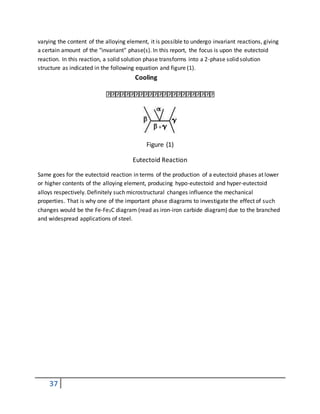
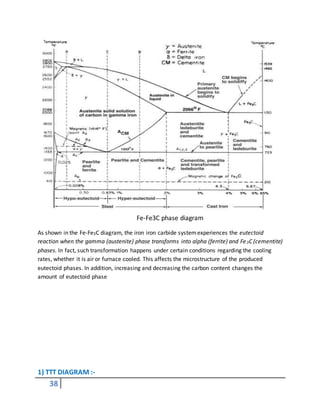
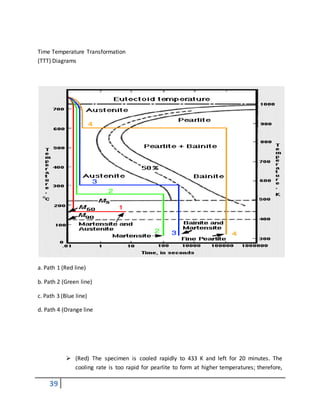
  • 97.
    97 The components arebrought to a uniform temperature in a neutral atmosphere. The caburising atmosphere is introduced only for the required time to ensure the correct depth of case. The carbon potential of the gas can be lowered to permit diffusion avoiding excess carbon in the surface layer. Gas carburising uses a gaseous atmosphere in a sealed furnace usually containing propane (C3H8) or butane (C4H10). Sometimes the generted carbon dioxide, water vapour, and oxygen are controlled at low levels by purifying using activated carbon filters at high tempertures. An alternative carburising atmosphere is sometime generated by using a drip feed system by feed an organic fluid based on methyl , ethyl or isopropyl achohol + benzene or equivalent is fed into the carburising chamber at a controlled rate. In this process there are generally internal fans working to ensure and even gas in the chamber. After carburizing, the work is either slow cooled for later quench hardening, or quenched directly into various liquid quenches. Quench selection is made to achieve the optimum properties with acceptable levels of dimensional change. Hot oil quenching is preferred for minimal distortion, but may be limited in application by the strength requirements for the product. Liquid carburising :- This process is mostly used for producing shallow case depths in thin sections. The components are heated quickly in a bath containing a suitable sodium cyanide salts and sodium carbonate. The proportion of NaCN being maintained 20% to 30% by controlled feed strong NaCN. The normal case depths for this process are about 0,25mm with bath strengths of 20% to 30% NaCN. High bath strengths 40% to 50% NaCN are required for case depths of 0,5mm. The case resulting from this process includes carbon and nitrogen. The nitrogen does provide a hard surface but can also encourage retained undesireable austenite in the surface layer. The bath is sometimes convered with a graphite material to reduce the nitrogen content. This process normall works with bath temperatures of 800oC to 950oC for immersion times from 2 to7 hours depending on the depth required. For thicker case depths (up to 1,6mm) activated salt baths are used these are based on cyanide and alkaline earth chlorides which act as the activators.
  • 98.
    98 Components are normallyjigged and pre-heated to about 350oC before being introduced into the bath. Advantages of gas carburization: 1) In gas carburization, the surface carbon content as well as the case depth can be accurately controlled. 2) It gives more uniform case depth. 3) It is much cleaner and more efficient method than pack carburizing. 4) Total time of carburization is much less than the pack carburization as the boxes and the solid carburizer are not to be heated. Disadvantages of gas carburizing:- 1) Furnace and gas generator are expensive. 2) Trays are expensive. 3) Greater degree of operating skill is required. 4) Handling of fire hazards and toxic gases is difficult. CASE HARDENING • Reasons – Easy to control depths – Good for complicated parts – Mass production compatible – Can use with low carbon steels (cheaper and tougher)
  • 99.
    99 Application of casehardening Typical applications include Transportation: Case-hardened components are needed in any engine-driven vehicle, whether it's a small car, a racecar, a truck or an ocean vessel. Energy generation: Gear wheels and large components have to withstand cyclic stress and wear in hydroelectric power stations, wind-turbine generators, propeller drives of drilling rigs and steam-turbine gears of power stations. General mechanical engineering: General mechanical engineering: Applications in this area include forging presses, metal rolling equipment, machine tools; drivelines of mining equipment and heavy-duty transmissions; earthmoving equipment and heavy-duty construction cranes. Wear resistance and good fatigue strength are always key characteristics of the case-hardened steels used for these applications Everything that moves needs case-hardened gears Quenching from the carburising temperature and subsequent tempering of the component produces a high-carbon martensite having great hardness and wear resistance near the surface. The uncarburised core retains its original good strength and toughness properties. HARDENING AND TEMPERING OF LOW CARBON STEEL :- Carbon steel: Carbon steel (plain carbon steel) is steel which contain main alloying element is carbon. Here we find maximum up to 1.5% carbon and other alloying elements like copper, manganese, silicon. Most of the steel produced now-a-days is plain carbon steel. It is divided into the following types depending upon the carbon content.
  • 100.
    100 1. Dead ormild steel (up to 0.15% carbon) 2. Low carbon steel (0.15%-0.45% carbon) 3. Medium carbon steel(0.45%-0.8% carbon) 4. High carbon steel (0.8%-1.5% carbon) Steel with low carbon content has properties similar to iron. As the carbon content increases the metal becomes harder and stronger but less ductile and more difficult to weld. Higher carbon content lowers the melting point and its temperature resistance carbon content cannot alter yield strength of material. Low carbon steel:- Low carbon steel has carbon content of 1.5% to 4.5%. Low carbon steel is the most common type of steel as its price is relatively low while its provides material properties that are acceptable for many applications. It is neither externally brittle nor ductile due to its low carbon content. It has lower tensile strength and EN353 GEAR. 1) CASE DEPTH :- Case depth is the thickness of the hardened layer on a specimen. Casehardening improves both the wear resistance and the fatigue strength of parts under dynamic and/or thermal stresses. Hardened steel parts are typically used in rotating applications where high wear resistance and strength is required.
  • 101.
    101 Total vs. EffectiveCase Depth One of the benefits of induction hardening is the ability to selectively apply a surface hardness or case hardness to steel materials. The case hardness will allow the piece to have superior wear and strength characteristics at the surface, but allow the interior of the piece to remain flexible. Case hardness is defined as the outer surface that has been made harder than the interior, or core. The term case depth refers to the depth of the case, or hardened layer of a piece of material. Case depth is typically measured as “total” or “effective”. The two terms are sometimes misunderstood, but are different and it is important to understand those differences. The term total case depth refers to the depth of hardness where the hardened layer reaches the same hardness and properties as the base or core material. Total case depth is typically measured by sectioning the work piece and polishing and etching with an acid solution to reveal the depth of the hardened layer. The measurements can then be taken visually and measured using a calibrated eyepiece or scale to qualify the total depth. The term effective case depth refers to the depth where a hardness measurement drops below a specified point. The hardness will then continue to decline until the “total” case depth is reached. The hardness at the effective depth is specified based on the characteristics required and the hardenabiltiy of the material. For example, high carbon steel that may have a minimum surface hardness of 60 HRc may call for an effective case depth of 0.120” at 50 HRc.
  • 102.
    102 The method ofdetermining effective case depth involves sectioning the piece and polishing the surface. Measurements of the hardness are then taken at regular depth intervals until the hardness drops to the specified range. This distance from the surface is then measured to determine the effective depth. 2) EFFECTIVE CASE DEPTH :- Effective case depth of a hardened case is the depth up to a further point, for which a specified level of hardness is maintained. Total case depth Total case depth of the hardened or unhardened case is the depth to a point where no differences in chemical or physical properties of the case and core can no longer be distinguished. Case hardening methods  Carburized cases  Cyanided cases  Carbonitrided cases  Nitrided cases  Flame or induction hardened cases 3.) CASE DEPTH DETERMINATION Methods employed for determining the depth of the case are the following:-  Chemical Methods This method is generally applicable only for carburized cases, but may be used for cyanided or carbonitrided cases. The procedure consists of determining the carbon content at various depths below the surface of a test sample. This method is considered as the most accurate for measuring the total case depth  Mechanical Methods
  • 103.
    103 In general thismethod is considered to be one of the most useful and accurate of the case depth measuring methods. It is the preferred method for determination for effective case depth and can be used effectively on all types of hardness cases. The following table suggests the hardness levels for various nominal carbon levels. Carbon content % C Effective Case Depth Carbon content % C Hardness HRC HV 0.28 – 0.32 35 345 0.33 – 0.42 40 392 0.43 – 0.52 45 446 0.53 and over 50 513  Visual Method This method in general applies visual procedure with or without the aid of magnification for reading the depth of case procedure by any of the various processes. Samples may be prepared by combinations of fracturing, cutting, grinding and polishing methods. Etching with a suitable reagent is normally required to produce the contrast between the case and core. Nital (concentrated nitric acid in alcohol) of various strengths is frequently used for this purpose.  Macroscopic Method Magnification methods for determination of case depth measurement are recommended for routine process control, primary because of the short time required for determinations, and the minimum of specialised equipment and trained personnel needed. They have the added advantage of being applicable to the measurement of all types of cases.  Microscopic Microscopic methods are generally for laboratory determination and require a complete metallographic polish and an etch suitable for the material and the process. Usually the
  • 104.
    104 magnification is 100x,in our case the used magnification is 40x which can be extra magnified by 2 or 3 times. Microscopic method may be used for laboratory determination of total case and effective case depths in the hardened condition. The distinction between macro and micro is based on the test forces in relation to the indentation depth. Attention is drawn to the fact that the micro range has an upper limit given by the force of 2N and a lower depth limit given by the indentation of 0.2 µm. Finally it is important to bear in mind that the method of case depth determination should be carefully selected on the basis of specific requirements in terms of economy Vickers Micro hardness test measurements principles The continuous monitoring of the force and the depth of the indentation can permit the determination of hardness and materials properties. The Diamond indenter is an orthogonal pyramid with a square base and in an inner angle α=136º between the opposite faces at the vertex. SPECIFIC HEAT TREATMENT PROCESSES 1) ANNEALING PROCESSES:-  Makes a metal as soft as possible  Hypoeutectoid steels (less than 0.83% carbon) are heated above upper critical temp., soaked and cooled slowly.  Hypereutecoid (above 0.83%) are heated above lower critical temp., soaked and allowed to cool slowly.
  • 105.
    105 – All thestructural changes obtained by hardening and tempering may be eliminated by annealing. • to relieve stresses • to increase softness, ductility, and toughness • to produce a specific microstructure – Process consists of • heating to the desired temperature • holding • cooling to room temperature – annealing time must be long enough to allow for any necessary transformation reactions – Normalizing - used to refine the grains – • cooling in air, less expensive, some sections of a part may cool too fast
  • 106.
    106 – Full anneal:Utilized in low and medium carbon steels that will be machined or plastically deformed • cooling in furnace to room temperature • final product is coarse perlite (soft and ductile) • – Spheroidizing • for medium and high carbon steels • Fe3C will turn into the spheroids – Some parts should be hard on the surface but soft and ductile inside • shafts, gears, guideways of machine tools • carious surface hardening processes • heating on the surface only and • quenching it
  • 107.
    107 • flame hardening(by torch) • induction hardening • carburizing 2) DIFFERENT TYPES OF ANNEALING PROCESS:- Types of Annealing There are various types of annealing. 1. Full Annealing - The process involves heating the steel to 30 to 50 degrees Centigrade above the critical temperature of steel and maintaining the temperature for a specified period of time, then allowing the material to slowly cool down inside the furnace itself without any forced means of cooling. Hot Worked sheets, forgings, and castings made from medium and high carbon steels need full annealing. 2. Process Annealing - This process is mainly suited for low carbon steel. The material is heated up to a temperature just below the lower critical temperature of steel. Cold worked steel normally tends to posses increased hardness and decrease ductility making it difficult to work. Process annealing tends to improve these characteristics. This is mainly carried out on cold rolled steel like wire drawn steel, etc. 3. Stress Relief Annealing - Large castings or welded structures tend to possess internal stresses caused mainly during their manufacture and uneven cooling. This internal stress cause brittleness at isolated locations in the castings or structures, which can lead to sudden breakage or failure of the material. This process involves heating the casting or structure to about 650 Degree centigrade. The temperature is maintained constantly for a few hours and allowed to cool down slowly. 4. Spherodise Annealing - This is a process for high carbon and alloy steel in order to improve their machinability. The process tends to improve the internal structure of the steel. This can be done by two methods a. The material is heated just below the lower critical temperature about 700 Degree centigrade and the temperature is maintained for about 8 hours and allowed to cool down slowly. b. Heating and cooling the material alternatively between temperatures just above and below the lower critical temperature. 5. Isothermal Annealing – This is a process where is steel is heated above the upper critical temperature. This causes the structure of the steel to be converted rapidly into austenite structure. The steel is then cooled to a temperature below the lower critical temperature about
  • 108.
    108 600 to 700Degree Centigrade. This cooling is done using a forced cooling means. The temperature is then maintained constant for a specified amount of time in order to produce a homogenous structure in the material. This is mainly applicable for low carbon and alloy steels to improve their machinability. Advantages of Annealing The following are some of the advantages of annealing. · It softens the steel. · It enhances and improves the machinability of steel. · It increases the ductility of steel · It enhances the toughness of steel · It improves the homogeneity in steel · The grain size of the steel is refined a lot by annealing · It prepares the steel for further heat treatment. 3) GRAIN SIZE & GRAIN GROWTH:- Definition: Grain size is normally quantified by a numbering system. Coarse 1-5 and fine 5-8. The number is derived from the formula N=2n-1 where n is the number of grains per square inch at a magnification of 100 diameters. Grain size has an important effect on physical properties. For service at ordinary temperatures it is generally considered that fine grained steels give a bettercombination of strength and toughness, whereas coarse grained steels have better machinability. GRAIN SIZE ANALYSIS Why do grain size analysis? Purely descriptive, quantitative measure of sediment
  • 109.
    109 Grain size distributionmay be characteristic of sediment deposited in certain environments Size distributions may provide data about transport, deposition and diagenesis of the sediment. Size is important in other properties like porosity and permeability Different Measures of Size Another complicating factor is the different measures of grain size. The planimetric method, described below, yields the number of grains per square millimeter area, NA, from which we can calculate the average grain area, A. It is common practice to take the square root of A and call this the grain diameter, d, although this assumes that the cross sectional shape of the grains is a square, which it is not. The intercept method yields a mean intercept length, L3 ; its relationship to NA, A, ord is not exceptionally well defined. A variety of planar grain size distribution methods have also been developed to estimate the number of grains per unit volume, Nv, from which the average grain volume, V, can be calculated. The relationship between these spatial measures of grain size and the above planar measures is also ill-defined. It is now common to express grain sizes in terms of a simple exponential equation: n = 2 G - 1 where: n = the number of grains per square inch at 100X magnification, and G = the ASTM grain size number. This approach was developed and introduced in 1951 with the premiere of ASTM standard E 91, Methods for Estimating the Average Grain Size of Non-Ferrous Metals, Other Than Copper and Their Alloys. Although the NA, d, or L3, values had been used for many years as measures of grain size, the G values were adopted readily due to their simplicity. As shown in Eq. 1, we can directly relate the number of grains per unit area to G, but the relationship between L3, and G,
  • 110.
    110 or NV andG are not as clearly defined. This problem is one of many being addressed by ASTM Committee E4 on Metallography. Grain growth is the increase in size of grains(crystallites) in a material at high temperature. This occurs when recovery and recrystallisation are complete and further reduction in the internal energy can only be achieved by reducing the total area of grain boundary. Microstructure of different annealing materials:- Pearlite and ferrite grain size
  • 111.
    111 1) NORMALIZING:- Applied tosome, but not all, engineering steels, normalising can soften, harden or stress relieve a material, depending on its initial state. The objective of the treatment is to counter the effects of prior processes, such as casting, forging or rolling, by refining the existing non-uniform structure into one which enhances machinability/formability or, in certain product forms, meets final mechanical property requirements. A primary purpose is to condition the steel so that, after subsequent shaping, a component responds satisfactorily to a hardening operation (e.g. aiding dimensional stability). Normalising consists of heating the suitable steel to a temperature typically in the range 830- 950°C (at or above the hardening temperature of hardening steels, or above the carburising temperature for carburising steels) and then cooling in air. Heating is usually carried out in air, so subsequent machining or surface finishing is required to remove scale or decarburised layers. Air-hardening steels (e.g. some automotive gear steels) are often "tempered" (subcritical annealing ) after normalising to soften the structure and/or promote machinability. Many aircraft specifications also call for this combination of treatments. Steels that are not usually normalised are those which would harden significantly during air cooling (e.g. many tool steels), or those which gain no structural benefit or produce inappropriate structures or mechanical properties (e.g. the stainless steels). Normalizing:-
  • 112.
    112  A heattreatment process consisting of austenitizing at temperatures of 30–80˚C above the AC3 transformation temperature followed by slow cooling (usually in air)  The aim of which is to obtain a fine-grained, uniformly distributed, ferrite–pearlite structure  Normalizing is applied mainly to unalloyed and low-alloy hypo eutectoid steels.  For hypereutectoid steels the austenitizing temperature is 30–80˚C above the AC1 or ACm transformation temperature Normalizing – Heating and Cooling:-
  • 113.
    113 After forging, hotrolling or casting a steel’s microstructure is often unhomogeneous consisting of large grains, and unwanted structural components such as bainite and carbides. Such a microstructure has a negative impact on the steel’s mechanical properties as well as on the machinability. Through normalising, the steel can obtain a more fine-grained homogeneous structure with predictable properties and machinability. Effect of Normalizing on Grain Size:-  Normalizing refines the grain of a steel that has become coarse-grained as a result of heating to a high temperature, e.g., for forging or welding steel of 0.5% C. (a) As-rolled or forged; (b) normalized. Magnification 500
  • 114.
    114 Normalizing is normallydone to achieve any one of the following purposes.  To modify and/or refine the grain structure and to eliminate coarse grained structures obtained in previous working operations such as rolling and forging etc.  To modify and improve cast dendritic structures and reduce segregation by homogenization of the microstructure.  To produce a homogeneous micro structure and to obtain desired microstructure and mechanical properties.  To improve machinability of low carbon steels  To improve dimensional stability  To reduce banding  To improve ductility and toughness  To provide a more consistent response when hardening or case hardening.  To remove macro structure created by irregular forming or by welding. ANNEALING AND NORMALIZING:- Annealing In general, the main purpose of annealing heat treatment is to soften the steel, regenerate overheated steel structures or just remove internal tensions. It basically consists of heating to austenitizing temperature (800ºC and 950ºC depending on the type of steel), followed by slow cooling. Normalizing Normalization is an annealing process. The objective of normalization is to intend to leave the material in a normal state, in other words with the absence of internal tensions and even distribution of carbon. For the process the high temperatures are maintained until the complete transformation of austenite with air cooling. It is usually used as a post-treatment to forging, and pre-treatment to quenching and tempering.
  • 115.
    115 Induction is usedin most applications of annealing and normalizing in compared to conventional ovens. 4) APPLICATION OF NORMALIZING PROCESS:- Application of normalizing:-Normalizing is the most extensively used industrial process since it is more economical to normalize the steel as against annealing. In normalizing since the cooling takes place in air, the furnace is ready for next cycle as soon as heating and soaking is over as compared to annealing where furnace cooling after heating and soaking needs 8 to twenty hours depending upon the quantity of charge. Hence in many cases annealing is replaced by normalizing to reduce the cost of heat treatment. Normalizing is adopted if the properties requirements are not very critical. Some typical examples of normalizing in commercial practice are as below. Normalizing of gear blanks prior to machining so that during subsequent hardening or case hardening dimensional changes such as growth, shrinkage or warpage can be controlled better. Homogenization of cast and wrought structures Cast metals and alloys are characterized by segregated, cored and dendritic structures as well as non uniform properties. Similarly wrought metal and alloys after mechanical working such as forging, rolling extrusion etc. have non uniform structure and properties. These structures and properties are made homogeneous by normalizing. In some few cases, when the steel is hot or cold worked, it is necessary to perform a normalizing heat treatment in order to recover its original mechanical properties. In case of normalizing heat treatment on weld metal the original as welded metal fine grained microstructure is changed to a coarse equiaxed ferrite with ferrite-carbide aggregates and the yield and tensile strength properties are considerably reduced.
  • 116.
    116 ADVANCE HEAT TREATMENTPROCESSES 1 NITRIDING FURNACE :-
  • 117.
  • 118.
    118 What is nitriding/ nitrocarburising? Gas nitriding and nitrocarburising belong to thermo chemical processes. During these processes the surface of several work pieces or machine parts is enriched with nitrogen (nitriding) or nitrogen with carbon (nitrocarburising). The former to improve the mechanic properties of the surface of the workpieces or machine parts. How does nitriding / nitrocarburising take place?During nitriding the components are exposed to a nitrogen emitting environment at a temperature between 480-580 ⁰C, During nitriding processes the components are exposed to a nitrogen emitting environment at a temperature between 480-580 ⁰C, whereby this nitrogen is diffused in the surface of the component. Build-up and structure:-
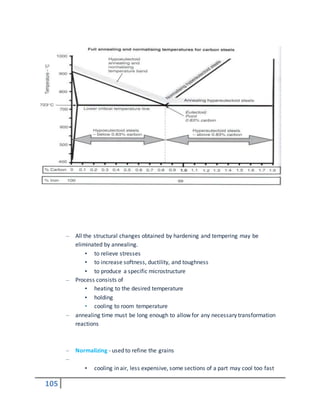
  • 119.
    119 Nitriding and nitrocarburisinglayers consist typically of two areas. The inner area, the diffusion area, is characterized by formation of nitride needles at the edge of the component. The normal layer thickness is between 0.2 to 1.5 mm. The outer area with a thickness between approximately 5 to 30 μm Process Variations:- Nitriding and nitrocarburising processes can be performed in gas atmosphere, where the nitrogen and carbon are available as gas, in a salt bath, where the nitrogen and carbon are offered by molten salts, or in plasma, where the carbon and nitrogen is provided in a vacuum atmosphere with ionized gasses. Except salt bath processes, all nitriding or nitrocarburising processes can be performed. Also, the special processes such as Nitrotec® or Stainihard® can be performed. Suitable materials :- All conventional steel, cast iron and sintering materials can be treated. Unalloyed as wel as low and/or medium and alloyed steels are suitable for gas nitriding or nitrocarburising. High- alloy steels with more than 13% Cr are due to their surface passivity only suitable for treatment under certain conditions. Alloying elements such as aluminum, chromium and titanium favor thereby increasing hardness and wear-resistance in the edge zone. Alternatively, for these highly alloyed (austenitizing) steels the Stainihard® process was developed. During this, stainless steel can be hardened without adversely affecting its corrosion resistance. Hardness Penetration Depth :- Nitriding and nitrocarburising layers are characterized by the following layer thickness
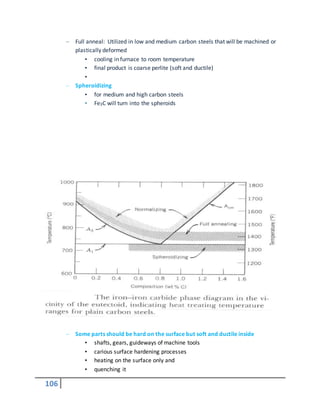
  • 120.
    120 and hardness penetrationdepth. The Nitriding Hardness Depth (NHT) according to DIN 50 190-3- is the vertical distance from the edge, where the hardness reaches the value of the core hardness plus 50 HV 0.5 hardness limit.The thickness of the connection zone and the Nitriding Hardness Depth must often be agreed with the client according to the specific material and the application. Advantages of plasma nitriding crank shafts Minimal distortion due to low temperature treatment. No crack formation in consequence of tension optimized characteristics of the plasma nitrided crank shafts.Very good emergency running properties due to lubrication oil stored in porous zone of the white layer.Increased fatigue strength cause by raised compressive stress after plasma nitriding.Threads and bore holes are not nitrided due to reduced gas pressure or mechanical masking.Absolute reproducibility of heat treatment. Disadvantages of conventional treatments The difficulty, especially the heat treatment of crank shafts for high performance engines with conventional treatment such as salt bath nitriding, gas nitriding and inductive hardening is well known and constitutes, depending on the technique, the following disadvantages: Thermal caused distortion and process-related inaccuracy of dimensions. Masking of threads and lubrication holes combined with relatively high efforts. Crack formation.Bad or no emergency running properties. Differences in tension in the peripheral zone. Low fatigue strength .Ecological impacts. Lack of reproducibility 2) DIFFERENT NITRIDING PROCESS:- Gas nitriding :-
  • 121.
    121 In gas nitriding,nitrogen is introduced into a steel surface from a controlled atmosphere by holding the metal at a suitable temperature in contact with a nitrogenous gas, usually ammonia, NH3. The process represents one of the most efficient among the various methods of improving the surface properties of engineering components, especially the parts with complicated shapes requiring homogeneous hardening of the steel Plasma nitriding :-
  • 122.
    122 Plasma nitriding usesplasma-discharge technology at lower temperature to introduce nascent nitrogen on the steel surface. It is another well-established surface hardening process in steel and also known as ion nitriding. Plasma is formed by high-voltage electrical energy in vacuum. Nitrogen ions are then accelerated to impinge on the workpiece which is connected as a cathode. The ion bombardment heats the work piece, cleans the surface and provides the nascent nitrogen for diffusion into the steel Salt bath nitriding / liquid nitriding :-
  • 123.
    123 is a subcriticalsurface enhancement process holding the longest track record of success over any case hardening technology. It is widely used to enhance the performance of titanium, chromium, and aluminum alloyed steels, as well as low alloy materials, and stainless steels. It is more intense, and more efficient than gas nitriding, or ion nitriding. Salt bath nitriding / liquid nitriding advantages include active case hardening process (compound zone), additional lubricity, improved corrosion resistance, as well as improved aesthetics. Dimensional stability of processed parts does not change and core properties are uncompromised. Salt bath nitriding / liquid nitriding can be performed on thru hardened steel. This yields the benefits of thru hardening in the addition to a harder surface. This can be up to 75Rc, depending on the material. Subjacent to the compound zone is another distinctive region, the diffusion zone. This evolves from progressive diffusion of the nitrogen, and consists of a solid solution of nitrogen in the base material. The diffusion zone contributes another critical benefit of salt bath nitriding: substantial enhancement of fatigue strength, typically between 20% to 100%. Application:
  • 124.
    124  Automobile industry Agricultural industry  Aviation  Machinery and plant construction  Tool-making  Electronic industry  Chemical industry  Power stations  Hydraulic industry BENEFITS OF PLASMA NITRIDING PROCESS  High resistance to abrasion  High surface hardness  Lower friction coefficient  Improved corrosion resistance  Improved heat resistance to about 500 °C  Increased fatigue strength  Good size and shape accuracy VACUUMHEAT TREATMENT
  • 125.
    125 1 VACUUM FURNACE:- VacuumHeat Treatment Vacuum Technology is the Basis for Process Innovation in Heat Treatment. Heat Treatment is the process in which metallic/steel parts are exposed completely or partially to time-temperature sequences in order to change the mechanical and/or corrosion properties. There are numerous application areas, e.g.: • Annealing • Hardening • Tempering • Aging • Case hardening to achieve a higher strength of the material, better wear resistance or to improve the corrosion behaviour of the components. All of these processes need a temperature up to 1.000 °C and higher as well as especially developed furnaces to achieve such ranges. From the past there are well-known technologies
  • 126.
    126 for the aboveprocesses, e.g.: • Technology using molten salt • Furnace for protective and/or activated atmospheres Specific tools and dies 1. Gears and shafts, 2. Vacuum heat treatment, 3. Atmospheric heat treatment Oxidation occurs on the part's surface when exposed to the atmosphere (air). This results in costly and time-consuming post treatments. Therefore, heat treatment is preferably conducted in an oxygen-free atmosphere. In addition to the use of high-purity protective gases, vacuum allows the best protection against oxidation, thus being the most cost-efficient atmosphere. Such furnaces are also used for high temperature brazing, a well established joining process. Hardened steel structure Martensite
  • 127.
    127 Annealing Annealing is onetype of heat treatment comprising heating up to a specific temperature, holding and cooling down slowly. Such processes are generally used to obtain a softer structure of the part and to optimise material structure for subsequent working steps (machining, forming). Parameters depend on the material and the desired structure. Hardening and Tempering Hardening is a typical heat treatment process combining heating to specific temperatures (mostly above 900 °C) and direct fast cooling or quenching of the part. The requirements are selected to change the materials’ structure partially or completely into martensite. The part undergoes tempering treatment after hardening in order to obtain high ductility and toughness. Case Hardening One of the important processes is the case hardening or carburizing process. Parts are heated up to 900 °C - 1.000 °C and by adding specific gases (hydrocarbons) into the atmosphere of the furnace the part’s surface is enriched by absorbing carbon. Following this treatment the part is quenched in order to achieve the required properties. This results in higher resistance to stresses and friction on the component’s surface. The core of the part remains somewhat softer and more ductile which allows the part to carry high stresses through its entire life. For example, all gear parts for transmissions are treated this way. Brazing Brazing is a process for joining components, whereby a filler melts under temperature and joins the components together after solidification. In this process, the solidus temperature of the parts to be joined is not reached. In high temperature brazing (above 900 °C) which ideally happens in vacuum, the atmosphere (vacuum) takes on the duties of the fluxing agent. 1. Piezo-Common-Rail diesel injection system, 2. Modular vacuum heat treatment furnace
  • 128.
    128 2) ADVANTAGES OFVACUUM HEAT TREATMENT:- Vacuum as "Protective Atmosphere" • No toxic protective gases containing CO • No health hazards in the work shop • No danger of explosion or open flames • No furnace conditioning • Use of inert gases (nitrogen or helium) • No CO2 emission Vacuum Carburizing • Use of various processes • Use of different gases • Shorter carburizing cycles than in conventional technology • Higher carburizing temperatures offer potential to further reduce process time • Small gas consumption l instead of m3 Gas Quenching Instead of OIL Quenching • Clean, dry parts after hardening • No washing machine - no disposal of washing water • No maintenance of washing equipment • No complicated washing water chemistry • Saves space • Cost benefits • Quenching intensity is controlled via gas pressure or gas velocity • No vapor blankets during quenching • Homogeneous quenching • Reduced distortion Surface Influences • Free of surface oxidation • No surface decarburization • Bright, metallic, shiny parts 3 ) PLANT OPERATION / INSTALLATION / MAINTENANCE • No idling over the weekend • No continuous gas consumption • Short heat-up times
  • 129.
    129 • Fast accessto installed modules • No fire detection or sprinkler system • No open flames • No flammable gas mixtures • Cold-Wall Technology • No gas emission • Minimum energy loss • No heat radiation to atmosphere Safety:- Auxiliary Equipment of Protective Gas Plants are no longer required, like: • Fire safety equipment • Sprinkler system • Exhausts • CO2 extinguisher for the oil bath • Measuring CO concentration in the shop • Smoke exhaust in the roof (automatic opening and closing) • Oil-proof floor or tank • Methanol storage Typical hard metal parts The main advantages of this process are:- • Bright oxide-free finishes • No carbonization or decarburization • Fluxless brazing • Controlled heating • Repeatability • No hazardous fumes or toxic waste
  • 130.
    130 A typical hardeningcycle is fully automated. For loading, the chamber assemblies are raised several inches from the quench tank flange by motor driven screw jacks, oil is pumped from the quench tank to the reservoir tank, and the gantry is moved away from the quench tank. The quench tank elevator is raised, the load is placed on it, and the elevator and load are lowered into the quench tank. The gantry is moved back into position and lowered until the bottom of the seal door chamber is sealed on the quench tank flange. The seal door and insulation doors open and the elevator raises the load into the heating chamber. As the elevator descends back into the quench tank the insulation doors, which also serve as the furnace hearth, close and receive the load. After the elevator is withdrawn, the seal door closes to isolate the heating chamber from the quench tank, the heating chamber is evacuated, and heating begins. While these processes are underway, the quench oil is pumped from the reservoir tank back into the quench tank. The quench tank is evacuated and backfilled with a partial pressure of nitrogen to slightly below atmospheric pressure. The load is preheated then austenitized according to specification requirements. At the beginning of the quenching sequence, the heating chamber is backfilled with nitrogen to a pressure equal to that in the quench tank. Power to the heating elements remains on during backfill to prevent heat loss in the load. The seal door opens and the elevator ascends to raise the load slightly above the hearth upon which the insulation doors open and the elevator quickly lowers the load into the quench tank. Quench delay in this process for a full 118 in. high load is less than 10 seconds. While the load is cooling in the quench tank, the gas quench system activates to cool the heating chamber in preparation for accepting the next load. A third, larger vacuum oil quench furnace, commissioned in December of 2005, was built for hardening very large components such as those being developed for the landing gear in the Airbus A380. The unit operates mostly on the same principles as its predecessor. Vacuum Tempering:- Vacuum tempering is being used for tempering high-speed steels and alloy steels to produce a scale-free finish. A vacuum tempering furnace is very versatile and can be used for bright tempering, aging and annealing. Other less common applications include decreasing, resin
  • 131.
    131 bake-off and preferentialoxide treatment of low carbon steels. Vacuum Tempering is almost always required after hardening (both in an atmosphere furnace as well as in vacuum), to reduce the hardness (and brittleness) of the treated material to a desirable level. Generally it is not necessary to use vacuum tempering after vacuum hardening, i.e., conventional tempering is most of the time used. Vacuum tempering may be used on high value products, when totally clean surface appearance is required. The expression "vacuum tempering" is used here to differentiate the process from.