Tejas Atyam 
III Sem- BE (Prod.)
Hardenability 
 One of the important properties of (processed) metals is 
hardenability 
 Hardenability is the capability of an alloy to be 
hardened by heat treatment 
 Measures the depth of hardness obtained by heat 
treatment/quenching 
 Hardenability is not the same as hardness. 
 The Hardness of a steel refers to its ability to resist deformation when a 
load is applied, whereas hardenability refers to its ability to be 
hardened to a particular depth under a particular set of conditions.
Jominy Test 
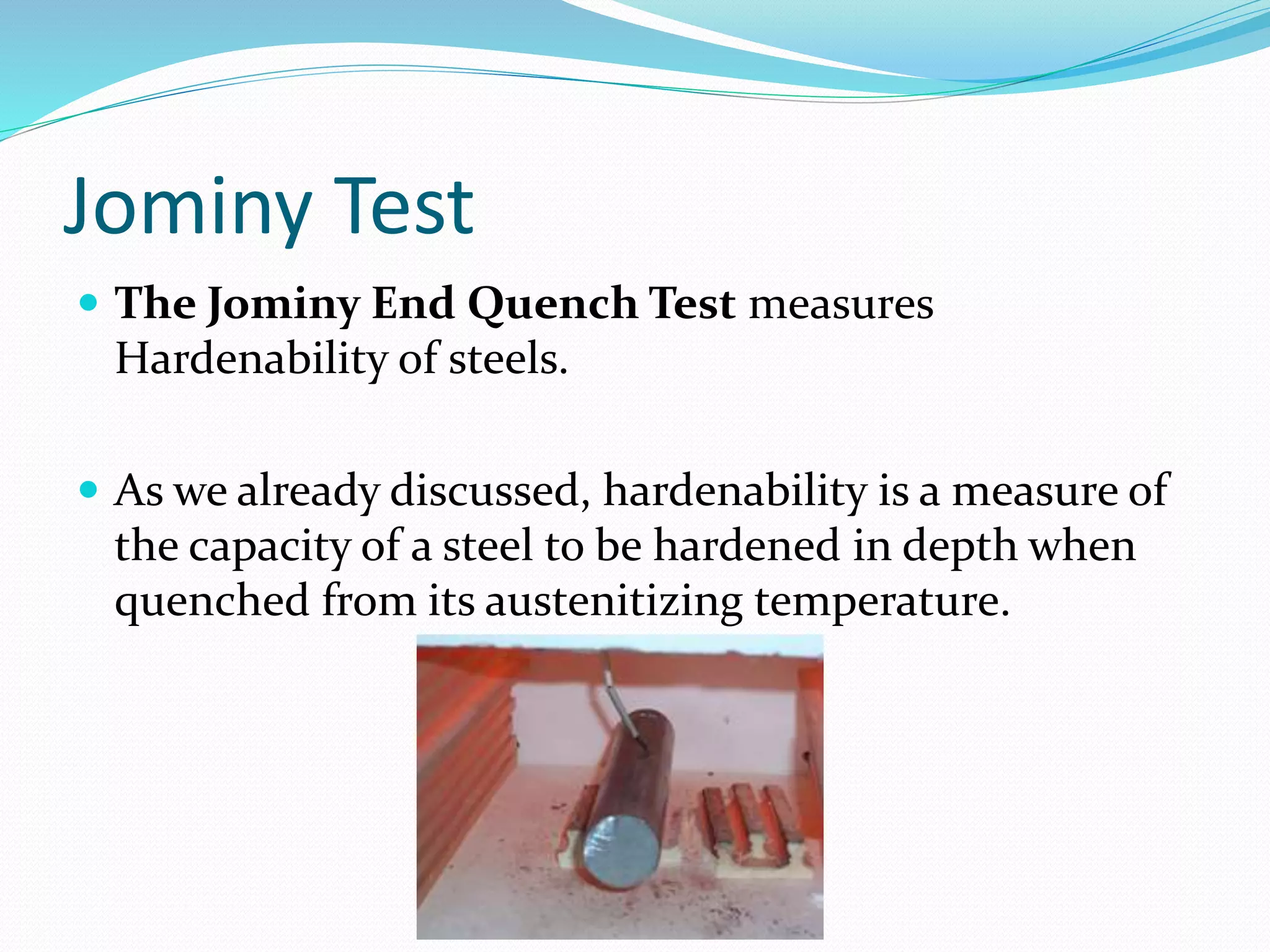
 The Jominy End Quench Test measures 
Hardenability of steels. 
 As we already discussed, hardenability is a measure of 
the capacity of a steel to be hardened in depth when 
quenched from its austenitizing temperature.
Why Jominy Test? 
 Information gained from this test is necessary in 
selecting the proper combination of alloy steel and 
heat treatment to minimize thermal stresses and 
distortion when manufacturing components of various 
sizes.
Steps to conduct Jominy Test 
1. First, a sample specimen cylinder either 100mm in length and 25mm 
in diameter, or alternatively, 102mm by 25.4mm is obtained 
2. Second, the steel sample is normalized to eliminate differences in 
microstructure due to previous forging, and then it is austenitised. 
This is usually at a temperature of 800 to 900°C. 
3. Next, the specimen is rapidly transferred to the test machine, where 
it is held vertically and sprayed with a controlled flow of water onto 
one end of the sample 
4. This cools the specimen from one end, simulating the effect of 
quenching a larger steel component in water 
(Because the cooling rate decreases as one moves further from the quenched 
end, one can measure the effects of a wide range of cooling rates from very 
rapid at the quenched end to air cooled at the far end.)
Steps to conduct Jominy Test 
….. Contd… 
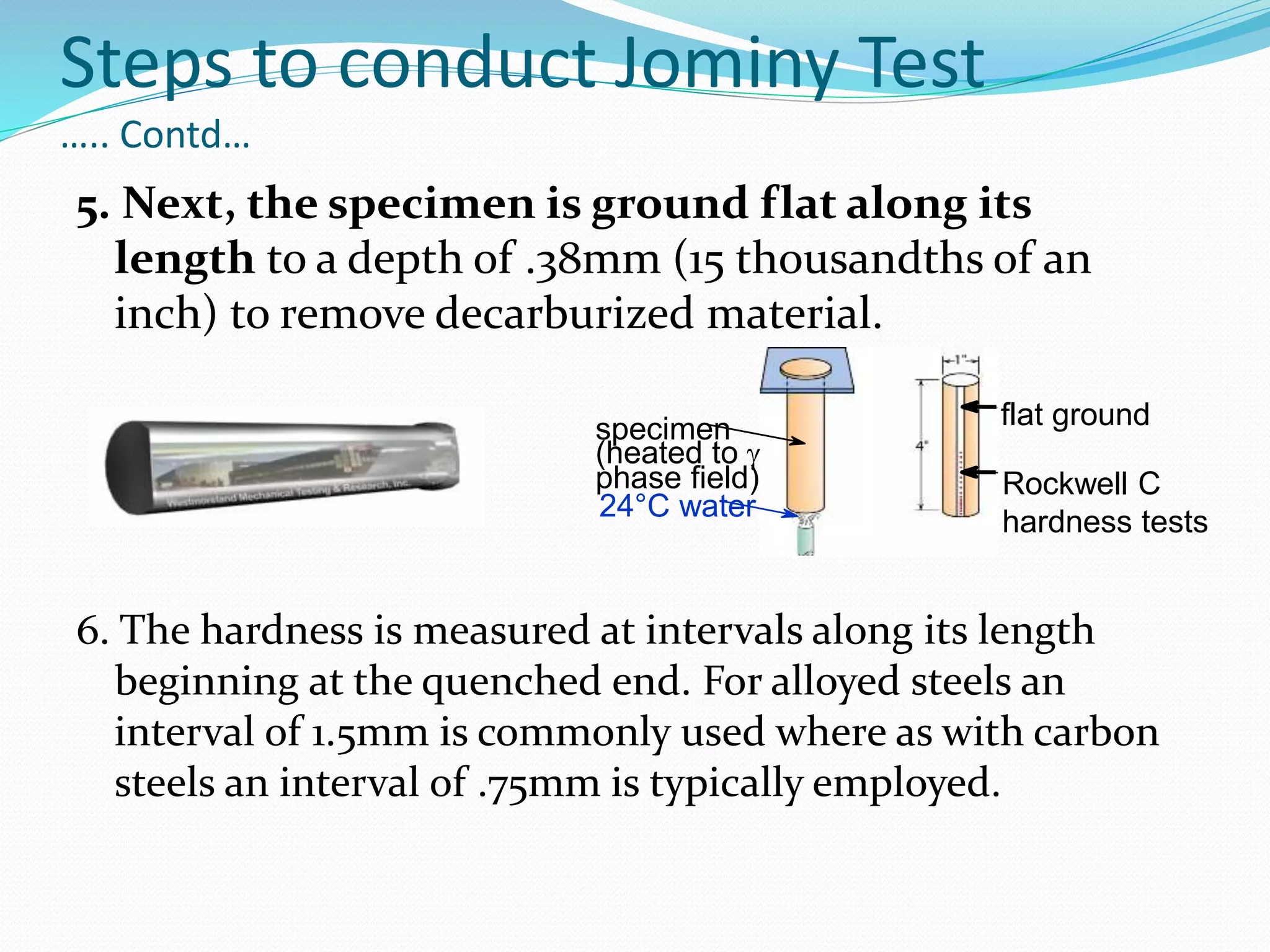
5. Next, the specimen is ground flat along its 
length to a depth of .38mm (15 thousandths of an 
inch) to remove decarburized material. 
specimen 
(heated to g 
phase field) 
24°C water 
flat ground 
Rockwell C 
hardness tests 
6. The hardness is measured at intervals along its length 
beginning at the quenched end. For alloyed steels an 
interval of 1.5mm is commonly used where as with carbon 
steels an interval of .75mm is typically employed.
Steps to conduct Jominy Test 
….. Contd… 
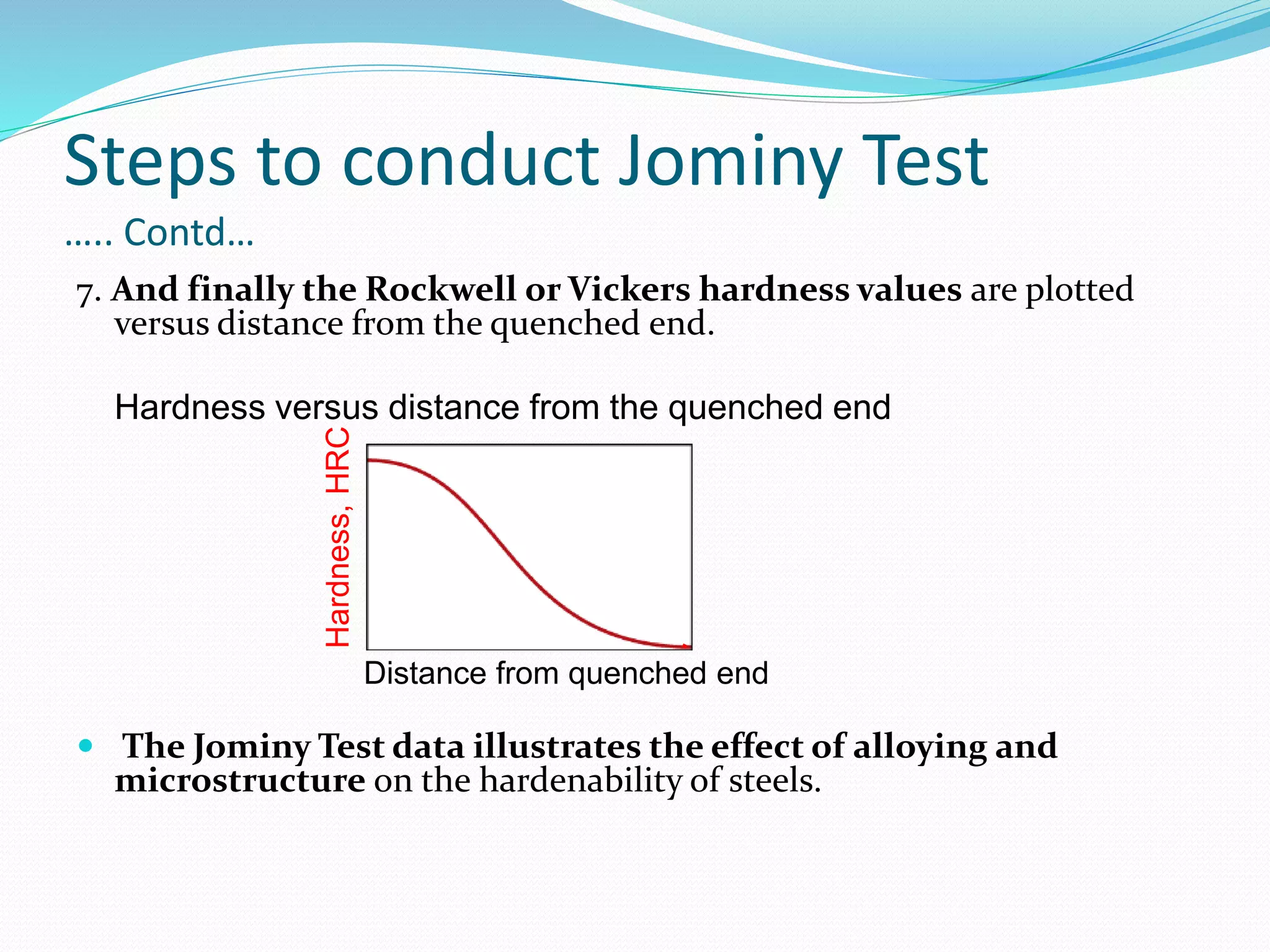
7. And finally the Rockwell or Vickers hardness values are plotted 
versus distance from the quenched end. 
Hardness versus distance from the quenched end 
Hardness, HRC 
Distance from quenched end 
 The Jominy Test data illustrates the effect of alloying and 
microstructure on the hardenability of steels.
End-Quench hardenability test 
(Jominy Test) - Summary 
 Quenching media 
 Water 
 Brine 
 Oil 
 Molten salts 
 Air 
 Caustic solutions 
 Polymer solutions 
 gases 
 Round test bar is 
austenized (heated to 
the proper temperature 
to form 100% austenite) 
 Bar then quenched at 
one end 
 Hardness decreases away 
from the quenched end 
of the bar
Commonly used elements that affect the hardenability of steel are 
carbon, boron, Chromium, Manganese, Molybdenum, Silicon, and 
Nickel. 
 Carbon is primarily a 
hardening agent in 
steel, although to a 
small degree it also 
increases hardenability 
by slowing the formation 
of pearlite and ferrite. 
But this affect is too 
small to be used as a 
control factor for 
hardenability. 
 Boron can be an 
effective alloy for 
improving 
hardenability at levels 
as low as 0005%. 
 Boron is most effective in 
steels of 0.25% Carbon or 
less.
And Finally 
 Slowing the phase transformation of austenite to 
ferrite and pearlite increases the hardenability of 
steels. 
 Chromium, Molybdenum, Manganese, Silicon, 
Nickel and Vanadium all effect the hardenability of 
steels in this manner. 
 Chromium, Molybdenum and Manganese being used 
most often.
11 
Why Hardness Changes with Position 
• The cooling rate varies with position. 
distance from quenched end (in) 
Adapted from Fig. 11.13, Callister 7e. 
(Fig. 11.13 adapted from H. Boyer (Ed.) 
Atlas of Isothermal Transformation and 
Cooling Transformation Diagrams, 
American Society for Metals, 1977, p. 
376.) 
Hardness, HRC 
60 
40 
20 
0 1 2 3 
T(°C) 
600 
400 
200 
M(start) 
A M 
0.1 1 10 100 1000 
Time (s) 
0 
0% 
100% 
M(finish)
Hardenability vs Alloy Composition 
12 
• Jominy end quench 
results, C = 0.4 wt% C 
Adapted from Fig. 11.14, Callister 7e. 
(Fig. 11.14 adapted from figure furnished 
courtesy Republic Steel Corporation.) 
• "Alloy Steels" 
(4140, 4340, 5140, 8640) 
--contain Ni, Cr, Mo 
(0.2 to 2wt%) 
--these elements shift 
the "nose". 
--martensite is easier 
to form. 
Cooling rate (°C/s) 
Hardness, HRC 
60 
40 
20 
100 10 3 2 
100 
4340 80 
%M 
50 
4140 
8640 
5140 
0 10 20 30 40 50 
Distance from quenched end (mm) 
800 
T(°C) 
600 
400 
200 
shift from 
A to B due 
to alloying 
M(start) 
M(90%) 
10-1 10 103 100 5 
Time (s) 
A B 
TE
13 
Quenching Medium & Geometry 
• Effect of quenching medium: 
Medium 
air 
oil 
water 
Severity of Quench 
low 
moderate 
high 
Hardness 
low 
moderate 
high 
• Effect of geometry: 
When surface-to-volume ratio increases: 
--cooling rate increases 
--hardness increases 
Position 
center 
surface 
Cooling rate 
low 
high 
Hardness 
low 
high
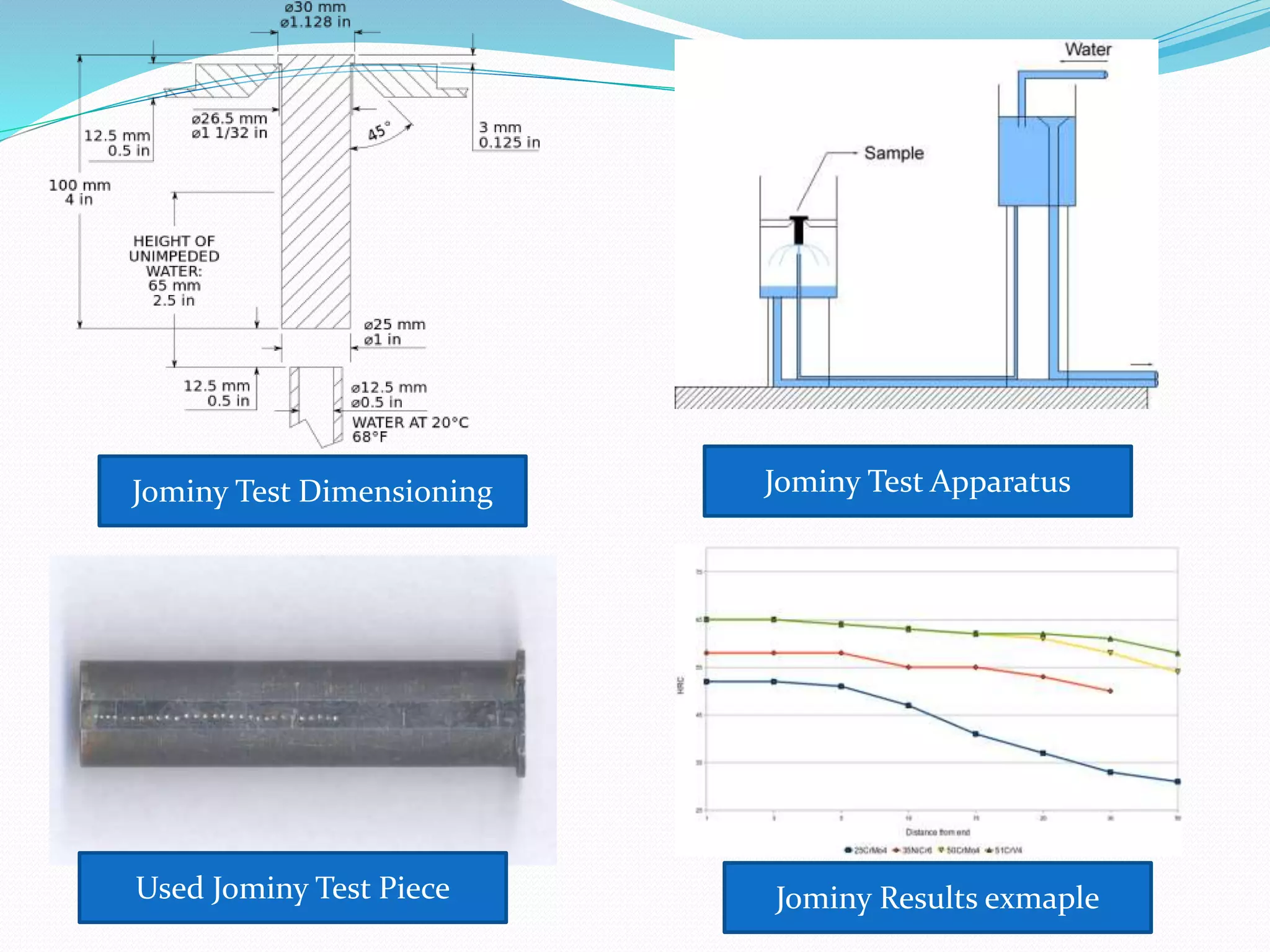
Jominy Test Dimensioning Jominy Test Apparatus 
Used Jominy Test Piece Jominy Results exmaple
Jominy end quench hardenability test

Jominy end quench hardenability test

  • 1.
    Tejas Atyam IIISem- BE (Prod.)
  • 2.
    Hardenability  Oneof the important properties of (processed) metals is hardenability  Hardenability is the capability of an alloy to be hardened by heat treatment  Measures the depth of hardness obtained by heat treatment/quenching  Hardenability is not the same as hardness.  The Hardness of a steel refers to its ability to resist deformation when a load is applied, whereas hardenability refers to its ability to be hardened to a particular depth under a particular set of conditions.
  • 3.
    Jominy Test The Jominy End Quench Test measures Hardenability of steels.  As we already discussed, hardenability is a measure of the capacity of a steel to be hardened in depth when quenched from its austenitizing temperature.
  • 4.
    Why Jominy Test?  Information gained from this test is necessary in selecting the proper combination of alloy steel and heat treatment to minimize thermal stresses and distortion when manufacturing components of various sizes.
  • 5.
    Steps to conductJominy Test 1. First, a sample specimen cylinder either 100mm in length and 25mm in diameter, or alternatively, 102mm by 25.4mm is obtained 2. Second, the steel sample is normalized to eliminate differences in microstructure due to previous forging, and then it is austenitised. This is usually at a temperature of 800 to 900°C. 3. Next, the specimen is rapidly transferred to the test machine, where it is held vertically and sprayed with a controlled flow of water onto one end of the sample 4. This cools the specimen from one end, simulating the effect of quenching a larger steel component in water (Because the cooling rate decreases as one moves further from the quenched end, one can measure the effects of a wide range of cooling rates from very rapid at the quenched end to air cooled at the far end.)
  • 6.
    Steps to conductJominy Test ….. Contd… 5. Next, the specimen is ground flat along its length to a depth of .38mm (15 thousandths of an inch) to remove decarburized material. specimen (heated to g phase field) 24°C water flat ground Rockwell C hardness tests 6. The hardness is measured at intervals along its length beginning at the quenched end. For alloyed steels an interval of 1.5mm is commonly used where as with carbon steels an interval of .75mm is typically employed.
  • 7.
    Steps to conductJominy Test ….. Contd… 7. And finally the Rockwell or Vickers hardness values are plotted versus distance from the quenched end. Hardness versus distance from the quenched end Hardness, HRC Distance from quenched end  The Jominy Test data illustrates the effect of alloying and microstructure on the hardenability of steels.
  • 8.
    End-Quench hardenability test (Jominy Test) - Summary  Quenching media  Water  Brine  Oil  Molten salts  Air  Caustic solutions  Polymer solutions  gases  Round test bar is austenized (heated to the proper temperature to form 100% austenite)  Bar then quenched at one end  Hardness decreases away from the quenched end of the bar
  • 9.
    Commonly used elementsthat affect the hardenability of steel are carbon, boron, Chromium, Manganese, Molybdenum, Silicon, and Nickel.  Carbon is primarily a hardening agent in steel, although to a small degree it also increases hardenability by slowing the formation of pearlite and ferrite. But this affect is too small to be used as a control factor for hardenability.  Boron can be an effective alloy for improving hardenability at levels as low as 0005%.  Boron is most effective in steels of 0.25% Carbon or less.
  • 10.
    And Finally Slowing the phase transformation of austenite to ferrite and pearlite increases the hardenability of steels.  Chromium, Molybdenum, Manganese, Silicon, Nickel and Vanadium all effect the hardenability of steels in this manner.  Chromium, Molybdenum and Manganese being used most often.
  • 11.
    11 Why HardnessChanges with Position • The cooling rate varies with position. distance from quenched end (in) Adapted from Fig. 11.13, Callister 7e. (Fig. 11.13 adapted from H. Boyer (Ed.) Atlas of Isothermal Transformation and Cooling Transformation Diagrams, American Society for Metals, 1977, p. 376.) Hardness, HRC 60 40 20 0 1 2 3 T(°C) 600 400 200 M(start) A M 0.1 1 10 100 1000 Time (s) 0 0% 100% M(finish)
  • 12.
    Hardenability vs AlloyComposition 12 • Jominy end quench results, C = 0.4 wt% C Adapted from Fig. 11.14, Callister 7e. (Fig. 11.14 adapted from figure furnished courtesy Republic Steel Corporation.) • "Alloy Steels" (4140, 4340, 5140, 8640) --contain Ni, Cr, Mo (0.2 to 2wt%) --these elements shift the "nose". --martensite is easier to form. Cooling rate (°C/s) Hardness, HRC 60 40 20 100 10 3 2 100 4340 80 %M 50 4140 8640 5140 0 10 20 30 40 50 Distance from quenched end (mm) 800 T(°C) 600 400 200 shift from A to B due to alloying M(start) M(90%) 10-1 10 103 100 5 Time (s) A B TE
  • 13.
    13 Quenching Medium& Geometry • Effect of quenching medium: Medium air oil water Severity of Quench low moderate high Hardness low moderate high • Effect of geometry: When surface-to-volume ratio increases: --cooling rate increases --hardness increases Position center surface Cooling rate low high Hardness low high
  • 14.
    Jominy Test DimensioningJominy Test Apparatus Used Jominy Test Piece Jominy Results exmaple